


.png)
![[One Charles] Logo_Stack 1 (1)](https://coastalbridgeadvisors.com/hubfs/%5BOne%20Charles%5D%20Logo_Stack%201%20(1).png)
.png)




.png?width=220&height=80&name=image%2028%20(1).png)
-1.png)
Most parents want their children to develop good financial habits – but knowing where to start can be challenging. With April marking National Financial Literacy Month, it’s a fitting time to revisit how families can practice financial education that sticks. In our experience, effective financial education has less to do with formal instruction and more to do with practical decision-making.
When children and teens are given responsibility within clear boundaries, concepts like delayed gratification and trade-offs start becoming tangible realities. In turn, those realities can form habits that last a lifetime. In this article, we outline a framework that families can use to help raise financially confident young adults.
Learning Through Real Decisions
It’s common for parents to shield their children from financial decisions or simply hand them money without context. But financial literacy is generally absorbed most effectively when it’s tied to real-world behavior – and real-world consequences. For parents seeking to build true financial literacy, the goal is to replace oversight with ownership.
A practical example is the back-to-school shopping trip. Instead of heading to the store with a credit card, a parent can provide their child with a fixed amount of cash and explain that any unspent funds can be kept. This dynamic helps teens learn that spending less has a direct benefit, and that financial choices always involve trade-offs.
The same principle applies on a larger scale. Assigning a monthly or seasonal budget for a specific category – clothing is a natural starting point – requires teens to think beyond immediate wants. If they spend heavily early on and later lack funds for something they need, the discomfort becomes the lesson.
Parents may be surprised by how quickly habits adjust once trade-offs are real and consistent. Tools like Greenlight, an app designed to give kids and teens hands-on experience managing real money, can help families put this kind of structure into practice. At any scale, the idea is the same: true learning occurs when abstract concepts become concrete reality.
Building an Investment Mindset Early
Once teens are comfortable navigating everyday spending decisions, investing becomes the natural next step. While teens don’t need to become portfolio managers, understanding basic investing concepts can be beneficial in the long run. A simple three-stage approach can help parents introduce age-appropriate investing lessons.
Stage #1: Start with milestone money.
Funds received during milestone events – a birthday, a Bar Mitzvah, or a Sweet 16 celebration – often provide a natural entry point for investing conversations. Rather than allowing these gifts to sit in the bank or be spent quickly, parents can discuss the idea of opening an investment account. These conversations help shift how a teen thinks about finances, viewing money as something to grow rather than something to spend.
Stage #2: Use early contributions to introduce core concepts.
Once an account is open, even a small initial investment creates an opportunity to discuss the basics: what a stock represents, how a bond works, and why diversification matters. These don’t need to be lengthy discussions. The act of selecting investments together, even broadly, gives teens a framework for understanding how markets function and what it means to own assets.
Stage #3: Revisit the account periodically.
Reviewing a child’s portfolio once a year (or after a meaningful market event) can reinforce investing concepts over time. Teens gain exposure to real market movements and begin to understand that investing may reward patience and long-term thinking. For families with a comprehensive estate plan, these conversations are typically part of a multigenerational transition strategy.
The math alone can be compelling. If a teenager opens a Roth IRA at age 18 with $1,000 from a part-time job and contributes just $1,000 per year thereafter, the account could be worth nearly $500,000 by age 65 (assuming a hypothetical 8% average annual return). Because Roth IRA contributions are made with after-tax dollars, qualified distributions in retirement are tax-free. 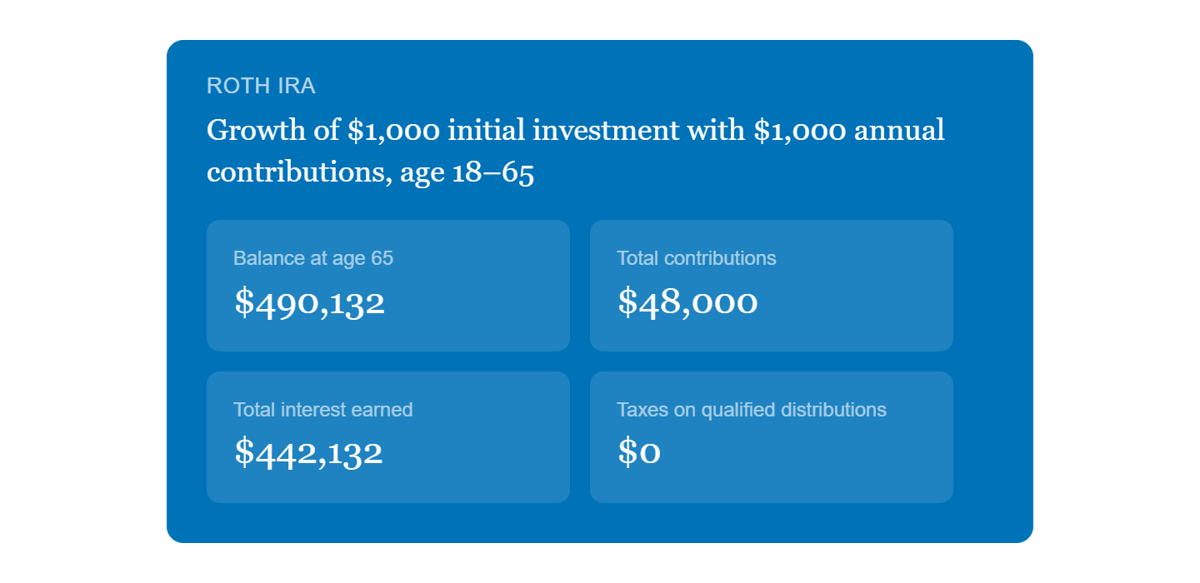
|
This is a hypothetical illustration for educational and illustrative purposes only and does not represent actual or guaranteed results. Assumes: $1,000 initial investment at age 18, $1,000 annual contributions, and a constant 8% annual return compounded annually through age 65. This example is not predictive of actual investment performance. Actual results will vary significantly based on market performance, timing, and other factors, and returns are not guaranteed. |
From Earned Income to Independence
Children usually start to learn financial lessons with money gifted from their parents. But earned income carries a different psychological weight. When teens earn money through summer jobs, part-time work, or entrepreneurship, they tend to develop a stronger sense of ownership over how it’s used.
As that shift takes hold, the parents’ role naturally evolves. The structure that worked in earlier years – fixed budgets, guided spending, supervised account openings – often moves toward collaborative supervision. This hand-off can help ensure that by the time a young adult is making independent decisions, strong habits are already in place.
For many families, college is where this transition is tested. It may be a teen’s first real experience managing money without daily parental oversight, and a candid discussion before they leave can set expectations around costs and trade-offs. Once on campus, one of the most valuable things a parent can offer is an open door – the assurance that they can always seek guidance before making a big financial decision
Conclusion: Starting the Conversation
How do parents know when financial education has been effective? The results typically aren’t dramatic, but they are visible – usually in thoughtful questions, more restrained spending, and a growing ability to articulate priorities. These are all marks that a teen is developing the judgment and confidence to navigate real decisions on their own.
For many of the families we work with, these conversations are already part of a broader wealth strategy. Whether it’s helping a teenager open their first investment account or advising parents on college planning, our team is here to help. If you’d like to explore how these topics connect to your family’s planning, we invite you to contact our team today.
Coastal Bridge Advisors, LLC is an SEC registered investment advisor. SEC registration does not constitute an endorsement of Coastal Bridge Advisors by the SEC nor does it indicate that the firm has attained a particular level of skill or ability. The information contained herein is provided for educational purposes only and should not be construed as tax, legal, or investment advice. Hypothetical examples are illustrative and do not guarantee future results. Actual investment results will vary and may be materially different depending on market conditions, timing, and other factors. For information regarding the firm, please visit www.coastalbridgeadvisors.com or email info@coastalbridgeadvisors.com.


.png)