
.png)
![[One Charles] Logo_Stack 1 (1)](https://coastalbridgeadvisors.com/hubfs/%5BOne%20Charles%5D%20Logo_Stack%201%20(1).png)
.png)




.png?width=220&height=80&name=image%2028%20(1).png)
Monthly Market Summary - March 1, 2026
- The S&P 500 Index declined -0.8% in February, but the headline masked broad underlying strength. The equal-weighted S&P 500 gained +3.5%, Large Cap Value rose +2.6%, and the Russell 2000 added +0.8%, as the rotation toward smaller and more value-oriented companies continued. In contrast, Large Cap Growth declined -3.4% and the Nasdaq fell -2.3% as technology stocks came under pressure.
- Utilities led all S&P 500 sectors with a +10.3% return, followed by Energy (+9.4%), Materials (+8.4%), Consumer Staples (+7.9%), and Industrials (+7.1%). Seven sectors outperformed the index, while the remaining four underperformed.
- Bonds traded higher as Treasury yields declined, with the U.S. Bond Aggregate returning +1.6%. Corporate bonds traded higher, with investment-grade outperforming high-yield, but underperformed as credit spreads widened.
- International stocks outperformed the S&P 500 for a third consecutive month, with Developed Markets gaining +4.6% and Emerging Markets returning +5.5%.
Market Leadership Continues to Broaden Amid Questions About AI’s Impact
The rotation away from mega-cap tech stocks that started in January extended into February. While the S&P 500 traded lower, the average stock, as measured by the equal-weighted index, gained over +3%. The rotation was broad-based: small caps outperformed large caps, value beat growth, seven of eleven sectors beat the S&P 500, and international stocks outpaced U.S. stocks. Market leadership is broadening after a long period in which a small group of mega-cap tech stocks drove most of the market’s gains, and diversified portfolios are benefiting from the rotation.
The technology sector’s weakness was tied to concerns that artificial intelligence will impact, and potentially disrupt, current business models. A wave of AI product launches caused investors to rethink not only the potential winners, but also which industries could face disruption, such as software, consulting, real estate services, freight brokers, and other industries where AI capabilities are advancing rapidly. The selling and volatility were most pronounced early in the month but later stabilized as the narrative shifted toward a more balanced view of AI as a tool that enhances existing businesses rather than replaces them. The disruption fears eased into month-end, but investors are likely to remain focused on AI's impact on industries beyond technology.
Bonds & Gold Trade Higher as Investors Seek Stability
February was a strong month for bonds, as the 10-year Treasury yield fell nearly -0.30% to end the month below 4.00%, the lowest since October. The decline in Treasury yields drove the bond market rally, with longer-maturity and higher-quality bonds outperforming as investors sought stability amid tech sector volatility, trade policy uncertainty tied to the Supreme Court’s tariff ruling, and rising tensions with the war with Iran. Long-duration Treasuries gained +4.1%, and mortgage-backed securities returned +1.6%, both outperforming the broad U.S. Bond Aggregate Index.
The bond rally is notable because it occurred even as expectations for interest rate cuts were pushed further out. The Federal Reserve held interest rates steady at its January meeting after cutting in December, and the market doesn’t expect the next rate cut until June, at the earliest. The distinction is important: falling Treasury yields reflected investor demand for lower volatility assets amid the tech sector sell-off and geopolitical tensions, not a signal that economic conditions are deteriorating. Gold gained more than +10% in February, reflecting the same demand for portfolio protection.
Minutes from the Fed's January meeting signaled a continued focus on controlling inflation, and the economic data supports the Fed's patience. The labor market added +130,000 jobs in January, the unemployment rate declined to 4.3%, and an index of manufacturing activity crossed back into expansion for the first time in nearly a year. Inflation continues to ease, with core CPI rising at a +2.5% annual rate, the slowest since early 2021. The combination of steady growth and cooling inflation gives the Fed room to remain on hold. While the market still expects the Fed to cut twice this year, the start date keeps drifting later.
Where Markets Stand Today
February was a busy month filled with AI headlines, shifting market leadership, and policy uncertainty. But beneath the surface, the economic backdrop remains stable, and the Federal Reserve remains patient. As leadership broadens beyond a narrow group of mega-cap stocks, diversified portfolios are beginning to benefit from a healthier market structure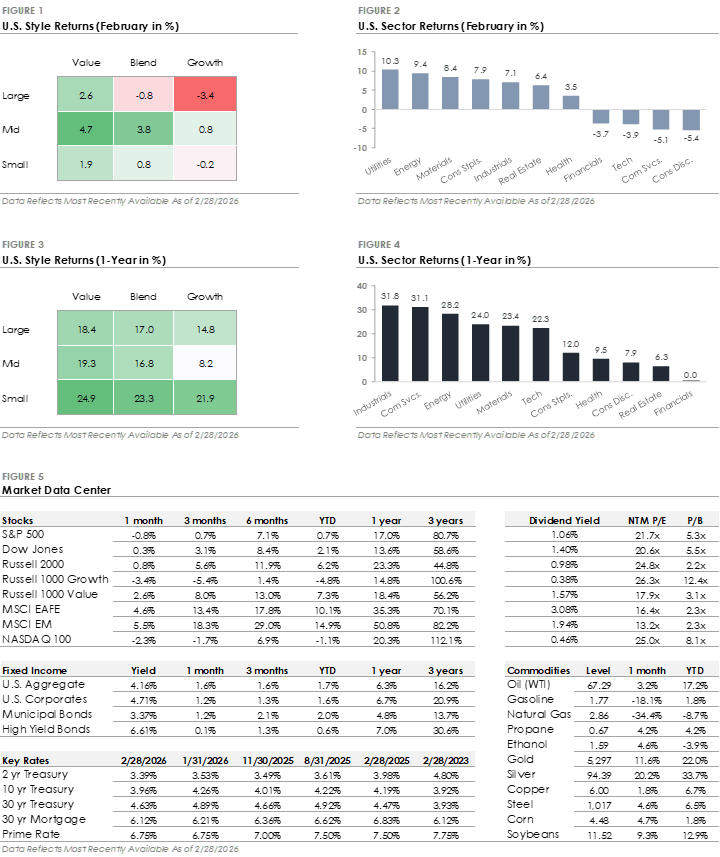
This material prepared by Coastal Bridge Advisors is for informational purposes only. Additional data provided by MarketDesk Research. It is not intended to serve as a substitute for personalized investment advice or as a recommendation or solicitation of any particular security, strategy, or investment product. Opinions expressed by CBA are based on economic or market conditions at the time this material was written. Economies and markets fluctuate. Actual economic or market events may turn out differently than anticipated. Facts presented have been obtained from sources believed to be reliable. CBA, however, cannot guarantee the accuracy or completeness of such information, and certain information may have been condensed or summarized from its original source.