
.png)
![[One Charles] Logo_Stack 1 (1)](https://coastalbridgeadvisors.com/hubfs/%5BOne%20Charles%5D%20Logo_Stack%201%20(1).png)
.png)



.png?width=220&height=80&name=image%2028%20(1).png)

THE BOTTOM LINE
For all the macro turmoil experienced within the third quarter, the US stock market ended the period where it began. The installation of any new Federal Reserve chair invites skepticism and disorientation. Fortunately, Chairman Warsh spoke resolutely about the current state of the economy and adjusted policy appropriately. The US economy and labor market hold durable momentum, but with elevated inflation levels. Warsh’s decision to raise rates, and hawkish rhetoric in response has reduced inflation expectations, recalibrated rate levels along the curve, and re-rated stock valuations appropriately. We now find ourselves within a familiar sequence: welcome a new Fed Chair, absorb new policy guidance, reset market prices, and reassess forward prospects. We successfully passed through the first three gates within the third quarter. Now comes the fourth gate and the fourth quarter. With recession risks contained, earnings expectations elevated, and valuations properly recalibrated with rates, we expect that within the fourth quarter… new highs are nigh!
The Full Story
While the stock market produced little change for investors within the third quarter, the macro market changed considerably. Overall, the S&P 500 (capitalization-weighted) gained 2% for the quarter, while the S&P 500 (equal-weighted) lost 2% for the quarter—effectively a push. However, outside of the S&P 500, macro measures were much sportier. Oil prices increased 13%. The 2-Year Treasury Yield increased 16%. The 10-Year Treasury Yield increased 13%. The Fed raised the Federal Funds rate 7% and the US Dollar Index increased 1%—typically a toxic brew for investors:
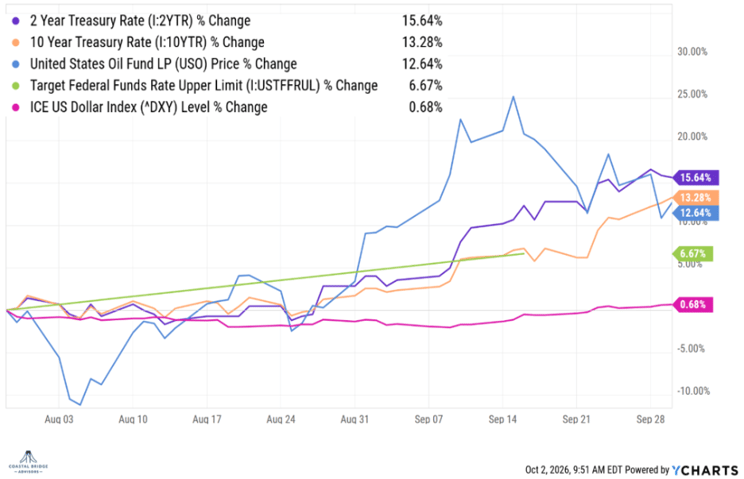
Indeed, these moves delivered hardship beneath the less interest rate sensitive Mag 7s and Mega Caps. More interest rate sensitive sectors like utilities, small cap stocks, and banks fell fast:
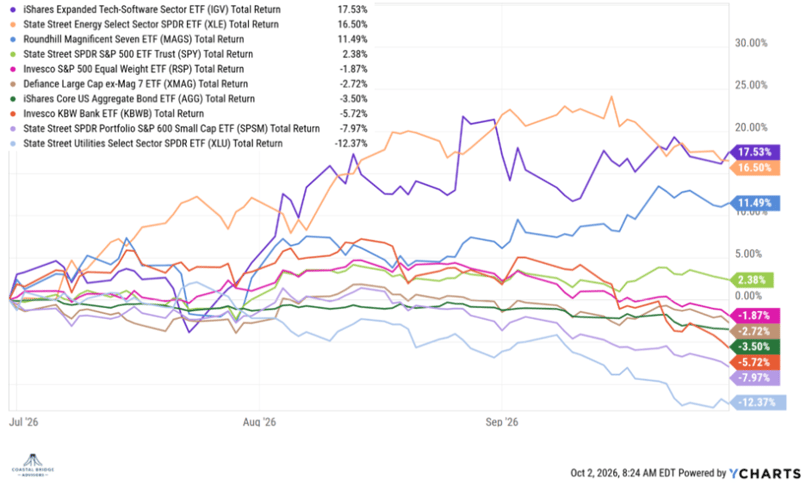
But why would higher valuation Mega Cap tech stocks gain ground? Additionally, why would highly leveraged software stocks gain nearly 20%? While the Fed described inflation as worrisome and deserving of intervention at both Jackson Hole and its most recent FOMC meeting, it also praised the strong labor market and strengthening economy. Certainly not a forecast for stagflation (lower GDP, higher rates) as many breathless commentators frequently espouse. In fact, contrary to popular opinion, higher interest rate cycles do not axiomatically induce slower GDP cycles or lower stock returns: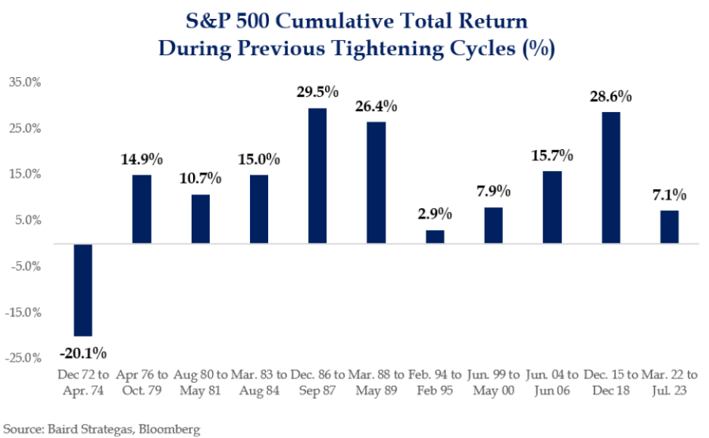 Note the last tightening cycle. The S&P 500 gained 7% despite Fed rate hikes from 0% to 5.5%! Furthermore, over the past eleven hiking cycles the market rose 12.6% on average. If the Fed is raising rates because the combination of inflation and economic growth are driving nominal GDP higher, it’s typically market positive until they cross a threshold of intolerance or an exogenous event triggers recession. It’s not the beginning of the Fed’s tightening cycle that triggers recessions and bear markets… it’s the end! Note the relationship between Nominal GDP and the Federal Funds rate since 1980:
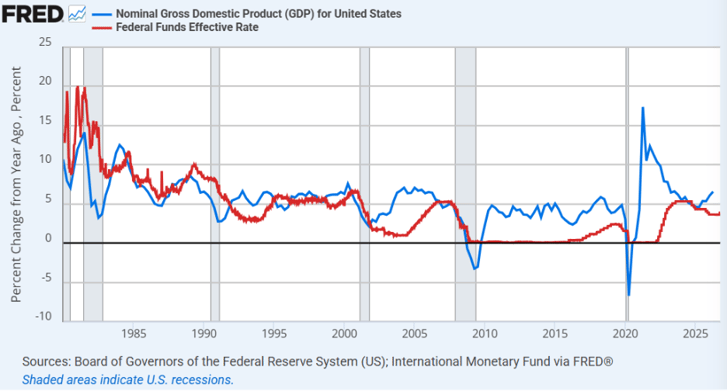
The recent spike higher in nominal GDP (economic growth + inflation) began in the second quarter of 2025 and yet, the Fed CUT rates 1.75% during that period under old Chair Powell. That’s why new Fed Chair Warsh correctly described the 3.75% Fed Funds rate as “accommodative” and signaled more accommodation removal could come through additional rate hikes. In our judgement, the biggest event last quarter was not the upward move in rates, but the restoration of Fed credibility seen in falling inflation expectations: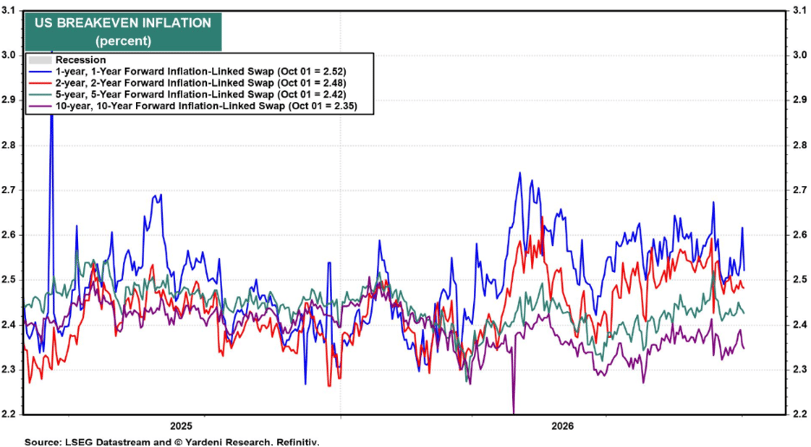
So here is the third-quarter bottom line: Interest rates along the curve rose for the right reasons. Economic growth remained resilient, inflation remained elevated, and the Fed reasserted its inflation-fighting credibility. Stocks finished mixed, with more rate-sensitive sectors repricing while less rate-sensitive sectors held steady. What may have felt like a macro mauling was in fact, a macro cleansing as higher rates restored discipline, reset valuations, and laid a firmer foundation for future gains, which we expect to see more of as we close the books on 2026.
Have a great Sunday!
-David
David S. Waddell, CFP® CEPA®
Chairman, Chief Investment Strategist
David Waddell is Chairman and Chief Investment Strategist at Coastal Bridge Advisors, where he chairs the firm's investment committee and helps guide portfolio strategy through macroeconomic analysis, market research, and risk assessment. With nearly three decades of experience, he is a nationally recognized commentator on economics and investing, with appearances on CNBC, Bloomberg, Fox Business, and Barron's. David is a CERTIFIED FINANCIAL PLANNER™ professional (CFP®) and a Certified Exit Planning Advisor (CEPA®). He holds a BA in Economics from The University of the South and an MBA in Finance and Investments from Babson College.
Sources: Yardeni Research, Federal Reserve Bank of St. Louis, Bloomberg, Fidelity Investments, Ycharts
The views and opinions expressed are those of David Waddell as of the date of publication and are subject to change without notice. Percentage changes in interest rates and yields reflect relative changes in the level of the applicable rate or yield and should not be interpreted as percentage-point changes. This material is provided for informational and educational purposes only and is not intended to constitute investment advice or a recommendation to buy or sell any security. References to specific companies, securities, market indicators or portfolio positioning are provided solely to illustrate the author’s market views and should not be interpreted as individualized investment recommendations. Statements regarding future market, economic, industry or company performance reflect the author’s current opinions, expectations and estimates and should not be interpreted as guarantees or assurances of future results. Actual results may differ materially from those expressed or implied. Market-implied probabilities, credit-market indicators and similar estimates reflect market pricing and underlying assumptions and should not be interpreted as precise forecasts of future outcomes. References to relationships or trends among market prices, valuations, credit spreads, earnings, capital spending or other financial and economic data are observational in nature and should not be interpreted as establishing causation. Market and economic conditions differ across periods, and historical relationships may not repeat. The information and opinions expressed are based on sources believed to be reliable, including third-party sources, but are not guaranteed as to accuracy or completeness. Third-party information has not been independently verified by CBA. Any forward-looking statements, projections, forecasts or hypothetical examples are for illustrative purposes only, are inherently uncertain and are subject to change based on market, economic, political, regulatory and company-specific conditions. Past performance is not indicative of future results. No investment strategy or security can guarantee a profit or protect against loss. References to portfolio positioning are general in nature and may not reflect the holdings, objectives or circumstances of any particular client account. Indexes are unmanaged and cannot be invested in directly. Index and investment vehicle performance does not reflect fees, expenses or other costs associated with investing.