
.png)
![[One Charles] Logo_Stack 1 (1)](https://coastalbridgeadvisors.com/hubfs/%5BOne%20Charles%5D%20Logo_Stack%201%20(1).png)
.png)




.png?width=220&height=80&name=image%2028%20(1).png)

THE BOTTOM LINE
This bull market just received a one-year extension based upon NVIDIA's earning release this week. According to CEO Jensen Huang, AI construction has only accelerated and will increase and broaden wider throughout 2027. NVIDIA's stock soared on the news, but remains below all-time highs, as do the stocks of its downstream component providers. Why haven’t record AI earnings provided record returns for AI stock investors? For that answer, we must migrate our thinking beyond the buildout of AI to the returns on AI. In short, it’s time for AI to prove it.
The Full Story
The AI Boom currently powers roughly 50% of GDP growth, 50% of S&P 500 earnings growth, and 50% of S&P 500 market cap. Therefore, at least for now, as goes AI, so goes the US economy. By far the largest company in the world and the largest contributor to the AI Boom is NVIDIA, powering over 70% of global AI compute. Furthermore, NVIDIA has become the central bank to the AI ecosystem through its myriad investments, lease guarantees, compute offtakes, and vendor financing deals. In fact, while CEO Jensen Huang may not say much about Fed Policy, the Fed speaks a lot about AI economics making NVIDIA arguably more relevant. Therefore, when NVIDIA reports earnings each quarter it isn’t just a company report, it’s an industry report and even more so an economic report rivaling the monthly jobs report or quarterly GDP. I am not sure in the twenty years I have been sending out weekly emails that I have ever written about just one company. NVIDIA released their earnings report on Wednesday night. Here is what we learned:
The Numbers
NVIDIA's second quarter revenue grew 106% over last year to $96 billion. Data center revenue grew 117% to $89 billion. Net income grew 126% to $60 billion. Not only has NVIDIA's revenue gone parabolic, but its profit margins have gone parabolic as well:
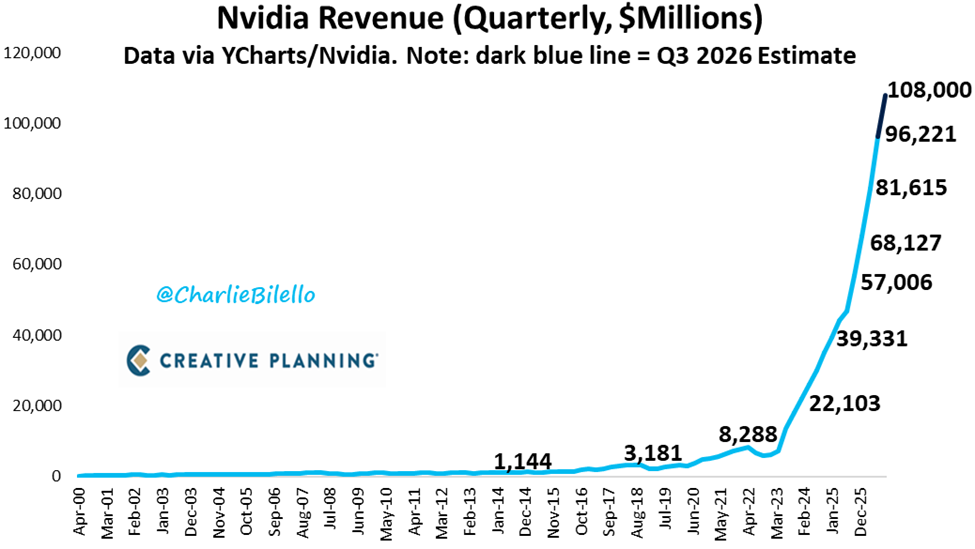
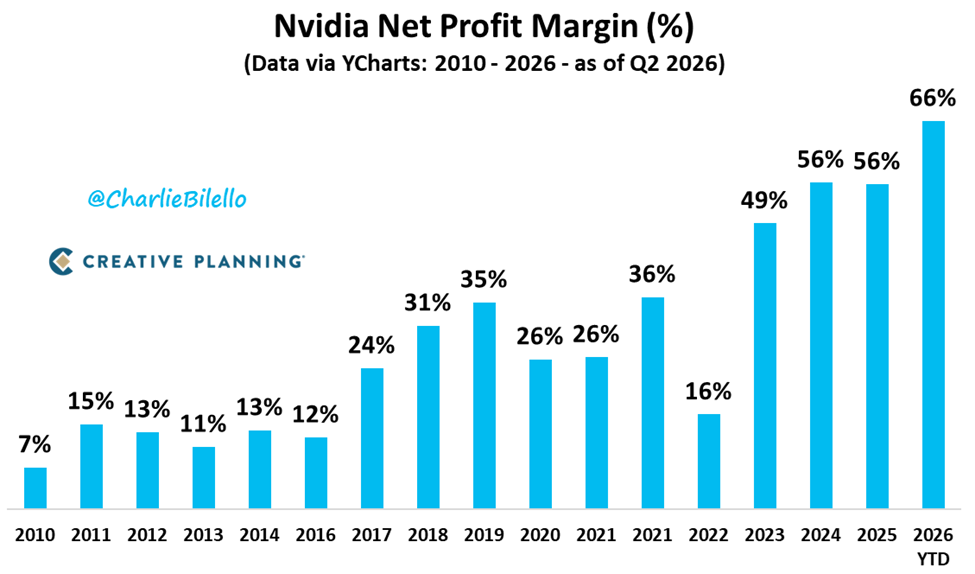
There is no corporate historical comparison for operating performance at this size and to this degree.
Limitless Demand
NVIDIA forecasts 70% revenue growth over their next fiscal year which runs from February 2027 through January of 2028 with the caveat that it would grow even more without supply constraints. Given the cyclical nature of semiconductor businesses, few have had the confidence historically to make long-term projections. Wall Street forecast 44% revenue growth potential in 2027, well below the guidance given. NVIDIA expects total hyperscaler AI capex in 2027 to reach $1.3 trillion, higher than the $800 billion or so spent this year and $300 billion more than wall street forecasts. According to NVIDIA, demand for AI infrastructure isn’t slowing, it’s growing, and supply cannot keep pace.
Constrained Supply
According to CFO Colete Kress, supply limitations may limit 2027 revenue by 30%. NVIDIA committed to $279 billion of pre-ordered components up from $119 billion in the previous quarter. That’s a $160 billion increase in supplier commitments in just three months! This not only ensures growth for the entire supply chain but also reveals the level of confidence NVIDIA has in their growth projections. For NVIDIA to meet demand projections, the chain has to meet their supply commitments, which requires higher productivity and additional capacity, which requires a lot more capital.
Transitioning from Build it to Prove it
Voracious demand and breathless suppliers suggest substantial economic returns for the users of AI. Jensen even espoused this point Wednesday saying, "AI has reached its inflection point. It's doing useful work. Its tokens are productive and profitable. Now, compute is revenue." Within the last quarter, companies certainly talked about the cost of AI, but few cited the returns on AI:
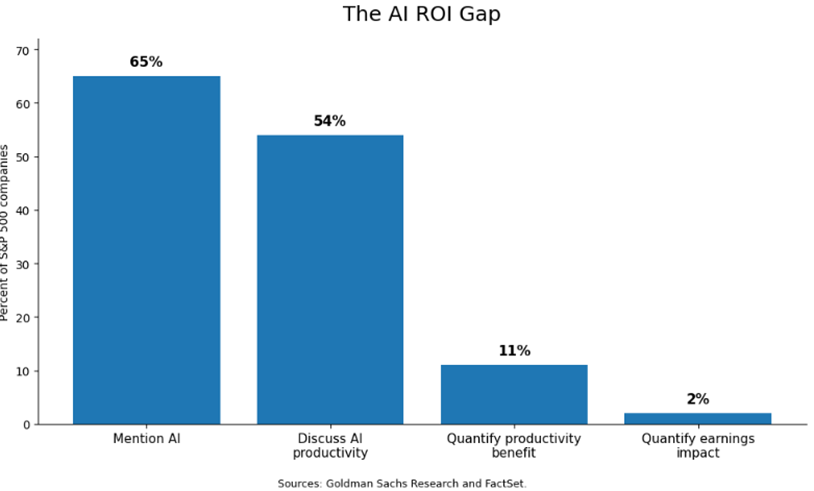
Last quarter, 65% of the companies that reported mentioned AI expenditure, 54% discussed AI productivity pursuits, 11% discussed productivity benefits, and 2% mentioned quantifiable earnings impact. If the theme of the last few years has been “Build It”, the theme of the next few years will be “Prove It”.
Credit Required
The Wall Street Journal ran a sobering piece on the labyrinth of financial structures required to support the AI Boom.
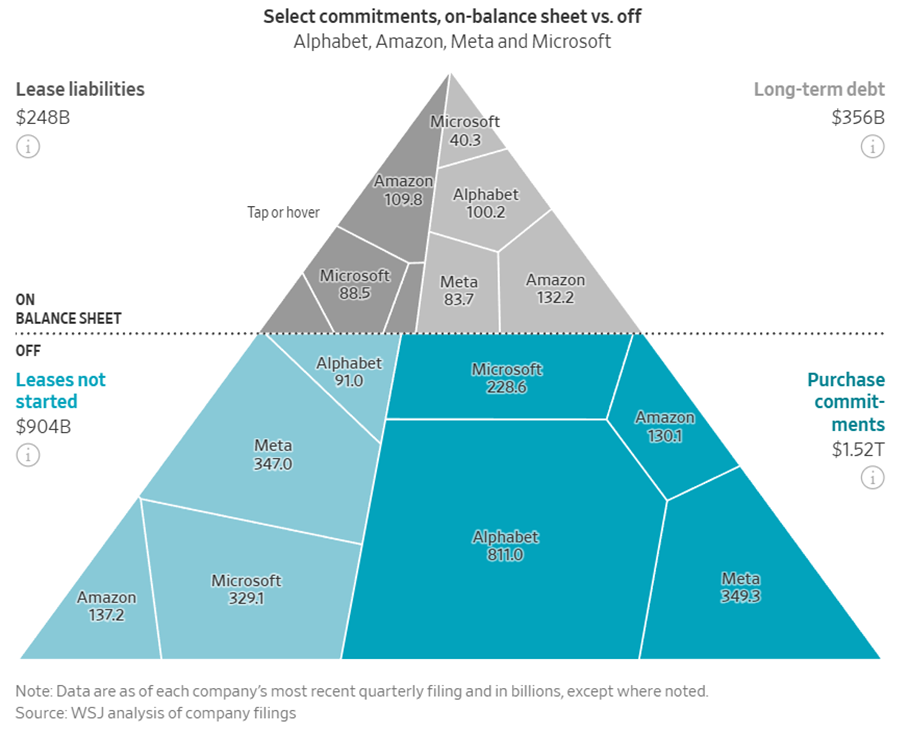
Google, Amazon, Meta and Microsoft alone hold liability commitments of $600 billion on balance sheet and $900 billion off balance sheet. Industry wide, these numbers blow out to roughly $1 trillion on balance sheet and $3 trillion off. These numbers will only increase as suppliers lever up to provide the vast compute anticipated to generate generational profits for users. In short, don’t confuse the large profit gains across the economy with the benefits of AI. Right now, the profit gains across the economy come from the levered-up construction of AI. The use profits remain a promise yet to be fulfilled.
Higher Anxiety = Lower Valuations
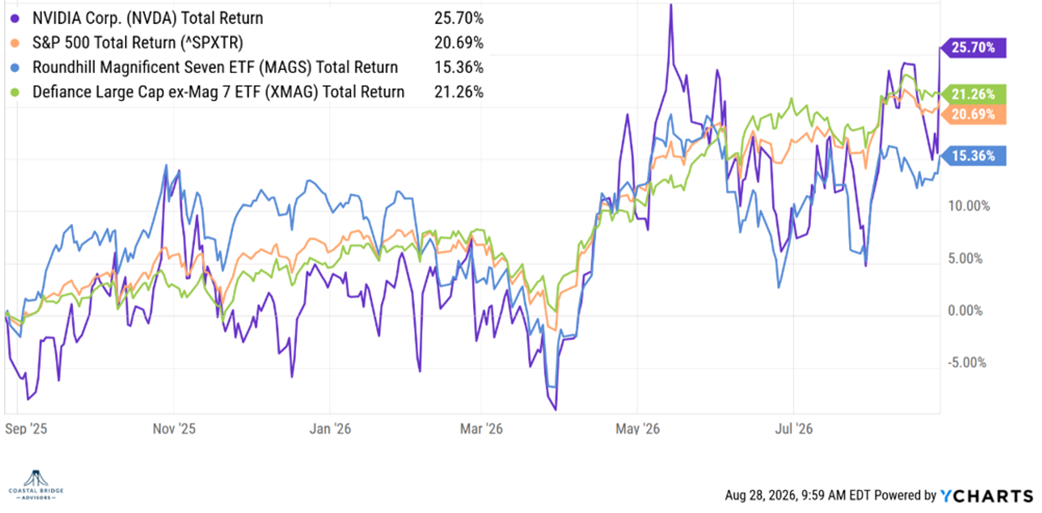
Despite the leaders of AI’s conviction, astounding earnings reports and salesmanship, the stock returns for the cohort have lagged. While NVIDIA doubled revenue and earnings over the past year, its stock price has only appreciated 25%, mostly lagging the S&P 500 until this week, and remains below its all-time high. The Mag 7 (Apple, Amazon, Google, Meta, Microsoft, NVIDIA, Tesla) overall have returned 15%, well below the 21% achieved by the Ex-Mags in the S&P 500:
And despite the attention drawn to the supplier shortages, particularly those of the memory providers like Micron and Sandisk, the semiconductor and DRAM cohorts remain well below recent highs:
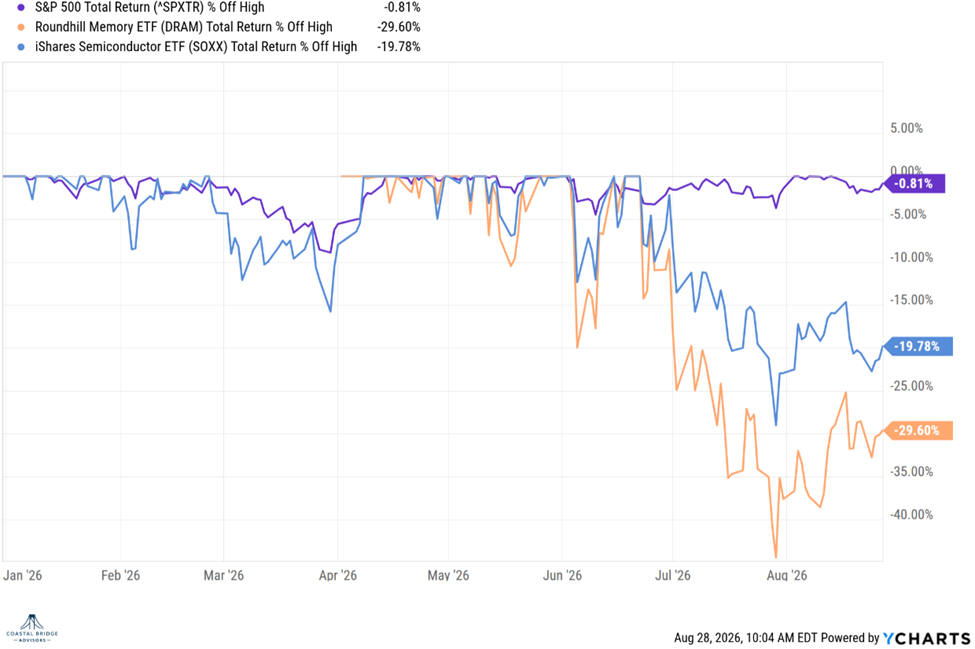
Surging earnings that produce lagging stocks must be plagued by valuation compression. Note the plunging P/E of NVIDIA over the past two years:
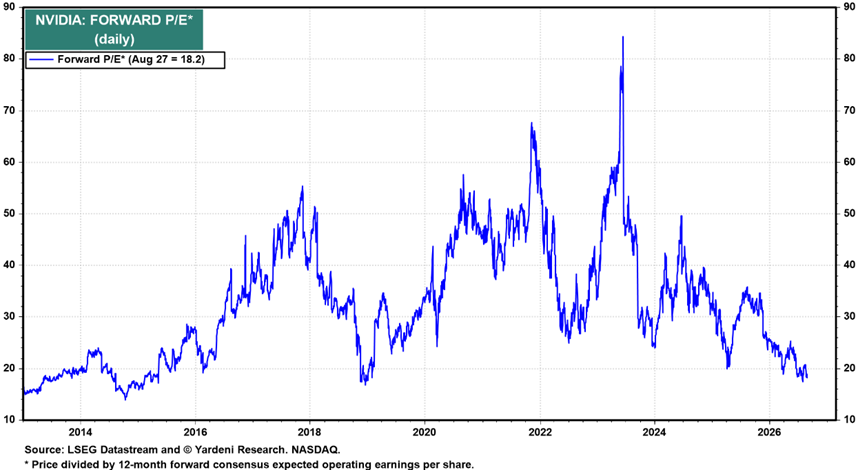
NVIDIA now trades at the lowest P/E level in more than a decade. But while this chart is falling, a related chart has been rising:
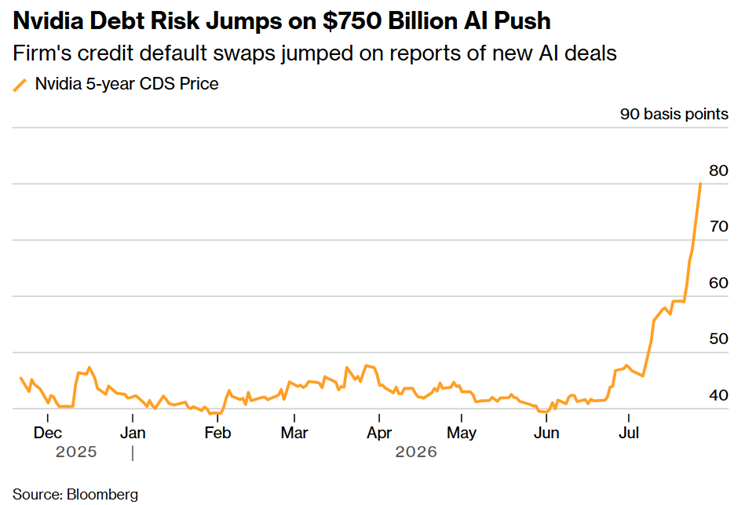
This chart chronicles the insurance premium charged to holders of NVIDIA's debt. Rising credit default spreads correspond with rising credit concerns and while these are not crisis levels, the trend is decidedly negative.
And if we widen the aperture of our analysis to the magnificent cohort, rising credit swaps have clearly undermined share appreciation (prices versus inverted CDS spreads):
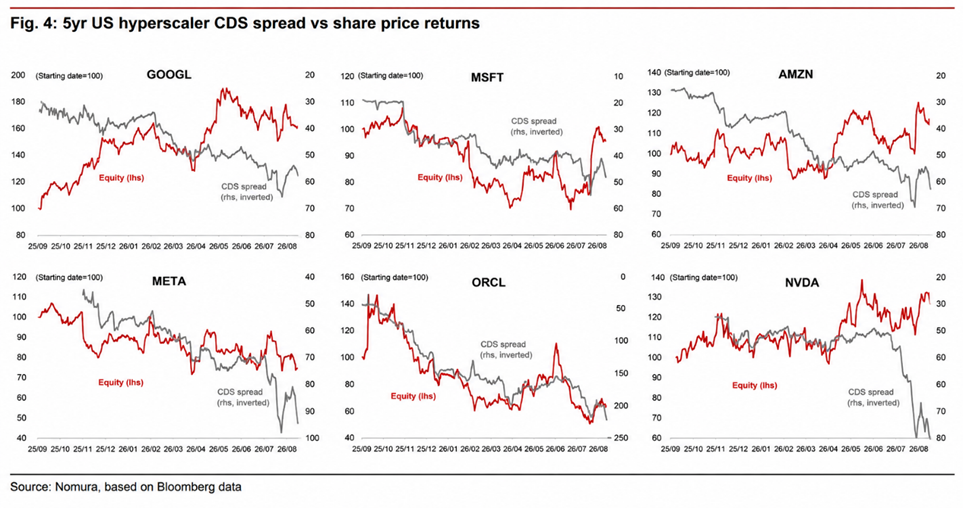
In short, rising earnings do not necessarily translate into rising returns for equity investors if doubts of end user profits create doubts in hyperscaler credit worthiness. AI fantasies will increasingly come under pressure to become AI realities. NVIDIA's ability to profit from the buildout has been historic and rewarding for investors, profits from AI utilization for both remain to be seen.
Have a great Sunday!
David
David S. Waddell, CFP® CEPA®
Chairman, Chief Investment Strategist
David Waddell is Chairman and Chief Investment Strategist at Coastal Bridge Advisors, where he chairs the firm's investment committee and helps guide portfolio strategy through macroeconomic analysis, market research, and risk assessment. With nearly three decades of experience, he is a nationally recognized commentator on economics and investing, with appearances on CNBC, Bloomberg, Fox Business, and Barron's. David is a CERTIFIED FINANCIAL PLANNER™ professional (CFP®) and a Certified Exit Planning Advisor (CEPA®). He holds a BA in Economics from The University of the South and an MBA in Finance and Investments from Babson College.
Sources: Bloomberg; Nomura; Yardeni Research; YCharts; The Wall Street Journal; Goldman Sachs Research; ING Research; Statista Market Insights, AI accelerator market share; NVIDIA Q2 FY2027 Earnings Release and Earnings Call Transcript, Aug. 26, 2026; Creative Planning; Charlie Bilello
The views and opinions expressed are those of David Waddell as of the date of publication and are subject to change without notice. This material is provided for informational and educational purposes only and is not intended to constitute investment advice or a recommendation to buy or sell any security. Statements regarding future market, economic, industry or company performance reflect the author’s current opinions, expectations and estimates and should not be interpreted as guarantees or assurances of future results. Actual results may differ materially from those expressed or implied. References to relationships or trends among market prices, valuations, credit spreads, earnings, capital spending or other financial and economic data are observational in nature and should not be interpreted as establishing causation. The information and opinions expressed are based on sources believed to be reliable, including third-party sources, but are not guaranteed as to accuracy or completeness. Third-party information has not been independently verified by CBA. Any forward-looking statements, projections, forecasts or hypothetical examples are for illustrative purposes only, are inherently uncertain and are subject to change based on market, economic, political, regulatory and company-specific conditions. Past performance is not indicative of future results. No investment strategy or security can guarantee a profit or protect against loss. Indexes are unmanaged and cannot be invested in directly. Index and investment vehicle performance does not reflect fees, expenses or other costs associated with investing.