

 Coastal Bridge Client Portal

 One Charles Private Wealth Client Portal






THE BOTTOM LINE
While investors have endured losses over the past month, the pain has been far from evenly distributed. Losses within the crowded AI Trade have been the most acute and traders who haven’t locked in outsized gains may experience even more outsized losses. While we believe economic momentum will continue to reward stock market participation, periods of indiscriminate liquidations such as these can punish thematic concentrations. Best to remove these outsized bets from the table, take position sizes back to neutral, and await more reliable leadership signals.
The Full Story
I had a single conversation this week with a small investor that helped me fog cut the many conversations happening on Wall Street between big investors. He has his 401(K) money with Fidelity. Eager for an earlier retirement date, in 2022, he invested his entire account into the $41 billion Fidelity Select Semiconductors Portfolio (FSELX). Between June 30th, 2022, and June 30th, 2026, his position gained 585% while the S&P 500 gained 109%. Retirement in sight! However, since then, his position has fallen 34%. While 34% sounds small compared with 585%, remember that the 34% has a much greater mathematical impact given the much larger base amount. The 34% reduction from the top has taken his overall gain down from 585% to 352%. Retirement delayed. He feels confident that semiconductors will come back and reclaim new highs but asked me what I would do. This is what I told him...
Trading and investing are different. Investing uses compounding to reach long-term goals. For instance, the Fidelity Total Market Index fund (FSKAX), also available to him within the plan, has compounded capital at a 14% annual rate over the last 15 years. Investors in this fund may not be winners every year, but historically, the odds are they are winners every decade. Investing only requires a correct buy decision. Trading seeks rapid capital appreciation to accomplish short-term goals. His trading decision to accelerate his retirement date by going “all in” on semi-conductors worked. Until it didn’t. That’s the difficulty with trading. Trading requires a correct sell decision in addition to a correct buy decision. Never mistake a trade for an investment. This was the trap he fell into. Once I reframed his decision as a trade, I congratulated him. While he may not have sold at the 585% top, at 352%, he still had the chance to sell his position and lock in 243 percentage points of index outperformance over the holding period. That’s a great trade! As a trade, I suggested he sell and reinvest the proceeds back into FSKAX to lock in his outperformance. In other words, take the trading win and take the investment funds back to neutral.
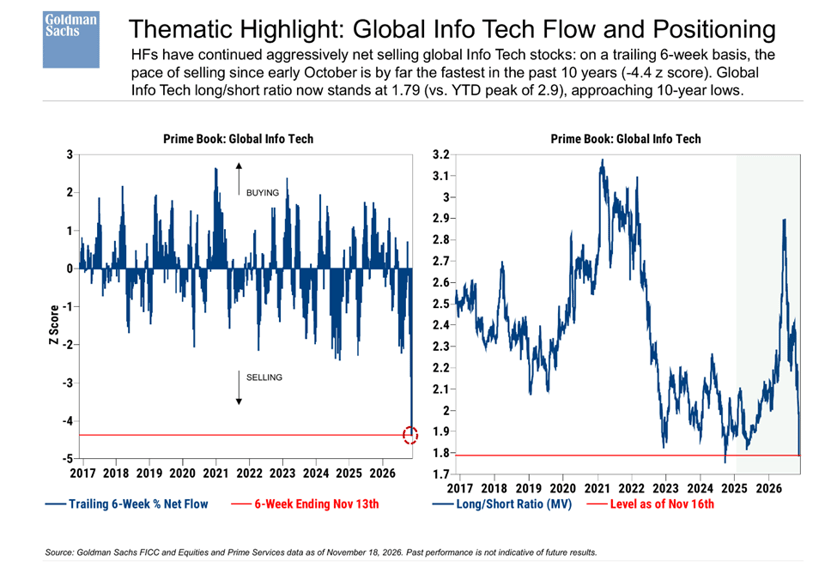
This simple example helps explain recent market activity. In addition to retail players seeking trading wins, highly leveraged institutional players wildly overallocated to the “AI Trade”, making it one of the most crowded trades in history. The collision of irrational expectations with the blue tsunami, a hawkish Fed, Jensen’s ouster, redoubled Chinese trade restrictions, skeptical credit markets and the failure of the largest IPO ever has traders taking gains (or losses) voluntarily and involuntarily amidst margin calls and investor redemptions. Consider the recent selling extremes from hedge funds:
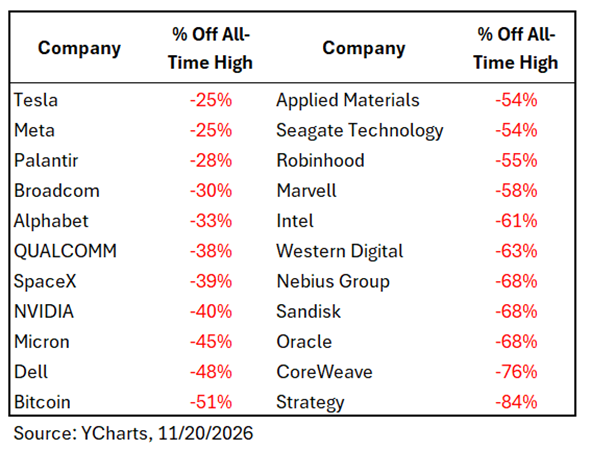
This mass liquidation has driven tech stocks down fast and furiously. Consider these resultant individual stock declines from recent all-time highs:
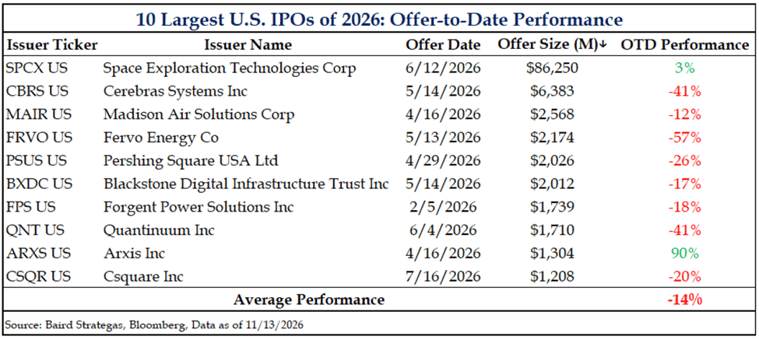
Also note that these are unlevered returns. Adding borrowed money on top only amplifies the losses. Hence, the panic feeling within the NASDAQ. Which brings me to the trading consequences of Anthropic. Anthropic raised over $100 billion in its public debut. That $100 billion had to come from somewhere. Many fund managers are fully invested by mandate meaning the Anthropic buying required the something else selling… further pressuring the AI trade. We did not participate. While we have access to IPO’s, they do not tend to be good entry points for investors. Consider IPO returns this year alone:
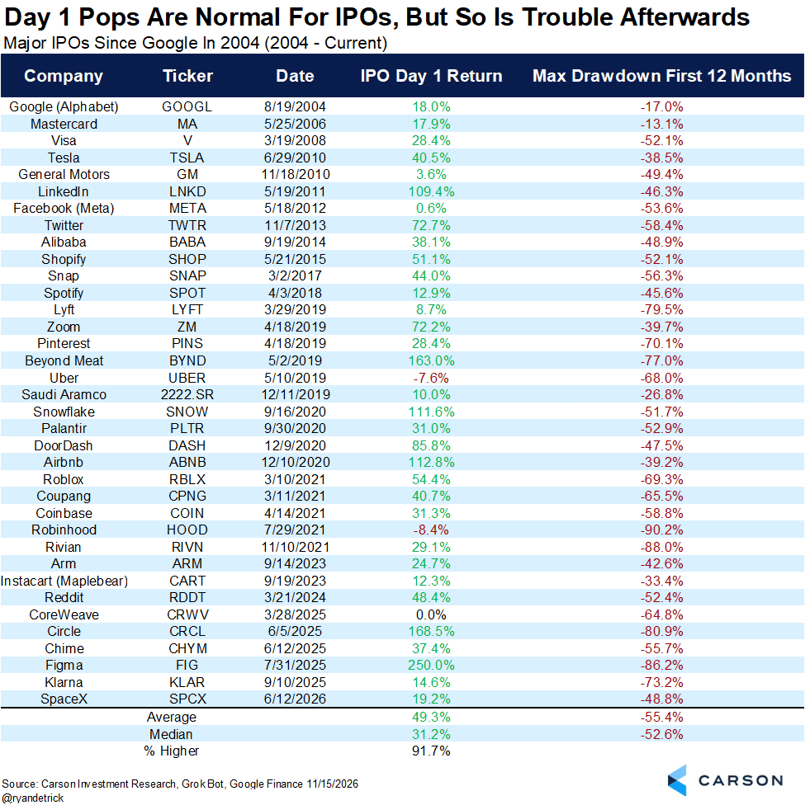
And these numbers don’t represent the at the market returns for investors without access to the pre-trading pricing. Those numbers get even worse as seen below:
Appraising Neutral
Away from the AI Trade wreck returns improve considerably. While there are many ways to slice and dice the market, viewing size and style categories helps identify calm amidst chaos:
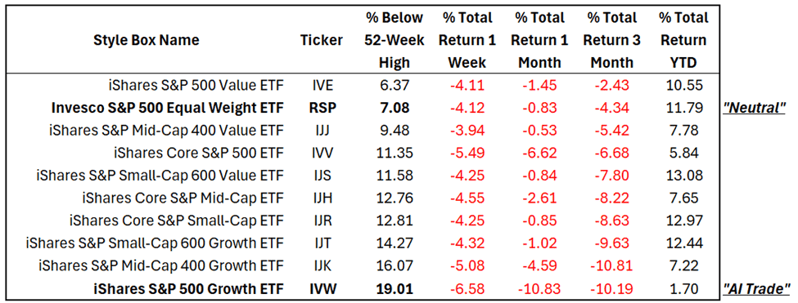
I know, it’s a spreadsheet, but bear with me. Locate the first data column on the left side labeled “% Below 52-Week High”. At the bottom, we see S&P 500 Growth (AI Trade) down nearly 20%. At the top, we see S&P 500 Value (Non-AI Trade) down 6.3%. For capitalization weighted S&P 500 investors, the diversified blend has fallen 11%, a drawdown level that occurs statistically about once a year. For equally weighted S&P 500 investors, the drawdown falls to 7%. Consider this a “neutral” posture, as labeled. The equal-weighted S&P 500 weights each company at 0.20% each. While Technology names account for nearly 40% of the cap weighted S&P 500, they account for less than 15% of the equal weight S&P 500. Despite the tech turmoil, this diversified index remains 12% higher on the year and relatively undisturbed by the recent turmoil. Here is why:
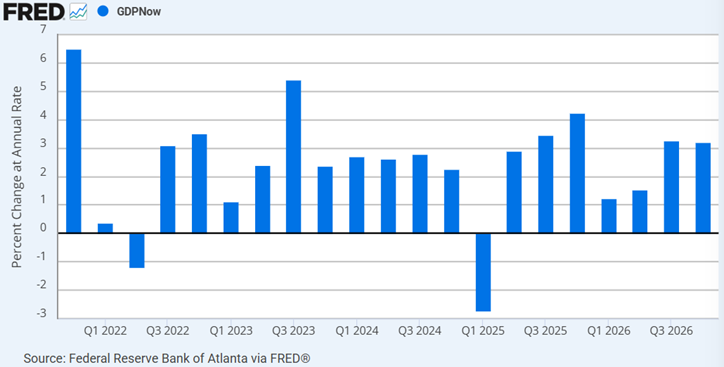
1. The Economy is Still Growing (last bar forecasts Q4 GDP):
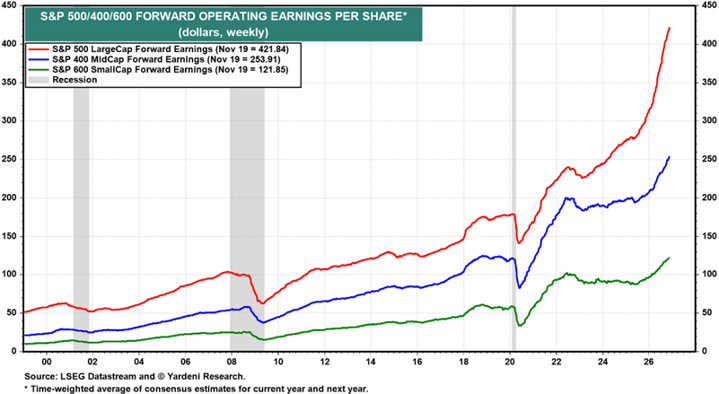
 2. Earnings are Still Robust (Large, mid and small company estimates rising):
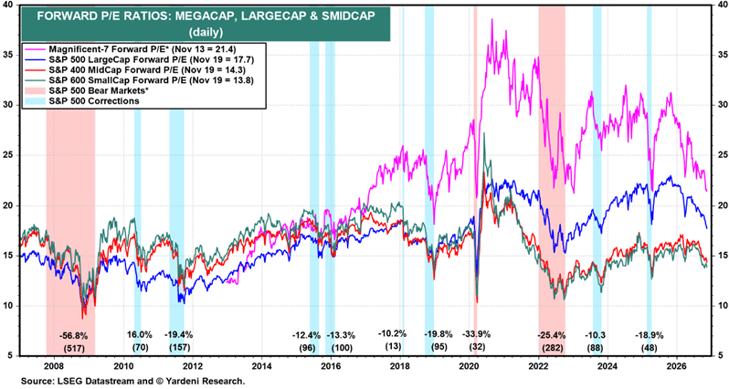
 3. Valuations have discounted potential disappointments considerably:
4. Negative Sentiment has reached extremes (second lowest level on the year):
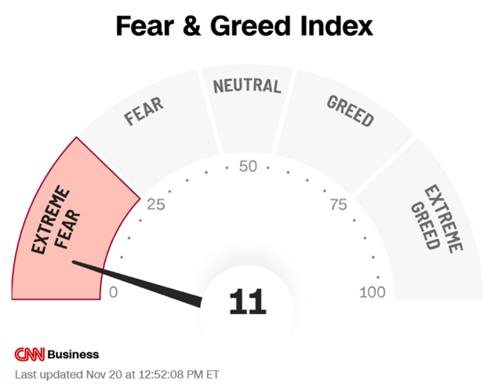
Clearly, valuations and sentiment have collapsed, but earnings and economic growth continue to ascend, making the collapse of the AI Trade contagious perhaps… but not fatal.
Have a great Sunday and a very Happy Thanksgiving.
-David
David S. Waddell, CFP® CEPA®
Chairman, Chief Investment Strategist
David Waddell is Chairman and Chief Investment Strategist at Coastal Bridge Advisors, where he chairs the firm's investment committee and helps guide portfolio strategy through macroeconomic analysis, market research, and risk assessment. With nearly three decades of experience, he is a nationally recognized commentator on economics and investing, with appearances on CNBC, Bloomberg, Fox Business, and Barron's. David is a CERTIFIED FINANCIAL PLANNER™ professional (CFP®) and a Certified Exit Planning Advisor (CEPA®). He holds a BA in Economics from The University of the South and an MBA in Finance and Investments from Babson College.
Sources: CNN Business, Yardeni Research, Federal Reserve Bank of Atlanta via FRED, Morningstar, Carson Investment Research, Baird Strategas, Bloomberg, Goldman Sachs, YCharts
The views expressed are those of David Waddell, as of the publication date and may change without notice. This material is for informational purposes only and does not constitute investment advice or a recommendation to buy or sell securities. Information is derived from sources believed reliable but has not been independently verified by CBA. Forward-looking statements and analyst estimates are subject to uncertainty, and actual results may differ. Past performance does not guarantee future results. Indexes are unmanaged and cannot be invested in directly. Individual securities and sector investments involve risks, including potential loss of principal.
Bye Jensen, Buy Nvidia?
In a week full of palace intrigue, Nvidia’s star CEO departed and Nvidia’s meteoric stock ran ...
Read More
Less is More
Sometimes less is more. This week's developments may offer several reasons for optimism. Easing ...
Read More
Year-End Tax Planning: Why Timing Still Matters
Year-end tax planning is often associated with the flurry of activity in December, but important ...
Read More