
.png)
![[One Charles] Logo_Stack 1 (1)](https://coastalbridgeadvisors.com/hubfs/%5BOne%20Charles%5D%20Logo_Stack%201%20(1).png)
.png)



.png?width=220&height=80&name=image%2028%20(1).png)

THE BOTTOM LINE:
Last week reinforced that markets often move before policymakers fully catch up. The Fed held its overnight rate steady, but Treasury yields continued to rise, increasing borrowing costs and pressuring stock valuations. Meanwhile, the Situational Awareness unwind showed how quickly a successful investment can run into trouble when leverage and concentration leave little room for error. Investors cannot control when the Fed moves or where Treasury yields trade. They can control diversification, position size, and leverage. Markets will always move first, but successful long-term investors build portfolios capable of moving with them.
The Full Story:
The Federal Reserve held interest rates steady last week amid a slate of corporate earnings announcements. The pause was expected, but not assured. Ahead of the decision, markets had assigned roughly a one-third probability to a rate increase, leaving investors positioned for either outcome to unwind their trades after the Fed stayed put.
Although the overnight rate controlled by the Fed did not change, market interest rates have risen steadily since the Iranian conflict began in early March. In other words, the Fed may have paused, but the bond market has continued moving. Consider the two-year US Treasury yield compared with the effective federal funds rate:
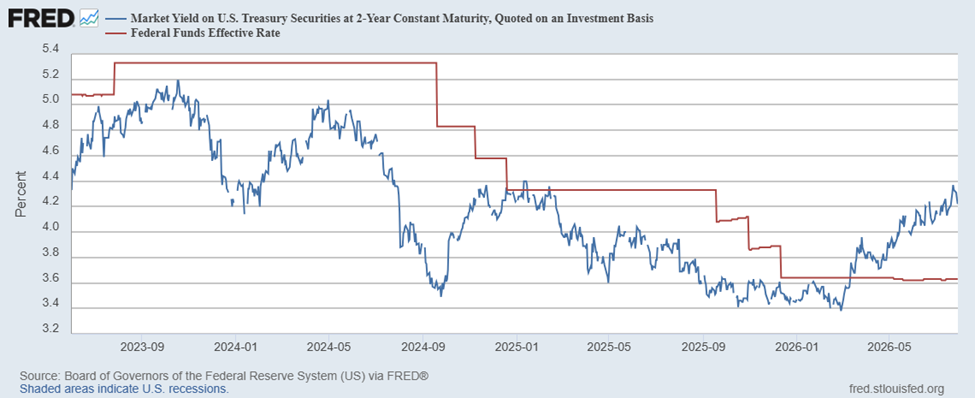
Following the Fed’s final rate hike in mid-2023, the two-year yield led the federal funds rate lower. Investors anticipated cooling inflation and moved ahead of the Fed before the rate-cutting cycle began. More recently, that relationship has reversed. The two-year yield has marched higher while the fed funds rate has remained unchanged. These gaps typically narrow over time. Either the Fed eventually follows market rates higher, or yields fall back toward the current policy rate. Under Warsh’s less prescriptive communication approach, however, investors may receive fewer clues about which side moves first.
Further out, the longer end of the yield curve has added pressure of its own. The 10-year Treasury yield bottomed near 3.93% at the beginning of March and now sits near 4.68%, a near 20% increase in five months. As longer interest rates rise, future earnings discount further. Strong earnings growth can offset that pressure, but companies must increasingly deliver results that justify both elevated valuations and a higher cost of capital. The Fed sets one rate, but markets set nearly everything else. Right now, markets are effectively raising rates across the curve for the Fed.
A Leveraged Unwind
Single-stock volatility typically rises during earnings season, but this past month was on another scale, particularly among companies tied to artificial intelligence. Some of those movements became easier to understand after reports emerged that the AI-focused hedge fund Situational Awareness had sold much of its public-stock portfolio to Citadel following heavy losses.
The fund had generated handsome returns through concentrated, leveraged investments in companies expected to benefit from rising AI infrastructure spending. Once several of those positions moved against it, losses accelerated, and the fund was forced to sell. A forced seller is not deciding whether a stock represents attractive long-term value. It is selling because it needs cash. When a concentrated portfolio is unwound quickly, that pressure can push individual-stock volatility well beyond what the underlying fundamentals might suggest.
There is a faint historical echo here.
In the 1990s, Long-Term Capital Management generated impressive returns before leverage turned against it and necessitated a private sector rescue. The Situational (Un) Awareness portfolio sale is small in systemic size, but the mechanics are familiar: concentration, leverage, falling prices, and forced selling.
The historical timing is nevertheless interesting. Consider the analog below between Netscape’s launch in the mid-1990s and ChatGPT’s launch in 2022, with the gray bar marking the LTCM collapse.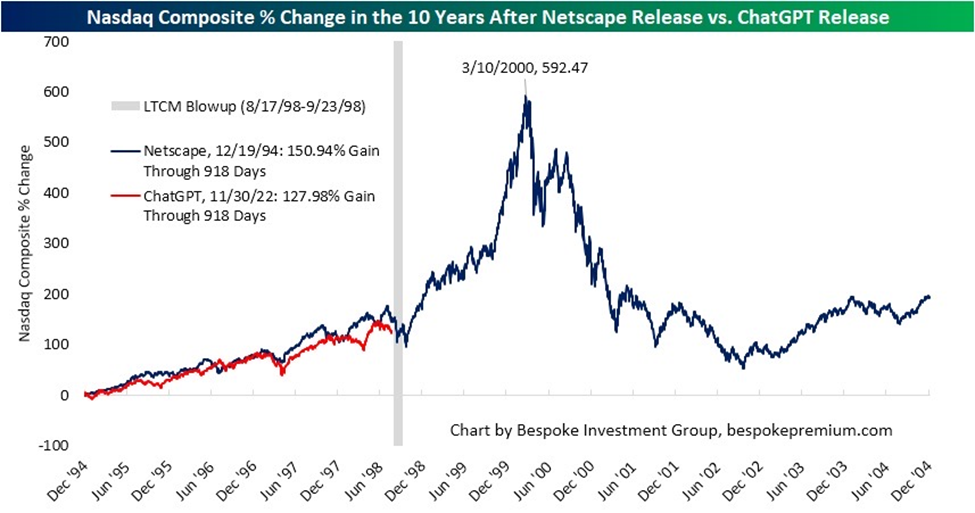
The comparison above is provided for illustrative purposes only and is not intended to predict future market performance. Past performance of an index is not indicative of future results. The Nasdaq Composite Index is unmanaged and does not reflect fees or expenses that may be associated with investing in securities.
The Situational Awareness fire sale occurred at nearly the same relative point in the current technology cycle. This comparison is not a forecast, but simply a reminder that transformational investment themes often attract excessive confidence, crowded positioning, and leverage before their full economic potential is known.
Have a great week!
Matt Gentzkow, CIMA®
Managing Director, Wealth Advisor
Sources: Federal Reserve Bank of St. Louis, Bespoke Investment Group
This communication and its contents are for informational and educational purposes only and should not be used as the sole basis for any investment decision. The information contained herein is based on publicly available sources believed to be reliable but is not a representation, expressed or implied, as to the accuracy, completeness, or correctness of said information which may include data, opinions, or commentary obtained from third-party sources believed to be reliable; Third-party sources are not affiliated with, and do not endorse, this material. Forward-looking statements, forecasts, and estimates reflect current views and expectations and are subject to change. Actual results may differ materially from those expressed or implied. References to political figures or policies are for informational purposes only and do not represent an endorsement by Coastal Bridge Advisors. Any forward-looking statements reflect current opinions and assumptions and are subject to change without notice; actual results may differ materially. Any references to market indices, benchmarks, sectors, or economic data are provided for illustrative purposes only and are not intended to imply that any client account or investment strategy will achieve similar results. Indices are unmanaged and cannot be invested in directly. Comparisons to indices or benchmarks may not reflect the fees, expenses, investment objectives, or risk characteristics of actual portfolios. Past performance does not guarantee future results. Coastal Bridge Advisors may use artificial intelligence tools to help generate or summarize content; all outputs are reviewed by our team for accuracy and relevance.