



%20(1).png?width=508&height=121&name=flourish-primary-logo@2x%20(1)%20(1).png)


The month of May is one of the biggest times of the year in my hometown in central Indiana. The racing world turns its attention to the Indianapolis 500, commonly held on the Sunday of Memorial Day weekend. Thirty-three drivers push speeds approaching 230 miles per hour with one goal: survive 500 miles of straightaways and left turns better than everyone else.
Every driver can go fast, but the winners rely on optimizing car balance and race strategy to navigate the track. Low downforce and you’ll struggle in the turns. Poor tire strategy and you’ll lose speed. Investing is no different, and my sport correlations don’t end! Let’s explore.
Two-Legged Stool
For the last several weeks, investors have enjoyed fruitful returns fueled by robust corporate earnings data and increasing forward earnings estimates. A 2026 full year S&P 500 bottom-up earnings estimate of $334 and a 4.5% 10-year treasury yield nets a fair value for the S&P at 7,544. The index sits right near this mark as of Friday.
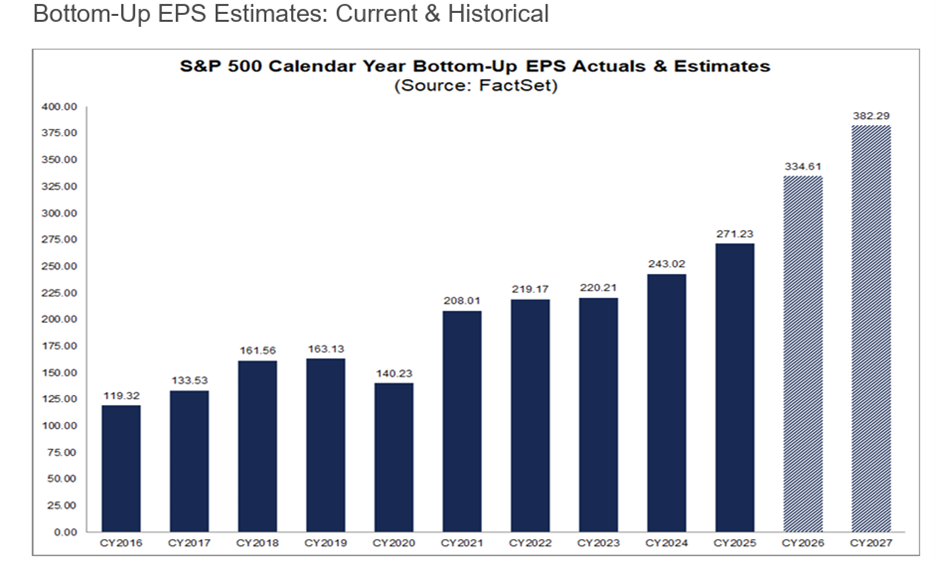
However, bond yields have continued their rise this year, with the 10-year Treasury reaching its highest level in more than a year. This has created downward pressure on bond total returns, which remain negative year-to-date in the U.S:
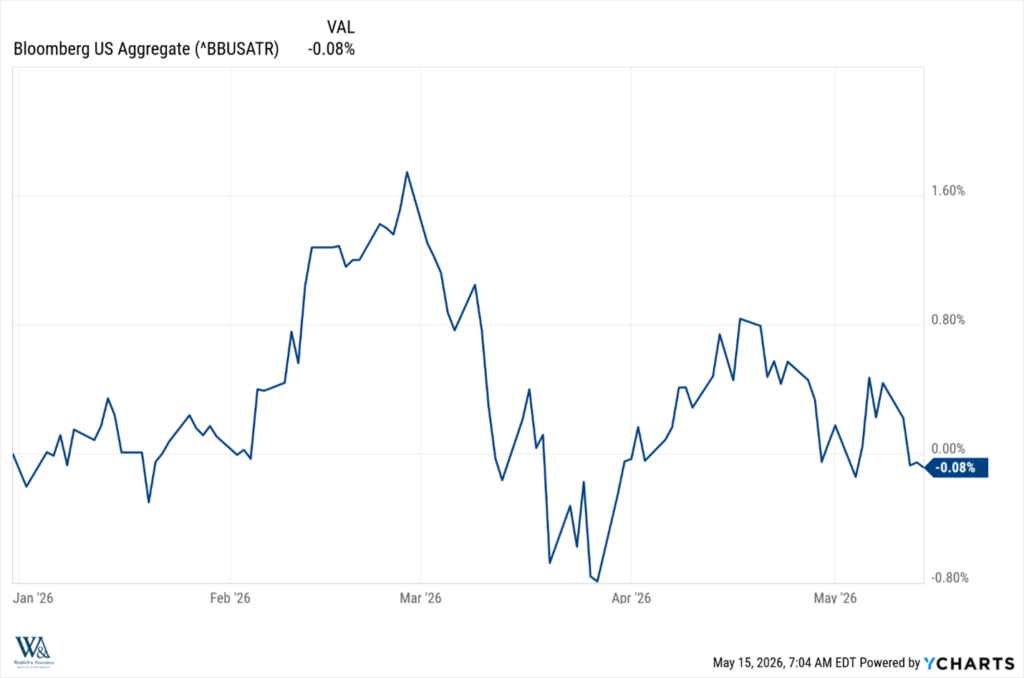
For decades, investors have relied on the classic “two-legged stool” of stocks and bonds. Stocks can provide growth, while bonds can offer income and downside protection. But recent market environments have exposed an important reality: sometimes both legs wobble at the same time.
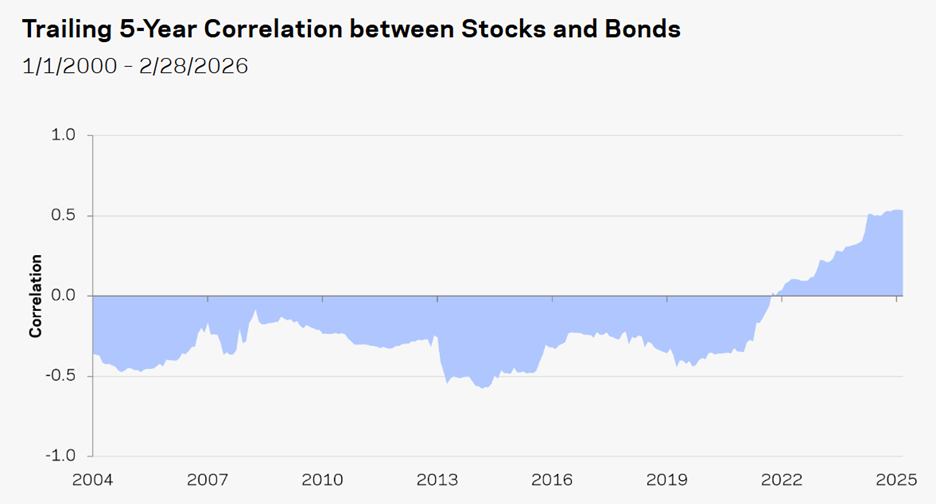
In 2022, for example, both stocks and bonds declined together as rising interest rates pressured traditional asset classes simultaneously. Investors learned that bonds alone do not always provide protection when correlations rise. The chart below highlights how stocks and bonds have behaved more similarly in recent years:
That is where liquid alternatives can serve as the portfolio’s third engine.
Liquid alternative strategies are designed to generate returns that are less dependent on the direction of traditional markets. Instead of simply riding markets higher or lower, these strategies seek opportunities through different approaches and can have lower correlation to stocks and bonds. Think of liquid alternatives as the pit crew of a portfolio. They are not responsible for driving the car at top speeds, but when markets become volatile, correlations spike, or economic conditions suddenly change, they can provide critical balance and stability.
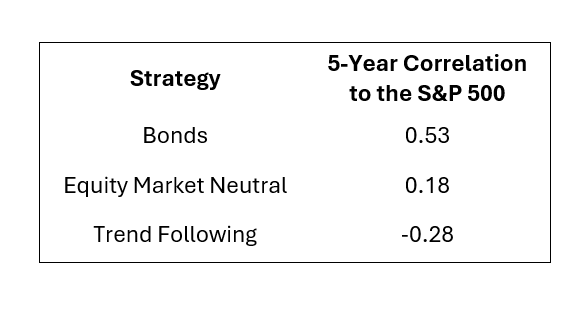
For a brief example, here is a chart of the same five-year correlation of returns comparing bonds, equity market neutral, and trend-following strategies relative to the S&P 500. The closer the number to 1, the more similar the assets behave. Notably, bonds have recently shown a higher correlation to stocks than these select alternative strategies.
Of course, diversification and risk management are the primary focus here, but investor returns matter as well. Importantly, liquid alternatives are not intended to replace stocks and bonds. Just as racecars require speed and durability, portfolios can benefit from growth and income-producing investments. Alternatives are designed to complement those core holdings by adding diversification from strategies that operate differently. The objective is not to eliminate risk but to build a more resilient portfolio capable of navigating changing market conditions.
Have a great week!
-Matt
Sources: FactSet, YCharts, AQR Capital Management
This communication and its contents are for informational and educational purposes only and should not be used as the sole basis for any investment decision. The information contained herein is based on publicly available sources believed to be reliable but is not a representation, expressed or implied, as to the accuracy, completeness, or correctness of said information. References to political figures or policies are for informational purposes only and do not represent an endorsement by Waddell & Associates. Any forward-looking statements reflect current opinions and assumptions and are subject to change without notice; actual results may differ materially. Past performance does not guarantee future results. Waddell & Associates may use artificial intelligence tools to help generate or summarize content; all outputs are reviewed by our team for accuracy and relevance.
">The Third Engine of Portfolio Diversification
The month of May is one of the biggest times of the year in my hometown in central Indiana. The racing world turns its attention to the Indianapolis 500, commonly held on the Sunday of Memorial Day weekend. Thirty-three drivers push speeds approaching 230 miles per hour with one goal: survive 500 miles of straightaways and left turns better than everyone else.
Every driver can go fast, but the winners rely on optimizing car balance and race strategy to navigate the track. Low downforce and you’ll struggle in the turns. Poor tire strategy and you’ll lose speed. Investing is no different, and my sport correlations don’t end! Let’s explore.
Two-Legged Stool
For the last several weeks, investors have enjoyed fruitful returns fueled by robust corporate earnings data and increasing forward earnings estimates. A 2026 full year S&P 500 bottom-up earnings estimate of $334 and a 4.5% 10-year treasury yield nets a fair value for the S&P at 7,544. The index sits right near this mark as of Friday.
However, bond yields have continued their rise this year, with the 10-year Treasury reaching its highest level in more than a year. This has created downward pressure on bond total returns, which remain negative year-to-date in the U.S:
For decades, investors have relied on the classic “two-legged stool” of stocks and bonds. Stocks can provide growth, while bonds can offer income and downside protection. But recent market environments have exposed an important reality: sometimes both legs wobble at the same time.
In 2022, for example, both stocks and bonds declined together as rising interest rates pressured traditional asset classes simultaneously. Investors learned that bonds alone do not always provide protection when correlations rise. The chart below highlights how stocks and bonds have behaved more similarly in recent years:
That is where liquid alternatives can serve as the portfolio’s third engine.
Liquid alternative strategies are designed to generate returns that are less dependent on the direction of traditional markets. Instead of simply riding markets higher or lower, these strategies seek opportunities through different approaches and can have lower correlation to stocks and bonds. Think of liquid alternatives as the pit crew of a portfolio. They are not responsible for driving the car at top speeds, but when markets become volatile, correlations spike, or economic conditions suddenly change, they can provide critical balance and stability.
For a brief example, here is a chart of the same five-year correlation of returns comparing bonds, equity market neutral, and trend-following strategies relative to the S&P 500. The closer the number to 1, the more similar the assets behave. Notably, bonds have recently shown a higher correlation to stocks than these select alternative strategies.
Of course, diversification and risk management are the primary focus here, but investor returns matter as well. Importantly, liquid alternatives are not intended to replace stocks and bonds. Just as racecars require speed and durability, portfolios can benefit from growth and income-producing investments. Alternatives are designed to complement those core holdings by adding diversification from strategies that operate differently. The objective is not to eliminate risk but to build a more resilient portfolio capable of navigating changing market conditions.
Have a great week!
-Matt
Sources: FactSet, YCharts, AQR Capital Management
This communication and its contents are for informational and educational purposes only and should not be used as the sole basis for any investment decision. The information contained herein is based on publicly available sources believed to be reliable but is not a representation, expressed or implied, as to the accuracy, completeness, or correctness of said information. References to political figures or policies are for informational purposes only and do not represent an endorsement by Waddell & Associates. Any forward-looking statements reflect current opinions and assumptions and are subject to change without notice; actual results may differ materially. Past performance does not guarantee future results. Waddell & Associates may use artificial intelligence tools to help generate or summarize content; all outputs are reviewed by our team for accuracy and relevance.
" class="link-chevron">
Wake up! It is Sunday morning at Augusta National, the place where fans are called patrons, the back nine is the second nine, and each hole is named after a plant, tree, or shrub —like Pink Dogwood, Flowering Peach, Azalea, and Firethorn, to name a few. Every year at The Masters, the course is the same on paper, but it can play a bit differently each year. Agronomists reshape the greens, tee boxes move, rain softens the layout, heat firms it up, and players spend all week trying to judge the swirling winds. Amid those variables, the comfort of familiarity gives way to a fresh challenge, as the same holes, fairways, greens, and pin positions demand a different strategy.
Markets work much the same way. The underlying course of investing—discipline, allocation, risk management, and patience—remains constant, but each year brings new conditions that challenge us as investors. Some years reward aggression, others punish it. Success comes not from assuming the course will play the same way it did in years prior, but from recognizing the conditions and adjusting accordingly.
This year, Augusta National is playing firm and fast. Shots that may have held in other years are bouncing forward. Approach shots require a more precise landing spot. A miss that might have left a manageable putt in softer years could now leave a nervy up-and-down. The margins are thinner, and the penalty for being out of position is more severe.
That feels like an appropriate analogy for the environment investors have faced so far this year. This has not been a calm, predictable year. Investors have digested war in the Middle East, uncertainty surrounding negotiations with Iran, large swings in oil prices, and a market pullback that felt worse than the numbers now suggest. Consider the below chart.
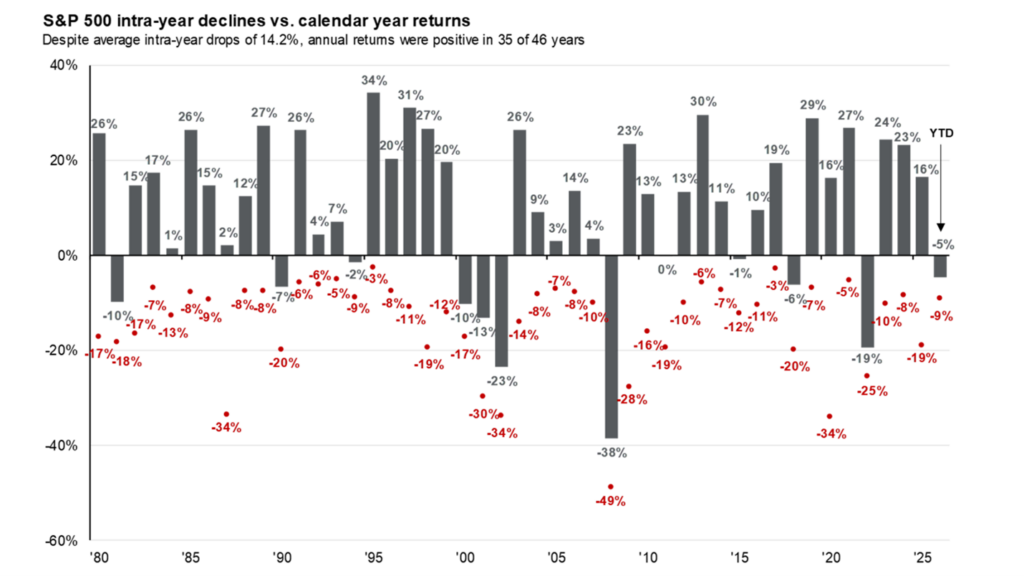
Nearly every year looks different. Some years bring modest setbacks, while others bring sharp drawdowns that test investor resolve. And yet, despite those pullbacks, most years still finish with positive calendar-year returns. In other words, the destination and the journey are often two very different things.
That has certainly been true so far this year. Investors have navigated war, fragile ceasefire negotiations, energy volatility, and a meaningful market pullback, only to see equities recover and the S&P work its way back toward flat on the year. Looking only at where the market stands today misses how demanding the path has been.
That is why The Masters is a fitting analogy. The course may be familiar, but the conditions change every year. In softer setups, players can attack. In firm and fast conditions like this year, precision, patience, and discipline matter more. Markets are no different. The best players at Augusta do not just play the course. They play the conditions. The best investors do the same!
Have a great week!
-Matt
Sources: JP Morgan Asset Management
This communication and its contents are for informational and educational purposes only and should not be used as the sole basis for any investment decision. The information contained herein is based on publicly available sources believed to be reliable but is not a representation, expressed or implied, as to the accuracy, completeness, or correctness of said information. References to political figures or policies are for informational purposes only and do not represent an endorsement by Waddell & Associates. Any forward-looking statements reflect current opinions and assumptions and are subject to change without notice; actual results may differ materially. Past performance does not guarantee future results. Waddell & Associates may use artificial intelligence tools to help generate or summarize content; all outputs are reviewed by our team for accuracy and relevance.
">The Masters and the Market: 2026’s Firm-and-Fast Conditions
Wake up! It is Sunday morning at Augusta National, the place where fans are called patrons, the back nine is the second nine, and each hole is named after a plant, tree, or shrub —like Pink Dogwood, Flowering Peach, Azalea, and Firethorn, to name a few. Every year at The Masters, the course is the same on paper, but it can play a bit differently each year. Agronomists reshape the greens, tee boxes move, rain softens the layout, heat firms it up, and players spend all week trying to judge the swirling winds. Amid those variables, the comfort of familiarity gives way to a fresh challenge, as the same holes, fairways, greens, and pin positions demand a different strategy.
Markets work much the same way. The underlying course of investing—discipline, allocation, risk management, and patience—remains constant, but each year brings new conditions that challenge us as investors. Some years reward aggression, others punish it. Success comes not from assuming the course will play the same way it did in years prior, but from recognizing the conditions and adjusting accordingly.
This year, Augusta National is playing firm and fast. Shots that may have held in other years are bouncing forward. Approach shots require a more precise landing spot. A miss that might have left a manageable putt in softer years could now leave a nervy up-and-down. The margins are thinner, and the penalty for being out of position is more severe.
That feels like an appropriate analogy for the environment investors have faced so far this year. This has not been a calm, predictable year. Investors have digested war in the Middle East, uncertainty surrounding negotiations with Iran, large swings in oil prices, and a market pullback that felt worse than the numbers now suggest. Consider the below chart.
Nearly every year looks different. Some years bring modest setbacks, while others bring sharp drawdowns that test investor resolve. And yet, despite those pullbacks, most years still finish with positive calendar-year returns. In other words, the destination and the journey are often two very different things.
That has certainly been true so far this year. Investors have navigated war, fragile ceasefire negotiations, energy volatility, and a meaningful market pullback, only to see equities recover and the S&P work its way back toward flat on the year. Looking only at where the market stands today misses how demanding the path has been.
That is why The Masters is a fitting analogy. The course may be familiar, but the conditions change every year. In softer setups, players can attack. In firm and fast conditions like this year, precision, patience, and discipline matter more. Markets are no different. The best players at Augusta do not just play the course. They play the conditions. The best investors do the same!
Have a great week!
-Matt
Sources: JP Morgan Asset Management
This communication and its contents are for informational and educational purposes only and should not be used as the sole basis for any investment decision. The information contained herein is based on publicly available sources believed to be reliable but is not a representation, expressed or implied, as to the accuracy, completeness, or correctness of said information. References to political figures or policies are for informational purposes only and do not represent an endorsement by Waddell & Associates. Any forward-looking statements reflect current opinions and assumptions and are subject to change without notice; actual results may differ materially. Past performance does not guarantee future results. Waddell & Associates may use artificial intelligence tools to help generate or summarize content; all outputs are reviewed by our team for accuracy and relevance.
" class="link-chevron">
Last week at this time fighting broke out between Iran, Israel, the United States, and more across the Middle East. Swift US military action on Friday night brought about another change in a foreign government, this time bringing Iran under intense pressure. The unfolding conflict is disheartening on many levels, particularly those with friends and family serving in uniform. I will attempt to provide some amount of clarity on the ongoing situation. For those investors curious about the ramifications of conflict in the Middle East, we’ve been here before; but let’s explore this specific situation.
The situation in Iran is a reminder that markets do not just price earnings, payrolls, and Fed meetings. They also price shipping lanes, oil flows, and the risk that regional conflicts escalate, adding another layer of uncertainty. This is the core of the Iranian headlines. Iran’s geography gives it leverage in the Strait of Hormuz, where roughly 20% of global oil and liquefied natural gas normally pass this narrow waterway that connects the Persian Gulf to the Indian Ocean, or the rest of the world:
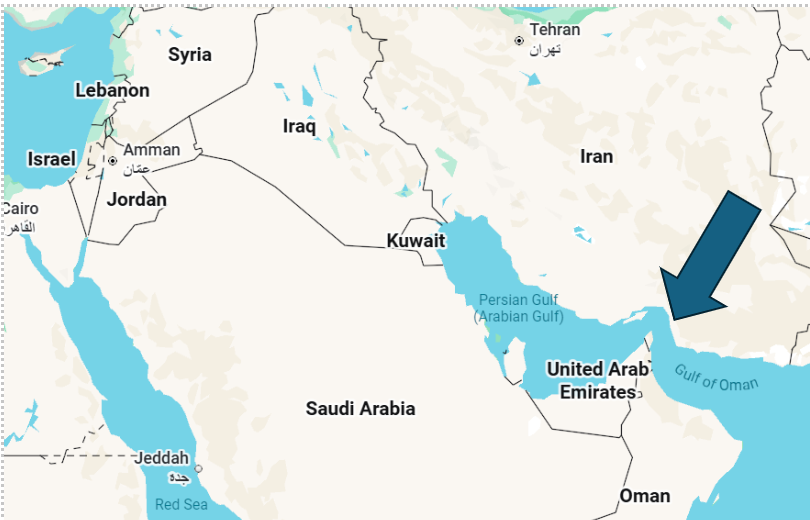
Any disruption to traffic through the Strait naturally raises concerns about global energy supply. As a result of the fighting and escalating tensions, oil tanker traffic in the region has come to a screeching halt. As the chokepoint looks vulnerable to attacks, insurers and re-insurers are no longer comfortable underwriting voyages through the Strait, making it impossible for cargo ships to move freely about towards their ports of destination. The result is visible in the data and in real time:
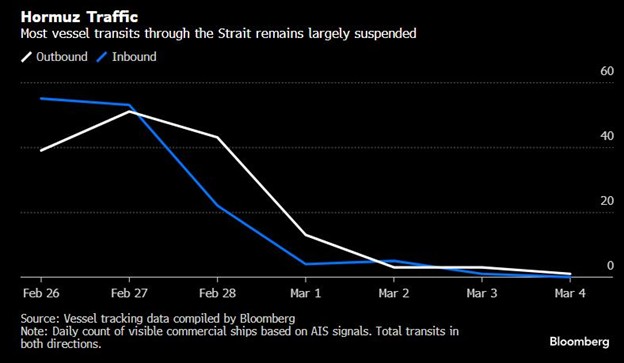
This chart shows almost zero vessel transits through the Strait. Here’s a map of current tankers on either side of the Strait:
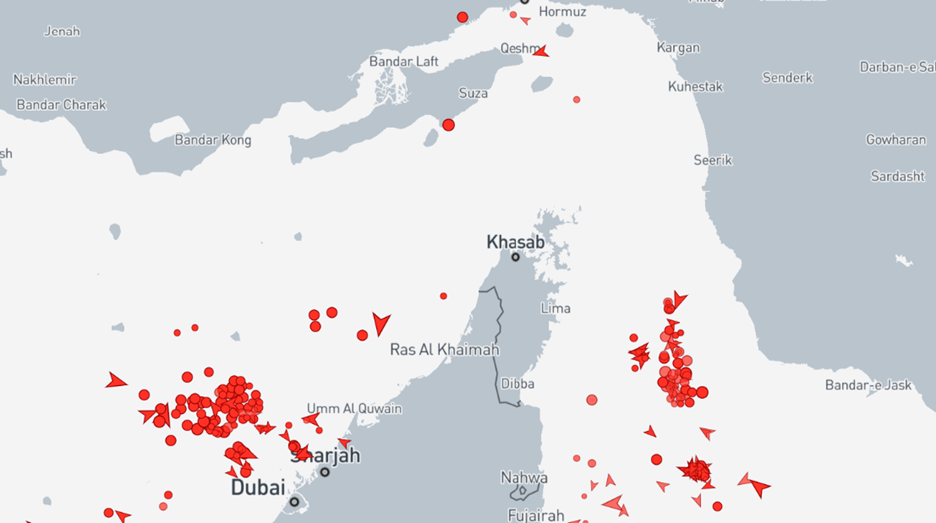
The red circle dots are tankers that have no current course direction. They sit idle awaiting clarity before hopefully continuing their routes.
For markets, this creates a chain reaction. When energy flows are threatened, we must re-assess oil supply, inflation expectations, and overall risk appetite. The re-pricing has been swift. Crude oil prices and gasoline futures have risen 30% since the conflict started and are up 50% on the year. Treasury yields are up 5-10% across the curve. Treasury volatility is rising after several months of hibernation.
This is the point where the White House narrative runs into reality. President Trump has repeatedly argued that lower oil prices are critical to combat inflation and create room for the Fed to lower interest rates. For much of 2025, that strategy was successful. Energy prices had fallen to levels not seen since before the Russia–Ukraine war, helping ease inflation pressures. However, this week’s sharp rise in oil prices threatens to undo much of that progress. During the 2024 campaign trail, oil prices traded between $70 and $90 per barrel, almost exactly where they sit today after the recent surge. With this week’s breakout in oil prices, Trump has undone much of the progress he’s made in just a few days.
Though the fog of war may be difficult to see through, this provides the most clarity to investors on the situation. The longer oil prices remain elevated, the more difficult it becomes to maintain low inflation and further cut interest rates. In my opinion, this is Trump’s breaking point over the conflict, and recent evidence suggests he understands this dynamic. Last Thursday, Trump publicly called on Iran to lay down their weapons signaling a possible near-term end to the conflict. The administration and the oil aboard the cargo ships sitting stalled in the Middle East would benefit greatly from a swift resolution so that the risk of re-inflation doesn’t come back around.
Still, long-term investors should be careful not to mistake unsettling headlines for a broken investment outlook. History argues for discipline. During the last two Gulf Wars, the S&P 500 enjoyed fruitful rallies in the three and six months post initial Middle East event headlines:
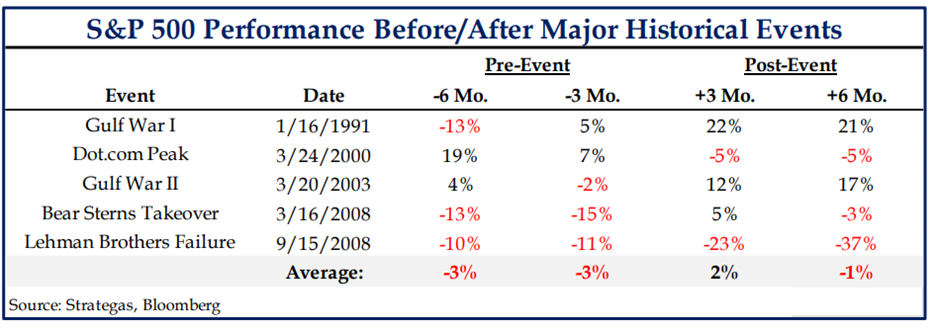
Military conflicts are difficult topics, but ones we must discuss. For disciplined investors, the lesson remains the same: periods of uncertainty are rarely the time to abandon a long-term investment strategy. More often, they are moments when patience and discipline are most rewarded.
Enjoy the rest of your weekend!
-Matt
Sources: Bloomberg, Google Maps, Marine Vessel Traffic, Strategas
This communication and its contents are for informational and educational purposes only and should not be used as the sole basis for any investment decision. The information contained herein is based on publicly available sources believed to be reliable but is not a representation, expressed or implied, as to the accuracy, completeness, or correctness of said information. References to political figures or policies are for informational purposes only and do not represent an endorsement by Waddell & Associates. Any forward-looking statements reflect current opinions and assumptions and are subject to change without notice; actual results may differ materially. Past performance does not guarantee future results. Waddell & Associates may use artificial intelligence tools to help generate or summarize content; all outputs are reviewed by our team for accuracy and relevance.
">Fog of War
Last week at this time fighting broke out between Iran, Israel, the United States, and more across the Middle East. Swift US military action on Friday night brought about another change in a foreign government, this time bringing Iran under intense pressure. The unfolding conflict is disheartening on many levels, particularly those with friends and family serving in uniform. I will attempt to provide some amount of clarity on the ongoing situation. For those investors curious about the ramifications of conflict in the Middle East, we’ve been here before; but let’s explore this specific situation.
The situation in Iran is a reminder that markets do not just price earnings, payrolls, and Fed meetings. They also price shipping lanes, oil flows, and the risk that regional conflicts escalate, adding another layer of uncertainty. This is the core of the Iranian headlines. Iran’s geography gives it leverage in the Strait of Hormuz, where roughly 20% of global oil and liquefied natural gas normally pass this narrow waterway that connects the Persian Gulf to the Indian Ocean, or the rest of the world:
Any disruption to traffic through the Strait naturally raises concerns about global energy supply. As a result of the fighting and escalating tensions, oil tanker traffic in the region has come to a screeching halt. As the chokepoint looks vulnerable to attacks, insurers and re-insurers are no longer comfortable underwriting voyages through the Strait, making it impossible for cargo ships to move freely about towards their ports of destination. The result is visible in the data and in real time:
This chart shows almost zero vessel transits through the Strait. Here’s a map of current tankers on either side of the Strait:
The red circle dots are tankers that have no current course direction. They sit idle awaiting clarity before hopefully continuing their routes.
For markets, this creates a chain reaction. When energy flows are threatened, we must re-assess oil supply, inflation expectations, and overall risk appetite. The re-pricing has been swift. Crude oil prices and gasoline futures have risen 30% since the conflict started and are up 50% on the year. Treasury yields are up 5-10% across the curve. Treasury volatility is rising after several months of hibernation.
This is the point where the White House narrative runs into reality. President Trump has repeatedly argued that lower oil prices are critical to combat inflation and create room for the Fed to lower interest rates. For much of 2025, that strategy was successful. Energy prices had fallen to levels not seen since before the Russia–Ukraine war, helping ease inflation pressures. However, this week’s sharp rise in oil prices threatens to undo much of that progress. During the 2024 campaign trail, oil prices traded between $70 and $90 per barrel, almost exactly where they sit today after the recent surge. With this week’s breakout in oil prices, Trump has undone much of the progress he’s made in just a few days.
Though the fog of war may be difficult to see through, this provides the most clarity to investors on the situation. The longer oil prices remain elevated, the more difficult it becomes to maintain low inflation and further cut interest rates. In my opinion, this is Trump’s breaking point over the conflict, and recent evidence suggests he understands this dynamic. Last Thursday, Trump publicly called on Iran to lay down their weapons signaling a possible near-term end to the conflict. The administration and the oil aboard the cargo ships sitting stalled in the Middle East would benefit greatly from a swift resolution so that the risk of re-inflation doesn’t come back around.
Still, long-term investors should be careful not to mistake unsettling headlines for a broken investment outlook. History argues for discipline. During the last two Gulf Wars, the S&P 500 enjoyed fruitful rallies in the three and six months post initial Middle East event headlines:
Military conflicts are difficult topics, but ones we must discuss. For disciplined investors, the lesson remains the same: periods of uncertainty are rarely the time to abandon a long-term investment strategy. More often, they are moments when patience and discipline are most rewarded.
Enjoy the rest of your weekend!
-Matt
Sources: Bloomberg, Google Maps, Marine Vessel Traffic, Strategas
This communication and its contents are for informational and educational purposes only and should not be used as the sole basis for any investment decision. The information contained herein is based on publicly available sources believed to be reliable but is not a representation, expressed or implied, as to the accuracy, completeness, or correctness of said information. References to political figures or policies are for informational purposes only and do not represent an endorsement by Waddell & Associates. Any forward-looking statements reflect current opinions and assumptions and are subject to change without notice; actual results may differ materially. Past performance does not guarantee future results. Waddell & Associates may use artificial intelligence tools to help generate or summarize content; all outputs are reviewed by our team for accuracy and relevance.
" class="link-chevron">
President Trump delivered his State of the Union address last week. It was long, and like most political speeches, it requires nuance. Rather than dissect the entire presentation, I want to focus on one specific item that matters to investors: the investment commitments secured from around the globe.
The flow of new capital is critical. When new money enters an economy and is deployed productively, it can increase economic output, improve productivity, raise wages, and ultimately support corporate earnings.
Let’s dive in.
Market Check-In
Before we turn to policy, a quick look at markets. If markets feel non-directional, you are right! The S&P500 has traded within just a 3% trading range the entire first two months of the year, or roughly 225 points. It sits flat on the year. However, under the hood and across the globe, things are quite different. Dispersion across US equities is at extreme highs. A trader’s paradise. Here is a table of year-to-date returns across the globe:
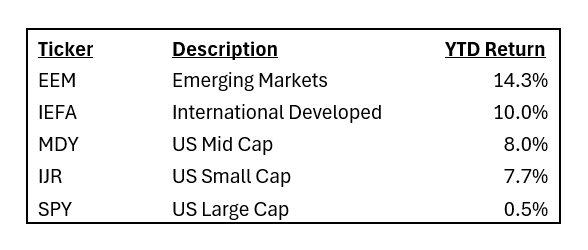
US Small caps, mid-caps, internationals, and emerging markets have enjoyed great success so far this year, while the S&P 500 is treading water. Good news for investors that own globally diversified portfolios!
Investment Commitments
Markets and economies are mostly efficient. Stock prices generally reflect known information and expectations about future earnings, but government policy can alter the environment these companies operate within. Interest rates, taxes, trade policy, and regulations all influence capital flows. One of my favorite quotes from Trump last week on financial commitments:
“In 12 months, I secured commitments for more than $18 trillion pouring in from all over the globe.” – Donald Trump, 2026 State of the Union Address
A big number, but let’s try to quantify and qualify the impact for investors. A review of the White House website shows a tally closer to $9.7 trillion. Within that number are large commitments from U.S.-based companies such as Meta, Apple, and Amazon. While important, those are domestic capital expenditures. The ones important to US investors are those called Foreign Direct Investments, which can improve a receiving country’s economy.
Strip out the U.S.-based commitments and you are left with $5.1 trillion in foreign investment commitments according to the White House. Here’s the breakdown:
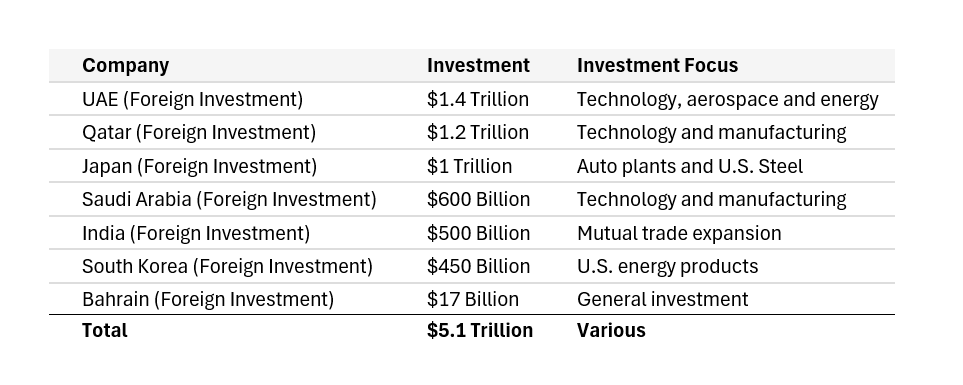
Still a substantial sum! But here’s the key: not all capital inflows are created equal.
The Multiplier Effect
For foreign investment to materially impact GDP, it must create productivity, not simply change ownership of assets. Building factories, expanding infrastructure, constructing facilities, and increasing domestic production create what economists call a multiplier effect. The multiplier reflects how one dollar spent can generate multiple dollars of economic activity.
For clarity, let’s say Japan spends their $1 trillion commitment on constructing new auto-plants across the US. A company like Vulcan Materials supplies stone, sand, and gravel to construct the plant thereby increasing their revenues. Their workers earn wages. Shareholders receive increased dividend payments. Their workers spend income in their communities. The finished plants create thousands of long-term jobs. Ongoing production generates additional output year after year.
That initial dollar investment circulates through the economy repeatedly.
For simplicity, assume a multiplier of 3x. Under that framework, $1 trillion dollars in direct investment could create $3 trillion in cumulative economic output over time. If the full $5.1 trillion were deployed into productivity-enhancing projects, the impact could be meaningful. U.S. annual GDP is approximately $30 trillion, so $5.1 trillion represents roughly 17% of annual GDP. Any multiplier effect applied to that base would be economically significant.
Consider the historical context. Here is the last twenty years of annual foreign direct investment in US.
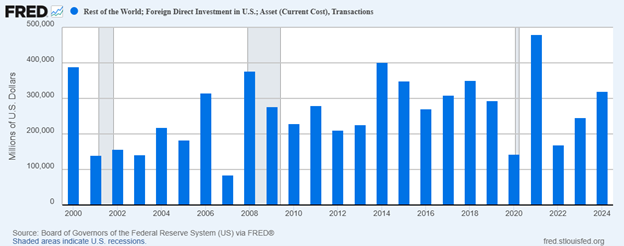
The average and median are much closer to $200 billion per year, much less than the potential $5.1 trillion secured by Trump. That’s the contrast.
But commitments are not GDP. They become GDP only when factories are built, equipment is installed, workers are hired, and supply chains are activated. However, if even a portion of the $5.1 trillion materializes as productivity-boosting investment, it would represent a multiple of typical foreign investment inflows and materially impact GDP to the positive ultimately paying investors a multiplier effect going forward!
Have a great week!
-Matt
Sources: Whitehouse.gov, Federal Reserve Bank of St. Louis, Ycharts
This communication and its contents are for informational and educational purposes only and should not be used as the sole basis for any investment decision. The information contained herein is based on publicly available sources believed to be reliable but is not a representation, expressed or implied, as to the accuracy, completeness, or correctness of said information. References to political figures or policies are for informational purposes only and do not represent an endorsement by Waddell & Associates. Any forward-looking statements reflect current opinions and assumptions and are subject to change without notice; actual results may differ materially. Past performance does not guarantee future results. Waddell & Associates may use artificial intelligence tools to help generate or summarize content; all outputs are reviewed by our team for accuracy and relevance.
">The $5.1 Trillion Multiplier
President Trump delivered his State of the Union address last week. It was long, and like most political speeches, it requires nuance. Rather than dissect the entire presentation, I want to focus on one specific item that matters to investors: the investment commitments secured from around the globe.
The flow of new capital is critical. When new money enters an economy and is deployed productively, it can increase economic output, improve productivity, raise wages, and ultimately support corporate earnings.
Let’s dive in.
Market Check-In
Before we turn to policy, a quick look at markets. If markets feel non-directional, you are right! The S&P500 has traded within just a 3% trading range the entire first two months of the year, or roughly 225 points. It sits flat on the year. However, under the hood and across the globe, things are quite different. Dispersion across US equities is at extreme highs. A trader’s paradise. Here is a table of year-to-date returns across the globe:
US Small caps, mid-caps, internationals, and emerging markets have enjoyed great success so far this year, while the S&P 500 is treading water. Good news for investors that own globally diversified portfolios!
Investment Commitments
Markets and economies are mostly efficient. Stock prices generally reflect known information and expectations about future earnings, but government policy can alter the environment these companies operate within. Interest rates, taxes, trade policy, and regulations all influence capital flows. One of my favorite quotes from Trump last week on financial commitments:
“In 12 months, I secured commitments for more than $18 trillion pouring in from all over the globe.” – Donald Trump, 2026 State of the Union Address
A big number, but let’s try to quantify and qualify the impact for investors. A review of the White House website shows a tally closer to $9.7 trillion. Within that number are large commitments from U.S.-based companies such as Meta, Apple, and Amazon. While important, those are domestic capital expenditures. The ones important to US investors are those called Foreign Direct Investments, which can improve a receiving country’s economy.
Strip out the U.S.-based commitments and you are left with $5.1 trillion in foreign investment commitments according to the White House. Here’s the breakdown:
Still a substantial sum! But here’s the key: not all capital inflows are created equal.
The Multiplier Effect
For foreign investment to materially impact GDP, it must create productivity, not simply change ownership of assets. Building factories, expanding infrastructure, constructing facilities, and increasing domestic production create what economists call a multiplier effect. The multiplier reflects how one dollar spent can generate multiple dollars of economic activity.
For clarity, let’s say Japan spends their $1 trillion commitment on constructing new auto-plants across the US. A company like Vulcan Materials supplies stone, sand, and gravel to construct the plant thereby increasing their revenues. Their workers earn wages. Shareholders receive increased dividend payments. Their workers spend income in their communities. The finished plants create thousands of long-term jobs. Ongoing production generates additional output year after year.
That initial dollar investment circulates through the economy repeatedly.
For simplicity, assume a multiplier of 3x. Under that framework, $1 trillion dollars in direct investment could create $3 trillion in cumulative economic output over time. If the full $5.1 trillion were deployed into productivity-enhancing projects, the impact could be meaningful. U.S. annual GDP is approximately $30 trillion, so $5.1 trillion represents roughly 17% of annual GDP. Any multiplier effect applied to that base would be economically significant.
Consider the historical context. Here is the last twenty years of annual foreign direct investment in US.
The average and median are much closer to $200 billion per year, much less than the potential $5.1 trillion secured by Trump. That’s the contrast.
But commitments are not GDP. They become GDP only when factories are built, equipment is installed, workers are hired, and supply chains are activated. However, if even a portion of the $5.1 trillion materializes as productivity-boosting investment, it would represent a multiple of typical foreign investment inflows and materially impact GDP to the positive ultimately paying investors a multiplier effect going forward!
Have a great week!
-Matt
Sources: Whitehouse.gov, Federal Reserve Bank of St. Louis, Ycharts
This communication and its contents are for informational and educational purposes only and should not be used as the sole basis for any investment decision. The information contained herein is based on publicly available sources believed to be reliable but is not a representation, expressed or implied, as to the accuracy, completeness, or correctness of said information. References to political figures or policies are for informational purposes only and do not represent an endorsement by Waddell & Associates. Any forward-looking statements reflect current opinions and assumptions and are subject to change without notice; actual results may differ materially. Past performance does not guarantee future results. Waddell & Associates may use artificial intelligence tools to help generate or summarize content; all outputs are reviewed by our team for accuracy and relevance.
" class="link-chevron">
Congratulations to the US Women’s Hockey team for their stunning defeat of Team Canada in Thursday afternoon’s gold medal game. Electric!
Throughout the Olympic Games this year, every American hockey goal was followed by Lynyrd Skynyrd’s “Free Bird”, the official Team USA hockey goal song at the 2026 Winter Olympics in Milan-Cortina. A fitting choice, symbolic of our beloved bald eagle. The beauty of the ‘free bird’ is its ability to go where it wants, when it wants, unrestricted in choice. For the last several years, America’s largest technology companies have operated with similar freedom in the form of free cash flow; but that bird might be soon landing. Let’s explore.
Cash is King
Over the last several years, big tech has generated extraordinary amounts of free cash flow. What is that? In simple terms, it is the cash a company generates after operating expenses and capital expenditures. In plain English, its money left over that companies can re-deploy towards shareholder dividends, new capital ventures, share buybacks, and more. Free cash flow is what gives companies strategic flexibility on their financial futures. For big technology companies like Microsoft, Alphabet, Amazon, META, and Oracle, that flexibility has historically been enormous with trailing twelve-month free cash flow totaling a combined $200 billion. But that freedom is now being tested.
The AI Investment Surge
These same companies are committing that free cash flow towards capital expenditures to build out their artificial intelligence advantages, including data centers, semiconductors, infrastructure, model training, and more. The scale and projected spending increase over last year is significant:
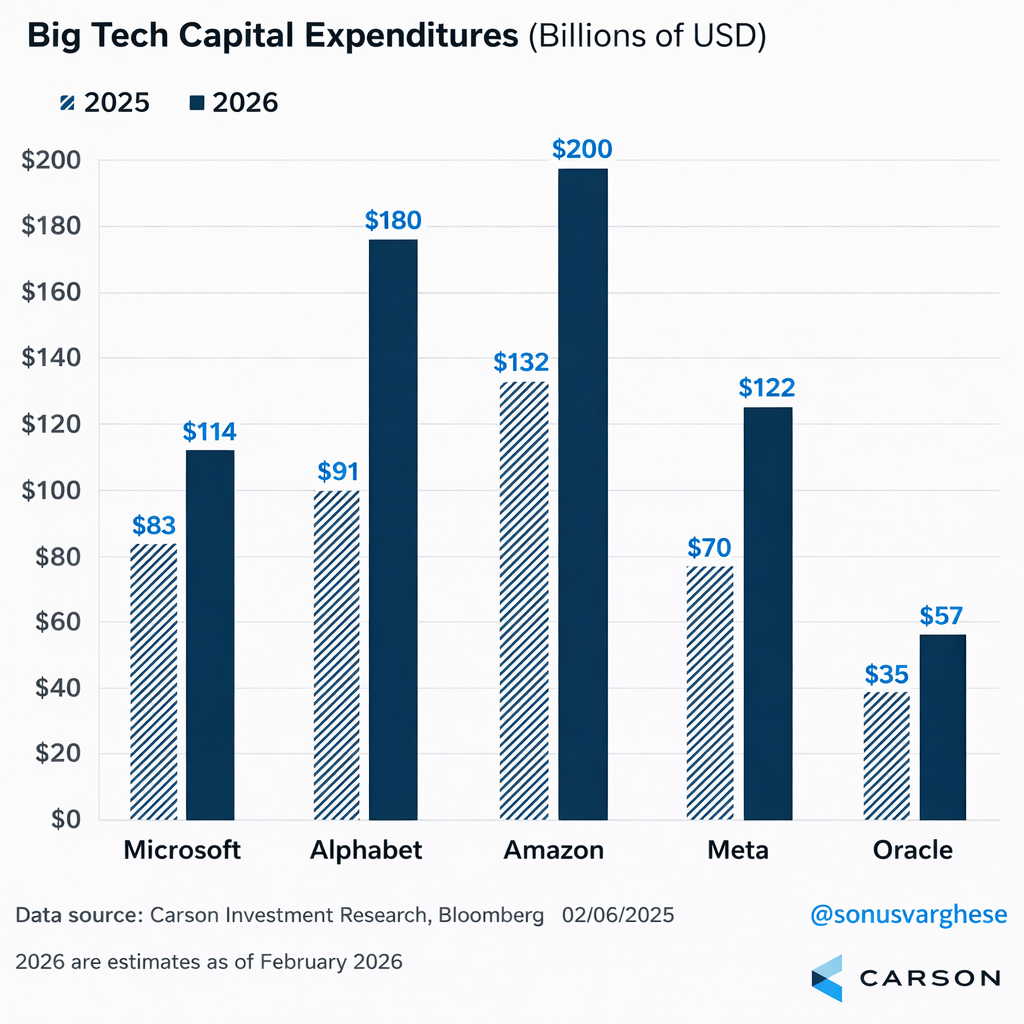
We don’t know what rate of return these investments will ultimately earn. We do know the surge in spending is projected to eat away at what made these companies so valuable over the last several years: near term free cash flow. The chart below depicts the impact of expected capital expenditure amounts on trailing free cash flow of these same companies:
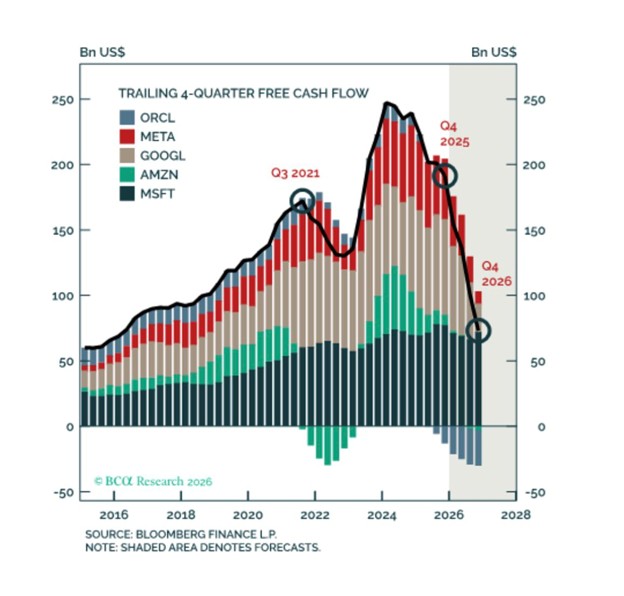
These forward estimates suggest net free cash flow declining 50% in just over a year. Meaningful. For years, ample free cash flow fueled aggressive share repurchase programs that offset dilution and improved shareholder value. But now, that free cash flow is being redirected and the market is taking notice. Below are the year-to-date returns of the same constituents reflecting investor recalibration as capital allocation priorities evolve amongst big tech.
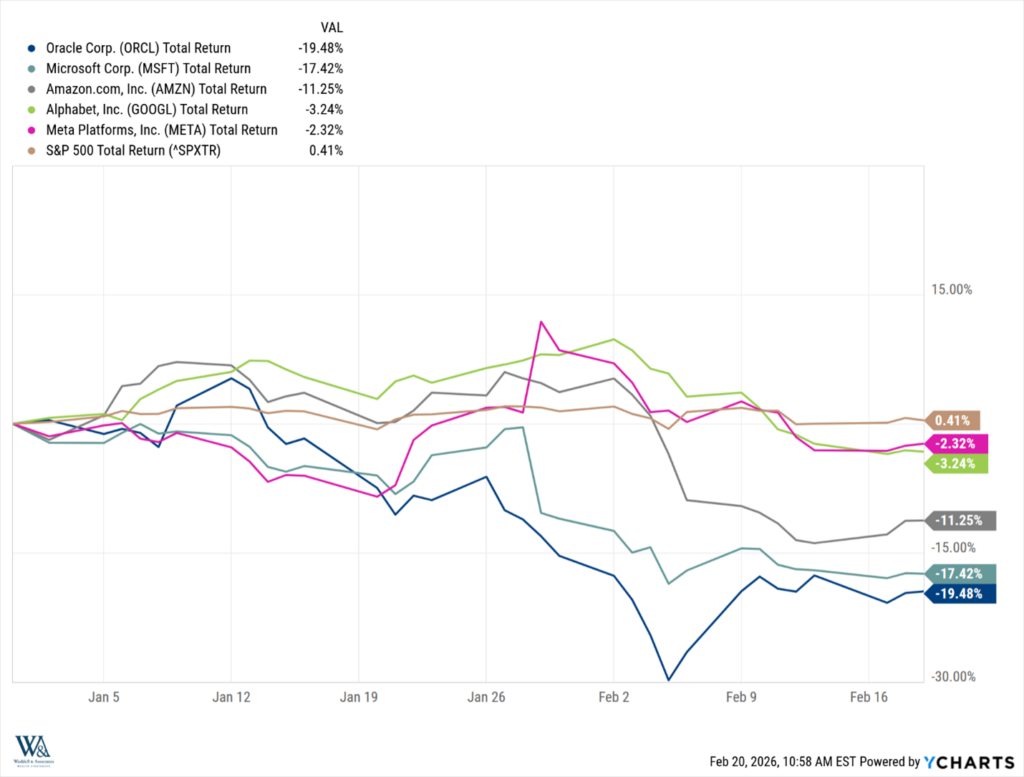
A small sample size, yes. Earnings are still projected to grow significantly. It doesn’t represent a downshift in profitability, but it does represent a strategic decision which ultimately will improve, or erode, future shareholder value.
Apple, By Contrast
But not everyone is partaking in the spending spree. Apple has lagged its peers considerably in their growth (or lack thereof) in Capex spending, noted below.
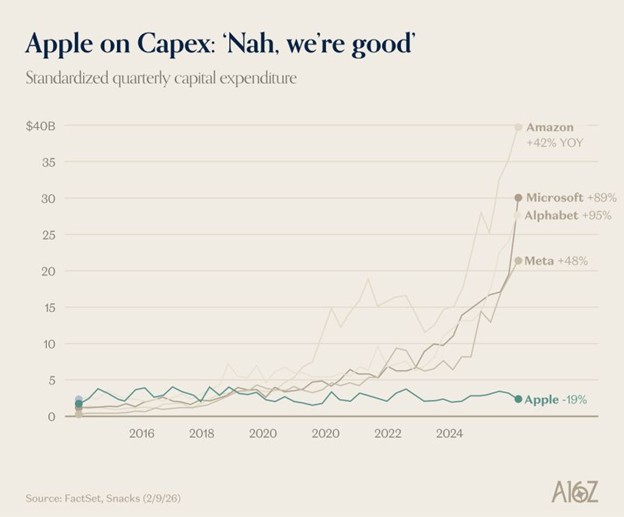
This raises an important strategic question. Is Apple demonstrating discipline or risking a “Kodak Moment”? For context, Eastman Kodak famously chose not to adopt new digital photo technology, opting to stay in its profitable film photography lane. Digital photography ultimately won the technological cycle, and Kodak lost their competitive moat in film photography.
This technological inflection point will reward decisive and disciplined capital allocation, and we’ll look back on this someday with clear hindsight as to the winners and losers. Big tech has operated like a financial free bird generating excess cash far beyond their recent reinvestment needs. That era of surplus is transitioning into intentional investment in the artificial intelligence buildout. The question is no longer how much free cash flow these companies generate, but how effectively they allocate it, and what return that capital ultimately generates for investors!
Have a great week!
-Matt
Sources: Ycharts, BCA Research, Carson Investment Research, Factset, Andreessen Horowitz
This communication and its contents are for informational and educational purposes only and should not be used as the sole basis for any investment decision. The information contained herein is based on publicly available sources believed to be reliable but is not a representation, expressed or implied, as to the accuracy, completeness, or correctness of said information. References to political figures or policies are for informational purposes only and do not represent an endorsement by Waddell & Associates. Any forward-looking statements reflect current opinions and assumptions and are subject to change without notice; actual results may differ materially. Past performance does not guarantee future results. Waddell & Associates may use artificial intelligence tools to help generate or summarize content; all outputs are reviewed by our team for accuracy and relevance.
">Free Bird!
Congratulations to the US Women’s Hockey team for their stunning defeat of Team Canada in Thursday afternoon’s gold medal game. Electric!
Throughout the Olympic Games this year, every American hockey goal was followed by Lynyrd Skynyrd’s “Free Bird”, the official Team USA hockey goal song at the 2026 Winter Olympics in Milan-Cortina. A fitting choice, symbolic of our beloved bald eagle. The beauty of the ‘free bird’ is its ability to go where it wants, when it wants, unrestricted in choice. For the last several years, America’s largest technology companies have operated with similar freedom in the form of free cash flow; but that bird might be soon landing. Let’s explore.
Cash is King
Over the last several years, big tech has generated extraordinary amounts of free cash flow. What is that? In simple terms, it is the cash a company generates after operating expenses and capital expenditures. In plain English, its money left over that companies can re-deploy towards shareholder dividends, new capital ventures, share buybacks, and more. Free cash flow is what gives companies strategic flexibility on their financial futures. For big technology companies like Microsoft, Alphabet, Amazon, META, and Oracle, that flexibility has historically been enormous with trailing twelve-month free cash flow totaling a combined $200 billion. But that freedom is now being tested.
The AI Investment Surge
These same companies are committing that free cash flow towards capital expenditures to build out their artificial intelligence advantages, including data centers, semiconductors, infrastructure, model training, and more. The scale and projected spending increase over last year is significant:
We don’t know what rate of return these investments will ultimately earn. We do know the surge in spending is projected to eat away at what made these companies so valuable over the last several years: near term free cash flow. The chart below depicts the impact of expected capital expenditure amounts on trailing free cash flow of these same companies:
These forward estimates suggest net free cash flow declining 50% in just over a year. Meaningful. For years, ample free cash flow fueled aggressive share repurchase programs that offset dilution and improved shareholder value. But now, that free cash flow is being redirected and the market is taking notice. Below are the year-to-date returns of the same constituents reflecting investor recalibration as capital allocation priorities evolve amongst big tech.
A small sample size, yes. Earnings are still projected to grow significantly. It doesn’t represent a downshift in profitability, but it does represent a strategic decision which ultimately will improve, or erode, future shareholder value.
Apple, By Contrast
But not everyone is partaking in the spending spree. Apple has lagged its peers considerably in their growth (or lack thereof) in Capex spending, noted below.
This raises an important strategic question. Is Apple demonstrating discipline or risking a “Kodak Moment”? For context, Eastman Kodak famously chose not to adopt new digital photo technology, opting to stay in its profitable film photography lane. Digital photography ultimately won the technological cycle, and Kodak lost their competitive moat in film photography.
This technological inflection point will reward decisive and disciplined capital allocation, and we’ll look back on this someday with clear hindsight as to the winners and losers. Big tech has operated like a financial free bird generating excess cash far beyond their recent reinvestment needs. That era of surplus is transitioning into intentional investment in the artificial intelligence buildout. The question is no longer how much free cash flow these companies generate, but how effectively they allocate it, and what return that capital ultimately generates for investors!
Have a great week!
-Matt
Sources: Ycharts, BCA Research, Carson Investment Research, Factset, Andreessen Horowitz
This communication and its contents are for informational and educational purposes only and should not be used as the sole basis for any investment decision. The information contained herein is based on publicly available sources believed to be reliable but is not a representation, expressed or implied, as to the accuracy, completeness, or correctness of said information. References to political figures or policies are for informational purposes only and do not represent an endorsement by Waddell & Associates. Any forward-looking statements reflect current opinions and assumptions and are subject to change without notice; actual results may differ materially. Past performance does not guarantee future results. Waddell & Associates may use artificial intelligence tools to help generate or summarize content; all outputs are reviewed by our team for accuracy and relevance.
" class="link-chevron">
The Indiana Hoosiers are national champions… in football. Yes, that Indiana. If I woke up with my head sewn to the carpet, I wouldn’t be more surprised than I am typing that sentence today. Congratulations to Hoosier Nation!
Indiana’s improbable run didn’t just produce a trophy, it produced a handful of quips from head coach Curt Cignetti that resonated beyond football. Over the past few weeks, Cignetti’s mindset, priorities, and emphasis on process and fundamentals have stuck with me because they apply just as directly to investing and financial planning as they do to building a championship program. Let’s explore.
Discipline & Process
“I tell my team all the time: the process will take care of the scoreboard.” – Curt Cignetti
Markets reminded investors this week once again that short-term noise is unavoidable. Earlier last week, news out of the White House of a forceful Greenland acquisition and additional tariff threats triggered a sharp 2% broad equity sell-off. A few days later, at the World Economic Forum in Davos, President Trump softened his rhetoric on acquiring Greenland and walked back sweeping 10% tariffs across Europe. By Thursday afternoon, the entire sell-off had been retraced leading to another fruitful week of returns for investors.
Daily swings like these are part of the investment process. The critical question is how investors respond. Indiana didn’t win because it had the most talented roster in the country. It won because it made fewer mistakes. Penalties were limited. Assignments were executed. Adjustments were made early, not after problems snowballed. In investing, discipline is the edge most people underestimate. You don’t need to predict every headline, policy shift, or market turn. What you do need is a well-constructed investment allocation and appropriate diversification aligned with your broader financial plan. Great investors focus less on being right and more on avoiding catastrophic mistakes. Indiana’s championship run was built on the same principle: a sound process consistently applied.
Patience Pays
“There are no shortcuts. Winning takes time, discipline, and perseverance.” – Curt Cignetti
National championships aren’t built overnight. From the beginning, Cignetti emphasized patience and consistency over flash. That mindset is especially relevant for investors. One destructive behavior can be abandoning a sound strategy simply because results haven’t appeared yet. Compounding requires time, and time requires patience. Pulling the plug during periods of market stress can lock in losses and forfeit future gains. Indiana’s rise wasn’t about winning every quarter. It was about executing each day correctly, over, and over, until the accumulation of small advantages produced a championship season. Successful investing works the same way. You don’t win by reacting to every data point or market swing. You win by consistently doing the right things even when they feel boring or temporarily unrewarding.
As Curt Cignetti and the Hoosiers just proved, championships are rarely won by brilliant individualism alone. They’re won by doing the fundamentals well, day after day, until success becomes inevitable!
Have a great week!
-Matt
Sources: IUHoosiers.com, Tony Dragna, YCharts
This communication and its contents are for informational and educational purposes only and should not be used as the sole basis for any investment decision. The information contained herein is based on publicly available sources believed to be reliable but is not a representation, expressed or implied, as to the accuracy, completeness, or correctness of said information. References to political figures or policies are for informational purposes only and do not represent an endorsement by Waddell & Associates. Any forward-looking statements reflect current opinions and assumptions and are subject to change without notice; actual results may differ materially. Past performance does not guarantee future results. Waddell & Associates may use artificial intelligence tools to help generate or summarize content; all outputs are reviewed by our team for accuracy and relevance.
">Championship Investing: What Indiana Football Teaches About Market Success
The Indiana Hoosiers are national champions… in football. Yes, that Indiana. If I woke up with my head sewn to the carpet, I wouldn’t be more surprised than I am typing that sentence today. Congratulations to Hoosier Nation!
Indiana’s improbable run didn’t just produce a trophy, it produced a handful of quips from head coach Curt Cignetti that resonated beyond football. Over the past few weeks, Cignetti’s mindset, priorities, and emphasis on process and fundamentals have stuck with me because they apply just as directly to investing and financial planning as they do to building a championship program. Let’s explore.
Discipline & Process
“I tell my team all the time: the process will take care of the scoreboard.” – Curt Cignetti
Markets reminded investors this week once again that short-term noise is unavoidable. Earlier last week, news out of the White House of a forceful Greenland acquisition and additional tariff threats triggered a sharp 2% broad equity sell-off. A few days later, at the World Economic Forum in Davos, President Trump softened his rhetoric on acquiring Greenland and walked back sweeping 10% tariffs across Europe. By Thursday afternoon, the entire sell-off had been retraced leading to another fruitful week of returns for investors.
Daily swings like these are part of the investment process. The critical question is how investors respond. Indiana didn’t win because it had the most talented roster in the country. It won because it made fewer mistakes. Penalties were limited. Assignments were executed. Adjustments were made early, not after problems snowballed. In investing, discipline is the edge most people underestimate. You don’t need to predict every headline, policy shift, or market turn. What you do need is a well-constructed investment allocation and appropriate diversification aligned with your broader financial plan. Great investors focus less on being right and more on avoiding catastrophic mistakes. Indiana’s championship run was built on the same principle: a sound process consistently applied.
Patience Pays
“There are no shortcuts. Winning takes time, discipline, and perseverance.” – Curt Cignetti
National championships aren’t built overnight. From the beginning, Cignetti emphasized patience and consistency over flash. That mindset is especially relevant for investors. One destructive behavior can be abandoning a sound strategy simply because results haven’t appeared yet. Compounding requires time, and time requires patience. Pulling the plug during periods of market stress can lock in losses and forfeit future gains. Indiana’s rise wasn’t about winning every quarter. It was about executing each day correctly, over, and over, until the accumulation of small advantages produced a championship season. Successful investing works the same way. You don’t win by reacting to every data point or market swing. You win by consistently doing the right things even when they feel boring or temporarily unrewarding.
As Curt Cignetti and the Hoosiers just proved, championships are rarely won by brilliant individualism alone. They’re won by doing the fundamentals well, day after day, until success becomes inevitable!
Have a great week!
-Matt
Sources: IUHoosiers.com, Tony Dragna, YCharts
This communication and its contents are for informational and educational purposes only and should not be used as the sole basis for any investment decision. The information contained herein is based on publicly available sources believed to be reliable but is not a representation, expressed or implied, as to the accuracy, completeness, or correctness of said information. References to political figures or policies are for informational purposes only and do not represent an endorsement by Waddell & Associates. Any forward-looking statements reflect current opinions and assumptions and are subject to change without notice; actual results may differ materially. Past performance does not guarantee future results. Waddell & Associates may use artificial intelligence tools to help generate or summarize content; all outputs are reviewed by our team for accuracy and relevance.
" class="link-chevron">
As fourth quarter earnings season gets underway, investor attention is again split between earnings expectations and reported realities. Earnings estimates for 2026 point to another great year, but valuation metrics and recent relative performance tell a more nuanced story across the small, mid, and large cap equities. Let’s explore.
Although final fourth quarter earnings results will be announced over the next several weeks, examining 2026 earnings expectations relative to full-year 2025 results provides clarity on the recent relative performance we’ve seen across various segments of the equity market.
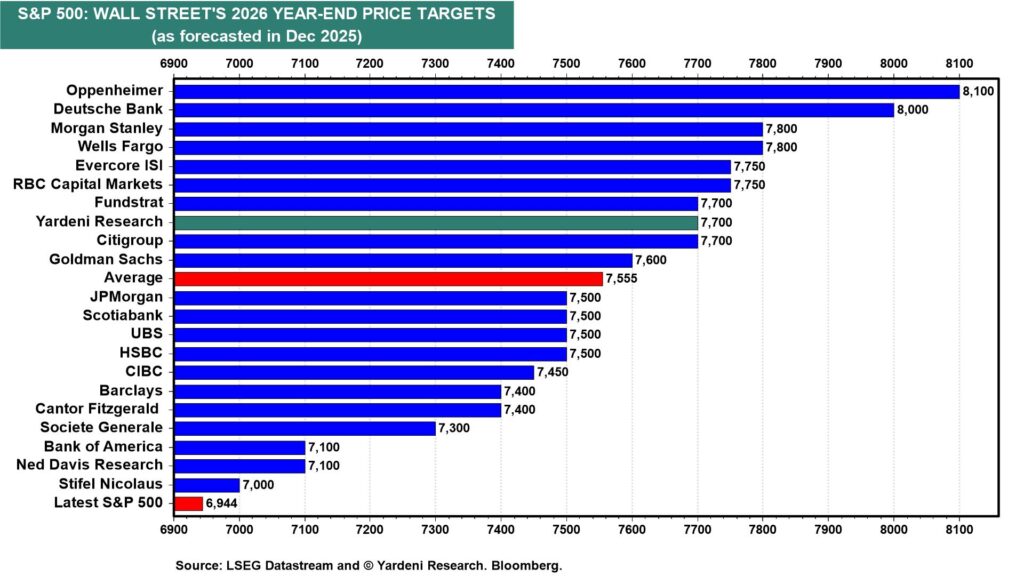
Overall, analysts are forecasting S&P500 earnings growth of 15% in 2026, well above the trailing 10-year average growth rate of 8.6%. In response, market forecasters have published their year-end 2026 targets for the S&P 500, with consensus expectations near 7,555, implying a roughly 10% return for the index this year.
Looking beneath the surface, earnings for the Magnificent 7 are expected to grow by 22.7% in 2026, in line with their estimated 22.3% growth in 2025. Meanwhile, analysts project the remaining 493 companies will generate 12.5% earnings growth for 2026, well above the estimated 9.4% growth for 2025. The difference lies not in the nominal number, but the pace of change in the growth itself. Advantage to the 493. As it stands, earnings for the 493 are set to accelerate by 33% versus 1.8% for the Mag 7:

It’s a significant trend and it is already appearing in market performance. The chart below highlights trailing 1, 3, and 6-month returns of large, mid, and small cap US equity indices illustrating the growing participation beyond the largest companies.

While calendar year performance is one way to measure results, investment cycles rarely move on a set schedule. This serves as a healthy reminder to investors that maintaining a broadly diversified equity allocation across market capitalizations is important to portfolio resilience and long-term financial plans.
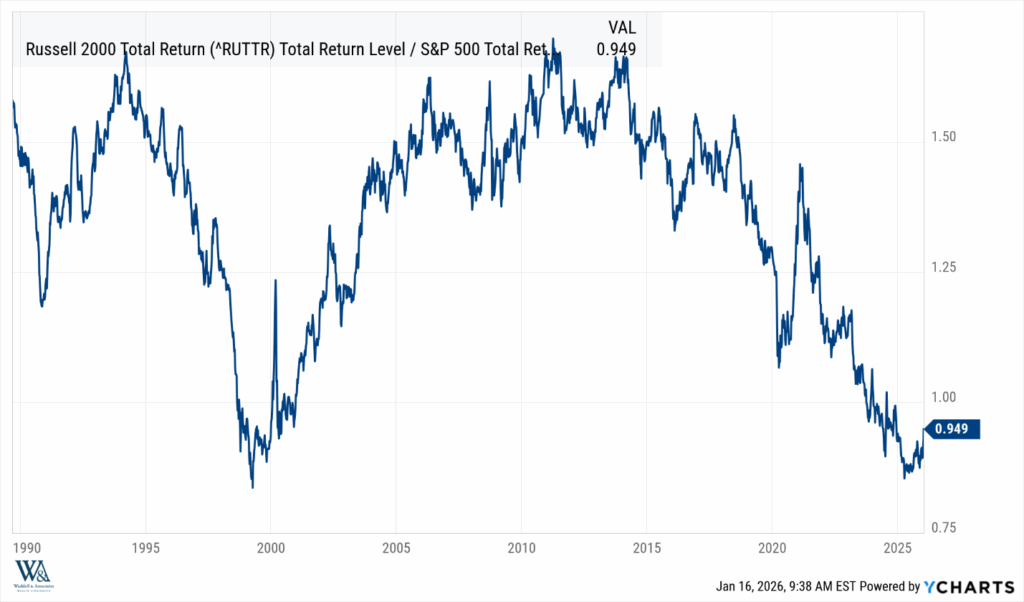
To that point, consider the following chart, which illustrates the relative performance ratio of the Russell 2000 and S&P500 total return dating back to 1989. As the indices move in relative performance, so does the line. As illustrated, the Russell 2000 enjoyed significant outperformance from about 2000-2010 but has lagged since 2021. However, this suggests the tide is turning, and history shows these cycles often have further room to run!
Happy Martin Luther King Jr. Day, and have a great week!
-Matt
Sources: Yardeni Research, Factset, Ycharts
This communication and its contents are for informational and educational purposes only and should not be used as the sole basis for any investment decision. The information contained herein is based on publicly available sources believed to be reliable but is not a representation, expressed or implied, as to the accuracy, completeness, or correctness of said information. References to political figures or policies are for informational purposes only and do not represent an endorsement by Waddell & Associates. Any forward-looking statements reflect current opinions and assumptions and are subject to change without notice; actual results may differ materially. Past performance does not guarantee future results. Waddell & Associates may use artificial intelligence tools to help generate or summarize content; all outputs are reviewed by our team for accuracy and relevance.
">Earnings Accelerator
As fourth quarter earnings season gets underway, investor attention is again split between earnings expectations and reported realities. Earnings estimates for 2026 point to another great year, but valuation metrics and recent relative performance tell a more nuanced story across the small, mid, and large cap equities. Let’s explore.
Although final fourth quarter earnings results will be announced over the next several weeks, examining 2026 earnings expectations relative to full-year 2025 results provides clarity on the recent relative performance we’ve seen across various segments of the equity market.
Overall, analysts are forecasting S&P500 earnings growth of 15% in 2026, well above the trailing 10-year average growth rate of 8.6%. In response, market forecasters have published their year-end 2026 targets for the S&P 500, with consensus expectations near 7,555, implying a roughly 10% return for the index this year.
Looking beneath the surface, earnings for the Magnificent 7 are expected to grow by 22.7% in 2026, in line with their estimated 22.3% growth in 2025. Meanwhile, analysts project the remaining 493 companies will generate 12.5% earnings growth for 2026, well above the estimated 9.4% growth for 2025. The difference lies not in the nominal number, but the pace of change in the growth itself. Advantage to the 493. As it stands, earnings for the 493 are set to accelerate by 33% versus 1.8% for the Mag 7:
It’s a significant trend and it is already appearing in market performance. The chart below highlights trailing 1, 3, and 6-month returns of large, mid, and small cap US equity indices illustrating the growing participation beyond the largest companies.
While calendar year performance is one way to measure results, investment cycles rarely move on a set schedule. This serves as a healthy reminder to investors that maintaining a broadly diversified equity allocation across market capitalizations is important to portfolio resilience and long-term financial plans.
To that point, consider the following chart, which illustrates the relative performance ratio of the Russell 2000 and S&P500 total return dating back to 1989. As the indices move in relative performance, so does the line. As illustrated, the Russell 2000 enjoyed significant outperformance from about 2000-2010 but has lagged since 2021. However, this suggests the tide is turning, and history shows these cycles often have further room to run!
Happy Martin Luther King Jr. Day, and have a great week!
-Matt
Sources: Yardeni Research, Factset, Ycharts
This communication and its contents are for informational and educational purposes only and should not be used as the sole basis for any investment decision. The information contained herein is based on publicly available sources believed to be reliable but is not a representation, expressed or implied, as to the accuracy, completeness, or correctness of said information. References to political figures or policies are for informational purposes only and do not represent an endorsement by Waddell & Associates. Any forward-looking statements reflect current opinions and assumptions and are subject to change without notice; actual results may differ materially. Past performance does not guarantee future results. Waddell & Associates may use artificial intelligence tools to help generate or summarize content; all outputs are reviewed by our team for accuracy and relevance.
" class="link-chevron">
For the second year in a row, I have the privilege of writing the week leading up to Thanksgiving, a time for family and feasting. Last year, in honor of the late John Madden, we handed out our inaugural Turkey Leg Award to the U.S. economy. This year, we’re back at the carving table. Let’s find out who takes home the trophy!
Last week, we highlighted the incremental rise in equity volatility. The S&P500 is down 5% from the all-time closing high from last month on October 28th. The NASDAQ is down 8% from the same day. Though, even as the market has backtracked, corporate earnings have accelerated higher. Price movement is irrational and non-linear in the short term, but corporate earnings growth drives long-term price appreciation and investor returns. So, for 2025, the Turkey Leg Award goes to… U.S. corporate earnings growth!
Earnings Feasting!
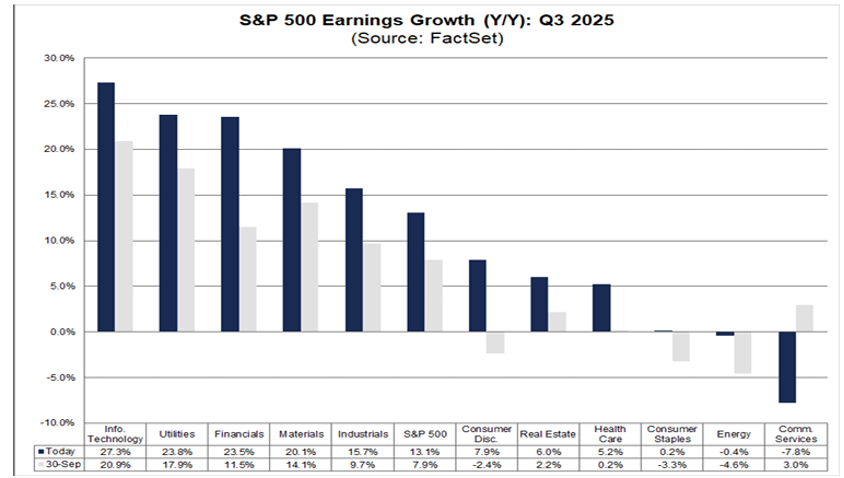
The S&P500 valuation is elevated and the forward question for further upside appreciation in the index was the deliverance of solid earnings and forward guidance. In large caps, over 92% of companies in the S&P500 have reported Q3 earnings and the blended growth rate sits at 13.1%.
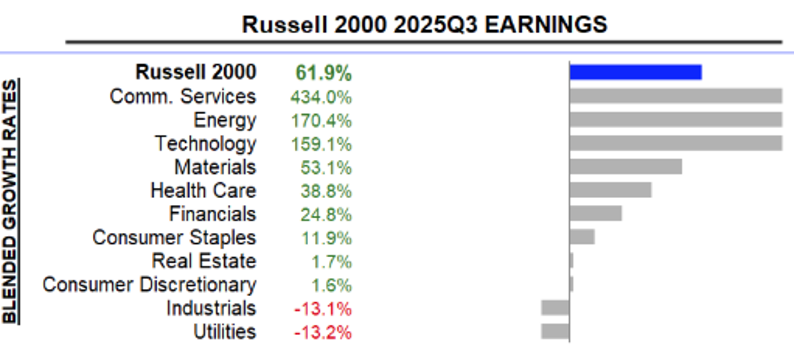
In small caps, over 82% of companies in the Russell 2000 have reported Q3 earnings growth and the blended growth rate sits at 61.9%.
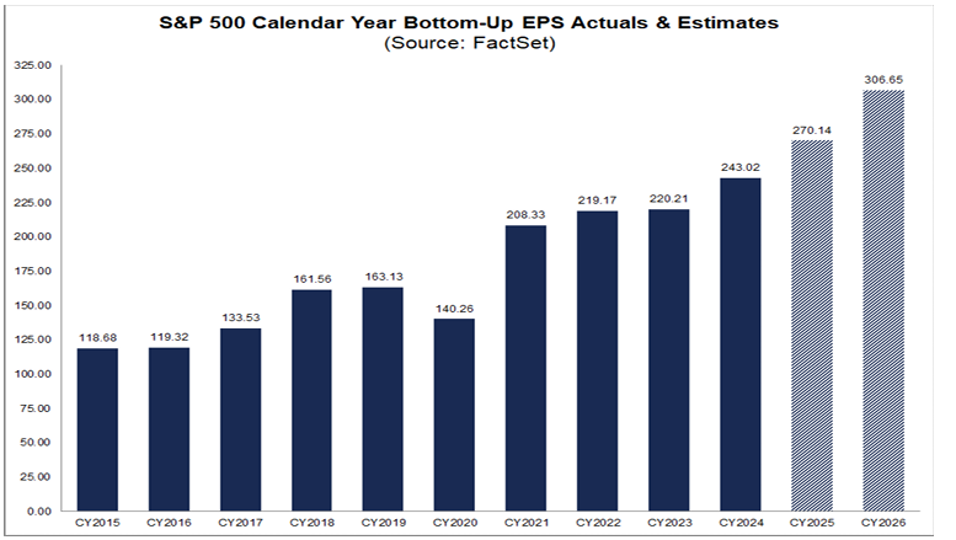
And analysts expect the growth to continue in 2026. In the S&P500, analysts expect another 13.5% growth rate in 2026—all good news for equity investors, but companies will need to deliver on these expectations:
Profit Margins Cooking!
Operating profits are growing too. With the Q3 earnings cycle nearly complete, the net profit margin for the S&P500 sits at 13.1%.
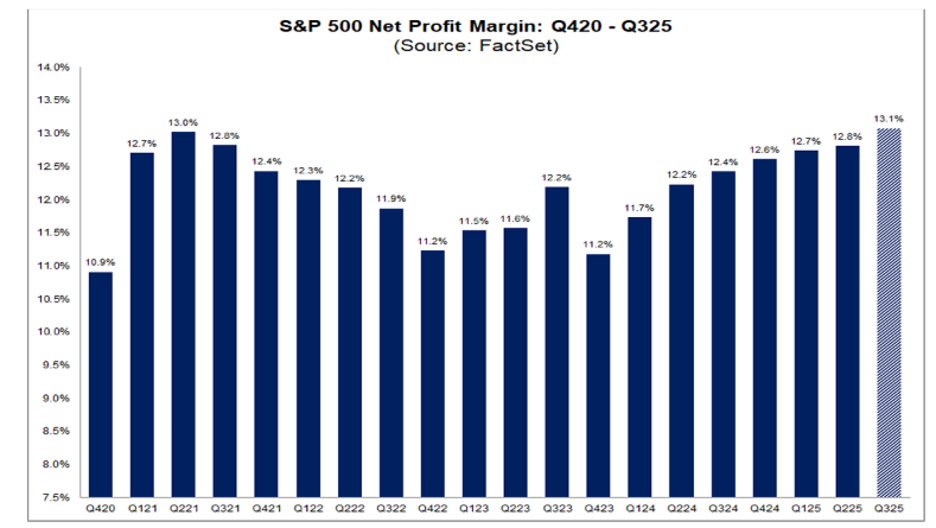
This would represent not only the highest quarterly reading since Q2 202, but a level higher than all readings since at least 2009, when FactSet began tracking the data. That’s a long time!
This quarter also marks the seventh consecutive quarter of margin expansion. Six of eleven sectors are showing year-over-year improvement led by:
- Utilities: 17.2% vs. 14.8%
- Financials: 20.2% vs. 17%
- Tech: 27.7% vs. 17%
Margins aren’t just holding up, they’re widening across multiple sectors.
Final Course
Analysts expect profit growth to accelerate further. Even with tougher quarterly comps ahead, annual profit margins in the S&P500 are expected to close 2025 at 13.3% and accelerate to 14.2% in 2026:
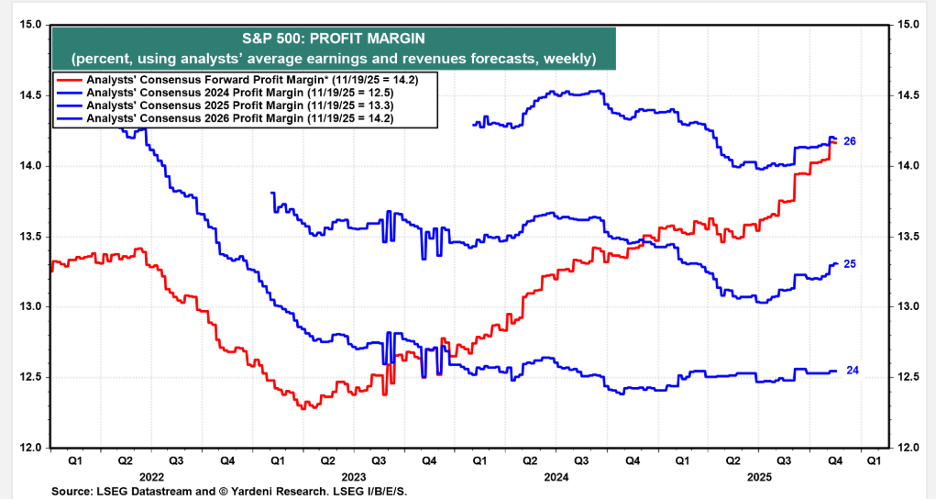
The margin expansion is meaningful. That’s important because margin expansion fuels more than just earnings growth. Stronger profitability boosts free cash flow, enabling companies to:
- Raise dividends.
- Increase share buybacks.
- Reinforce balance sheets.
- Reinvest for long-term growth.
Stronger margins strengthen the entire ecosystem.
Putting it all together
The U.S. corporate profit engine is alive and well, continuing to deliver steady earnings growth, positive surprise relative to expectations, and incrementally improving profitability. This Thanksgiving, raise your turkey leg to corporate earnings, the underlying force powering long-term growth behind the scenes.
From our family to yours, wishing you a Happy Thanksgiving.
Cheers,
Matt
Sources: FactSet, LSEG I/B/E/S, Yardeni Research
This communication and its contents are for informational and educational purposes only and should not be used as the sole basis for any investment decision. The information contained herein is based on publicly available sources believed to be reliable but is not a representation, expressed or implied, as to the accuracy, completeness, or correctness of said information. References to political figures or policies are for informational purposes only and do not represent an endorsement by Waddell & Associates. Any forward-looking statements reflect current opinions and assumptions and are subject to change without notice; actual results may differ materially. Past performance does not guarantee future results. Waddell & Associates may use artificial intelligence tools to help generate or summarize content; all outputs are reviewed by our team for accuracy and relevance.
">Giving Turkey Legs!
For the second year in a row, I have the privilege of writing the week leading up to Thanksgiving, a time for family and feasting. Last year, in honor of the late John Madden, we handed out our inaugural Turkey Leg Award to the U.S. economy. This year, we’re back at the carving table. Let’s find out who takes home the trophy!
This communication and its contents are for informational and educational purposes only and should not be used as the sole basis for any investment decision. The information contained herein is based on publicly available sources believed to be reliable but is not a representation, expressed or implied, as to the accuracy, completeness, or correctness of said information. References to political figures or policies are for informational purposes only and do not represent an endorsement by Waddell & Associates. Any forward-looking statements reflect current opinions and assumptions and are subject to change without notice; actual results may differ materially. Past performance does not guarantee future results. Waddell & Associates may use artificial intelligence tools to help generate or summarize content; all outputs are reviewed by our team for accuracy and relevance.
Last week, we highlighted the incremental rise in equity volatility. The S&P500 is down 5% from the all-time closing high from last month on October 28th. The NASDAQ is down 8% from the same day. Though, even as the market has backtracked, corporate earnings have accelerated higher. Price movement is irrational and non-linear in the short term, but corporate earnings growth drives long-term price appreciation and investor returns. So, for 2025, the Turkey Leg Award goes to… U.S. corporate earnings growth!
Earnings Feasting!
The S&P500 valuation is elevated and the forward question for further upside appreciation in the index was the deliverance of solid earnings and forward guidance. In large caps, over 92% of companies in the S&P500 have reported Q3 earnings and the blended growth rate sits at 13.1%.
In small caps, over 82% of companies in the Russell 2000 have reported Q3 earnings growth and the blended growth rate sits at 61.9%.
And analysts expect the growth to continue in 2026. In the S&P500, analysts expect another 13.5% growth rate in 2026—all good news for equity investors, but companies will need to deliver on these expectations:
Profit Margins Cooking!
Operating profits are growing too. With the Q3 earnings cycle nearly complete, the net profit margin for the S&P500 sits at 13.1%.
This would represent not only the highest quarterly reading since Q2 202, but a level higher than all readings since at least 2009, when FactSet began tracking the data. That’s a long time!
This quarter also marks the seventh consecutive quarter of margin expansion. Six of eleven sectors are showing year-over-year improvement led by:
- Utilities: 17.2% vs. 14.8%
- Financials: 20.2% vs. 17%
- Tech: 27.7% vs. 17%
Margins aren’t just holding up, they’re widening across multiple sectors.
Final Course
Analysts expect profit growth to accelerate further. Even with tougher quarterly comps ahead, annual profit margins in the S&P500 are expected to close 2025 at 13.3% and accelerate to 14.2% in 2026:
The margin expansion is meaningful. That’s important because margin expansion fuels more than just earnings growth. Stronger profitability boosts free cash flow, enabling companies to:
- Raise dividends.
- Increase share buybacks.
- Reinforce balance sheets.
- Reinvest for long-term growth.
Stronger margins strengthen the entire ecosystem.
Putting it all together
The U.S. corporate profit engine is alive and well, continuing to deliver steady earnings growth, positive surprise relative to expectations, and incrementally improving profitability. This Thanksgiving, raise your turkey leg to corporate earnings, the underlying force powering long-term growth behind the scenes.
From our family to yours, wishing you a Happy Thanksgiving.
Cheers,
Matt
Sources: FactSet, LSEG I/B/E/S, Yardeni Research
This communication and its contents are for informational and educational purposes only and should not be used as the sole basis for any investment decision. The information contained herein is based on publicly available sources believed to be reliable but is not a representation, expressed or implied, as to the accuracy, completeness, or correctness of said information. References to political figures or policies are for informational purposes only and do not represent an endorsement by Waddell & Associates. Any forward-looking statements reflect current opinions and assumptions and are subject to change without notice; actual results may differ materially. Past performance does not guarantee future results. Waddell & Associates may use artificial intelligence tools to help generate or summarize content; all outputs are reviewed by our team for accuracy and relevance.

November has brought about a more turbulent stretch for markets. The longest government shutdown in history officially ended this past Wednesday, but not all sources of uncertainty have faded. The Supreme Court is set to hear arguments related to President Trump’s tariff authority over the coming weeks adding a fresh layer of policy risk. Meanwhile, earnings season has largely wrapped up, yet investor attention will be focused on Nvidia’s results Wednesday evening, a spectacle that increasingly serves as a proxy for broader sentiment on AI, capex, and mega-cap leadership.
Taken together, these forces have produced an uptick in equity volatility to start November. But when you look across other indicators of stress, the picture clears. Bond volatility is subdued, credit spreads remain tight, and currency volatility is still near cycle lows. The disconnect is meaningful: it suggests the stress in equities is not being driven by macro fears or financial instability but rather a healthy, if sometimes uncomfortable, hedge of uncertainty.
Stocks, Bonds, and Currencies
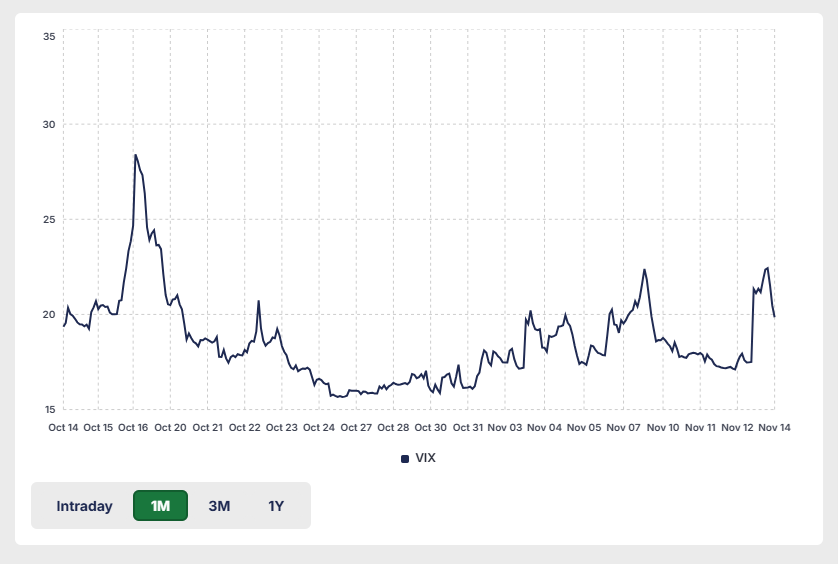
The CBOE Volatility Index (VIX), the market’s most common gauge of near-term S&P 500 volatility, has been steadily climbing since Halloween. We’ve seen two notable 1–2% pullbacks in recent weeks: Friday, Nov. 7 and again Friday morning, Nov. 14, both of which were quickly bought back. This pattern of sharp dips followed by equally sharp recoveries has contributed to a grind higher in equity volatility over the last two weeks.
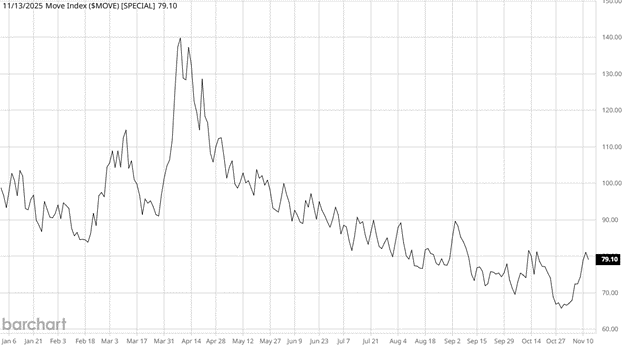
In contrast to equities, Treasury volatility tells a much calmer story. The MOVE Index, the bond-market equivalent of the VIX, has ticked slightly higher but remains near year-to-date lows. When bond volatility stays anchored, it signals that investors are not concerned about recession risk, liquidity, or expect major shifts in Fed policy. Fixed income markets are behaving as if the current bout of equity volatility is noise, not signal.
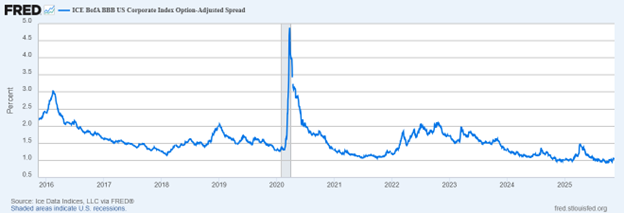
High-yield spreads, another gauge of risk appetite, remain at cycle lows. Tight spreads indicate that credit investors, historically quicker to detect financial fragility, see little to no meaningful deterioration in corporate fundamentals. If there were real macro or earnings-driven stress brewing, spreads would be increasingly widening, but alas, they are not.
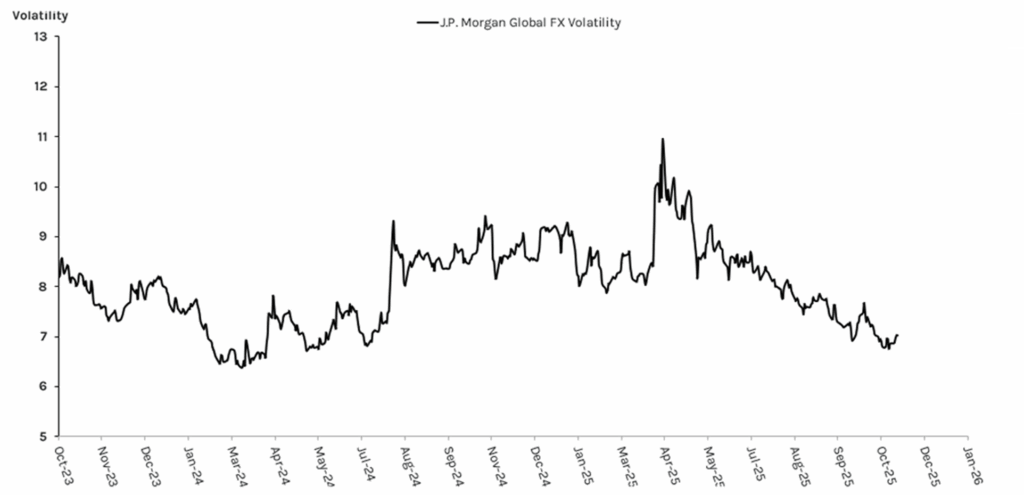
Lastly, global currency volatility remains at very depressed levels. FX or currency markets are the original 24-hour trading markets. They are usually the quickest to react to geopolitical events, liquidity stress, or growth fears. No currency volatility means a lack of financial distress.
In sum, though equity volatility has risen over the last few weeks, the bond, credit, and currency markets say the volatility is episodic, non-trending, and localized to equities rather than a broader risk-off signal.
Have a great week!
-Matt
Sources: YCharts, Hedgeye, Federal Reserve Bank of St. Louis, Barchart, CBOE
This communication and its contents are for informational and educational purposes only and should not be used as the sole basis for any investment decision. The information contained herein is based on publicly available sources believed to be reliable but is not a representation, expressed or implied, as to the accuracy, completeness, or correctness of said information. References to political figures or policies are for informational purposes only and do not represent an endorsement by Waddell & Associates. Any forward-looking statements reflect current opinions and assumptions and are subject to change without notice; actual results may differ materially. Past performance does not guarantee future results. Waddell & Associates may use artificial intelligence tools to help generate or summarize content; all outputs are reviewed by our team for accuracy and relevance.
">The Vol of Fall
November has brought about a more turbulent stretch for markets. The longest government shutdown in history officially ended this past Wednesday, but not all sources of uncertainty have faded. The Supreme Court is set to hear arguments related to President Trump’s tariff authority over the coming weeks adding a fresh layer of policy risk. Meanwhile, earnings season has largely wrapped up, yet investor attention will be focused on Nvidia’s results Wednesday evening, a spectacle that increasingly serves as a proxy for broader sentiment on AI, capex, and mega-cap leadership.
Taken together, these forces have produced an uptick in equity volatility to start November. But when you look across other indicators of stress, the picture clears. Bond volatility is subdued, credit spreads remain tight, and currency volatility is still near cycle lows. The disconnect is meaningful: it suggests the stress in equities is not being driven by macro fears or financial instability but rather a healthy, if sometimes uncomfortable, hedge of uncertainty.
Stocks, Bonds, and Currencies
The CBOE Volatility Index (VIX), the market’s most common gauge of near-term S&P 500 volatility, has been steadily climbing since Halloween. We’ve seen two notable 1–2% pullbacks in recent weeks: Friday, Nov. 7 and again Friday morning, Nov. 14, both of which were quickly bought back. This pattern of sharp dips followed by equally sharp recoveries has contributed to a grind higher in equity volatility over the last two weeks.
In contrast to equities, Treasury volatility tells a much calmer story. The MOVE Index, the bond-market equivalent of the VIX, has ticked slightly higher but remains near year-to-date lows. When bond volatility stays anchored, it signals that investors are not concerned about recession risk, liquidity, or expect major shifts in Fed policy. Fixed income markets are behaving as if the current bout of equity volatility is noise, not signal.
High-yield spreads, another gauge of risk appetite, remain at cycle lows. Tight spreads indicate that credit investors, historically quicker to detect financial fragility, see little to no meaningful deterioration in corporate fundamentals. If there were real macro or earnings-driven stress brewing, spreads would be increasingly widening, but alas, they are not.
Lastly, global currency volatility remains at very depressed levels. FX or currency markets are the original 24-hour trading markets. They are usually the quickest to react to geopolitical events, liquidity stress, or growth fears. No currency volatility means a lack of financial distress.
In sum, though equity volatility has risen over the last few weeks, the bond, credit, and currency markets say the volatility is episodic, non-trending, and localized to equities rather than a broader risk-off signal.
Have a great week!
-Matt
Sources: YCharts, Hedgeye, Federal Reserve Bank of St. Louis, Barchart, CBOE
This communication and its contents are for informational and educational purposes only and should not be used as the sole basis for any investment decision. The information contained herein is based on publicly available sources believed to be reliable but is not a representation, expressed or implied, as to the accuracy, completeness, or correctness of said information. References to political figures or policies are for informational purposes only and do not represent an endorsement by Waddell & Associates. Any forward-looking statements reflect current opinions and assumptions and are subject to change without notice; actual results may differ materially. Past performance does not guarantee future results. Waddell & Associates may use artificial intelligence tools to help generate or summarize content; all outputs are reviewed by our team for accuracy and relevance.
" class="link-chevron">
As markets climb to new all-time highs, it’s natural to feel a bit uneasy. After all, buying stocks when they’re most expensive feels counterintuitive. Many investors ponder, “Should I wait for a pullback before putting more cash to work?”
It’s a reasonable question—one that surfaces nearly every time the market reaches a new peak. But history tells us a reassuring story: investing at all-time highs is not as scary as it seems. In fact, the data says that investing through new highs has often led to stronger results. Let’s explore!
Time In the Market
Markets never move in a straight line. In the short-term, news and headlines drive price swings. Over the long haul, earnings growth, productivity, and innovation determine direction.
When markets make new highs, new investors often fear buying the peak, and existing investors wrestle with loss aversion, or our tendency to feel the pain of losses more intensely than the joy of like size gains. But time in the market has consistently proven more valuable than trying to time the market. Furthermore, take the chart below. Since 1988, investing on a day when the S&P500 hits a new all-time high has historically produced better cumulative returns than investing on any other day.
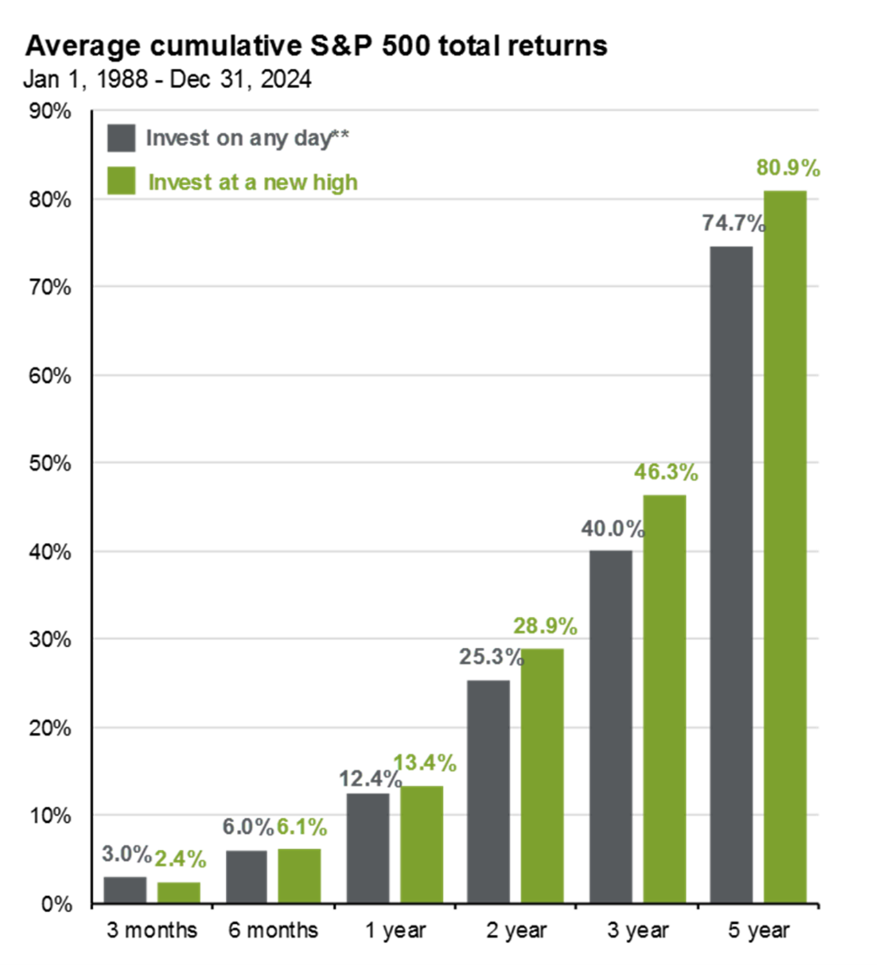
There are a few different factors for this, but the long and short is that new highs tend to perpetuate more, new all-time highs. Growth begets growth. The key takeaway is that new highs typically don’t signal the end of opportunity, but the continuation of it!
What to Do When Markets Feel Expensive
Investing at all-time highs doesn’t mean ignoring the risk but managing it thoughtfully. If investors do feel uneasy with markets at new highs, here are three things to focus on to stay disciplined and strategic:
- Revisit your allocation. After a strong market rally, portfolios may have drifted from a target mix of stocks, bonds, and alternatives. Rebalancing, or selling a bit of what’s grown and adding to what’s lagged, can help maintain discipline and manage risk.
- Have a plan. For new investors, structure matters. Whether one decides to invest in a lump sum or dollar-cost-average investment over a set timeframe, having a defined strategy can reduce the emotional burden of ‘buying the top’.
- Keep perspective. Market pullbacks are normal, even healthy at times. Historically, the S&P500 has averaged an intra-year decline of around 10%, while oftentimes finishing positive despite the decline. Volatility and dips are part of the journey, not the destination!
Further Running of the Bull?
With markets hitting record highs, the question becomes: What could keep this bull market charging further? Two forces stand out today: earnings and pessimism.
Third quarter earnings season kicked off earlier this month and early results have been encouraging. As valuations have increased, earnings must deliver to sustain upward momentum. Of the companies that have reported thus far, 86% have reported a positive earnings surprise. Blended year-over-year earnings growth sits at 8.5%. Looking further ahead, analysts expect earnings growth to broaden beyond the Magnificent 7. Forecasts for 2026 expect Mag 7 earnings to grow but decelerate, while the remaining 493 firms pick up the slack:
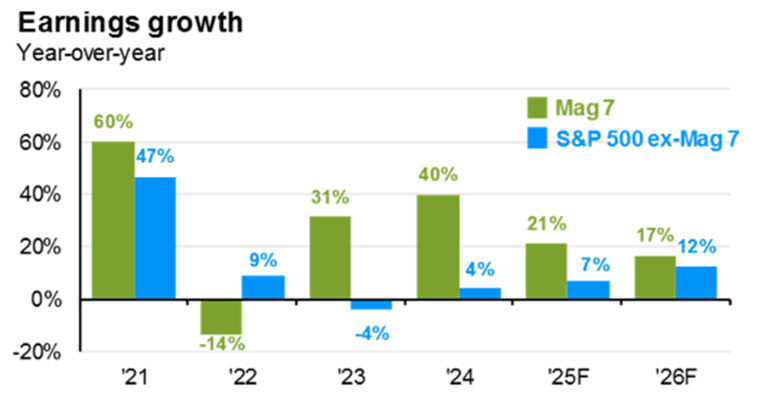
At the same time, consumer and investor sentiment remains remarkably subdued. Surveys of both investors and consumers show confidence at low levels, even as portfolios and household net worths climb higher. The irony is that the pessimism often serves as fuel for future gains. Historically, periods of low sentiment have preceded above average forward returns, as negative expectations leave room for upside surprises!
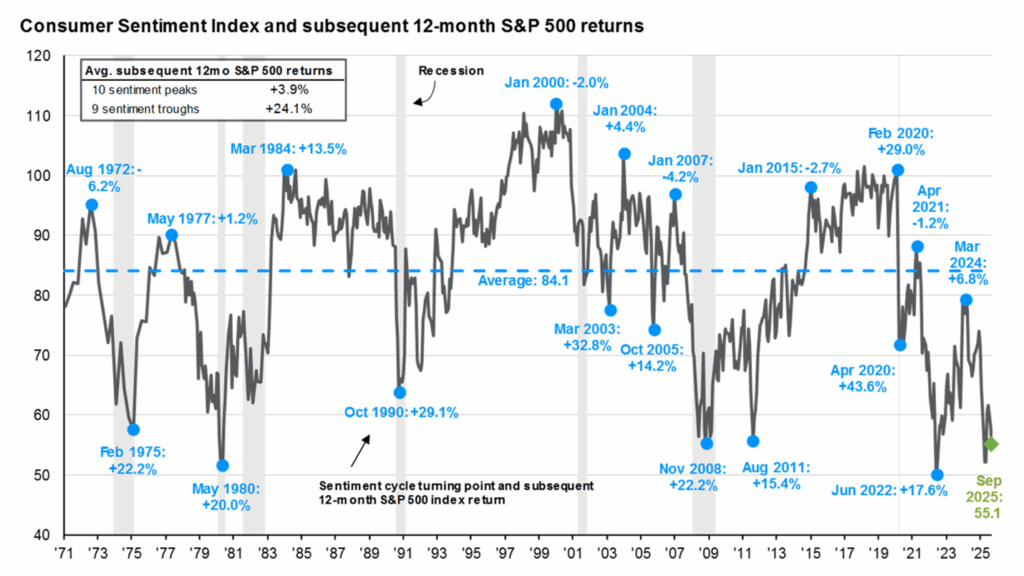
Enjoy the rest of your weekend!
-Matt
Source: JP Morgan Asset Management, Guide to the Markets
This communication and its contents are for informational and educational purposes only and should not be used as the sole basis for any investment decision. The information contained herein is based on publicly available sources believed to be reliable but is not a representation, expressed or implied, as to the accuracy, completeness, or correctness of said information. References to political figures or policies are for informational purposes only and do not represent an endorsement by Waddell & Associates. Any forward-looking statements reflect current opinions and assumptions and are subject to change without notice; actual results may differ materially. Past performance does not guarantee future results. Waddell & Associates may use artificial intelligence tools to help generate or summarize content; all outputs are reviewed by our team for accuracy and relevance.
">All-Time is Long Time
As markets climb to new all-time highs, it’s natural to feel a bit uneasy. After all, buying stocks when they’re most expensive feels counterintuitive. Many investors ponder, “Should I wait for a pullback before putting more cash to work?”
It’s a reasonable question—one that surfaces nearly every time the market reaches a new peak. But history tells us a reassuring story: investing at all-time highs is not as scary as it seems. In fact, the data says that investing through new highs has often led to stronger results. Let’s explore!
Time In the Market
Markets never move in a straight line. In the short-term, news and headlines drive price swings. Over the long haul, earnings growth, productivity, and innovation determine direction.
When markets make new highs, new investors often fear buying the peak, and existing investors wrestle with loss aversion, or our tendency to feel the pain of losses more intensely than the joy of like size gains. But time in the market has consistently proven more valuable than trying to time the market. Furthermore, take the chart below. Since 1988, investing on a day when the S&P500 hits a new all-time high has historically produced better cumulative returns than investing on any other day.
There are a few different factors for this, but the long and short is that new highs tend to perpetuate more, new all-time highs. Growth begets growth. The key takeaway is that new highs typically don’t signal the end of opportunity, but the continuation of it!
What to Do When Markets Feel Expensive
Investing at all-time highs doesn’t mean ignoring the risk but managing it thoughtfully. If investors do feel uneasy with markets at new highs, here are three things to focus on to stay disciplined and strategic:
- Revisit your allocation. After a strong market rally, portfolios may have drifted from a target mix of stocks, bonds, and alternatives. Rebalancing, or selling a bit of what’s grown and adding to what’s lagged, can help maintain discipline and manage risk.
- Have a plan. For new investors, structure matters. Whether one decides to invest in a lump sum or dollar-cost-average investment over a set timeframe, having a defined strategy can reduce the emotional burden of ‘buying the top’.
- Keep perspective. Market pullbacks are normal, even healthy at times. Historically, the S&P500 has averaged an intra-year decline of around 10%, while oftentimes finishing positive despite the decline. Volatility and dips are part of the journey, not the destination!
Further Running of the Bull?
With markets hitting record highs, the question becomes: What could keep this bull market charging further? Two forces stand out today: earnings and pessimism.
Third quarter earnings season kicked off earlier this month and early results have been encouraging. As valuations have increased, earnings must deliver to sustain upward momentum. Of the companies that have reported thus far, 86% have reported a positive earnings surprise. Blended year-over-year earnings growth sits at 8.5%. Looking further ahead, analysts expect earnings growth to broaden beyond the Magnificent 7. Forecasts for 2026 expect Mag 7 earnings to grow but decelerate, while the remaining 493 firms pick up the slack:
At the same time, consumer and investor sentiment remains remarkably subdued. Surveys of both investors and consumers show confidence at low levels, even as portfolios and household net worths climb higher. The irony is that the pessimism often serves as fuel for future gains. Historically, periods of low sentiment have preceded above average forward returns, as negative expectations leave room for upside surprises!
Enjoy the rest of your weekend!
-Matt
Source: JP Morgan Asset Management, Guide to the Markets
This communication and its contents are for informational and educational purposes only and should not be used as the sole basis for any investment decision. The information contained herein is based on publicly available sources believed to be reliable but is not a representation, expressed or implied, as to the accuracy, completeness, or correctness of said information. References to political figures or policies are for informational purposes only and do not represent an endorsement by Waddell & Associates. Any forward-looking statements reflect current opinions and assumptions and are subject to change without notice; actual results may differ materially. Past performance does not guarantee future results. Waddell & Associates may use artificial intelligence tools to help generate or summarize content; all outputs are reviewed by our team for accuracy and relevance.
" class="link-chevron">