



%20(1).png?width=508&height=121&name=flourish-primary-logo@2x%20(1)%20(1).png)


Central banks worldwide spent much of 2022–2023 draining the liquidity they had pumped into markets after COVID to combat accelerating inflation. Since then, inflationary pressures have cooled, and asset prices have rewarded investors with strong gains. But beneath the surface, a global easing cycle, rising liquidity, and loosening financial conditions have been a key support, and they remain firmly in place. Let’s review.
The Global Easing Cycle
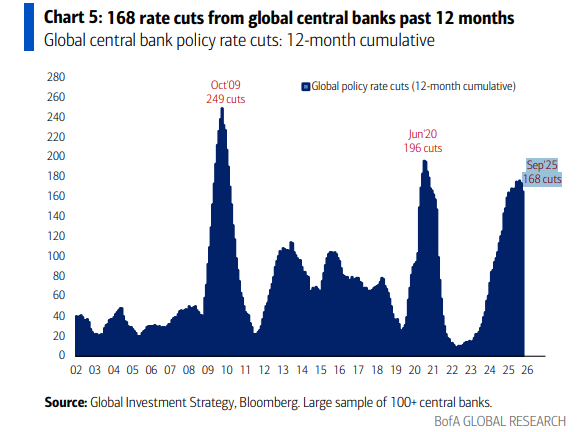
Last week we highlighted Jerome Powell’s 25-basis point “risk management” rate cut. But zoom out, and it’s only one piece of a much larger puzzle. Across the globe, central banks are cutting in unison to the tune of 168 rate cuts since mid-2023. When central banks ease in lockstep, liquidity rises system wide. Stress across funding markets is relieved, capital becomes cheaper, and risk appetite improves.
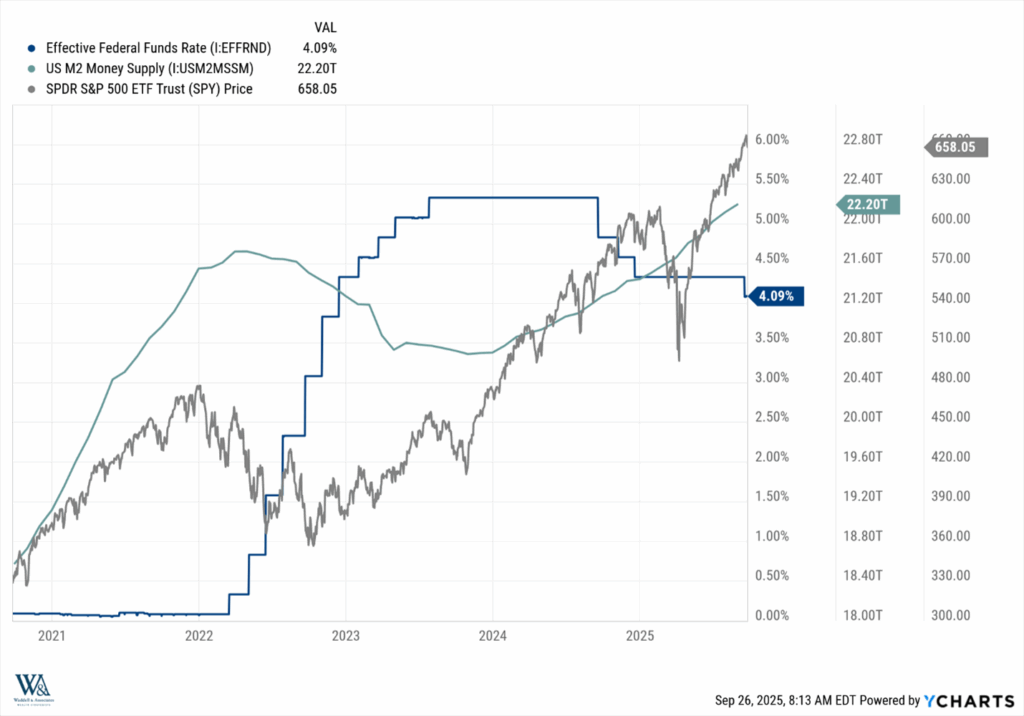
The chart below tells the story. The overlay in the chart is the US federal funds rate, the M2 money supply index, and the S&P500 index (Ticker $SPY). As the Fed raised rates through 2022–2023, money supply contracted, draining liquidity, and pushing stocks lower. But once money supply leveled off and began to rise again, equities moved higher in lockstep. This is no coincidence. Increasing money supply is naturally supportive of capital markets and public equity flows.
Loosening Conditions
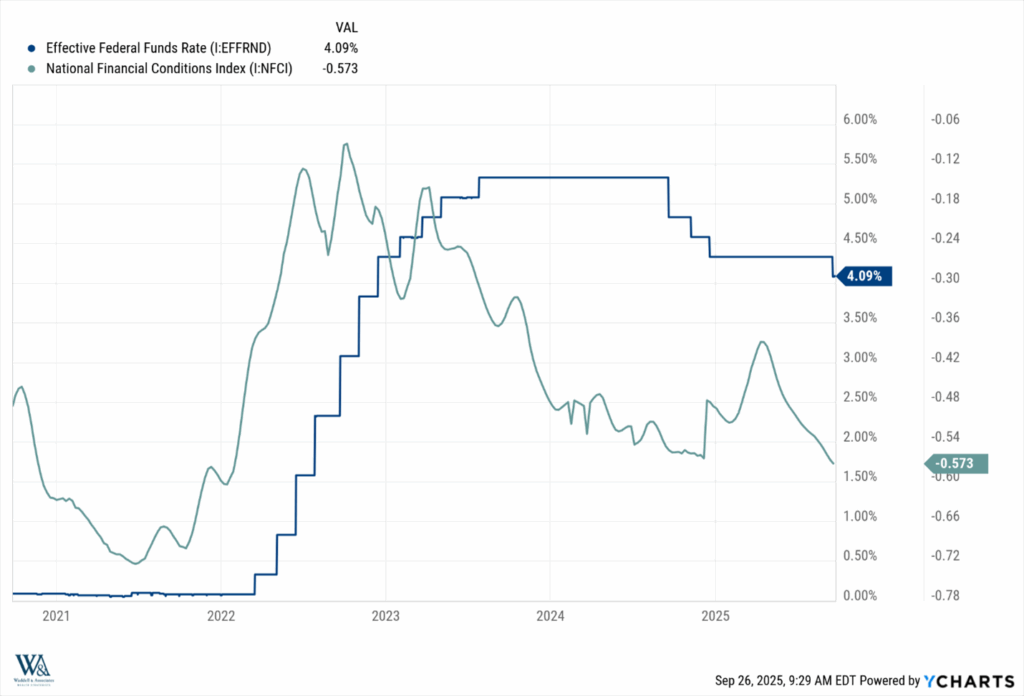
Financial conditions confirm the same trend. Once the Fed stopped hiking rates in 2023, financial conditions loosened and continue their same trajectory today. After the Fed rate cut earlier this month, financial conditions now sit at their easiest since late 2021. This translates to cheaper financing, stronger issuance, and again, healthy capital markets.
Credit spreads!
The market’s vote of confidence shows up in corporate credit spreads, and they too confirm the same trend. As rates rose and liquidity dropped throughout 2022, spreads widened out, reflecting the increase in credit and default risk across the system. But since then, it’s been trending back lower as rates dropped, liquidity rose, and conditions loosened.
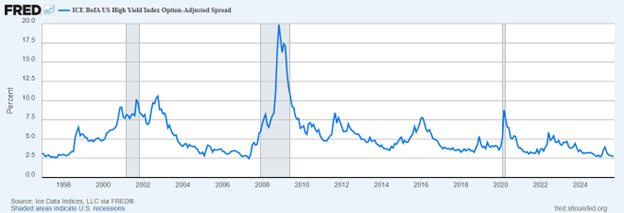
Tight spreads do more than send a signal—they actively reinforce easier conditions. Narrower spreads lower the cost of capital for companies, making refinancing and new issuance more attractive. They reduce the odds of a credit crunch, encourage investment, and extend the cycle.
In the end, markets are being carried by a powerful current: a synchronized global easing cycle, abundant liquidity, loosening financial conditions, and tight credit spreads that signal confidence rather than stress. These forces don’t remove risk, but they do create an environment where capital is plentiful and the path of least resistance for asset prices remains higher. For investors, the message is simple: liquidity drives markets, and right now, the money is still flowing.
That’s all for this week!
-Matt
Sources: Bank of America Global Research, YCharts, Federal Reserve Bank of St. Louis
This communication and its contents are for informational and educational purposes only and should not be used as the sole basis for any investment decision. The information contained herein is based on publicly available sources believed to be reliable but is not a representation, expressed or implied, as to the accuracy, completeness, or correctness of said information. References to political figures or policies are for informational purposes only and do not represent an endorsement by Waddell & Associates. Any forward-looking statements reflect current opinions and assumptions and are subject to change without notice; actual results may differ materially. Past performance does not guarantee future results. Waddell & Associates may use artificial intelligence tools to help generate or summarize content; all outputs are reviewed by our team for accuracy and relevance.
">Show Me The Money!
Central banks worldwide spent much of 2022–2023 draining the liquidity they had pumped into markets after COVID to combat accelerating inflation. Since then, inflationary pressures have cooled, and asset prices have rewarded investors with strong gains. But beneath the surface, a global easing cycle, rising liquidity, and loosening financial conditions have been a key support, and they remain firmly in place. Let’s review.
The Global Easing Cycle
Last week we highlighted Jerome Powell’s 25-basis point “risk management” rate cut. But zoom out, and it’s only one piece of a much larger puzzle. Across the globe, central banks are cutting in unison to the tune of 168 rate cuts since mid-2023. When central banks ease in lockstep, liquidity rises system wide. Stress across funding markets is relieved, capital becomes cheaper, and risk appetite improves.
The chart below tells the story. The overlay in the chart is the US federal funds rate, the M2 money supply index, and the S&P500 index (Ticker $SPY). As the Fed raised rates through 2022–2023, money supply contracted, draining liquidity, and pushing stocks lower. But once money supply leveled off and began to rise again, equities moved higher in lockstep. This is no coincidence. Increasing money supply is naturally supportive of capital markets and public equity flows.
Loosening Conditions
Financial conditions confirm the same trend. Once the Fed stopped hiking rates in 2023, financial conditions loosened and continue their same trajectory today. After the Fed rate cut earlier this month, financial conditions now sit at their easiest since late 2021. This translates to cheaper financing, stronger issuance, and again, healthy capital markets.
Credit spreads!
The market’s vote of confidence shows up in corporate credit spreads, and they too confirm the same trend. As rates rose and liquidity dropped throughout 2022, spreads widened out, reflecting the increase in credit and default risk across the system. But since then, it’s been trending back lower as rates dropped, liquidity rose, and conditions loosened.
Tight spreads do more than send a signal—they actively reinforce easier conditions. Narrower spreads lower the cost of capital for companies, making refinancing and new issuance more attractive. They reduce the odds of a credit crunch, encourage investment, and extend the cycle.
In the end, markets are being carried by a powerful current: a synchronized global easing cycle, abundant liquidity, loosening financial conditions, and tight credit spreads that signal confidence rather than stress. These forces don’t remove risk, but they do create an environment where capital is plentiful and the path of least resistance for asset prices remains higher. For investors, the message is simple: liquidity drives markets, and right now, the money is still flowing.
That’s all for this week!
-Matt
Sources: Bank of America Global Research, YCharts, Federal Reserve Bank of St. Louis
This communication and its contents are for informational and educational purposes only and should not be used as the sole basis for any investment decision. The information contained herein is based on publicly available sources believed to be reliable but is not a representation, expressed or implied, as to the accuracy, completeness, or correctness of said information. References to political figures or policies are for informational purposes only and do not represent an endorsement by Waddell & Associates. Any forward-looking statements reflect current opinions and assumptions and are subject to change without notice; actual results may differ materially. Past performance does not guarantee future results. Waddell & Associates may use artificial intelligence tools to help generate or summarize content; all outputs are reviewed by our team for accuracy and relevance.
" class="link-chevron">
The Fed convened last week and cut base interest rate policy by 0.25%. In the press conference that followed, Fed Chair Jerome Powell described this as a “Risk Management Cut.”
In the investment world, “risk management” is a familiar phrase, and with Powell’s background, he surely understands it well. But what exactly are the risks of raising, holding, or cutting interest rates, and what is the appropriate path of monetary policy given the data at hand?
With recent revisions in employment data and tone surrounding this rate cut, the Fed appears to be shifting the balance of its dual mandate more towards maximum employment than price stability. Powell has repeatedly emphasized that this Fed is data dependent. So, what does the data actually show, and is there cause for rising economic risk? Let’s tour a few government offices and see what their data had to say last week!
First Stop: Atlanta
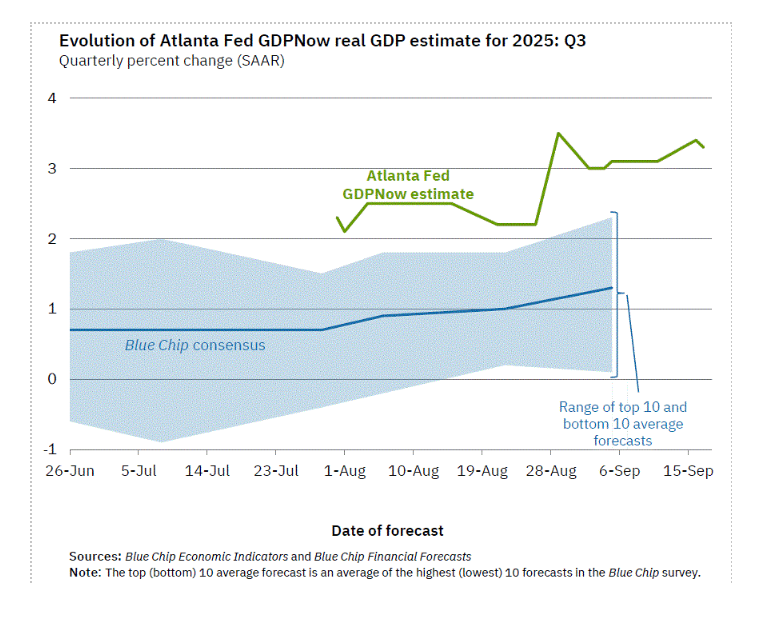
The Atlanta office of the Federal Reserve produces a “GDPNow” forecasting model. It provides a “nowcast” of the official estimate of GDP. It estimates growth using a methodology similar to the official one used by the US Bureau of Economic Analysis. Last week, the latest release estimated 2025 GDP growth at 3.3%, well above long-run potential growth of 1.8%.
Next Stop: Philly
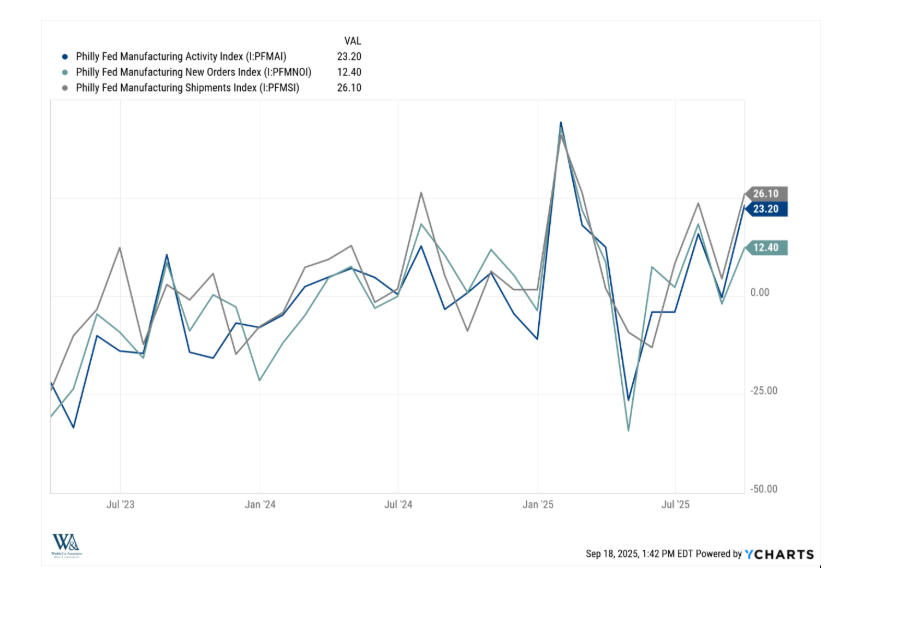
The Philadelphia office of the Fed conducts a monthly manufacturing business survey. While not a nationwide survey, its local scope often makes it a reliable, real-time signal. September’s results indicated regional manufacturing activity expanded. Indicators for activity, new orders, and shipments all rose month over month and have been in a relative uptrend since mid-2022.
Next stop: Washington, D.C.
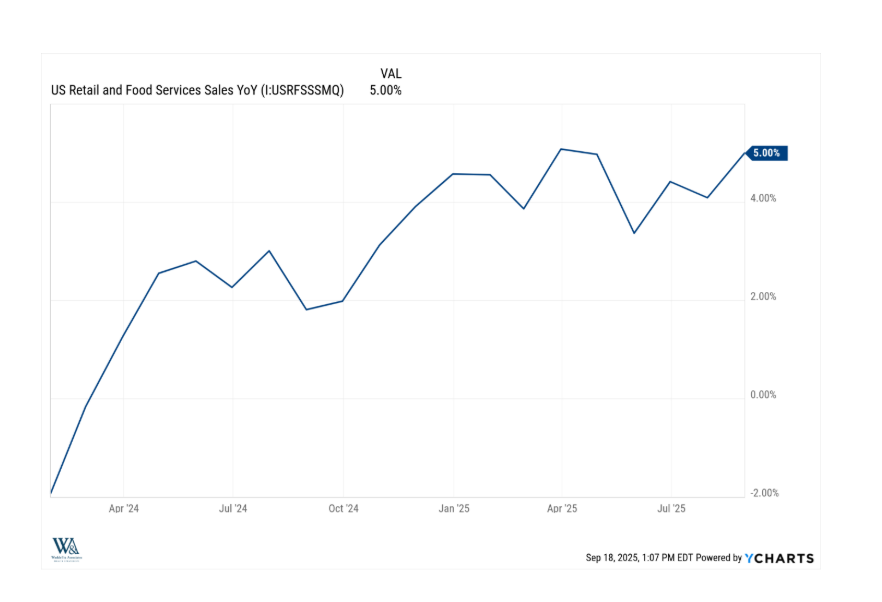
The US Census Bureau released advanced monthly sales for retail and food last week. Investor and consumer spending accounts for over 70% of US GDP. Incrementally, spending increased month over month and now sits 5% higher year-over-year, and it too remains in a relative uptrend.
Last Stop… The Federal Reserve
Once a quarter, the Federal Reserve releases its Summary of Economic Projections (SEP). This report contains FOMC member projections for the unemployment rate, inflation, and GDP. It provides a median forecast of the members which serves as a guide for projected path of monetary policy. This quarter, you’ll see that FOMC members increased their GDP projections, decreased their unemployment projections, and mostly held their inflation estimates in line.
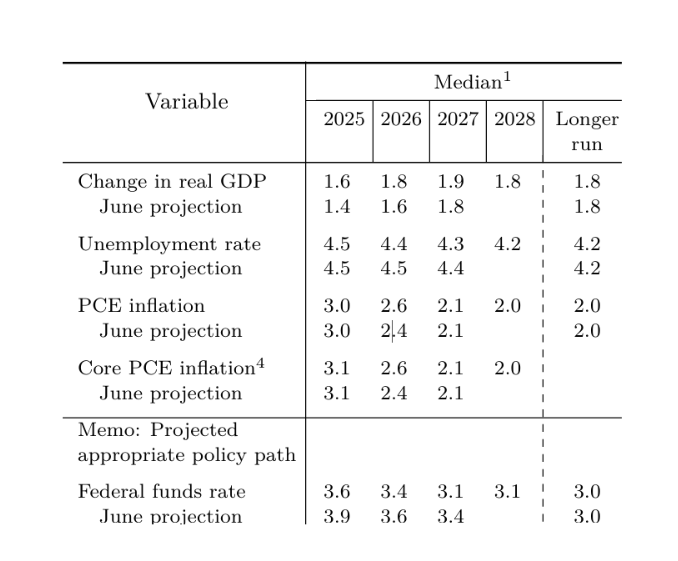
Of course, Powell would tell you these numbers are not predictions, more suggestions as to the appropriate path of monetary policy alongside the dual mandate of price stability and maximum employment.
In the end, Powell may frame the latest rate cut as a matter of “risk management”, but the Fed’s own projections and last week’s data tell a different story. Strong GDP growth, improving manufacturing data, and a spending consumer make this economy healthier than they think!
That’s all for this week!
-Matt
Sources: YCharts, Federal Reserve Bank of Philadelphia, Federal Reserve Bank of Atlanta, Federal Open Market Committee Summary of Economic Projections
This communication and its contents are for informational and educational purposes only and should not be used as the sole basis for any investment decision. The information contained herein is based on publicly available sources believed to be reliable but is not a representation, expressed or implied, as to the accuracy, completeness, or correctness of said information. References to political figures or policies are for informational purposes only and do not represent an endorsement by Waddell & Associates. Any forward-looking statements reflect current opinions and assumptions and are subject to change without notice; actual results may differ materially. Past performance does not guarantee future results. Waddell & Associates may use artificial intelligence tools to help generate or summarize content; all outputs are reviewed by our team for accuracy and relevance.
">A Risk Management Cut
The Fed convened last week and cut base interest rate policy by 0.25%. In the press conference that followed, Fed Chair Jerome Powell described this as a “Risk Management Cut.”
In the investment world, “risk management” is a familiar phrase, and with Powell’s background, he surely understands it well. But what exactly are the risks of raising, holding, or cutting interest rates, and what is the appropriate path of monetary policy given the data at hand?
With recent revisions in employment data and tone surrounding this rate cut, the Fed appears to be shifting the balance of its dual mandate more towards maximum employment than price stability. Powell has repeatedly emphasized that this Fed is data dependent. So, what does the data actually show, and is there cause for rising economic risk? Let’s tour a few government offices and see what their data had to say last week!
First Stop: Atlanta
The Atlanta office of the Federal Reserve produces a “GDPNow” forecasting model. It provides a “nowcast” of the official estimate of GDP. It estimates growth using a methodology similar to the official one used by the US Bureau of Economic Analysis. Last week, the latest release estimated 2025 GDP growth at 3.3%, well above long-run potential growth of 1.8%.
Next Stop: Philly
The Philadelphia office of the Fed conducts a monthly manufacturing business survey. While not a nationwide survey, its local scope often makes it a reliable, real-time signal. September’s results indicated regional manufacturing activity expanded. Indicators for activity, new orders, and shipments all rose month over month and have been in a relative uptrend since mid-2022.
Next stop: Washington, D.C.
The US Census Bureau released advanced monthly sales for retail and food last week. Investor and consumer spending accounts for over 70% of US GDP. Incrementally, spending increased month over month and now sits 5% higher year-over-year, and it too remains in a relative uptrend.
Last Stop… The Federal Reserve
Once a quarter, the Federal Reserve releases its Summary of Economic Projections (SEP). This report contains FOMC member projections for the unemployment rate, inflation, and GDP. It provides a median forecast of the members which serves as a guide for projected path of monetary policy. This quarter, you’ll see that FOMC members increased their GDP projections, decreased their unemployment projections, and mostly held their inflation estimates in line.
Of course, Powell would tell you these numbers are not predictions, more suggestions as to the appropriate path of monetary policy alongside the dual mandate of price stability and maximum employment.
In the end, Powell may frame the latest rate cut as a matter of “risk management”, but the Fed’s own projections and last week’s data tell a different story. Strong GDP growth, improving manufacturing data, and a spending consumer make this economy healthier than they think!
That’s all for this week!
-Matt
Sources: YCharts, Federal Reserve Bank of Philadelphia, Federal Reserve Bank of Atlanta, Federal Open Market Committee Summary of Economic Projections
This communication and its contents are for informational and educational purposes only and should not be used as the sole basis for any investment decision. The information contained herein is based on publicly available sources believed to be reliable but is not a representation, expressed or implied, as to the accuracy, completeness, or correctness of said information. References to political figures or policies are for informational purposes only and do not represent an endorsement by Waddell & Associates. Any forward-looking statements reflect current opinions and assumptions and are subject to change without notice; actual results may differ materially. Past performance does not guarantee future results. Waddell & Associates may use artificial intelligence tools to help generate or summarize content; all outputs are reviewed by our team for accuracy and relevance.
" class="link-chevron">
September and October have always carried weight in markets. They’re months when volatility tends to pick up, mutual fund fiscal years come to an end, and the year’s outlook can shift quickly. As we kick off this fall, three forces are now front and center: Powell, Trump, and the data!
Powell: A Near Certain Cut
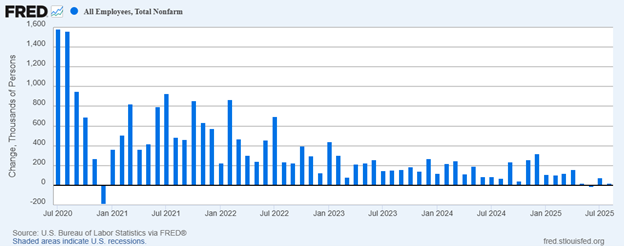
The next Federal Reserve meeting on monetary policy is scheduled for September 16th and 17th, meaning we are less than two weeks away. After Friday’s job numbers, fed-funds futures imply over a 99% chance of at least a 25bp cut this month. Some traders are even pricing in the chance of a 50bps cut. The fed’s dual mandate of maximum employment and 2% inflation has become harder to balance, but the backdrop certainly justifies a cut, and perhaps more going forward. Job growth and inflation momentum have slowed. Since January’s Fed pause, monthly payroll gains have been positive, but meaningfully lower, and the trend lower in payroll growth is clear:
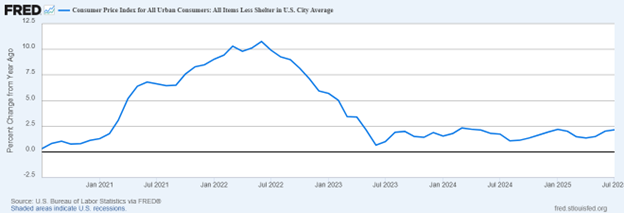
Then consider inflation. The largest component of the consumer price index measurement of inflation is housing and shelter. It makes up about 1/3 of CPI. Without it, CPI has been relatively unchanged since mid-2023:
With it, housing costs continue to moderate back to pre-pandemic levels. The owners-equivalent rent component inside of CPI continues to drag lower, with it’s month over month impact continuing to slide south:
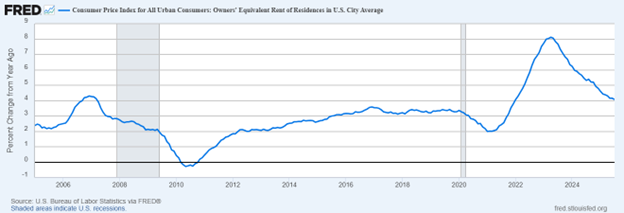
Unlocking the housing market is an important relief valve for the Fed, releasing more inventory and taking pressure from affordability issues. With only one inflation report left before the Fed meeting, the focus of the Fed mandate has shifted toward employment. But the real driver won’t be the cut itself, it will be Powell’s messaging thereafter. If he cuts and signals patience, markets may retrace their October and December rate expectations. If he cuts and focuses on the weakening labor market, future rate cut expectations will accelerate.
Trump: Tariffs in Legal Limbo
Was Powell too late? Trump may be right, but he has his own fiscal issues to deal with. The one big, beautiful bill was passed on the backs of tariff revenue that is now hanging in the balance of the courts. Tariffs have long been one of Trump’s hallmark economic weapons. They’ve reshaped supply chains, boosted certain domestic industries, and become a central talking point around American competitiveness. But now the legal ground has slightly shifted. On August 29th, (yes, the Friday before a long holiday weekend!), a Federal Court of Appeals ruled that the President’s use of the International Emergency Economic Powers Act (IEEPA) to impose reciprocal tariffs exceeded his authority. The court concluded IEEPA does not provide a blanket authority to the executive branch to levy sweeping tariff programs.
Importantly, the court withheld its mandate until October 14th, keeping tariffs in place while the administration seeks an emergency appeal in the Supreme Court. The government has already petitioned the justices for expedited review, arguing the tariffs are essential.
The near-term fork in the road is two-fold:
- If the Supreme Court grants a stay, the tariffs keep running during the appeal process.
- If the stay is denied, collection halts and importers could begin seeking refunds.
Either outcome carries some market consequence. For investors, this is not just about a legal circus; it’s about whether Q4 starts with tariff revenues or refunds and how they shift the dynamics. Historically, September and October are already prone to market weakness and volatility, and this ruling simply reinforces that historical pattern.
The Data
Payrolls are still growing but at a slower pace. Inflation ex-shelter has been relatively flat since mid-2023, and housing costs, the largest component of CPI, are trending lower.
Despite these crosscurrents, equities remain near all-time highs. What makes this interesting is the contrast: markets keep grinding higher as sentiment surveys show more pessimism. The chart below illustrates the S&P 500 and bearish investor sentiment levels. As markets have rebounded off the April lows, bearishness, though lower, has remained elevated. So long as the pessimism persists, it will continue to create opportunity for long-term investors as the skepticism of future market returns helps propel them higher!
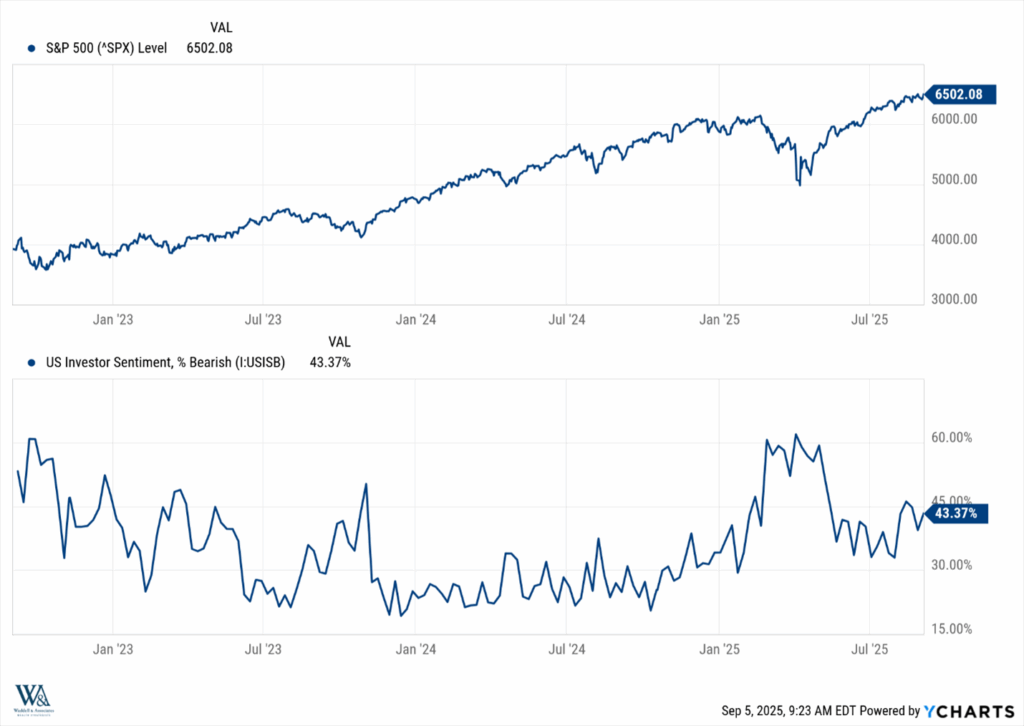
That’s all for this week!
-Matt
Sources: YCharts, Federal Reserve Bank of St. Louis, CME Group FedWatch
This communication and its contents are for informational and educational purposes only and should not be used as the sole basis for any investment decision. The information contained herein is based on publicly available sources believed to be reliable but is not a representation, expressed or implied, as to the accuracy, completeness, or correctness of said information. References to political figures or policies are for informational purposes only and do not represent an endorsement by Waddell & Associates. Any forward-looking statements reflect current opinions and assumptions and are subject to change without notice; actual results may differ materially. Past performance does not guarantee future results. Waddell & Associates may use artificial intelligence tools to help generate or summarize content; all outputs are reviewed by our team for accuracy and relevance.
">The Boys of Fall: Powell, Trump, and the Data
September and October have always carried weight in markets. They’re months when volatility tends to pick up, mutual fund fiscal years come to an end, and the year’s outlook can shift quickly. As we kick off this fall, three forces are now front and center: Powell, Trump, and the data!
Powell: A Near Certain Cut
The next Federal Reserve meeting on monetary policy is scheduled for September 16th and 17th, meaning we are less than two weeks away. After Friday’s job numbers, fed-funds futures imply over a 99% chance of at least a 25bp cut this month. Some traders are even pricing in the chance of a 50bps cut. The fed’s dual mandate of maximum employment and 2% inflation has become harder to balance, but the backdrop certainly justifies a cut, and perhaps more going forward. Job growth and inflation momentum have slowed. Since January’s Fed pause, monthly payroll gains have been positive, but meaningfully lower, and the trend lower in payroll growth is clear:
Then consider inflation. The largest component of the consumer price index measurement of inflation is housing and shelter. It makes up about 1/3 of CPI. Without it, CPI has been relatively unchanged since mid-2023:
With it, housing costs continue to moderate back to pre-pandemic levels. The owners-equivalent rent component inside of CPI continues to drag lower, with it’s month over month impact continuing to slide south:
Unlocking the housing market is an important relief valve for the Fed, releasing more inventory and taking pressure from affordability issues. With only one inflation report left before the Fed meeting, the focus of the Fed mandate has shifted toward employment. But the real driver won’t be the cut itself, it will be Powell’s messaging thereafter. If he cuts and signals patience, markets may retrace their October and December rate expectations. If he cuts and focuses on the weakening labor market, future rate cut expectations will accelerate.
Trump: Tariffs in Legal Limbo
Was Powell too late? Trump may be right, but he has his own fiscal issues to deal with. The one big, beautiful bill was passed on the backs of tariff revenue that is now hanging in the balance of the courts. Tariffs have long been one of Trump’s hallmark economic weapons. They’ve reshaped supply chains, boosted certain domestic industries, and become a central talking point around American competitiveness. But now the legal ground has slightly shifted. On August 29th, (yes, the Friday before a long holiday weekend!), a Federal Court of Appeals ruled that the President’s use of the International Emergency Economic Powers Act (IEEPA) to impose reciprocal tariffs exceeded his authority. The court concluded IEEPA does not provide a blanket authority to the executive branch to levy sweeping tariff programs.
Importantly, the court withheld its mandate until October 14th, keeping tariffs in place while the administration seeks an emergency appeal in the Supreme Court. The government has already petitioned the justices for expedited review, arguing the tariffs are essential.
The near-term fork in the road is two-fold:
- If the Supreme Court grants a stay, the tariffs keep running during the appeal process.
- If the stay is denied, collection halts and importers could begin seeking refunds.
Either outcome carries some market consequence. For investors, this is not just about a legal circus; it’s about whether Q4 starts with tariff revenues or refunds and how they shift the dynamics. Historically, September and October are already prone to market weakness and volatility, and this ruling simply reinforces that historical pattern.
The Data
Payrolls are still growing but at a slower pace. Inflation ex-shelter has been relatively flat since mid-2023, and housing costs, the largest component of CPI, are trending lower.
Despite these crosscurrents, equities remain near all-time highs. What makes this interesting is the contrast: markets keep grinding higher as sentiment surveys show more pessimism. The chart below illustrates the S&P 500 and bearish investor sentiment levels. As markets have rebounded off the April lows, bearishness, though lower, has remained elevated. So long as the pessimism persists, it will continue to create opportunity for long-term investors as the skepticism of future market returns helps propel them higher!
That’s all for this week!
-Matt
Sources: YCharts, Federal Reserve Bank of St. Louis, CME Group FedWatch
This communication and its contents are for informational and educational purposes only and should not be used as the sole basis for any investment decision. The information contained herein is based on publicly available sources believed to be reliable but is not a representation, expressed or implied, as to the accuracy, completeness, or correctness of said information. References to political figures or policies are for informational purposes only and do not represent an endorsement by Waddell & Associates. Any forward-looking statements reflect current opinions and assumptions and are subject to change without notice; actual results may differ materially. Past performance does not guarantee future results. Waddell & Associates may use artificial intelligence tools to help generate or summarize content; all outputs are reviewed by our team for accuracy and relevance.
" class="link-chevron">
The Full Story:
You might have missed it, and I wouldn’t blame you. Amid the daily whirlwind of political drama, from a federal takeover of Washington DC to a public spat with the Intel CEO, an important economic metric quietly beat expectations: US Labor Productivity rose 2.4% in the second quarter of 2025, continuing an upward trend that is worth paying attention to.
What is it?
At its core, labor productivity measures how much economic output (GDP) is generated per hour of work. It answers a fundamental question: How efficiently are workers turning time and effort into goods and services? GDP, remember, is just a comprehensive measure of the total value of all final goods and services produced, and there are two ways to grow it:
- Employ more workers.
- Make each worker more productive.
With aging populations and decreasing labor force participation rates, the productivity of each unit of labor is increasingly critical to GDP growth.
Why It Matters
Over the long-run, productivity growth is a key driver of economic prosperity. When a worker can produce more goods and services in an hour, businesses can afford to pay higher wages without raising their prices, improving the standard of living. This was a key principle of your painfully boring microeconomics class: Productivity growth drives wage gains, expands profit margins, and feeds a cycle of income growth and consumption.
The Long-Term Trends
Since WWII, US labor force productivity has shown strength over the long run, averaging over 2% per year, but the pace of growth has been cyclical. We can divide the post-WWII era into four distinct cycles of labor productivity growth:
- 1950-1970: +2.7% per year
- 1971-1994: +1.7% per year
- 1995-2005: +2.8% per year
- 2006-2022: +1.6% per year
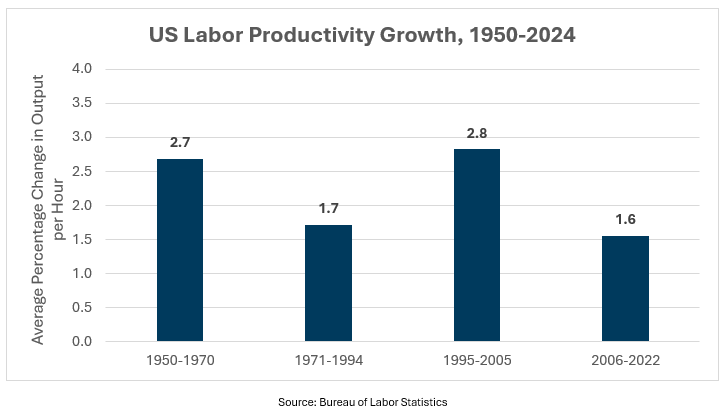
In 2023 and 2024, labor productivity grew at 1.9% and 2.7%, respectively, more in line with a long-term upswing in productivity. If we are entering a new cycle of stronger productivity growth, there are a few combining forces driving the acceleration:
- Artificial intelligence: Businesses are investing aggressively in AI technologies that reduce routine tasks and enhance efficiencies.
- Entrepreneurial boom: The U.S. has seen record new business formations, signaling an uptick in creative innovation.
- Reshoring and manufacturing: Strategic efforts to bring back production capacity, particularly in semiconductors and advanced manufacturing.
- Hybrid work models: More flexible work arrangements have in many cases increased output.
Taken together, these dynamics I think suggest more than just a post-pandemic bounce. They are structural shifts in how, when, and where work gets done.
Impact for Investors
Productivity is an important engine in long-term economic progress but also financial markets. When companies can produce more with the same labor force, margins expand and returns on capital improve, creating a powerful feedback loop:
Higher productivity → higher corporate earnings → higher wages →
higher consumption → stronger GDP → higher asset prices
But have investors been rewarded during cycles of increased productivity? Yes. Here’s the same chart with the average S&P annual return during the same periods:
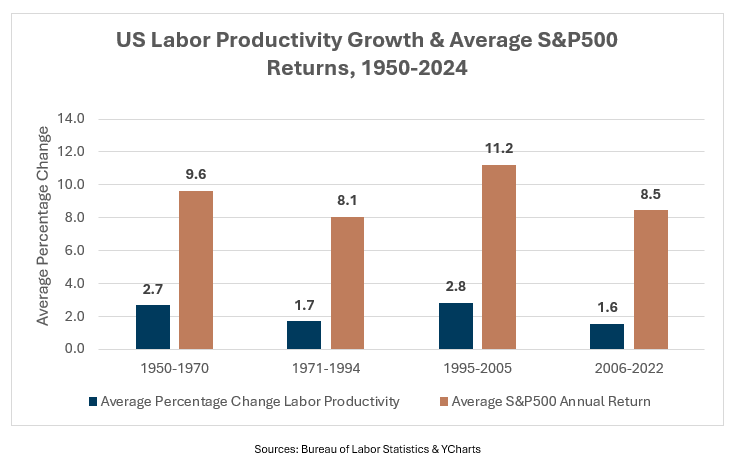
Of course, many factors influence equity returns, and past performance is not a guarantee of future results, but the recent uptick in productivity is a positive signal as we move ahead!
Enjoy the rest of your weekend!
-Matt
Sources: Bureau of Labor Statistics; YCharts
This communication and its contents are for informational and educational purposes only and should not be used as the sole basis for any investment decision. The information contained herein is based on publicly available sources believed to be reliable but is not a representation, expressed or implied, as to the accuracy, completeness, or correctness of said information. References to political figures or policies are for informational purposes only and do not represent an endorsement by Waddell & Associates. Any forward-looking statements reflect current opinions and assumptions and are subject to change without notice; actual results may differ materially. Past performance does not guarantee future results. Waddell & Associates may use artificial intelligence tools to help generate or summarize content; all outputs are reviewed by our team for accuracy and relevance.
">The Power of Productivity The Full Story:You might have missed it, and I wouldn’t blame you. Amid the daily whirlwind of political drama, from a federal takeover of Washington DC to a public spat with the Intel CEO, an important economic metric quietly beat expectations: US Labor Productivity rose 2.4% in the second quarter of 2025, continuing an upward trend that is worth paying attention to.
What is it?
At its core, labor productivity measures how much economic output (GDP) is generated per hour of work. It answers a fundamental question: How efficiently are workers turning time and effort into goods and services? GDP, remember, is just a comprehensive measure of the total value of all final goods and services produced, and there are two ways to grow it:
- Employ more workers.
- Make each worker more productive.
With aging populations and decreasing labor force participation rates, the productivity of each unit of labor is increasingly critical to GDP growth.
Why It Matters
Over the long-run, productivity growth is a key driver of economic prosperity. When a worker can produce more goods and services in an hour, businesses can afford to pay higher wages without raising their prices, improving the standard of living. This was a key principle of your painfully boring microeconomics class: Productivity growth drives wage gains, expands profit margins, and feeds a cycle of income growth and consumption.
The Long-Term Trends
Since WWII, US labor force productivity has shown strength over the long run, averaging over 2% per year, but the pace of growth has been cyclical. We can divide the post-WWII era into four distinct cycles of labor productivity growth:
- 1950-1970: +2.7% per year
- 1971-1994: +1.7% per year
- 1995-2005: +2.8% per year
- 2006-2022: +1.6% per year
In 2023 and 2024, labor productivity grew at 1.9% and 2.7%, respectively, more in line with a long-term upswing in productivity. If we are entering a new cycle of stronger productivity growth, there are a few combining forces driving the acceleration:
- Artificial intelligence: Businesses are investing aggressively in AI technologies that reduce routine tasks and enhance efficiencies.
- Entrepreneurial boom: The U.S. has seen record new business formations, signaling an uptick in creative innovation.
- Reshoring and manufacturing: Strategic efforts to bring back production capacity, particularly in semiconductors and advanced manufacturing.
- Hybrid work models: More flexible work arrangements have in many cases increased output.
Taken together, these dynamics I think suggest more than just a post-pandemic bounce. They are structural shifts in how, when, and where work gets done.
Impact for Investors
Productivity is an important engine in long-term economic progress but also financial markets. When companies can produce more with the same labor force, margins expand and returns on capital improve, creating a powerful feedback loop:
Higher productivity → higher corporate earnings → higher wages →
higher consumption → stronger GDP → higher asset prices
But have investors been rewarded during cycles of increased productivity? Yes. Here’s the same chart with the average S&P annual return during the same periods:
Of course, many factors influence equity returns, and past performance is not a guarantee of future results, but the recent uptick in productivity is a positive signal as we move ahead!
Enjoy the rest of your weekend!
-Matt
Sources: Bureau of Labor Statistics; YCharts
This communication and its contents are for informational and educational purposes only and should not be used as the sole basis for any investment decision. The information contained herein is based on publicly available sources believed to be reliable but is not a representation, expressed or implied, as to the accuracy, completeness, or correctness of said information. References to political figures or policies are for informational purposes only and do not represent an endorsement by Waddell & Associates. Any forward-looking statements reflect current opinions and assumptions and are subject to change without notice; actual results may differ materially. Past performance does not guarantee future results. Waddell & Associates may use artificial intelligence tools to help generate or summarize content; all outputs are reviewed by our team for accuracy and relevance.
" class="link-chevron">
As we pass the halfway mark of 2025, one of the important themes shaping the investment landscape is the performance of the U.S. dollar. As the world’s reserve currency, the dollar wields unique influence over international markets from equity and bond returns to commodity pricing and capital flows. And this year, its story is one of meaningful weakness.
As measured by the DXY (U.S. Dollar Index), the greenback is down roughly 10% year-to-date. The index, which tracks the dollar’s value relative to a basket of other currencies (The euro, Japanese yen, British pound, Canadian dollar, Swedish krona, and Swiss franc), hasn’t experienced a double-digit annual drop since 2017—and before that, 2002. Moves of this magnitude have been rare in recent memory, and it materially impacts investor portfolios.
Why a Weaker Dollar Matters
For investors with international equity exposure, this year’s dollar decline has been a major tailwind. When the dollar weakens, gains in foreign markets, priced in local currency, translate into even stronger returns in dollar terms.
And the results have been impressive:
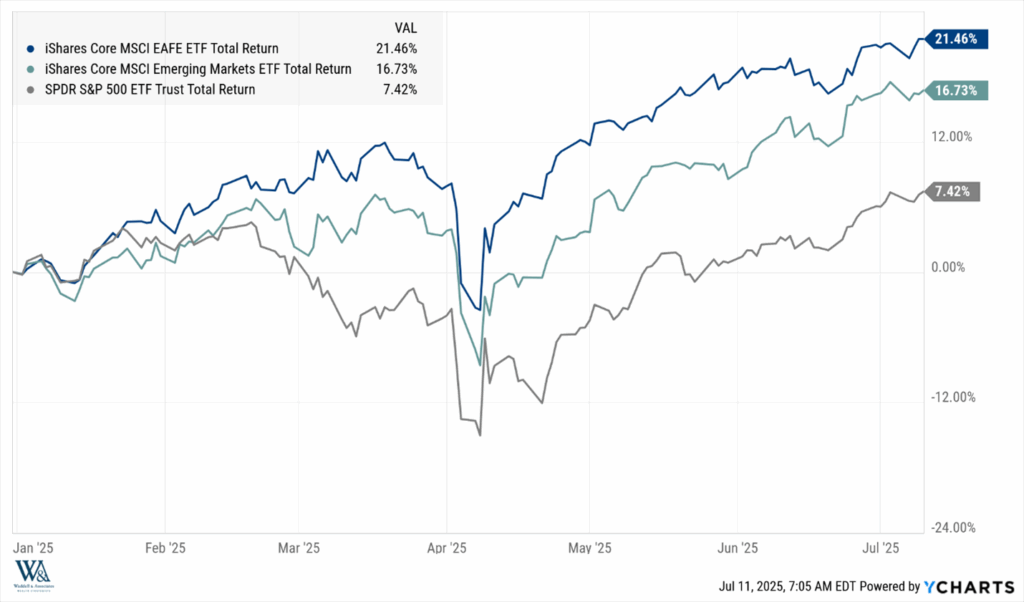
- Developed market equities, as represented by the iShares Core MSCI EAFE ETF (IEFA), are up 21% YTD in USD terms.
- Emerging market equities, via the iShares Core MSCI Emerging Markets ETF (IEMG), are up 16% YTD.
But if you remove the impact of the falling dollar, those returns fall to 11% and 6%, respectively. In other words, currency appreciation accounted for half the gains. That’s the power of foreign exchange working for, rather than against, global investors.
A Trend Reversal?
The shift represents a clear departure from recent history. For much of the past decade, a strong dollar suppressed foreign asset performance. When local currencies weakened against the dollar, U.S.-based investors often saw overseas gains erased in translation. The USD strength underpinned an era of U.S. asset outperformance and contributed to consistent home bias.
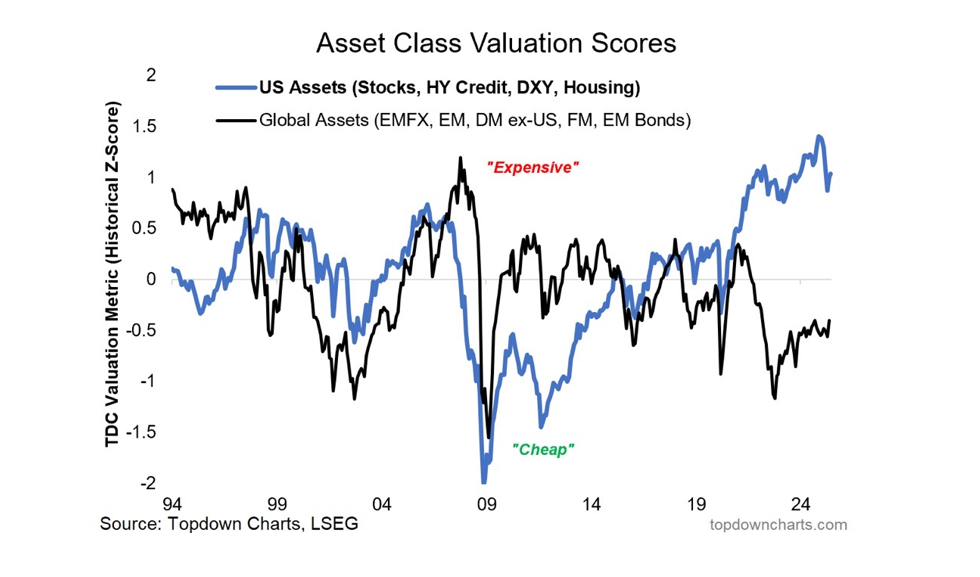
But 2025 is reminding investors that when the dollar falls, global diversification pays. And after 15 years of U.S. outperformance, the valuation gap between US and international assets has become increasingly difficult to ignore. U.S. assets are expensive relative to their global peers, and dollar weakness gives international markets both valuation appeal and performance momentum.
Reassessing Global Assumptions
It can be easy to fall victim to the narratives of recent market performance, but an environment with a weakening dollar necessitates a fresh look at portfolio factors, specifically:
- Currency exposure, historically viewed as a risk factor, is now a contributor to returns, particularly for investors in unhedged international allocations.
- Global diversification, often a defensive strategy, is now a source of alpha as foreign markets outperform and currency gains compound returns.
- While U.S. multinationals may benefit from currency translation, it’s international companies with revenues tied to strengthening local currencies that gain the most, both in earnings and relative valuation. The weaker dollar helps level the playing field, making non-U.S. equities more competitive on a global basis.
Enjoy the rest of your weekend!
-Matt
Sources: Ycharts, Topdown Charts, LSEG
This communication and its contents are for informational and educational purposes only and should not be used as the sole basis for any investment decision. The information contained herein is based on publicly available sources believed to be reliable but is not a representation, expressed or implied, as to the accuracy, completeness, or correctness of said information. Past performance does not guarantee future results. Waddell & Associates may use artificial intelligence tools to help generate or summarize content; all outputs are reviewed by our team for accuracy and relevance.
">U.S. Dollar: Implications for Global Returns
As we pass the halfway mark of 2025, one of the important themes shaping the investment landscape is the performance of the U.S. dollar. As the world’s reserve currency, the dollar wields unique influence over international markets from equity and bond returns to commodity pricing and capital flows. And this year, its story is one of meaningful weakness.
As measured by the DXY (U.S. Dollar Index), the greenback is down roughly 10% year-to-date. The index, which tracks the dollar’s value relative to a basket of other currencies (The euro, Japanese yen, British pound, Canadian dollar, Swedish krona, and Swiss franc), hasn’t experienced a double-digit annual drop since 2017—and before that, 2002. Moves of this magnitude have been rare in recent memory, and it materially impacts investor portfolios.
Why a Weaker Dollar Matters
For investors with international equity exposure, this year’s dollar decline has been a major tailwind. When the dollar weakens, gains in foreign markets, priced in local currency, translate into even stronger returns in dollar terms.
And the results have been impressive:
- Developed market equities, as represented by the iShares Core MSCI EAFE ETF (IEFA), are up 21% YTD in USD terms.
- Emerging market equities, via the iShares Core MSCI Emerging Markets ETF (IEMG), are up 16% YTD.
But if you remove the impact of the falling dollar, those returns fall to 11% and 6%, respectively. In other words, currency appreciation accounted for half the gains. That’s the power of foreign exchange working for, rather than against, global investors.
A Trend Reversal?
The shift represents a clear departure from recent history. For much of the past decade, a strong dollar suppressed foreign asset performance. When local currencies weakened against the dollar, U.S.-based investors often saw overseas gains erased in translation. The USD strength underpinned an era of U.S. asset outperformance and contributed to consistent home bias.
But 2025 is reminding investors that when the dollar falls, global diversification pays. And after 15 years of U.S. outperformance, the valuation gap between US and international assets has become increasingly difficult to ignore. U.S. assets are expensive relative to their global peers, and dollar weakness gives international markets both valuation appeal and performance momentum.
Reassessing Global Assumptions
It can be easy to fall victim to the narratives of recent market performance, but an environment with a weakening dollar necessitates a fresh look at portfolio factors, specifically:
- Currency exposure, historically viewed as a risk factor, is now a contributor to returns, particularly for investors in unhedged international allocations.
- Global diversification, often a defensive strategy, is now a source of alpha as foreign markets outperform and currency gains compound returns.
- While U.S. multinationals may benefit from currency translation, it’s international companies with revenues tied to strengthening local currencies that gain the most, both in earnings and relative valuation. The weaker dollar helps level the playing field, making non-U.S. equities more competitive on a global basis.
Enjoy the rest of your weekend!
-Matt
Sources: Ycharts, Topdown Charts, LSEG
This communication and its contents are for informational and educational purposes only and should not be used as the sole basis for any investment decision. The information contained herein is based on publicly available sources believed to be reliable but is not a representation, expressed or implied, as to the accuracy, completeness, or correctness of said information. Past performance does not guarantee future results. Waddell & Associates may use artificial intelligence tools to help generate or summarize content; all outputs are reviewed by our team for accuracy and relevance.
" class="link-chevron">
What a roller coaster of a first half! As I’ve told many, the first few months of 2025 have felt like a few years at this point. New administration—check. Liberation Day—check. Tax bill—check. Middle East conflict—check. New all-time highs—check. And while we spend much of our time looking forward, since we’ve reached the halfway mark of 2025, I think it’s an appropriate time to look back at the first half of the year.
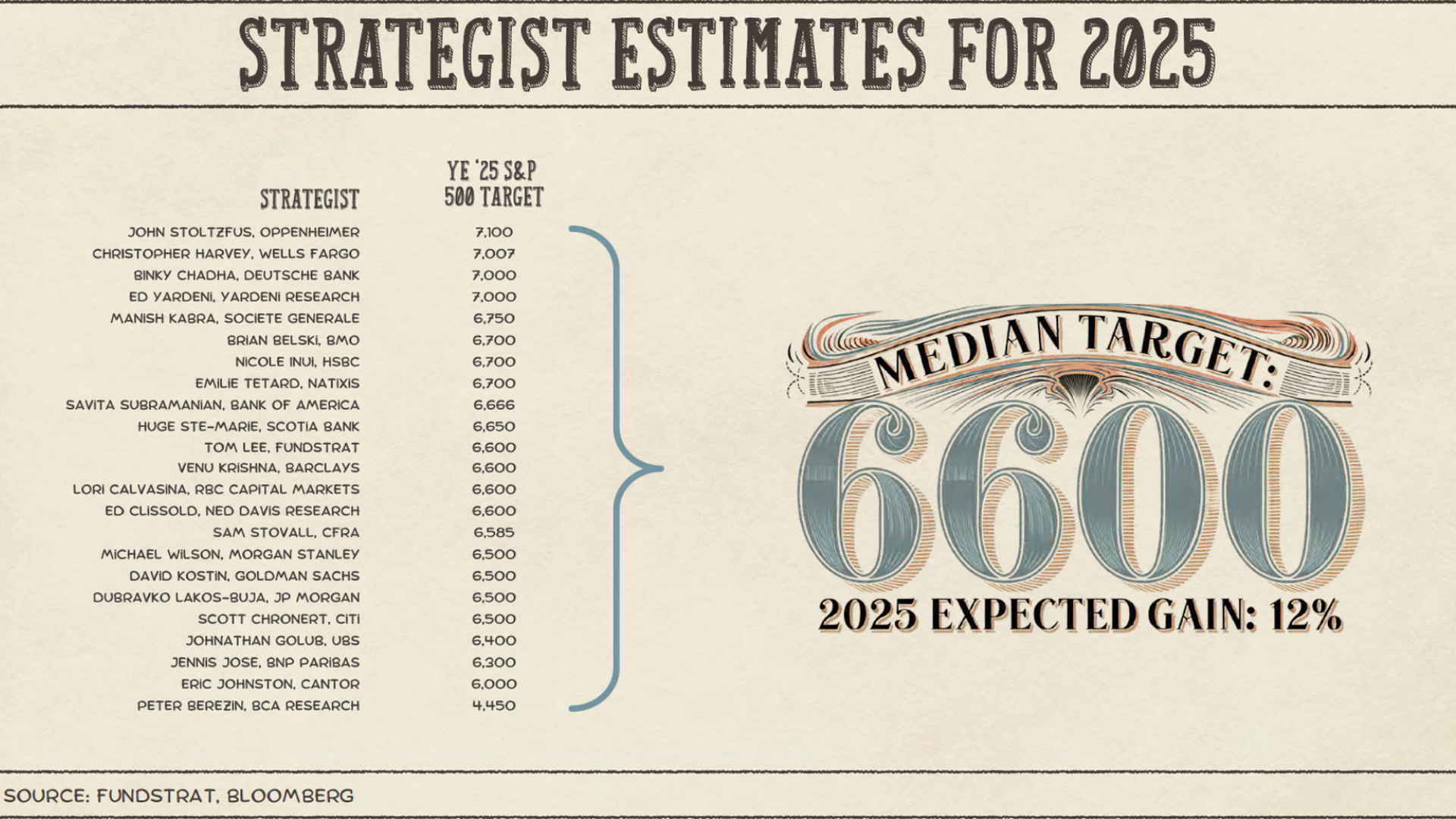
At the outset of the year, the median 2025 year-end target for the S&P 500 from strategists across Wall Street sat at 6,600, or a 12% gain. Today the index sits at nearly 6,175, up ~5% on the year. Most strategists were forecasting some market appreciation, while strategists at Oppenheimer, Wells, Deutchse, and even Yardeni predicted nearly 20% returns this year.
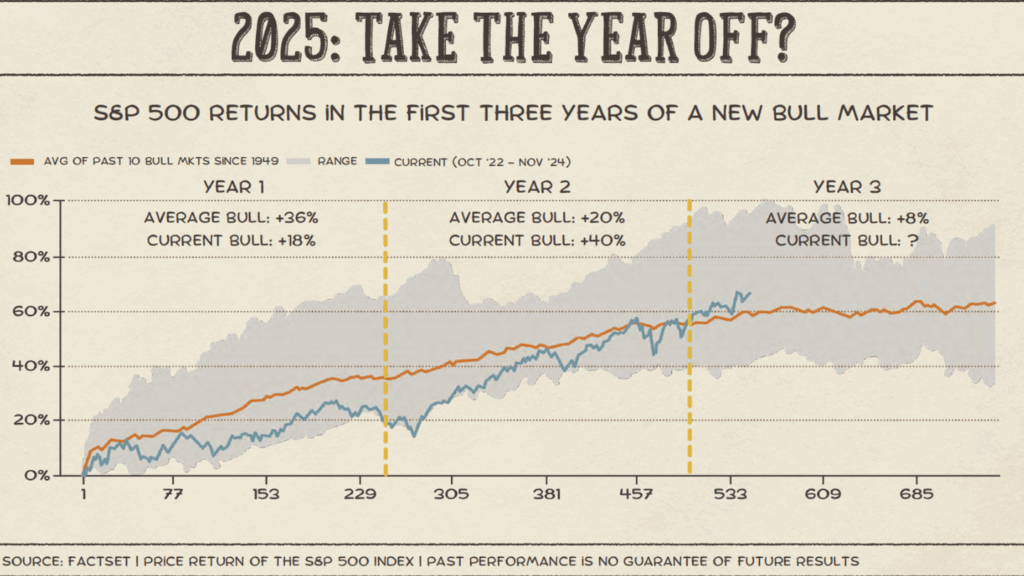
As we opined in our 2025 outlook presentation, we were cautiously optimistic that the bull market would continue, but likely in a more muted fashion. After big returns in 2023 and 2024, returns in year 3 of bull markets typically take a breather, averaging a modest 8%. Halfway through the year, we’re right on track.
If you missed the first half of the year and woke up today +5% year-to-date, congratulations on avoiding the news cycles. Funny how that works! Volatility, as measured by the VIX, ballooned north of 60 on April 7th and crashed to near 16 today (Friday, June 27th, 2025).
Similarly, high yield spreads are down 33% over the same time. Even oil prices that once rocketed on escalating tensions in the Middle East cratered -12% last week on news of a ceasefire. Many markets are back at all-time highs, having recalibrated to the news frequency and distribution methods of the new US administration.
Though the S&P sits +5% this year, the source of return inside the US has varied. Take the Mag-7. Combined, they are mostly flat on the year, with Apple and Tesla lagging and Meta, Microsoft, and Nvidia leading the way:
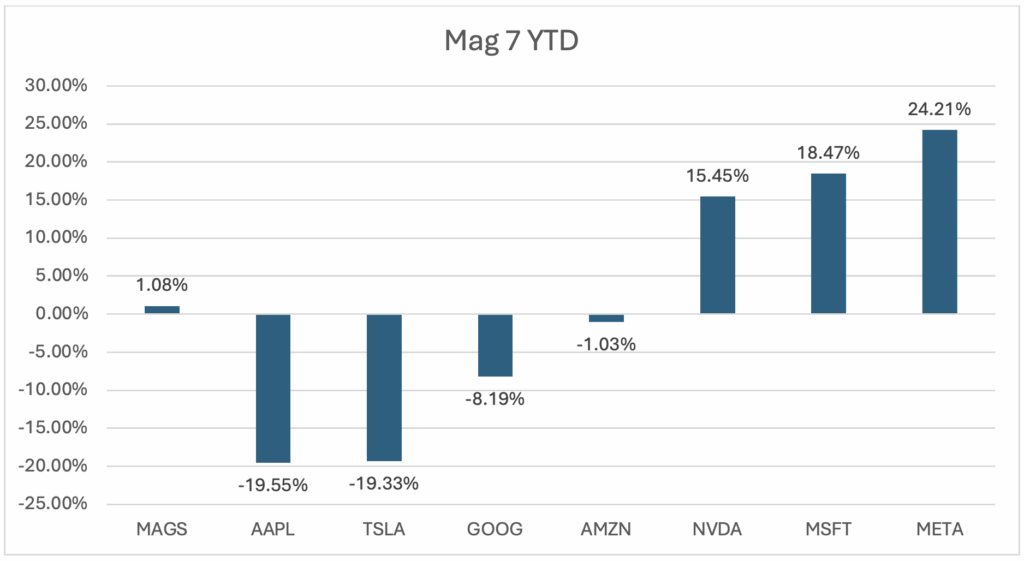
Source: YCharts, 6/27/2025
Outside of US equities, international stocks are up 19% (ETF: IEFA), while emerging markets are up 16% (ETF: EEM). Bond investors have been paid as well, with various US bond indices up between 3-4% year-to-date (AGG, LQD, and HYG, etc.). Not to be outdone, gold and silver are both up 25% (ETF: GLD & SLV). Overall, it’s been a great start to the year across most asset classes!
What lies ahead?
Of course we can’t just look backwards, though! Looking ahead, we are moving towards what are known as the seasonally weak months of the early fall. However, we first need to navigate July.
What makes this July unique is the volatility wind-down from April. When volatility blows out like it did in April, volatility-control funds, by nature of their rules, pare down exposure to keep overall portfolio volatility at a certain level. But, as realized volatility rolls off, they go from net sellers to net buyers. And for the folks that follow this space closely, next month the volatility metrics tell us vol-control funds will be big buyers—so big that the projected monthly purchase from vol-control funds is the biggest it’s ever been as far back as the data has been tracked (2004). On to the second half!
Have a great weekend!
-Matt
Sources: YCharts, Nomura Asset Management
This communication and its contents are for informational and educational purposes only and should not be used as the sole basis for any investment decision. Waddell & Associates does not provide personalized investment advice through this communication. The information contained herein is based on publicly available sources believed to be reliable but is not a representation, expressed or implied, as to the accuracy, completeness, or correctness of said information. Past performance does not guarantee future results.
">Halftime Highs!
What a roller coaster of a first half! As I’ve told many, the first few months of 2025 have felt like a few years at this point. New administration—check. Liberation Day—check. Tax bill—check. Middle East conflict—check. New all-time highs—check. And while we spend much of our time looking forward, since we’ve reached the halfway mark of 2025, I think it’s an appropriate time to look back at the first half of the year.
At the outset of the year, the median 2025 year-end target for the S&P 500 from strategists across Wall Street sat at 6,600, or a 12% gain. Today the index sits at nearly 6,175, up ~5% on the year. Most strategists were forecasting some market appreciation, while strategists at Oppenheimer, Wells, Deutchse, and even Yardeni predicted nearly 20% returns this year.
As we opined in our 2025 outlook presentation, we were cautiously optimistic that the bull market would continue, but likely in a more muted fashion. After big returns in 2023 and 2024, returns in year 3 of bull markets typically take a breather, averaging a modest 8%. Halfway through the year, we’re right on track.
If you missed the first half of the year and woke up today +5% year-to-date, congratulations on avoiding the news cycles. Funny how that works! Volatility, as measured by the VIX, ballooned north of 60 on April 7th and crashed to near 16 today (Friday, June 27th, 2025).
Similarly, high yield spreads are down 33% over the same time. Even oil prices that once rocketed on escalating tensions in the Middle East cratered -12% last week on news of a ceasefire. Many markets are back at all-time highs, having recalibrated to the news frequency and distribution methods of the new US administration.
Though the S&P sits +5% this year, the source of return inside the US has varied. Take the Mag-7. Combined, they are mostly flat on the year, with Apple and Tesla lagging and Meta, Microsoft, and Nvidia leading the way:
Source: YCharts, 6/27/2025
Outside of US equities, international stocks are up 19% (ETF: IEFA), while emerging markets are up 16% (ETF: EEM). Bond investors have been paid as well, with various US bond indices up between 3-4% year-to-date (AGG, LQD, and HYG, etc.). Not to be outdone, gold and silver are both up 25% (ETF: GLD & SLV). Overall, it’s been a great start to the year across most asset classes!
What lies ahead?
Of course we can’t just look backwards, though! Looking ahead, we are moving towards what are known as the seasonally weak months of the early fall. However, we first need to navigate July.
What makes this July unique is the volatility wind-down from April. When volatility blows out like it did in April, volatility-control funds, by nature of their rules, pare down exposure to keep overall portfolio volatility at a certain level. But, as realized volatility rolls off, they go from net sellers to net buyers. And for the folks that follow this space closely, next month the volatility metrics tell us vol-control funds will be big buyers—so big that the projected monthly purchase from vol-control funds is the biggest it’s ever been as far back as the data has been tracked (2004). On to the second half!
Have a great weekend!
-Matt
Sources: YCharts, Nomura Asset Management
This communication and its contents are for informational and educational purposes only and should not be used as the sole basis for any investment decision. Waddell & Associates does not provide personalized investment advice through this communication. The information contained herein is based on publicly available sources believed to be reliable but is not a representation, expressed or implied, as to the accuracy, completeness, or correctness of said information. Past performance does not guarantee future results.
" class="link-chevron">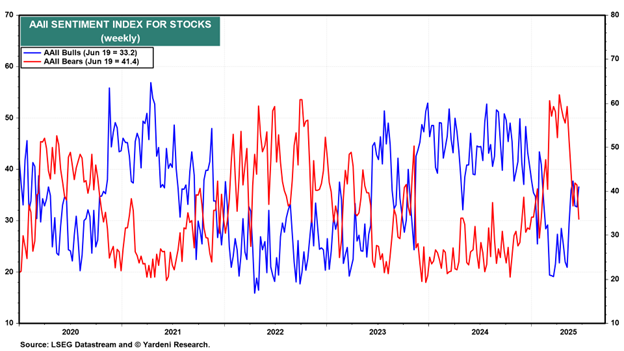
As we discussed in our Market Outlook from February, it was likely a year to take off, and my guess is that most of Wall Street is out enjoying the Hamptons. For now, investors should continue to capitalize on opportunities when sentiment is overly bullish or bearish and allow it to serve as a guide for intermediate-term price action.
All this means is it’s officially baseball season. As has been said before, sports are more than entertainment—they’re a classroom for life. They deliver lessons, memories, and moments that shape our character. Last week, Arkansas exited the Men’s College World Series after a couple of tough breaks. It stings. Those players will carry that taste for a while. But the most powerful moment came after the final out, and it offered a lesson that’s just as relevant to our work as it is to theirs.
The Scene of the Crime
The Razorbacks led 5–3 in the bottom of the ninth. Two outs. Runners on first and second. A line drive heads to left field—straight to Charles Davalan, the Hogs’ left fielder. He hadn’t made an error all season. Seriously. But in this moment, he misjudges the ball. It skips past him to the wall, the runners score, and the game is tied. Arkansas would eventually lose in extra innings. Ouch. Here’s the replay.
Imagine the replay in his head… a single play that will live with him for a long time.
But then, something awesome happened. As cameras kept rolling, Charles was swarmed—not with criticism, but compassion. Coaches and teammates. Tears and hugs. Encouragement and support. Here’s the video. Charles was in a rough spot, but his coaches and teammates were there when he needed them most.
Why Work with an Advisor?
So, what does this have to do with financial planning?
It’s a question we hear often: Why should I hire an advisor to manage my financial life?
Here’s why: because, like Arkansas’ coaches and teammates, we’re not just there when you hit a home run. We’re by your side through the errors, the strikeouts, the walks, the wild pitches. When faced with an obstacle, we’re right alongside. A good advisor—like a good coach or teammate—offers insight, advice, perspective, and calm in the midst of a storm. Financial planning isn’t one-size-fits-all. It’s personal. It’s long-term. And it’s a journey best traveled with someone who’s invested in you.
So, build your village. Find your coach, and partner with a strategist who’s there for the big moments and the hard ones. As markets revisit all-time highs, the value of your advisor relationship will provide the most alpha to your financial plan over time.
That’s all for this week.
Cheers,
Matt
Sources: LSEG Datastream and Yardeni Research
This communication and its contents are for informational and educational purposes only and should not be used as the sole basis for any investment decision. Waddell & Associates does not provide personalized investment advice through this communication. The information contained herein is based on publicly available sources believed to be reliable but is not a representation, expressed or implied, as to the accuracy, completeness, or correctness of said information. Past performance does not guarantee future results.
">
Football is wrapped. Basketball is (nearly) in the books. We’ve officially entered the dog days of summer. With it, US equity markets have rebounded sharply from the lows of “Liberation Day”, and the S&P 500 sits less than 3% from the all-time closing high on February 19th. Stock sentiment has recalibrated with this V-shape recovery:
As we discussed in our Market Outlook from February, it was likely a year to take off, and my guess is that most of Wall Street is out enjoying the Hamptons. For now, investors should continue to capitalize on opportunities when sentiment is overly bullish or bearish and allow it to serve as a guide for intermediate-term price action.
All this means is it’s officially baseball season. As has been said before, sports are more than entertainment—they’re a classroom for life. They deliver lessons, memories, and moments that shape our character. Last week, Arkansas exited the Men’s College World Series after a couple of tough breaks. It stings. Those players will carry that taste for a while. But the most powerful moment came after the final out, and it offered a lesson that’s just as relevant to our work as it is to theirs.
The Scene of the Crime
The Razorbacks led 5–3 in the bottom of the ninth. Two outs. Runners on first and second. A line drive heads to left field—straight to Charles Davalan, the Hogs’ left fielder. He hadn’t made an error all season. Seriously. But in this moment, he misjudges the ball. It skips past him to the wall, the runners score, and the game is tied. Arkansas would eventually lose in extra innings. Ouch. Here’s the replay.
Imagine the replay in his head… a single play that will live with him for a long time.
But then, something awesome happened. As cameras kept rolling, Charles was swarmed—not with criticism, but compassion. Coaches and teammates. Tears and hugs. Encouragement and support. Here’s the video. Charles was in a rough spot, but his coaches and teammates were there when he needed them most.
Why Work with an Advisor?
So, what does this have to do with financial planning?
It’s a question we hear often: Why should I hire an advisor to manage my financial life?
Here’s why: because, like Arkansas’ coaches and teammates, we’re not just there when you hit a home run. We’re by your side through the errors, the strikeouts, the walks, the wild pitches. When faced with an obstacle, we’re right alongside. A good advisor—like a good coach or teammate—offers insight, advice, perspective, and calm in the midst of a storm. Financial planning isn’t one-size-fits-all. It’s personal. It’s long-term. And it’s a journey best traveled with someone who’s invested in you.
So, build your village. Find your coach, and partner with a strategist who’s there for the big moments and the hard ones. As markets revisit all-time highs, the value of your advisor relationship will provide the most alpha to your financial plan over time.
That’s all for this week.
Cheers,
Matt
Sources: LSEG Datastream and Yardeni Research
This communication and its contents are for informational and educational purposes only and should not be used as the sole basis for any investment decision. Waddell & Associates does not provide personalized investment advice through this communication. The information contained herein is based on publicly available sources believed to be reliable but is not a representation, expressed or implied, as to the accuracy, completeness, or correctness of said information. Past performance does not guarantee future results.
">The Value of a Good Teammate (and Advisor) Football is wrapped. Basketball is (nearly) in the books. We’ve officially entered the dog days of summer. With it, US equity markets have rebounded sharply from the lows of “Liberation Day”, and the S&P 500 sits less than 3% from the all-time closing high on February 19th. Stock sentiment has recalibrated with this V-shape recovery:
As we discussed in our Market Outlook from February, it was likely a year to take off, and my guess is that most of Wall Street is out enjoying the Hamptons. For now, investors should continue to capitalize on opportunities when sentiment is overly bullish or bearish and allow it to serve as a guide for intermediate-term price action.
All this means is it’s officially baseball season. As has been said before, sports are more than entertainment—they’re a classroom for life. They deliver lessons, memories, and moments that shape our character. Last week, Arkansas exited the Men’s College World Series after a couple of tough breaks. It stings. Those players will carry that taste for a while. But the most powerful moment came after the final out, and it offered a lesson that’s just as relevant to our work as it is to theirs.
The Scene of the Crime
The Razorbacks led 5–3 in the bottom of the ninth. Two outs. Runners on first and second. A line drive heads to left field—straight to Charles Davalan, the Hogs’ left fielder. He hadn’t made an error all season. Seriously. But in this moment, he misjudges the ball. It skips past him to the wall, the runners score, and the game is tied. Arkansas would eventually lose in extra innings. Ouch. Here’s the replay.
Imagine the replay in his head… a single play that will live with him for a long time.
But then, something awesome happened. As cameras kept rolling, Charles was swarmed—not with criticism, but compassion. Coaches and teammates. Tears and hugs. Encouragement and support. Here’s the video. Charles was in a rough spot, but his coaches and teammates were there when he needed them most.
Why Work with an Advisor?
So, what does this have to do with financial planning?
It’s a question we hear often: Why should I hire an advisor to manage my financial life?
Here’s why: because, like Arkansas’ coaches and teammates, we’re not just there when you hit a home run. We’re by your side through the errors, the strikeouts, the walks, the wild pitches. When faced with an obstacle, we’re right alongside. A good advisor—like a good coach or teammate—offers insight, advice, perspective, and calm in the midst of a storm. Financial planning isn’t one-size-fits-all. It’s personal. It’s long-term. And it’s a journey best traveled with someone who’s invested in you.
So, build your village. Find your coach, and partner with a strategist who’s there for the big moments and the hard ones. As markets revisit all-time highs, the value of your advisor relationship will provide the most alpha to your financial plan over time.
That’s all for this week.
Cheers,
Matt
Sources: LSEG Datastream and Yardeni Research
This communication and its contents are for informational and educational purposes only and should not be used as the sole basis for any investment decision. Waddell & Associates does not provide personalized investment advice through this communication. The information contained herein is based on publicly available sources believed to be reliable but is not a representation, expressed or implied, as to the accuracy, completeness, or correctness of said information. Past performance does not guarantee future results.
" class="link-chevron">Research indicates that the number of publicly traded U.S. companies has roughly halved over the past two decades. This isn’t mere coincidence—it’s a fundamental shift in how businesses approach capital.
Companies are strategically choosing to remain private longer, which means their most dynamic growth phases often occur well before they ever appear on a public exchange. Some high-performing enterprises have no intention of going public at all.
For sophisticated investors, focusing exclusively on public markets means potentially missing an entire universe of opportunity.
This is precisely where alternative investments can play a significant role in a sophisticated portfolio. Beyond just private equity and debt, the alternatives ecosystem encompasses a diverse array of strategies—from hedge funds and venture capital to real assets like infrastructure, farmland, and commercial real estate.
I often describe alternatives as the essential “third leg of the stool.” When thoughtfully integrated, alternatives complement traditional public equities and fixed income to create a more structurally stable portfolio. This strategic advantage explains why alternatives have become a cornerstone for institutional investors like university endowments and sovereign wealth funds.
Yet, despite their compelling benefits, individual investors—even those with significant wealth—have been comparatively slower to incorporate alternatives into their wealth strategy. This presents both a challenge and an opportunity for families seeking to preserve and grow their wealth across generations.
Why consider alts?
Alternatives have some compelling advantages.
First, they can provide diversification through low correlation* with traditional investments. In other words, they don’t tend to move in lockstep with stocks or bonds. During periods of volatility, that can help smooth returns and reduce portfolio swings.
*Correlation, in this context, measures how investments move relative to each other. Assets with low or negative correlation don’t rise and fall together, which can help balance a portfolio.
Second, some alternative strategies have historically outpaced public markets. Private equity, for example, has outperformed the S&P 500 in different periods over the last 20 years.
Third, alternatives can provide exposure to innovative sectors and companies that are still in their early, high-growth years. Because companies today stay private longer, investors in private equity, venture capital, and other alternative strategies can access opportunities that aren’t available through the public markets alone.
Finally, alternatives can provide a psychological buffer during market volatility.
Unlike publicly traded investments, many alternatives are not priced daily. This lack of constant valuation can help investors stay focused on long-term goals rather than reacting to short-term market swings.
Nonetheless, alternatives remain surrounded by misconceptions that can prevent investors from leveraging these powerful tools.
Common misconceptions of alternative investments
Costs:
The first reaction I hear from clients exploring alternatives is sticker shock. Some alternative investments do carry higher fees—typically between 1% to 2% of assets under management plus a performance fee of 10% to 20% of profits.
However, this isn’t universally true. Mutual and exchange-traded funds that offer alternative strategies are typically prohibited from charging performance fees, although their expenses are higher than most other mutual funds and ETFs.
Transparency:
Transparency is another common concern. Unlike buying shares of Apple or Nvidia through a brokerage account, alternatives typically involve hiring managers to execute strategies through more complex structures. Managers usually disclose their investments quarterly, offering a limited view into their holdings.
Unrealistic expectations:
Some investors also have inflated expectations about alternatives based on stories they’ve heard, usually from a boastful relative around the Thanksgiving table. These anecdotes create misconceptions about the role alternatives should play in a sophisticated portfolio.
Are alternatives right for me? In what ways?
When we explore alternatives with you here at Waddell & Associates, we focus on how these assets might enhance your overall wealth strategy. This evaluation centers around several key dimensions:
Investment Time Horizon
Some alternative investments, like typical drawdown structure private equity, require commitments of 7-10 years or longer—an important consideration we explore in depth:
How does this timeline align with your wealth transition plans? Will these funds need to be accessible during a particular life season?
If you have multi-generational wealth objectives, longer-term alternative investments can serve as ideal vehicles for wealth earmarked for future generations.
Liquidity Strategy
We also examine a client’s comprehensive liquidity profile:
How might periodic or limited access to these funds affect your lifestyle needs and other financial objectives?
Rather than simply asking if clients are comfortable with illiquidity, we help visualize specific scenarios where limited access might impact plans, then develop strategies to address those potential situations.
Portfolio Integration
Alternatives should complement your existing investment approach, not dominate it. We consider:
How do these alternatives interact with your current holdings? What exposures are you seeking to enhance or minimize?
The W&A Approach
Remember, our conversations about alternatives are simply one aspect of our broader strategic partnership. As we explore these opportunities together, we’ll continue to place them in context with your complete wealth picture—ensuring any decisions align with both your long-term vision and near-term priorities.
New here? Learn about the Waddell & Associates difference and explore how you can work with us. We’d love to hear from you.
Matt Gentzkow is an Investment Strategist with Waddell & Associates
Sources: Commonfund.org, FSInvestments.com, Credit-Suisse.com
This communication and its contents are for informational and educational purposes only and should not be used as the sole basis for any investment decision. Waddell & Associates does not provide personalized investment advice through this communication. The information contained herein is based on publicly available sources believed to be reliable but is not a representation, expressed or implied, as to the accuracy, completeness, or correctness of said information. Past performance does not guarantee future results.
">
Before we discuss alternative investments, it’s worth noting an important shift in the investment landscape: public markets have contracted, and significantly so.
Research indicates that the number of publicly traded U.S. companies has roughly halved over the past two decades. This isn’t mere coincidence—it’s a fundamental shift in how businesses approach capital.
Companies are strategically choosing to remain private longer, which means their most dynamic growth phases often occur well before they ever appear on a public exchange. Some high-performing enterprises have no intention of going public at all.
For sophisticated investors, focusing exclusively on public markets means potentially missing an entire universe of opportunity.
This is precisely where alternative investments can play a significant role in a sophisticated portfolio. Beyond just private equity and debt, the alternatives ecosystem encompasses a diverse array of strategies—from hedge funds and venture capital to real assets like infrastructure, farmland, and commercial real estate.
I often describe alternatives as the essential “third leg of the stool.” When thoughtfully integrated, alternatives complement traditional public equities and fixed income to create a more structurally stable portfolio. This strategic advantage explains why alternatives have become a cornerstone for institutional investors like university endowments and sovereign wealth funds.
Yet, despite their compelling benefits, individual investors—even those with significant wealth—have been comparatively slower to incorporate alternatives into their wealth strategy. This presents both a challenge and an opportunity for families seeking to preserve and grow their wealth across generations.
Why consider alts?
Alternatives have some compelling advantages.
First, they can provide diversification through low correlation* with traditional investments. In other words, they don’t tend to move in lockstep with stocks or bonds. During periods of volatility, that can help smooth returns and reduce portfolio swings.
*Correlation, in this context, measures how investments move relative to each other. Assets with low or negative correlation don’t rise and fall together, which can help balance a portfolio.
Second, some alternative strategies have historically outpaced public markets. Private equity, for example, has outperformed the S&P 500 in different periods over the last 20 years.
Third, alternatives can provide exposure to innovative sectors and companies that are still in their early, high-growth years. Because companies today stay private longer, investors in private equity, venture capital, and other alternative strategies can access opportunities that aren’t available through the public markets alone.
Finally, alternatives can provide a psychological buffer during market volatility.
Unlike publicly traded investments, many alternatives are not priced daily. This lack of constant valuation can help investors stay focused on long-term goals rather than reacting to short-term market swings.
Nonetheless, alternatives remain surrounded by misconceptions that can prevent investors from leveraging these powerful tools.
Common misconceptions of alternative investments
Costs:
The first reaction I hear from clients exploring alternatives is sticker shock. Some alternative investments do carry higher fees—typically between 1% to 2% of assets under management plus a performance fee of 10% to 20% of profits.
However, this isn’t universally true. Mutual and exchange-traded funds that offer alternative strategies are typically prohibited from charging performance fees, although their expenses are higher than most other mutual funds and ETFs.
Transparency:
Transparency is another common concern. Unlike buying shares of Apple or Nvidia through a brokerage account, alternatives typically involve hiring managers to execute strategies through more complex structures. Managers usually disclose their investments quarterly, offering a limited view into their holdings.
Unrealistic expectations:
Some investors also have inflated expectations about alternatives based on stories they’ve heard, usually from a boastful relative around the Thanksgiving table. These anecdotes create misconceptions about the role alternatives should play in a sophisticated portfolio.
Are alternatives right for me? In what ways?
When we explore alternatives with you here at Waddell & Associates, we focus on how these assets might enhance your overall wealth strategy. This evaluation centers around several key dimensions:
Investment Time Horizon
Some alternative investments, like typical drawdown structure private equity, require commitments of 7-10 years or longer—an important consideration we explore in depth:
How does this timeline align with your wealth transition plans? Will these funds need to be accessible during a particular life season?
If you have multi-generational wealth objectives, longer-term alternative investments can serve as ideal vehicles for wealth earmarked for future generations.
Liquidity Strategy
We also examine a client’s comprehensive liquidity profile:
How might periodic or limited access to these funds affect your lifestyle needs and other financial objectives?
Rather than simply asking if clients are comfortable with illiquidity, we help visualize specific scenarios where limited access might impact plans, then develop strategies to address those potential situations.
Portfolio Integration
Alternatives should complement your existing investment approach, not dominate it. We consider:
How do these alternatives interact with your current holdings? What exposures are you seeking to enhance or minimize?
The W&A Approach
Remember, our conversations about alternatives are simply one aspect of our broader strategic partnership. As we explore these opportunities together, we’ll continue to place them in context with your complete wealth picture—ensuring any decisions align with both your long-term vision and near-term priorities.
New here? Learn about the Waddell & Associates difference and explore how you can work with us. We’d love to hear from you.
Matt Gentzkow is an Investment Strategist with Waddell & Associates
Sources: Commonfund.org, FSInvestments.com, Credit-Suisse.com
This communication and its contents are for informational and educational purposes only and should not be used as the sole basis for any investment decision. Waddell & Associates does not provide personalized investment advice through this communication. The information contained herein is based on publicly available sources believed to be reliable but is not a representation, expressed or implied, as to the accuracy, completeness, or correctness of said information. Past performance does not guarantee future results.
">Beyond Stocks and Bonds: The Strategic Role of Alternative Investments Before we discuss alternative investments, it’s worth noting an important shift in the investment landscape: public markets have contracted, and significantly so.Research indicates that the number of publicly traded U.S. companies has roughly halved over the past two decades. This isn’t mere coincidence—it’s a fundamental shift in how businesses approach capital.
Companies are strategically choosing to remain private longer, which means their most dynamic growth phases often occur well before they ever appear on a public exchange. Some high-performing enterprises have no intention of going public at all.
For sophisticated investors, focusing exclusively on public markets means potentially missing an entire universe of opportunity.
This is precisely where alternative investments can play a significant role in a sophisticated portfolio. Beyond just private equity and debt, the alternatives ecosystem encompasses a diverse array of strategies—from hedge funds and venture capital to real assets like infrastructure, farmland, and commercial real estate.
I often describe alternatives as the essential “third leg of the stool.” When thoughtfully integrated, alternatives complement traditional public equities and fixed income to create a more structurally stable portfolio. This strategic advantage explains why alternatives have become a cornerstone for institutional investors like university endowments and sovereign wealth funds.
Yet, despite their compelling benefits, individual investors—even those with significant wealth—have been comparatively slower to incorporate alternatives into their wealth strategy. This presents both a challenge and an opportunity for families seeking to preserve and grow their wealth across generations.
Why consider alts?
Alternatives have some compelling advantages.
First, they can provide diversification through low correlation* with traditional investments. In other words, they don’t tend to move in lockstep with stocks or bonds. During periods of volatility, that can help smooth returns and reduce portfolio swings.
*Correlation, in this context, measures how investments move relative to each other. Assets with low or negative correlation don’t rise and fall together, which can help balance a portfolio.
Second, some alternative strategies have historically outpaced public markets. Private equity, for example, has outperformed the S&P 500 in different periods over the last 20 years.
Third, alternatives can provide exposure to innovative sectors and companies that are still in their early, high-growth years. Because companies today stay private longer, investors in private equity, venture capital, and other alternative strategies can access opportunities that aren’t available through the public markets alone.
Finally, alternatives can provide a psychological buffer during market volatility.
Unlike publicly traded investments, many alternatives are not priced daily. This lack of constant valuation can help investors stay focused on long-term goals rather than reacting to short-term market swings.
Nonetheless, alternatives remain surrounded by misconceptions that can prevent investors from leveraging these powerful tools.
Common misconceptions of alternative investments
Costs:
The first reaction I hear from clients exploring alternatives is sticker shock. Some alternative investments do carry higher fees—typically between 1% to 2% of assets under management plus a performance fee of 10% to 20% of profits.
However, this isn’t universally true. Mutual and exchange-traded funds that offer alternative strategies are typically prohibited from charging performance fees, although their expenses are higher than most other mutual funds and ETFs.
Transparency:
Transparency is another common concern. Unlike buying shares of Apple or Nvidia through a brokerage account, alternatives typically involve hiring managers to execute strategies through more complex structures. Managers usually disclose their investments quarterly, offering a limited view into their holdings.
Unrealistic expectations:
Some investors also have inflated expectations about alternatives based on stories they’ve heard, usually from a boastful relative around the Thanksgiving table. These anecdotes create misconceptions about the role alternatives should play in a sophisticated portfolio.
Are alternatives right for me? In what ways?
When we explore alternatives with you here at Waddell & Associates, we focus on how these assets might enhance your overall wealth strategy. This evaluation centers around several key dimensions:
Investment Time Horizon
Some alternative investments, like typical drawdown structure private equity, require commitments of 7-10 years or longer—an important consideration we explore in depth:
How does this timeline align with your wealth transition plans? Will these funds need to be accessible during a particular life season?
If you have multi-generational wealth objectives, longer-term alternative investments can serve as ideal vehicles for wealth earmarked for future generations.
Liquidity Strategy
We also examine a client’s comprehensive liquidity profile:
How might periodic or limited access to these funds affect your lifestyle needs and other financial objectives?
Rather than simply asking if clients are comfortable with illiquidity, we help visualize specific scenarios where limited access might impact plans, then develop strategies to address those potential situations.
Portfolio Integration
Alternatives should complement your existing investment approach, not dominate it. We consider:
How do these alternatives interact with your current holdings? What exposures are you seeking to enhance or minimize?
The W&A Approach
Remember, our conversations about alternatives are simply one aspect of our broader strategic partnership. As we explore these opportunities together, we’ll continue to place them in context with your complete wealth picture—ensuring any decisions align with both your long-term vision and near-term priorities.
New here? Learn about the Waddell & Associates difference and explore how you can work with us. We’d love to hear from you.
Matt Gentzkow is an Investment Strategist with Waddell & Associates
Sources: Commonfund.org, FSInvestments.com, Credit-Suisse.com
This communication and its contents are for informational and educational purposes only and should not be used as the sole basis for any investment decision. Waddell & Associates does not provide personalized investment advice through this communication. The information contained herein is based on publicly available sources believed to be reliable but is not a representation, expressed or implied, as to the accuracy, completeness, or correctness of said information. Past performance does not guarantee future results.
" class="link-chevron">
In recent decades, corporate stock buybacks have become a force in the financial landscape. Once rare, buybacks are now one of the most common ways corporations return capital to shareholders, alongside or even in place of dividends. Most importantly, under the current market structure, buybacks provide market liquidity and naturally support equity prices. But while buybacks are a shareholder and investor-friendly move, they also raise critical questions about financial engineering, or a fancy way of making the math friendlier to company financial metrics.
Buy, Buy, Buy Back!
Q1 2025 earnings growth of the S&P500 sits at 12.1%, and while companies have cut guidance and expectations for Q2 and Q3, their management teams have also agreed to hit the buy button on their own company stocks. Corporate buybacks, or when a company repurchases its own shares in the open market, are hitting record highs:
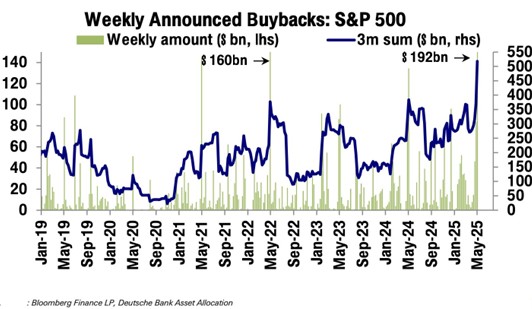
Corporate buybacks are important to investors for a few different reasons:
- Buybacks are positive flows and provide liquidity to markets when they might otherwise not have it.
- They suggest management confidence in a company’s growth prospects.
- Buybacks could indicate that management perceives a valuation discount on the current market price.
The Invisible Hand
I’ve written here before about market structure and its dynamics, but not specifically on buybacks. Markets, and specifically equity prices, are a constant valuation of supply and demand. Buybacks have been around for a few decades; however, the practice has grown substantially over the last fifteen years:
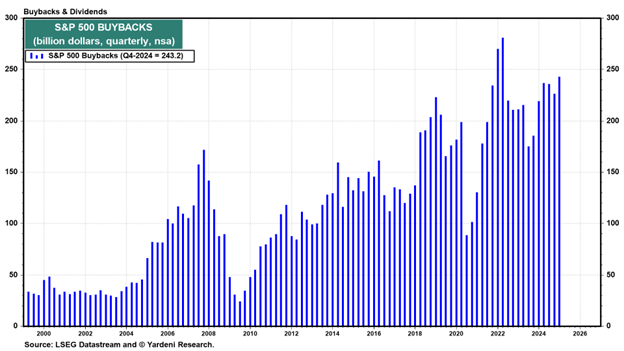
Though measured quarterly, you can see that in 2009, just roughly $150 billion was spent on share repurchases. In 2022? Well over $1 trillion. US companies are scooping up their own stock at depressed prices. These buyback flows prove supportive to equity prices on both sides of supply and demand, as the actual number of shares outstanding decreases, while simultaneously driving demand higher as they purchase the shares themselves on the open market.
Management Confidence
The underlying strength in buybacks during periods of market distress can help guide us through corrective phases in prices. Peaks in recent share repurchases came in 2018, 2020, 2022, and now 2025. As US companies generate record profit margins, they increasingly deliver capital back to shareholders through repurchases. Management teams have been some of the best price dip buyers over the last decade. If the recent record increase in announced buybacks in the S&P is any indication, we should have positive flows in the market supporting equities over the intermediate term as the announced plans are executed.
It’s Just Math
Though corporate buybacks are positive for investors, there are some who argue that corporate buybacks are glorified financial engineering, because corporate buybacks augment underlying valuation metrics. Let’s explore.
When a company decides to buy back its stock on the open market, it reduces the shares outstanding for the company. If net income remains constant, it will increase the company’s earnings per share metric:
Earnings Per Share = Net Income / Shares Outstanding
For example:
$100 million net income / 50 million shares = $2.00 Earnings Per Share
After buying back 10 million shares:
$100 million net income / 40 million shares = $2.50 Earnings Per Share
Voila! An increase in EPS!
Even further, an increase in EPS is supportive of valuation metrics like P/E ratios (price/earnings). Again, this is just math, but follow me here. If EPS increases via a corporate buyback, and stock prices remain unchanged, the P/E ratio will fall simply because the denominator (EPS) has increased. Given the decrease in P/E, a company’s stock or even an index could look “cheaper” from a valuation standpoint, perpetuating more buy-side demand for the stock or index. Why does this matter for investors? As I touched on last week, companies have begun reducing guidance and EPS growth for the latter half of the year, while now also announcing stock buybacks. Since companies are mathematically increasing EPS through reducing shares outstanding (denominator of EPS), if they at all beat expectations on net income in the coming quarters (numerator of EPS), and market prices stay relatively unchanged, the market could be “undervalued” from a P/E ratio perspective later this year, perpetuating more demand for equities. You can call it a buyback or financial engineering, but it’s just math, and buybacks are naturally supportive of equity prices, ultimately benefiting investors.
Have a great weekend!
-Matt
Sources: Yardeni, Bloomberg Finance LP, Deutsche Bank
This communication and its contents are for informational and educational purposes only and should not be used as the sole basis for any investment decision. Waddell & Associates does not provide personalized investment advice through this communication. The information contained herein is based on publicly available sources believed to be reliable but is not a representation, expressed or implied, as to the accuracy, completeness, or correctness of said information. Past performance does not guarantee future results.
">Corporate Buybacks: Inspiring Confidence or Engineering Financials?
In recent decades, corporate stock buybacks have become a force in the financial landscape. Once rare, buybacks are now one of the most common ways corporations return capital to shareholders, alongside or even in place of dividends. Most importantly, under the current market structure, buybacks provide market liquidity and naturally support equity prices. But while buybacks are a shareholder and investor-friendly move, they also raise critical questions about financial engineering, or a fancy way of making the math friendlier to company financial metrics.
Buy, Buy, Buy Back!
Q1 2025 earnings growth of the S&P500 sits at 12.1%, and while companies have cut guidance and expectations for Q2 and Q3, their management teams have also agreed to hit the buy button on their own company stocks. Corporate buybacks, or when a company repurchases its own shares in the open market, are hitting record highs:
Corporate buybacks are important to investors for a few different reasons:
- Buybacks are positive flows and provide liquidity to markets when they might otherwise not have it.
- They suggest management confidence in a company’s growth prospects.
- Buybacks could indicate that management perceives a valuation discount on the current market price.
The Invisible Hand
I’ve written here before about market structure and its dynamics, but not specifically on buybacks. Markets, and specifically equity prices, are a constant valuation of supply and demand. Buybacks have been around for a few decades; however, the practice has grown substantially over the last fifteen years:
Though measured quarterly, you can see that in 2009, just roughly $150 billion was spent on share repurchases. In 2022? Well over $1 trillion. US companies are scooping up their own stock at depressed prices. These buyback flows prove supportive to equity prices on both sides of supply and demand, as the actual number of shares outstanding decreases, while simultaneously driving demand higher as they purchase the shares themselves on the open market.
Management Confidence
The underlying strength in buybacks during periods of market distress can help guide us through corrective phases in prices. Peaks in recent share repurchases came in 2018, 2020, 2022, and now 2025. As US companies generate record profit margins, they increasingly deliver capital back to shareholders through repurchases. Management teams have been some of the best price dip buyers over the last decade. If the recent record increase in announced buybacks in the S&P is any indication, we should have positive flows in the market supporting equities over the intermediate term as the announced plans are executed.
It’s Just Math
Though corporate buybacks are positive for investors, there are some who argue that corporate buybacks are glorified financial engineering, because corporate buybacks augment underlying valuation metrics. Let’s explore.
When a company decides to buy back its stock on the open market, it reduces the shares outstanding for the company. If net income remains constant, it will increase the company’s earnings per share metric:
Earnings Per Share = Net Income / Shares Outstanding
For example:
$100 million net income / 50 million shares = $2.00 Earnings Per Share
After buying back 10 million shares:
$100 million net income / 40 million shares = $2.50 Earnings Per Share
Voila! An increase in EPS!
Even further, an increase in EPS is supportive of valuation metrics like P/E ratios (price/earnings). Again, this is just math, but follow me here. If EPS increases via a corporate buyback, and stock prices remain unchanged, the P/E ratio will fall simply because the denominator (EPS) has increased. Given the decrease in P/E, a company’s stock or even an index could look “cheaper” from a valuation standpoint, perpetuating more buy-side demand for the stock or index. Why does this matter for investors? As I touched on last week, companies have begun reducing guidance and EPS growth for the latter half of the year, while now also announcing stock buybacks. Since companies are mathematically increasing EPS through reducing shares outstanding (denominator of EPS), if they at all beat expectations on net income in the coming quarters (numerator of EPS), and market prices stay relatively unchanged, the market could be “undervalued” from a P/E ratio perspective later this year, perpetuating more demand for equities. You can call it a buyback or financial engineering, but it’s just math, and buybacks are naturally supportive of equity prices, ultimately benefiting investors.
Have a great weekend!
-Matt
Sources: Yardeni, Bloomberg Finance LP, Deutsche Bank
This communication and its contents are for informational and educational purposes only and should not be used as the sole basis for any investment decision. Waddell & Associates does not provide personalized investment advice through this communication. The information contained herein is based on publicly available sources believed to be reliable but is not a representation, expressed or implied, as to the accuracy, completeness, or correctness of said information. Past performance does not guarantee future results.
" class="link-chevron">
In what can feel like an early kickoff to summer, the first Saturday in May draws millions to the heart of Kentucky for the annual running of the Kentucky Derby. Otherwise known as the “The Most Exciting Two Minutes in Sports”, it’s become much more than a horse race. I’ve often felt that sports are the fabric of many of our lives, and annual events like the Derby allow us to add new stitching each year. Throughout the seasons of the teams we follow, the fabric reminds us of the past, lives through the present, and shapes our dreams of the future. It’s been a bumpy market ride through the quarter pole of 2025, but let’s review as we head towards the backstretch.
Exacta, Trifecta, Place Your Bet!
Below is a chart of year-to-date returns of most world markets as a factor of one. So far, developed international markets lead the pack by a substantial margin. Now, international markets were not a horse that would have won you a lot of bets over the last several years. However, they’ve caught a tailwind in parts due to the European Central Bank cutting interest rates at a faster pace than the US Federal Reserve, President Trump’s tariff tirades, and a devaluation of the USD relative to foreign currencies. As such, US markets have lagged the rest of the world quite substantially so far this year.
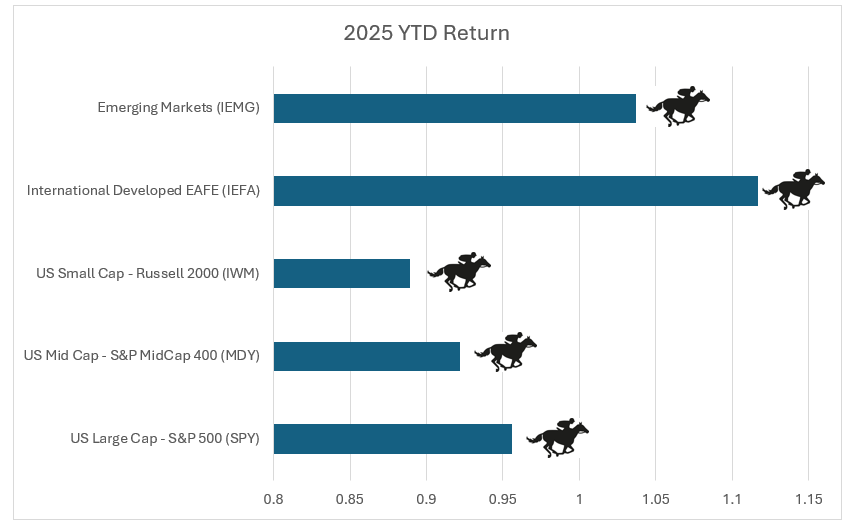
If you’ve ever had the pleasure of attending a horse race, you might have ventured to the window to place a friendly wager on a thoroughbred. After all, not only does the winning Derby horse receive a vast bouquet of roses, but they also take home $3.1 million in winnings. Common bets to place include win, place, show, exacta, or even a trifecta. My favorite, the “trifecta box” allows you to pick three horses to finish first, second or third, in any order, increasing your chances of a win. Though the payout may be lower than a single, longshot bet to win, the odds of success rise significantly.
This is diversification in action. Betting your entire portfolio on a single stock, country, or even asset class can be exhilarating, but it also carries excess risk. A diversified portfolio spreads risk across many opportunities, increasing the odds that something will perform well, even when others falter. Like the trifecta box, diversification in asset allocation doesn’t guarantee a win, but does improve the odds of success in any given environment.
Odds, Expectations, and Outcomes
On race day, odds are posted for every horse. These odds aren’t a prophecy—they’re a reflection of how the betting public perceives each horse’s chance of winning. High odds can signal low expectations, and vice versa. But everyone knows surprises happen. Markets work the same way. Prices reflect consensus expectations. When those expectations are too optimistic, even solid earnings can disappoint. Conversely, low expectations can lead to upside surprises.
Let’s look at the odds markets posted as of Friday morning. After the positive jobs report on Friday, the odds of a recession in 2025 still sit at 61%:
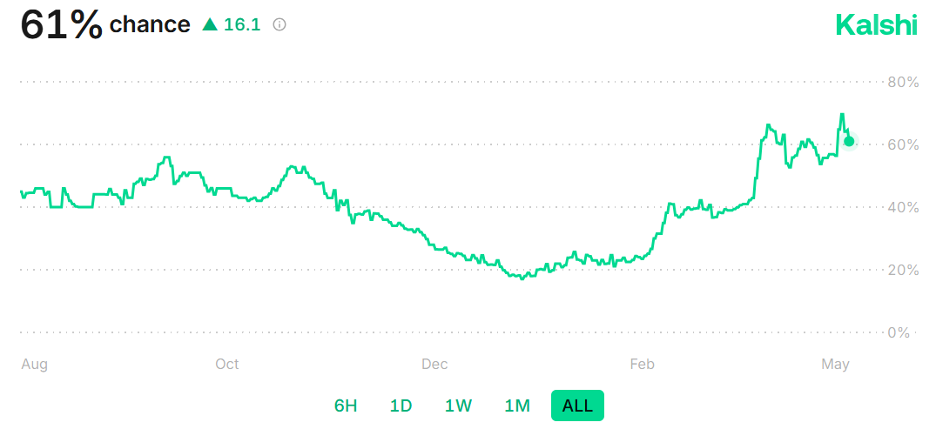
Similarly, after the jobs report Friday, the odds of a rate cut in June are now simply a coin flip:
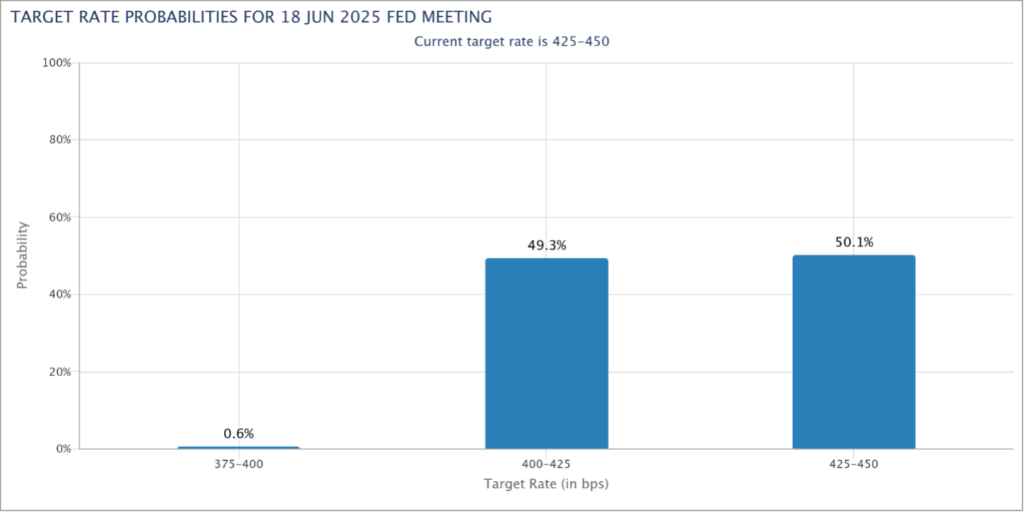
And there’s only a 23% chance of a trade deal with China by June:
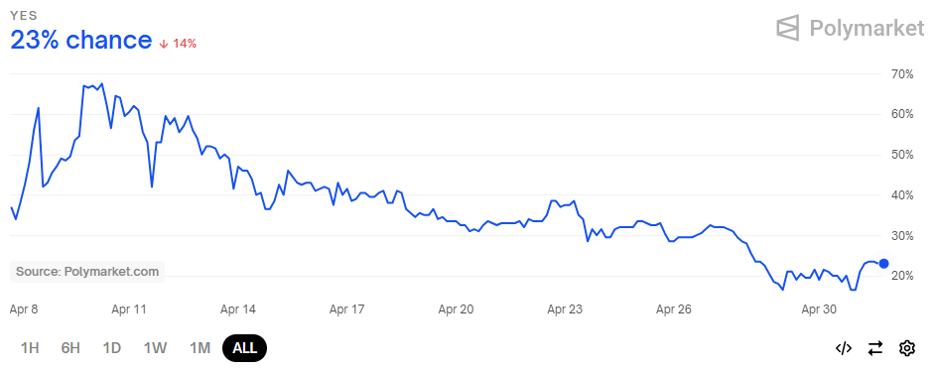
Even further, though Q1 S&P 500 earnings have been solid, they have come with forward concerns. With the ongoing tariff talks, Q2 S&P500 earnings growth rates have been cut nearly in half from 10.2% to 6.4%.
Remember, markets trade on news and expectations. Forward expectations for a recession, rate cuts, trade deals, and earnings are all tilted toward the side of pessimism. This paints a clear path to positive upside surprise for investors: No recession, earlier than expected Fed interest rate cuts, and completed trade deals, which would bring better than expected corporate earnings along with them. So, stick with the process and place your bets accordingly, because when you consider the current odds, upside surprise is the dark horse for the remainder of 2025’s race!
Enjoy your weekend!
-Matt
This communication and its contents are for informational and educational purposes only and should not be used as the sole basis for any investment decision. The information contained herein is based on publicly available sources believed to be reliable but is not a representation, expressed or implied, as to the accuracy, completeness, or correctness of said information. Past performance does not guarantee future results.
Sources: YCharts, Returns as of 5/1/2025, Polymarket, Kalshi, CME Group, Factset,
">The First Saturday in May
In what can feel like an early kickoff to summer, the first Saturday in May draws millions to the heart of Kentucky for the annual running of the Kentucky Derby. Otherwise known as the “The Most Exciting Two Minutes in Sports”, it’s become much more than a horse race. I’ve often felt that sports are the fabric of many of our lives, and annual events like the Derby allow us to add new stitching each year. Throughout the seasons of the teams we follow, the fabric reminds us of the past, lives through the present, and shapes our dreams of the future. It’s been a bumpy market ride through the quarter pole of 2025, but let’s review as we head towards the backstretch.
Below is a chart of year-to-date returns of most world markets as a factor of one. So far, developed international markets lead the pack by a substantial margin. Now, international markets were not a horse that would have won you a lot of bets over the last several years. However, they’ve caught a tailwind in parts due to the European Central Bank cutting interest rates at a faster pace than the US Federal Reserve, President Trump’s tariff tirades, and a devaluation of the USD relative to foreign currencies. As such, US markets have lagged the rest of the world quite substantially so far this year.
If you’ve ever had the pleasure of attending a horse race, you might have ventured to the window to place a friendly wager on a thoroughbred. After all, not only does the winning Derby horse receive a vast bouquet of roses, but they also take home $3.1 million in winnings. Common bets to place include win, place, show, exacta, or even a trifecta. My favorite, the “trifecta box” allows you to pick three horses to finish first, second or third, in any order, increasing your chances of a win. Though the payout may be lower than a single, longshot bet to win, the odds of success rise significantly.
This is diversification in action. Betting your entire portfolio on a single stock, country, or even asset class can be exhilarating, but it also carries excess risk. A diversified portfolio spreads risk across many opportunities, increasing the odds that something will perform well, even when others falter. Like the trifecta box, diversification in asset allocation doesn’t guarantee a win, but does improve the odds of success in any given environment.
Odds, Expectations, and Outcomes
On race day, odds are posted for every horse. These odds aren’t a prophecy—they’re a reflection of how the betting public perceives each horse’s chance of winning. High odds can signal low expectations, and vice versa. But everyone knows surprises happen. Markets work the same way. Prices reflect consensus expectations. When those expectations are too optimistic, even solid earnings can disappoint. Conversely, low expectations can lead to upside surprises.
Let’s look at the odds markets posted as of Friday morning. After the positive jobs report on Friday, the odds of a recession in 2025 still sit at 61%:
Remember, markets trade on news and expectations. Forward expectations for a recession, rate cuts, trade deals, and earnings are all tilted toward the side of pessimism. This paints a clear path to positive upside surprise for investors: No recession, earlier than expected Fed interest rate cuts, and completed trade deals, which would bring better than expected corporate earnings along with them. So, stick with the process and place your bets accordingly, because when you consider the current odds, upside surprise is the dark horse for the remainder of 2025’s race!
Exacta, Trifecta, Place Your Bet!
Below is a chart of year-to-date returns of most world markets as a factor of one. So far, developed international markets lead the pack by a substantial margin. Now, international markets were not a horse that would have won you a lot of bets over the last several years. However, they’ve caught a tailwind in parts due to the European Central Bank cutting interest rates at a faster pace than the US Federal Reserve, President Trump’s tariff tirades, and a devaluation of the USD relative to foreign currencies. As such, US markets have lagged the rest of the world quite substantially so far this year.
If you’ve ever had the pleasure of attending a horse race, you might have ventured to the window to place a friendly wager on a thoroughbred. After all, not only does the winning Derby horse receive a vast bouquet of roses, but they also take home $3.1 million in winnings. Common bets to place include win, place, show, exacta, or even a trifecta. My favorite, the “trifecta box” allows you to pick three horses to finish first, second or third, in any order, increasing your chances of a win. Though the payout may be lower than a single, longshot bet to win, the odds of success rise significantly.
This is diversification in action. Betting your entire portfolio on a single stock, country, or even asset class can be exhilarating, but it also carries excess risk. A diversified portfolio spreads risk across many opportunities, increasing the odds that something will perform well, even when others falter. Like the trifecta box, diversification in asset allocation doesn’t guarantee a win, but does improve the odds of success in any given environment.
Odds, Expectations, and Outcomes
On race day, odds are posted for every horse. These odds aren’t a prophecy—they’re a reflection of how the betting public perceives each horse’s chance of winning. High odds can signal low expectations, and vice versa. But everyone knows surprises happen. Markets work the same way. Prices reflect consensus expectations. When those expectations are too optimistic, even solid earnings can disappoint. Conversely, low expectations can lead to upside surprises.
Let’s look at the odds markets posted as of Friday morning. After the positive jobs report on Friday, the odds of a recession in 2025 still sit at 61%:
Similarly, after the jobs report Friday, the odds of a rate cut in June are now simply a coin flip:
And there’s only a 23% chance of a trade deal with China by June:
Even further, though Q1 S&P 500 earnings have been solid, they have come with forward concerns. With the ongoing tariff talks, Q2 S&P500 earnings growth rates have been cut nearly in half from 10.2% to 6.4%.
Remember, markets trade on news and expectations. Forward expectations for a recession, rate cuts, trade deals, and earnings are all tilted toward the side of pessimism. This paints a clear path to positive upside surprise for investors: No recession, earlier than expected Fed interest rate cuts, and completed trade deals, which would bring better than expected corporate earnings along with them. So, stick with the process and place your bets accordingly, because when you consider the current odds, upside surprise is the dark horse for the remainder of 2025’s race!
Enjoy your weekend!
-Matt
This communication and its contents are for informational and educational purposes only and should not be used as the sole basis for any investment decision. The information contained herein is based on publicly available sources believed to be reliable but is not a representation, expressed or implied, as to the accuracy, completeness, or correctness of said information. Past performance does not guarantee future results.
Sources: YCharts, Returns as of 5/1/2025, Polymarket, Kalshi, CME Group, Factset,
" class="link-chevron">