 Coastal Bridge Client Portal
.png?width=25&height=25&name=fi_7794669%20(1).png)
![[One Charles] Logo_Stack 1 (1)](https://coastalbridgeadvisors.com/hs-fs/hubfs/%5BOne%20Charles%5D%20Logo_Stack%201%20(1).png?width=47&height=34&name=%5BOne%20Charles%5D%20Logo_Stack%201%20(1).png) One Charles Private Wealth Client Portal
One Charles Private Wealth Client Portal
.png?width=88&height=53&name=WA%20Icon%20(1).png)
.png?width=13&height=13&name=fi_7794669%20(1).png)



.png?width=220&height=80&name=image%2028%20(1).png)
THE BOTTOM LINE
Markets rallied to end the week despite a hot inflation number, higher rate hike expectations, $100 oil, and 5% Treasuries. While no one variable explains a daily move, this strategist would suggest the AI Boom spot check received in Oracle’s earnings provided the lift. Within the report, Oracle reiterated their data center capex plans while raising their revenue backlog--an important macro indicator relevant to all investors. Recessions do not begin when economic infrastructure demand is rising. However, at a micro level, Oracle’s reliance on debt and equity markets to finance their compute capacity remains concerning given the yet proven margins on simply hosting compute (largely for OpenAI). Herein lies the conflict. AI demand continues to accelerate, AI financing continues to swell, AI provider returns remain dubious. Oracle’s earnings report was decidedly bullish for the market but far less so for itself. So goes creative destruction in the age of AI. Technological revolutions provide wins for the economy, but don’t necessarily ensure wins for the revolutionaries themselves.
The Full Story
The main challenge of being a macro strategist in an unprecedented environment is identifying which micro indicators to follow and how to properly weigh them. Framing often solves this problem more simply when history rhymes. For example, in our opinion, the COVID period best resembled the Asian Flu period between 1957 and 1958. Focusing our macro attentions on this period led us to determine that any introduction of a partial vaccine would unlock major animal spirits boosting GDP and investment returns organically. The S&P 500 rose nearly 44% in 1958 and 12% in 1959. Add major fiscal and monetary stimulus to animal spirits and it became clear to us, morbid as it may seem, that COVID was a major buy signal based upon history. The S&P 500 rose 20% in 2020 and 30% in 2021. Analogy and strategy validated. Unfortunately, the AI boom doesn’t fit as cleanly into historical framing. It rhymes with the railroad build-out of the 1850’s, but the capital markets were very immature, deeply corrupted, and the rails were slow to monetize. It rhymes with the fiber optic build-out of the 1990’s, but the internet use case wasn’t nearly as strong as AI and much of the capex anticipated demand rather than simply responding to it like today. Because the AI boom doesn’t have a clear analog, we must construct an image within a frame rather than just transport one from history holding a similar landscape. This is when strategists must become artists and choose color, location, and context from a palate of indicators. While the negative headlines for the week cited oil at $100 a barrel, the 10-year Treasury yield at 5%, and consumer price inflation at 3.4%, they underreported a far more important variable: Oracle’s earnings report.
Over the past five years, Oracle has transitioned from a capital light software business into an increasingly capital heavy hardware business as seen in its capex splurge:
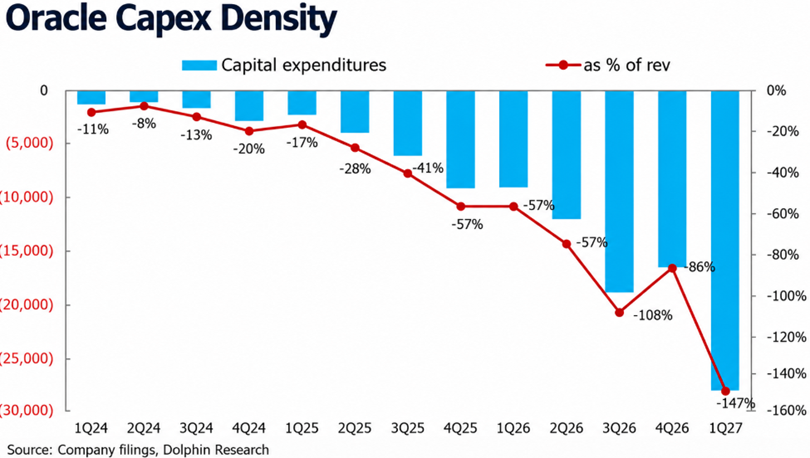
The decision to match the hyperscalers in data center production without the hyperscalers’ cash flow generation has led to Oracle’s reliance on the capital markets to finance its data center build-out. Given the financing mass compared with Oracle’s cash flow capabilities, Standard and Poor’s lowered Oracle’s credit rating to BBB- in July, one level above “junk” status, while the bond market has priced its credit default swap over 200, suggesting a 16% chance of default over the next five years. In short, Oracle has bet the farm to build-out their server farms. Should demand faulter, should expenses rise, or the lag between the spending and the profits elongate, stress at Oracle could signal stress for the AI boom overall. This makes Oracle a core subject within our frame.
On Thursday, Oracle released their quarterly results. Revenues rose 30% overall to $19.3 billion. Data center revenue rose 121% to $7.4 billion. RPOs (effectively promises to pay from customers like OpenAI for future data center capacity) rose 4% over last quarter to $664 billion. These numbers validate NVIDIA’s claims that demand for AI hasn’t peaked. In fact, it’s still accelerating, a very positive indicator for the continuation of the AI boom and another macroeconomic indicator mitigating recession fears. According to Kalshi, 2027 recession odds within the betting markets have fallen by half over the past few months: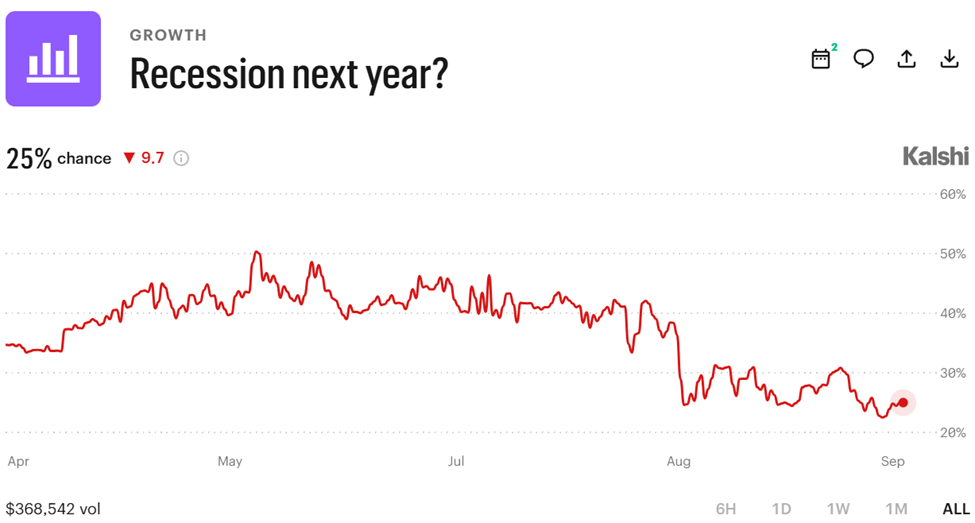
To meet demand, Oracle restated its capex guidance of $90-95 billion for 2027. They spent $56 billion in 2026. Given Oracle’s indebtedness, it’s encouraging that they didn’t raise their capex guidance. Even more encouraging, they raised revenue guidance suggesting higher monetization rate expectations. Also encouraging, customers increased their advance payments on future compute, helping Oracle finance more of their build-out internally. However, spending $90-95 billion building data centers in 2027 compared with total revenue of “at least” $90 billion still equates to a capex/revenue ratio of over 100% making them heavily reliant on capital markets, heavily reliant on power and component availability to build out its empire, and heavily reliant on promises to pay to become future profits before servicing its debt obligations sinks the ship.
For the economy and for the AI Boom food chain, and for our purposes as macro strategists, Oracle’s report was positive and reassuring. For Oracle shareholders, the risks remain omnipresent. The risk of build-out delays, increased resource and financing costs, declining gross margins due to shifting from software to hardware, and most importantly their reliance on OpenAI as their largest customer explain why, even after such encouraging top line growth, the stock fell 5% on the week.
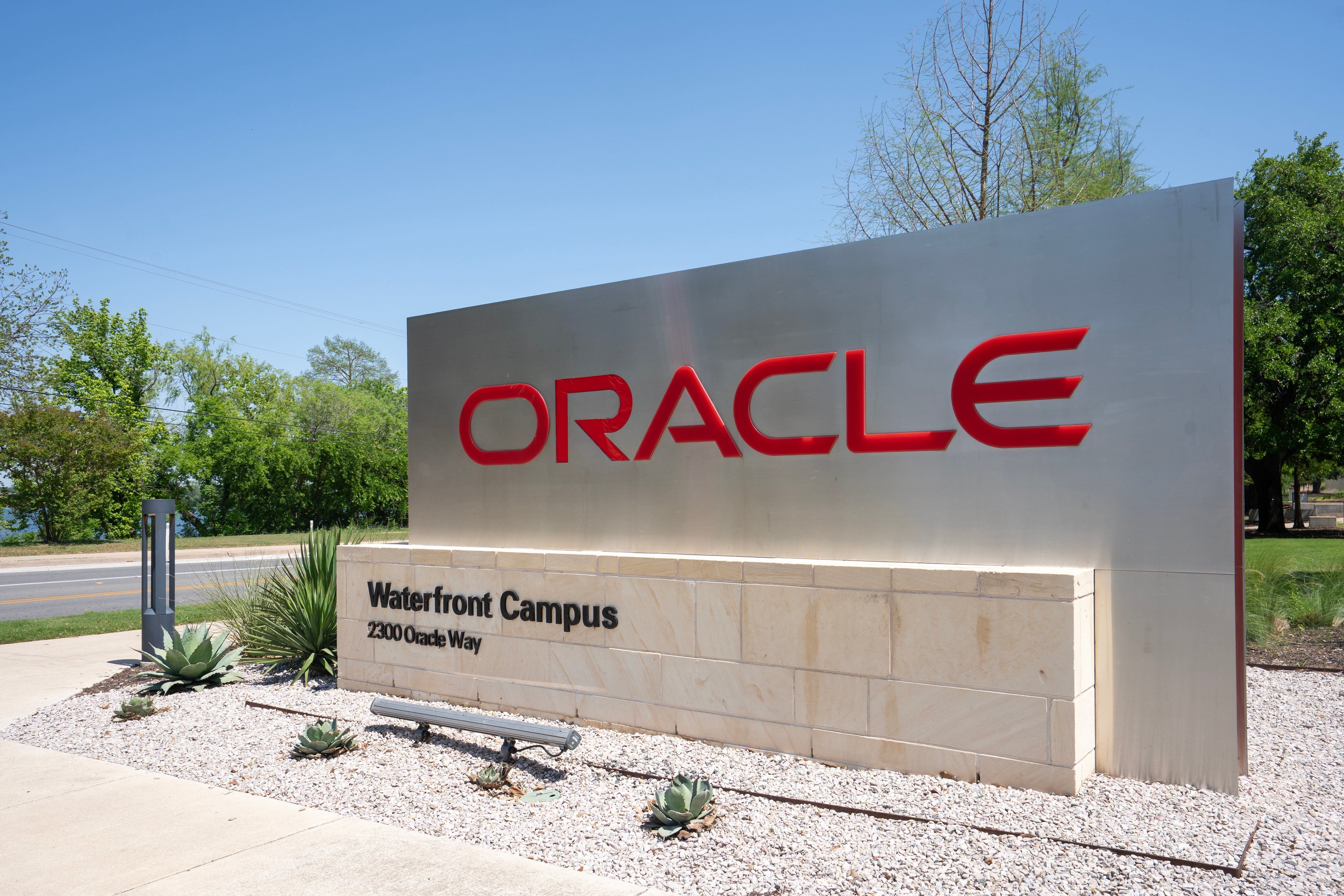
In sum, our visit to the Oracle of Austin revealed that while the demand for AI remains extraordinary and undersupplied, the returns on AI capex remain unknown. It’s certain that AI will generate significant efficiencies and profits across the economy, it’s less certain who will profit most: the providers of the AI, or the consumers of AI. Based upon our portfolio positioning, we suspect the latter.
Have a great Sunday!
-David
David S. Waddell, CFP® CEPA®
Chairman, Chief Investment Strategist
David Waddell is Chairman and Chief Investment Strategist at Coastal Bridge Advisors, where he chairs the firm's investment committee and helps guide portfolio strategy through macroeconomic analysis, market research, and risk assessment. With nearly three decades of experience, he is a nationally recognized commentator on economics and investing, with appearances on CNBC, Bloomberg, Fox Business, and Barron's. David is a CERTIFIED FINANCIAL PLANNER™ professional (CFP®) and a Certified Exit Planning Advisor (CEPA®). He holds a BA in Economics from The University of the South and an MBA in Finance and Investments from Babson College.
Sources: Dolphin Research, Kalshi Prediction Market, YCharts, US Securities and Exchange Commission
The views and opinions expressed are those of David Waddell as of the date of publication and are subject to change without notice. This material is provided for informational and educational purposes only and is not intended to constitute investment advice or a recommendation to buy or sell any security. References to specific companies, securities, market indicators or portfolio positioning are provided solely to illustrate the author’s market views and should not be interpreted as individualized investment recommendations. Statements regarding future market, economic, industry or company performance reflect the author’s current opinions, expectations and estimates and should not be interpreted as guarantees or assurances of future results. Actual results may differ materially from those expressed or implied. Market-implied probabilities, credit-market indicators and similar estimates reflect market pricing and underlying assumptions and should not be interpreted as precise forecasts of future outcomes. References to relationships or trends among market prices, valuations, credit spreads, earnings, capital spending or other financial and economic data are observational in nature and should not be interpreted as establishing causation. Market and economic conditions differ across periods, and historical relationships may not repeat. The information and opinions expressed are based on sources believed to be reliable, including third-party sources, but are not guaranteed as to accuracy or completeness. Third-party information has not been independently verified by CBA. Any forward-looking statements, projections, forecasts or hypothetical examples are for illustrative purposes only, are inherently uncertain and are subject to change based on market, economic, political, regulatory and company-specific conditions. Past performance is not indicative of future results. No investment strategy or security can guarantee a profit or protect against loss. References to portfolio positioning are general in nature and may not reflect the holdings, objectives or circumstances of any particular client account. Indexes are unmanaged and cannot be invested in directly. Index and investment vehicle performance does not reflect fees, expenses or other costs associated with investing.

%20copy%202.png?width=1750&height=1172&name=Body%20(10)%20copy%202.png)