

.png)
![[One Charles] Logo_Stack 1 (1)](https://coastalbridgeadvisors.com/hubfs/%5BOne%20Charles%5D%20Logo_Stack%201%20(1).png)
.png)



.png?width=220&height=80&name=image%2028%20(1).png)

THE BOTTOM LINE
The Fed’s latest rate hike reinforces a higher-for-longer policy stance, but the market reaction was more nuanced. Longer-term Treasury yields moved lower, equities rallied, and the Fed’s updated economic projections now look more consistent with where market interest rates are already trading.
Higher rates come with costs, particularly forward federal government net interest expense, but they also reflect an economy that, so far, continues to produce higher than long-run average results. For investors, robust corporate earnings growth with sustained economic growth and resilient employment provides flexibility for higher forward interest rate policy expectations.
The Full Story
Much has been written here about Kevin Warsh and the Federal Reserve. Although we invest in companies, not governments or unelected bureaucrats, both play a role in the economic ecosystem. Keynesian economic theory expresses that output equals the sum of consumption, investment, net exports, and government spending. Government nonetheless interacts with our scope of work making it a worthy topic of discussion. Last week, the Federal Reserve unanimously voted to raise base interest rate policy by 0.25%, bringing the target rate to 3.75%-4%. Alongside the rate decision, they also released their latest summary of economic projections. There is much to unpack, but the message was straightforward: economic growth remains robust, inflation remains too high, and the Fed is willing to restrict policy further and longer to bring inflation back towards their 2% target.
The Cost of a Quarter Point
As David Waddell wrote a few weeks ago, part of the recent rise in longer-dated Treasury yields was attributed to a rise in term premium. Competition for capital is rising as the AI hyperscalers turn to the debt markets to finance their spending on data centers and infrastructure. More debt supply competing for the same pool of investor capital demands higher yields, or compensation, for attracting buyers.
Enter a Fed rate hike...
Federal deficits are already large, and net interest expense is the second largest line item of the federal budget. We are about two weeks away from the end of the government fiscal year, and fiscal year-to-date net interest expense is already greater than $1trillion. For sizing context, this amount exceeds Medicare spending, and even defense spending.
Last week, Warsh reiterated that the Fed is independent, intends to stay in its lane, and that fiscal issues are not the Fed’s problem. Institutionally, he is correct, but monetary and fiscal policy are not mutually exclusive. Higher short-term interest rates increase the incremental cost at which the government refinances its debt.
The federal fiscal year runs from October 1 through September 30, making this an appropriate time to consider the potential impact. According to the US Treasury data month-end 8/31, roughly $10 trillion of US government debt will mature in the next fiscal year. Assuming the Treasury continues to issue short-dated bills to recycle the debt load, you could reasonably assume an extra $25b of interest expense alone from just rolling maturities in the next fiscal year.
This is intentionally simplistic, and the actual cost would be different depending on the actual maturity schedule. But the exercise demonstrates the scale. $25 billion is more than NASA’s entire FY2026 budget request, and over double the amount of the FBI’s. So, though monetary policy may be more restrictive, the forward federal deficit just got bigger, creating a feedback mechanism. Higher interest expense contributes to larger deficits, requiring additional borrowing, potentially putting further upward pressure on yields as investors require more compensation for the incremental risk of repayment.
Short End Up, Long End Down
And yet, amid all of this, 10- and 30-year bond yields traded slightly down after the Fed meeting while equities rallied. How? I see two primary reasons. First, the Fed demonstrated resolve to return 2% price inflation. A central bank willing to tighten policy even when doing so creates some fiscal discomfort reinforces the perception of Fed independence. Fiscal responsibility, meanwhile, remains with the elected officials rather than the central bank.
Second, investor positioning was already bearish heading into the Fed meeting. The S&P 500 had fallen in six of the seven trading sessions before September 16th, while the AAII Bearish Sentiment index climbed to its highest level since last year’s tariff tantrum:
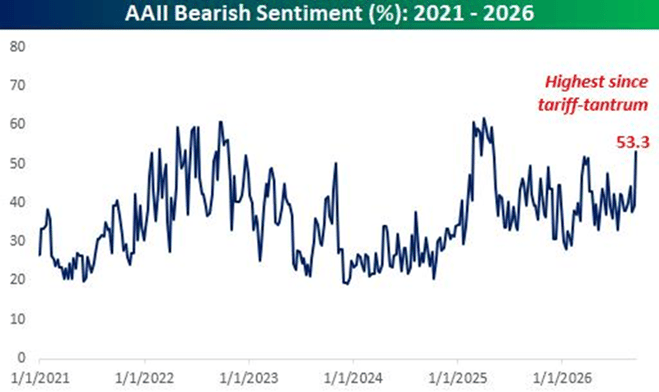
Also, market participants hedge known event risk prior to their occurrence. Once the event passes without delivering a tail-risk outcome, those hedges are removed and the unwind itself creates additional, supportive flows for equities. In other words, markets had prepared for bad news that didn’t materialize. All told, the Fed hiked short-term rates, the bond market cut long-term rates, and equities rallied.
The Fed Meets the Market
The quarterly Fed Summary of Economic Projections was released alongside the committee’s statement and policy change. Notably, these projections provide a window to committee member expectations on growth, inflation, and unemployment. The differences from June are revealing, specifically:
GDP: Higher
Unemployment: Lower
Inflation: Higher
Equals: Interest Rates Higher for Longer
The median committee member now expects the Fed funds rate to sit at 4.1% through the end of 2027. This ultimately suggests at least one more rate hike before the end of the year, before an extended pause, and reduction thereafter.
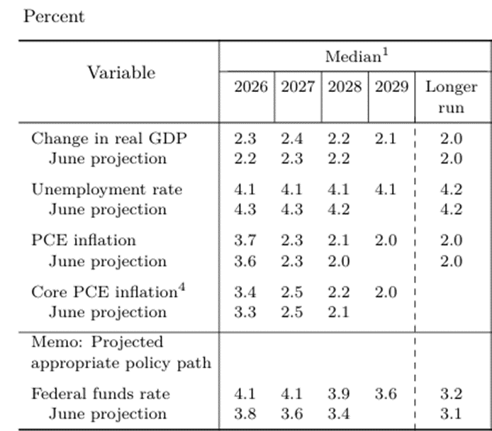
Of course, these are imperfect projections, but the Fed is forecasting better growth, lower unemployment, with elevated inflation. This gives Warsh more latitude to maintain or further restrict policy rates. Undoubtedly, everyone would prefer inflation to trend closer to 2%, but “it’s the economy, stupid!” An economy capable of sustaining real growth north of 2% while inflation remains above target is naturally more consistent with a higher nominal-rate environment. Interestingly, the Fed’s projections themselves point to roughly 4.9% nominal economic growth in 2027:
2.4% Real GDP + 2.5% Core PCE = 4.9%
This is a simple framework for understanding the 10-year treasury rate, and at the time of writing the 10-year Treasury sits at 5%. The Fed’s revised projections now describe an economic environment that looks consistent with where longer-term market interest rates are already trading. Warsh has repeatedly emphasized the importance of market signals. The Fed controls the overnight rate, but longer-term borrowing costs are ultimately set by the market. And right now, the two appear considerably closer in their assessment of the economy.
Enjoy your Sunday!
- Matt
Matt Gentzkow CIMA®
Managing Director, Wealth Advisor
Matt Gentzkow is Managing Director and Wealth Advisor at Coastal Bridge Advisors, where he shares his insights with the investment committee and guides clients toward their financial goals. Before joining the firm, he held advisory and wealth strategy roles at UBS and Morgan Stanley. Matt earned bachelor's degrees in finance and economics from Xavier University and is a Certified Investment Management Analyst® (CIMA®). His market insights have been featured in publications including The Wall Street Journal and Kiplinger.
Sources: The Federal Reserve, Bespoke Investment Group, AAII, NASA, US Treasury
The views and opinions expressed are those of Matt Gentzkow, CIMA® as of the date of publication and are subject to change without notice. This material is provided for informational and educational purposes only and is not intended to constitute investment advice or a recommendation to buy or sell any security. The information and opinions expressed are based on sources believed to be reliable, including third-party sources, but are not guaranteed as to accuracy or completeness. Third-party information has not been independently verified by CBA. Any forward-looking statements or hypothetical examples are for illustrative purposes only and are subject to change based on market and economic conditions. Past performance is not indicative of future results.

.png)