



%20(1).png?width=508&height=121&name=flourish-primary-logo@2x%20(1)%20(1).png)


On June 17, new Fed Head Kevin Warsh will hold his first post-FOMC press conference to comment on the rate decision, his outlook for employment and inflation, and his governance plans for Federal Reserve activities. Markets love to test new Fed Chairs. Donald Trump selected Kevin Warsh mainly for his lower interest rate bias. And yet, from the date of Warsh’s nomination, the 2-year Treasury yield (the market’s best proxy for future Fed policy decisions) has increased from 3.5% to 4.13%, above the current policy rate of 3.75%. While The Chair may want lower rates, The Market expects higher rates. This conflict requires resolution. We will not receive full resolution on Wednesday, but the resolution process will begin. To help frame the arguments let’s examine current conditions for both of the Fed’s congressional mandates, price stability and maximum employment.
Price Stability
Fed Head Ben Bernanke established a 2% inflation target for the Federal Funds rate in 2012. Prior to that, the Fed didn’t have a numerical inflation bogey. Post that decision, markets calibrated economic and interest rate expectations around the 2% objective. Unfortunately, inflation bedevils the Fed by continuously undershooting and overshooting the 2%:
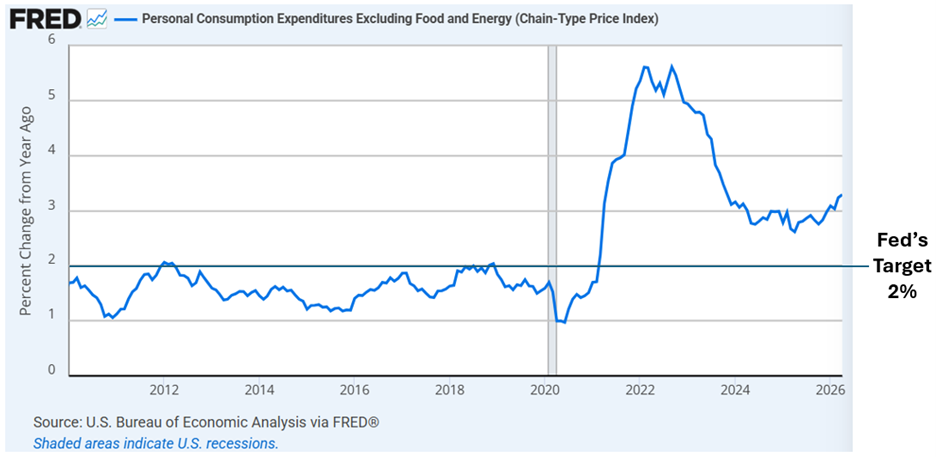
Pre-Covid stimulus spray, inflation held stubbornly below 2%, inspiring Fed Head Powell to loosen the target to an “average” of 2% in August of 2020. Since then, inflation has averaged 3.6%. After some encouraging disinflation in early 2025, the combination of the AI buildout boom, immigration controls, tariff impositions, and oil blockades has pressured inflation higher. When adding back food and energy, excluded from the Fed’s preferred measure due to volatility, the inflation story worsens:
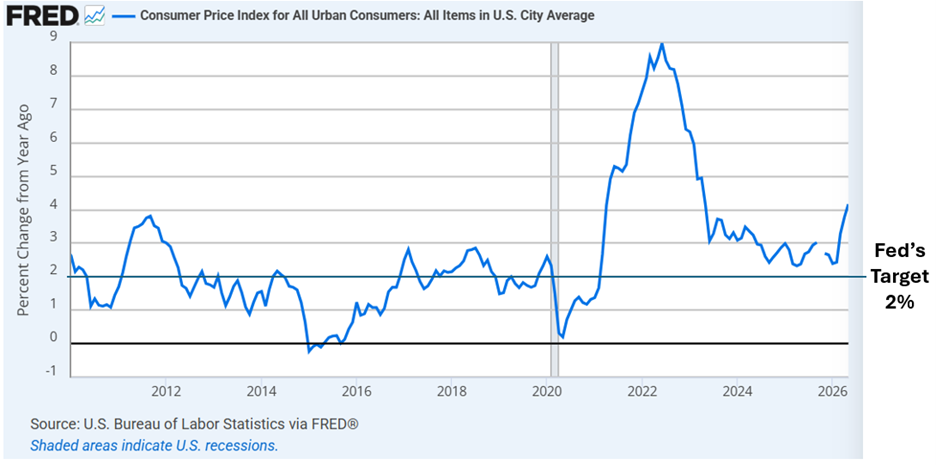
For the year ending in May, overall US consumer price inflation rose 4.2%. Therefore, while the Fed may have a 3.3% policy inflation problem, they have a 4.2% headline inflation problem, making a solid case for the Fed to raise rates, not lower them.
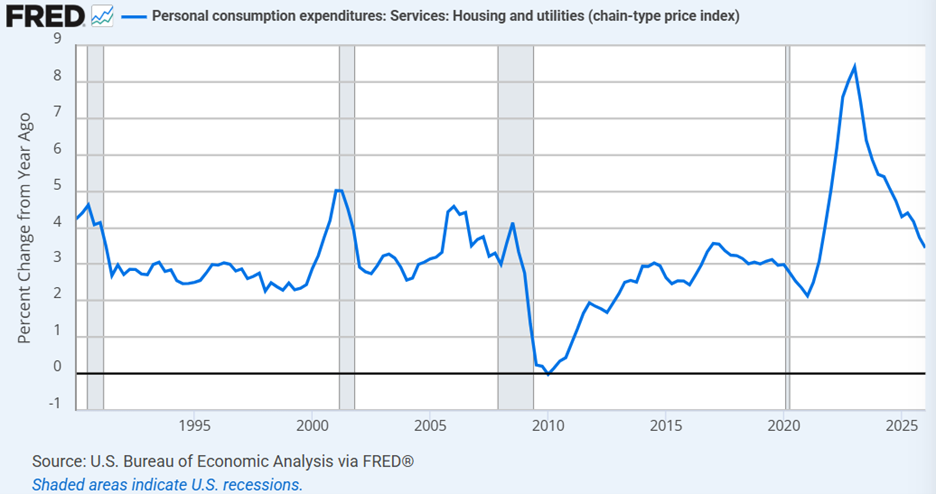
For Warsh to argue for lower rates, he must identify more durable disinflationary forces within the data. Housing inflation trends add some assistance and represent 18% of the Fed’s preferred inflation measure, deserving reference:
Warsh has also spoken to the disinflationary impact of AI productivity gains across the economy. While we support this observation, the economy must build the AI before benefitting from the AI, which implies shortage driven inflation in the near term (commodities, tech hardware, utility capacity, etc.) in exchange for productivity disinflation in the longer term. If the Fed overreacts to the near-term inflation, it could forestall more durable longer-term economic benefits by restraining AI Capex. For now, the productivity argument appears real and intact:
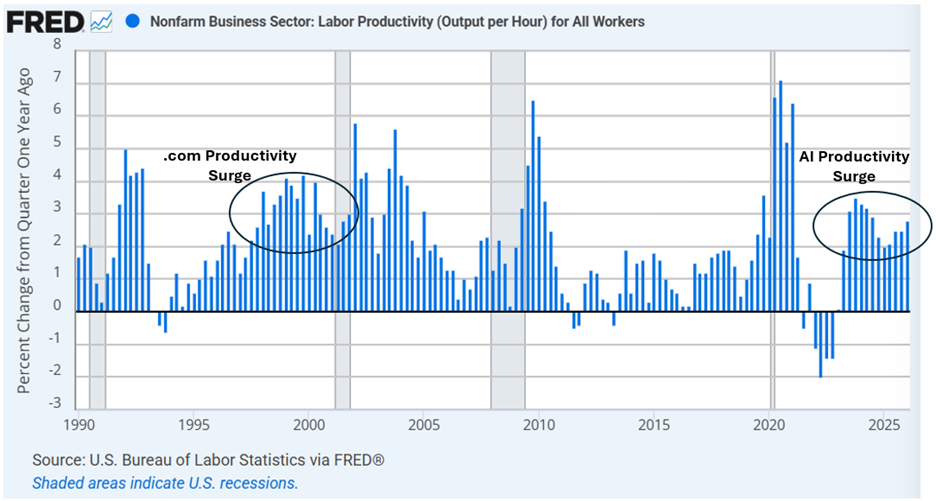
Ignore recession driven productivity gains as distorted data. The last true productivity surge occurred during the late 1990’s. During this period (1995-2000) core inflation averaged 1.7% and fell as productivity rose. There is certainly modern historical precedent for Warsh’s productivity argument. I would expect him to harp on this next Wednesday.
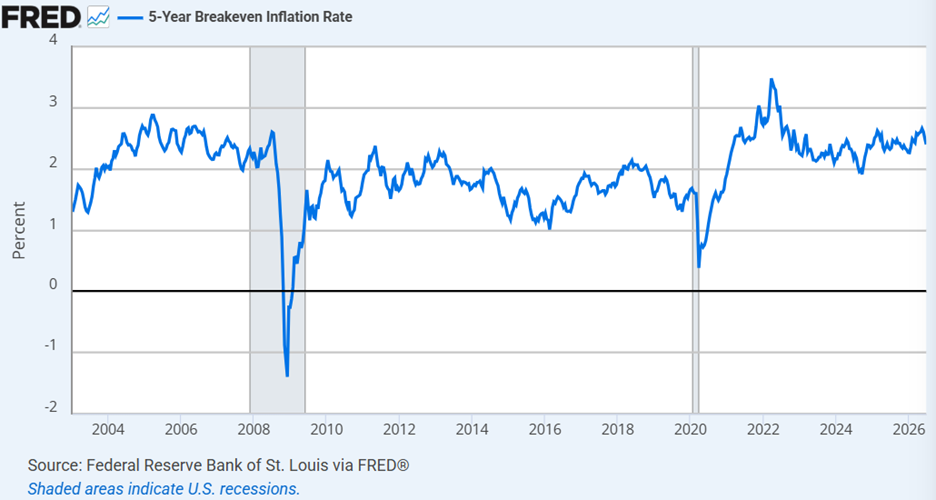
Lastly, Warsh may site the “transitory” nature of current inflation. 60% of the inflationary gain last month can be attributed to war stoked energy inflation, any war relief should provide inflation relief. Also, AI Capex may cool at the margin as companies reconcile spending with returns, rationalizing shortages. Lastly, inflationary base effects may provide optical relief as June, July, and August 2025 ran hot and those numbers will fall away with each upcoming release. Taken together, longer term inflation expectations appear well within normal ranges, having actually fallen recently:
Maximum Employment
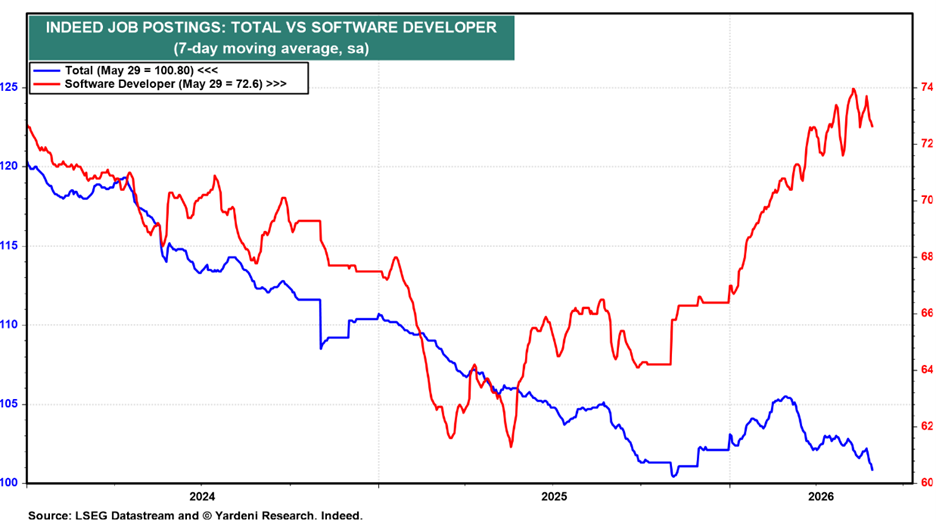
As we have long argued, gains in productivity do not mean fewer jobs and lower wages as frequently feared, but more jobs and higher wages as frequently proven. Nothing punctuates this point better than the comparison of job opening data for software developers versus the economy at large:
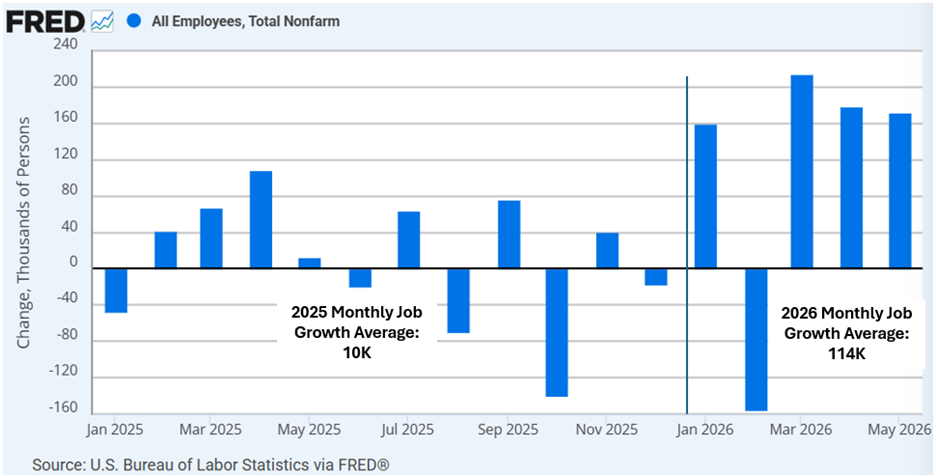
Furthermore, the AI jobs apocalypse remains overdue as the US economy has blown away hiring expectations so far this year:
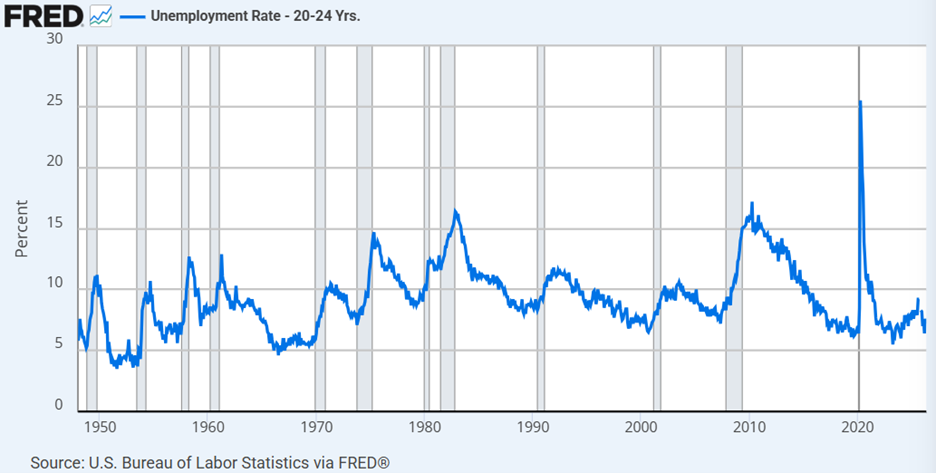
Overall, the US unemployment rate sits at 4.3%, well within the Fed’s range of “maximum employment.” Additionally, the unemployment rate for the youth cohort most “AI at risk” registers at 7.2%, which seems high until you compare that rate to itself over time:
So, the good news is that jobs seem plentiful for all… even the youth and software developers. Therefore, the Fed has met its maximum employment mandate. The bad news is that tight labor markets can often metastasize into inflation up-force. Fortunately, despite employment gains, overall employment inflation, while still elevated from COVID levels, appears largely contained:
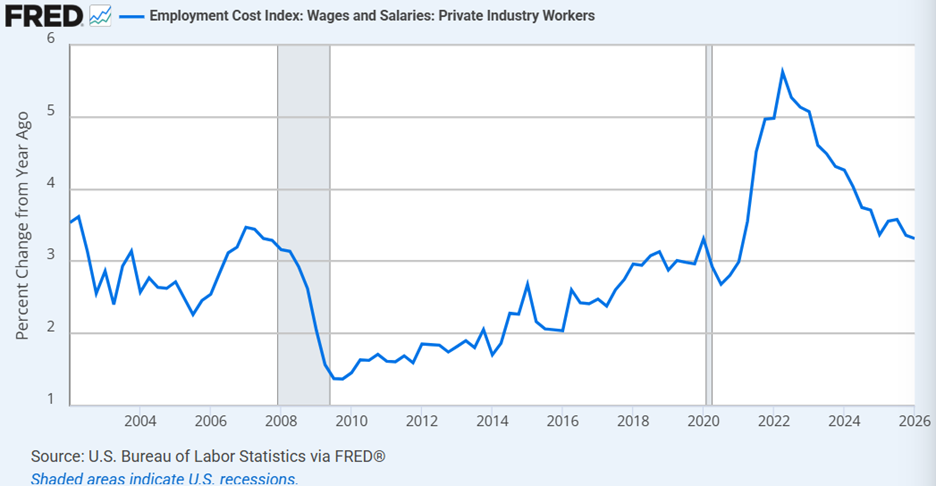
The employment cost index rate of 3.3% is the lowest year-over-year growth rate since 2021. For the Fed, a 3.5% employment cost index minus a 2.5% productivity growth rate leaves a unit labor cost inflation rate of 1%. Historically, this is unusual as labor inflation rates often exceed headline inflation rates. That is not the case currently and helps support Fed Head Warsh’s dovish stance despite tight labor markets.
While SpaceX made the story of the week, the fireworks over Warsh’s first official press conference interests us more, and will matter more to longer term investors, overall. Popcorn popping!
Have a great Sunday!
-David
Sources: Federal Reserve Bank of St. Louis, Yardeni Research
This communication and its contents are for informational and educational purposes only and should not be used as the sole basis for any investment decision. The information contained herein is based on publicly available sources believed to be reliable but is not a representation, expressed or implied, as to the accuracy, completeness, or correctness of said information. References to political figures or policies are for informational purposes only and do not represent an endorsement by Waddell & Associates. Any forward-looking statements reflect current opinions and assumptions and are subject to change without notice; actual results may differ materially. Past performance does not guarantee future results. Waddell & Associates may use artificial intelligence tools to help generate or summarize content; all outputs are reviewed by our team for accuracy and relevance.
">Mr. Warsh Meets the Market
On June 17, new Fed Head Kevin Warsh will hold his first post-FOMC press conference to comment on the rate decision, his outlook for employment and inflation, and his governance plans for Federal Reserve activities. Markets love to test new Fed Chairs. Donald Trump selected Kevin Warsh mainly for his lower interest rate bias. And yet, from the date of Warsh’s nomination, the 2-year Treasury yield (the market’s best proxy for future Fed policy decisions) has increased from 3.5% to 4.13%, above the current policy rate of 3.75%. While The Chair may want lower rates, The Market expects higher rates. This conflict requires resolution. We will not receive full resolution on Wednesday, but the resolution process will begin. To help frame the arguments let’s examine current conditions for both of the Fed’s congressional mandates, price stability and maximum employment.
Price Stability
Fed Head Ben Bernanke established a 2% inflation target for the Federal Funds rate in 2012. Prior to that, the Fed didn’t have a numerical inflation bogey. Post that decision, markets calibrated economic and interest rate expectations around the 2% objective. Unfortunately, inflation bedevils the Fed by continuously undershooting and overshooting the 2%:
Pre-Covid stimulus spray, inflation held stubbornly below 2%, inspiring Fed Head Powell to loosen the target to an “average” of 2% in August of 2020. Since then, inflation has averaged 3.6%. After some encouraging disinflation in early 2025, the combination of the AI buildout boom, immigration controls, tariff impositions, and oil blockades has pressured inflation higher. When adding back food and energy, excluded from the Fed’s preferred measure due to volatility, the inflation story worsens:
For the year ending in May, overall US consumer price inflation rose 4.2%. Therefore, while the Fed may have a 3.3% policy inflation problem, they have a 4.2% headline inflation problem, making a solid case for the Fed to raise rates, not lower them.
For Warsh to argue for lower rates, he must identify more durable disinflationary forces within the data. Housing inflation trends add some assistance and represent 18% of the Fed’s preferred inflation measure, deserving reference:
Warsh has also spoken to the disinflationary impact of AI productivity gains across the economy. While we support this observation, the economy must build the AI before benefitting from the AI, which implies shortage driven inflation in the near term (commodities, tech hardware, utility capacity, etc.) in exchange for productivity disinflation in the longer term. If the Fed overreacts to the near-term inflation, it could forestall more durable longer-term economic benefits by restraining AI Capex. For now, the productivity argument appears real and intact:
Ignore recession driven productivity gains as distorted data. The last true productivity surge occurred during the late 1990’s. During this period (1995-2000) core inflation averaged 1.7% and fell as productivity rose. There is certainly modern historical precedent for Warsh’s productivity argument. I would expect him to harp on this next Wednesday.
Lastly, Warsh may site the “transitory” nature of current inflation. 60% of the inflationary gain last month can be attributed to war stoked energy inflation, any war relief should provide inflation relief. Also, AI Capex may cool at the margin as companies reconcile spending with returns, rationalizing shortages. Lastly, inflationary base effects may provide optical relief as June, July, and August 2025 ran hot and those numbers will fall away with each upcoming release. Taken together, longer term inflation expectations appear well within normal ranges, having actually fallen recently:
Maximum Employment
As we have long argued, gains in productivity do not mean fewer jobs and lower wages as frequently feared, but more jobs and higher wages as frequently proven. Nothing punctuates this point better than the comparison of job opening data for software developers versus the economy at large:
Furthermore, the AI jobs apocalypse remains overdue as the US economy has blown away hiring expectations so far this year:
Overall, the US unemployment rate sits at 4.3%, well within the Fed’s range of “maximum employment.” Additionally, the unemployment rate for the youth cohort most “AI at risk” registers at 7.2%, which seems high until you compare that rate to itself over time:
So, the good news is that jobs seem plentiful for all… even the youth and software developers. Therefore, the Fed has met its maximum employment mandate. The bad news is that tight labor markets can often metastasize into inflation up-force. Fortunately, despite employment gains, overall employment inflation, while still elevated from COVID levels, appears largely contained:
The employment cost index rate of 3.3% is the lowest year-over-year growth rate since 2021. For the Fed, a 3.5% employment cost index minus a 2.5% productivity growth rate leaves a unit labor cost inflation rate of 1%. Historically, this is unusual as labor inflation rates often exceed headline inflation rates. That is not the case currently and helps support Fed Head Warsh’s dovish stance despite tight labor markets.
While SpaceX made the story of the week, the fireworks over Warsh’s first official press conference interests us more, and will matter more to longer term investors, overall. Popcorn popping!
Have a great Sunday!
-David
Sources: Federal Reserve Bank of St. Louis, Yardeni Research
This communication and its contents are for informational and educational purposes only and should not be used as the sole basis for any investment decision. The information contained herein is based on publicly available sources believed to be reliable but is not a representation, expressed or implied, as to the accuracy, completeness, or correctness of said information. References to political figures or policies are for informational purposes only and do not represent an endorsement by Waddell & Associates. Any forward-looking statements reflect current opinions and assumptions and are subject to change without notice; actual results may differ materially. Past performance does not guarantee future results. Waddell & Associates may use artificial intelligence tools to help generate or summarize content; all outputs are reviewed by our team for accuracy and relevance.
" class="link-chevron">
Markets hit new highs again this week as powerful earnings releases and promising war negotiations cheered investors. The AI Revolution rivals any in world history as demand projections for computing power seem infinite. During the industrial revolution, companies competed for workers. During the AI revolution, companies are competing for compute. Some might even say blindly so as not to be left behind, leading to frenzy-like activity. In line with this thesis, consider the profound growth rate in IT investment today across the US economy:
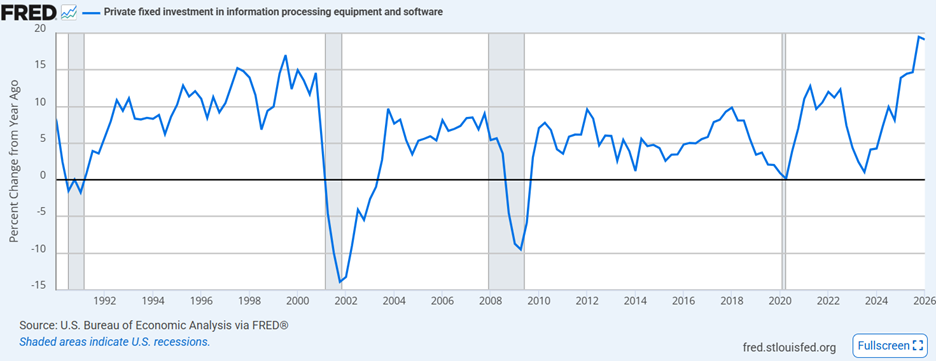
In the mid-1990’s, IT investment grew between 10-12% annually, reaching a peak to offset the Y2K threat at 17%. Following COVID and the inception of the virtual office economy, IT investment grew 10-12%. Today, IT investment is growing by nearly 20%, well above any rate seen over the period. Moreso, that growth rate comes on top of an already sizable base. When adjusting the chart above for dollar change rather than percentage change, the investment scale becomes even more notable:
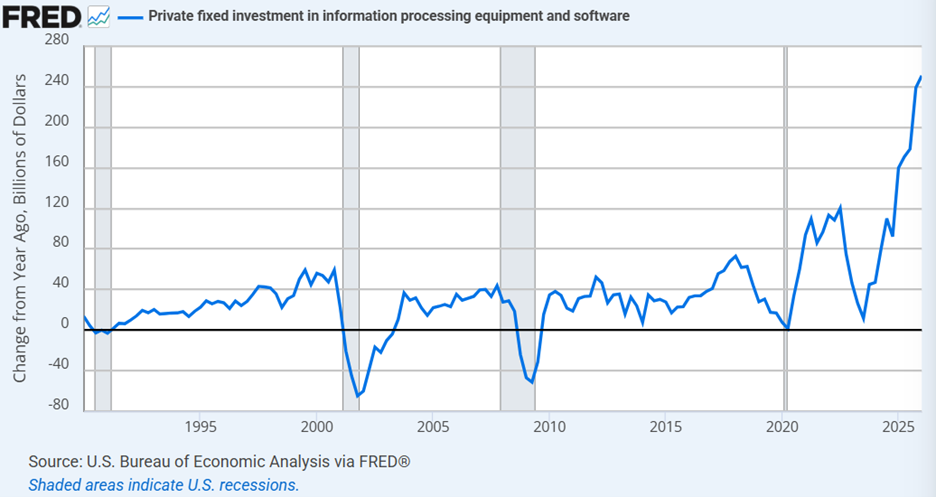
And because of the historic magnitude of this investment cycle, the influence and economic stimulus of IT investment within the US economy continues to grow in magnitude as well:
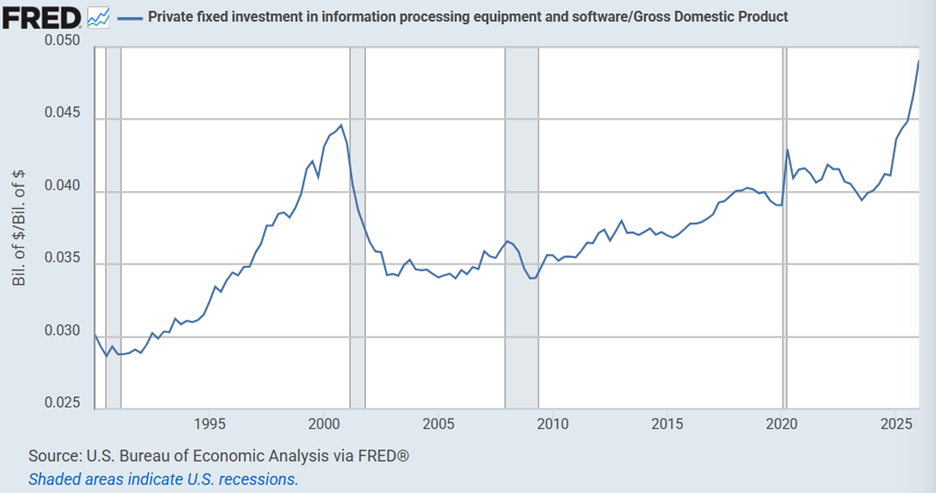
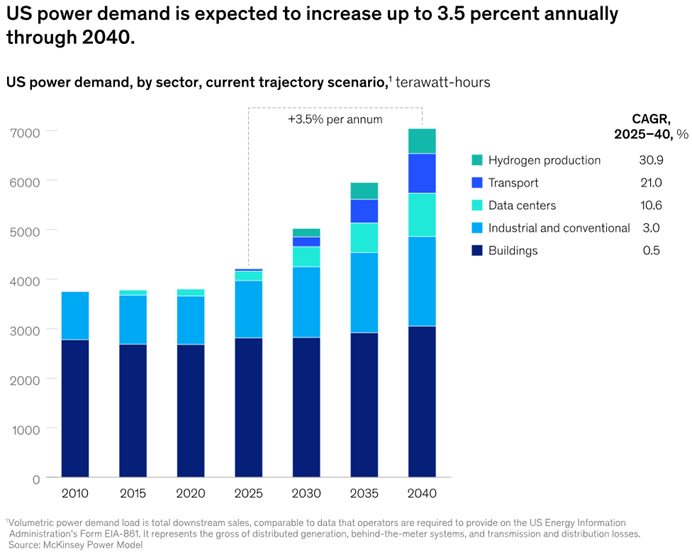
IT investment now accounts for 5% of the entire US economy. In other words, the US is allocating $1 out of every $20 the economy produces to IT investment. In addition to becoming such a large allocation, IT investment has become the largest contributor to US GDP growth, contributing 67% of Q1 GDP growth, far beyond anything seen before. And because the investment boom is largely hardware related, it trickles down the entire supply chain from high tech fliers to infrastructure and power suppliers. Consider the sheer amount of electricity demand being created by the AI revolution:
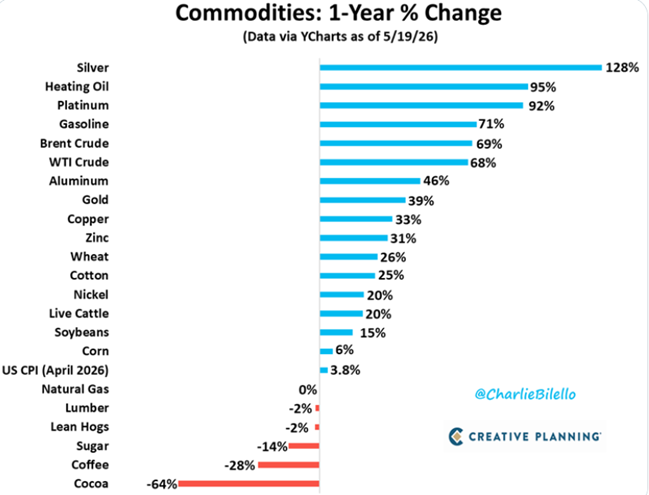
All this hardware, construction, and power demand creates supply shortages and price pressures across various commodities:
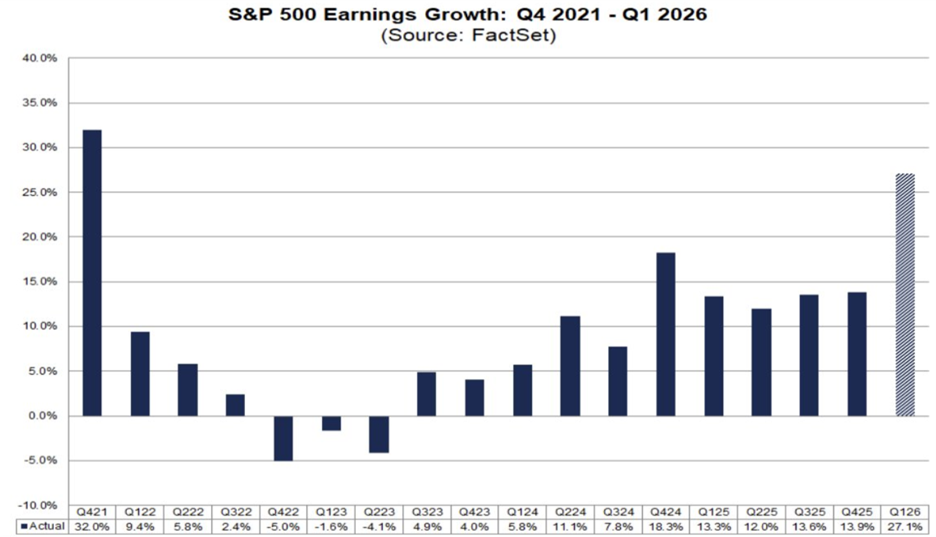
This brings us to corporate earnings, which surged in the first quarter to levels seldom seen outside of post recessionary turns:
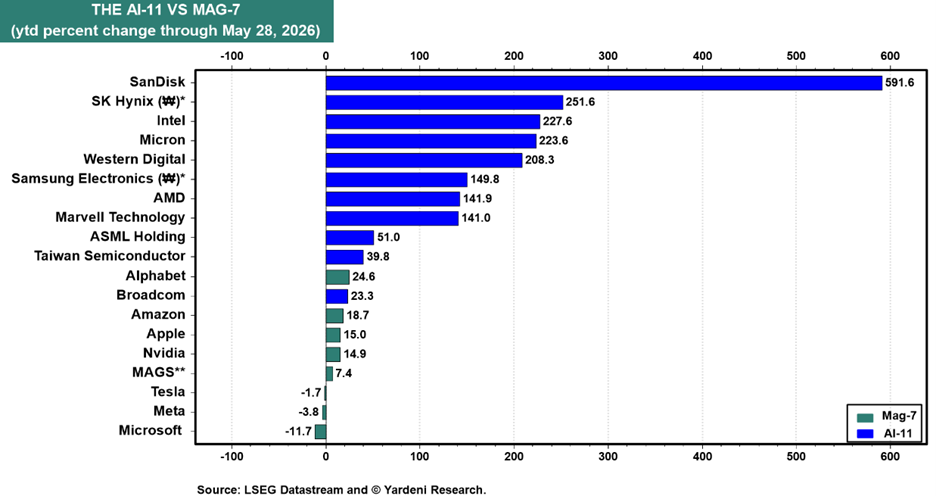
Excited yet? The combination of insatiable demand for compute, deep pools of earnings and capital to finance CAPEX, and shortages across the economy have unlocked generational levels of corporate profits and investor returns. Lastly, given the “structural” nature of the AI Revolution rather than the “cyclical” nature of typical technology cycles, valuations for more cyclically oriented companies like Micron and SanDisk should rise to levels of less cyclical companies like Microsoft and Apple. This perspective calls not for a rally in these cyclical players but a complete repricing given their transformation from episodic businesses into stalwart annuity businesses!
Furthermore, analysts have mapped the “structural not cyclical” earnings benefits across the entire US market complex.
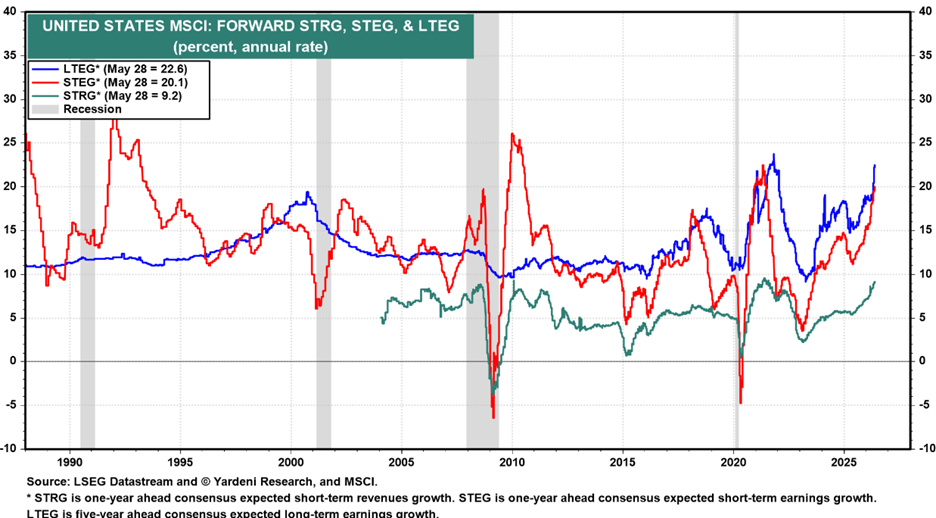
Of all the charts presented, this is perhaps the most profound. According to analysts, over the next 5 years (the blue line) US public companies will experience earnings growth of nearly 23% annually. This requires an historic combination of revenue growth and profit margin growth to get there. Corporate revenues, or sales, largely track nominal GDP growth (growth + inflation since revenues are quoted gross of inflation). In Q1, US nominal GDP grew a spirited 5.9%, towards the top end of its recent range:
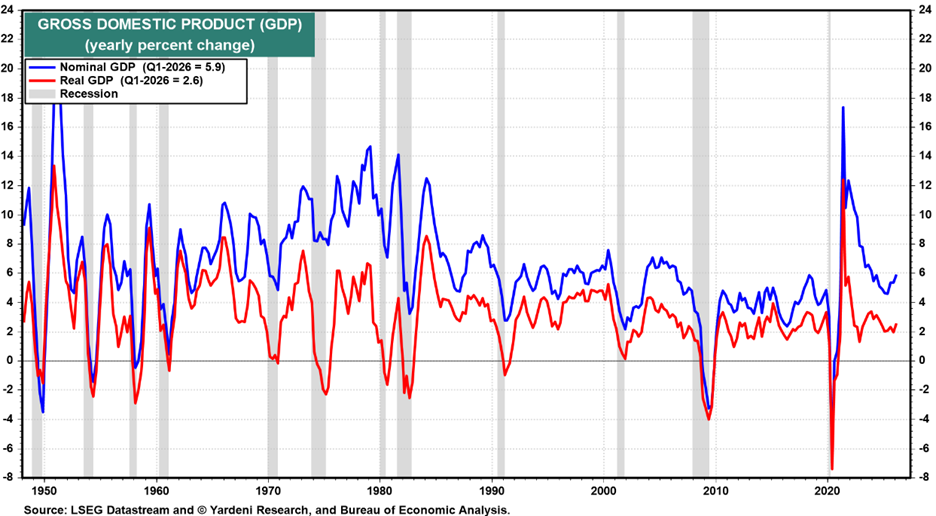
To accommodate the revenue growth required over the next five years, nominal GDP would have to rise substantially back to levels we haven’t seen since the 1970s. Absent that level of nominal GDP growth, profit margins would have to expand substantially, which has been occurring in tech land but not as obviously in non-tech land:
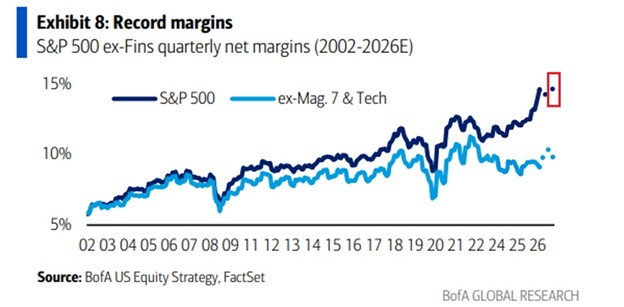
For profit margins to surge enough from here to overcome nominal GDP and revenue constraints, non-tech participants will need to double their operating efficiencies to meet these wildly ambitious forward earnings forecasts. Possible perhaps, but not probable. Lastly, corporations could source additional earnings power from “other income” and accounting adjustments. For instance, last quarter the circular financing within the hyper-scalers (swapping cloud capacity for Anthropic and Open AI stock), led to mark-to-market gains that accounted for perhaps a third of overall Q1 earnings growth:
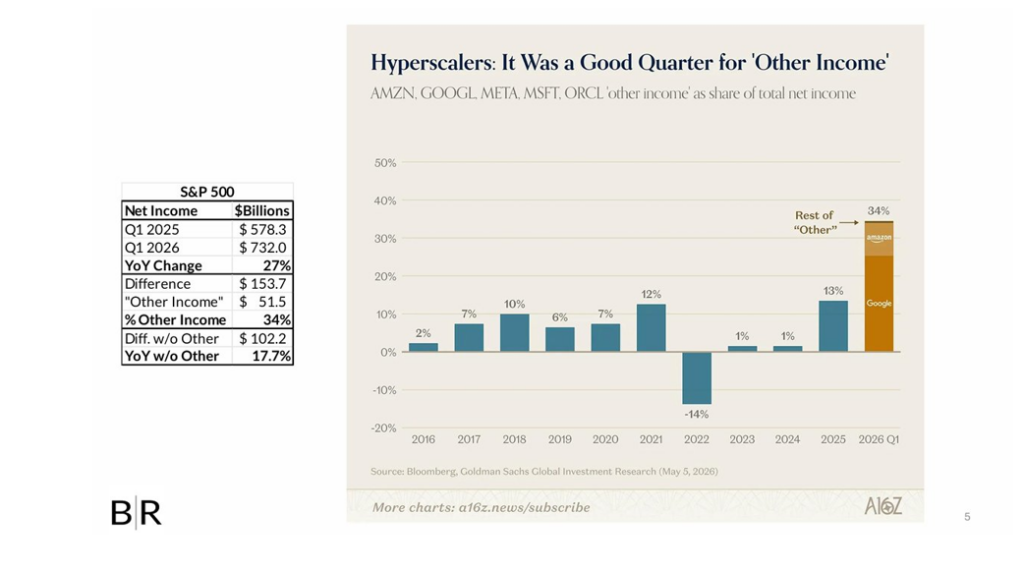
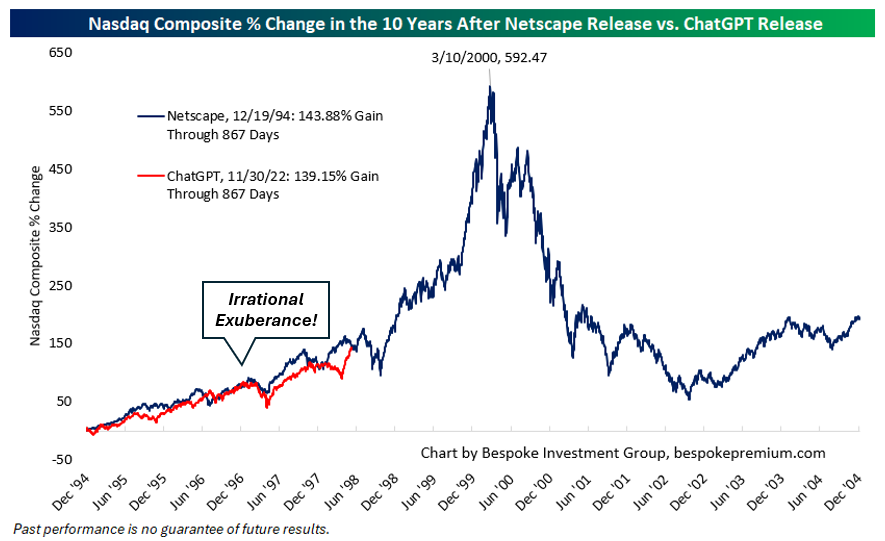
As long as these trillion-dollar startups double their valuations each year over the next five years, “other income” accounting adjustments will contribute significantly. Consider the mark-to-market benefits for the Japanese Nikkei at the end of the 1980s! Absent this accounting alchemy, revenues and margin expansions will likely fall far short of analyst expectations and terms like “insatiable demand” and “unlimited pricing power” will once again become siren calls leading investors into the rocks. While that seems inevitable to us, the timing of comeuppance remains unknowable. Recall that Greenspan labeled the last episode of market exuberance “irrational” three years prior to its demise. While today’s AI Revolution may not be immune to cyclicality, it’s clearly a super cycle poised to run beyond rationality, if it hasn’t already. We will monitor the macro cues for what’s reasonable and watch the unreasonable, from afar.
Have a great weekend!
-David
Sources: Federal Reserve Bank of St. Louis, McKinsey & Company, Charlie Bilello & Creative Planning, Factset, Yardeni Research, Bank of America Research, Bianco Research, Andreessen Horowitz, Bespoke Investment Group
This communication and its contents are for informational and educational purposes only and should not be used as the sole basis for any investment decision. The information contained herein is based on publicly available sources believed to be reliable but is not a representation, expressed or implied, as to the accuracy, completeness, or correctness of said information. References to political figures or policies are for informational purposes only and do not represent an endorsement by Waddell & Associates. Any forward-looking statements reflect current opinions and assumptions and are subject to change without notice; actual results may differ materially. Past performance does not guarantee future results. Waddell & Associates may use artificial intelligence tools to help generate or summarize content; all outputs are reviewed by our team for accuracy and relevance.
">When Super-Cycles Meet Super-Sized Expectations
Markets hit new highs again this week as powerful earnings releases and promising war negotiations cheered investors. The AI Revolution rivals any in world history as demand projections for computing power seem infinite. During the industrial revolution, companies competed for workers. During the AI revolution, companies are competing for compute. Some might even say blindly so as not to be left behind, leading to frenzy-like activity. In line with this thesis, consider the profound growth rate in IT investment today across the US economy:
In the mid-1990’s, IT investment grew between 10-12% annually, reaching a peak to offset the Y2K threat at 17%. Following COVID and the inception of the virtual office economy, IT investment grew 10-12%. Today, IT investment is growing by nearly 20%, well above any rate seen over the period. Moreso, that growth rate comes on top of an already sizable base. When adjusting the chart above for dollar change rather than percentage change, the investment scale becomes even more notable:
And because of the historic magnitude of this investment cycle, the influence and economic stimulus of IT investment within the US economy continues to grow in magnitude as well:
IT investment now accounts for 5% of the entire US economy. In other words, the US is allocating $1 out of every $20 the economy produces to IT investment. In addition to becoming such a large allocation, IT investment has become the largest contributor to US GDP growth, contributing 67% of Q1 GDP growth, far beyond anything seen before. And because the investment boom is largely hardware related, it trickles down the entire supply chain from high tech fliers to infrastructure and power suppliers. Consider the sheer amount of electricity demand being created by the AI revolution:
All this hardware, construction, and power demand creates supply shortages and price pressures across various commodities:
This brings us to corporate earnings, which surged in the first quarter to levels seldom seen outside of post recessionary turns:
Excited yet? The combination of insatiable demand for compute, deep pools of earnings and capital to finance CAPEX, and shortages across the economy have unlocked generational levels of corporate profits and investor returns. Lastly, given the “structural” nature of the AI Revolution rather than the “cyclical” nature of typical technology cycles, valuations for more cyclically oriented companies like Micron and SanDisk should rise to levels of less cyclical companies like Microsoft and Apple. This perspective calls not for a rally in these cyclical players but a complete repricing given their transformation from episodic businesses into stalwart annuity businesses!
Furthermore, analysts have mapped the “structural not cyclical” earnings benefits across the entire US market complex.
Of all the charts presented, this is perhaps the most profound. According to analysts, over the next 5 years (the blue line) US public companies will experience earnings growth of nearly 23% annually. This requires an historic combination of revenue growth and profit margin growth to get there. Corporate revenues, or sales, largely track nominal GDP growth (growth + inflation since revenues are quoted gross of inflation). In Q1, US nominal GDP grew a spirited 5.9%, towards the top end of its recent range:
To accommodate the revenue growth required over the next five years, nominal GDP would have to rise substantially back to levels we haven’t seen since the 1970s. Absent that level of nominal GDP growth, profit margins would have to expand substantially, which has been occurring in tech land but not as obviously in non-tech land:
For profit margins to surge enough from here to overcome nominal GDP and revenue constraints, non-tech participants will need to double their operating efficiencies to meet these wildly ambitious forward earnings forecasts. Possible perhaps, but not probable. Lastly, corporations could source additional earnings power from “other income” and accounting adjustments. For instance, last quarter the circular financing within the hyper-scalers (swapping cloud capacity for Anthropic and Open AI stock), led to mark-to-market gains that accounted for perhaps a third of overall Q1 earnings growth:
As long as these trillion-dollar startups double their valuations each year over the next five years, “other income” accounting adjustments will contribute significantly. Consider the mark-to-market benefits for the Japanese Nikkei at the end of the 1980s! Absent this accounting alchemy, revenues and margin expansions will likely fall far short of analyst expectations and terms like “insatiable demand” and “unlimited pricing power” will once again become siren calls leading investors into the rocks. While that seems inevitable to us, the timing of comeuppance remains unknowable. Recall that Greenspan labeled the last episode of market exuberance “irrational” three years prior to its demise. While today’s AI Revolution may not be immune to cyclicality, it’s clearly a super cycle poised to run beyond rationality, if it hasn’t already. We will monitor the macro cues for what’s reasonable and watch the unreasonable, from afar.
Have a great weekend!
-David
Sources: Federal Reserve Bank of St. Louis, McKinsey & Company, Charlie Bilello & Creative Planning, Factset, Yardeni Research, Bank of America Research, Bianco Research, Andreessen Horowitz, Bespoke Investment Group
This communication and its contents are for informational and educational purposes only and should not be used as the sole basis for any investment decision. The information contained herein is based on publicly available sources believed to be reliable but is not a representation, expressed or implied, as to the accuracy, completeness, or correctness of said information. References to political figures or policies are for informational purposes only and do not represent an endorsement by Waddell & Associates. Any forward-looking statements reflect current opinions and assumptions and are subject to change without notice; actual results may differ materially. Past performance does not guarantee future results. Waddell & Associates may use artificial intelligence tools to help generate or summarize content; all outputs are reviewed by our team for accuracy and relevance.
" class="link-chevron">
The stock market hit new highs again this week as earnings rose, oil fell, and rates retreated. While we talk about “the market” each week, it’s been a bit since we have disaggregated it for discussion. For our own purposes we disaggregate “the market” into the following categories: geography, investment style, market cap (company size), and sectors. This week let’s do a brief survey of the disaggregated returns and draw some conclusions.
Geography
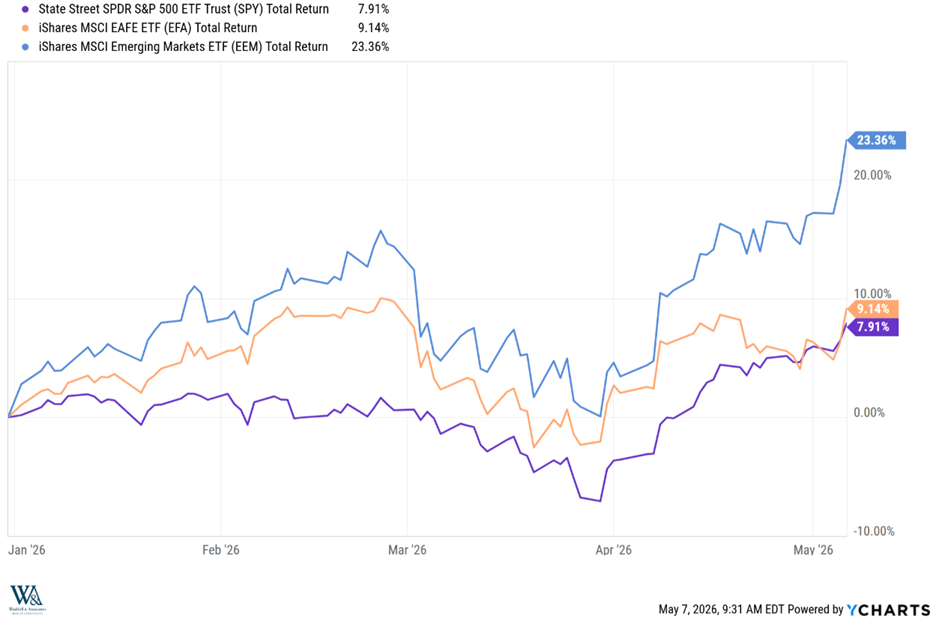
Despite the headlines that Epic Fury has inflicted more pain on the offshore economies than our own, the investment returns read otherwise. While the US market (represented here by the S&P 500) has risen 8% year to date, the developed international markets (represented by the EAFE) have risen 9%, and the emerging markets (represented by the MSCI EM) have risen 23%. If we disaggregate further, even more surprises arise. For instance, the Israeli stock market (ETF: EIS) has climbed 24% this year, perhaps because wars ultimately have winners. International investors must also consider currency fluctuations. Typically, geopolitical frictions trigger capital flights to quality, boosting the USD. This happened in the initial phases of Epic Fury, but this has since reverted with the US Dollar down 0.5% on the year, adding a slight uptick to international return calculations. In all, the Geographic returns remind us that headlines and bottom lines often do not correlate.
Investment Style
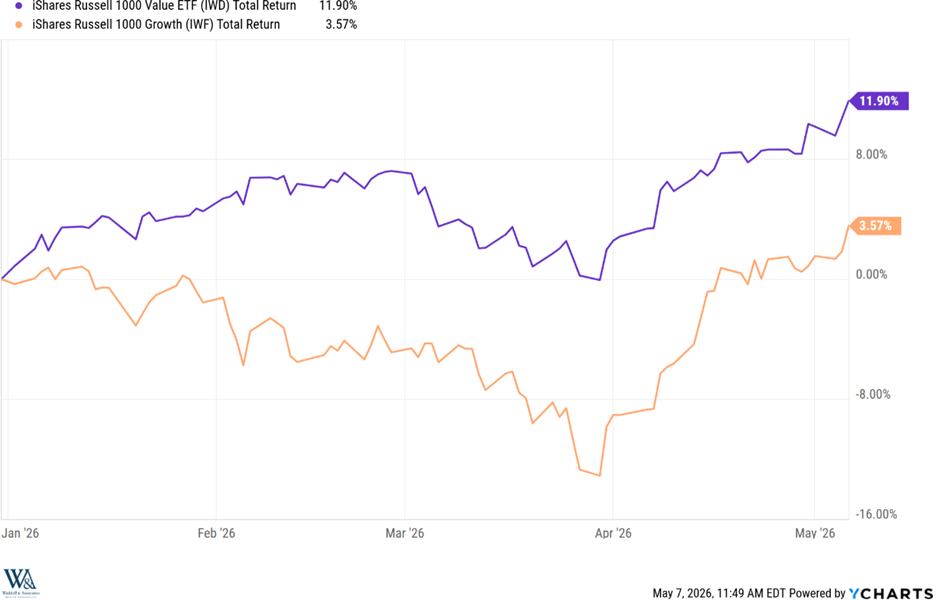
Investment bias essentially established two investment styles. Those who want to invest in what’s cheap today became known as “value” investors and those who want to invest in what will become bigger tomorrow became known as “growth” investors. Berkshire Hathaway is the largest holding in the value index above (ETF: IWD), while NVIDIA is the largest holding in the growth index above (ETF: IWF). Because the AI trade has become so dominant growth indices rely heavily on NVIDIA and the Magnificent 7 for direction. These stocks struggled early in the year as investors questioned the viability of the capex spending and the trajectory for their earnings. This created an advantage for the more “knowable” value style companies trading at lower P/E’s with lower earnings expectations thresholds to overcome. However, enthusiasm for growth has returned with the war winding down, rate cuts on approach, and stellar earnings results from the Magnificents. As clearly shown, there are no “right” investment styles, only oscillations between them.
Market Capitalization
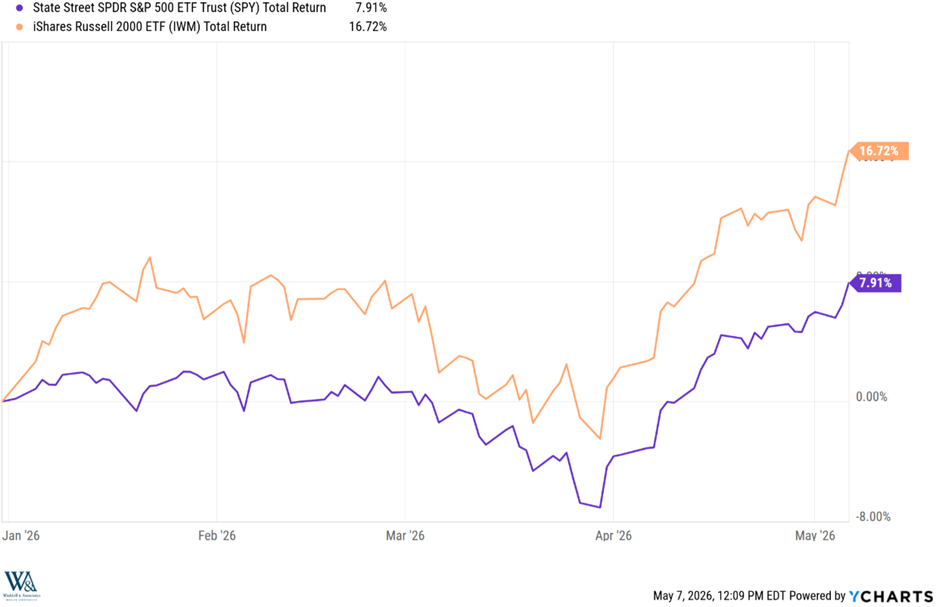
In theory, smaller companies grow faster than larger companies due to scale advantages, which should support higher investment returns. While this has been true over a long period of time, it has not been true over the last mega tech decade. Over the past 10 years the S&P 500 large cap index (ETF: SPY) has returned 320% for investors while the Russell 2000 small cap index (ETF: IWM) returned 194%. That yawning divide has left many who believe in reversion to the mean to favor small over large more recently. Their bets have been rewarded as the smalls have gained 17% on the year versus 8% for the bigs. Will this continue? Perhaps. The combination of economic acceleration and lower short-term interest rates should support the small co earnings complex, while valuation convergence continues. But should the macros deteriorate, it’s likely the smalls will as well. They historically trade as volatility enhancers which can be great on the upside… but less great on the downside.
Sectors
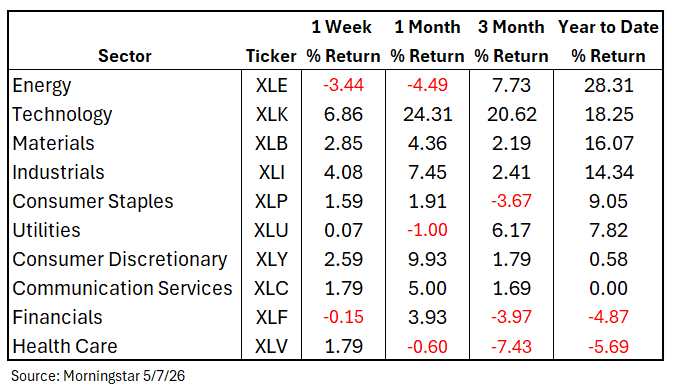
Sectors often make the best thematic tracing vehicles. Think the economy is going to accelerate? Consider owning those most cyclically oriented like energy, materials, and industrials. Think the economy will recess? Consider owning those most defensive like consumer staples, healthcare, and utilities. These tend to be reliable bets unless something peculiar occurs like regulatory changes for healthcare or AI Capex demands making utilities behave like growth stocks. On the year, the cluster of energy, technology, materials, and industrials in the lead suggests a broad-based economic advance. Consumer discretionary has lagged amidst concerns over energy spending displacement and financials lack an AI narrative and the promise of rate cuts. From here, resolution in Iran will pressure energy lower, but other cyclicals higher. Financials look cheap with loan volumes rising and rates falling, perhaps poised for a move. Healthcare performance resembles the healthcare sector overall: sluggish and confusing.
Taken together, the complex shows some return variations but conformity with a theme. The US economy isn’t recessing anytime soon, the capex cycle isn’t ending anytime soon, and this bull market isn’t ending anytime soon.
Have a great weekend and Happy Mother’s Day!
-David
Sources: YCharts, Morningstar
This communication and its contents are for informational and educational purposes only and should not be used as the sole basis for any investment decision. The information contained herein is based on publicly available sources believed to be reliable but is not a representation, expressed or implied, as to the accuracy, completeness, or correctness of said information. References to political figures or policies are for informational purposes only and do not represent an endorsement by Waddell & Associates. Any forward-looking statements reflect current opinions and assumptions and are subject to change without notice; actual results may differ materially. Past performance does not guarantee future results. Waddell & Associates may use artificial intelligence tools to help generate or summarize content; all outputs are reviewed by our team for accuracy and relevance.
">The Market Beneath the Market
The stock market hit new highs again this week as earnings rose, oil fell, and rates retreated. While we talk about “the market” each week, it’s been a bit since we have disaggregated it for discussion. For our own purposes we disaggregate “the market” into the following categories: geography, investment style, market cap (company size), and sectors. This week let’s do a brief survey of the disaggregated returns and draw some conclusions.
Geography
Despite the headlines that Epic Fury has inflicted more pain on the offshore economies than our own, the investment returns read otherwise. While the US market (represented here by the S&P 500) has risen 8% year to date, the developed international markets (represented by the EAFE) have risen 9%, and the emerging markets (represented by the MSCI EM) have risen 23%. If we disaggregate further, even more surprises arise. For instance, the Israeli stock market (ETF: EIS) has climbed 24% this year, perhaps because wars ultimately have winners. International investors must also consider currency fluctuations. Typically, geopolitical frictions trigger capital flights to quality, boosting the USD. This happened in the initial phases of Epic Fury, but this has since reverted with the US Dollar down 0.5% on the year, adding a slight uptick to international return calculations. In all, the Geographic returns remind us that headlines and bottom lines often do not correlate.
Investment Style
Investment bias essentially established two investment styles. Those who want to invest in what’s cheap today became known as “value” investors and those who want to invest in what will become bigger tomorrow became known as “growth” investors. Berkshire Hathaway is the largest holding in the value index above (ETF: IWD), while NVIDIA is the largest holding in the growth index above (ETF: IWF). Because the AI trade has become so dominant growth indices rely heavily on NVIDIA and the Magnificent 7 for direction. These stocks struggled early in the year as investors questioned the viability of the capex spending and the trajectory for their earnings. This created an advantage for the more “knowable” value style companies trading at lower P/E’s with lower earnings expectations thresholds to overcome. However, enthusiasm for growth has returned with the war winding down, rate cuts on approach, and stellar earnings results from the Magnificents. As clearly shown, there are no “right” investment styles, only oscillations between them.
Market Capitalization
In theory, smaller companies grow faster than larger companies due to scale advantages, which should support higher investment returns. While this has been true over a long period of time, it has not been true over the last mega tech decade. Over the past 10 years the S&P 500 large cap index (ETF: SPY) has returned 320% for investors while the Russell 2000 small cap index (ETF: IWM) returned 194%. That yawning divide has left many who believe in reversion to the mean to favor small over large more recently. Their bets have been rewarded as the smalls have gained 17% on the year versus 8% for the bigs. Will this continue? Perhaps. The combination of economic acceleration and lower short-term interest rates should support the small co earnings complex, while valuation convergence continues. But should the macros deteriorate, it’s likely the smalls will as well. They historically trade as volatility enhancers which can be great on the upside… but less great on the downside.
Sectors
Sectors often make the best thematic tracing vehicles. Think the economy is going to accelerate? Consider owning those most cyclically oriented like energy, materials, and industrials. Think the economy will recess? Consider owning those most defensive like consumer staples, healthcare, and utilities. These tend to be reliable bets unless something peculiar occurs like regulatory changes for healthcare or AI Capex demands making utilities behave like growth stocks. On the year, the cluster of energy, technology, materials, and industrials in the lead suggests a broad-based economic advance. Consumer discretionary has lagged amidst concerns over energy spending displacement and financials lack an AI narrative and the promise of rate cuts. From here, resolution in Iran will pressure energy lower, but other cyclicals higher. Financials look cheap with loan volumes rising and rates falling, perhaps poised for a move. Healthcare performance resembles the healthcare sector overall: sluggish and confusing.
Taken together, the complex shows some return variations but conformity with a theme. The US economy isn’t recessing anytime soon, the capex cycle isn’t ending anytime soon, and this bull market isn’t ending anytime soon.
Have a great weekend and Happy Mother’s Day!
-David
Sources: YCharts, Morningstar
This communication and its contents are for informational and educational purposes only and should not be used as the sole basis for any investment decision. The information contained herein is based on publicly available sources believed to be reliable but is not a representation, expressed or implied, as to the accuracy, completeness, or correctness of said information. References to political figures or policies are for informational purposes only and do not represent an endorsement by Waddell & Associates. Any forward-looking statements reflect current opinions and assumptions and are subject to change without notice; actual results may differ materially. Past performance does not guarantee future results. Waddell & Associates may use artificial intelligence tools to help generate or summarize content; all outputs are reviewed by our team for accuracy and relevance.
" class="link-chevron">
Oil Prices?
Iran has recently increased its defiance. Trump has recently increased his threats. Onshore oil prices peaked this week roughly 10% below their wartime high while offshore oil prices peaked 10% above their wartime high. The longer the conflict lasts, the more depleted oil inventories become, and the more upward pressure exerts on price:
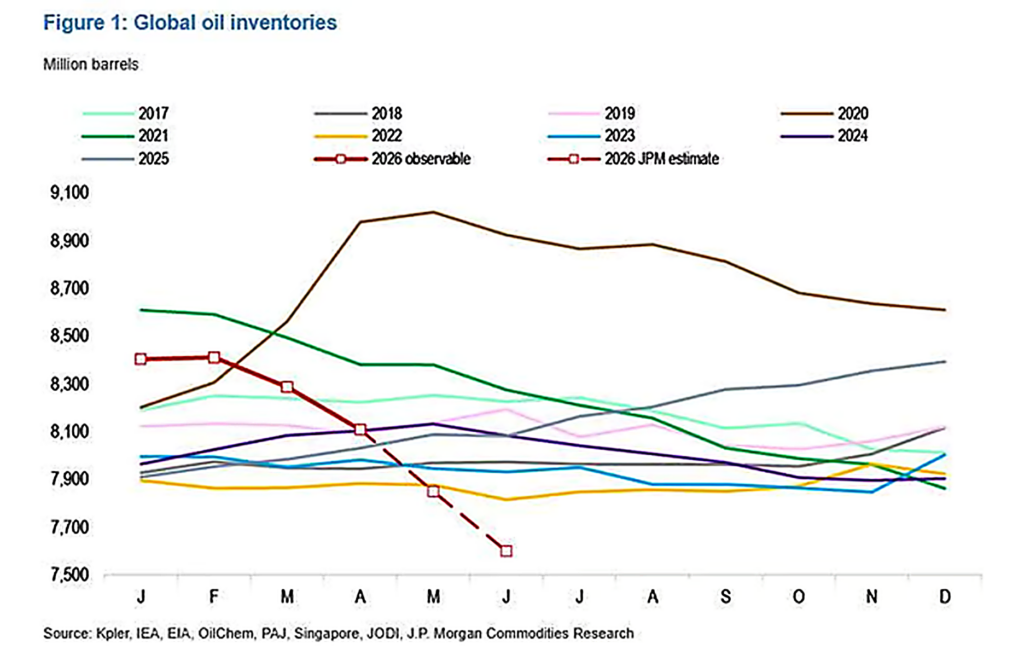
Oil traders have to balance supply restriction and demand destruction, with conflict resolution odds, to project prices into the future. Here are the changes across the Brent crude futures curve:
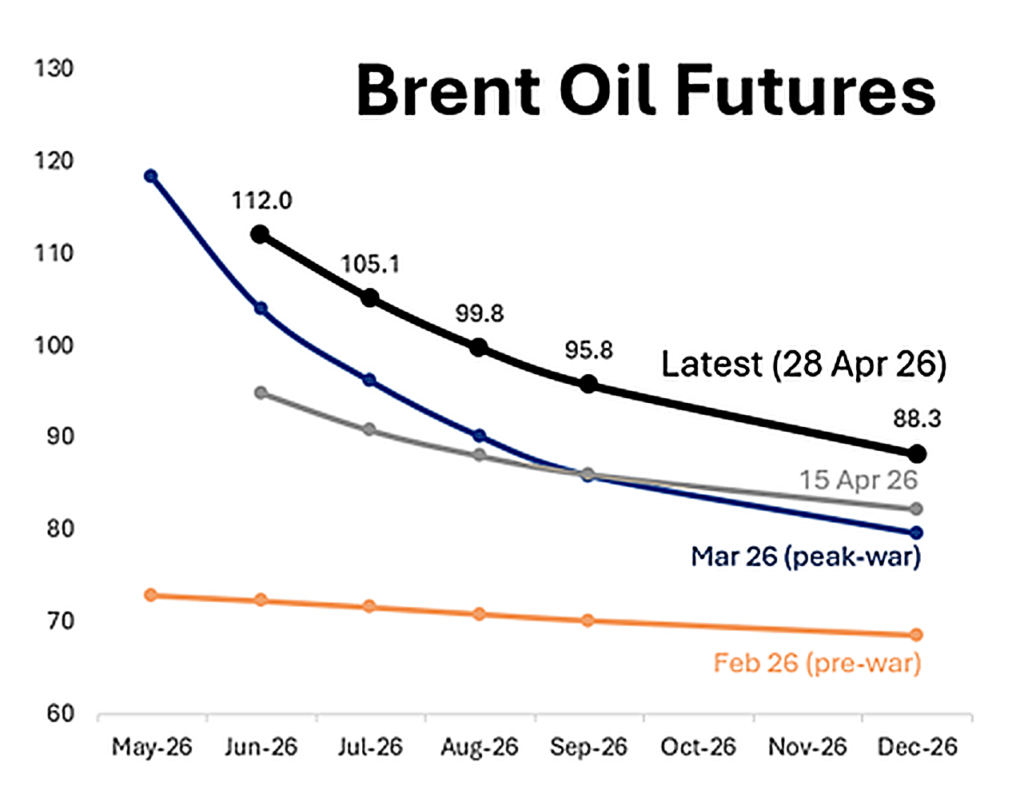
Brent futures price in more Middle East disruption given its seaborn nature. Here in the US, we quote West Texas Intermediate prices as we supply our own oil onshore, largely insulating us from the Middle East disruption. This has created a $10 per barrel savings for US citizens compared with the curve above. Nonetheless, across the curve, prices have shifted higher, accounting for falling confidence in swift war resolution. In sum, probability has risen that oil prices will be higher for longer as negotiation impasses persist, increasing stagflation risks and stock market vulnerabilities.
Capex Pace?
Five of the Magnificent 7 (Apple, Amazon, Google, Meta, Microsoft, Nvidia, Tesla) reported earnings this week. Each reported better earnings than analysts expected, as usual. More importantly, the cohort raised their AI capital expenditures estimates for 2026 from roughly $650 billion to $725 billion. Note not only the scale, but also the significant acceleration this year:
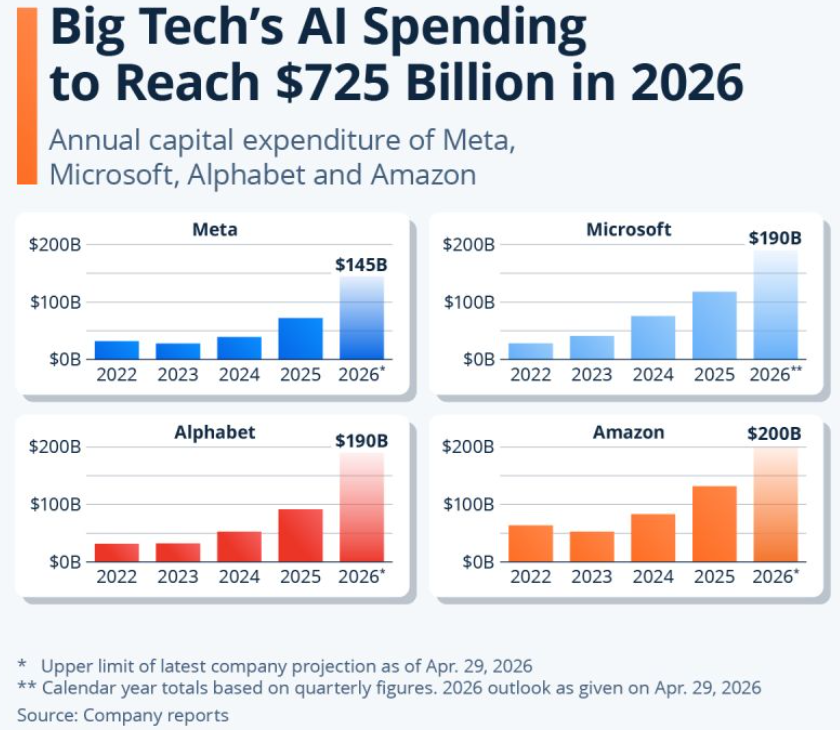
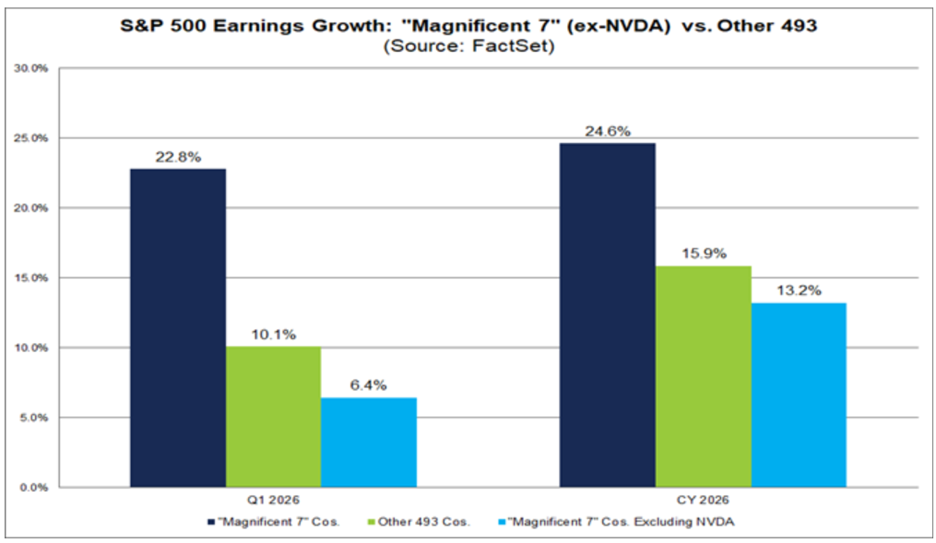
To help size the magnitude of this investment, consider that the US Economy grew 2% in the first quarter of 2026 and capital expenditures accounted for 70% of that growth rate. This rising tide lifts all boats seen in the earnings surge for non-tech companies that supply tech companies with copper, cables, concrete, etc. In fact, the highest sector level returns this year do not belong to technology (who will win?), but to energy, materials and industrials (everyone wins!). While Mag-7 earnings have fueled the market advance over the last couple of years, the Non-Mags have begun catching up. Stripping Nvidia from the calculation, Non-Mags earning growth will likely outpace the Mag-7 earnings growth rate for 2026:
This AI Capex driven earnings cornucopia doesn’t only exist within the S&P 500 Large Cap universe, but also within the S&P 400 Mid Cap and S&P 600 Small Cap universes as well:
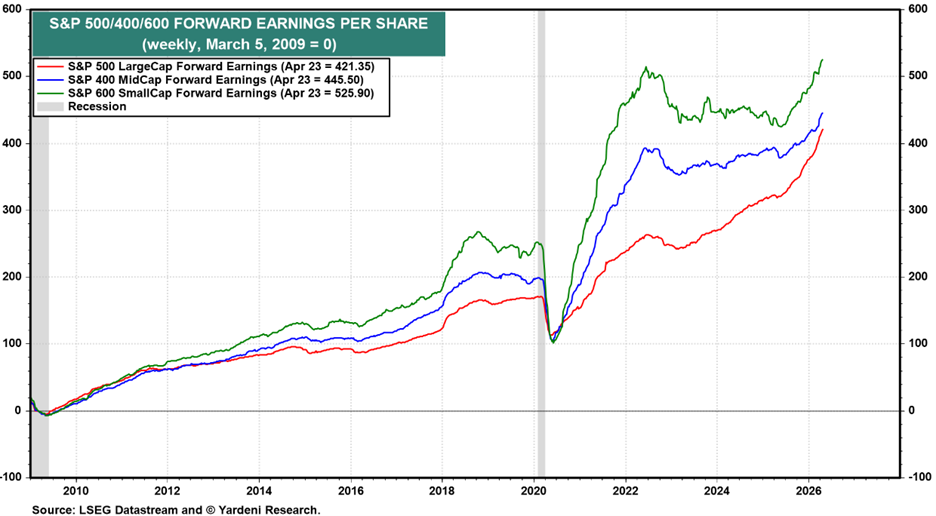
Frankly, I am not sure I recall a time with this much earnings power present so ubiquitously. The risk arises when considering how much financial capacity the Mag-7 have for spending at this level. Fortunately, they run very high profit margins and generate significant cash flow allowing them to largely self-finance (source: Bespoke):
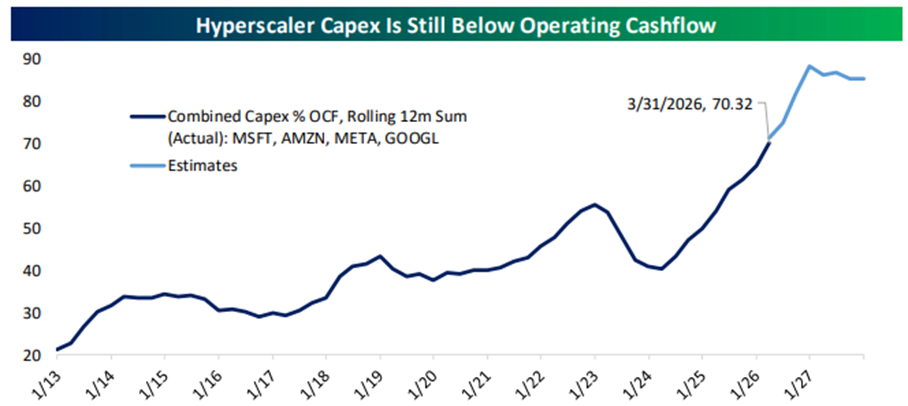
Meaning, while Capex spending levels may seem atmospheric, they have yet to peak. In sum, probabilities have risen that AI capital expenditures will be higher for longer as the AI arms race persists, increasing economic, earnings and investor prospects.
So, which matters more to markets, oil prices or capex pace? With markets closing the month out at all-time highs, it seems resolved that the AI Capex cycle being higher for longer matters more than oil prices being higher for longer.
Bonus Data Point: US Households spend $650 billion directly and indirectly on oil annually; roughly $100 billion less than the Magnificent 7 will spend on AI capex in 2026.
Have a great weekend!
-David
Sources: JP Morgan, Emre Akcakmak (East Capital Group), Statista.com, Yardeni Research, Bespoke, FactSet Earnings Insight
This communication and its contents are for informational and educational purposes only and should not be used as the sole basis for any investment decision. The information contained herein is based on publicly available sources believed to be reliable but is not a representation, expressed or implied, as to the accuracy, completeness, or correctness of said information. References to political figures or policies are for informational purposes only and do not represent an endorsement by Waddell & Associates. Any forward-looking statements reflect current opinions and assumptions and are subject to change without notice; actual results may differ materially. Past performance does not guarantee future results. Waddell & Associates may use artificial intelligence tools to help generate or summarize content; all outputs are reviewed by our team for accuracy and relevance.
">The One Data Point That Rules Them All
Oil Prices?
Iran has recently increased its defiance. Trump has recently increased his threats. Onshore oil prices peaked this week roughly 10% below their wartime high while offshore oil prices peaked 10% above their wartime high. The longer the conflict lasts, the more depleted oil inventories become, and the more upward pressure exerts on price:
Oil traders have to balance supply restriction and demand destruction, with conflict resolution odds, to project prices into the future. Here are the changes across the Brent crude futures curve:
Brent futures price in more Middle East disruption given its seaborn nature. Here in the US, we quote West Texas Intermediate prices as we supply our own oil onshore, largely insulating us from the Middle East disruption. This has created a $10 per barrel savings for US citizens compared with the curve above. Nonetheless, across the curve, prices have shifted higher, accounting for falling confidence in swift war resolution. In sum, probability has risen that oil prices will be higher for longer as negotiation impasses persist, increasing stagflation risks and stock market vulnerabilities.
Capex Pace?
Five of the Magnificent 7 (Apple, Amazon, Google, Meta, Microsoft, Nvidia, Tesla) reported earnings this week. Each reported better earnings than analysts expected, as usual. More importantly, the cohort raised their AI capital expenditures estimates for 2026 from roughly $650 billion to $725 billion. Note not only the scale, but also the significant acceleration this year:
To help size the magnitude of this investment, consider that the US Economy grew 2% in the first quarter of 2026 and capital expenditures accounted for 70% of that growth rate. This rising tide lifts all boats seen in the earnings surge for non-tech companies that supply tech companies with copper, cables, concrete, etc. In fact, the highest sector level returns this year do not belong to technology (who will win?), but to energy, materials and industrials (everyone wins!). While Mag-7 earnings have fueled the market advance over the last couple of years, the Non-Mags have begun catching up. Stripping Nvidia from the calculation, Non-Mags earning growth will likely outpace the Mag-7 earnings growth rate for 2026:
This AI Capex driven earnings cornucopia doesn’t only exist within the S&P 500 Large Cap universe, but also within the S&P 400 Mid Cap and S&P 600 Small Cap universes as well:
Frankly, I am not sure I recall a time with this much earnings power present so ubiquitously. The risk arises when considering how much financial capacity the Mag-7 have for spending at this level. Fortunately, they run very high profit margins and generate significant cash flow allowing them to largely self-finance (source: Bespoke):
Meaning, while Capex spending levels may seem atmospheric, they have yet to peak. In sum, probabilities have risen that AI capital expenditures will be higher for longer as the AI arms race persists, increasing economic, earnings and investor prospects.
So, which matters more to markets, oil prices or capex pace? With markets closing the month out at all-time highs, it seems resolved that the AI Capex cycle being higher for longer matters more than oil prices being higher for longer.
Bonus Data Point: US Households spend $650 billion directly and indirectly on oil annually; roughly $100 billion less than the Magnificent 7 will spend on AI capex in 2026.
Have a great weekend!
-David
Sources: JP Morgan, Emre Akcakmak (East Capital Group), Statista.com, Yardeni Research, Bespoke, FactSet Earnings Insight
This communication and its contents are for informational and educational purposes only and should not be used as the sole basis for any investment decision. The information contained herein is based on publicly available sources believed to be reliable but is not a representation, expressed or implied, as to the accuracy, completeness, or correctness of said information. References to political figures or policies are for informational purposes only and do not represent an endorsement by Waddell & Associates. Any forward-looking statements reflect current opinions and assumptions and are subject to change without notice; actual results may differ materially. Past performance does not guarantee future results. Waddell & Associates may use artificial intelligence tools to help generate or summarize content; all outputs are reviewed by our team for accuracy and relevance.
" class="link-chevron">
The world is in crisis. War rages. Tariffs disrupt. Allegiances fray. Protests seethe. Impeachment looms. Consumer confidence sits at record lows. US markets sit at record highs. How is this possible? Math. Forgive me for oversimplifying what should be more complicated, but the value of the market relies on only two variables: corporate earnings and how much investors are willing to pay for them.
Corporate Earnings
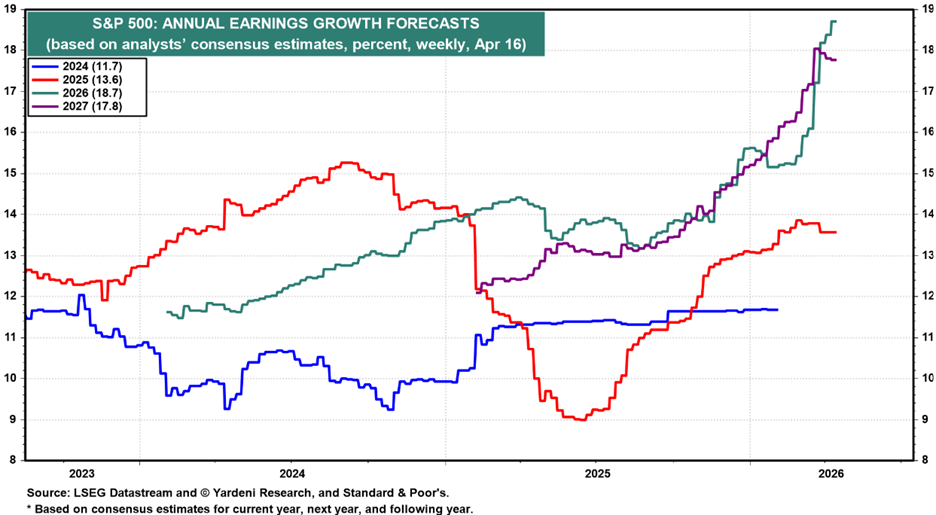
At the beginning of 2026, analysts expected around 15% annual earnings growth for the S&P 500 (the green line). Since then, analysts have marked up their earnings estimates to over 18%. Compare this with the 8.8% median growth rate over the last 20 years. Analysts also expect constituent revenues to increase nearly 10% this year while profit margins expand. Higher revenues, higher profit margins, higher earnings. Hat Trick! Seem unreasonable? So far, 9% of the S&P 500 companies have reported their first-quarter earnings. 90% have beaten expectations. Analysts have raised their revenue and earnings targets considerably since the war began. Should these assumptions prove correct, the S&P 500 will generate $323 in earnings this year. How much should investors pay for them?
Fair Value
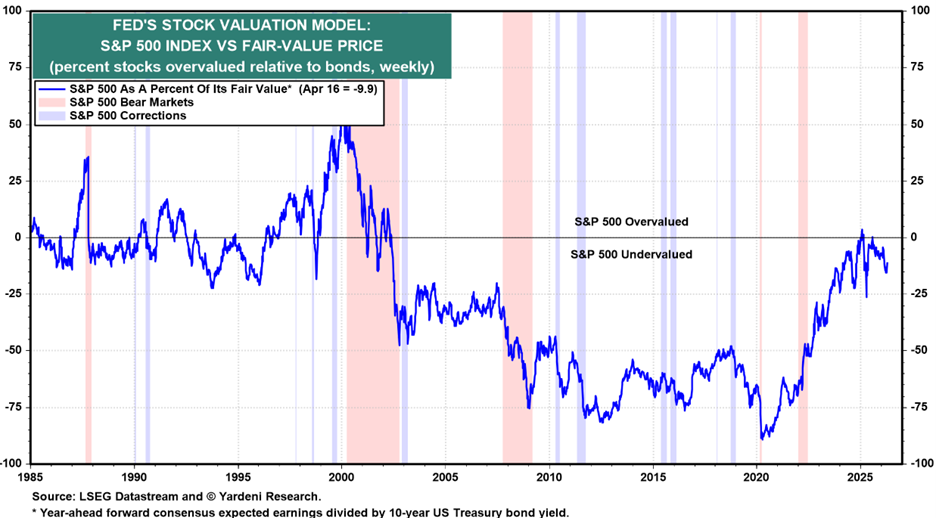
In finance, what investors willingly pay for earnings is known as “the multiple”. If a company earns $100 and you are willing to pay $1,000 for it, the company has a 10x multiple. If it’s a great company with higher-than-average prospects, perhaps you will pay 20x. As in real estate, all individual company valuation decisions are local. At the market level, prevailing interest rates largely determine multiples. To arrive at a fair-value multiple, simply invert them. For instance, a 10% interest rate environment supports a 10x multiple, while a 5% interest rate environment supports a 20x multiple. Today, the 10-year Treasury bond yields 4.25%, supporting a fair market multiple of 23.5x for the S&P 500. During the fog of war, the S&P 500 multiple fell to just over 19x, making the market meaningfully undervalued as seen above. Now, let’s do math! $323 in expected earnings multiplied by 23.5x produces a fair value estimate of 7,590. That’s 11% higher than last Friday’s close at 6,817, and that doesn’t even begin to consider 2027’s earnings estimate of $378.
Mathing Iran
Anytime the government increases spending without raising taxes, fiscal deficits increase. Economists call increased deficits economic “stimulus”. By many estimates the war in Iran increased deficit spending $1 billion a day. That’s stimulus. Conversely, higher oil prices tax the economy. Gasoline increased 35% per gallon due to production and transportation disruptions. On average, US households spend around $50 a week on gas. A 35% increase equates to an additional $15 a week. The war has lasted 6 weeks, costing the US consumer $90 extra dollars at the pump, so far. Fortunately, this tax season, IRS refunds increased 11%, generating an additional $350 for each filer, on average. This stimulus more than offsets the drag at the pump, making the consumer hit from $100 oil largely a non-event, leaving earnings expectations intact.
The Math
Concerns over wartime inflation drove interest rates up from 4% to 4.44% at their apex. This put mathematical downforce on fair value multiples from 25x to 22.5x, overshadowing the resilience of earnings. Certain stocks (tech stocks) with above-market multiples corrected most, while those more reasonably priced corrected least. However, overall valuations entered the period below fair value raising the risk of overshot and increasing the potential for rapid recovery. The multiple for the S&P 500 ended last year around 23x and bottomed recently at 19x. That’s a 17% discount!
With war waning, increased earnings expectations combined with decreased valuations enable a double positive. Higher earnings times higher multiples powered these higher highs. It’s just math!
Have a great Sunday!
-David
Sources: Yardeni Research
This communication and its contents are for informational and educational purposes only and should not be used as the sole basis for any investment decision. The information contained herein is based on publicly available sources believed to be reliable but is not a representation, expressed or implied, as to the accuracy, completeness, or correctness of said information. References to political figures or policies are for informational purposes only and do not represent an endorsement by Waddell & Associates. Any forward-looking statements reflect current opinions and assumptions and are subject to change without notice; actual results may differ materially. Past performance does not guarantee future results. Waddell & Associates may use artificial intelligence tools to help generate or summarize content; all outputs are reviewed by our team for accuracy and relevance.
">Markets at Record Highs: The Math Behind Earnings Growth and Market Valuations
The world is in crisis. War rages. Tariffs disrupt. Allegiances fray. Protests seethe. Impeachment looms. Consumer confidence sits at record lows. US markets sit at record highs. How is this possible? Math. Forgive me for oversimplifying what should be more complicated, but the value of the market relies on only two variables: corporate earnings and how much investors are willing to pay for them.
Corporate Earnings
At the beginning of 2026, analysts expected around 15% annual earnings growth for the S&P 500 (the green line). Since then, analysts have marked up their earnings estimates to over 18%. Compare this with the 8.8% median growth rate over the last 20 years. Analysts also expect constituent revenues to increase nearly 10% this year while profit margins expand. Higher revenues, higher profit margins, higher earnings. Hat Trick! Seem unreasonable? So far, 9% of the S&P 500 companies have reported their first-quarter earnings. 90% have beaten expectations. Analysts have raised their revenue and earnings targets considerably since the war began. Should these assumptions prove correct, the S&P 500 will generate $323 in earnings this year. How much should investors pay for them?
Fair Value
In finance, what investors willingly pay for earnings is known as “the multiple”. If a company earns $100 and you are willing to pay $1,000 for it, the company has a 10x multiple. If it’s a great company with higher-than-average prospects, perhaps you will pay 20x. As in real estate, all individual company valuation decisions are local. At the market level, prevailing interest rates largely determine multiples. To arrive at a fair-value multiple, simply invert them. For instance, a 10% interest rate environment supports a 10x multiple, while a 5% interest rate environment supports a 20x multiple. Today, the 10-year Treasury bond yields 4.25%, supporting a fair market multiple of 23.5x for the S&P 500. During the fog of war, the S&P 500 multiple fell to just over 19x, making the market meaningfully undervalued as seen above. Now, let’s do math! $323 in expected earnings multiplied by 23.5x produces a fair value estimate of 7,590. That’s 11% higher than last Friday’s close at 6,817, and that doesn’t even begin to consider 2027’s earnings estimate of $378.
Mathing Iran
Anytime the government increases spending without raising taxes, fiscal deficits increase. Economists call increased deficits economic “stimulus”. By many estimates the war in Iran increased deficit spending $1 billion a day. That’s stimulus. Conversely, higher oil prices tax the economy. Gasoline increased 35% per gallon due to production and transportation disruptions. On average, US households spend around $50 a week on gas. A 35% increase equates to an additional $15 a week. The war has lasted 6 weeks, costing the US consumer $90 extra dollars at the pump, so far. Fortunately, this tax season, IRS refunds increased 11%, generating an additional $350 for each filer, on average. This stimulus more than offsets the drag at the pump, making the consumer hit from $100 oil largely a non-event, leaving earnings expectations intact.
The Math
Concerns over wartime inflation drove interest rates up from 4% to 4.44% at their apex. This put mathematical downforce on fair value multiples from 25x to 22.5x, overshadowing the resilience of earnings. Certain stocks (tech stocks) with above-market multiples corrected most, while those more reasonably priced corrected least. However, overall valuations entered the period below fair value raising the risk of overshot and increasing the potential for rapid recovery. The multiple for the S&P 500 ended last year around 23x and bottomed recently at 19x. That’s a 17% discount!
With war waning, increased earnings expectations combined with decreased valuations enable a double positive. Higher earnings times higher multiples powered these higher highs. It’s just math!
Have a great Sunday!
-David
Sources: Yardeni Research
This communication and its contents are for informational and educational purposes only and should not be used as the sole basis for any investment decision. The information contained herein is based on publicly available sources believed to be reliable but is not a representation, expressed or implied, as to the accuracy, completeness, or correctness of said information. References to political figures or policies are for informational purposes only and do not represent an endorsement by Waddell & Associates. Any forward-looking statements reflect current opinions and assumptions and are subject to change without notice; actual results may differ materially. Past performance does not guarantee future results. Waddell & Associates may use artificial intelligence tools to help generate or summarize content; all outputs are reviewed by our team for accuracy and relevance.
" class="link-chevron">
We entered 2026 as we almost always do, bullish but fearful. Bullish because, on average, equity markets appreciate 75% of the time in any given year and appreciate 85% of the time without a recession. The combined fiscal, monetary, deregulatory and AI Capex stimulus should insure against recession and corporate profit margin expansion and earnings momentum should ensure continued gains for investors. Fearful, because supply shortages across the economy (labor and semiconductors) might overwhelm productivity benefits leading to stubborn, if not elevated, inflation levels. This could force Trump’s handpicked Fed to tighten policy, rather than loosen it, as ordered. Higher inflation doesn’t necessarily mean lower stock prices. In 2021, inflation rose from 1.3% to 7.1% while the S&P 500 rose 28%. However, it does increase performance disparity within the market, making selectivity more important. Higher rates increase the cost of debt and threaten higher valuations, leading us to favor companies with lower debt levels and lower P/E’s. In short, our strategy entering the year: expect continued gains, expect inflation risks, select accordingly.
The War Impact
Prior to the first air raid in Iran, capital rotations within the market endorsed our view. Note the performance differential between the S&P Pure Value ETF sporting a 12x P/E vs. the MAG 7 with a 28x P/E, through February:
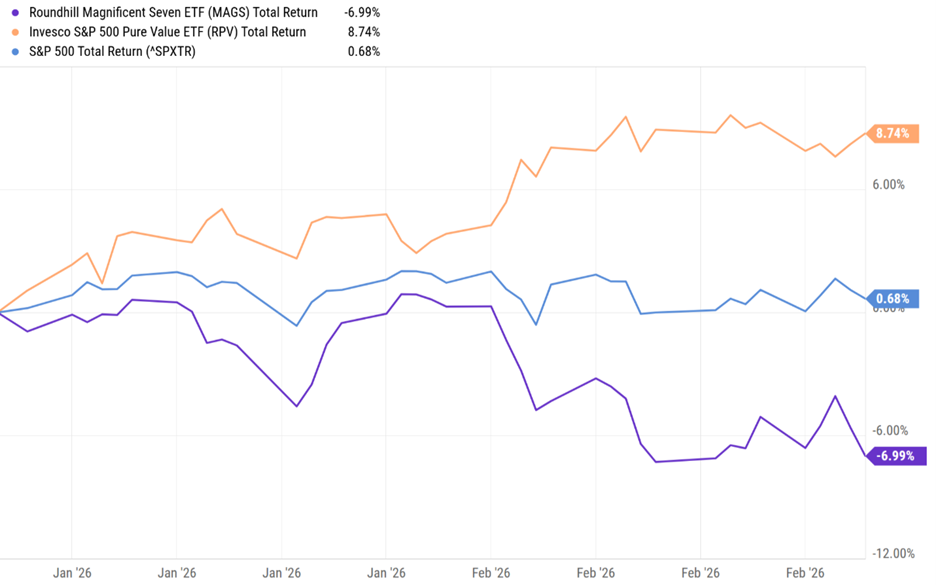
A 16% performance disparity between these high P/E and low P/E cohorts before the war, within an S&P up 1%, well articulates the point. How about since Epic Fury began:
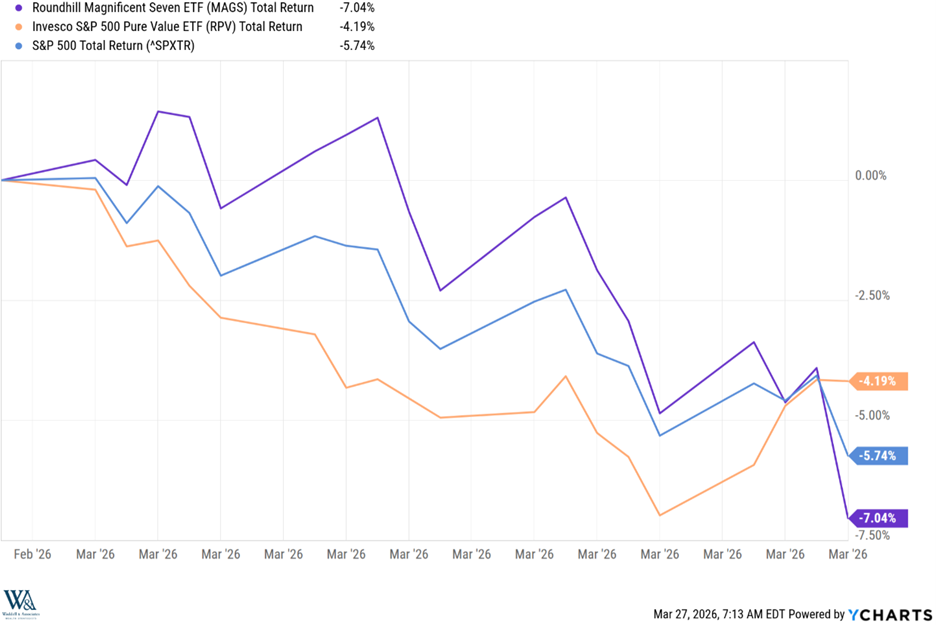
Clearly, the war hasn’t helped investors. Initially, the higher P/E Mag 7 cohort made a relative comeback (purple line) as investors crowded into comfortable earnings growth bunkers, only to rethink valuations and rotate back to safety (orange line). For the trained eye, this chart conveys the uncertainty present in the marketplace. Will earnings growth persist? Will inflation levels rise? Will economic growth decay? Will the S&P 500 violate technical levels leading to an algorithmic washout? When and where will this market bottom? Where can I hide out until then?
Seeking clarity, I posed these questions to Chat GPT. Chat doesn’t know. So goes the fog of war. Therefore, we can only draw on experience. First, our base case outlook gained validation prior to the conflict and therefore should sustain post. Rotating capital within or across asset classes amidst the fog of war makes little sense as demonstrated above. These are binary moments where investors either raise liquidity (sell everything) or deploy liquidity (buy everything). Trying to game a market being gamed by Truth Social isn’t strategic, its gambling. In unknowable moments, there is safety in stability. Second, because of the anxieties they create, investors often overestimate the economic implications of geopolitical events. Remember the European panic ignited by Russia’s invasion of Ukraine in 2022? European equities actually outperformed American equities that year. In fact, if you look at past geopolitical events, markets tend to absorb inital shocks and rebound smartly:
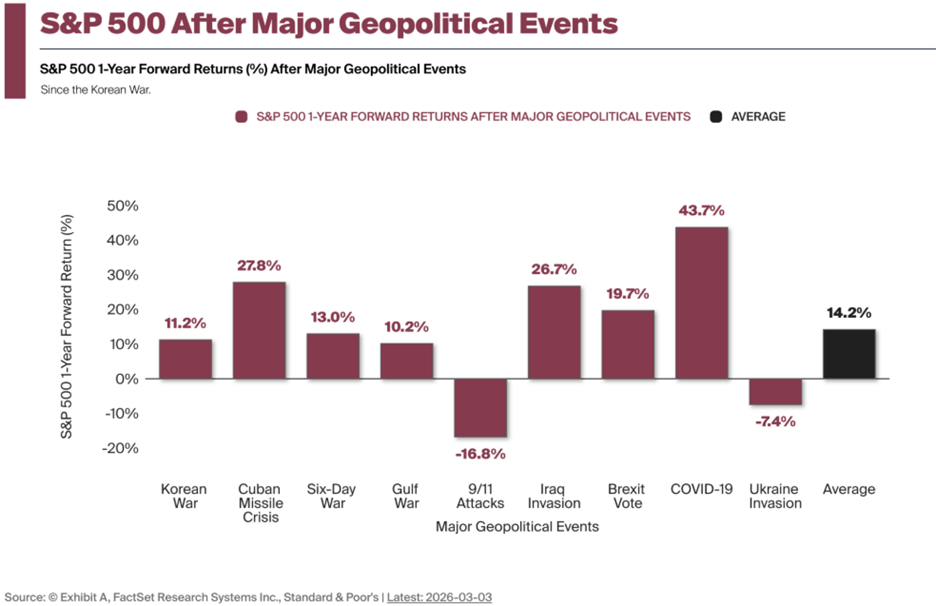
The two down years include 9/11, which occurred during the Dot-Com collapse, and the Ukraine invasion which occurred alongside 9% inflation. Those events may have agitated the markets decline, but they didn’t cause it. With our current backdrop of economic and earnings momentum we have a far sturdier foundation reflected in the markets limited drawdown to date. Consider the probabilities of drawdowns in any given year:
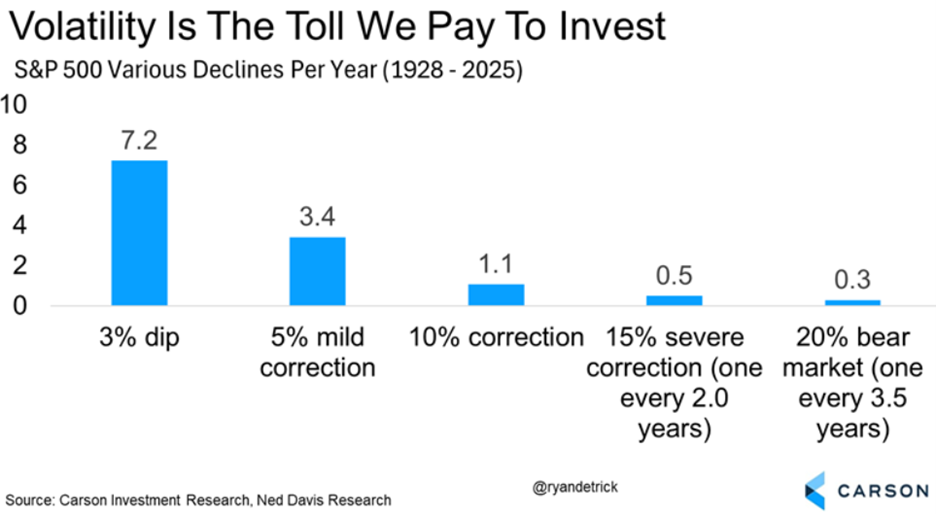
In any given year, on average, the market declines by 3% 7.2 times, 5% 3.4 times, and 10% at least 1 time while appreciating 75% of the time. Do I expect this market to pierce the 10% drawdown level, probably. Do I expect a 15% decline, maybe. Neither would be unusual or insurmountable, especially for a mid-term election year:
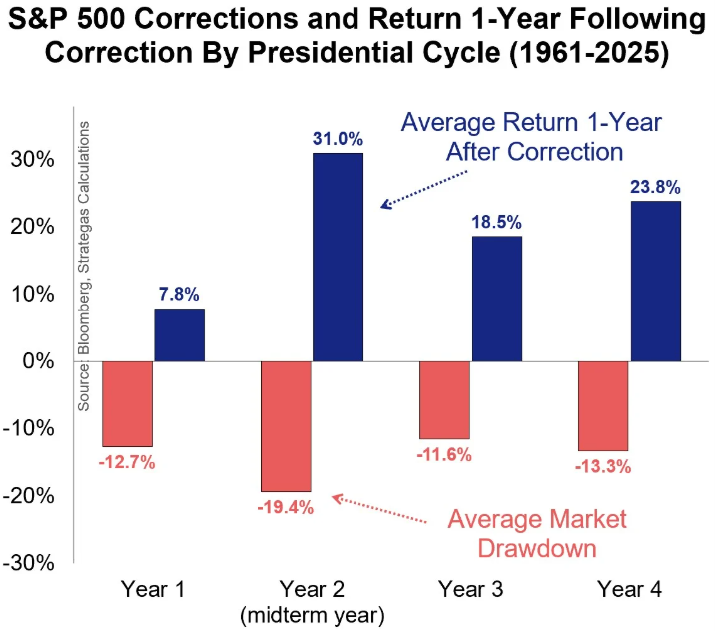
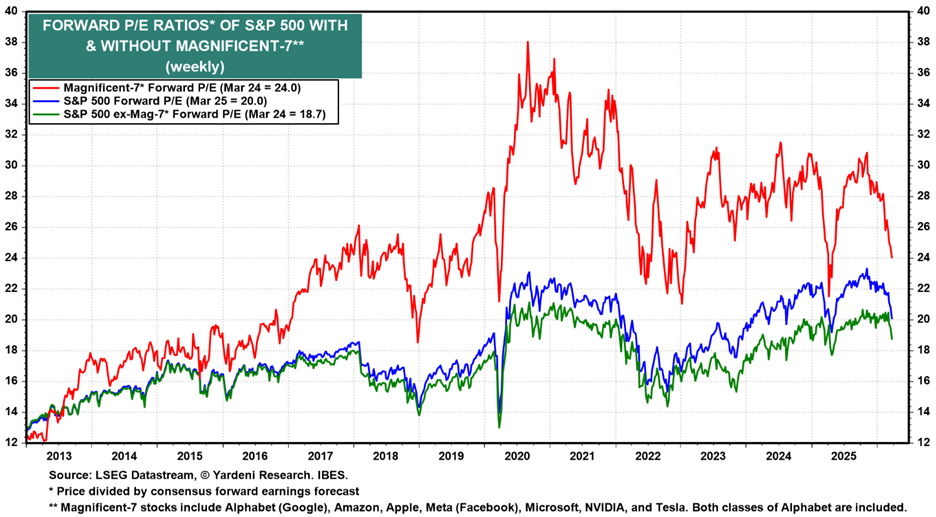
Should this market decline accelerate, we will refer to our down-market playbook and reprise our activity seen in April of 2025. We will sell positions to harvest tax losses, locking in future tax benefits, and we will redeploy capital opportunistically anticipating recovery. Remember, down markets have benefits. The valuations that so concerned investors entering 2026 have corrected, making the menu of buying opportunities longer:
In sum, it’s misguided to trade headlines within the fog of war. Should markets move to extremes, mispricing may create opportunities, but any transactions must comply with overall strategic outlooks. Under-trading geopolitical events has produced far higher investment returns for investors than overtrading. Be patient, be opportunistic, and stay the course.
Have a great week!
-David
Sources: YCharts, Factset, Carson Investment Research, Baird, Yardeni Research
This communication and its contents are for informational and educational purposes only and should not be used as the sole basis for any investment decision. The information contained herein is based on publicly available sources believed to be reliable but is not a representation, expressed or implied, as to the accuracy, completeness, or correctness of said information. References to political figures or policies are for informational purposes only and do not represent an endorsement by Waddell & Associates. Any forward-looking statements reflect current opinions and assumptions and are subject to change without notice; actual results may differ materially. Past performance does not guarantee future results. Waddell & Associates may use artificial intelligence tools to help generate or summarize content; all outputs are reviewed by our team for accuracy and relevance.
">In or Out: Navigating Markets in the Fog of War
We entered 2026 as we almost always do, bullish but fearful. Bullish because, on average, equity markets appreciate 75% of the time in any given year and appreciate 85% of the time without a recession. The combined fiscal, monetary, deregulatory and AI Capex stimulus should insure against recession and corporate profit margin expansion and earnings momentum should ensure continued gains for investors. Fearful, because supply shortages across the economy (labor and semiconductors) might overwhelm productivity benefits leading to stubborn, if not elevated, inflation levels. This could force Trump’s handpicked Fed to tighten policy, rather than loosen it, as ordered. Higher inflation doesn’t necessarily mean lower stock prices. In 2021, inflation rose from 1.3% to 7.1% while the S&P 500 rose 28%. However, it does increase performance disparity within the market, making selectivity more important. Higher rates increase the cost of debt and threaten higher valuations, leading us to favor companies with lower debt levels and lower P/E’s. In short, our strategy entering the year: expect continued gains, expect inflation risks, select accordingly.
The War Impact
Prior to the first air raid in Iran, capital rotations within the market endorsed our view. Note the performance differential between the S&P Pure Value ETF sporting a 12x P/E vs. the MAG 7 with a 28x P/E, through February:
A 16% performance disparity between these high P/E and low P/E cohorts before the war, within an S&P up 1%, well articulates the point. How about since Epic Fury began:
Clearly, the war hasn’t helped investors. Initially, the higher P/E Mag 7 cohort made a relative comeback (purple line) as investors crowded into comfortable earnings growth bunkers, only to rethink valuations and rotate back to safety (orange line). For the trained eye, this chart conveys the uncertainty present in the marketplace. Will earnings growth persist? Will inflation levels rise? Will economic growth decay? Will the S&P 500 violate technical levels leading to an algorithmic washout? When and where will this market bottom? Where can I hide out until then?
Seeking clarity, I posed these questions to Chat GPT. Chat doesn’t know. So goes the fog of war. Therefore, we can only draw on experience. First, our base case outlook gained validation prior to the conflict and therefore should sustain post. Rotating capital within or across asset classes amidst the fog of war makes little sense as demonstrated above. These are binary moments where investors either raise liquidity (sell everything) or deploy liquidity (buy everything). Trying to game a market being gamed by Truth Social isn’t strategic, its gambling. In unknowable moments, there is safety in stability. Second, because of the anxieties they create, investors often overestimate the economic implications of geopolitical events. Remember the European panic ignited by Russia’s invasion of Ukraine in 2022? European equities actually outperformed American equities that year. In fact, if you look at past geopolitical events, markets tend to absorb inital shocks and rebound smartly:
The two down years include 9/11, which occurred during the Dot-Com collapse, and the Ukraine invasion which occurred alongside 9% inflation. Those events may have agitated the markets decline, but they didn’t cause it. With our current backdrop of economic and earnings momentum we have a far sturdier foundation reflected in the markets limited drawdown to date. Consider the probabilities of drawdowns in any given year:
In any given year, on average, the market declines by 3% 7.2 times, 5% 3.4 times, and 10% at least 1 time while appreciating 75% of the time. Do I expect this market to pierce the 10% drawdown level, probably. Do I expect a 15% decline, maybe. Neither would be unusual or insurmountable, especially for a mid-term election year:
Should this market decline accelerate, we will refer to our down-market playbook and reprise our activity seen in April of 2025. We will sell positions to harvest tax losses, locking in future tax benefits, and we will redeploy capital opportunistically anticipating recovery. Remember, down markets have benefits. The valuations that so concerned investors entering 2026 have corrected, making the menu of buying opportunities longer:
In sum, it’s misguided to trade headlines within the fog of war. Should markets move to extremes, mispricing may create opportunities, but any transactions must comply with overall strategic outlooks. Under-trading geopolitical events has produced far higher investment returns for investors than overtrading. Be patient, be opportunistic, and stay the course.
Have a great week!
-David
Sources: YCharts, Factset, Carson Investment Research, Baird, Yardeni Research
This communication and its contents are for informational and educational purposes only and should not be used as the sole basis for any investment decision. The information contained herein is based on publicly available sources believed to be reliable but is not a representation, expressed or implied, as to the accuracy, completeness, or correctness of said information. References to political figures or policies are for informational purposes only and do not represent an endorsement by Waddell & Associates. Any forward-looking statements reflect current opinions and assumptions and are subject to change without notice; actual results may differ materially. Past performance does not guarantee future results. Waddell & Associates may use artificial intelligence tools to help generate or summarize content; all outputs are reviewed by our team for accuracy and relevance.
" class="link-chevron">
The conflict in the middle east has largely confused investors and commentators. We have been through many of these military market shocks before and gained well-earned perspective. To gauge investment impact and assess the case for reallocation, we focus less on battlefield maneuvers and more on key indicator maneuvers. This week, I will quickly share our war room dashboard and our investment battle plan.
Inflation Expectations
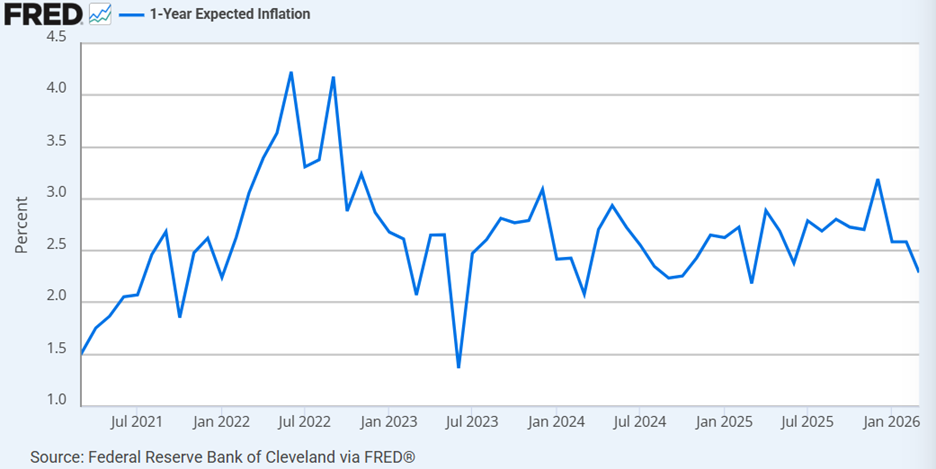
The Fed’s 1-Year Expected Inflation measure reveals a market that perceives the conflict in Iran as temporary. We received several backward-looking inflation indicators this week that were also largely benign. Most notably, consumer price inflation (CPI) fell to 2.4% year-over-year, its lowest reading in 5 years. This number will surely rise in the next report reflecting higher gasoline prices, and the Fed will most certainly not cut rates next week, but for now inflation expectations sees war driven inflation as transitory.
Investor Sentiment
Aggregate measures of investor sentiment have declined sharply since the war began, but they have not reached capitulation levels. I favor the AAII Bullish sentiment indicator most at times of stress. Whenever the number of retail bulls (the surveyed participants who believe the market will rise) falls anywhere near 20%, an upward market turn typically follows.
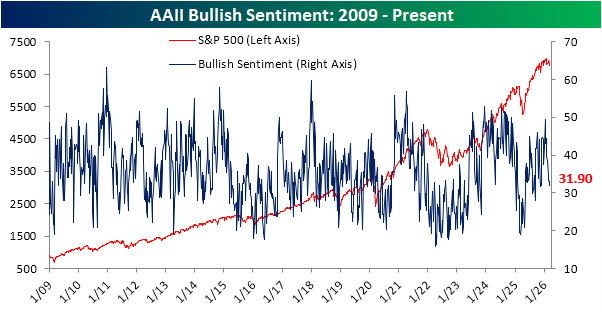
With 31.9% still bullish, while we have corrected the froth from 50% a month ago, we have not reached the moribund levels that signal panic, or an imminent advance.
Volatility
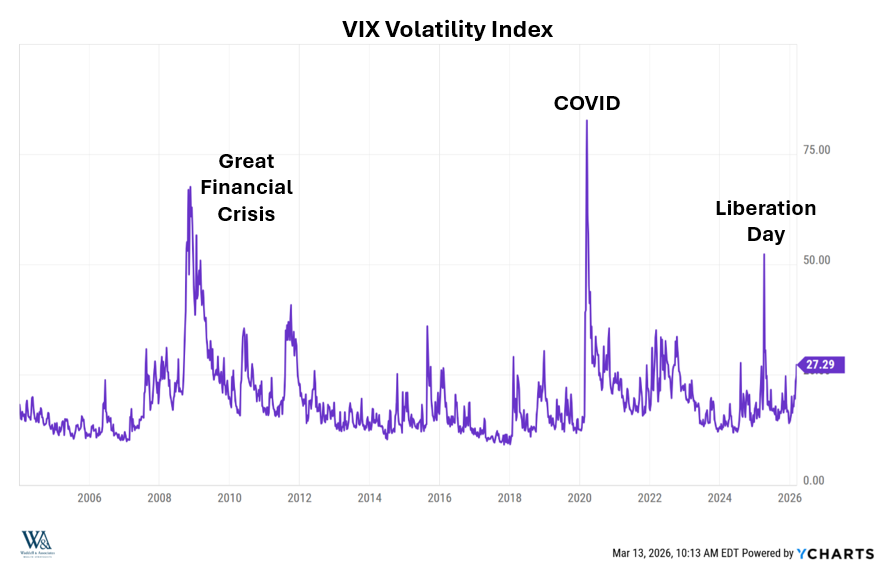
The VIX volatility index provides another investable measure of sentiment. When panic hits, the VIX spikes, but panic typically overestimates negative possibilities presenting a great buying opportunity for investors. For instance, after Trump’s Liberation Day announcement, the VIX spiked above 50 and we became enthusiastic buyers. Trump scaled down tariff rates through negotiations, and the S&P 500 went on to hit new highs. Currently, the VIX sits at 27—elevated, but not panicky:
The Favorable Fundamentals
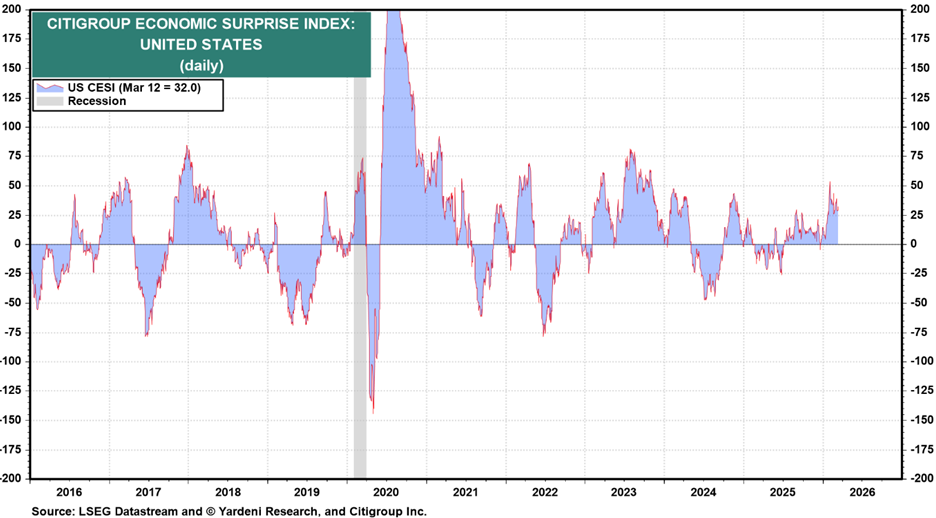
When military conflicts and geopolitics command attention, investors tend to lose track of the fundamentals. One can claim that this conflict negates the usefulness of using recent trends to predict future trends, but economic movements contain deep inertia. Prior to the bombing campaign, US economic releases had been steadily surprising economists to the upside:
Simultaneously, Wall Street analysts have been consistently raising forward earnings expectations:
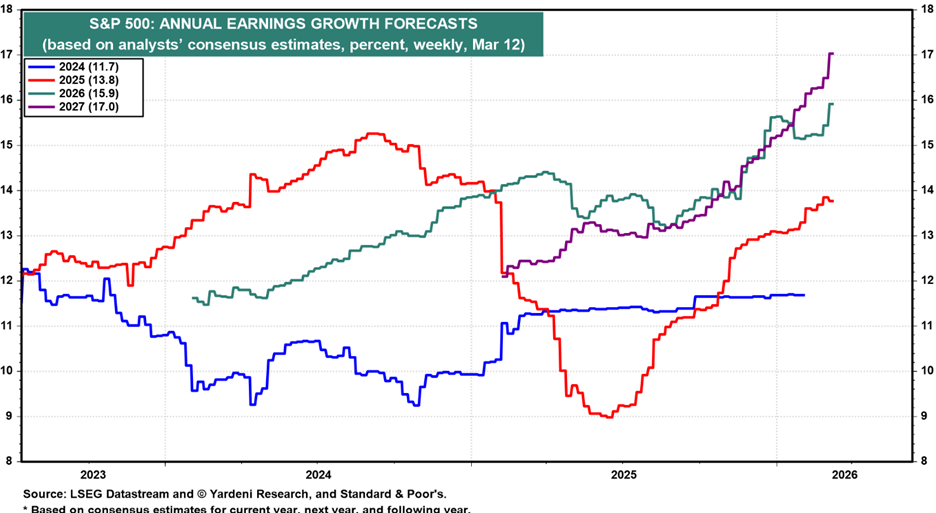
Let’s take a moment here. The chart above chronicles S&P 500 earnings estimate changes over time for the years 2024, 2025, 2026, and 2027. Earnings grew 11.7% in 2024, ending near the high end of the expected range. Earnings grew 13.8% in 2025, also ending near the high end of the expected range. Earnings estimates for 2026 and 2027 have been climbing and now sit at the highest levels of their expected ranges at 15.9% and 17% growth, respectively. This powerful earnings expectations up-force has undoubtedly muted the Iran conflicts downforce. This earnings inertia explains the measured sentiment response and the less than 5% drawdown in the S&P 500 from recent highs.
Have a great week!
-David
Sources: Federal Reserve, YCharts, Yardeni Research, Bespoke Investment Group
This communication and its contents are for informational and educational purposes only and should not be used as the sole basis for any investment decision. The information contained herein is based on publicly available sources believed to be reliable but is not a representation, expressed or implied, as to the accuracy, completeness, or correctness of said information. References to political figures or policies are for informational purposes only and do not represent an endorsement by Waddell & Associates. Any forward-looking statements reflect current opinions and assumptions and are subject to change without notice; actual results may differ materially. Past performance does not guarantee future results. Waddell & Associates may use artificial intelligence tools to help generate or summarize content; all outputs are reviewed by our team for accuracy and relevance.
">Filtering The Fight
The conflict in the middle east has largely confused investors and commentators. We have been through many of these military market shocks before and gained well-earned perspective. To gauge investment impact and assess the case for reallocation, we focus less on battlefield maneuvers and more on key indicator maneuvers. This week, I will quickly share our war room dashboard and our investment battle plan.
Inflation Expectations
The Fed’s 1-Year Expected Inflation measure reveals a market that perceives the conflict in Iran as temporary. We received several backward-looking inflation indicators this week that were also largely benign. Most notably, consumer price inflation (CPI) fell to 2.4% year-over-year, its lowest reading in 5 years. This number will surely rise in the next report reflecting higher gasoline prices, and the Fed will most certainly not cut rates next week, but for now inflation expectations sees war driven inflation as transitory.
Investor Sentiment
Aggregate measures of investor sentiment have declined sharply since the war began, but they have not reached capitulation levels. I favor the AAII Bullish sentiment indicator most at times of stress. Whenever the number of retail bulls (the surveyed participants who believe the market will rise) falls anywhere near 20%, an upward market turn typically follows.
With 31.9% still bullish, while we have corrected the froth from 50% a month ago, we have not reached the moribund levels that signal panic, or an imminent advance.
Volatility
The VIX volatility index provides another investable measure of sentiment. When panic hits, the VIX spikes, but panic typically overestimates negative possibilities presenting a great buying opportunity for investors. For instance, after Trump’s Liberation Day announcement, the VIX spiked above 50 and we became enthusiastic buyers. Trump scaled down tariff rates through negotiations, and the S&P 500 went on to hit new highs. Currently, the VIX sits at 27—elevated, but not panicky:
The Favorable Fundamentals
When military conflicts and geopolitics command attention, investors tend to lose track of the fundamentals. One can claim that this conflict negates the usefulness of using recent trends to predict future trends, but economic movements contain deep inertia. Prior to the bombing campaign, US economic releases had been steadily surprising economists to the upside:
Simultaneously, Wall Street analysts have been consistently raising forward earnings expectations:
Let’s take a moment here. The chart above chronicles S&P 500 earnings estimate changes over time for the years 2024, 2025, 2026, and 2027. Earnings grew 11.7% in 2024, ending near the high end of the expected range. Earnings grew 13.8% in 2025, also ending near the high end of the expected range. Earnings estimates for 2026 and 2027 have been climbing and now sit at the highest levels of their expected ranges at 15.9% and 17% growth, respectively. This powerful earnings expectations up-force has undoubtedly muted the Iran conflicts downforce. This earnings inertia explains the measured sentiment response and the less than 5% drawdown in the S&P 500 from recent highs.
Have a great week!
-David
Sources: Federal Reserve, YCharts, Yardeni Research, Bespoke Investment Group
This communication and its contents are for informational and educational purposes only and should not be used as the sole basis for any investment decision. The information contained herein is based on publicly available sources believed to be reliable but is not a representation, expressed or implied, as to the accuracy, completeness, or correctness of said information. References to political figures or policies are for informational purposes only and do not represent an endorsement by Waddell & Associates. Any forward-looking statements reflect current opinions and assumptions and are subject to change without notice; actual results may differ materially. Past performance does not guarantee future results. Waddell & Associates may use artificial intelligence tools to help generate or summarize content; all outputs are reviewed by our team for accuracy and relevance.
" class="link-chevron">Emerging Markets Rotation
We have always approached the emerging markets with a value bias, seeing exposure to the segment as growthy enough. Small cap emerging market names can provide additional downside insurance as they trade far less frequently than their larger cap peers, leading to less performance volatility driven by low conviction capital volatility. In uncertain periods we will hold small cap exposure to avoid capital whipsaws. Unfortunately, just as the low trading volumes limit selling pressure, low trading volumes also limit buying pressure. With conviction growing in the durability of emerging market outperformance, after twenty years of underperformance, we have chosen to swap our emerging markets small cap passive position for a larger cap active position that will benefit more from incoming capital flows. Our selected manager prioritizes dividend paying companies, maintaining our quality bias, while also aligning with our “prove it” financial bias at this point in the cycle. Consider the following factors supporting our Emerging Market exposure:
- Note the valuation differential when comparing the Emerging Market stock market index with other world indices:
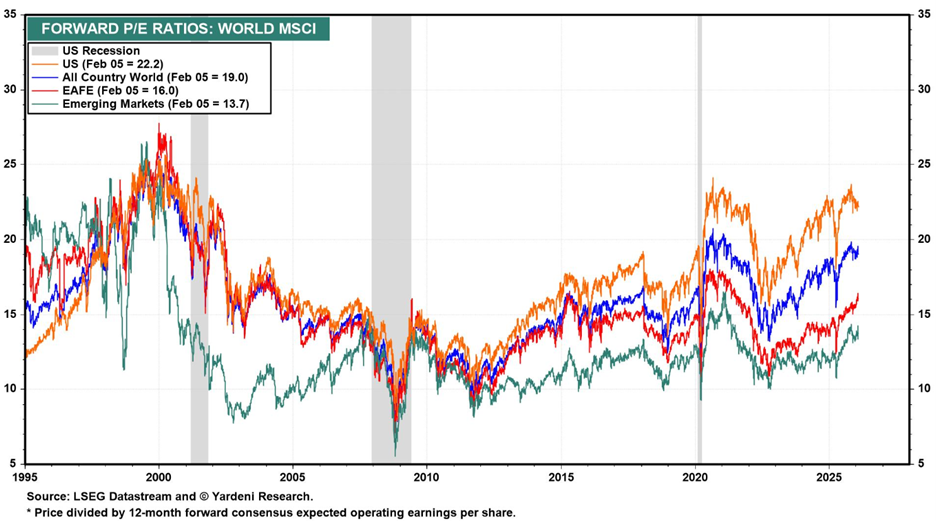
The emerging market complex trades at 13.7x forward earnings within the midpoint of its historical range, while the US trades at 22x, near the top of its historical range.
2. Consider the earnings momentum that “Re-globalization”, technological adoption, and voracious demand for materials and components have unlocked:
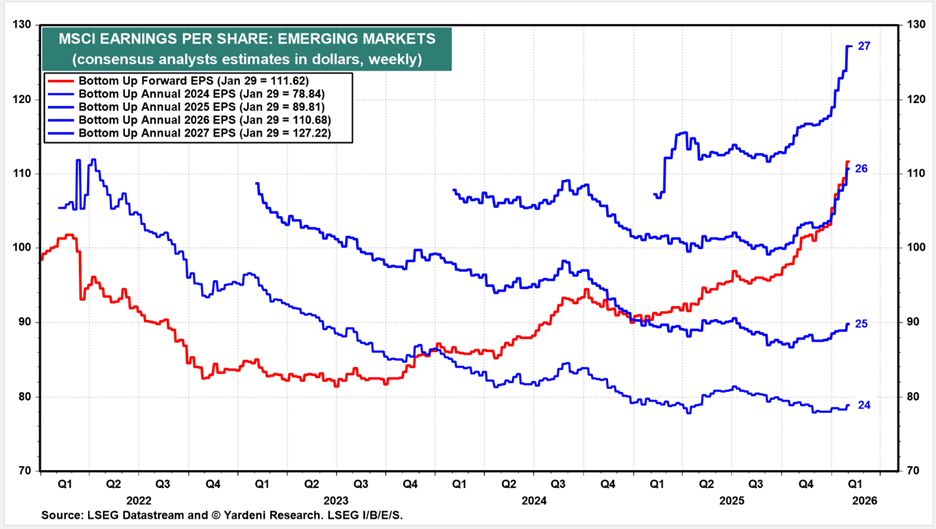
While analysts expect US earnings to grow 15% and 16% in 2026 and 2027 respectively, they forecast 23% and 15% earnings growth within Emerging Markets.
3. Consider money flows into Emerging Markets from January alone:
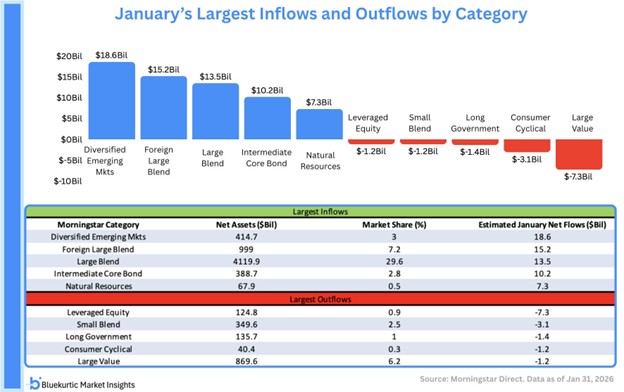
How long can these catalytic money flows persist? Lower valuations and improving earnings momentum paired with Mag-7 fatigue and institutional under allocation to the asset class could fuel relative outperformance for years.
4. Consider the last twenty years of relative underperformance and the spread available for recapture:
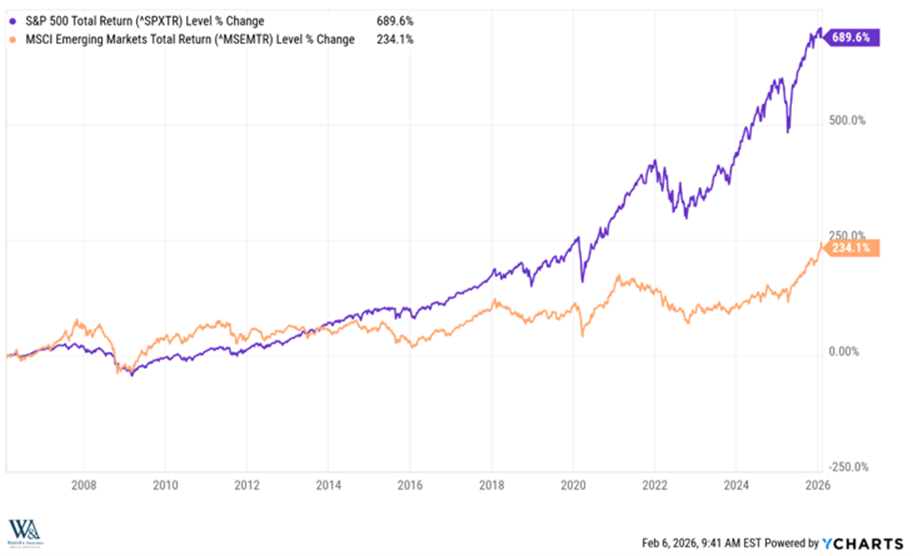
In this year alone, the Emerging Markets index has advanced 7% while the S&P 500 has declined 1%. Last year, the Emerging Markets index outperformed the S&P 500 by 16.5%. Relative performance ebbs and flows, but after two decades of neglect, the revival of the Emerging Markets seems well overdue and fundamentally defensible.
Large Value Rotation
Over the past week, panic attacks incited by fears of AI capex overallocation, infighting among the Mag 7, and the threat of AI agents cannibalizing the software sector created dramatic deleveraging and a flight to quality within the markets. Consider the performance divergence between the Mag-7 complex and the S&P 500 Dividend Aristocrats index over the past week alone:
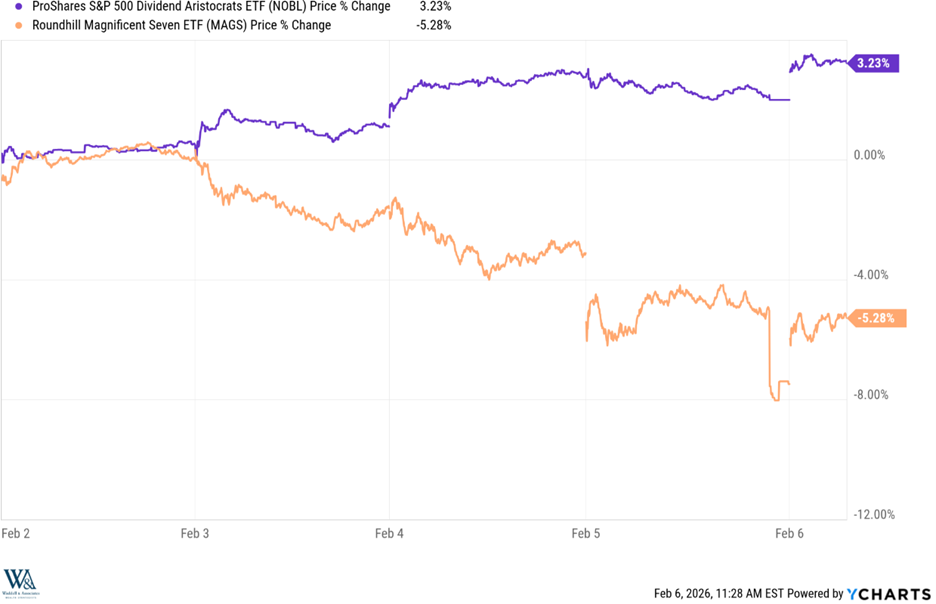
It’s highly unusual to see an 8% performance spread between such large weightings over a short amount of time, but it validates our thinking. While AI deployment will benefit some technology providers, it will benefit all who utilize it. Therefore, while the tech sector becomes more capital intensive to produce AI, traditionally capital-intensive businesses will become less capital intensive through utilizing AI. Additionally, the historic capex cycle we find ourselves in building out virtual AI, and ultimately physical AI, will require all forms of financing, including massive debt issuance. Much of this bloat can hide in circular financing structures and private debt markets, making investors unsure of true creditworthiness within the marketplace. This reveals the Achilles’ heel for this fast-paced economic cycle. While we are not concerned about an imminent credit event, we are attuned to rising investor skittishness as displayed last week. This drives part of our decision to rotate out of an agnostic deep value manager into another more dividend focused manager, finding comfort in the “prove it” attributes of tangible cash distributions. We expect to see more dividend payer appetite as the debt cycle enlarges, which means more demand, and higher prices for dividend centric strategies.
When Trump won the election in November, the US dollar strengthened. In theory, the orderly deployment of a tariff agenda should increase exports (purchases of dollars) and decrease imports (sales of dollars), supporting currency strength. In recognition, we repatriated a portion of our international exposure to avoid potential currency drag.
Trump’s tariff agenda was anything but orderly, overriding the economics and inciting dollar debasement benefiting Gold, Silver, etc. With Kevin Warsh’s appointment, we have less clarity on the dollar’s direction, but we do see Europe starting to consider economic growth as national security in a disorderly political environment. Increased military spending, fiscal deficit expansion, resumption of energy production, and whispers of deregulation should lift profit margins and earnings. We already see this in rising earnings expectations across Europe:
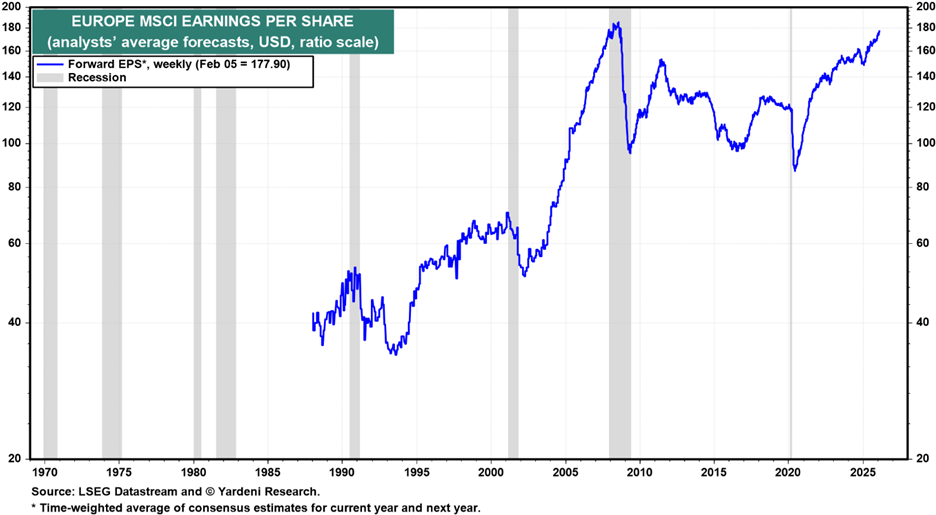
The combination of “prove it” cash flows and additional developed world international exposure informed our search and selection of a new value focused large cap manager screening for high free cash flows and juicy dividends, worldwide.
Fortunately, the remainder of our holdings properly calibrate with our worldview, which we will reveal next Thursday. Position changes from here will likely be situational (tax trades) rather than strategic, unless our worldview changes significantly. Remember, history shows a clear inverse relationship between frequent trading and investment returns!
Have a great week!
-David
Sources: Yardeni Research
This communication and its contents are for informational and educational purposes only and should not be used as the sole basis for any investment decision. The information contained herein is based on publicly available sources believed to be reliable but is not a representation, expressed or implied, as to the accuracy, completeness, or correctness of said information. References to political figures or policies are for informational purposes only and do not represent an endorsement by Waddell & Associates. Any forward-looking statements reflect current opinions and assumptions and are subject to change without notice; actual results may differ materially. Past performance does not guarantee future results. Waddell & Associates may use artificial intelligence tools to help generate or summarize content; all outputs are reviewed by our team for accuracy and relevance.
">
W&A clients will soon see confirmations of two rotational trades within our equity portfolios that better align portfolios with our 2026 Outlook (register for our live webinar here). While the SEC will not let us discuss specific trade details within this format, we can discuss general strategic decisions. For more insight and information on the specific transactions, feel free to call your W&A advisor.
Emerging Markets Rotation
We have always approached the emerging markets with a value bias, seeing exposure to the segment as growthy enough. Small cap emerging market names can provide additional downside insurance as they trade far less frequently than their larger cap peers, leading to less performance volatility driven by low conviction capital volatility. In uncertain periods we will hold small cap exposure to avoid capital whipsaws. Unfortunately, just as the low trading volumes limit selling pressure, low trading volumes also limit buying pressure. With conviction growing in the durability of emerging market outperformance, after twenty years of underperformance, we have chosen to swap our emerging markets small cap passive position for a larger cap active position that will benefit more from incoming capital flows. Our selected manager prioritizes dividend paying companies, maintaining our quality bias, while also aligning with our “prove it” financial bias at this point in the cycle. Consider the following factors supporting our Emerging Market exposure:
- Note the valuation differential when comparing the Emerging Market stock market index with other world indices:
The emerging market complex trades at 13.7x forward earnings within the midpoint of its historical range, while the US trades at 22x, near the top of its historical range.
2. Consider the earnings momentum that “Re-globalization”, technological adoption, and voracious demand for materials and components have unlocked:
While analysts expect US earnings to grow 15% and 16% in 2026 and 2027 respectively, they forecast 23% and 15% earnings growth within Emerging Markets.
3. Consider money flows into Emerging Markets from January alone:
How long can these catalytic money flows persist? Lower valuations and improving earnings momentum paired with Mag-7 fatigue and institutional under allocation to the asset class could fuel relative outperformance for years.
4. Consider the last twenty years of relative underperformance and the spread available for recapture:
In this year alone, the Emerging Markets index has advanced 7% while the S&P 500 has declined 1%. Last year, the Emerging Markets index outperformed the S&P 500 by 16.5%. Relative performance ebbs and flows, but after two decades of neglect, the revival of the Emerging Markets seems well overdue and fundamentally defensible.
Large Value Rotation
Over the past week, panic attacks incited by fears of AI capex overallocation, infighting among the Mag 7, and the threat of AI agents cannibalizing the software sector created dramatic deleveraging and a flight to quality within the markets. Consider the performance divergence between the Mag-7 complex and the S&P 500 Dividend Aristocrats index over the past week alone:
It’s highly unusual to see an 8% performance spread between such large weightings over a short amount of time, but it validates our thinking. While AI deployment will benefit some technology providers, it will benefit all who utilize it. Therefore, while the tech sector becomes more capital intensive to produce AI, traditionally capital-intensive businesses will become less capital intensive through utilizing AI. Additionally, the historic capex cycle we find ourselves in building out virtual AI, and ultimately physical AI, will require all forms of financing, including massive debt issuance. Much of this bloat can hide in circular financing structures and private debt markets, making investors unsure of true creditworthiness within the marketplace. This reveals the Achilles’ heel for this fast-paced economic cycle. While we are not concerned about an imminent credit event, we are attuned to rising investor skittishness as displayed last week. This drives part of our decision to rotate out of an agnostic deep value manager into another more dividend focused manager, finding comfort in the “prove it” attributes of tangible cash distributions. We expect to see more dividend payer appetite as the debt cycle enlarges, which means more demand, and higher prices for dividend centric strategies.
When Trump won the election in November, the US dollar strengthened. In theory, the orderly deployment of a tariff agenda should increase exports (purchases of dollars) and decrease imports (sales of dollars), supporting currency strength. In recognition, we repatriated a portion of our international exposure to avoid potential currency drag.
Trump’s tariff agenda was anything but orderly, overriding the economics and inciting dollar debasement benefiting Gold, Silver, etc. With Kevin Warsh’s appointment, we have less clarity on the dollar’s direction, but we do see Europe starting to consider economic growth as national security in a disorderly political environment. Increased military spending, fiscal deficit expansion, resumption of energy production, and whispers of deregulation should lift profit margins and earnings. We already see this in rising earnings expectations across Europe:
The combination of “prove it” cash flows and additional developed world international exposure informed our search and selection of a new value focused large cap manager screening for high free cash flows and juicy dividends, worldwide.
Fortunately, the remainder of our holdings properly calibrate with our worldview, which we will reveal next Thursday. Position changes from here will likely be situational (tax trades) rather than strategic, unless our worldview changes significantly. Remember, history shows a clear inverse relationship between frequent trading and investment returns!
Have a great week!
-David
Sources: Yardeni Research
This communication and its contents are for informational and educational purposes only and should not be used as the sole basis for any investment decision. The information contained herein is based on publicly available sources believed to be reliable but is not a representation, expressed or implied, as to the accuracy, completeness, or correctness of said information. References to political figures or policies are for informational purposes only and do not represent an endorsement by Waddell & Associates. Any forward-looking statements reflect current opinions and assumptions and are subject to change without notice; actual results may differ materially. Past performance does not guarantee future results. Waddell & Associates may use artificial intelligence tools to help generate or summarize content; all outputs are reviewed by our team for accuracy and relevance.
">Trade Alerts! W&A clients will soon see confirmations of two rotational trades within our equity portfolios that better align portfolios with our 2026 Outlook (register for our live webinar here). While the SEC will not let us discuss specific trade details within this format, we can discuss general strategic decisions. For more insight and information on the specific transactions, feel free to call your W&A advisor.Emerging Markets Rotation
We have always approached the emerging markets with a value bias, seeing exposure to the segment as growthy enough. Small cap emerging market names can provide additional downside insurance as they trade far less frequently than their larger cap peers, leading to less performance volatility driven by low conviction capital volatility. In uncertain periods we will hold small cap exposure to avoid capital whipsaws. Unfortunately, just as the low trading volumes limit selling pressure, low trading volumes also limit buying pressure. With conviction growing in the durability of emerging market outperformance, after twenty years of underperformance, we have chosen to swap our emerging markets small cap passive position for a larger cap active position that will benefit more from incoming capital flows. Our selected manager prioritizes dividend paying companies, maintaining our quality bias, while also aligning with our “prove it” financial bias at this point in the cycle. Consider the following factors supporting our Emerging Market exposure:
- Note the valuation differential when comparing the Emerging Market stock market index with other world indices:
The emerging market complex trades at 13.7x forward earnings within the midpoint of its historical range, while the US trades at 22x, near the top of its historical range.
2. Consider the earnings momentum that “Re-globalization”, technological adoption, and voracious demand for materials and components have unlocked:
While analysts expect US earnings to grow 15% and 16% in 2026 and 2027 respectively, they forecast 23% and 15% earnings growth within Emerging Markets.
3. Consider money flows into Emerging Markets from January alone:
How long can these catalytic money flows persist? Lower valuations and improving earnings momentum paired with Mag-7 fatigue and institutional under allocation to the asset class could fuel relative outperformance for years.
4. Consider the last twenty years of relative underperformance and the spread available for recapture:
In this year alone, the Emerging Markets index has advanced 7% while the S&P 500 has declined 1%. Last year, the Emerging Markets index outperformed the S&P 500 by 16.5%. Relative performance ebbs and flows, but after two decades of neglect, the revival of the Emerging Markets seems well overdue and fundamentally defensible.
Large Value Rotation
Over the past week, panic attacks incited by fears of AI capex overallocation, infighting among the Mag 7, and the threat of AI agents cannibalizing the software sector created dramatic deleveraging and a flight to quality within the markets. Consider the performance divergence between the Mag-7 complex and the S&P 500 Dividend Aristocrats index over the past week alone:
It’s highly unusual to see an 8% performance spread between such large weightings over a short amount of time, but it validates our thinking. While AI deployment will benefit some technology providers, it will benefit all who utilize it. Therefore, while the tech sector becomes more capital intensive to produce AI, traditionally capital-intensive businesses will become less capital intensive through utilizing AI. Additionally, the historic capex cycle we find ourselves in building out virtual AI, and ultimately physical AI, will require all forms of financing, including massive debt issuance. Much of this bloat can hide in circular financing structures and private debt markets, making investors unsure of true creditworthiness within the marketplace. This reveals the Achilles’ heel for this fast-paced economic cycle. While we are not concerned about an imminent credit event, we are attuned to rising investor skittishness as displayed last week. This drives part of our decision to rotate out of an agnostic deep value manager into another more dividend focused manager, finding comfort in the “prove it” attributes of tangible cash distributions. We expect to see more dividend payer appetite as the debt cycle enlarges, which means more demand, and higher prices for dividend centric strategies.
When Trump won the election in November, the US dollar strengthened. In theory, the orderly deployment of a tariff agenda should increase exports (purchases of dollars) and decrease imports (sales of dollars), supporting currency strength. In recognition, we repatriated a portion of our international exposure to avoid potential currency drag.
Trump’s tariff agenda was anything but orderly, overriding the economics and inciting dollar debasement benefiting Gold, Silver, etc. With Kevin Warsh’s appointment, we have less clarity on the dollar’s direction, but we do see Europe starting to consider economic growth as national security in a disorderly political environment. Increased military spending, fiscal deficit expansion, resumption of energy production, and whispers of deregulation should lift profit margins and earnings. We already see this in rising earnings expectations across Europe:
The combination of “prove it” cash flows and additional developed world international exposure informed our search and selection of a new value focused large cap manager screening for high free cash flows and juicy dividends, worldwide.
Fortunately, the remainder of our holdings properly calibrate with our worldview, which we will reveal next Thursday. Position changes from here will likely be situational (tax trades) rather than strategic, unless our worldview changes significantly. Remember, history shows a clear inverse relationship between frequent trading and investment returns!
Have a great week!
-David
Sources: Yardeni Research
This communication and its contents are for informational and educational purposes only and should not be used as the sole basis for any investment decision. The information contained herein is based on publicly available sources believed to be reliable but is not a representation, expressed or implied, as to the accuracy, completeness, or correctness of said information. References to political figures or policies are for informational purposes only and do not represent an endorsement by Waddell & Associates. Any forward-looking statements reflect current opinions and assumptions and are subject to change without notice; actual results may differ materially. Past performance does not guarantee future results. Waddell & Associates may use artificial intelligence tools to help generate or summarize content; all outputs are reviewed by our team for accuracy and relevance.
" class="link-chevron">
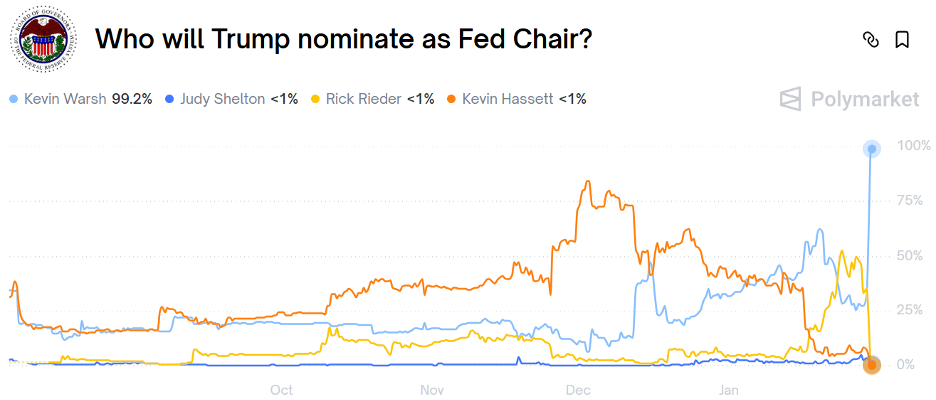
Fifteen months of speculation have now ended. Donald Trump has nominated Kevin Warsh as the 17th Chairman of the Federal Reserve. Warsh has pedigree credentials with degrees from Stanford, Harvard, and MIT. He began his career as a Wall Street investment banker before transferring to K Street as an economic policy advisor under President Bush. In 2006, he became the youngest person ever appointed to the Federal Reserve Board of Governors at age 35 and played an active role during the Great Financial Crisis as an emissary between policy makers and market participants.
Following his tenure at the Fed, he lectured at Stanford’s business school, invested alongside Stan Druckenmiller within his family office, and maintained policy influence within the Congressional Budget Office. He also managed to marry Jane Lauder, the heiress to the Estée Lauder fortune. Kevin has built an impressive career with exceptional accomplishments within both the public and private domains.
Interestingly, Kevin trailed in the prediction markets for most of the campaign cycle, largely because he seemed the least sycophantic and least dovish of the potential nominees. Why would Trump choose a more hawkish candidate? That’s the right question to ask and only Donald knows why Donald does, but I will offer my best guess: Trump’s biggest issue is not economic growth. The economy has grown substantially since Trump took office—and markets trade near all-time highs—yet consumer sentiment languishes near record lows as seen in the chart below:
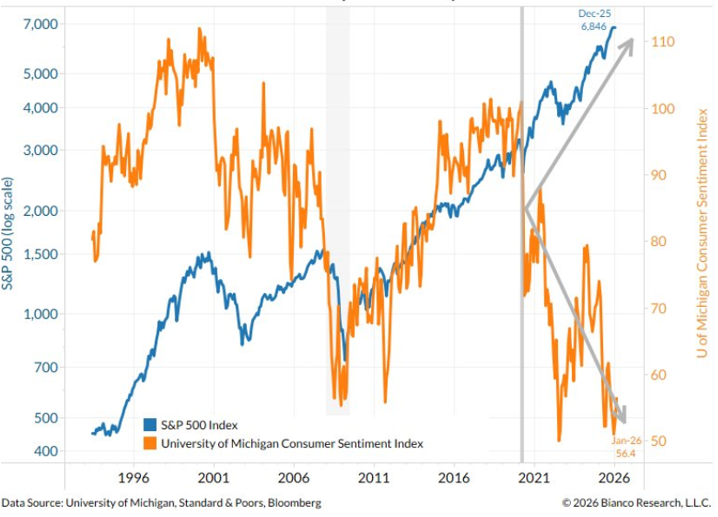
Although Trump’s policies have boosted economic and wealth creation, they have not relieved inflation agitations. Consumer prices stand 27% higher today than pre-COVID levels. Inflation rates have drifted lower, but remain well above the Fed’s 2% target.
While Chairman-to-Be Warsh appears to favor lower interest rates, he also favors shrinking the Fed’s balance sheet, philosophically blaming quantitative easing policies for the post-Covid inflation, not lower rate policies. Therefore, Warsh believes that the Fed can lower interest rates without raising inflation. If he is right, his policy combo of lowering rates while tightening money supply could provide lower rates, lower inflation, and perhaps—most importantly to Trump—happier voters!
Trump’s nomination still requires Senate confirmation. Warsh will not simply replace Powell, as Powell has three years remaining on the board post-Chairmanship and has not yet indicated whether he intends to step down or not. Therefore, to attain a seat on the board, Warsh must apply for Stephen Miran’s seat as well as the Chairman’s role. This makes the process a little clumsier, but we expect Powell will retire and Warsh will attain Senate confirmation.
Overall, we view this as a solid choice that de-risks the politicization of the Fed and increases the odds of supportive rate cuts while also lowering the threat of re-inflation. Markets clearly agree, as the US Dollar rallied nearly 1% following the announcement, and safe-haven metals tarnished substantially.
Markets will test Kevin in the months to come, as they always do, but he’s battle-hardened and resilient. While Trump’s tactics often destabilize, his appointment of Kevin Warsh should provide bankable stability at the Fed.
Enjoy your week!
-David
Sources: Bianco Research, Polymarket
This communication and its contents are for informational and educational purposes only and should not be used as the sole basis for any investment decision. The information contained herein is based on publicly available sources believed to be reliable but is not a representation, expressed or implied, as to the accuracy, completeness, or correctness of said information. References to political figures or policies are for informational purposes only and do not represent an endorsement by Waddell & Associates. Any forward-looking statements reflect current opinions and assumptions and are subject to change without notice; actual results may differ materially. Past performance does not guarantee future results. Waddell & Associates may use artificial intelligence tools to help generate or summarize content; all outputs are reviewed by our team for accuracy and relevance.
">Meet the New Fed Head
Fifteen months of speculation have now ended. Donald Trump has nominated Kevin Warsh as the 17th Chairman of the Federal Reserve. Warsh has pedigree credentials with degrees from Stanford, Harvard, and MIT. He began his career as a Wall Street investment banker before transferring to K Street as an economic policy advisor under President Bush. In 2006, he became the youngest person ever appointed to the Federal Reserve Board of Governors at age 35 and played an active role during the Great Financial Crisis as an emissary between policy makers and market participants.
Following his tenure at the Fed, he lectured at Stanford’s business school, invested alongside Stan Druckenmiller within his family office, and maintained policy influence within the Congressional Budget Office. He also managed to marry Jane Lauder, the heiress to the Estée Lauder fortune. Kevin has built an impressive career with exceptional accomplishments within both the public and private domains.
Interestingly, Kevin trailed in the prediction markets for most of the campaign cycle, largely because he seemed the least sycophantic and least dovish of the potential nominees. Why would Trump choose a more hawkish candidate? That’s the right question to ask and only Donald knows why Donald does, but I will offer my best guess: Trump’s biggest issue is not economic growth. The economy has grown substantially since Trump took office—and markets trade near all-time highs—yet consumer sentiment languishes near record lows as seen in the chart below:
Although Trump’s policies have boosted economic and wealth creation, they have not relieved inflation agitations. Consumer prices stand 27% higher today than pre-COVID levels. Inflation rates have drifted lower, but remain well above the Fed’s 2% target.
While Chairman-to-Be Warsh appears to favor lower interest rates, he also favors shrinking the Fed’s balance sheet, philosophically blaming quantitative easing policies for the post-Covid inflation, not lower rate policies. Therefore, Warsh believes that the Fed can lower interest rates without raising inflation. If he is right, his policy combo of lowering rates while tightening money supply could provide lower rates, lower inflation, and perhaps—most importantly to Trump—happier voters!
Trump’s nomination still requires Senate confirmation. Warsh will not simply replace Powell, as Powell has three years remaining on the board post-Chairmanship and has not yet indicated whether he intends to step down or not. Therefore, to attain a seat on the board, Warsh must apply for Stephen Miran’s seat as well as the Chairman’s role. This makes the process a little clumsier, but we expect Powell will retire and Warsh will attain Senate confirmation.
Overall, we view this as a solid choice that de-risks the politicization of the Fed and increases the odds of supportive rate cuts while also lowering the threat of re-inflation. Markets clearly agree, as the US Dollar rallied nearly 1% following the announcement, and safe-haven metals tarnished substantially.
Markets will test Kevin in the months to come, as they always do, but he’s battle-hardened and resilient. While Trump’s tactics often destabilize, his appointment of Kevin Warsh should provide bankable stability at the Fed.
Enjoy your week!
-David
Sources: Bianco Research, Polymarket
This communication and its contents are for informational and educational purposes only and should not be used as the sole basis for any investment decision. The information contained herein is based on publicly available sources believed to be reliable but is not a representation, expressed or implied, as to the accuracy, completeness, or correctness of said information. References to political figures or policies are for informational purposes only and do not represent an endorsement by Waddell & Associates. Any forward-looking statements reflect current opinions and assumptions and are subject to change without notice; actual results may differ materially. Past performance does not guarantee future results. Waddell & Associates may use artificial intelligence tools to help generate or summarize content; all outputs are reviewed by our team for accuracy and relevance.
" class="link-chevron">
Markets have certainly wished investors Happy New Year with roaring returns over the first 5 days of 2026. This may sound novel but returns over the first five days provide the first of many indicators for strategists formulating full year outlooks. Specifically, the S&P 500 rose 1.1% over the first five days hitting new intra-day highs and closing highs along the way. Let’s consider the historical outcomes after first 5-day periods:
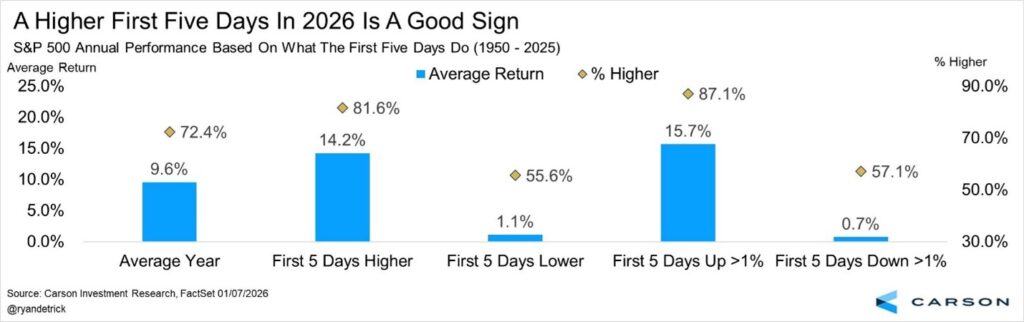
Starting from the left, markets tend to rise 73% of the time in an average year by close to 10%. When the first 5 days are higher, positive return odds jump to 82% and average returns jump to over 14%. When the first 5 days are lower, positive return odds fall to 56% and average returns fall to 1.1%. However, the proper data set for our current situation is first 5 days with greater than 1% returns. When the first 5 days rise more than 1%, positive return odds rise to 87% and average returns climb to nearly 16%. While we find this encouraging, it’s less encouraging than what happened over the first 5 days beyond the S&P 500.
Rise of the Rest
At the end of 2025 the total market capitalization of the Magnificent 7 stocks equaled $21.5 trillion dollars. We have argued that any investor migration away from the overinvestment in the Magnificent 7 cohort into underinvested corners of the market would create surprising results due to disproportionate market capitalizations. Let’s consider the below:
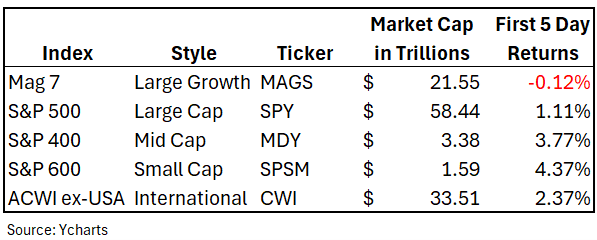
At the end of 2025, global investors allocated $21.5 trillion to the Magnificent 7 accounting for nearly 40% of the entire capitalization for the S&P 500. In contrast, investors only allocated $3.4 trillion and $1.6 trillion to the S&P 400 mid cap and S&P 600 small cap indices. Outside of the US, the MSCI All-Cap World ex-US held $33.5 trillion or roughly 36% of total world market capitalization, near a record low. Examining performance, it’s clear that the slight repositioning of disproportionate capital away from the Magnificent 7 sparked disproportionate gains in underinvested indices with the smallest of the market caps (S&P 600) generating the largest returns. Moral of the story, when it comes to smaller market cap indices, a little capital migration sure goes a long way!
The #1 Thing
If the promise of AI holds true, it will appear in economic productivity data. Productivity measures the economic output per worker. Economies with low technological advancement have low productivity measures. Economies with high technological advancements have high productivity measures. While productivity gains accompany “creative destruction” for some, higher productivity also drives higher earnings for corporations and higher lifestyle levels for consumers overall as inflation pressures abate as well. This week we received blockbuster productivity data for Q3. Productivity rose 4.9% as overall output rose 5.4% while hours worked increased .5%. Over a longer lookback, it’s clear that US productivity has upshifted rapidly:
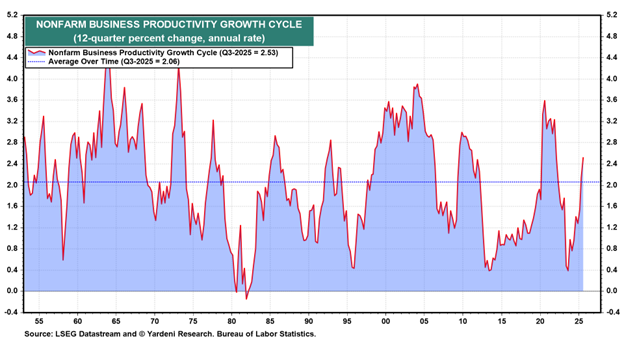
We usually see surges in productivity like this during recessions as companies shed workforce faster than output falls. It hasn’t been since the mid-nineties that we have seen productivity figures this high during expansion. We suspect that this predates the lift from AI as employers have undoubtedly been hiring less in anticipation of benefits to come. Therefore, high productivity levels could prove persistent, taking the US economy, US earnings and US quality of life measures even higher. The abundance this generates benefits not only the producers of AI (the Mag 7) but also the consumers of AI (the Rest). The more investors believe in this continuing productivity boom, the more money investors will make as the superlative returns for the leading Mag 7 become the superlative returns for the lagging Rest.
Have a great week!
-David
Sources: Carson Investment Research, Yardeni Research, YCharts
This communication and its contents are for informational and educational purposes only and should not be used as the sole basis for any investment decision. The information contained herein is based on publicly available sources believed to be reliable but is not a representation, expressed or implied, as to the accuracy, completeness, or correctness of said information. References to political figures or policies are for informational purposes only and do not represent an endorsement by Waddell & Associates. Any forward-looking statements reflect current opinions and assumptions and are subject to change without notice; actual results may differ materially. Past performance does not guarantee future results. Waddell & Associates may use artificial intelligence tools to help generate or summarize content; all outputs are reviewed by our team for accuracy and relevance.
">Place Your Bets!
Markets have certainly wished investors Happy New Year with roaring returns over the first 5 days of 2026. This may sound novel but returns over the first five days provide the first of many indicators for strategists formulating full year outlooks. Specifically, the S&P 500 rose 1.1% over the first five days hitting new intra-day highs and closing highs along the way. Let’s consider the historical outcomes after first 5-day periods:
Starting from the left, markets tend to rise 73% of the time in an average year by close to 10%. When the first 5 days are higher, positive return odds jump to 82% and average returns jump to over 14%. When the first 5 days are lower, positive return odds fall to 56% and average returns fall to 1.1%. However, the proper data set for our current situation is first 5 days with greater than 1% returns. When the first 5 days rise more than 1%, positive return odds rise to 87% and average returns climb to nearly 16%. While we find this encouraging, it’s less encouraging than what happened over the first 5 days beyond the S&P 500.
Rise of the Rest
At the end of 2025 the total market capitalization of the Magnificent 7 stocks equaled $21.5 trillion dollars. We have argued that any investor migration away from the overinvestment in the Magnificent 7 cohort into underinvested corners of the market would create surprising results due to disproportionate market capitalizations. Let’s consider the below:
At the end of 2025, global investors allocated $21.5 trillion to the Magnificent 7 accounting for nearly 40% of the entire capitalization for the S&P 500. In contrast, investors only allocated $3.4 trillion and $1.6 trillion to the S&P 400 mid cap and S&P 600 small cap indices. Outside of the US, the MSCI All-Cap World ex-US held $33.5 trillion or roughly 36% of total world market capitalization, near a record low. Examining performance, it’s clear that the slight repositioning of disproportionate capital away from the Magnificent 7 sparked disproportionate gains in underinvested indices with the smallest of the market caps (S&P 600) generating the largest returns. Moral of the story, when it comes to smaller market cap indices, a little capital migration sure goes a long way!
The #1 Thing
If the promise of AI holds true, it will appear in economic productivity data. Productivity measures the economic output per worker. Economies with low technological advancement have low productivity measures. Economies with high technological advancements have high productivity measures. While productivity gains accompany “creative destruction” for some, higher productivity also drives higher earnings for corporations and higher lifestyle levels for consumers overall as inflation pressures abate as well. This week we received blockbuster productivity data for Q3. Productivity rose 4.9% as overall output rose 5.4% while hours worked increased .5%. Over a longer lookback, it’s clear that US productivity has upshifted rapidly:
We usually see surges in productivity like this during recessions as companies shed workforce faster than output falls. It hasn’t been since the mid-nineties that we have seen productivity figures this high during expansion. We suspect that this predates the lift from AI as employers have undoubtedly been hiring less in anticipation of benefits to come. Therefore, high productivity levels could prove persistent, taking the US economy, US earnings and US quality of life measures even higher. The abundance this generates benefits not only the producers of AI (the Mag 7) but also the consumers of AI (the Rest). The more investors believe in this continuing productivity boom, the more money investors will make as the superlative returns for the leading Mag 7 become the superlative returns for the lagging Rest.
Have a great week!
-David
Sources: Carson Investment Research, Yardeni Research, YCharts
This communication and its contents are for informational and educational purposes only and should not be used as the sole basis for any investment decision. The information contained herein is based on publicly available sources believed to be reliable but is not a representation, expressed or implied, as to the accuracy, completeness, or correctness of said information. References to political figures or policies are for informational purposes only and do not represent an endorsement by Waddell & Associates. Any forward-looking statements reflect current opinions and assumptions and are subject to change without notice; actual results may differ materially. Past performance does not guarantee future results. Waddell & Associates may use artificial intelligence tools to help generate or summarize content; all outputs are reviewed by our team for accuracy and relevance.
" class="link-chevron">