



%20(1).png?width=508&height=121&name=flourish-primary-logo@2x%20(1)%20(1).png)


As we come to the end of the year, markets have fixated on two primary narratives. First, will the AI trade and Magnificent-7 (Apple, Amazon, Google, META, Microsoft, NVIDIA & Tesla) continue outperforming in 2026, and second, will economic reacceleration lead to outperformance in all new market quadrants? Good questions! Let’s explore.
2025: The Old Magnificents
2025 will certainly be remembered as a breakout year for technology. While the S&P 500 has provided investors with 16% returns, the Technology and Communication Services sectors provided the highest returns among the investable sectors with 22% and 21% returns, respectively. Likewise, the Magnificent-7 had another year of outperformance as a cohort delivering 22% returns. By all measures, another pleasurable year for Tech investors. However, if we disaggregate the group the narrative becomes less convincing:
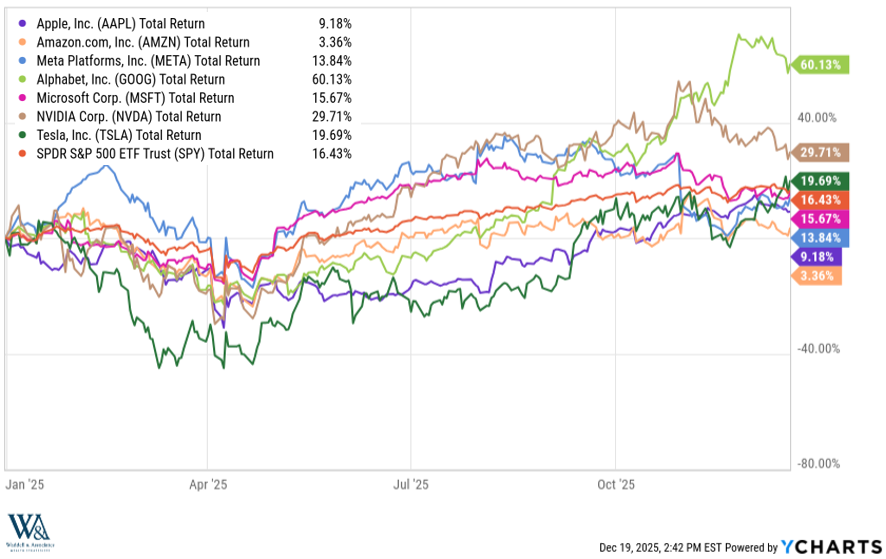
Google’s newfound favor with its latest Gemini launch vaulted its share price up 60% on the year, NVIDIA’s chip dominance powered its 30% return, Tesla just squeaked ahead of the S&P, but the remaining Magnificent 4 lagged in 2025 with Apple and Amazon in single digits. Overall, the median return for the group lagged the S&P 500. Furthermore, while the S&P 500 has recently made new highs, many tech stocks remain well below theirs, with NVIDIA and META 16% below their recent highs. Lastly, the margin of outperformance for the Mags vs. the non-Mags declined significantly in 2025:
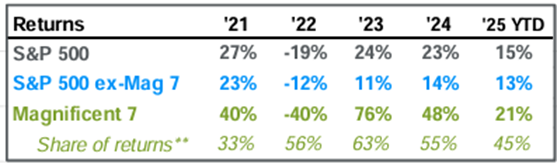
In 2023, the Mag-7 outperformed the Non-Mags by 65%; in 2024, by 34%; and in 2025, by 8%. And if we use rolling returns and look back over the last 12 months, the Mag-7 have only outperformed by 2.4%, continuing this diminishing trend. With all the concerns about circular financing and credit issuance, it’s right for investors to question the Mag-7’s continued dominance and begin disaggregating the components to assess their individual merits. We suspect these dynamics will continue to disinflate the excess returns of these Old Magnificents.
The New Magnificents
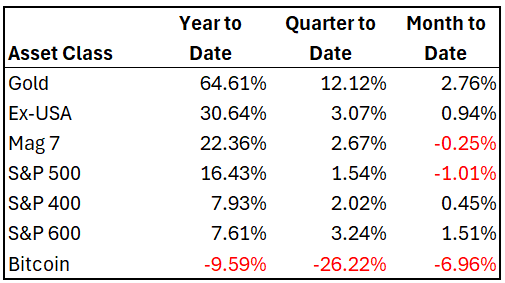
Gold shined brightest this year as the “debasement” of the US Dollar narrative and expansion of Central Bank gold holdings attracted sizable flows into a non-sizable asset class. While the Mag-7 and the S&P 500 delivered shiny results of their own, US equity returns lagged Ex-US equities. Developed and emerging equities provided investors with 30% returns, outperforming domestic stock markets even when adjusted for currency impacts. Low valuations, surprising fundamental strength, and FX tailwinds provided the lift which could persist into 2026. Here at home, small (S&P 600) and midcap (S&P 400) markets lagged again this year, but they have outperformed the Mag-7 and the S&P 500 since September, aided by rate cuts and rising earnings trajectories. The composition of these indices differs greatly from the composition of the S&P 500 with much greater exposure across economically sensitive sectors:
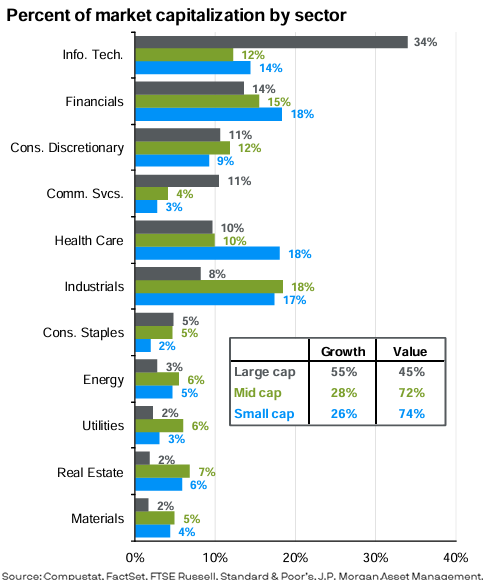
Note that while Technology receives a 34% weight within the S&P 500, it only occupies 12% and 14% of the mid-cap and small-cap indices. Furthermore, while industrials only occupy 8% of the S&P 500, they comprise 18% and 17% of the mid-cap and small-cap indices. As I have said before, 2025 was about putting the Trump policies in place, 2026 will be about putting them into practice. If we do see the economic reacceleration anticipated by many economists and the Fed, the smaller, lagging, but more economically sensitive sectors of this market could become… the New Magnificents!
Have a wonderful week and a very Merry Christmas!
– David
Sources: YCharts, JP Morgan Asset Management
This communication and its contents are for informational and educational purposes only and should not be used as the sole basis for any investment decision. The information contained herein is based on publicly available sources believed to be reliable but is not a representation, expressed or implied, as to the accuracy, completeness, or correctness of said information. References to political figures or policies are for informational purposes only and do not represent an endorsement by Waddell & Associates. Any forward-looking statements reflect current opinions and assumptions and are subject to change without notice; actual results may differ materially. Past performance does not guarantee future results. Waddell & Associates may use artificial intelligence tools to help generate or summarize content; all outputs are reviewed by our team for accuracy and relevance.
">Meet the New Magnificents
As we come to the end of the year, markets have fixated on two primary narratives. First, will the AI trade and Magnificent-7 (Apple, Amazon, Google, META, Microsoft, NVIDIA & Tesla) continue outperforming in 2026, and second, will economic reacceleration lead to outperformance in all new market quadrants? Good questions! Let’s explore.
2025: The Old Magnificents
2025 will certainly be remembered as a breakout year for technology. While the S&P 500 has provided investors with 16% returns, the Technology and Communication Services sectors provided the highest returns among the investable sectors with 22% and 21% returns, respectively. Likewise, the Magnificent-7 had another year of outperformance as a cohort delivering 22% returns. By all measures, another pleasurable year for Tech investors. However, if we disaggregate the group the narrative becomes less convincing:
Google’s newfound favor with its latest Gemini launch vaulted its share price up 60% on the year, NVIDIA’s chip dominance powered its 30% return, Tesla just squeaked ahead of the S&P, but the remaining Magnificent 4 lagged in 2025 with Apple and Amazon in single digits. Overall, the median return for the group lagged the S&P 500. Furthermore, while the S&P 500 has recently made new highs, many tech stocks remain well below theirs, with NVIDIA and META 16% below their recent highs. Lastly, the margin of outperformance for the Mags vs. the non-Mags declined significantly in 2025:
In 2023, the Mag-7 outperformed the Non-Mags by 65%; in 2024, by 34%; and in 2025, by 8%. And if we use rolling returns and look back over the last 12 months, the Mag-7 have only outperformed by 2.4%, continuing this diminishing trend. With all the concerns about circular financing and credit issuance, it’s right for investors to question the Mag-7’s continued dominance and begin disaggregating the components to assess their individual merits. We suspect these dynamics will continue to disinflate the excess returns of these Old Magnificents.
The New Magnificents
Gold shined brightest this year as the “debasement” of the US Dollar narrative and expansion of Central Bank gold holdings attracted sizable flows into a non-sizable asset class. While the Mag-7 and the S&P 500 delivered shiny results of their own, US equity returns lagged Ex-US equities. Developed and emerging equities provided investors with 30% returns, outperforming domestic stock markets even when adjusted for currency impacts. Low valuations, surprising fundamental strength, and FX tailwinds provided the lift which could persist into 2026. Here at home, small (S&P 600) and midcap (S&P 400) markets lagged again this year, but they have outperformed the Mag-7 and the S&P 500 since September, aided by rate cuts and rising earnings trajectories. The composition of these indices differs greatly from the composition of the S&P 500 with much greater exposure across economically sensitive sectors:
Note that while Technology receives a 34% weight within the S&P 500, it only occupies 12% and 14% of the mid-cap and small-cap indices. Furthermore, while industrials only occupy 8% of the S&P 500, they comprise 18% and 17% of the mid-cap and small-cap indices. As I have said before, 2025 was about putting the Trump policies in place, 2026 will be about putting them into practice. If we do see the economic reacceleration anticipated by many economists and the Fed, the smaller, lagging, but more economically sensitive sectors of this market could become… the New Magnificents!
Have a wonderful week and a very Merry Christmas!
– David
Sources: YCharts, JP Morgan Asset Management
This communication and its contents are for informational and educational purposes only and should not be used as the sole basis for any investment decision. The information contained herein is based on publicly available sources believed to be reliable but is not a representation, expressed or implied, as to the accuracy, completeness, or correctness of said information. References to political figures or policies are for informational purposes only and do not represent an endorsement by Waddell & Associates. Any forward-looking statements reflect current opinions and assumptions and are subject to change without notice; actual results may differ materially. Past performance does not guarantee future results. Waddell & Associates may use artificial intelligence tools to help generate or summarize content; all outputs are reviewed by our team for accuracy and relevance.
" class="link-chevron">The Bottom Line:
- Should I change my portfolio allocation after a market run? Only if your financial plan has changed materially. Otherwise, we typically use rebalancing to de-risk appropriately.
- What is Waddell & Associate’s “red button” hedge strategy? A prepared emergency allocation we can employ that may help reduce risk exposure if a recession appears imminent, helping limit major downturns.
- Why focus on financial plan probability instead of returns? Because what matters most isn’t stock market performance; it’s whether your life plans stay on track.
The Full Story:
I know what many of you are thinking as we close out another year of record market highs: This feels a little unsettling. Should we be doing something?
We’ve hit so many new highs this year that I’ve honestly lost count. And anytime we get a run like this, the same questions surface: Is this a bubble? Should we de-risk? Are we being smart or are we just lucky?
That gut reaction is completely normal. It’s also not a particularly good reason to change your portfolio allocation.
As a client of W&A, your asset allocation was built around your financial plan. If nothing material has changed in your life (you haven’t retired early, sold your business, or are suddenly sending three kids to college next year), then there’s likely no real reason to overhaul your long-term investment strategy.
So, what do we do about it? How do we acknowledge legitimate concerns without making emotional decisions we’ll regret later? We have a framework for exactly this situation, and I want to walk you through it.
Watching the Right Scoreboard
Many people watch the stock market like it’s a scoreboard for their entire financial life. When it’s up, they feel great. When it’s down, anxiety sets in.
But the stock market isn’t your “scoreboard.” Your real benchmark for success is the probability that your financial plan “works” across different scenarios.
Every financial plan we build already contemplates market declines. For example, if you have about a third of your total net worth invested in stocks, and the market suddenly drops 10%, your overall wealth likely dips just 3%. That’s not comfortable, but it’s also not catastrophic. And frankly, it’s exactly what a well-built plan was designed to handle. This is why we keep coming back to your plan—not to be repetitive, but because it’s the one thing you can control.
Related: Why Financial Plans (Not Market Headlines) Should Drive Asset Allocation
Managing Risk in 2026: Three Levers We Can Pull (and When We Pull Them)
As we head into 2026, it’s natural to feel a mix of optimism and unease. The markets have delivered another remarkable run, one that feels both exciting and worthy of thoughtful attention.
At Waddell & Associates, our portfolio allocation strategy for 2026 is designed around discipline, not prediction. We don’t chase trends or react to headlines. Instead, we rely on a clear framework with three built-in levers we can pull when conditions warrant. Each one helps protect your long-term plan while keeping you meaningfully invested.
Lever One: Rebalancing
In a strong market (like the one we’ve seen through 2025), stocks often outpace everything else, which means your portfolio can quietly become riskier than intended. You might start the year with 60% in stocks but end up with 70% just because equities have climbed so much. That extra 10% may not sound like much, but it can significantly increase volatility when the market turns. That’s when we turn to Lever One: rebalancing.
Rebalancing is a quiet form of risk management that we do at set intervals and whenever markets move significantly enough to shift allocations beyond tolerance bands. It forces us to “sell high” on what’s overextended and “buy low” where opportunity remains. As we head into 2026, that means we’ll likely be trimming gains from equities and redeploying into underweighted areas like bonds or alternatives.
What is Rebalancing?
Rebalancing is the process of realigning your portfolio back to its intended mix of assets (stocks, bonds, and other investments). When one part of the portfolio grows faster than others, we trim it back and reinvest in areas that have lagged.
Lever Two: Shifting Within Your Stock Portfolio
Sometimes the right move isn’t to reduce your overall stock exposure but to adjust where that exposure lives. Within equities, we can move between sectors, regions, or company sizes to position the portfolio for the environment ahead.
After a long bull market, certain areas (like the so-called “Magnificent Seven” tech giants) can become crowded and expensive. At the same time, other parts of the market may offer better balance and long-term opportunity. That’s why we’re staying bullish but cautious by leaning more toward value and quality.*
By shifting within equities, we’re not trying to time the market; we’re simply helping to ensure your portfolio isn’t overexposed to sectors that have already had an extraordinary run.
Heading into 2026, we’re paying close attention to earnings trends, interest rate paths, and valuation spreads between sectors. If we see signs that leadership is broadening or that defensive characteristics are being rewarded, we can gradually adjust further toward more insulated parts of the market.
Lever Three: The “Red Button” Hedge
The best time to prepare for market stress is before it happens. By having a clearly defined hedge strategy in place, we can move decisively if conditions warrant, without scrambling or reacting emotionally.
Our “red button” hedge is a pre-defined, evidence-based allocation designed to protect client portfolios only if forward indicators signal a genuine recessionary threat. Our portfolios are designed to reduce equity exposure by up to 40% if conditions warrant.**
We only consider the red button when key recession indicators align, as only recessionary markets provide enough durable downside risk to justify hedging. It’s not about what we feel the market might do; it’s about what the data says. Heading into the new year, that readiness is what allows you to stay invested through uncertainty with confidence.
What This Means as We Head Into 2026
In a historic bull market, it’s natural to want to actively manage what’s working. But the truth is, thoughtful portfolio management isn’t about reacting to every move the market makes. It’s about knowing which moves matter, and when to make them.
Our three levers—rebalancing, shifting within equities, and the red button—exist so you can stay focused on what actually matters: the probability your plan succeeds. As we move into 2026, that remains our true scoreboard.
Related: The Strategic Questions Every Sophisticated Investor Should Ask Right Now
What if You Have an Especially Complex Portfolio?
If your balance sheet includes company stock, rental properties, or private business interests, you might be wondering if this framework applies to you. Short answer: it absolutely does, we just look at the whole picture first.
Complex portfolios often look diversified but can be heavily correlated in downturns. By coordinating across all accounts (personal, business, and trust), we manage to your plan’s overall probability of success.
Our three levers still apply here:
- Rebalancing keeps your total exposure in check, not just your portfolio weights.
- Shifting within equities helps offset risks tied to your industry or business.
- The “red button” hedge protects both personal and business liquidity if recession risk rises.
Our 2026 approach starts by viewing your whole balance sheet as one ecosystem, so we can manage risk across all parts of your wealth, not just your market holdings.
If your company stock or private business already carries growth risk, for instance, we might balance that with more stable, liquid assets. If real estate is a major holding, we might dial back cyclical or income-sensitive investments. The goal is to ensure no single area dominates your financial future.
Starting 2026 With Clarity
Successful portfolio allocation isn’t about reacting to what’s loudest. It’s about staying aligned to what’s lasting. The markets will shift, leadership will rotate, and volatility will return. Through it all, the constant is your plan and the discipline behind it.
The truth is, no two clients enter 2026 from the same place. Some of you are thinking about succession planning. Others are watching interest rates or considering a business exit. Whatever’s on your radar, we’d love to hear about it.
If anything in this conversation raised new questions about your portfolio or you’re anticipating any upcoming life changes in the new year, let’s connect. Even small updates can shift how your plan or allocation should evolve heading into 2026.
And if you’re not yet working with our team and are looking for a wealth partner who blends data-driven discipline with deeply personal planning, we invite you to learn more about the W&A difference. Our approach helps clients face markets like this one with clarity, confidence, and a plan built to last.
*These observations are for illustrative purposes and not intended as specific sector or security recommendations.
**The “red button” hedge is not a guarantee against loss, but a disciplined framework that may be activated if economic data signals elevated risk.
This content is for informational and educational purposes only and should not be construed as investment, legal, or tax advice. Waddell & Associates, Inc. is an SEC-registered investment adviser. Registration does not imply a certain level of skill or training.
The strategies and examples discussed are illustrative only and may not be appropriate for every individual. All investments and planning decisions involve risk, including the possible loss of principal.
Please consult your financial advisor, attorney, or tax professional before making any decisions related to retirement, estate, or healthcare planning.
">
Discover the framework designed to help keep you invested through uncertainty and protect what you’ve built
The Bottom Line:
- Should I change my portfolio allocation after a market run? Only if your financial plan has changed materially. Otherwise, we typically use rebalancing to de-risk appropriately.
- What is Waddell & Associate’s “red button” hedge strategy? A prepared emergency allocation we can employ that may help reduce risk exposure if a recession appears imminent, helping limit major downturns.
- Why focus on financial plan probability instead of returns? Because what matters most isn’t stock market performance; it’s whether your life plans stay on track.
The Full Story:
I know what many of you are thinking as we close out another year of record market highs: This feels a little unsettling. Should we be doing something?
We’ve hit so many new highs this year that I’ve honestly lost count. And anytime we get a run like this, the same questions surface: Is this a bubble? Should we de-risk? Are we being smart or are we just lucky?
That gut reaction is completely normal. It’s also not a particularly good reason to change your portfolio allocation.
As a client of W&A, your asset allocation was built around your financial plan. If nothing material has changed in your life (you haven’t retired early, sold your business, or are suddenly sending three kids to college next year), then there’s likely no real reason to overhaul your long-term investment strategy.
So, what do we do about it? How do we acknowledge legitimate concerns without making emotional decisions we’ll regret later? We have a framework for exactly this situation, and I want to walk you through it.
Watching the Right Scoreboard
Many people watch the stock market like it’s a scoreboard for their entire financial life. When it’s up, they feel great. When it’s down, anxiety sets in.
But the stock market isn’t your “scoreboard.” Your real benchmark for success is the probability that your financial plan “works” across different scenarios.
Every financial plan we build already contemplates market declines. For example, if you have about a third of your total net worth invested in stocks, and the market suddenly drops 10%, your overall wealth likely dips just 3%. That’s not comfortable, but it’s also not catastrophic. And frankly, it’s exactly what a well-built plan was designed to handle. This is why we keep coming back to your plan—not to be repetitive, but because it’s the one thing you can control.
Related: Why Financial Plans (Not Market Headlines) Should Drive Asset Allocation
Managing Risk in 2026: Three Levers We Can Pull (and When We Pull Them)
As we head into 2026, it’s natural to feel a mix of optimism and unease. The markets have delivered another remarkable run, one that feels both exciting and worthy of thoughtful attention.
At Waddell & Associates, our portfolio allocation strategy for 2026 is designed around discipline, not prediction. We don’t chase trends or react to headlines. Instead, we rely on a clear framework with three built-in levers we can pull when conditions warrant. Each one helps protect your long-term plan while keeping you meaningfully invested.
Lever One: Rebalancing
In a strong market (like the one we’ve seen through 2025), stocks often outpace everything else, which means your portfolio can quietly become riskier than intended. You might start the year with 60% in stocks but end up with 70% just because equities have climbed so much. That extra 10% may not sound like much, but it can significantly increase volatility when the market turns. That’s when we turn to Lever One: rebalancing.
Rebalancing is a quiet form of risk management that we do at set intervals and whenever markets move significantly enough to shift allocations beyond tolerance bands. It forces us to “sell high” on what’s overextended and “buy low” where opportunity remains. As we head into 2026, that means we’ll likely be trimming gains from equities and redeploying into underweighted areas like bonds or alternatives.
What is Rebalancing?
Rebalancing is the process of realigning your portfolio back to its intended mix of assets (stocks, bonds, and other investments). When one part of the portfolio grows faster than others, we trim it back and reinvest in areas that have lagged.
Lever Two: Shifting Within Your Stock Portfolio
Sometimes the right move isn’t to reduce your overall stock exposure but to adjust where that exposure lives. Within equities, we can move between sectors, regions, or company sizes to position the portfolio for the environment ahead.
After a long bull market, certain areas (like the so-called “Magnificent Seven” tech giants) can become crowded and expensive. At the same time, other parts of the market may offer better balance and long-term opportunity. That’s why we’re staying bullish but cautious by leaning more toward value and quality.*
By shifting within equities, we’re not trying to time the market; we’re simply helping to ensure your portfolio isn’t overexposed to sectors that have already had an extraordinary run.
Heading into 2026, we’re paying close attention to earnings trends, interest rate paths, and valuation spreads between sectors. If we see signs that leadership is broadening or that defensive characteristics are being rewarded, we can gradually adjust further toward more insulated parts of the market.
Lever Three: The “Red Button” Hedge
The best time to prepare for market stress is before it happens. By having a clearly defined hedge strategy in place, we can move decisively if conditions warrant, without scrambling or reacting emotionally.
Our “red button” hedge is a pre-defined, evidence-based allocation designed to protect client portfolios only if forward indicators signal a genuine recessionary threat. Our portfolios are designed to reduce equity exposure by up to 40% if conditions warrant.**
We only consider the red button when key recession indicators align, as only recessionary markets provide enough durable downside risk to justify hedging. It’s not about what we feel the market might do; it’s about what the data says. Heading into the new year, that readiness is what allows you to stay invested through uncertainty with confidence.
What This Means as We Head Into 2026
In a historic bull market, it’s natural to want to actively manage what’s working. But the truth is, thoughtful portfolio management isn’t about reacting to every move the market makes. It’s about knowing which moves matter, and when to make them.
Our three levers—rebalancing, shifting within equities, and the red button—exist so you can stay focused on what actually matters: the probability your plan succeeds. As we move into 2026, that remains our true scoreboard.
Related: The Strategic Questions Every Sophisticated Investor Should Ask Right Now
What if You Have an Especially Complex Portfolio?
If your balance sheet includes company stock, rental properties, or private business interests, you might be wondering if this framework applies to you. Short answer: it absolutely does, we just look at the whole picture first.
Complex portfolios often look diversified but can be heavily correlated in downturns. By coordinating across all accounts (personal, business, and trust), we manage to your plan’s overall probability of success.
Our three levers still apply here:
- Rebalancing keeps your total exposure in check, not just your portfolio weights.
- Shifting within equities helps offset risks tied to your industry or business.
- The “red button” hedge protects both personal and business liquidity if recession risk rises.
Our 2026 approach starts by viewing your whole balance sheet as one ecosystem, so we can manage risk across all parts of your wealth, not just your market holdings.
If your company stock or private business already carries growth risk, for instance, we might balance that with more stable, liquid assets. If real estate is a major holding, we might dial back cyclical or income-sensitive investments. The goal is to ensure no single area dominates your financial future.
Starting 2026 With Clarity
Successful portfolio allocation isn’t about reacting to what’s loudest. It’s about staying aligned to what’s lasting. The markets will shift, leadership will rotate, and volatility will return. Through it all, the constant is your plan and the discipline behind it.
The truth is, no two clients enter 2026 from the same place. Some of you are thinking about succession planning. Others are watching interest rates or considering a business exit. Whatever’s on your radar, we’d love to hear about it.
If anything in this conversation raised new questions about your portfolio or you’re anticipating any upcoming life changes in the new year, let’s connect. Even small updates can shift how your plan or allocation should evolve heading into 2026.
And if you’re not yet working with our team and are looking for a wealth partner who blends data-driven discipline with deeply personal planning, we invite you to learn more about the W&A difference. Our approach helps clients face markets like this one with clarity, confidence, and a plan built to last.
*These observations are for illustrative purposes and not intended as specific sector or security recommendations.
**The “red button” hedge is not a guarantee against loss, but a disciplined framework that may be activated if economic data signals elevated risk.
This content is for informational and educational purposes only and should not be construed as investment, legal, or tax advice. Waddell & Associates, Inc. is an SEC-registered investment adviser. Registration does not imply a certain level of skill or training.
The strategies and examples discussed are illustrative only and may not be appropriate for every individual. All investments and planning decisions involve risk, including the possible loss of principal.
Please consult your financial advisor, attorney, or tax professional before making any decisions related to retirement, estate, or healthcare planning.
">Portfolio Allocation Strategies for 2026: Three Levers for Managing Risk in a Historic Bull Market Discover the framework designed to help keep you invested through uncertainty and protect what you’ve builtThe Bottom Line:
- Should I change my portfolio allocation after a market run? Only if your financial plan has changed materially. Otherwise, we typically use rebalancing to de-risk appropriately.
- What is Waddell & Associate’s “red button” hedge strategy? A prepared emergency allocation we can employ that may help reduce risk exposure if a recession appears imminent, helping limit major downturns.
- Why focus on financial plan probability instead of returns? Because what matters most isn’t stock market performance; it’s whether your life plans stay on track.
The Full Story:
I know what many of you are thinking as we close out another year of record market highs: This feels a little unsettling. Should we be doing something?
We’ve hit so many new highs this year that I’ve honestly lost count. And anytime we get a run like this, the same questions surface: Is this a bubble? Should we de-risk? Are we being smart or are we just lucky?
That gut reaction is completely normal. It’s also not a particularly good reason to change your portfolio allocation.
As a client of W&A, your asset allocation was built around your financial plan. If nothing material has changed in your life (you haven’t retired early, sold your business, or are suddenly sending three kids to college next year), then there’s likely no real reason to overhaul your long-term investment strategy.
So, what do we do about it? How do we acknowledge legitimate concerns without making emotional decisions we’ll regret later? We have a framework for exactly this situation, and I want to walk you through it.
Watching the Right Scoreboard
Many people watch the stock market like it’s a scoreboard for their entire financial life. When it’s up, they feel great. When it’s down, anxiety sets in.
But the stock market isn’t your “scoreboard.” Your real benchmark for success is the probability that your financial plan “works” across different scenarios.
Every financial plan we build already contemplates market declines. For example, if you have about a third of your total net worth invested in stocks, and the market suddenly drops 10%, your overall wealth likely dips just 3%. That’s not comfortable, but it’s also not catastrophic. And frankly, it’s exactly what a well-built plan was designed to handle. This is why we keep coming back to your plan—not to be repetitive, but because it’s the one thing you can control.
Related: Why Financial Plans (Not Market Headlines) Should Drive Asset Allocation
Managing Risk in 2026: Three Levers We Can Pull (and When We Pull Them)
As we head into 2026, it’s natural to feel a mix of optimism and unease. The markets have delivered another remarkable run, one that feels both exciting and worthy of thoughtful attention.
At Waddell & Associates, our portfolio allocation strategy for 2026 is designed around discipline, not prediction. We don’t chase trends or react to headlines. Instead, we rely on a clear framework with three built-in levers we can pull when conditions warrant. Each one helps protect your long-term plan while keeping you meaningfully invested.
Lever One: Rebalancing
In a strong market (like the one we’ve seen through 2025), stocks often outpace everything else, which means your portfolio can quietly become riskier than intended. You might start the year with 60% in stocks but end up with 70% just because equities have climbed so much. That extra 10% may not sound like much, but it can significantly increase volatility when the market turns. That’s when we turn to Lever One: rebalancing.
Rebalancing is a quiet form of risk management that we do at set intervals and whenever markets move significantly enough to shift allocations beyond tolerance bands. It forces us to “sell high” on what’s overextended and “buy low” where opportunity remains. As we head into 2026, that means we’ll likely be trimming gains from equities and redeploying into underweighted areas like bonds or alternatives.
What is Rebalancing?
Rebalancing is the process of realigning your portfolio back to its intended mix of assets (stocks, bonds, and other investments). When one part of the portfolio grows faster than others, we trim it back and reinvest in areas that have lagged.
Lever Two: Shifting Within Your Stock Portfolio
Sometimes the right move isn’t to reduce your overall stock exposure but to adjust where that exposure lives. Within equities, we can move between sectors, regions, or company sizes to position the portfolio for the environment ahead.
After a long bull market, certain areas (like the so-called “Magnificent Seven” tech giants) can become crowded and expensive. At the same time, other parts of the market may offer better balance and long-term opportunity. That’s why we’re staying bullish but cautious by leaning more toward value and quality.*
By shifting within equities, we’re not trying to time the market; we’re simply helping to ensure your portfolio isn’t overexposed to sectors that have already had an extraordinary run.
Heading into 2026, we’re paying close attention to earnings trends, interest rate paths, and valuation spreads between sectors. If we see signs that leadership is broadening or that defensive characteristics are being rewarded, we can gradually adjust further toward more insulated parts of the market.
Lever Three: The “Red Button” Hedge
The best time to prepare for market stress is before it happens. By having a clearly defined hedge strategy in place, we can move decisively if conditions warrant, without scrambling or reacting emotionally.
Our “red button” hedge is a pre-defined, evidence-based allocation designed to protect client portfolios only if forward indicators signal a genuine recessionary threat. Our portfolios are designed to reduce equity exposure by up to 40% if conditions warrant.**
We only consider the red button when key recession indicators align, as only recessionary markets provide enough durable downside risk to justify hedging. It’s not about what we feel the market might do; it’s about what the data says. Heading into the new year, that readiness is what allows you to stay invested through uncertainty with confidence.
What This Means as We Head Into 2026
In a historic bull market, it’s natural to want to actively manage what’s working. But the truth is, thoughtful portfolio management isn’t about reacting to every move the market makes. It’s about knowing which moves matter, and when to make them.
Our three levers—rebalancing, shifting within equities, and the red button—exist so you can stay focused on what actually matters: the probability your plan succeeds. As we move into 2026, that remains our true scoreboard.
Related: The Strategic Questions Every Sophisticated Investor Should Ask Right Now
What if You Have an Especially Complex Portfolio?
If your balance sheet includes company stock, rental properties, or private business interests, you might be wondering if this framework applies to you. Short answer: it absolutely does, we just look at the whole picture first.
Complex portfolios often look diversified but can be heavily correlated in downturns. By coordinating across all accounts (personal, business, and trust), we manage to your plan’s overall probability of success.
Our three levers still apply here:
- Rebalancing keeps your total exposure in check, not just your portfolio weights.
- Shifting within equities helps offset risks tied to your industry or business.
- The “red button” hedge protects both personal and business liquidity if recession risk rises.
Our 2026 approach starts by viewing your whole balance sheet as one ecosystem, so we can manage risk across all parts of your wealth, not just your market holdings.
If your company stock or private business already carries growth risk, for instance, we might balance that with more stable, liquid assets. If real estate is a major holding, we might dial back cyclical or income-sensitive investments. The goal is to ensure no single area dominates your financial future.
Starting 2026 With Clarity
Successful portfolio allocation isn’t about reacting to what’s loudest. It’s about staying aligned to what’s lasting. The markets will shift, leadership will rotate, and volatility will return. Through it all, the constant is your plan and the discipline behind it.
The truth is, no two clients enter 2026 from the same place. Some of you are thinking about succession planning. Others are watching interest rates or considering a business exit. Whatever’s on your radar, we’d love to hear about it.
If anything in this conversation raised new questions about your portfolio or you’re anticipating any upcoming life changes in the new year, let’s connect. Even small updates can shift how your plan or allocation should evolve heading into 2026.
And if you’re not yet working with our team and are looking for a wealth partner who blends data-driven discipline with deeply personal planning, we invite you to learn more about the W&A difference. Our approach helps clients face markets like this one with clarity, confidence, and a plan built to last.
*These observations are for illustrative purposes and not intended as specific sector or security recommendations.
**The “red button” hedge is not a guarantee against loss, but a disciplined framework that may be activated if economic data signals elevated risk.
This content is for informational and educational purposes only and should not be construed as investment, legal, or tax advice. Waddell & Associates, Inc. is an SEC-registered investment adviser. Registration does not imply a certain level of skill or training.
The strategies and examples discussed are illustrative only and may not be appropriate for every individual. All investments and planning decisions involve risk, including the possible loss of principal.
Please consult your financial advisor, attorney, or tax professional before making any decisions related to retirement, estate, or healthcare planning.
" class="link-chevron">
On Wednesday of this past week, the Federal Reserve concluded their eighth and final FOMC meeting of the year. With a record Government shutdown suspending vital data releases (inflation, GDP, and job creation), the official statement, the summary of economic projections and Powell’s presser took on outsized significance. This week we will dig into each, translate, and determine whether the brew adds fuel to Santa’s sleigh.
The Official Statement
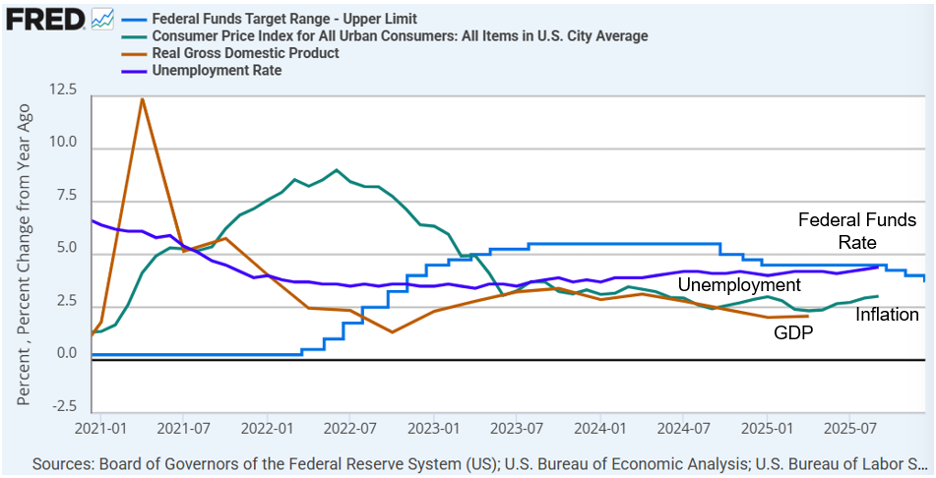
The Federal Open Market Committee sees economic growth expending at a moderate pace, though the unemployment rate has drifted higher. Inflation remains stubborn and elevated above the 2% target but of lower risk than rising unemployment. As such, they lowered the target federal funds rate by .25% from 4% to 3.75%. The committee remains open to further cuts, as justified by incoming data patterns, as shown below:
The committee also noted signs of stress in short-term funding markets and committed to purchasing short-term treasuries to inject additional liquidity.
Translation:
Rates have now fallen 1.75% from their high point. This significant reduction has occurred while economic growth and inflation remain within acceptable ranges. However, worries about the labor market have increased warranting an interest rate cut for “insurance”. More cuts are possible but need firmer justification from upcoming data releases. Concern about market liquidity measures prompted additional monetary easing in the form of treasury purchases.
Market impact:
Rate cuts mean cheaper money, higher earnings, and higher valuations. The market expected the rate cut, but the official statement eliminated any doubt. The market did not expect the Fed to begin immediate Treasury bill purchases to shore up short-term funding markets. The certainty of the rate cut and the positive surprise of additional liquidity added uplift to the rally and support for its continuation.
The Summary of Economic Projections
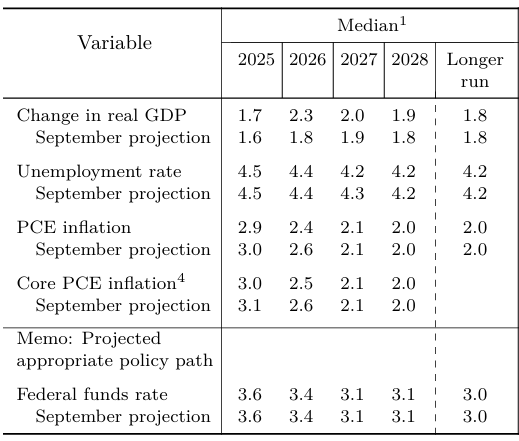
For full year 2025, the FOMC survey participants raised their GDP growth expectation by .1% while lowering their core inflation projection by .1%, compared with the September survey. For 2026, the FOMC survey participants raised their GDP growth expectation by .5% while lowering their core inflation projection by .1%. Expectations for the unemployment rate falling from 4.5% to 4.4% went unchanged. Expectations for lowering the Federal funds rate another .25% also remained in place.
Translation:
The Fed raised its expectations for both a stronger economy and a lower inflation rate, while maintaining its intention to cut interest rates further in 2026. The magnitude by which the Fed revised its GDP growth expectations upward provided further rally fuel for markets, as higher GDP equals higher revenues, while lower inflation equals higher profit margins and higher earnings. For equity investors, their SEP forecast couldn’t have been better, adding even more resolute rally support.
Powell’s Press Conference
Here are the most material quotes from Powell’s press conference:
On Growth:
“Fiscal policy is going to be supportive. AI spending will continue. The consumer continues to spend. So it looks like the baseline would be solid growth next year.”
On Inflation:
“The story with inflation is that…if you get away from tariffs, inflation is in the low 2’s.”
On Labor:
“The downside risks to employment appear to have risen in recent months.” “Surveys of households and businesses both show declining supply and demand for workers.”
On AI:
“I never thought I would see a time when we had 5-6 years of 2 percent productivity growth. This is higher. This is definitively higher”
On Rate Cuts:
“We are at the high-end range of neutral, I would say.”
Translation:
Powell expects inflation to fall materially over the next six months as one-time tariff adjustments flow through. He has concerns about the labor market being softer than it appears. This shifts the balance toward further rate cuts as Powell himself sees us at the high end of the neutral range.
Powell also seems fascinated by the tech-enabled upgrades to productivity. This unlocks higher growth and lower inflation—the opposite of the Stagflation people feared entering 2025. For those who thought Powell would provide hawkish testimony on Wednesday, the opposite occurred. Powell believes the productivity gains within the economy will boost growth and temper inflation, and he expects rates to fall further. With this additional Powell promotion, the Dow, S&P 500, and Russell 2000 index all hit… all-time highs.
Have a great week!
—David
Sources: Federal Reserve Bank of St. Louis, Federal Reserve Board of Governors, Summary of Economic Projections
This communication and its contents are for informational and educational purposes only and should not be used as the sole basis for any investment decision. The information contained herein is based on publicly available sources believed to be reliable but is not a representation, expressed or implied, as to the accuracy, completeness, or correctness of said information. References to political figures or policies are for informational purposes only and do not represent an endorsement by Waddell & Associates. Any forward-looking statements reflect current opinions and assumptions and are subject to change without notice; actual results may differ materially. Past performance does not guarantee future results. Waddell & Associates may use artificial intelligence tools to help generate or summarize content; all outputs are reviewed by our team for accuracy and relevance.
">Fed Unwraps Holiday Highs
On Wednesday of this past week, the Federal Reserve concluded their eighth and final FOMC meeting of the year. With a record Government shutdown suspending vital data releases (inflation, GDP, and job creation), the official statement, the summary of economic projections and Powell’s presser took on outsized significance. This week we will dig into each, translate, and determine whether the brew adds fuel to Santa’s sleigh.
Sources: Federal Reserve Bank of St. Louis, Federal Reserve Board of Governors, Summary of Economic Projections
The Official Statement
The Federal Open Market Committee sees economic growth expending at a moderate pace, though the unemployment rate has drifted higher. Inflation remains stubborn and elevated above the 2% target but of lower risk than rising unemployment. As such, they lowered the target federal funds rate by .25% from 4% to 3.75%. The committee remains open to further cuts, as justified by incoming data patterns, as shown below:
The committee also noted signs of stress in short-term funding markets and committed to purchasing short-term treasuries to inject additional liquidity.
Translation:
Rates have now fallen 1.75% from their high point. This significant reduction has occurred while economic growth and inflation remain within acceptable ranges. However, worries about the labor market have increased warranting an interest rate cut for “insurance”. More cuts are possible but need firmer justification from upcoming data releases. Concern about market liquidity measures prompted additional monetary easing in the form of treasury purchases.
Market impact:
Rate cuts mean cheaper money, higher earnings, and higher valuations. The market expected the rate cut, but the official statement eliminated any doubt. The market did not expect the Fed to begin immediate Treasury bill purchases to shore up short-term funding markets. The certainty of the rate cut and the positive surprise of additional liquidity added uplift to the rally and support for its continuation.
The Summary of Economic Projections
For full year 2025, the FOMC survey participants raised their GDP growth expectation by .1% while lowering their core inflation projection by .1%, compared with the September survey. For 2026, the FOMC survey participants raised their GDP growth expectation by .5% while lowering their core inflation projection by .1%. Expectations for the unemployment rate falling from 4.5% to 4.4% went unchanged. Expectations for lowering the Federal funds rate another .25% also remained in place.
Translation:
The Fed raised its expectations for both a stronger economy and a lower inflation rate, while maintaining its intention to cut interest rates further in 2026. The magnitude by which the Fed revised its GDP growth expectations upward provided further rally fuel for markets, as higher GDP equals higher revenues, while lower inflation equals higher profit margins and higher earnings. For equity investors, their SEP forecast couldn’t have been better, adding even more resolute rally support.
Powell’s Press Conference
Here are the most material quotes from Powell’s press conference:
On Growth:
“Fiscal policy is going to be supportive. AI spending will continue. The consumer continues to spend. So it looks like the baseline would be solid growth next year.”
On Inflation:
“The story with inflation is that…if you get away from tariffs, inflation is in the low 2’s.”
On Labor:
“The downside risks to employment appear to have risen in recent months.” “Surveys of households and businesses both show declining supply and demand for workers.”
On AI:
“I never thought I would see a time when we had 5-6 years of 2 percent productivity growth. This is higher. This is definitively higher”
On Rate Cuts:
“We are at the high-end range of neutral, I would say.”
Translation:
Powell expects inflation to fall materially over the next six months as one-time tariff adjustments flow through. He has concerns about the labor market being softer than it appears. This shifts the balance toward further rate cuts as Powell himself sees us at the high end of the neutral range.
Powell also seems fascinated by the tech-enabled upgrades to productivity. This unlocks higher growth and lower inflation—the opposite of the Stagflation people feared entering 2025. For those who thought Powell would provide hawkish testimony on Wednesday, the opposite occurred. Powell believes the productivity gains within the economy will boost growth and temper inflation, and he expects rates to fall further. With this additional Powell promotion, the Dow, S&P 500, and Russell 2000 index all hit… all-time highs.
Have a great week!
—David
Sources: Federal Reserve Bank of St. Louis, Federal Reserve Board of Governors, Summary of Economic Projections
This communication and its contents are for informational and educational purposes only and should not be used as the sole basis for any investment decision. The information contained herein is based on publicly available sources believed to be reliable but is not a representation, expressed or implied, as to the accuracy, completeness, or correctness of said information. References to political figures or policies are for informational purposes only and do not represent an endorsement by Waddell & Associates. Any forward-looking statements reflect current opinions and assumptions and are subject to change without notice; actual results may differ materially. Past performance does not guarantee future results. Waddell & Associates may use artificial intelligence tools to help generate or summarize content; all outputs are reviewed by our team for accuracy and relevance.
" class="link-chevron">
Corporate culture isn’t something you install, it’s something you express. It’s the fusion of the passions, values, capabilities, and personalities of the people within a firm that radiates outward as identity. I spoke with a reporter earlier this week about which achievement I am most proud of.
As W&A approaches our 40th anniversary, our greatest achievement is not the amount of money that we manage, it’s not the number of clients that we serve, it’s not our geographic expansion into a national footprint, and it’s not the numerous awards that we have received. Our greatest achievement is the continuity of our culture. We enrich lives by providing clarity. We do the right things for the right reasons. We voyage together with our clients, colleagues, and communities. We are always learning, so we are always improving. Our gratitude inspires us to honor your trust and confidence in us with dedicated care.
Phyllis Scruggs joined our firm in 1993 as our 4th member after selling her family business and immersing herself in technology and finance. Her rapid accumulation of academic and professional credentials (MBA, CFA®, CFP®) brought a new level of capabilities—and spirited debate—to our small firm.
My father founded W&A to rebel against a Wall Street culture that often manipulated, mismanaged, and misappropriated investor assets. Simply offering jaded investors with honest and capable money management services provided plenty of marketplace differentiation with which to build a business. W&A was a premium product business built on trustworthiness and investment results.
Phyllis wanted W&A to be a premium service business built on immersive financial planning and continuous client communications. While the asset management business and the financial planning business seem similar, they have vastly different staffing requirements and vastly different profit margins. At that time, the combination of the two disciplines, now known ubiquitously as “wealth management” didn’t really exist.
When I entered the firm in 2000, I settled the debate. We would use the financial planning process to determine the rate of return required for each client to achieve their vision of financial success, and we would use our asset management capabilities to provide the prescribed returns.
We would employ financial planners as relationship managers, not salespeople or stock-pickers, and our investment committee would supply them with portfolios to employ in coordination with client objectives. And because life happens and objectives change, we would communicate with our clients frequently to ensure continuous and proper calibration. This strategic decision evolved our business from a luxury product into a highly bespoke service, combining the best of Duke Waddell with the best of Phyllis Scruggs.
Only 30% of family businesses successfully transition to the second generation. Recognizing this dispiriting reality, succession planning became a priority as soon as I joined the firm. At the time, W&A had three partners: Duke Waddell the investor, Phyllis Scruggs the financial planner, and Bill Wunderlich the relationship developer. Before long, and with lots of courage—and debt, we began transitioning ownership from the founding partners.
When we approached Phyllis, the conversation changed. As a spirited negotiator, we anticipated an impasse, but none occurred. Phyllis wanted to create an ESOP with her shares. She wanted the associates she cared for to remain dedicated to our firm, and to our clients, and she wanted them to participate in W&A’s success through direct ownership.
We worked together, constructed the ESOP, and created a fantastic financial windfall for our associates. Following the transaction, Phyllis remained just as active within the business. She served on our board as Vice Chairman, she served as an active member of our investment committee, and she served her client base with the same professionalism and vigor as always. Phyllis was in it for the money… it just wasn’t her money she focused on.
Phyllis’s client meetings became legendary at W&A. Rarely did a call or a meeting not run for hours. We had to build additional conference rooms as Phyllis would perpetually commandeer one. With Phyllis, there were no small details. Her dedication to mastering her craft paled in comparison with her dedication to mastering her client’s details. She over-prepared and she over-delivered.
She became the standard bearer, not only within W&A but also within our industry. Phyllis served on the board of our local Financial Professional Association which won a national award for excellence in 1998 with Phyllis as Chairman. She served in leadership roles in many other community organizations as well as nationwide, each achieving newfound levels of success with Phyllis on the job.
On Saturday morning, November 1st, Phyllis Scruggs peacefully passed away in the arms of her greatest dedication; her husband of 54 years, David Scruggs. Over the last week, I have spoken with many of her clients. You would expect respect, you would expect sadness, you would expect condolences, but what I received was so much more:
“I am living a life I only dreamed of because of her.”
“She saved me from all of the bad decisions that would have ruined me.”
“She knows more about my financial life than I do.”
“She wasn’t just my financial advisor; she was one of my closest and dearest friends.”
“I don’t think I could have gotten through my mother’s death without her.”
Thank you, Phyllis, for providing our firm direction, for nurturing our associates, and for loving our clients. While you may no longer share your wisdom, you will always share your spirit. It lives within our design, it lives within our culture, and it lives within our hearts.
We will honor you by forever staying true to the values, craftsmanship, and dedication you lived, and instilled in us. For that is the true measure of our success.
Life and career well done, Phyllis. Rest easy.
David

This communication and its contents are for informational and educational purposes only and should not be used as the sole basis for any investment decision. The information contained herein is based on publicly available sources believed to be reliable but is not a representation, expressed or implied, as to the accuracy, completeness, or correctness of said information. References to political figures or policies are for informational purposes only and do not represent an endorsement by Waddell & Associates. Any forward-looking statements reflect current opinions and assumptions and are subject to change without notice; actual results may differ materially. Past performance does not guarantee future results. Waddell & Associates may use artificial intelligence tools to help generate or summarize content; all outputs are reviewed by our team for accuracy and relevance.
">For Phyllis
Corporate culture isn’t something you install, it’s something you express. It’s the fusion of the passions, values, capabilities, and personalities of the people within a firm that radiates outward as identity. I spoke with a reporter earlier this week about which achievement I am most proud of.
As W&A approaches our 40th anniversary, our greatest achievement is not the amount of money that we manage, it’s not the number of clients that we serve, it’s not our geographic expansion into a national footprint, and it’s not the numerous awards that we have received. Our greatest achievement is the continuity of our culture. We enrich lives by providing clarity. We do the right things for the right reasons. We voyage together with our clients, colleagues, and communities. We are always learning, so we are always improving. Our gratitude inspires us to honor your trust and confidence in us with dedicated care.
Phyllis Scruggs joined our firm in 1993 as our 4th member after selling her family business and immersing herself in technology and finance. Her rapid accumulation of academic and professional credentials (MBA, CFA®, CFP®) brought a new level of capabilities—and spirited debate—to our small firm.
My father founded W&A to rebel against a Wall Street culture that often manipulated, mismanaged, and misappropriated investor assets. Simply offering jaded investors with honest and capable money management services provided plenty of marketplace differentiation with which to build a business. W&A was a premium product business built on trustworthiness and investment results.
Phyllis wanted W&A to be a premium service business built on immersive financial planning and continuous client communications. While the asset management business and the financial planning business seem similar, they have vastly different staffing requirements and vastly different profit margins. At that time, the combination of the two disciplines, now known ubiquitously as “wealth management” didn’t really exist.
When I entered the firm in 2000, I settled the debate. We would use the financial planning process to determine the rate of return required for each client to achieve their vision of financial success, and we would use our asset management capabilities to provide the prescribed returns.
We would employ financial planners as relationship managers, not salespeople or stock-pickers, and our investment committee would supply them with portfolios to employ in coordination with client objectives. And because life happens and objectives change, we would communicate with our clients frequently to ensure continuous and proper calibration. This strategic decision evolved our business from a luxury product into a highly bespoke service, combining the best of Duke Waddell with the best of Phyllis Scruggs.
Only 30% of family businesses successfully transition to the second generation. Recognizing this dispiriting reality, succession planning became a priority as soon as I joined the firm. At the time, W&A had three partners: Duke Waddell the investor, Phyllis Scruggs the financial planner, and Bill Wunderlich the relationship developer. Before long, and with lots of courage—and debt, we began transitioning ownership from the founding partners.
When we approached Phyllis, the conversation changed. As a spirited negotiator, we anticipated an impasse, but none occurred. Phyllis wanted to create an ESOP with her shares. She wanted the associates she cared for to remain dedicated to our firm, and to our clients, and she wanted them to participate in W&A’s success through direct ownership.
We worked together, constructed the ESOP, and created a fantastic financial windfall for our associates. Following the transaction, Phyllis remained just as active within the business. She served on our board as Vice Chairman, she served as an active member of our investment committee, and she served her client base with the same professionalism and vigor as always. Phyllis was in it for the money… it just wasn’t her money she focused on.
Phyllis’s client meetings became legendary at W&A. Rarely did a call or a meeting not run for hours. We had to build additional conference rooms as Phyllis would perpetually commandeer one. With Phyllis, there were no small details. Her dedication to mastering her craft paled in comparison with her dedication to mastering her client’s details. She over-prepared and she over-delivered.
She became the standard bearer, not only within W&A but also within our industry. Phyllis served on the board of our local Financial Professional Association which won a national award for excellence in 1998 with Phyllis as Chairman. She served in leadership roles in many other community organizations as well as nationwide, each achieving newfound levels of success with Phyllis on the job.
On Saturday morning, November 1st, Phyllis Scruggs peacefully passed away in the arms of her greatest dedication; her husband of 54 years, David Scruggs. Over the last week, I have spoken with many of her clients. You would expect respect, you would expect sadness, you would expect condolences, but what I received was so much more:
“I am living a life I only dreamed of because of her.”
“She saved me from all of the bad decisions that would have ruined me.”
“She knows more about my financial life than I do.”
“She wasn’t just my financial advisor; she was one of my closest and dearest friends.”
“I don’t think I could have gotten through my mother’s death without her.”
Thank you, Phyllis, for providing our firm direction, for nurturing our associates, and for loving our clients. While you may no longer share your wisdom, you will always share your spirit. It lives within our design, it lives within our culture, and it lives within our hearts.
We will honor you by forever staying true to the values, craftsmanship, and dedication you lived, and instilled in us. For that is the true measure of our success.
Life and career well done, Phyllis. Rest easy.
David
This communication and its contents are for informational and educational purposes only and should not be used as the sole basis for any investment decision. The information contained herein is based on publicly available sources believed to be reliable but is not a representation, expressed or implied, as to the accuracy, completeness, or correctness of said information. References to political figures or policies are for informational purposes only and do not represent an endorsement by Waddell & Associates. Any forward-looking statements reflect current opinions and assumptions and are subject to change without notice; actual results may differ materially. Past performance does not guarantee future results. Waddell & Associates may use artificial intelligence tools to help generate or summarize content; all outputs are reviewed by our team for accuracy and relevance.
" class="link-chevron">
The Full Story:
This week contained a cornucopia of market-moving morsels. Fed action, earnings action, tariff action, and year-end positioning pressed all three major stock market indices to fresh new highs. However, beneath the surface, individual stock performance showed far less conviction. With ten months of the year and 15%+ returns now behind us, will this rally rest…for the rest of 2025?
Powell Says What?
Jerome Powell provided monetary easing by cutting the Federal Funds rate .25%, but also conversational tightening by saying further cuts in December are “not a forgone conclusion” and, in fact, “far from it”. Odds of a December rate cut fell from 95% before the meeting to 60% after. This added some uplift to longer-term yields across the Treasury curve and downforce on more interest-rate sensitive areas of the market like the Ex-Mags and smaller cap stocks. Powell apparently sees more strength in the labor markets and risk of reinflation than markets anticipated. The lack of economic data releases due to the shutdown only exacerbated communication confusion as perhaps Powell knows something we don’t know. Ironically, the impact of the government shutdown should be less growth, less labor strength and lower inflation. Go figure. Stocks struggled with the interpretation, ending Wednesday essentially unchanged due to the dovish cut and hawkish chat. Whether the Fed cuts rates in December or not, they will be cutting rates further in 2026 as each of Trump’s candidates to replace Powell on May 15th have assured.
Friends Again
Donald Trump stylized his meeting with Xi Jinping of China a 12 on a 10-point scale. As a result of the pleasantries and gift exchange, the US agreed to cut tariffs on Chinese goods from 57% to 47% while China agreed they will sell us more rare earth materials, less fentanyl, and will buy more soybeans. This amounts to a tactical trade truce with China for now, removing a key risk factor for the markets. None of this has been papered of course but concerns over a reescalation of trade tensions with China have abated.
How Magnificent!
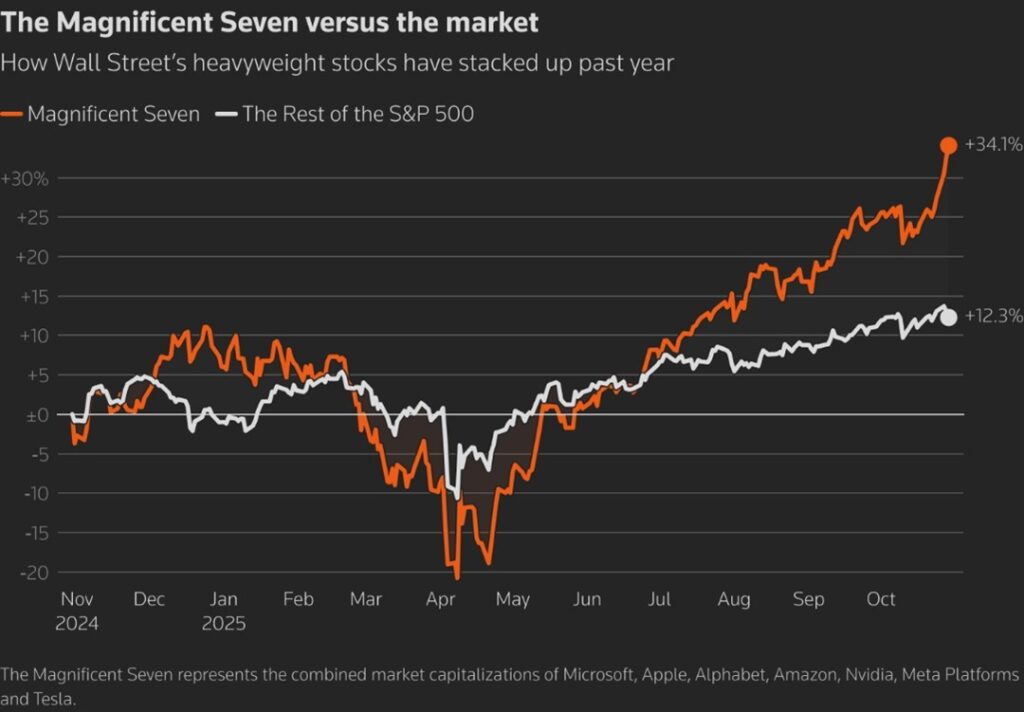
Six of the Mag 7 stocks have now reported their 3rd quarter earnings. Investors praised and rewarded results for Apple, Amazon, and Google, while punishing Tesla, Microsoft, and META. Nvidia matters most but will not report until November 19th. Investments into AI continue to outpace returns on AI for these companies, but their legacy business units continue to perform well and provide cash flow to underwrite the hyper scaling. However, the ratio of cash flow to capex ratio has been declining given the ever-higher level of AI investment. This bears watching as rising financing requirements on unknown outcomes increases risk, but this hasn’t interrupted return trends to date. Overall, the market passed this quarter’s Mag 7 earnings moment (pending Nvidia), and their atmospheric trends as a cohort continue:
Is That You, Santa Claus?
Welcome to November and the potential for a year-end Santa Claus rally. By this point in the year most problematic unknowns have become pacifying knowns. The trade war has effectively ended. The OBBB has passed. The Fed has started its rate reduction campaign. Gaza has a peace plan on paper. Russia’s theatre seems contained (even more so since we re-friended China), and the US border has been sealed without economic distress. The indices have priced this reality in as evidenced by the continuous claims of all-time highs. Traditionally, late October marks the beginning of a year-end rally, but also the completion of a seasonal pullback period:
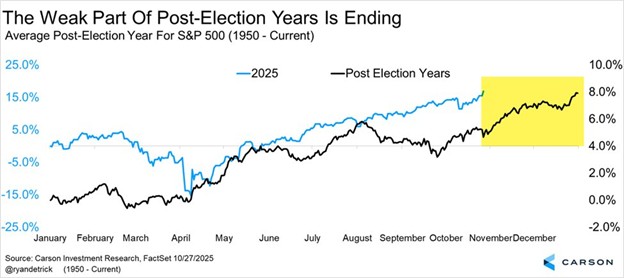
That didn’t happen this year as both September and October provided above average returns. Did Santa come early? Maybe, but historically a strong first 10 months presages a strong last two months as well:
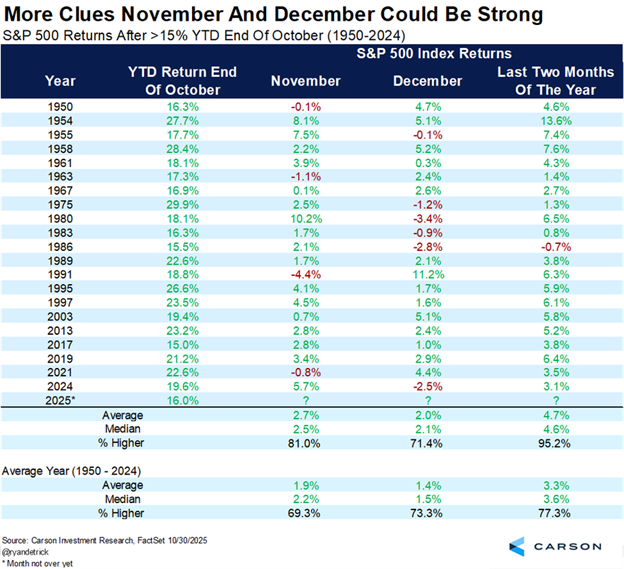
Over the last 75 years, when the S&P 500 has gained more than 15% in the first ten months, it rose another 4.7% on average over the last two. Furthermore, the two-month period over these occurrences delivered positive returns 95% of the time. Markets have a way of embarrassing forecasters, but with strong results for this earnings season, and positive guidance for many earnings seasons to come, Santa may just yet deliver S&P 7,000 by year end, unless interrupted by some unforeseen Grinch. Rally Ho!
Have a great weekend!
-David
Sources: Bloomberg, Carson Investment Research
This communication and its contents are for informational and educational purposes only and should not be used as the sole basis for any investment decision. The information contained herein is based on publicly available sources believed to be reliable but is not a representation, expressed or implied, as to the accuracy, completeness, or correctness of said information. References to political figures or policies are for informational purposes only and do not represent an endorsement by Waddell & Associates. Any forward-looking statements reflect current opinions and assumptions and are subject to change without notice; actual results may differ materially. Past performance does not guarantee future results. Waddell & Associates may use artificial intelligence tools to help generate or summarize content; all outputs are reviewed by our team for accuracy and relevance.
">‘Tis The Season? The Full Story:This week contained a cornucopia of market-moving morsels. Fed action, earnings action, tariff action, and year-end positioning pressed all three major stock market indices to fresh new highs. However, beneath the surface, individual stock performance showed far less conviction. With ten months of the year and 15%+ returns now behind us, will this rally rest…for the rest of 2025?
Powell Says What?
Jerome Powell provided monetary easing by cutting the Federal Funds rate .25%, but also conversational tightening by saying further cuts in December are “not a forgone conclusion” and, in fact, “far from it”. Odds of a December rate cut fell from 95% before the meeting to 60% after. This added some uplift to longer-term yields across the Treasury curve and downforce on more interest-rate sensitive areas of the market like the Ex-Mags and smaller cap stocks. Powell apparently sees more strength in the labor markets and risk of reinflation than markets anticipated. The lack of economic data releases due to the shutdown only exacerbated communication confusion as perhaps Powell knows something we don’t know. Ironically, the impact of the government shutdown should be less growth, less labor strength and lower inflation. Go figure. Stocks struggled with the interpretation, ending Wednesday essentially unchanged due to the dovish cut and hawkish chat. Whether the Fed cuts rates in December or not, they will be cutting rates further in 2026 as each of Trump’s candidates to replace Powell on May 15th have assured.
Friends Again
Donald Trump stylized his meeting with Xi Jinping of China a 12 on a 10-point scale. As a result of the pleasantries and gift exchange, the US agreed to cut tariffs on Chinese goods from 57% to 47% while China agreed they will sell us more rare earth materials, less fentanyl, and will buy more soybeans. This amounts to a tactical trade truce with China for now, removing a key risk factor for the markets. None of this has been papered of course but concerns over a reescalation of trade tensions with China have abated.
How Magnificent!
Six of the Mag 7 stocks have now reported their 3rd quarter earnings. Investors praised and rewarded results for Apple, Amazon, and Google, while punishing Tesla, Microsoft, and META. Nvidia matters most but will not report until November 19th. Investments into AI continue to outpace returns on AI for these companies, but their legacy business units continue to perform well and provide cash flow to underwrite the hyper scaling. However, the ratio of cash flow to capex ratio has been declining given the ever-higher level of AI investment. This bears watching as rising financing requirements on unknown outcomes increases risk, but this hasn’t interrupted return trends to date. Overall, the market passed this quarter’s Mag 7 earnings moment (pending Nvidia), and their atmospheric trends as a cohort continue:
Is That You, Santa Claus?
Welcome to November and the potential for a year-end Santa Claus rally. By this point in the year most problematic unknowns have become pacifying knowns. The trade war has effectively ended. The OBBB has passed. The Fed has started its rate reduction campaign. Gaza has a peace plan on paper. Russia’s theatre seems contained (even more so since we re-friended China), and the US border has been sealed without economic distress. The indices have priced this reality in as evidenced by the continuous claims of all-time highs. Traditionally, late October marks the beginning of a year-end rally, but also the completion of a seasonal pullback period:
That didn’t happen this year as both September and October provided above average returns. Did Santa come early? Maybe, but historically a strong first 10 months presages a strong last two months as well:
Over the last 75 years, when the S&P 500 has gained more than 15% in the first ten months, it rose another 4.7% on average over the last two. Furthermore, the two-month period over these occurrences delivered positive returns 95% of the time. Markets have a way of embarrassing forecasters, but with strong results for this earnings season, and positive guidance for many earnings seasons to come, Santa may just yet deliver S&P 7,000 by year end, unless interrupted by some unforeseen Grinch. Rally Ho!
Have a great weekend!
-David
Sources: Bloomberg, Carson Investment Research
This communication and its contents are for informational and educational purposes only and should not be used as the sole basis for any investment decision. The information contained herein is based on publicly available sources believed to be reliable but is not a representation, expressed or implied, as to the accuracy, completeness, or correctness of said information. References to political figures or policies are for informational purposes only and do not represent an endorsement by Waddell & Associates. Any forward-looking statements reflect current opinions and assumptions and are subject to change without notice; actual results may differ materially. Past performance does not guarantee future results. Waddell & Associates may use artificial intelligence tools to help generate or summarize content; all outputs are reviewed by our team for accuracy and relevance.
" class="link-chevron">
Markets have finally fulfilled their seasonal promise of declining as we approach All Hallows Eve. Those who have known us for a long time know that we tend to dollar cost average capital received mid-year into Halloween given typical summer doldrums and early fall apprehensions. We altered our emphasis on seasonality a bit this year given the Trumpian overlay, but historical odds favor September/October swoons that initiate November/December boons. Will that occur this year, or is our only fear the fear itself?
The Fear to Fear
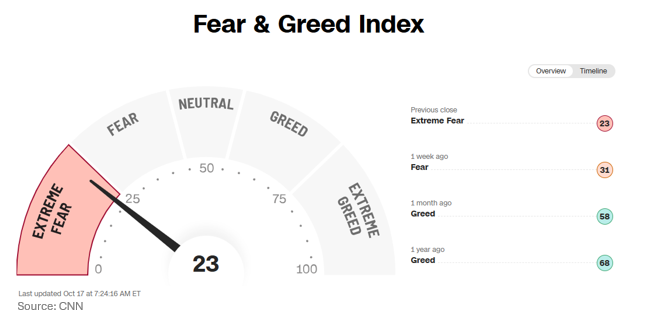
CNN business compiles several sentiment readings into a simple gauge measuring fear and greed. The current level marks the most fearful since Liberation Day. Most underlying factors show short-term shivers driven by recently harrowing headlines, but longer-term measures like market breadth reveal a more concerning rot.
Technically Stanky Breadth
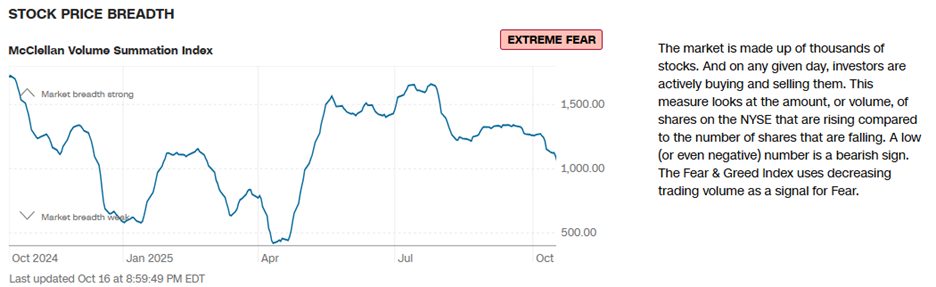
Market breadth measures trader conviction. More confident markets show more bet diversification and higher breadth, while less confident markets show more bet concentration and lower breadth. With the Mag 7 now commanding over 35% of total S&P 500 capitalization, moves higher in that cohort alone can drive indices to new highs despite a sideways drift for the remaining 493, as the chart below indicates:
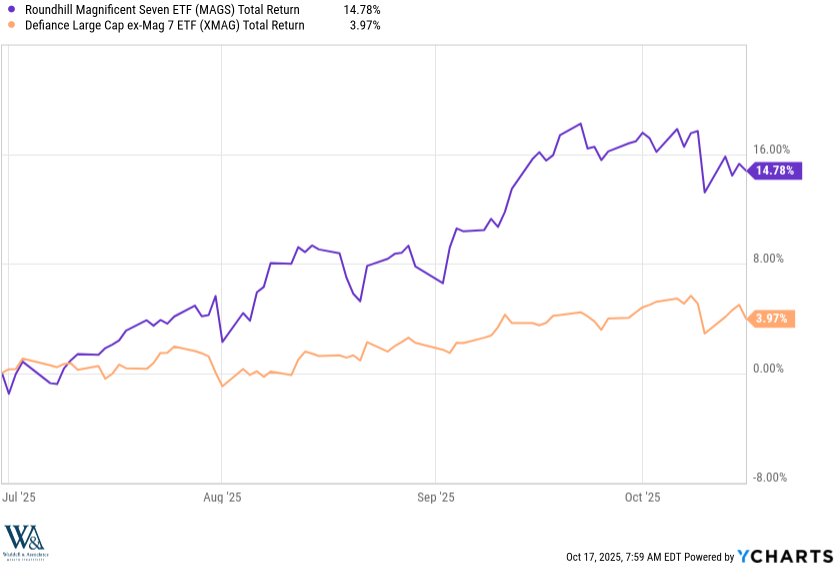
With the 493 trending sideways, any Mag 7 misstep can exacerbate downside dips, which has been the case over the past week. A lack of non-Mag conviction paired with Mag 7 jitters presents the perfect target for a technical sell-off.
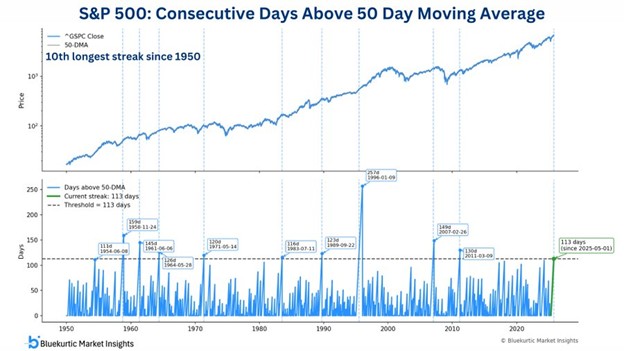
The recent rally off the April lows has strung together a string of superlatives. For instance, the amount of time the S&P 500 has spent above its 50-day moving average rivals some of the longest streaks in last 50 years. The last unblemished rally of this duration occurred nearly 15 years ago making this a rally in search of retraction. Tech bubble blabber, Trumps tariff tantrum, shutdown shutters and credit consternations provide ample kindling for technical burn-off:
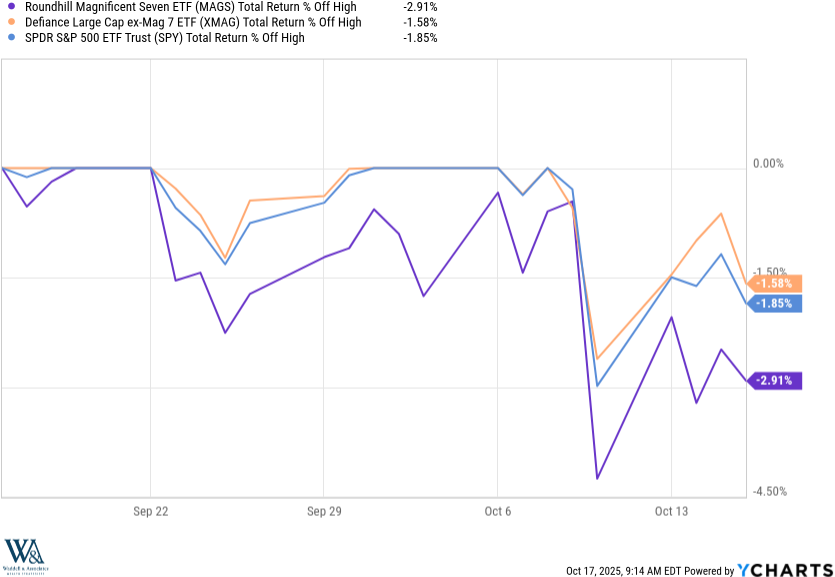
The chart above plots index movement off the highs. While the non-Mags in orange may not have captured the buying momentum of the Mag 7 on the upside, they also didn’t capture the selling momentum on the downside, suggesting fundamental breadth may not be as concerning as technical breadth.
Fundamentally Minty Breadth
As Buffet famously said in referencing sentiment and technical market factors, “in the short run the market is a voting machine, but in the long run it’s a weighing machine.” Translation: markets react to technical influences but ultimately follow the fundamentals.
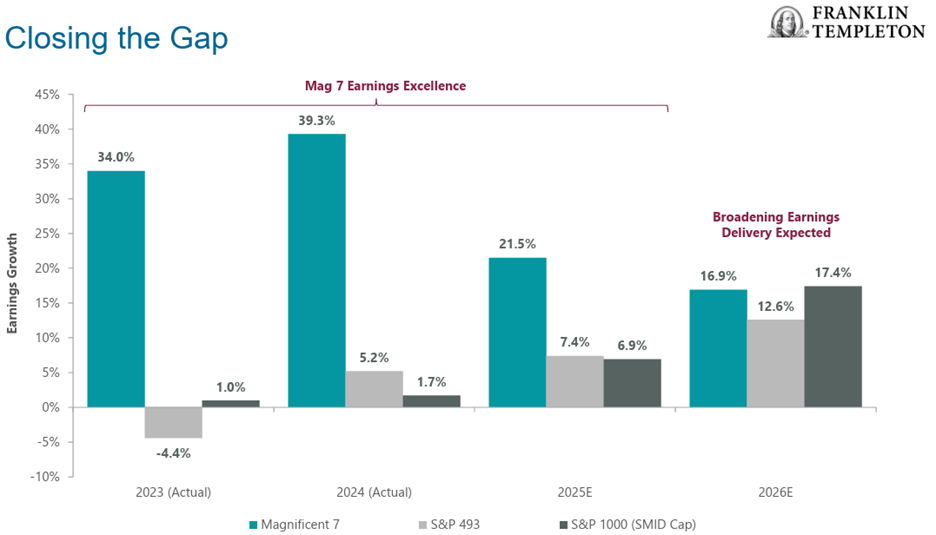
From a fundamental perspective, earnings production for the Magnificent 7 has been otherworldly compared with everything else, making their outperformance since the October 22 lows well-earned. However, as we peer forward, earnings breadth should improve markedly. Note that in 2026, the expected earnings differential between the Mag 7 and non-Mags within the S&P narrows, drawing more attention to the valuation differential of 30x for the Mag 7 vs. 20x for the non-Mags. Advantage non-Mags. Further down the cap spectrum, the S&P 1000 small and midcap index could see even faster earnings growth at a valuation of 15x vs. 30x. Advantage Smidcaps. In fairness, markets have tended to underestimate the strength of Mag 7 earnings growth and overestimate the strength of non-Mag earnings growth since this bull began, but that may be changing:
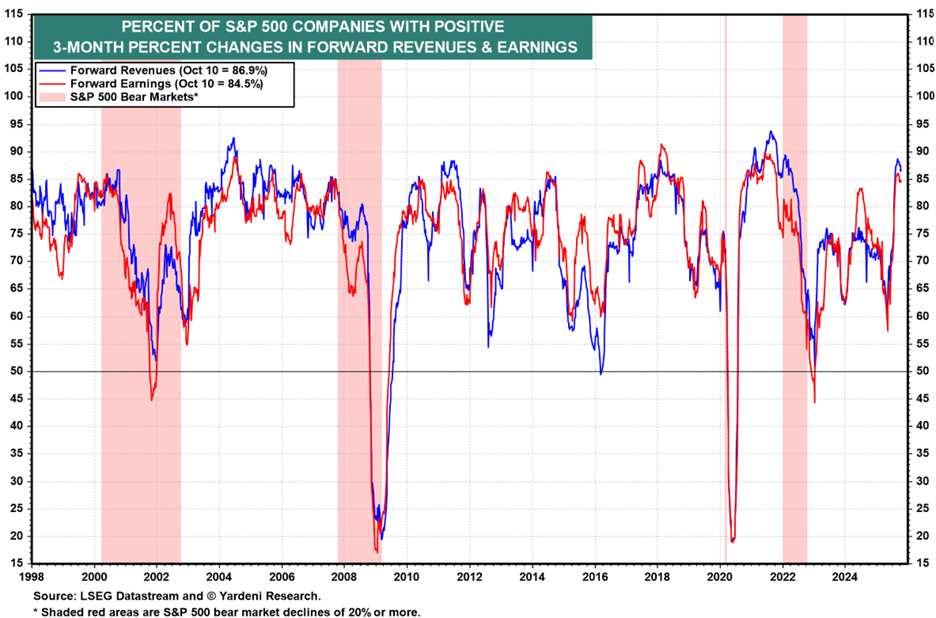
For the first time since 2021, analysts are raising their forward revenue and earnings estimates on over 85% of S&P 500 companies. In our opinion, this accounts for the stimulus smorgasbord of monetary stimulus, fiscal stimulus, de-regulatory stimulus, currency depreciation stimulus, and AI capital expenditure stimulus on approach. That’s a wide array of stimulus programs supporting a wide array of earnings programs as seen in the early reporting this earnings season. Fifty-one of the S&P 500 companies have reported so far with 82% of those outperforming estimates. A third of S&P 500 financial companies have reported earnings, 90% have outperformed estimates, and none are in the Magnificent 7.
Lastly, while the rally in Gold has attracted fascination of late, it’s the rally in Small Caps despite bad technical breadth that deserves it more. While the Mag 7s have well outperformed the non-Mags since July, the Russell 2000 small caps have well outperformed them both:
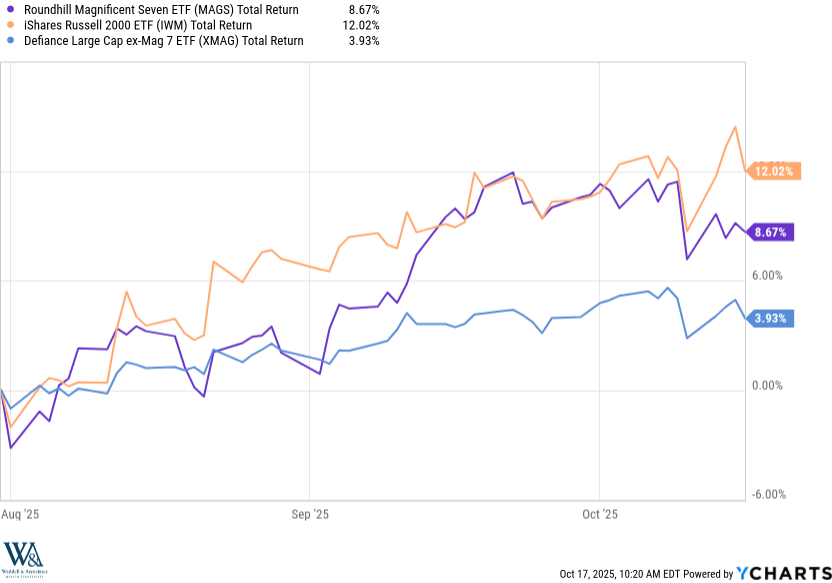
Enjoy your Sunday!
-David
Sources: YCharts, Yardeni Research, Franklin Templeton, Bluekurtic Market Insights, CNN Business
This communication and its contents are for informational and educational purposes only and should not be used as the sole basis for any investment decision. The information contained herein is based on publicly available sources believed to be reliable but is not a representation, expressed or implied, as to the accuracy, completeness, or correctness of said information. References to political figures or policies are for informational purposes only and do not represent an endorsement by Waddell & Associates. Any forward-looking statements reflect current opinions and assumptions and are subject to change without notice; actual results may differ materially. Past performance does not guarantee future results. Waddell & Associates may use artificial intelligence tools to help generate or summarize content; all outputs are reviewed by our team for accuracy and relevance.
">Spooktober
Markets have finally fulfilled their seasonal promise of declining as we approach All Hallows Eve. Those who have known us for a long time know that we tend to dollar cost average capital received mid-year into Halloween given typical summer doldrums and early fall apprehensions. We altered our emphasis on seasonality a bit this year given the Trumpian overlay, but historical odds favor September/October swoons that initiate November/December boons. Will that occur this year, or is our only fear the fear itself?
The Fear to Fear
CNN business compiles several sentiment readings into a simple gauge measuring fear and greed. The current level marks the most fearful since Liberation Day. Most underlying factors show short-term shivers driven by recently harrowing headlines, but longer-term measures like market breadth reveal a more concerning rot.
Technically Stanky Breadth
Market breadth measures trader conviction. More confident markets show more bet diversification and higher breadth, while less confident markets show more bet concentration and lower breadth. With the Mag 7 now commanding over 35% of total S&P 500 capitalization, moves higher in that cohort alone can drive indices to new highs despite a sideways drift for the remaining 493, as the chart below indicates:
With the 493 trending sideways, any Mag 7 misstep can exacerbate downside dips, which has been the case over the past week. A lack of non-Mag conviction paired with Mag 7 jitters presents the perfect target for a technical sell-off.
The recent rally off the April lows has strung together a string of superlatives. For instance, the amount of time the S&P 500 has spent above its 50-day moving average rivals some of the longest streaks in last 50 years. The last unblemished rally of this duration occurred nearly 15 years ago making this a rally in search of retraction. Tech bubble blabber, Trumps tariff tantrum, shutdown shutters and credit consternations provide ample kindling for technical burn-off:
The chart above plots index movement off the highs. While the non-Mags in orange may not have captured the buying momentum of the Mag 7 on the upside, they also didn’t capture the selling momentum on the downside, suggesting fundamental breadth may not be as concerning as technical breadth.
Fundamentally Minty Breadth
As Buffet famously said in referencing sentiment and technical market factors, “in the short run the market is a voting machine, but in the long run it’s a weighing machine.” Translation: markets react to technical influences but ultimately follow the fundamentals.
From a fundamental perspective, earnings production for the Magnificent 7 has been otherworldly compared with everything else, making their outperformance since the October 22 lows well-earned. However, as we peer forward, earnings breadth should improve markedly. Note that in 2026, the expected earnings differential between the Mag 7 and non-Mags within the S&P narrows, drawing more attention to the valuation differential of 30x for the Mag 7 vs. 20x for the non-Mags. Advantage non-Mags. Further down the cap spectrum, the S&P 1000 small and midcap index could see even faster earnings growth at a valuation of 15x vs. 30x. Advantage Smidcaps. In fairness, markets have tended to underestimate the strength of Mag 7 earnings growth and overestimate the strength of non-Mag earnings growth since this bull began, but that may be changing:
For the first time since 2021, analysts are raising their forward revenue and earnings estimates on over 85% of S&P 500 companies. In our opinion, this accounts for the stimulus smorgasbord of monetary stimulus, fiscal stimulus, de-regulatory stimulus, currency depreciation stimulus, and AI capital expenditure stimulus on approach. That’s a wide array of stimulus programs supporting a wide array of earnings programs as seen in the early reporting this earnings season. Fifty-one of the S&P 500 companies have reported so far with 82% of those outperforming estimates. A third of S&P 500 financial companies have reported earnings, 90% have outperformed estimates, and none are in the Magnificent 7.
Lastly, while the rally in Gold has attracted fascination of late, it’s the rally in Small Caps despite bad technical breadth that deserves it more. While the Mag 7s have well outperformed the non-Mags since July, the Russell 2000 small caps have well outperformed them both:
Enjoy your Sunday!
-David
Sources: YCharts, Yardeni Research, Franklin Templeton, Bluekurtic Market Insights, CNN Business
This communication and its contents are for informational and educational purposes only and should not be used as the sole basis for any investment decision. The information contained herein is based on publicly available sources believed to be reliable but is not a representation, expressed or implied, as to the accuracy, completeness, or correctness of said information. References to political figures or policies are for informational purposes only and do not represent an endorsement by Waddell & Associates. Any forward-looking statements reflect current opinions and assumptions and are subject to change without notice; actual results may differ materially. Past performance does not guarantee future results. Waddell & Associates may use artificial intelligence tools to help generate or summarize content; all outputs are reviewed by our team for accuracy and relevance.
" class="link-chevron">
After an Oval Office impasse Tuesday evening leaving the continuing resolution bill unsigned, the US government began furloughing non-essential services and employees. At stake? The Mid-Terms. Democrats want the continuing resolution (CR) bill to continue COVID era subsidies for Obamacare which the Republicans voted to discontinue at year’s end in the OBBB. The 60 votes required in the Senate to pass the CR enable this re-trade as there are only 53 Republican Senators leaving them 7 short. Democrats failed to use this same leverage when passing the March CR, fearing that Trump would use the financial shortfall to permanently gut sacrosanct programs like National Public Radio. Today, the Democrats have the OBBB in hand to cherry pick “heartless” measures like ending healthcare subsidies for the “needy”. Republicans initially seemed resolute, but less so recently, with Trump and JD Vance expressing willingness to negotiate (either before or after passage of the CR). How will this end? Who knows, and from the market’s perspective… Who Cares?
Higher Highs
The S&P 500 has hit new closing highs 30 times this year, including every day this week. Beneath the relentless move higher in stock prices lies the relentless move higher in earnings expectations:
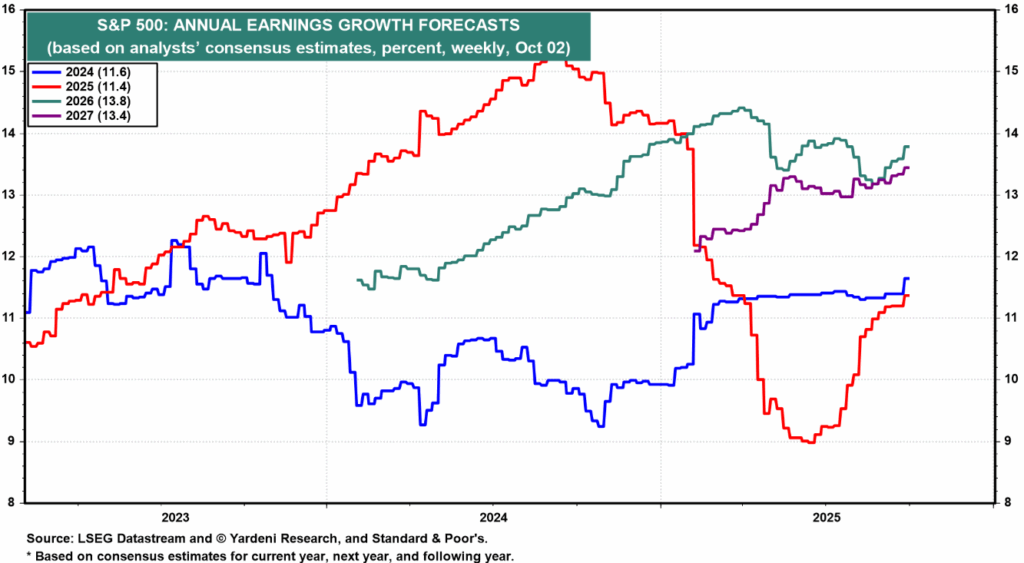
I know it’s a busy chart but let’s digest. The lines move left to right and chronicle analyst earnings projections as time advances. Note the harmonic surge higher in 2025 earnings expectations (red), 2026 earnings expectations (green) and 2027 earnings expectations (purple) over the past few months. This accompanies increases in revenue expectations:
And increases in profit margin expectations:
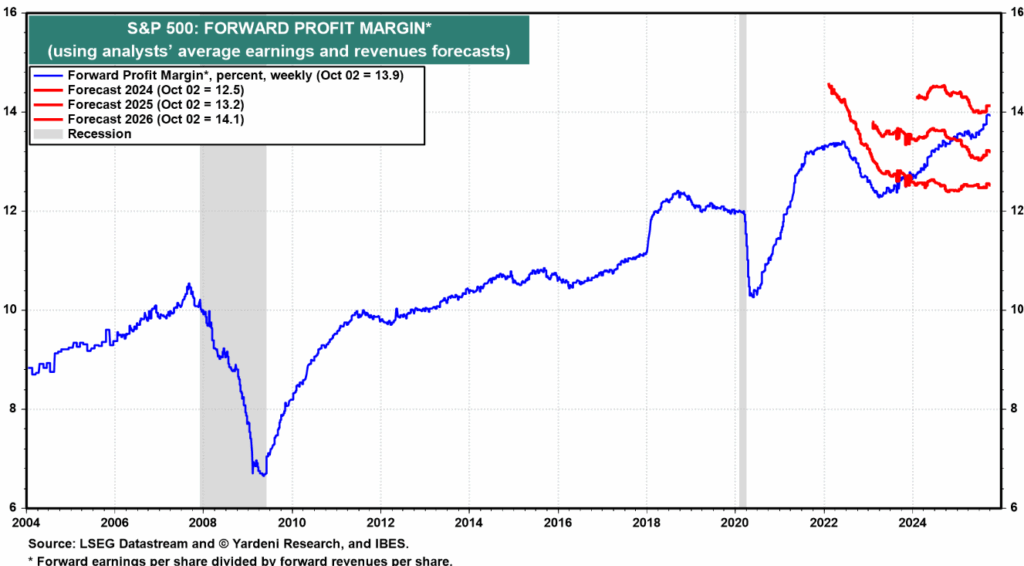
Rising revenues + Rising Profit Margins = Exponential Earnings! As we have noted, the combination of monetary stimulus from rate cuts, fiscal stimulus from tax cuts, currency stimulus from dollar depreciation, and CAPEX stimulus from the AI arms race all combine to boost economic and revenue growth while technology adoptions boost profit margins. While tariffs and shutdowns apply levitation counterweights, they merely amount to strings on the ballon.
In the Absence of Data
Apparently, the Government deems economic data unessential. This hurts our feelings and requires us to construct our own labor market assessments. The Trump labor market differs greatly from the Biden labor market given the immigration halt. Under Biden, the surge of immigrants into the workforce required an addition of 150,000 jobs a month to keep the unemployment rate level. Under Trump, this number has fallen to approximately 40,000 a month in job creation needed to keep the unemployment rate level.
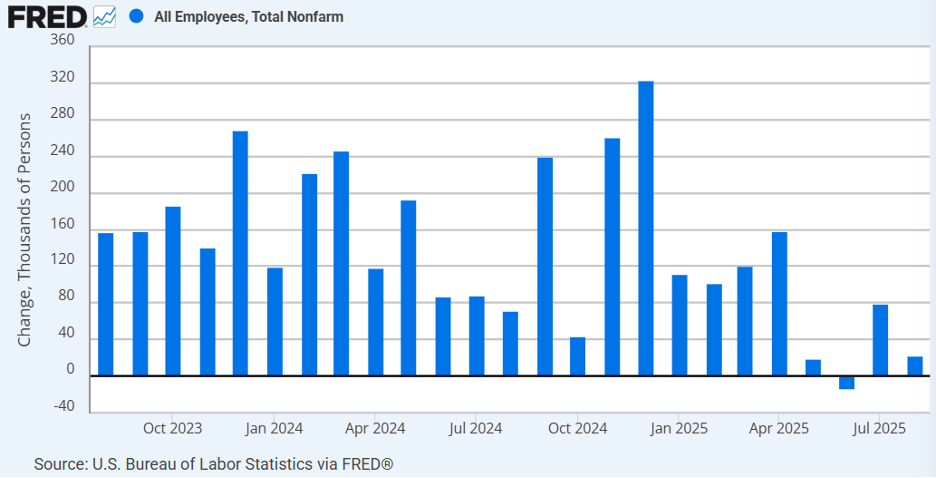
The optics of this chart invite concern as the surge in hiring evident in late 2024 has apparently collapsed into 2025. This has not been lost on the Fed who have noted deteriorating strength in the labor market as evidenced by their .25% rate cut in September and another .25% cut likely on October 28th. A prolonged shutdown only increases odds of further rate reductions with odds of a December reduction of .25% currently at 85%. This aligns with the Feds projections released in September. Only a significantly stronger employment report would derail their intentions, which seems unlikely as the steady state number has fallen and the number of virtual hirings has risen.
Companies today seem to be competing now on how many real people they can replace with AI agents as seen in the following headlines:

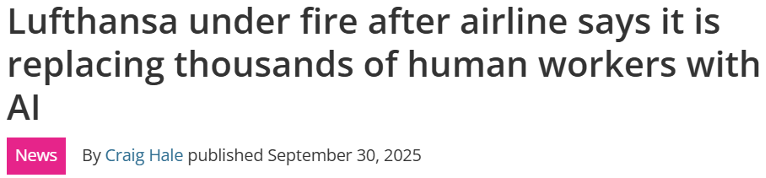
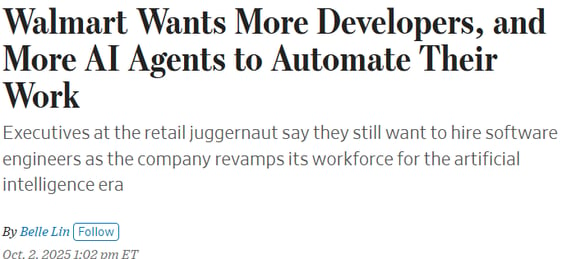
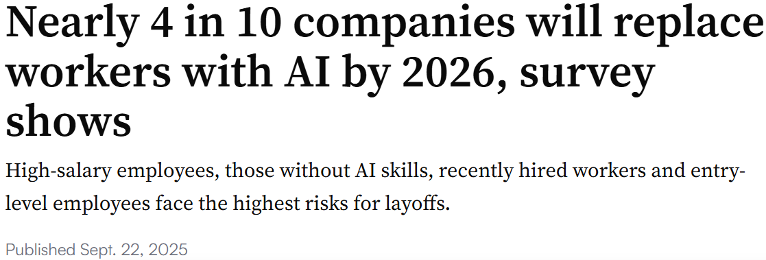
I could go on and on. Also, note the industry diversity represented above. What started out as a tech trend has now metastasized across other industries as well. In traditional economics, a slowdown in hiring accompanies a slowdown in GDP, requiring rate cuts from the Fed. Within this cycle, despite the slowdown in job creation, the US economy grew 3.8% in the 2nd quarter and the Fed’s GDPNow predicts another 3.8% growth in the 3rd quarter.
Welcome to the brave new world. Will Fed rate cuts offset AI driven employment cuts? Unlikely. With less influence over the labor market, perhaps the Fed’s dual mandate becomes a more singular focus on inflation. However, not only does AI suppress hiring, it’s productivity enhancements also suppress inflation. Companies that can do more with less, can afford to charge less. We see this in today’s record profit margins, poised to climb higher. In sum, a slowdown in hiring this time may not accompany a slowdown in growth. The axiomatic Fed rate cuts to support the labor market only reduce the expense of AI investments, further encouraging the labor substitution impacts. This higher growth/lower employment/lower inflation AI paradigm remains theoretical, but evidence is amassing. And if true… it’s not good news for laborers… but it is great news for investors!
Enjoy the rest of your week!
-David
Sources: Yardeni Research, Federal Reserve Bank of St. Louis, Federal Reserve Bank of Atlanta
This communication and its contents are for informational and educational purposes only and should not be used as the sole basis for any investment decision. The information contained herein is based on publicly available sources believed to be reliable but is not a representation, expressed or implied, as to the accuracy, completeness, or correctness of said information. References to political figures or policies are for informational purposes only and do not represent an endorsement by Waddell & Associates. Any forward-looking statements reflect current opinions and assumptions and are subject to change without notice; actual results may differ materially. Past performance does not guarantee future results. Waddell & Associates may use artificial intelligence tools to help generate or summarize content; all outputs are reviewed by our team for accuracy and relevance.
">The Upside to the Shutdown
After an Oval Office impasse Tuesday evening leaving the continuing resolution bill unsigned, the US government began furloughing non-essential services and employees. At stake? The Mid-Terms. Democrats want the continuing resolution (CR) bill to continue COVID era subsidies for Obamacare which the Republicans voted to discontinue at year’s end in the OBBB. The 60 votes required in the Senate to pass the CR enable this re-trade as there are only 53 Republican Senators leaving them 7 short. Democrats failed to use this same leverage when passing the March CR, fearing that Trump would use the financial shortfall to permanently gut sacrosanct programs like National Public Radio. Today, the Democrats have the OBBB in hand to cherry pick “heartless” measures like ending healthcare subsidies for the “needy”. Republicans initially seemed resolute, but less so recently, with Trump and JD Vance expressing willingness to negotiate (either before or after passage of the CR). How will this end? Who knows, and from the market’s perspective… Who Cares?
Higher Highs
The S&P 500 has hit new closing highs 30 times this year, including every day this week. Beneath the relentless move higher in stock prices lies the relentless move higher in earnings expectations:
I know it’s a busy chart but let’s digest. The lines move left to right and chronicle analyst earnings projections as time advances. Note the harmonic surge higher in 2025 earnings expectations (red), 2026 earnings expectations (green) and 2027 earnings expectations (purple) over the past few months. This accompanies increases in revenue expectations:
And increases in profit margin expectations:
Rising revenues + Rising Profit Margins = Exponential Earnings! As we have noted, the combination of monetary stimulus from rate cuts, fiscal stimulus from tax cuts, currency stimulus from dollar depreciation, and CAPEX stimulus from the AI arms race all combine to boost economic and revenue growth while technology adoptions boost profit margins. While tariffs and shutdowns apply levitation counterweights, they merely amount to strings on the ballon.
In the Absence of Data
Apparently, the Government deems economic data unessential. This hurts our feelings and requires us to construct our own labor market assessments. The Trump labor market differs greatly from the Biden labor market given the immigration halt. Under Biden, the surge of immigrants into the workforce required an addition of 150,000 jobs a month to keep the unemployment rate level. Under Trump, this number has fallen to approximately 40,000 a month in job creation needed to keep the unemployment rate level.
The optics of this chart invite concern as the surge in hiring evident in late 2024 has apparently collapsed into 2025. This has not been lost on the Fed who have noted deteriorating strength in the labor market as evidenced by their .25% rate cut in September and another .25% cut likely on October 28th. A prolonged shutdown only increases odds of further rate reductions with odds of a December reduction of .25% currently at 85%. This aligns with the Feds projections released in September. Only a significantly stronger employment report would derail their intentions, which seems unlikely as the steady state number has fallen and the number of virtual hirings has risen.
Companies today seem to be competing now on how many real people they can replace with AI agents as seen in the following headlines:
I could go on and on. Also, note the industry diversity represented above. What started out as a tech trend has now metastasized across other industries as well. In traditional economics, a slowdown in hiring accompanies a slowdown in GDP, requiring rate cuts from the Fed. Within this cycle, despite the slowdown in job creation, the US economy grew 3.8% in the 2nd quarter and the Fed’s GDPNow predicts another 3.8% growth in the 3rd quarter.
Welcome to the brave new world. Will Fed rate cuts offset AI driven employment cuts? Unlikely. With less influence over the labor market, perhaps the Fed’s dual mandate becomes a more singular focus on inflation. However, not only does AI suppress hiring, it’s productivity enhancements also suppress inflation. Companies that can do more with less, can afford to charge less. We see this in today’s record profit margins, poised to climb higher. In sum, a slowdown in hiring this time may not accompany a slowdown in growth. The axiomatic Fed rate cuts to support the labor market only reduce the expense of AI investments, further encouraging the labor substitution impacts. This higher growth/lower employment/lower inflation AI paradigm remains theoretical, but evidence is amassing. And if true… it’s not good news for laborers… but it is great news for investors!
Enjoy the rest of your week!
-David
Sources: Yardeni Research, Federal Reserve Bank of St. Louis, Federal Reserve Bank of Atlanta
This communication and its contents are for informational and educational purposes only and should not be used as the sole basis for any investment decision. The information contained herein is based on publicly available sources believed to be reliable but is not a representation, expressed or implied, as to the accuracy, completeness, or correctness of said information. References to political figures or policies are for informational purposes only and do not represent an endorsement by Waddell & Associates. Any forward-looking statements reflect current opinions and assumptions and are subject to change without notice; actual results may differ materially. Past performance does not guarantee future results. Waddell & Associates may use artificial intelligence tools to help generate or summarize content; all outputs are reviewed by our team for accuracy and relevance.
" class="link-chevron">As markets continue to push higher, I’ve been asking myself: what are the strategic questions investors should be considering right now?
When portfolios are performing well, the natural instinct is either to lock in gains or chase what’s working even harder. In our experience, acting on these impulses without a broader plan can sometimes create long-term challenges.
Here’s how we’re approaching these decisions with clients right now.
The Economic Engine Running Hot
Before we talk strategy, let me what I believe may be helping to push markets higher.
We’re seeing four types of economic support working together, as noted in our Halftime Report:
- Monetary stimulus – Central banks have been cutting rates, and recent data suggests money has been growing around 5% year-over-year
- Currency effects – The dollar weakened by roughly 11% in the first half, which can benefit overseas earnings when American companies translate foreign profits back to dollars
- Fiscal stimulus – Recent tax legislation has been estimated at around $3.5 trillion, including roughly $1 trillion in new spending beyond extending previous tax cuts
- Capital expenditure surge – Companies have been increasing their spending on artificial intelligence infrastructure, approaching $500 billion annually
Altogether, that represents roughly $4.5 trillion in potential stimulus flowing through our $30 trillion economy. In my view, that could provide meaningful support for corporate earnings and broader economic activity.
In my experience, this much coordinated stimulus overlaps, it can create real opportunities for investors – but it can also lead to “market giddiness.” And that’s where things get interesting.
When Markets Start Acting “Giddy”
Here’s what has my attention right now.
I believe we’re seeing signs of speculative behavior return. SPACs are back, these are essentially blank check companies that raise money to buy other businesses later. Many investors faced losses in 2021 when SPAC enthusiasm faded, but renewed sentiment appears to be driving their resurgence.
So-called meme stocks are rallying again. Companies like Krispy Kreme, GoPro, and Kohl’s are trading up substantially based on social media momentum rather than business improvements.
Cryptocurrency markets continue pushing higher despite regulatory uncertainty. Bitcoin, Ethereum, Solana, they’re all rallying on speculation rather than fundamental adoption.
Most notably, the largest technology companies (what market watchers call the “Magnificent 7”) now trade at 30 times their annual earnings. That’s actually higher than comparable technology stocks traded at the peak of the internet bubble in 2000.
I find this concerning because markets tend to get less forgiving when speculation runs this high.
Our Framework for Smart Positioning
Here’s how I’m thinking through portfolio decisions with clients today.
We want to participate in legitimate economic growth. With this much stimulus support, staying completely defensive would likely be a costly mistake.
But we don’t need to chase speculative areas to benefit from the expansion.
Our research shows mid-sized company stocks trading at about 17.5 times earnings and smaller company stocks at 17.1 times earnings. Those are reasonable valuations compared to the broader market’s current 24 times earnings, which sits near 2000 peak levels.
We’re also finding opportunities in sectors positioned to benefit from infrastructure spending. Industrial companies, materials producers, and utilities should see increased demand from the massive data center construction required for artificial intelligence, without the speculative premiums attached to the technology giants themselves.
The Real Decisions You’re Facing
When markets hit new highs, emotion can override strategy. I see this with even the most sophisticated investors.
The questions I’m working through with clients right now center on managing success without getting complacent.
- Concentration concerns
How much of your portfolio should remain in the stocks that got you here? Many clients have significant exposure to large technology companies through various holdings. We’re reviewing whether that concentration still makes sense given current valuations.
- The rebalancing discipline
Should you be taking profits from areas that have performed exceptionally well? This feels counterintuitive when things are working, but systematic rebalancing often captures gains from speculative areas and redeploys them into more reasonable opportunities.
- Growth without speculation
Where do you find growth opportunities without paying bubble-level prices? We can model different approaches and stress-test them against various market scenarios.
- Timeline reality
How does your need for portfolio liquidity affect these decisions? If you’re planning major expenses or lifestyle changes in the next 2-3 years, that changes how we think about current positioning.
What the Market Is Actually Telling Us
The behavioral patterns I’m tracking suggest markets are becoming more discriminating.
During this earnings season, companies beating expectations are getting smaller positive reactions than usual. Companies missing expectations are getting punished about 2% more severely than the 10-year average.
This shift toward selectivity typically happens when valuations stretch, and investors become more careful about where they place bets. It’s a warning sign that the easy money phase of this cycle may be ending.
We’re also seeing that while the economic fundamentals remain strong, unemployment at 4.1% and more job openings than workers to fill them, the psychology of investing is shifting toward caution.
How We Navigate This Together
Rather than making dramatic changes based on where markets sit today, I’m helping clients fine-tune positions based on their complete financial picture.
For some clients, that means reducing concentration in the largest technology names while maintaining growth exposure through mid-sized company positions. For others, it means adding some defensive positioning without abandoning growth entirely.
The key is making these adjustments systematically rather than emotionally.
We can review your current allocation and discuss whether modifications make sense given your specific goals and timeline. We can also model how different positioning approaches might perform across various market scenarios, including what happens if speculation cools or if stimulus drives markets even higher.
Staying Smart When Markets Get Exciting
I often tell clients to “party on, but stay sober.” Markets with this much stimulus support tend to continue higher over 12-24 month periods. But they also tend to be more volatile along the way.
The question isn’t whether to stay invested. The question is how to stay invested intelligently.
If you’re feeling the urge to make changes, either to lock in gains or chase what’s working, that’s normal. We can channel that energy into strategic portfolio improvements rather than emotional reactions.
The stimulus environment creates real opportunities. We can help you capture them without taking unnecessary risks.
If you want the complete analysis behind this strategic thinking, you can watch our full 2025 Halftime Report on our website. And if you’d like to discuss how these market dynamics affect your specific portfolio, please reach out to your W&A wealth strategist to schedule a conversation.
New here? Learn about the Waddell & Associates difference and explore how you can work with us. We’d love to hear from you.
">
When and how to adjust positioning in rising markets
As markets continue to push higher, I’ve been asking myself: what are the strategic questions investors should be considering right now?
When portfolios are performing well, the natural instinct is either to lock in gains or chase what’s working even harder. In our experience, acting on these impulses without a broader plan can sometimes create long-term challenges.
Here’s how we’re approaching these decisions with clients right now.
The Economic Engine Running Hot
Before we talk strategy, let me what I believe may be helping to push markets higher.
We’re seeing four types of economic support working together, as noted in our Halftime Report:
- Monetary stimulus – Central banks have been cutting rates, and recent data suggests money has been growing around 5% year-over-year
- Currency effects – The dollar weakened by roughly 11% in the first half, which can benefit overseas earnings when American companies translate foreign profits back to dollars
- Fiscal stimulus – Recent tax legislation has been estimated at around $3.5 trillion, including roughly $1 trillion in new spending beyond extending previous tax cuts
- Capital expenditure surge – Companies have been increasing their spending on artificial intelligence infrastructure, approaching $500 billion annually
Altogether, that represents roughly $4.5 trillion in potential stimulus flowing through our $30 trillion economy. In my view, that could provide meaningful support for corporate earnings and broader economic activity.
In my experience, this much coordinated stimulus overlaps, it can create real opportunities for investors – but it can also lead to “market giddiness.” And that’s where things get interesting.
When Markets Start Acting “Giddy”
Here’s what has my attention right now.
I believe we’re seeing signs of speculative behavior return. SPACs are back, these are essentially blank check companies that raise money to buy other businesses later. Many investors faced losses in 2021 when SPAC enthusiasm faded, but renewed sentiment appears to be driving their resurgence.
So-called meme stocks are rallying again. Companies like Krispy Kreme, GoPro, and Kohl’s are trading up substantially based on social media momentum rather than business improvements.
Cryptocurrency markets continue pushing higher despite regulatory uncertainty. Bitcoin, Ethereum, Solana, they’re all rallying on speculation rather than fundamental adoption.
Most notably, the largest technology companies (what market watchers call the “Magnificent 7”) now trade at 30 times their annual earnings. That’s actually higher than comparable technology stocks traded at the peak of the internet bubble in 2000.
I find this concerning because markets tend to get less forgiving when speculation runs this high.
Our Framework for Smart Positioning
Here’s how I’m thinking through portfolio decisions with clients today.
We want to participate in legitimate economic growth. With this much stimulus support, staying completely defensive would likely be a costly mistake.
But we don’t need to chase speculative areas to benefit from the expansion.
Our research shows mid-sized company stocks trading at about 17.5 times earnings and smaller company stocks at 17.1 times earnings. Those are reasonable valuations compared to the broader market’s current 24 times earnings, which sits near 2000 peak levels.
We’re also finding opportunities in sectors positioned to benefit from infrastructure spending. Industrial companies, materials producers, and utilities should see increased demand from the massive data center construction required for artificial intelligence, without the speculative premiums attached to the technology giants themselves.
The Real Decisions You’re Facing
When markets hit new highs, emotion can override strategy. I see this with even the most sophisticated investors.
The questions I’m working through with clients right now center on managing success without getting complacent.
- Concentration concerns
How much of your portfolio should remain in the stocks that got you here? Many clients have significant exposure to large technology companies through various holdings. We’re reviewing whether that concentration still makes sense given current valuations.
- The rebalancing discipline
Should you be taking profits from areas that have performed exceptionally well? This feels counterintuitive when things are working, but systematic rebalancing often captures gains from speculative areas and redeploys them into more reasonable opportunities.
- Growth without speculation
Where do you find growth opportunities without paying bubble-level prices? We can model different approaches and stress-test them against various market scenarios.
- Timeline reality
How does your need for portfolio liquidity affect these decisions? If you’re planning major expenses or lifestyle changes in the next 2-3 years, that changes how we think about current positioning.
What the Market Is Actually Telling Us
The behavioral patterns I’m tracking suggest markets are becoming more discriminating.
During this earnings season, companies beating expectations are getting smaller positive reactions than usual. Companies missing expectations are getting punished about 2% more severely than the 10-year average.
This shift toward selectivity typically happens when valuations stretch, and investors become more careful about where they place bets. It’s a warning sign that the easy money phase of this cycle may be ending.
We’re also seeing that while the economic fundamentals remain strong, unemployment at 4.1% and more job openings than workers to fill them, the psychology of investing is shifting toward caution.
How We Navigate This Together
Rather than making dramatic changes based on where markets sit today, I’m helping clients fine-tune positions based on their complete financial picture.
For some clients, that means reducing concentration in the largest technology names while maintaining growth exposure through mid-sized company positions. For others, it means adding some defensive positioning without abandoning growth entirely.
The key is making these adjustments systematically rather than emotionally.
We can review your current allocation and discuss whether modifications make sense given your specific goals and timeline. We can also model how different positioning approaches might perform across various market scenarios, including what happens if speculation cools or if stimulus drives markets even higher.
Staying Smart When Markets Get Exciting
I often tell clients to “party on, but stay sober.” Markets with this much stimulus support tend to continue higher over 12-24 month periods. But they also tend to be more volatile along the way.
The question isn’t whether to stay invested. The question is how to stay invested intelligently.
If you’re feeling the urge to make changes, either to lock in gains or chase what’s working, that’s normal. We can channel that energy into strategic portfolio improvements rather than emotional reactions.
The stimulus environment creates real opportunities. We can help you capture them without taking unnecessary risks.
If you want the complete analysis behind this strategic thinking, you can watch our full 2025 Halftime Report on our website. And if you’d like to discuss how these market dynamics affect your specific portfolio, please reach out to your W&A wealth strategist to schedule a conversation.
New here? Learn about the Waddell & Associates difference and explore how you can work with us. We’d love to hear from you.
">The Strategic Questions Every Sophisticated Investor Should Ask Right Now When and how to adjust positioning in rising marketsAs markets continue to push higher, I’ve been asking myself: what are the strategic questions investors should be considering right now?
When portfolios are performing well, the natural instinct is either to lock in gains or chase what’s working even harder. In our experience, acting on these impulses without a broader plan can sometimes create long-term challenges.
Here’s how we’re approaching these decisions with clients right now.
The Economic Engine Running Hot
Before we talk strategy, let me what I believe may be helping to push markets higher.
We’re seeing four types of economic support working together, as noted in our Halftime Report:
- Monetary stimulus – Central banks have been cutting rates, and recent data suggests money has been growing around 5% year-over-year
- Currency effects – The dollar weakened by roughly 11% in the first half, which can benefit overseas earnings when American companies translate foreign profits back to dollars
- Fiscal stimulus – Recent tax legislation has been estimated at around $3.5 trillion, including roughly $1 trillion in new spending beyond extending previous tax cuts
- Capital expenditure surge – Companies have been increasing their spending on artificial intelligence infrastructure, approaching $500 billion annually
Altogether, that represents roughly $4.5 trillion in potential stimulus flowing through our $30 trillion economy. In my view, that could provide meaningful support for corporate earnings and broader economic activity.
In my experience, this much coordinated stimulus overlaps, it can create real opportunities for investors – but it can also lead to “market giddiness.” And that’s where things get interesting.
When Markets Start Acting “Giddy”
Here’s what has my attention right now.
I believe we’re seeing signs of speculative behavior return. SPACs are back, these are essentially blank check companies that raise money to buy other businesses later. Many investors faced losses in 2021 when SPAC enthusiasm faded, but renewed sentiment appears to be driving their resurgence.
So-called meme stocks are rallying again. Companies like Krispy Kreme, GoPro, and Kohl’s are trading up substantially based on social media momentum rather than business improvements.
Cryptocurrency markets continue pushing higher despite regulatory uncertainty. Bitcoin, Ethereum, Solana, they’re all rallying on speculation rather than fundamental adoption.
Most notably, the largest technology companies (what market watchers call the “Magnificent 7”) now trade at 30 times their annual earnings. That’s actually higher than comparable technology stocks traded at the peak of the internet bubble in 2000.
I find this concerning because markets tend to get less forgiving when speculation runs this high.
Our Framework for Smart Positioning
Here’s how I’m thinking through portfolio decisions with clients today.
We want to participate in legitimate economic growth. With this much stimulus support, staying completely defensive would likely be a costly mistake.
But we don’t need to chase speculative areas to benefit from the expansion.
Our research shows mid-sized company stocks trading at about 17.5 times earnings and smaller company stocks at 17.1 times earnings. Those are reasonable valuations compared to the broader market’s current 24 times earnings, which sits near 2000 peak levels.
We’re also finding opportunities in sectors positioned to benefit from infrastructure spending. Industrial companies, materials producers, and utilities should see increased demand from the massive data center construction required for artificial intelligence, without the speculative premiums attached to the technology giants themselves.
The Real Decisions You’re Facing
When markets hit new highs, emotion can override strategy. I see this with even the most sophisticated investors.
The questions I’m working through with clients right now center on managing success without getting complacent.
- Concentration concerns
How much of your portfolio should remain in the stocks that got you here? Many clients have significant exposure to large technology companies through various holdings. We’re reviewing whether that concentration still makes sense given current valuations.
- The rebalancing discipline
Should you be taking profits from areas that have performed exceptionally well? This feels counterintuitive when things are working, but systematic rebalancing often captures gains from speculative areas and redeploys them into more reasonable opportunities.
- Growth without speculation
Where do you find growth opportunities without paying bubble-level prices? We can model different approaches and stress-test them against various market scenarios.
- Timeline reality
How does your need for portfolio liquidity affect these decisions? If you’re planning major expenses or lifestyle changes in the next 2-3 years, that changes how we think about current positioning.
What the Market Is Actually Telling Us
The behavioral patterns I’m tracking suggest markets are becoming more discriminating.
During this earnings season, companies beating expectations are getting smaller positive reactions than usual. Companies missing expectations are getting punished about 2% more severely than the 10-year average.
This shift toward selectivity typically happens when valuations stretch, and investors become more careful about where they place bets. It’s a warning sign that the easy money phase of this cycle may be ending.
We’re also seeing that while the economic fundamentals remain strong, unemployment at 4.1% and more job openings than workers to fill them, the psychology of investing is shifting toward caution.
How We Navigate This Together
Rather than making dramatic changes based on where markets sit today, I’m helping clients fine-tune positions based on their complete financial picture.
For some clients, that means reducing concentration in the largest technology names while maintaining growth exposure through mid-sized company positions. For others, it means adding some defensive positioning without abandoning growth entirely.
The key is making these adjustments systematically rather than emotionally.
We can review your current allocation and discuss whether modifications make sense given your specific goals and timeline. We can also model how different positioning approaches might perform across various market scenarios, including what happens if speculation cools or if stimulus drives markets even higher.
Staying Smart When Markets Get Exciting
I often tell clients to “party on, but stay sober.” Markets with this much stimulus support tend to continue higher over 12-24 month periods. But they also tend to be more volatile along the way.
The question isn’t whether to stay invested. The question is how to stay invested intelligently.
If you’re feeling the urge to make changes, either to lock in gains or chase what’s working, that’s normal. We can channel that energy into strategic portfolio improvements rather than emotional reactions.
The stimulus environment creates real opportunities. We can help you capture them without taking unnecessary risks.
If you want the complete analysis behind this strategic thinking, you can watch our full 2025 Halftime Report on our website. And if you’d like to discuss how these market dynamics affect your specific portfolio, please reach out to your W&A wealth strategist to schedule a conversation.
New here? Learn about the Waddell & Associates difference and explore how you can work with us. We’d love to hear from you.
" class="link-chevron">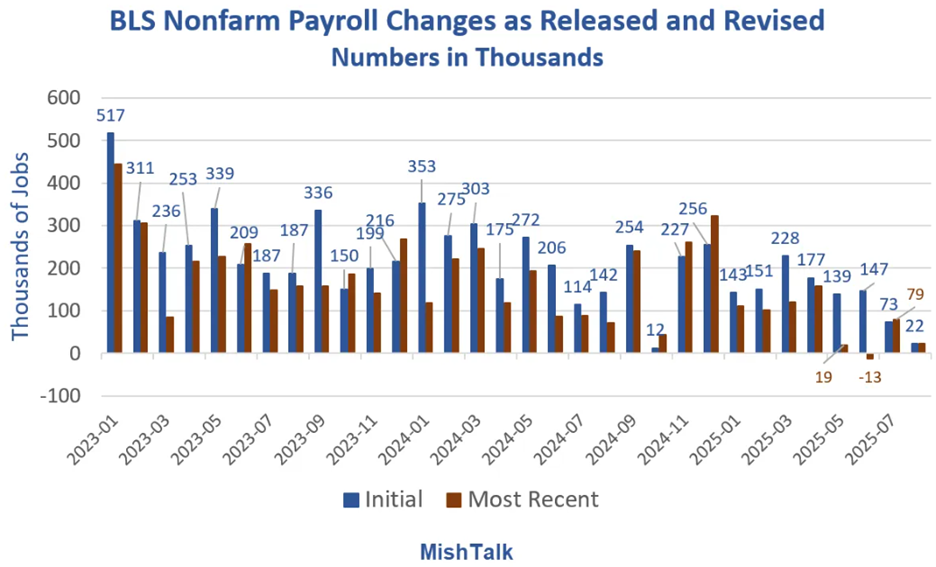
Once a year, the BLS reconciles its data with data from a slower, but more extensive, government survey (The Quarterly Census of Employment and Wages). Over the past few years, these surveys have strongly diverged. Many reasons account for the discrepancy, but most notably, undocumented workers that show up in the BLS survey do not appear in the QCEW report. As illegal immigration increased, so has the size of the downward revisions. For the year ending in March, the government revised payroll gains down by 911,000. That takes away roughly HALF of the job gains previously reported. Furthermore, this marks a record for an annual revision as seen in the chart below:
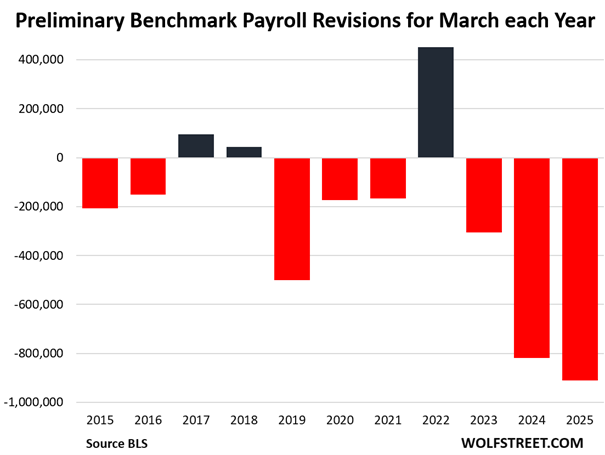
This week we also received higher than expected unemployment claims over the past week. This caught the market’s attention, but the continuing unemployment claims didn’t point to major deterioration. Nonetheless, it’s another negative data point. In sum, the BLS has overstated the strength of the US labor market for some time and recent reports show that softness driven by tariff, DOGE and immigration policy changes could reinforce the tepid trends. This will certainly shift the Fed’s narrative away from inflation concerns toward employment concerns, leading traders to price in three rate cuts before year end:
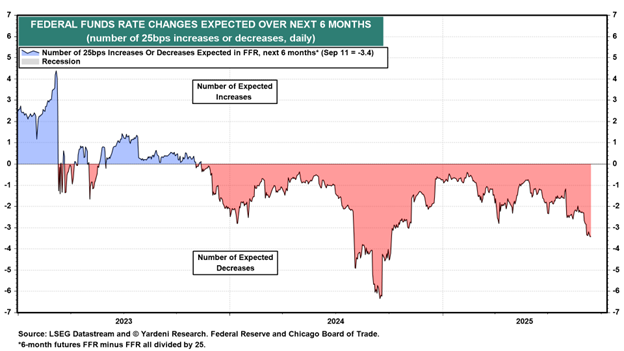
Given that the stock market uses earnings data and prevailing interest rates to calculate value, weak job growth does not imply weak stock market performance. In fact, stocks usually rally on layoff announcements as lower labor costs imply higher profits. Additionally, lower employment growth implies lower interest rates which support higher valuation multiples. As evidence, despite the gloomy labor data, the NASDAQ and S&P 500 hit record highs on Wednesday.
Get Real
Remember, jobs themselves do not power the economy. Spending does. With all of the goofiness associated with labor market calculations, we prefer to track real disposable income as a more accurate read on the consumer:
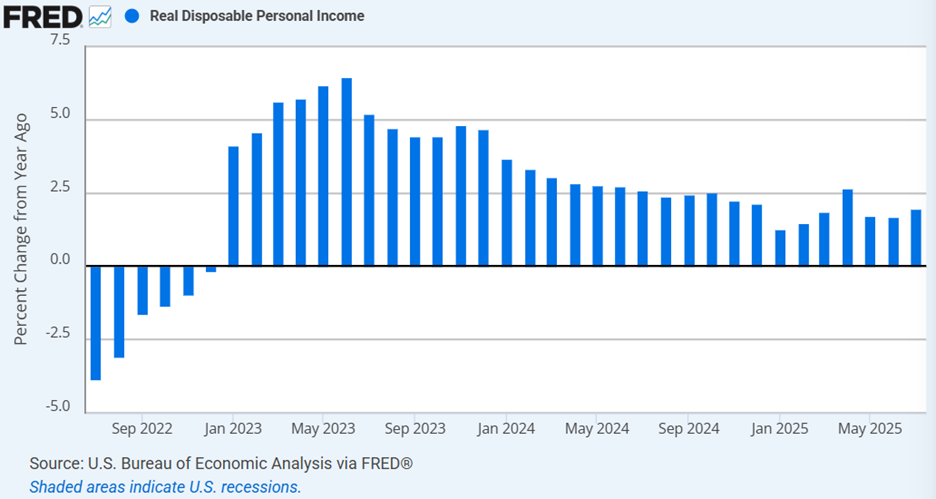
As you can see, real disposable income has downshifted slightly over the past year but remains healthy overall. The 2022 and 2023 highs and lows reflect inflationary distortions. Removing those leaves real disposable income performing right around long-term trends associated with healthy economic growth.
Lastly, if labor force growth isn’t driving economic growth, productivity growth must be. Enhancements in technology should be driving more output per unit of labor. Should the promise of AI and robotics prove true, we should see accelerating productivity trends. We have:
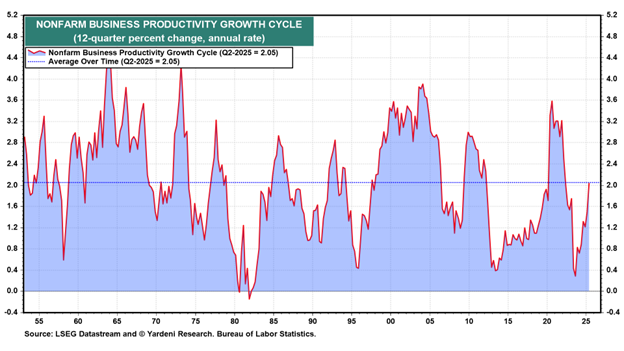
While the current level reflects long-term averages, productivity clearly has upside momentum. Should this persist, the economy can afford both higher wages for workers and higher profits for investors. The first will power consumption, the latter will power even more productivity enhancing investments. Virtuous!
Enjoy the rest of your Sunday!
-David
Sources: MishTalk, Yardeni Research, Federal Reserve Bank of St. Louis, Wolfstreet, Bureau of Labor Statistics
This communication and its contents are for informational and educational purposes only and should not be used as the sole basis for any investment decision. The information contained herein is based on publicly available sources believed to be reliable but is not a representation, expressed or implied, as to the accuracy, completeness, or correctness of said information. References to political figures or policies are for informational purposes only and do not represent an endorsement by Waddell & Associates. Any forward-looking statements reflect current opinions and assumptions and are subject to change without notice; actual results may differ materially. Past performance does not guarantee future results. Waddell & Associates may use artificial intelligence tools to help generate or summarize content; all outputs are reviewed by our team for accuracy and relevance.
">
Recent reports on the state of the US labor market have been dispiriting to say the least. Last Friday, the Bureau of Labor Statistics (BLS) released its monthly employment report showing 22,000 jobs were created in August versus 77,000 expected. Each monthly release also provides revisions to past month’s figures—these figures come from survey data. The initial release, like the one last Friday, only includes about 60% of the survey respondents. Revisions occur as more data arrives. For instance, the BLS estimated that the US created 147,000 jobs in June only to revise this number to 13,000 jobs lost. That’s the first month since December of 2020 that the US shed workers with more negative revisions likely to come. In fact, most revisions tend to reduce initial estimates. Consider the differences between the first and final reads on monthly job creation below:
Once a year, the BLS reconciles its data with data from a slower, but more extensive, government survey (The Quarterly Census of Employment and Wages). Over the past few years, these surveys have strongly diverged. Many reasons account for the discrepancy, but most notably, undocumented workers that show up in the BLS survey do not appear in the QCEW report. As illegal immigration increased, so has the size of the downward revisions. For the year ending in March, the government revised payroll gains down by 911,000. That takes away roughly HALF of the job gains previously reported. Furthermore, this marks a record for an annual revision as seen in the chart below:
This week we also received higher than expected unemployment claims over the past week. This caught the market’s attention, but the continuing unemployment claims didn’t point to major deterioration. Nonetheless, it’s another negative data point. In sum, the BLS has overstated the strength of the US labor market for some time and recent reports show that softness driven by tariff, DOGE and immigration policy changes could reinforce the tepid trends. This will certainly shift the Fed’s narrative away from inflation concerns toward employment concerns, leading traders to price in three rate cuts before year end:
Given that the stock market uses earnings data and prevailing interest rates to calculate value, weak job growth does not imply weak stock market performance. In fact, stocks usually rally on layoff announcements as lower labor costs imply higher profits. Additionally, lower employment growth implies lower interest rates which support higher valuation multiples. As evidence, despite the gloomy labor data, the NASDAQ and S&P 500 hit record highs on Wednesday.
Get Real
Remember, jobs themselves do not power the economy. Spending does. With all of the goofiness associated with labor market calculations, we prefer to track real disposable income as a more accurate read on the consumer:
As you can see, real disposable income has downshifted slightly over the past year but remains healthy overall. The 2022 and 2023 highs and lows reflect inflationary distortions. Removing those leaves real disposable income performing right around long-term trends associated with healthy economic growth.
Lastly, if labor force growth isn’t driving economic growth, productivity growth must be. Enhancements in technology should be driving more output per unit of labor. Should the promise of AI and robotics prove true, we should see accelerating productivity trends. We have:
While the current level reflects long-term averages, productivity clearly has upside momentum. Should this persist, the economy can afford both higher wages for workers and higher profits for investors. The first will power consumption, the latter will power even more productivity enhancing investments. Virtuous!
Enjoy the rest of your Sunday!
-David
Sources: MishTalk, Yardeni Research, Federal Reserve Bank of St. Louis, Wolfstreet, Bureau of Labor Statistics
This communication and its contents are for informational and educational purposes only and should not be used as the sole basis for any investment decision. The information contained herein is based on publicly available sources believed to be reliable but is not a representation, expressed or implied, as to the accuracy, completeness, or correctness of said information. References to political figures or policies are for informational purposes only and do not represent an endorsement by Waddell & Associates. Any forward-looking statements reflect current opinions and assumptions and are subject to change without notice; actual results may differ materially. Past performance does not guarantee future results. Waddell & Associates may use artificial intelligence tools to help generate or summarize content; all outputs are reviewed by our team for accuracy and relevance.
">Lower Jobs, Higher Stocks Recent reports on the state of the US labor market have been dispiriting to say the least. Last Friday, the Bureau of Labor Statistics (BLS) released its monthly employment report showing 22,000 jobs were created in August versus 77,000 expected. Each monthly release also provides revisions to past month’s figures—these figures come from survey data. The initial release, like the one last Friday, only includes about 60% of the survey respondents. Revisions occur as more data arrives. For instance, the BLS estimated that the US created 147,000 jobs in June only to revise this number to 13,000 jobs lost. That’s the first month since December of 2020 that the US shed workers with more negative revisions likely to come. In fact, most revisions tend to reduce initial estimates. Consider the differences between the first and final reads on monthly job creation below:
Once a year, the BLS reconciles its data with data from a slower, but more extensive, government survey (The Quarterly Census of Employment and Wages). Over the past few years, these surveys have strongly diverged. Many reasons account for the discrepancy, but most notably, undocumented workers that show up in the BLS survey do not appear in the QCEW report. As illegal immigration increased, so has the size of the downward revisions. For the year ending in March, the government revised payroll gains down by 911,000. That takes away roughly HALF of the job gains previously reported. Furthermore, this marks a record for an annual revision as seen in the chart below:
This week we also received higher than expected unemployment claims over the past week. This caught the market’s attention, but the continuing unemployment claims didn’t point to major deterioration. Nonetheless, it’s another negative data point. In sum, the BLS has overstated the strength of the US labor market for some time and recent reports show that softness driven by tariff, DOGE and immigration policy changes could reinforce the tepid trends. This will certainly shift the Fed’s narrative away from inflation concerns toward employment concerns, leading traders to price in three rate cuts before year end:
Given that the stock market uses earnings data and prevailing interest rates to calculate value, weak job growth does not imply weak stock market performance. In fact, stocks usually rally on layoff announcements as lower labor costs imply higher profits. Additionally, lower employment growth implies lower interest rates which support higher valuation multiples. As evidence, despite the gloomy labor data, the NASDAQ and S&P 500 hit record highs on Wednesday.
Get Real
Remember, jobs themselves do not power the economy. Spending does. With all of the goofiness associated with labor market calculations, we prefer to track real disposable income as a more accurate read on the consumer:
As you can see, real disposable income has downshifted slightly over the past year but remains healthy overall. The 2022 and 2023 highs and lows reflect inflationary distortions. Removing those leaves real disposable income performing right around long-term trends associated with healthy economic growth.
Lastly, if labor force growth isn’t driving economic growth, productivity growth must be. Enhancements in technology should be driving more output per unit of labor. Should the promise of AI and robotics prove true, we should see accelerating productivity trends. We have:
While the current level reflects long-term averages, productivity clearly has upside momentum. Should this persist, the economy can afford both higher wages for workers and higher profits for investors. The first will power consumption, the latter will power even more productivity enhancing investments. Virtuous!
Enjoy the rest of your Sunday!
-David
Sources: MishTalk, Yardeni Research, Federal Reserve Bank of St. Louis, Wolfstreet, Bureau of Labor Statistics
This communication and its contents are for informational and educational purposes only and should not be used as the sole basis for any investment decision. The information contained herein is based on publicly available sources believed to be reliable but is not a representation, expressed or implied, as to the accuracy, completeness, or correctness of said information. References to political figures or policies are for informational purposes only and do not represent an endorsement by Waddell & Associates. Any forward-looking statements reflect current opinions and assumptions and are subject to change without notice; actual results may differ materially. Past performance does not guarantee future results. Waddell & Associates may use artificial intelligence tools to help generate or summarize content; all outputs are reviewed by our team for accuracy and relevance.
" class="link-chevron">
As a Philadelphia Philles baseball fan, I often spend late August dreaming of “Red October”. With 162 games played in a season, baseball is an endurance sport. Only one month remains in the season, and postseason success depends heavily upon momentum entering the playoffs. To evaluate the quality of a team’s momentum, fans analyze each game’s box score which tallies the performance statistics of each individual player. Entering October, fans might want to see rising trends in batting average, home runs, or even walks depending on the player. To illustrate the matrix, here is a superlative box score from a Phillies Mariners game this week:
For Phillies fans, 20 hits on 41 at bats with 11 runs spread across the roster bodes well for post-season aspirations. But momentum can change on a dime and shifts often appear in the box score before they appear on the scoreboard. For investors, the same framework applies. The stock market has its own daily box score, and momentum shifts often carry greater meaning. Over the past month, momentum trends within the market have changed. Whether these shifts will threaten or support investors returns into year end remains to be seen, but it pays to do the analysis and consider year-end rostering.
The Investment Style Box
Morningstar created stock market style box analysis in the late 90’s to help investors understand an investment manager’s strategy. The matrix contains 9 boxes. The vertical axis groups stocks by size; (market capitalization) small, medium, or large. The horizontal axis groups stocks by style; value, blend or growth. Here is the theory illustration provided by Christine Benz in 1992:
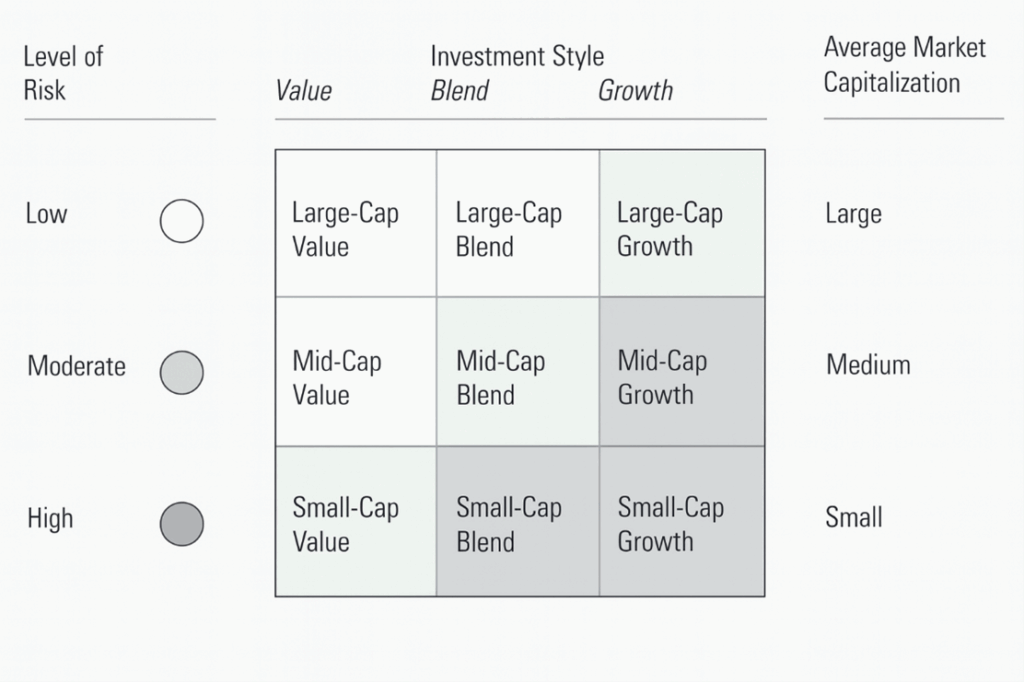
At the time, active money managers managed most investor assets by picking stocks. This grid allowed investors in mutual funds to decode portfolios and determine return drivers. Today, most investor assets are managed passively within index funds. Therefore, rather than using the style box to decode managed portfolios, investors now use the style box to construct passive portfolios. How investors move aggregate assets around the style box reveals trends. Over the last 10 years, the rise of the Mag 7 has driven return differentials for the Large Cap Growth box to historic levels comparable to the 1990s:
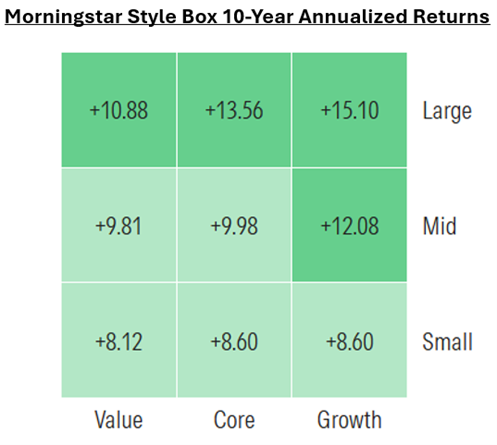
But this run didn’t occur without interruption, the following chart details Large Cap Growth style box drawdowns over the past 5 years (I included Nvidia, its leader, as well). The recession scare of 2022 drove Large Cap Growth down 33%, while Nvidia shed 66% into October. This year, the Deep Seek scare followed by the Tariff Turmoil, drove Large Cap Growth down 22% while Nvidia shed 40%.
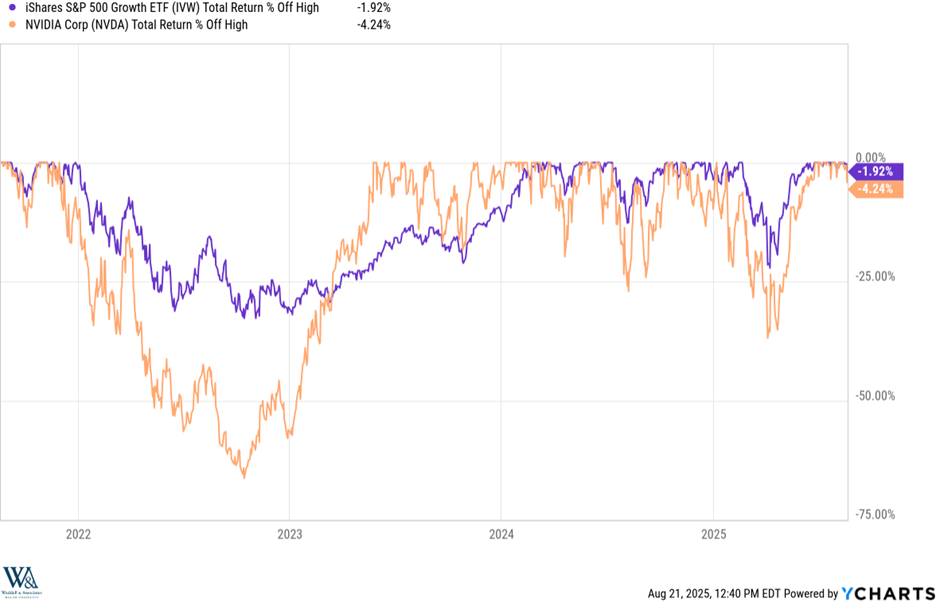
Within the last two weeks, Nvidia and its large cap tech brethren have started shedding altitude causing some to question this current break in momentum. They are right to question. Expectations for AI came under scrutiny when MIT released a report questioning its business utility and anxieties rose about Nvidia’s upcoming earnings release. Tech rallied 45% off the April lows in a straight line so some rest is well-earned. However, the selling doesn’t seem to represent selling of the market overall, just repositioning as momentum has begun appearing elsewhere:
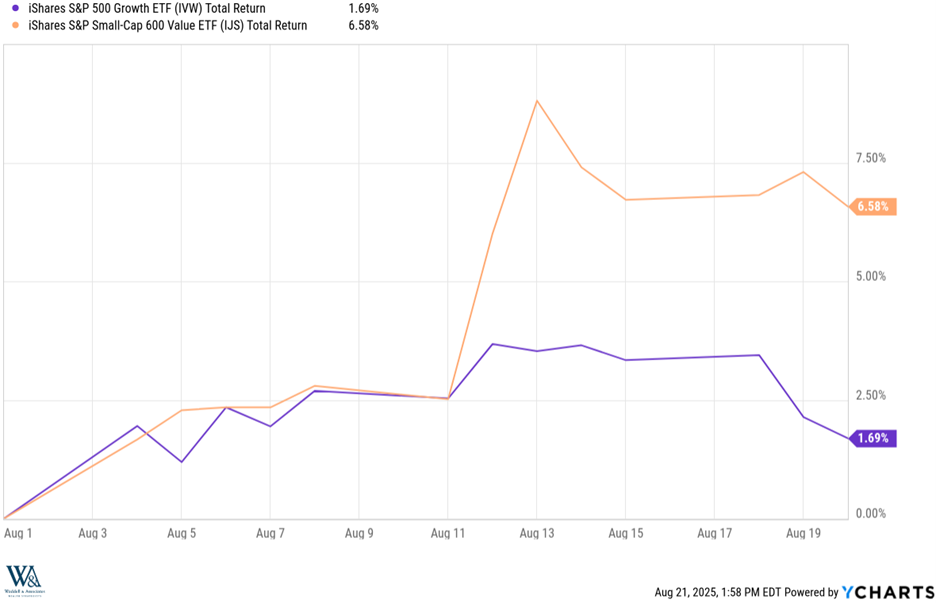
A prolonged hot streak, weak seasonals and a downbeat AI report from MIT explains the drawdown in Large Cap Growth box as shown above, but what explains the surge higher in the Small Cap Value box?
Second Half Playbook
As we discussed in our halftime report, the combination of fiscal stimulus, monetary stimulus, currency stimulus and AI Capital Expenditures stimulus will far outweigh the tariff drag, sequester recession risks, and drive stock prices higher. During the first half of 2025, earnings resiliency amidst ambiguity drove investors into the earnings juggernauts within the Large Cap Growth box. But in the second half, earnings participation should broaden out as Trumps stimulus packages bite and interest rates fall. Small companies rely much more heavily on debt than large companies, benefiting disproportionately from rate cuts. Regulatory relief reduces compliance drags and encourages mergers and acquisitions, disproportionately benefiting small companies. Policy-inspired recoveries in US manufacturing activity will also disproportionately benefit smaller cap industrial companies more than larger cap technology companies. From a valuation perspective, the Small Cap Value box trades for 15x earnings, while the Large Cap Growth box trades for 34x earnings, creating a sizable discount for the smalls. Lastly, while the Large Cap Growth box has a total market value of $40.1 trillion, the Small Cap Value box has a total market value of less than $1 trillion. It doesn’t take much of a rotation between boxes to create meaningful lift as demonstrated in the chart above. While earnings resilience gave the Large Cap Growth box advantage in the first half of the year, low valuations and interest rate cuts should give the Small Cap Value box advantage in the second half of the year. Time to sketch out year-end playbooks, evaluate your rosters, and ensure you have the right batters… in the box.
Or leave it to us. We would be happy to manage your team!
Have a great weekend!
-David
Sources: YCharts, Morningstar
This communication and its contents are for informational and educational purposes only and should not be used as the sole basis for any investment decision. The information contained herein is based on publicly available sources believed to be reliable but is not a representation, expressed or implied, as to the accuracy, completeness, or correctness of said information. References to political figures or policies are for informational purposes only and do not represent an endorsement by Waddell & Associates. Any forward-looking statements reflect current opinions and assumptions and are subject to change without notice; actual results may differ materially. Past performance does not guarantee future results. Waddell & Associates may use artificial intelligence tools to help generate or summarize content; all outputs are reviewed by our team for accuracy and relevance.
">Checking the Boxes
As a Philadelphia Philles baseball fan, I often spend late August dreaming of “Red October”. With 162 games played in a season, baseball is an endurance sport. Only one month remains in the season, and postseason success depends heavily upon momentum entering the playoffs. To evaluate the quality of a team’s momentum, fans analyze each game’s box score which tallies the performance statistics of each individual player. Entering October, fans might want to see rising trends in batting average, home runs, or even walks depending on the player. To illustrate the matrix, here is a superlative box score from a Phillies Mariners game this week:
For Phillies fans, 20 hits on 41 at bats with 11 runs spread across the roster bodes well for post-season aspirations. But momentum can change on a dime and shifts often appear in the box score before they appear on the scoreboard. For investors, the same framework applies. The stock market has its own daily box score, and momentum shifts often carry greater meaning. Over the past month, momentum trends within the market have changed. Whether these shifts will threaten or support investors returns into year end remains to be seen, but it pays to do the analysis and consider year-end rostering.
The Investment Style Box
Morningstar created stock market style box analysis in the late 90’s to help investors understand an investment manager’s strategy. The matrix contains 9 boxes. The vertical axis groups stocks by size; (market capitalization) small, medium, or large. The horizontal axis groups stocks by style; value, blend or growth. Here is the theory illustration provided by Christine Benz in 1992:
At the time, active money managers managed most investor assets by picking stocks. This grid allowed investors in mutual funds to decode portfolios and determine return drivers. Today, most investor assets are managed passively within index funds. Therefore, rather than using the style box to decode managed portfolios, investors now use the style box to construct passive portfolios. How investors move aggregate assets around the style box reveals trends. Over the last 10 years, the rise of the Mag 7 has driven return differentials for the Large Cap Growth box to historic levels comparable to the 1990s:
But this run didn’t occur without interruption, the following chart details Large Cap Growth style box drawdowns over the past 5 years (I included Nvidia, its leader, as well). The recession scare of 2022 drove Large Cap Growth down 33%, while Nvidia shed 66% into October. This year, the Deep Seek scare followed by the Tariff Turmoil, drove Large Cap Growth down 22% while Nvidia shed 40%.
Within the last two weeks, Nvidia and its large cap tech brethren have started shedding altitude causing some to question this current break in momentum. They are right to question. Expectations for AI came under scrutiny when MIT released a report questioning its business utility and anxieties rose about Nvidia’s upcoming earnings release. Tech rallied 45% off the April lows in a straight line so some rest is well-earned. However, the selling doesn’t seem to represent selling of the market overall, just repositioning as momentum has begun appearing elsewhere:
A prolonged hot streak, weak seasonals and a downbeat AI report from MIT explains the drawdown in Large Cap Growth box as shown above, but what explains the surge higher in the Small Cap Value box?
Second Half Playbook
As we discussed in our halftime report, the combination of fiscal stimulus, monetary stimulus, currency stimulus and AI Capital Expenditures stimulus will far outweigh the tariff drag, sequester recession risks, and drive stock prices higher. During the first half of 2025, earnings resiliency amidst ambiguity drove investors into the earnings juggernauts within the Large Cap Growth box. But in the second half, earnings participation should broaden out as Trumps stimulus packages bite and interest rates fall. Small companies rely much more heavily on debt than large companies, benefiting disproportionately from rate cuts. Regulatory relief reduces compliance drags and encourages mergers and acquisitions, disproportionately benefiting small companies. Policy-inspired recoveries in US manufacturing activity will also disproportionately benefit smaller cap industrial companies more than larger cap technology companies. From a valuation perspective, the Small Cap Value box trades for 15x earnings, while the Large Cap Growth box trades for 34x earnings, creating a sizable discount for the smalls. Lastly, while the Large Cap Growth box has a total market value of $40.1 trillion, the Small Cap Value box has a total market value of less than $1 trillion. It doesn’t take much of a rotation between boxes to create meaningful lift as demonstrated in the chart above. While earnings resilience gave the Large Cap Growth box advantage in the first half of the year, low valuations and interest rate cuts should give the Small Cap Value box advantage in the second half of the year. Time to sketch out year-end playbooks, evaluate your rosters, and ensure you have the right batters… in the box.
Or leave it to us. We would be happy to manage your team!
Have a great weekend!
-David
Sources: YCharts, Morningstar
This communication and its contents are for informational and educational purposes only and should not be used as the sole basis for any investment decision. The information contained herein is based on publicly available sources believed to be reliable but is not a representation, expressed or implied, as to the accuracy, completeness, or correctness of said information. References to political figures or policies are for informational purposes only and do not represent an endorsement by Waddell & Associates. Any forward-looking statements reflect current opinions and assumptions and are subject to change without notice; actual results may differ materially. Past performance does not guarantee future results. Waddell & Associates may use artificial intelligence tools to help generate or summarize content; all outputs are reviewed by our team for accuracy and relevance.
" class="link-chevron">