Resources

Your Life, Your Legacy, Our Guidance

Resources to help individuals, families, business owners, and institutions pursue their financial goals and secure their legacy

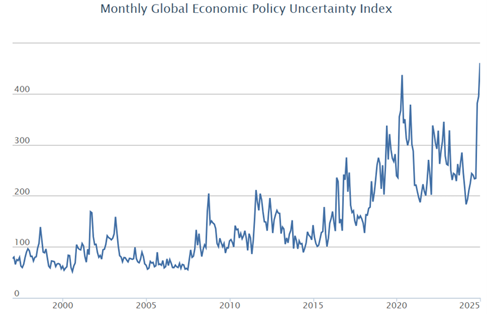
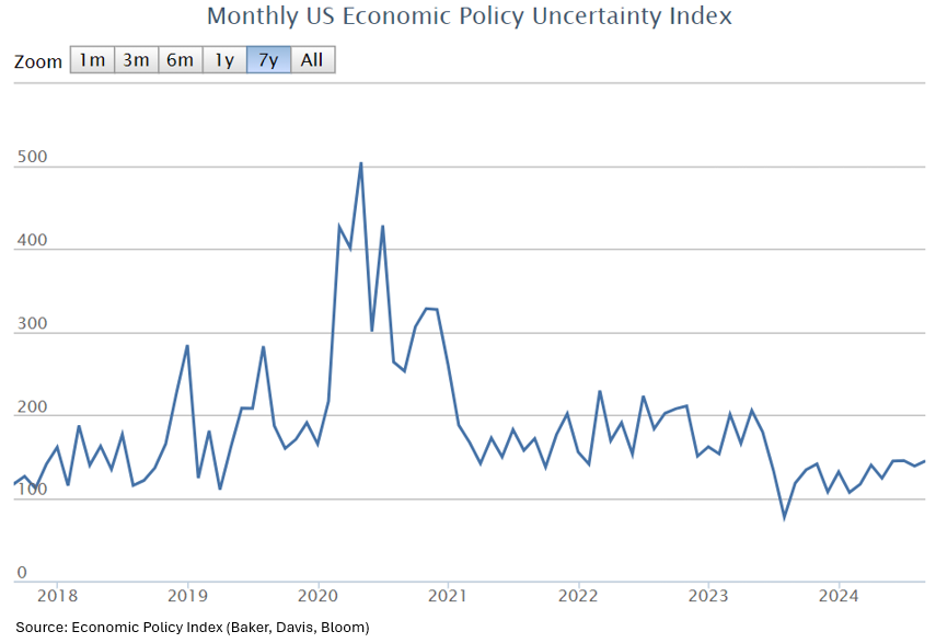
The Trump administration’s “ready, fire, aim” tariff campaign has produced a “ready, fire, aim” selling campaign within the markets.  Over the past three weeks, the Mag 7 stocks have declined 16% while the S&P 500 has declined by over 10%. Morning recovery rallies have been interrupted by tariff tantrums, and late day sell-offs have been dispiriting. The Global Policy Uncertainty Index has reached record levels:

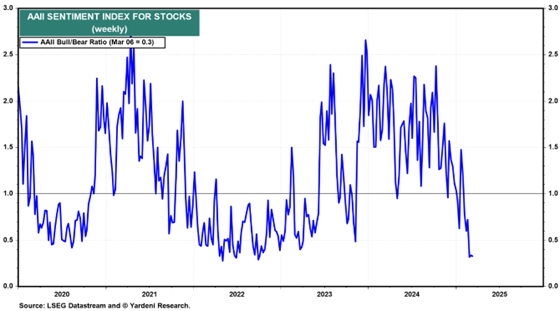
While Investor Sentiment levels have collapsed to near record lows:

With so much anxiety and uncertainty afoot, should you sell?

Corrections Reflections

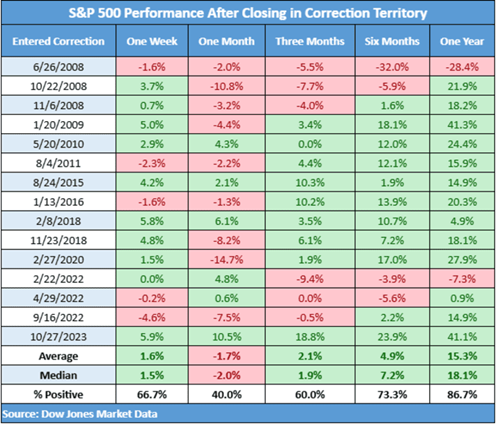
On average, markets decline 3% about seven times per year, 5% about three times per year, and 10% at least once per year. Larger drawdowns become less frequent with 20% declines occurring every four years. Drawdowns of this magnitude typically require recessions. Historically, selling into market corrections has only returned regret for investors. Consider the following chart:

Buying into the last 15 corrections rewarded investors with positive returns 87% of the time over the next year. In two of the occurrences or 13% of the time, selling into the correction proved prescient. While this is compelling, corrections do happen for reasons, and they do require resolution. Note that once markets have reached correction points, the subsequent month and three-month periods offer both losses and minimal returns. Intrepid investors early in corrections risk becoming fatigued as markets equivocate. I suspect this is where we are now.

What We Are Doing About It

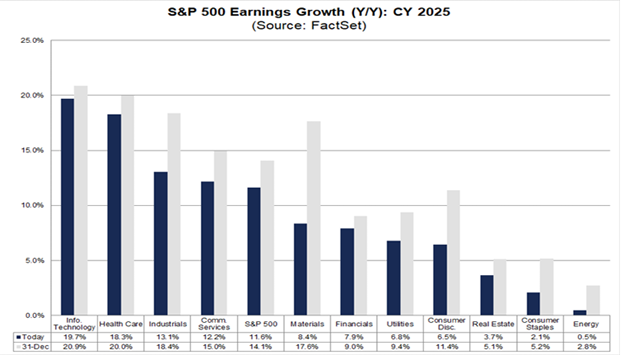
The time to plan for a firefight is not while you are in it, but before it begins. Earlier this year, we rotated two core positions within the equity model portfolio to achieve two key objectives (for compliance reasons, we cannot discuss trade specifics here, call us for details). First, we de-risked a position within the portfolio to lock in previous Magnificent 7 gains. Second, we aligned a position within the portfolio with Trump’s re-industrialization agenda.The first strategy provided immediate benefits as the Mag 7 became the Lag 7 over the past month. The second strategy should benefit from tariff impositions once longer-term industrial investment projects are initiated. These will not begin in earnest until Trump’s tariff commitments harden. For now, the tariffs appear non-committal making investment projects non-committal. Hence the “growth scare” that plagues equities. Business commitments will remain on pause until the economic uncertainty index profiled above the mean reverts. Businesses have an uncanny ability to adapt and generate profits once they know the rules. The “uncertainty pause” has not led analysts to throw in the towel on 2025 earnings:


Source: https://advantage.factset.com/hubfs/Website/Resources%20Section/Research%20Desk/Earnings%20Insight/EarningsInsight_031425.pdf

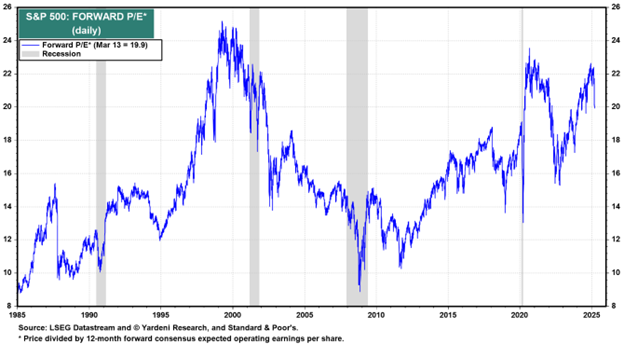
While the S&P 500 has corrected 10%, full-year 2025 earnings estimates have only declined from 14.1% to 11.6%, still well above long-term averages. Additionally, analysts still expect earnings growth across every sector. While earnings have remained supportive for this bull, valuations have not. Recall our concern over stock market multiples entering the year. At 22 times earnings, the valuation for the S&P 500 appeared problematic, requiring resolution. Either earnings would have to grow faster than returns to reduce the valuation multiple (our base case) or the market would correct, forcing faster multiple compression.

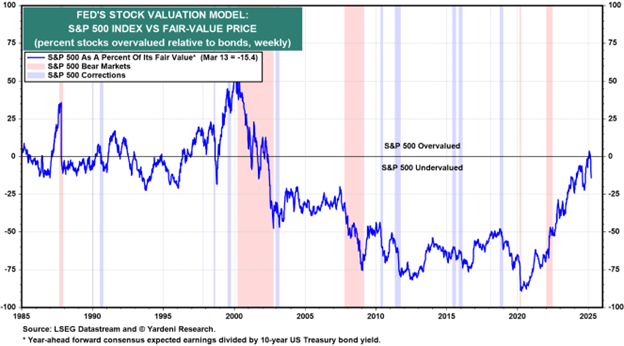
Given the relatively steady earnings outlook, this correction has triggered meaningful multiple compression. The 22x P/E at the end of 2024 has become 19.9x by March 13th.  Paired with a 10-year Treasury yield of 4.3%, this market has flipped from being slightly over-valued to being undervalued:

This does not ensure that the rally resumes but it does provide insurance against anything far nastier than a garden variety correction. Therefore, we remain committed to our allocations and to our strategy of adding to positions during negative sentiment extremes in anticipation of a brighter 2026.  2025’s “growth scares,” “uncertainty pauses,” and “policy panics” will require investor patience and vigilance. We have both. So let us worry for you… and you can enjoy your weekend!!    

-David

Sources: PolicyUncertainty.com, FactSet, Yardeni Research, Market Watch

This communication and its contents are for informational and educational purposes only and should not be used as the sole basis for any investment decision. The information contained herein is based on publicly available sources believed to be reliable but is not a representation, expressed or implied, as to the accuracy, completeness, or correctness of said information. Past performance does not guarantee future results.


">
March 14, 2025
The Trump administration’s “ready, fire, aim” tariff campaign has produced a “ready, fire, aim” selling campaign within the markets.  Over the past three weeks, the Mag 7 stocks have declined 16% while the S&P 500 has declined by over 10%. Morning recovery rallies have been interrupted by tariff tantrums, and late day sell-offs have been dispiriting. The Global Policy Uncertainty Index has reached record levels:

While Investor Sentiment levels have collapsed to near record lows:

With so much anxiety and uncertainty afoot, should you sell?

Corrections Reflections

On average, markets decline 3% about seven times per year, 5% about three times per year, and 10% at least once per year. Larger drawdowns become less frequent with 20% declines occurring every four years. Drawdowns of this magnitude typically require recessions. Historically, selling into market corrections has only returned regret for investors. Consider the following chart:

Buying into the last 15 corrections rewarded investors with positive returns 87% of the time over the next year. In two of the occurrences or 13% of the time, selling into the correction proved prescient. While this is compelling, corrections do happen for reasons, and they do require resolution. Note that once markets have reached correction points, the subsequent month and three-month periods offer both losses and minimal returns. Intrepid investors early in corrections risk becoming fatigued as markets equivocate. I suspect this is where we are now.

What We Are Doing About It

The time to plan for a firefight is not while you are in it, but before it begins. Earlier this year, we rotated two core positions within the equity model portfolio to achieve two key objectives (for compliance reasons, we cannot discuss trade specifics here, call us for details). First, we de-risked a position within the portfolio to lock in previous Magnificent 7 gains. Second, we aligned a position within the portfolio with Trump’s re-industrialization agenda.The first strategy provided immediate benefits as the Mag 7 became the Lag 7 over the past month. The second strategy should benefit from tariff impositions once longer-term industrial investment projects are initiated. These will not begin in earnest until Trump’s tariff commitments harden. For now, the tariffs appear non-committal making investment projects non-committal. Hence the “growth scare” that plagues equities. Business commitments will remain on pause until the economic uncertainty index profiled above the mean reverts. Businesses have an uncanny ability to adapt and generate profits once they know the rules. The “uncertainty pause” has not led analysts to throw in the towel on 2025 earnings:


Source: https://advantage.factset.com/hubfs/Website/Resources%20Section/Research%20Desk/Earnings%20Insight/EarningsInsight_031425.pdf

While the S&P 500 has corrected 10%, full-year 2025 earnings estimates have only declined from 14.1% to 11.6%, still well above long-term averages. Additionally, analysts still expect earnings growth across every sector. While earnings have remained supportive for this bull, valuations have not. Recall our concern over stock market multiples entering the year. At 22 times earnings, the valuation for the S&P 500 appeared problematic, requiring resolution. Either earnings would have to grow faster than returns to reduce the valuation multiple (our base case) or the market would correct, forcing faster multiple compression.

Given the relatively steady earnings outlook, this correction has triggered meaningful multiple compression. The 22x P/E at the end of 2024 has become 19.9x by March 13th.  Paired with a 10-year Treasury yield of 4.3%, this market has flipped from being slightly over-valued to being undervalued:

This does not ensure that the rally resumes but it does provide insurance against anything far nastier than a garden variety correction. Therefore, we remain committed to our allocations and to our strategy of adding to positions during negative sentiment extremes in anticipation of a brighter 2026.  2025’s “growth scares,” “uncertainty pauses,” and “policy panics” will require investor patience and vigilance. We have both. So let us worry for you… and you can enjoy your weekend!!    

-David

Sources: PolicyUncertainty.com, FactSet, Yardeni Research, Market Watch

This communication and its contents are for informational and educational purposes only and should not be used as the sole basis for any investment decision. The information contained herein is based on publicly available sources believed to be reliable but is not a representation, expressed or implied, as to the accuracy, completeness, or correctness of said information. Past performance does not guarantee future results.

">Riding the Tariff Tornado: Why Market Corrections Are More Opportunity Than Crisis The Trump administration’s “ready, fire, aim” tariff campaign has produced a “ready, fire, aim” selling campaign within the markets.  Over the past three weeks, the Mag 7 stocks have declined 16% while the S&P 500 has declined by over 10%. Morning recovery rallies have been interrupted by tariff tantrums, and late day sell-offs have been dispiriting. The Global Policy Uncertainty Index has reached record levels:

While Investor Sentiment levels have collapsed to near record lows:

With so much anxiety and uncertainty afoot, should you sell?

Corrections Reflections

On average, markets decline 3% about seven times per year, 5% about three times per year, and 10% at least once per year. Larger drawdowns become less frequent with 20% declines occurring every four years. Drawdowns of this magnitude typically require recessions. Historically, selling into market corrections has only returned regret for investors. Consider the following chart:

Buying into the last 15 corrections rewarded investors with positive returns 87% of the time over the next year. In two of the occurrences or 13% of the time, selling into the correction proved prescient. While this is compelling, corrections do happen for reasons, and they do require resolution. Note that once markets have reached correction points, the subsequent month and three-month periods offer both losses and minimal returns. Intrepid investors early in corrections risk becoming fatigued as markets equivocate. I suspect this is where we are now.

What We Are Doing About It

The time to plan for a firefight is not while you are in it, but before it begins. Earlier this year, we rotated two core positions within the equity model portfolio to achieve two key objectives (for compliance reasons, we cannot discuss trade specifics here, call us for details). First, we de-risked a position within the portfolio to lock in previous Magnificent 7 gains. Second, we aligned a position within the portfolio with Trump’s re-industrialization agenda.The first strategy provided immediate benefits as the Mag 7 became the Lag 7 over the past month. The second strategy should benefit from tariff impositions once longer-term industrial investment projects are initiated. These will not begin in earnest until Trump’s tariff commitments harden. For now, the tariffs appear non-committal making investment projects non-committal. Hence the “growth scare” that plagues equities. Business commitments will remain on pause until the economic uncertainty index profiled above the mean reverts. Businesses have an uncanny ability to adapt and generate profits once they know the rules. The “uncertainty pause” has not led analysts to throw in the towel on 2025 earnings:


Source: https://advantage.factset.com/hubfs/Website/Resources%20Section/Research%20Desk/Earnings%20Insight/EarningsInsight_031425.pdf

While the S&P 500 has corrected 10%, full-year 2025 earnings estimates have only declined from 14.1% to 11.6%, still well above long-term averages. Additionally, analysts still expect earnings growth across every sector. While earnings have remained supportive for this bull, valuations have not. Recall our concern over stock market multiples entering the year. At 22 times earnings, the valuation for the S&P 500 appeared problematic, requiring resolution. Either earnings would have to grow faster than returns to reduce the valuation multiple (our base case) or the market would correct, forcing faster multiple compression.

Given the relatively steady earnings outlook, this correction has triggered meaningful multiple compression. The 22x P/E at the end of 2024 has become 19.9x by March 13th.  Paired with a 10-year Treasury yield of 4.3%, this market has flipped from being slightly over-valued to being undervalued:

This does not ensure that the rally resumes but it does provide insurance against anything far nastier than a garden variety correction. Therefore, we remain committed to our allocations and to our strategy of adding to positions during negative sentiment extremes in anticipation of a brighter 2026.  2025’s “growth scares,” “uncertainty pauses,” and “policy panics” will require investor patience and vigilance. We have both. So let us worry for you… and you can enjoy your weekend!!    

-David

Sources: PolicyUncertainty.com, FactSet, Yardeni Research, Market Watch

This communication and its contents are for informational and educational purposes only and should not be used as the sole basis for any investment decision. The information contained herein is based on publicly available sources believed to be reliable but is not a representation, expressed or implied, as to the accuracy, completeness, or correctness of said information. Past performance does not guarantee future results.

" class="link-chevron"> Watch Now
I hope you have had a chance to watch our 2025 Outlook presentation. If not, click here! In it, we conclude with the notion that high expectations for 2025 will likely lead to lower returns for investors.

Remember that investment returns largely rely on reality exceeding expectations. High economic and investment return expectations at the end of 2024 reduce the odds of positive surprises in 2025 and increase the odds of negative surprises.

Many of Trump’s campaign promises fueled these expectations. Trump promised to “reaccelerate” economic growth. That’s hard to do with economic growth already running well above potential—especially when imposing tariffs, slashing government spending, and reducing labor force growth reduce GDP.

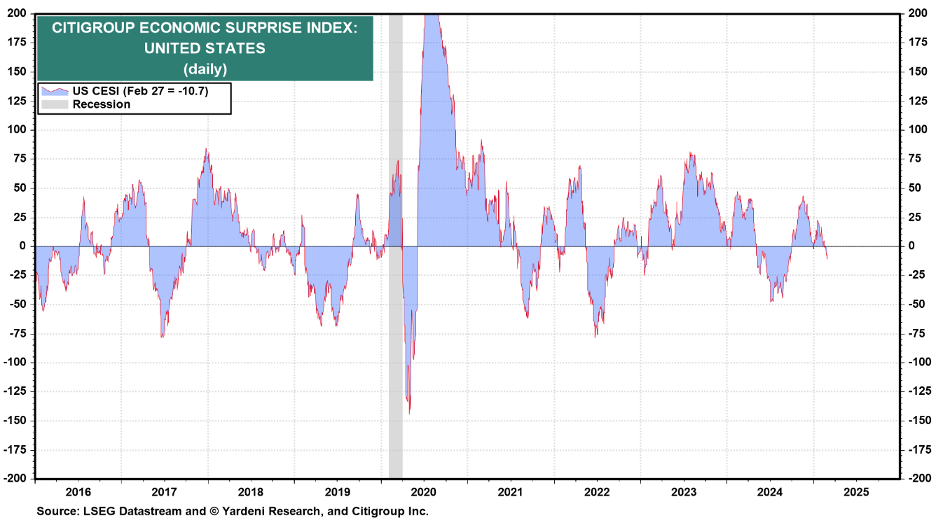
These policies may be good for America as Trump restructures our economy, but in the short term, they act to reduce growth, not accelerate it as seen in the current Citigroup economic surprise index. Positive readings mean economic realities are exceeding expectations, while negative readings mean economic realities are falling below expectations:

Fortunately, as you can see, mismatches between expectations and reality become resolved as expectations adjust. During the middle of 2024, we had a solid growth scare when GDP fell to a 1.6% growth rate in Q1, the unemployment rate rose from 3.7% to 4.5% in July, and the S&P 500 fell 8.5% in August.

Moved by fears of being “behind the curve”, the Fed cut rates in September by 0.5%, clearly unnerved by the deceleration in activity. Fortunately, the growth scare of 2024 didn’t metastasize into a growth collapse as GDP reaccelerated and reality began outperforming lowered expectations as seen in the chart above. By year end, the S&P 500 rallied 13.5% off the August lows.

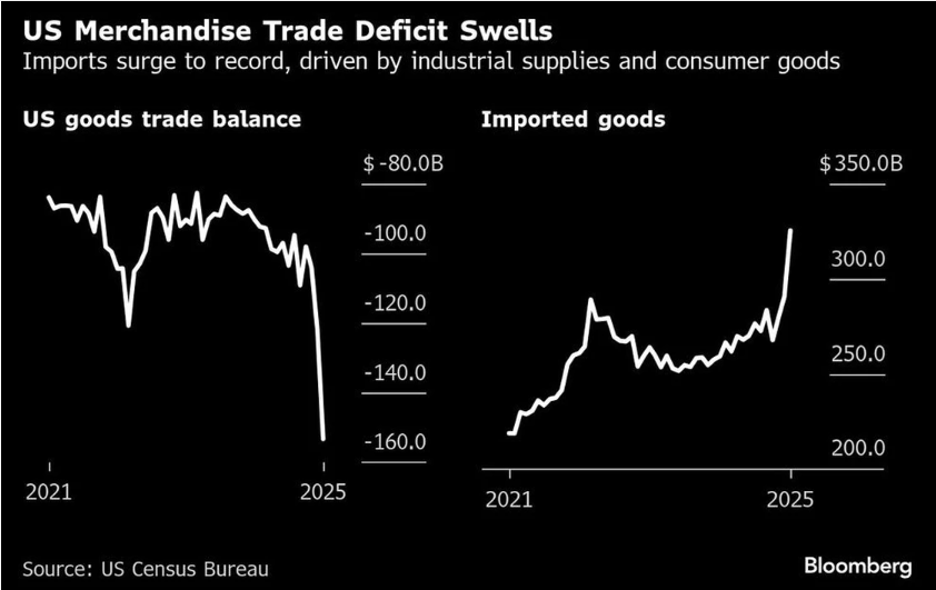
In a market wrestling with so many policy unknowns, moves in activity and sentiment can become exaggerated. For instance, business operators fearful of upcoming tariffs have accelerated offshore purchase orders to stockpile supplies. On Friday, we received a much higher than expected trade deficit report:

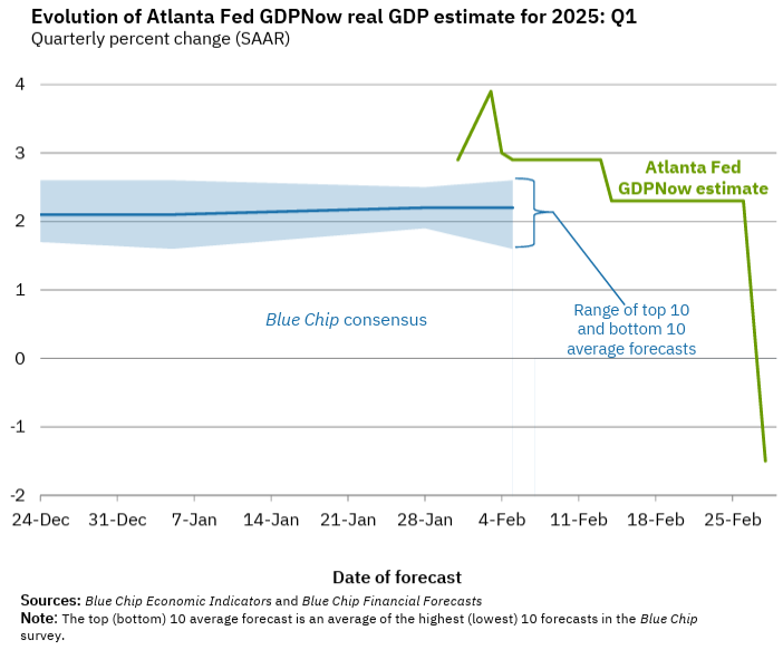
This massive distortion will weigh heavily on first quarter GDP. Import levels rose 12% (negative for GDP) while export levels rose 2% (positive for GDP). Consider the impact on the real-time Federal Reserve’s GDPNow estimate for first quarter GDP:

In the words of the Atlanta Fed:

“The GDPNow model estimate for real GDP growth (seasonally adjusted annual rate) in the first quarter of 2025 is -1.5 percent on February 28, down from 2.3 percent on February 19. After recent releases from the US Bureau of Economic Analysis and the US Census Bureau, the nowcast of the contribution of net exports to first-quarter real GDP growth fell from -0.41 percentage points to -3.70 percentage points.”

I don’t recall an economic report that upended growth estimates this much. And yet, markets rallied Friday morning, comforted by a benign reading from the Fed’s preferred inflation gauge and a stronger-than-expected report on real personal income.

So, if the books closed on Q1 today, precautionary import activity and restrained Government spending could offset positive investment and consumption activity, perhaps producing a negative GDP number. Were the tariffs imposed tomorrow, imports would collapse and entirely reverse the polarity.

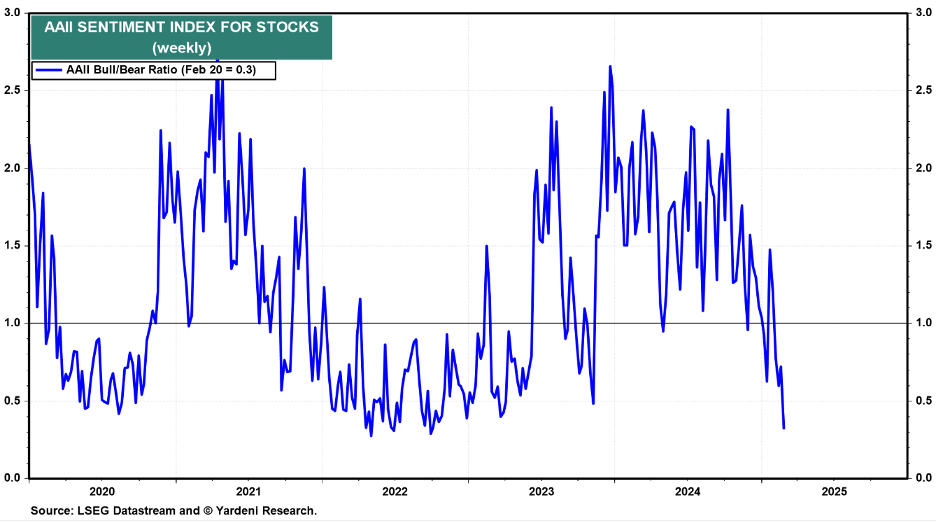
In the following quarter, consumption might collapse under the weight of higher import prices, and investment might accelerate as domestic suppliers ramp up production. Seasick yet? No wonder options volatility levels have spiked and investor sentiment levels have collapsed:

This chart divides the number of retail investors declaring themselves “bullish” by the level of retail investors declaring themselves “bearish”.

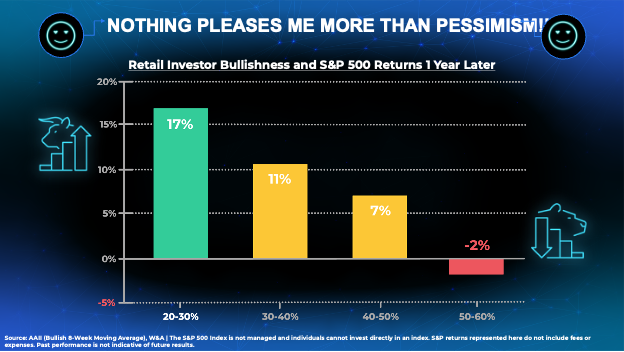
Currently. 19.4% of survey respondents count themselves “bullish”, while 60.6% count themselves as “bearish”. These are the most pessimistic numbers we have seen since 2022 and one of the most rapid collapses in sentiment on record.

As a result, market leadership has shifted significantly, with the MAG-7 having declined 8% on the year while healthcare, consumer staples, and utilities have gained 6%, 4%, and 3%, respectively. This “risk off” sentiment calibrates with growth concerns, and with our 2025 outlook predictions.

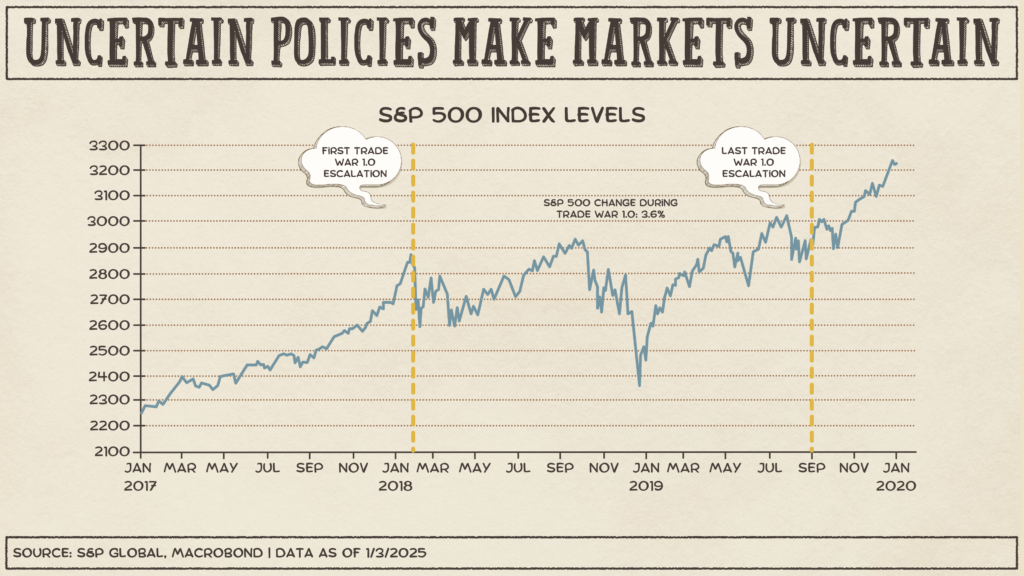
Trump levied his first tariffs on imported goods in January of 2018. Trump concluded his tariff campaign late in 2019. Markets struggled to advance during this period, unsure of the policies and their economic implications:

However, during this volatile period, the late 2018 growth scare led to a fantastic entry point for investors as the Federal Reserve cut rates and confidence reaccelerated. GDP reached the highest growth rate of Trump’s first administration at nearly 5% during the third quarter of 2019, and the S&P advanced nearly 32% on the year.

We expect similar results from the current environment. Expect markets to lack conviction, and trade within a range that has occasional collapses in sentiment. Use these moments to increase risk within portfolios since low expectation extremes create copious opportunities for positive surprises. The current retail investor survey may mark such an entry point worth exploiting, but be patient—we suspect this will not be the only one.

Enjoy your week!

-David

Sources: LSEG Datastream, Yardeni Research, Citigroup, Census Bureau, Blue Chip, Atlanta Fed, S&P Global, Macrobond

This communication and its contents are for informational and educational purposes only and should not be used as the sole basis for any investment decision. The information contained herein is based on publicly available sources believed to be reliable but is not a representation, expressed or implied, as to the accuracy, completeness, or correctness of said information. Past performance does not guarantee future results.

">
March 2, 2025
I hope you have had a chance to watch our 2025 Outlook presentation. If not, click here! In it, we conclude with the notion that high expectations for 2025 will likely lead to lower returns for investors.

Remember that investment returns largely rely on reality exceeding expectations. High economic and investment return expectations at the end of 2024 reduce the odds of positive surprises in 2025 and increase the odds of negative surprises.

Many of Trump’s campaign promises fueled these expectations. Trump promised to “reaccelerate” economic growth. That’s hard to do with economic growth already running well above potential—especially when imposing tariffs, slashing government spending, and reducing labor force growth reduce GDP.

These policies may be good for America as Trump restructures our economy, but in the short term, they act to reduce growth, not accelerate it as seen in the current Citigroup economic surprise index. Positive readings mean economic realities are exceeding expectations, while negative readings mean economic realities are falling below expectations:

Fortunately, as you can see, mismatches between expectations and reality become resolved as expectations adjust. During the middle of 2024, we had a solid growth scare when GDP fell to a 1.6% growth rate in Q1, the unemployment rate rose from 3.7% to 4.5% in July, and the S&P 500 fell 8.5% in August.

Moved by fears of being “behind the curve”, the Fed cut rates in September by 0.5%, clearly unnerved by the deceleration in activity. Fortunately, the growth scare of 2024 didn’t metastasize into a growth collapse as GDP reaccelerated and reality began outperforming lowered expectations as seen in the chart above. By year end, the S&P 500 rallied 13.5% off the August lows.

In a market wrestling with so many policy unknowns, moves in activity and sentiment can become exaggerated. For instance, business operators fearful of upcoming tariffs have accelerated offshore purchase orders to stockpile supplies. On Friday, we received a much higher than expected trade deficit report:

This massive distortion will weigh heavily on first quarter GDP. Import levels rose 12% (negative for GDP) while export levels rose 2% (positive for GDP). Consider the impact on the real-time Federal Reserve’s GDPNow estimate for first quarter GDP:

In the words of the Atlanta Fed:

“The GDPNow model estimate for real GDP growth (seasonally adjusted annual rate) in the first quarter of 2025 is -1.5 percent on February 28, down from 2.3 percent on February 19. After recent releases from the US Bureau of Economic Analysis and the US Census Bureau, the nowcast of the contribution of net exports to first-quarter real GDP growth fell from -0.41 percentage points to -3.70 percentage points.”

I don’t recall an economic report that upended growth estimates this much. And yet, markets rallied Friday morning, comforted by a benign reading from the Fed’s preferred inflation gauge and a stronger-than-expected report on real personal income.

So, if the books closed on Q1 today, precautionary import activity and restrained Government spending could offset positive investment and consumption activity, perhaps producing a negative GDP number. Were the tariffs imposed tomorrow, imports would collapse and entirely reverse the polarity.

In the following quarter, consumption might collapse under the weight of higher import prices, and investment might accelerate as domestic suppliers ramp up production. Seasick yet? No wonder options volatility levels have spiked and investor sentiment levels have collapsed:

This chart divides the number of retail investors declaring themselves “bullish” by the level of retail investors declaring themselves “bearish”.

Currently. 19.4% of survey respondents count themselves “bullish”, while 60.6% count themselves as “bearish”. These are the most pessimistic numbers we have seen since 2022 and one of the most rapid collapses in sentiment on record.

As a result, market leadership has shifted significantly, with the MAG-7 having declined 8% on the year while healthcare, consumer staples, and utilities have gained 6%, 4%, and 3%, respectively. This “risk off” sentiment calibrates with growth concerns, and with our 2025 outlook predictions.

Trump levied his first tariffs on imported goods in January of 2018. Trump concluded his tariff campaign late in 2019. Markets struggled to advance during this period, unsure of the policies and their economic implications:

However, during this volatile period, the late 2018 growth scare led to a fantastic entry point for investors as the Federal Reserve cut rates and confidence reaccelerated. GDP reached the highest growth rate of Trump’s first administration at nearly 5% during the third quarter of 2019, and the S&P advanced nearly 32% on the year.

We expect similar results from the current environment. Expect markets to lack conviction, and trade within a range that has occasional collapses in sentiment. Use these moments to increase risk within portfolios since low expectation extremes create copious opportunities for positive surprises. The current retail investor survey may mark such an entry point worth exploiting, but be patient—we suspect this will not be the only one.

Enjoy your week!

-David

Sources: LSEG Datastream, Yardeni Research, Citigroup, Census Bureau, Blue Chip, Atlanta Fed, S&P Global, Macrobond

This communication and its contents are for informational and educational purposes only and should not be used as the sole basis for any investment decision. The information contained herein is based on publicly available sources believed to be reliable but is not a representation, expressed or implied, as to the accuracy, completeness, or correctness of said information. Past performance does not guarantee future results.

">What to Expect from the Unexpected
I hope you have had a chance to watch our 2025 Outlook presentation. If not, click here! In it, we conclude with the notion that high expectations for 2025 will likely lead to lower returns for investors.

Remember that investment returns largely rely on reality exceeding expectations. High economic and investment return expectations at the end of 2024 reduce the odds of positive surprises in 2025 and increase the odds of negative surprises.

Many of Trump’s campaign promises fueled these expectations. Trump promised to “reaccelerate” economic growth. That’s hard to do with economic growth already running well above potential—especially when imposing tariffs, slashing government spending, and reducing labor force growth reduce GDP.

These policies may be good for America as Trump restructures our economy, but in the short term, they act to reduce growth, not accelerate it as seen in the current Citigroup economic surprise index. Positive readings mean economic realities are exceeding expectations, while negative readings mean economic realities are falling below expectations:

Fortunately, as you can see, mismatches between expectations and reality become resolved as expectations adjust. During the middle of 2024, we had a solid growth scare when GDP fell to a 1.6% growth rate in Q1, the unemployment rate rose from 3.7% to 4.5% in July, and the S&P 500 fell 8.5% in August.

Moved by fears of being “behind the curve”, the Fed cut rates in September by 0.5%, clearly unnerved by the deceleration in activity. Fortunately, the growth scare of 2024 didn’t metastasize into a growth collapse as GDP reaccelerated and reality began outperforming lowered expectations as seen in the chart above. By year end, the S&P 500 rallied 13.5% off the August lows.

In a market wrestling with so many policy unknowns, moves in activity and sentiment can become exaggerated. For instance, business operators fearful of upcoming tariffs have accelerated offshore purchase orders to stockpile supplies. On Friday, we received a much higher than expected trade deficit report:

This massive distortion will weigh heavily on first quarter GDP. Import levels rose 12% (negative for GDP) while export levels rose 2% (positive for GDP). Consider the impact on the real-time Federal Reserve’s GDPNow estimate for first quarter GDP:

In the words of the Atlanta Fed:

“The GDPNow model estimate for real GDP growth (seasonally adjusted annual rate) in the first quarter of 2025 is -1.5 percent on February 28, down from 2.3 percent on February 19. After recent releases from the US Bureau of Economic Analysis and the US Census Bureau, the nowcast of the contribution of net exports to first-quarter real GDP growth fell from -0.41 percentage points to -3.70 percentage points.”

I don’t recall an economic report that upended growth estimates this much. And yet, markets rallied Friday morning, comforted by a benign reading from the Fed’s preferred inflation gauge and a stronger-than-expected report on real personal income.

So, if the books closed on Q1 today, precautionary import activity and restrained Government spending could offset positive investment and consumption activity, perhaps producing a negative GDP number. Were the tariffs imposed tomorrow, imports would collapse and entirely reverse the polarity.

In the following quarter, consumption might collapse under the weight of higher import prices, and investment might accelerate as domestic suppliers ramp up production. Seasick yet? No wonder options volatility levels have spiked and investor sentiment levels have collapsed:

This chart divides the number of retail investors declaring themselves “bullish” by the level of retail investors declaring themselves “bearish”.

Currently. 19.4% of survey respondents count themselves “bullish”, while 60.6% count themselves as “bearish”. These are the most pessimistic numbers we have seen since 2022 and one of the most rapid collapses in sentiment on record.

As a result, market leadership has shifted significantly, with the MAG-7 having declined 8% on the year while healthcare, consumer staples, and utilities have gained 6%, 4%, and 3%, respectively. This “risk off” sentiment calibrates with growth concerns, and with our 2025 outlook predictions.

Trump levied his first tariffs on imported goods in January of 2018. Trump concluded his tariff campaign late in 2019. Markets struggled to advance during this period, unsure of the policies and their economic implications:

However, during this volatile period, the late 2018 growth scare led to a fantastic entry point for investors as the Federal Reserve cut rates and confidence reaccelerated. GDP reached the highest growth rate of Trump’s first administration at nearly 5% during the third quarter of 2019, and the S&P advanced nearly 32% on the year.

We expect similar results from the current environment. Expect markets to lack conviction, and trade within a range that has occasional collapses in sentiment. Use these moments to increase risk within portfolios since low expectation extremes create copious opportunities for positive surprises. The current retail investor survey may mark such an entry point worth exploiting, but be patient—we suspect this will not be the only one.

Enjoy your week!

-David

Sources: LSEG Datastream, Yardeni Research, Citigroup, Census Bureau, Blue Chip, Atlanta Fed, S&P Global, Macrobond

This communication and its contents are for informational and educational purposes only and should not be used as the sole basis for any investment decision. The information contained herein is based on publicly available sources believed to be reliable but is not a representation, expressed or implied, as to the accuracy, completeness, or correctness of said information. Past performance does not guarantee future results.

" class="link-chevron"> Watch Now
Can you imagine the impact on your family or your business if you thought every thought out loud, just as thought, with emotion and without filters? How cringeworthy! 

I wake up every morning and second guess every portfolio decision we have made. As a portfolio manager, I learned long ago that you must “repurchase” your portfolio every day. Over my first two cups of coffee, I actively self-debate the state of the economy, the prospects for corporate earnings, political risks, monetary risks, investor sentiment levels, the merits of our overall portfolio strategy, and the merits of each one of our individual holdings. Some mornings, I leave the exercise convinced. Some mornings I leave the exercise befuddled, requiring more study and more time for assessment. 

Given that there are no certainties in forecasting markets, the investment threshold lies with simply believing one thing more than believing the opposite thing. If I held a press conference every morning to share my tossed salad of thoughts, internal debates and opinions, you might find my process erratic. I assure you that it is not. It’s the process every diligent money manager performs. The more heated the internal debates, the more diligent the research, and the better the decision making. The outcomes certainly benefit our clients, but broadcasting each thought along the way certainly would not. 

Over the past four years, Joe Biden held 15 solo press conferences. For the Biden administration, silence was golden. For Trump 2.0, the press seems to have a seat with Trump at a partner’s desk in the Oval Office. Should we invade Panama? Should we abolish FEMA, USAID, and the Department of Education? Should we return to the gold standard? Should we buy Greenland?  Should we tariff Canadian and Mexican imports by 25%? Maybe not. Trump seemingly never just thinks his thoughts. This, understandably, leaves observers and investors conditioned under “Hidin’ Biden” feeling anxious and disoriented.

In last week’s missive, we worked to redirect focus away from Trump’s thought experiments back towards observable fundamentals. Is the economy growing? Are earnings growing? Are valuations sustainable? The answers are yes, yes and yes. Recognize that Trump’s “out loud” pontifications don’t neatly result in policies. Also remember that we invest in corporations, not governments. When the outlook for corporations diminishes, we will reduce our risk exposures, but not before. Trying to trade a Trump thought tracker is a money loser. On this, there is no debate.

Market Reactions

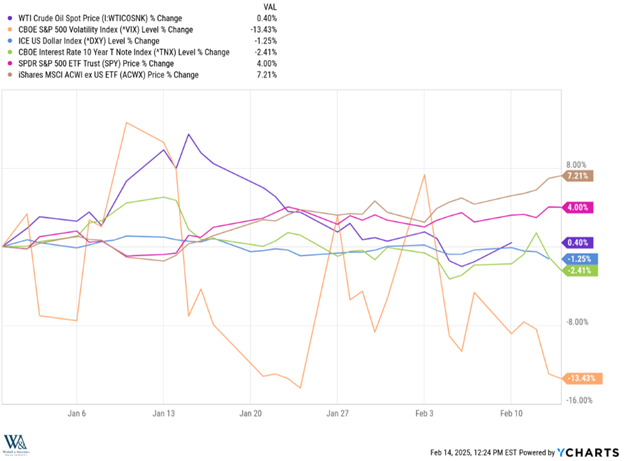
Since the beginning of the year, despite Trump’s vocal volatility, stock market volatility has declined. The VIX volatility index, which measures expectations for market volatility over the next 30 days as calculated by the options market, has fallen 13% year-to-date. Interest rates, as measured by the 10-year Treasury note have fallen 2.6% year-to-date (from 4.57% to 4.45%). Despite all the tough Trump tariff talk, the US dollar has declined 1.25% year-to-date, while oil prices per barrel have flatlined. Concurrently, US equities as measured by the S&P have advanced 4% on the year, while international equities have advanced 7% on the year.

Perhaps the most encouraging reading comes from the highly influential Magnificent 7. Taken together, the market capitalizations of Apple, Amazon, Google, Meta, Microsoft, Nvidia and Tesla account for 30% of the entire S&P 500. For the past two years, the Mag 7 stocks have powered the S&P 500 higher with superlative returns. This year, four of the seven have posted negative returns, turning the Mag 7 into the Lag 7. And yet, the S&P 500 has capably advanced without them:

While it’s unlikely that stocks will maintain this pace of gains throughout the year, it’s clear that Trump’s “out loud” volatility hasn’t translated into downside market volatility.

Enjoy the rest of your weekend!

-David

Sources: LSEG Datastream and Yardeni Research, YCharts

This communication and its contents are for informational and educational purposes only and should not be used as the sole basis for any investment decision. The information contained herein is based on publicly available sources believed to be reliable but is not a representation, expressed or implied, as to the accuracy, completeness, or correctness of said information. Past performance does not guarantee future results.

">
February 14, 2025
Can you imagine the impact on your family or your business if you thought every thought out loud, just as thought, with emotion and without filters? How cringeworthy! 

I wake up every morning and second guess every portfolio decision we have made. As a portfolio manager, I learned long ago that you must “repurchase” your portfolio every day. Over my first two cups of coffee, I actively self-debate the state of the economy, the prospects for corporate earnings, political risks, monetary risks, investor sentiment levels, the merits of our overall portfolio strategy, and the merits of each one of our individual holdings. Some mornings, I leave the exercise convinced. Some mornings I leave the exercise befuddled, requiring more study and more time for assessment. 

Given that there are no certainties in forecasting markets, the investment threshold lies with simply believing one thing more than believing the opposite thing. If I held a press conference every morning to share my tossed salad of thoughts, internal debates and opinions, you might find my process erratic. I assure you that it is not. It’s the process every diligent money manager performs. The more heated the internal debates, the more diligent the research, and the better the decision making. The outcomes certainly benefit our clients, but broadcasting each thought along the way certainly would not. 

Over the past four years, Joe Biden held 15 solo press conferences. For the Biden administration, silence was golden. For Trump 2.0, the press seems to have a seat with Trump at a partner’s desk in the Oval Office. Should we invade Panama? Should we abolish FEMA, USAID, and the Department of Education? Should we return to the gold standard? Should we buy Greenland?  Should we tariff Canadian and Mexican imports by 25%? Maybe not. Trump seemingly never just thinks his thoughts. This, understandably, leaves observers and investors conditioned under “Hidin’ Biden” feeling anxious and disoriented.

In last week’s missive, we worked to redirect focus away from Trump’s thought experiments back towards observable fundamentals. Is the economy growing? Are earnings growing? Are valuations sustainable? The answers are yes, yes and yes. Recognize that Trump’s “out loud” pontifications don’t neatly result in policies. Also remember that we invest in corporations, not governments. When the outlook for corporations diminishes, we will reduce our risk exposures, but not before. Trying to trade a Trump thought tracker is a money loser. On this, there is no debate.

Market Reactions

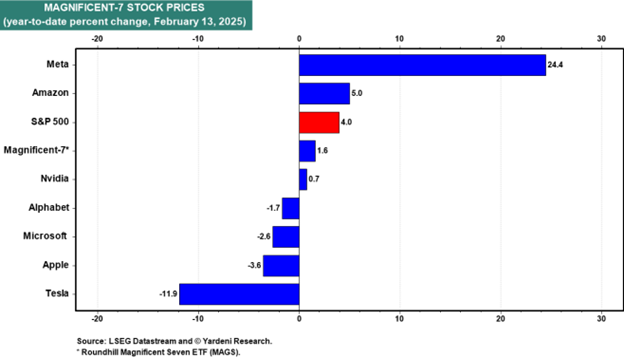
Since the beginning of the year, despite Trump’s vocal volatility, stock market volatility has declined. The VIX volatility index, which measures expectations for market volatility over the next 30 days as calculated by the options market, has fallen 13% year-to-date. Interest rates, as measured by the 10-year Treasury note have fallen 2.6% year-to-date (from 4.57% to 4.45%). Despite all the tough Trump tariff talk, the US dollar has declined 1.25% year-to-date, while oil prices per barrel have flatlined. Concurrently, US equities as measured by the S&P have advanced 4% on the year, while international equities have advanced 7% on the year.

Perhaps the most encouraging reading comes from the highly influential Magnificent 7. Taken together, the market capitalizations of Apple, Amazon, Google, Meta, Microsoft, Nvidia and Tesla account for 30% of the entire S&P 500. For the past two years, the Mag 7 stocks have powered the S&P 500 higher with superlative returns. This year, four of the seven have posted negative returns, turning the Mag 7 into the Lag 7. And yet, the S&P 500 has capably advanced without them:

While it’s unlikely that stocks will maintain this pace of gains throughout the year, it’s clear that Trump’s “out loud” volatility hasn’t translated into downside market volatility.

Enjoy the rest of your weekend!

-David

Sources: LSEG Datastream and Yardeni Research, YCharts

This communication and its contents are for informational and educational purposes only and should not be used as the sole basis for any investment decision. The information contained herein is based on publicly available sources believed to be reliable but is not a representation, expressed or implied, as to the accuracy, completeness, or correctness of said information. Past performance does not guarantee future results.

">From ‘Hidin’ Biden’ to ‘Talking Trump’: What It Means for Investors
Can you imagine the impact on your family or your business if you thought every thought out loud, just as thought, with emotion and without filters? How cringeworthy! 

I wake up every morning and second guess every portfolio decision we have made. As a portfolio manager, I learned long ago that you must “repurchase” your portfolio every day. Over my first two cups of coffee, I actively self-debate the state of the economy, the prospects for corporate earnings, political risks, monetary risks, investor sentiment levels, the merits of our overall portfolio strategy, and the merits of each one of our individual holdings. Some mornings, I leave the exercise convinced. Some mornings I leave the exercise befuddled, requiring more study and more time for assessment. 

Given that there are no certainties in forecasting markets, the investment threshold lies with simply believing one thing more than believing the opposite thing. If I held a press conference every morning to share my tossed salad of thoughts, internal debates and opinions, you might find my process erratic. I assure you that it is not. It’s the process every diligent money manager performs. The more heated the internal debates, the more diligent the research, and the better the decision making. The outcomes certainly benefit our clients, but broadcasting each thought along the way certainly would not. 

Over the past four years, Joe Biden held 15 solo press conferences. For the Biden administration, silence was golden. For Trump 2.0, the press seems to have a seat with Trump at a partner’s desk in the Oval Office. Should we invade Panama? Should we abolish FEMA, USAID, and the Department of Education? Should we return to the gold standard? Should we buy Greenland?  Should we tariff Canadian and Mexican imports by 25%? Maybe not. Trump seemingly never just thinks his thoughts. This, understandably, leaves observers and investors conditioned under “Hidin’ Biden” feeling anxious and disoriented.

In last week’s missive, we worked to redirect focus away from Trump’s thought experiments back towards observable fundamentals. Is the economy growing? Are earnings growing? Are valuations sustainable? The answers are yes, yes and yes. Recognize that Trump’s “out loud” pontifications don’t neatly result in policies. Also remember that we invest in corporations, not governments. When the outlook for corporations diminishes, we will reduce our risk exposures, but not before. Trying to trade a Trump thought tracker is a money loser. On this, there is no debate.

Market Reactions

Since the beginning of the year, despite Trump’s vocal volatility, stock market volatility has declined. The VIX volatility index, which measures expectations for market volatility over the next 30 days as calculated by the options market, has fallen 13% year-to-date. Interest rates, as measured by the 10-year Treasury note have fallen 2.6% year-to-date (from 4.57% to 4.45%). Despite all the tough Trump tariff talk, the US dollar has declined 1.25% year-to-date, while oil prices per barrel have flatlined. Concurrently, US equities as measured by the S&P have advanced 4% on the year, while international equities have advanced 7% on the year.

Perhaps the most encouraging reading comes from the highly influential Magnificent 7. Taken together, the market capitalizations of Apple, Amazon, Google, Meta, Microsoft, Nvidia and Tesla account for 30% of the entire S&P 500. For the past two years, the Mag 7 stocks have powered the S&P 500 higher with superlative returns. This year, four of the seven have posted negative returns, turning the Mag 7 into the Lag 7. And yet, the S&P 500 has capably advanced without them:

While it’s unlikely that stocks will maintain this pace of gains throughout the year, it’s clear that Trump’s “out loud” volatility hasn’t translated into downside market volatility.

Enjoy the rest of your weekend!

-David

Sources: LSEG Datastream and Yardeni Research, YCharts

This communication and its contents are for informational and educational purposes only and should not be used as the sole basis for any investment decision. The information contained herein is based on publicly available sources believed to be reliable but is not a representation, expressed or implied, as to the accuracy, completeness, or correctness of said information. Past performance does not guarantee future results.

" class="link-chevron"> Watch Now
No one consumes typeset like Donald Trump. Between tariff fire drills, department closures, federal layoffs, and border reversals, Big Don’s executive orders have rendered the media breathless. Expect this to continue, but don’t lose sight of what ultimately drives stock prices: economic growth prospects, earnings growth rates, and interest rates. Let’s review!

Economic Growth Prospects

According to the US Federal Reserve, the USA has a long-term potential GDP growth rate of 1.8%. Therefore, anything above 1.8% indicates an economy overperforming and anything less than 1.8% indicates an economy underperforming. While the GDP growth rate descended in the fourth quarter to 2.3%, the US economy advanced 2.8% for the full year, a full percentage point above our potential growth rate and down only slightly from 2023’s 2.9% growth rate. Currently, the Fed’s GDP Now model predicts a 2.9% growth rate for Q1 2025 based on economic data releases to date. For the full year, economists expect the US economy will continue growing above potential while recession odds continue to recede:

Love Trump or hate Trump, the resilient US economy appears poised for another year of above-average growth.

Earnings Growth Rates

So far, 270 of the S&P 500 companies have reported earnings. Seventy-eight percent have beaten analyst estimates, delivering a 13.5% growth rate overall, exceeding the less than 12% rate expected. For all of 2025, analysts forecast a 13.7% growth rate for S&P 500 earnings, followed by a 14% growth rate in 2026. Should these growth rates materialize, S&P 500 earnings at year-end 2026 will stand a full 30% above year-end 2024 levels. Furthermore, earnings beyond the S&P 500 show even more promise, with S&P 400 companies (mid-caps) expected to grow 32% and S&P 600 companies (small caps) expected to grow 41%.

Source: https://advantage.factset.com/hubfs/Website/Resources%20Section/Research%20Desk/Earnings%20Insight/EarningsInsight_020725A.pdf

Love Trump or hate Trump, US corporations appear poised for another year of above average earnings growth.

Interest Rates

Modern investors pay a disproportionate amount of attention to the short-term Federal Funds rate. While Federal Reserve policy decisions hold high economic influence, most asset prices, and certainly stock prices, rely on longer-term interest rate levels to compute valuation. For simple math, a 3% 10-year Treasury yield supports a P/E level of 33x for the stock market. A 4% 10-year Treasury yield supports a P/E level of 25x for the stock market, and a 5% 10-year Treasury supports a P/E level of 20x for the stock market. With a yield of 4.44% currently, the 10-year Treasury currently supports a P/E level of 22.7x, roughly where the S&P 500 is valued today:

Source: https://yardeni.com/charts/feds-stock-valuation-model/

The chart above compares S&P 500 P/E levels with 10-year Treasury yields. After the great financial crisis, the Fed distorted interest rate levels with zero interest rate policies and continuous quantitative easing campaigns. The markets rightly expected these programs to end and didn’t bid stocks up to astronomical valuation levels as a result.

So, ignore the distorted 2000’s and focus instead on the 1985-2000 period. Clearly, stock valuations and bond yields held a tighter relationship until the late 90s when stock valuations overshot, only to earn their comeuppance in the early 2000s. For the first time in over 20 years, stocks and bond valuations have harmonized. Therefore, movements in the 10-year Treasury yield this year will greatly influence market performance. Of the 51 year-end forecasts compiled by Bloomberg, only three expect higher yields than today. On average, the 51 forecasters expect a 4.12% ten-year yield at year-end.

What about tariff-driven inflation? Won’t that drive up yields? 

We received our answer this week as Trump’s tariff talk reduced rates rather than raised them.  Why? Raising prices 25% happens once, while the downshift in growth persists. Therefore, the downward force on rates from falling growth expectations exceeded the upward force on rates from rising inflation expectations. For rates to rise materially from here, GDP growth rates would need to rise materially from here. Were that to happen, earnings expectations would rise as well, providing a counterbalance.

Lastly, this week, Trump and Treasury Secretary Bessent called for lower interest rates. The media denounced this as Central Bank meddling. The duo then explained they meant the 10-year Treasury rate, not the Fed Funds rate. Economics… they understand.

Love Trump or hate Trump, the 10-year Treasury appears poised to spend the year within a narrow range that supports current valuation levels.

Special Note: W&A clients will notice trade confirmations in their mailboxes next week. Our investment committee decided to reposition two strategic equity holdings to reduce risk and better align with the Trump agenda. The SEC prohibits us from providing details here. For specific information, please contact your advisor directly. For additional rationale, please tune into our 2025 Outlook on February 20th!  

Have a great weekend and enjoy the game!

-David

Sources: Wall St. Journal surveys of economists, FactSet, LSEG Datastream and Yardeni Research

This communication and its contents are for informational and educational purposes only and should not be used as the sole basis for any investment decision. The information contained herein is based on publicly available sources believed to be reliable but is not a representation, expressed or implied, as to the accuracy, completeness, or correctness of said information. Past performance does not guarantee future results.

">
February 7, 2025
No one consumes typeset like Donald Trump. Between tariff fire drills, department closures, federal layoffs, and border reversals, Big Don’s executive orders have rendered the media breathless. Expect this to continue, but don’t lose sight of what ultimately drives stock prices: economic growth prospects, earnings growth rates, and interest rates. Let’s review!

Economic Growth Prospects

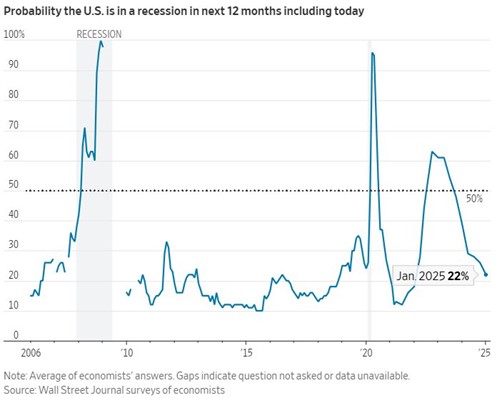
According to the US Federal Reserve, the USA has a long-term potential GDP growth rate of 1.8%. Therefore, anything above 1.8% indicates an economy overperforming and anything less than 1.8% indicates an economy underperforming. While the GDP growth rate descended in the fourth quarter to 2.3%, the US economy advanced 2.8% for the full year, a full percentage point above our potential growth rate and down only slightly from 2023’s 2.9% growth rate. Currently, the Fed’s GDP Now model predicts a 2.9% growth rate for Q1 2025 based on economic data releases to date. For the full year, economists expect the US economy will continue growing above potential while recession odds continue to recede:

Love Trump or hate Trump, the resilient US economy appears poised for another year of above-average growth.

Earnings Growth Rates

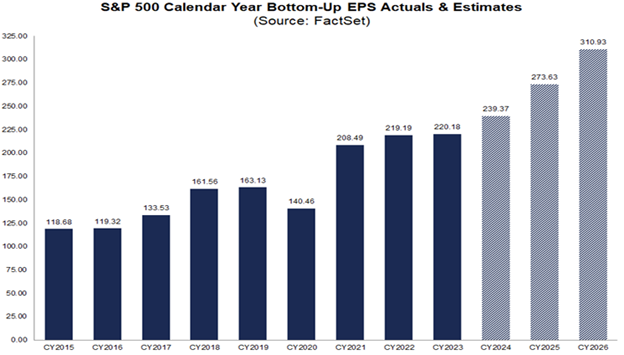
So far, 270 of the S&P 500 companies have reported earnings. Seventy-eight percent have beaten analyst estimates, delivering a 13.5% growth rate overall, exceeding the less than 12% rate expected. For all of 2025, analysts forecast a 13.7% growth rate for S&P 500 earnings, followed by a 14% growth rate in 2026. Should these growth rates materialize, S&P 500 earnings at year-end 2026 will stand a full 30% above year-end 2024 levels. Furthermore, earnings beyond the S&P 500 show even more promise, with S&P 400 companies (mid-caps) expected to grow 32% and S&P 600 companies (small caps) expected to grow 41%.

Source: https://advantage.factset.com/hubfs/Website/Resources%20Section/Research%20Desk/Earnings%20Insight/EarningsInsight_020725A.pdf

Love Trump or hate Trump, US corporations appear poised for another year of above average earnings growth.

Interest Rates

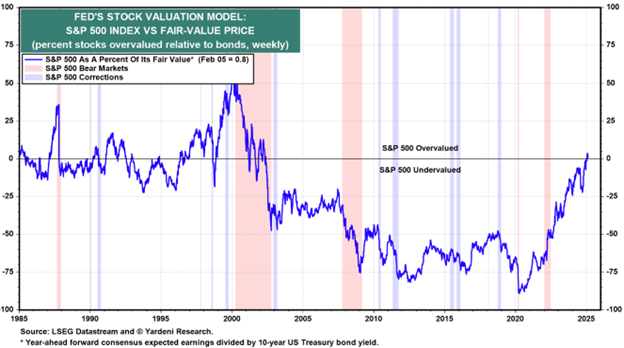
Modern investors pay a disproportionate amount of attention to the short-term Federal Funds rate. While Federal Reserve policy decisions hold high economic influence, most asset prices, and certainly stock prices, rely on longer-term interest rate levels to compute valuation. For simple math, a 3% 10-year Treasury yield supports a P/E level of 33x for the stock market. A 4% 10-year Treasury yield supports a P/E level of 25x for the stock market, and a 5% 10-year Treasury supports a P/E level of 20x for the stock market. With a yield of 4.44% currently, the 10-year Treasury currently supports a P/E level of 22.7x, roughly where the S&P 500 is valued today:

Source: https://yardeni.com/charts/feds-stock-valuation-model/

The chart above compares S&P 500 P/E levels with 10-year Treasury yields. After the great financial crisis, the Fed distorted interest rate levels with zero interest rate policies and continuous quantitative easing campaigns. The markets rightly expected these programs to end and didn’t bid stocks up to astronomical valuation levels as a result.

So, ignore the distorted 2000’s and focus instead on the 1985-2000 period. Clearly, stock valuations and bond yields held a tighter relationship until the late 90s when stock valuations overshot, only to earn their comeuppance in the early 2000s. For the first time in over 20 years, stocks and bond valuations have harmonized. Therefore, movements in the 10-year Treasury yield this year will greatly influence market performance. Of the 51 year-end forecasts compiled by Bloomberg, only three expect higher yields than today. On average, the 51 forecasters expect a 4.12% ten-year yield at year-end.

What about tariff-driven inflation? Won’t that drive up yields? 

We received our answer this week as Trump’s tariff talk reduced rates rather than raised them.  Why? Raising prices 25% happens once, while the downshift in growth persists. Therefore, the downward force on rates from falling growth expectations exceeded the upward force on rates from rising inflation expectations. For rates to rise materially from here, GDP growth rates would need to rise materially from here. Were that to happen, earnings expectations would rise as well, providing a counterbalance.

Lastly, this week, Trump and Treasury Secretary Bessent called for lower interest rates. The media denounced this as Central Bank meddling. The duo then explained they meant the 10-year Treasury rate, not the Fed Funds rate. Economics… they understand.

Love Trump or hate Trump, the 10-year Treasury appears poised to spend the year within a narrow range that supports current valuation levels.

Special Note: W&A clients will notice trade confirmations in their mailboxes next week. Our investment committee decided to reposition two strategic equity holdings to reduce risk and better align with the Trump agenda. The SEC prohibits us from providing details here. For specific information, please contact your advisor directly. For additional rationale, please tune into our 2025 Outlook on February 20th!  

Have a great weekend and enjoy the game!

-David

Sources: Wall St. Journal surveys of economists, FactSet, LSEG Datastream and Yardeni Research

This communication and its contents are for informational and educational purposes only and should not be used as the sole basis for any investment decision. The information contained herein is based on publicly available sources believed to be reliable but is not a representation, expressed or implied, as to the accuracy, completeness, or correctness of said information. Past performance does not guarantee future results.

">Market Signals Amid the Noise: Why Fundamentals Still Rule No one consumes typeset like Donald Trump. Between tariff fire drills, department closures, federal layoffs, and border reversals, Big Don’s executive orders have rendered the media breathless. Expect this to continue, but don’t lose sight of what ultimately drives stock prices: economic growth prospects, earnings growth rates, and interest rates. Let’s review!

Economic Growth Prospects

According to the US Federal Reserve, the USA has a long-term potential GDP growth rate of 1.8%. Therefore, anything above 1.8% indicates an economy overperforming and anything less than 1.8% indicates an economy underperforming. While the GDP growth rate descended in the fourth quarter to 2.3%, the US economy advanced 2.8% for the full year, a full percentage point above our potential growth rate and down only slightly from 2023’s 2.9% growth rate. Currently, the Fed’s GDP Now model predicts a 2.9% growth rate for Q1 2025 based on economic data releases to date. For the full year, economists expect the US economy will continue growing above potential while recession odds continue to recede:

Love Trump or hate Trump, the resilient US economy appears poised for another year of above-average growth.

Earnings Growth Rates

So far, 270 of the S&P 500 companies have reported earnings. Seventy-eight percent have beaten analyst estimates, delivering a 13.5% growth rate overall, exceeding the less than 12% rate expected. For all of 2025, analysts forecast a 13.7% growth rate for S&P 500 earnings, followed by a 14% growth rate in 2026. Should these growth rates materialize, S&P 500 earnings at year-end 2026 will stand a full 30% above year-end 2024 levels. Furthermore, earnings beyond the S&P 500 show even more promise, with S&P 400 companies (mid-caps) expected to grow 32% and S&P 600 companies (small caps) expected to grow 41%.

Source: https://advantage.factset.com/hubfs/Website/Resources%20Section/Research%20Desk/Earnings%20Insight/EarningsInsight_020725A.pdf

Love Trump or hate Trump, US corporations appear poised for another year of above average earnings growth.

Interest Rates

Modern investors pay a disproportionate amount of attention to the short-term Federal Funds rate. While Federal Reserve policy decisions hold high economic influence, most asset prices, and certainly stock prices, rely on longer-term interest rate levels to compute valuation. For simple math, a 3% 10-year Treasury yield supports a P/E level of 33x for the stock market. A 4% 10-year Treasury yield supports a P/E level of 25x for the stock market, and a 5% 10-year Treasury supports a P/E level of 20x for the stock market. With a yield of 4.44% currently, the 10-year Treasury currently supports a P/E level of 22.7x, roughly where the S&P 500 is valued today:

Source: https://yardeni.com/charts/feds-stock-valuation-model/

The chart above compares S&P 500 P/E levels with 10-year Treasury yields. After the great financial crisis, the Fed distorted interest rate levels with zero interest rate policies and continuous quantitative easing campaigns. The markets rightly expected these programs to end and didn’t bid stocks up to astronomical valuation levels as a result.

So, ignore the distorted 2000’s and focus instead on the 1985-2000 period. Clearly, stock valuations and bond yields held a tighter relationship until the late 90s when stock valuations overshot, only to earn their comeuppance in the early 2000s. For the first time in over 20 years, stocks and bond valuations have harmonized. Therefore, movements in the 10-year Treasury yield this year will greatly influence market performance. Of the 51 year-end forecasts compiled by Bloomberg, only three expect higher yields than today. On average, the 51 forecasters expect a 4.12% ten-year yield at year-end.

What about tariff-driven inflation? Won’t that drive up yields? 

We received our answer this week as Trump’s tariff talk reduced rates rather than raised them.  Why? Raising prices 25% happens once, while the downshift in growth persists. Therefore, the downward force on rates from falling growth expectations exceeded the upward force on rates from rising inflation expectations. For rates to rise materially from here, GDP growth rates would need to rise materially from here. Were that to happen, earnings expectations would rise as well, providing a counterbalance.

Lastly, this week, Trump and Treasury Secretary Bessent called for lower interest rates. The media denounced this as Central Bank meddling. The duo then explained they meant the 10-year Treasury rate, not the Fed Funds rate. Economics… they understand.

Love Trump or hate Trump, the 10-year Treasury appears poised to spend the year within a narrow range that supports current valuation levels.

Special Note: W&A clients will notice trade confirmations in their mailboxes next week. Our investment committee decided to reposition two strategic equity holdings to reduce risk and better align with the Trump agenda. The SEC prohibits us from providing details here. For specific information, please contact your advisor directly. For additional rationale, please tune into our 2025 Outlook on February 20th!  

Have a great weekend and enjoy the game!

-David

Sources: Wall St. Journal surveys of economists, FactSet, LSEG Datastream and Yardeni Research

This communication and its contents are for informational and educational purposes only and should not be used as the sole basis for any investment decision. The information contained herein is based on publicly available sources believed to be reliable but is not a representation, expressed or implied, as to the accuracy, completeness, or correctness of said information. Past performance does not guarantee future results.

" class="link-chevron"> Watch Now
The Full Story:

The Trump “bump” for the stock market began as betting markets started pricing in Don’s victory. Between early August and late November, the S&P 500 large cap index rallied more than 15% while the Russell 2000 small cap index rallied more than 20%.

Stock markets react quickly. Other markets react more slowly.

This past month, the 10-year Treasury yield rose by 13%, oil prices per barrel rose by 11%, and the US Dollar index rose by 3%.  The “catch-up” appreciations in interest rates, oil, and the US dollar have capped further appreciations for stocks. I know of very few reliable truths in investing, but when interest rates, oil, and the US Dollar rise simultaneously, stocks do not. This explains the recent weakness in equities, making it more of a moment for digestion and less of a moment for apprehension. Nonetheless, 2025 presents more questions than answers for investors. Here are the major ones driving market anxieties:

Fiscal Policy?

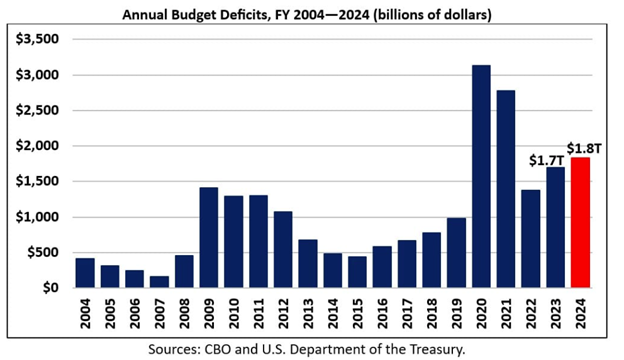
Donald Trump swept the ballot box on promises of faster economic growth, lower consumer inflation, and more fiscal accountability. Fiscal policy can either be economically expansionary or contractionary. For 2024, the US government received roughly $5 trillion and spent $7 trillion, driving a fiscal deficit of nearly $2 trillion—that’s more than 6% of our nation’s GDP. Traditionally, US fiscal deficits average around 3% of GDP. At 6%, President Biden’s fiscal policy has been highly expansionary, as our economic growth attests.

Trump campaigned on slashing spending while using tax cuts to increase economic growth even further. These missions seem slightly at odds as tax cuts (in the short run) increase deficits while spending cuts reduce them. Depending on the relative size of both reductions the deficit could either expand (stimulus) or contract (constraint).  Relying on foreign tax receipts through tariffs may neatly solve the math problem, but historically, spirited tariff tournaments have created several others.

It’s unclear, at this moment, what legislation will follow and, therefore, whether we will have fiscal expansion or fiscal contraction.  But we do have some Trump budget experience to draw upon. During the first Trump administration, the fiscal deficit rose from 3.4% of GDP to 4.6% of GDP (pre-COVID). This was decidedly expansionary, even as inflation fell. Unfortunately, this time around, fiscal expansion would start with deficit levels at 6%+. Bond markets could protest deeper deficits with Treasury downgrades and/or higher yield demands on Treasury issuance. This could weigh on economic growth prospects just as reductions in deficits at the hands of the DOGE committee might.

Until we gain greater clarity on Trump’s legislative intentions, fiscal policy’s 2025 contribution/deduction from GDP is largely… unknowable.    

Monetary Policy?                              

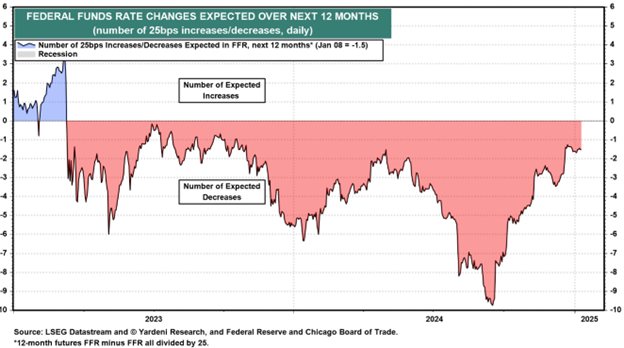
This time last year, the US Federal Reserve projected that the overnight US interest rate would end 2025 at 3.6%. In their most recent summary of economic projections, they forecast year-end rates of 3.9%. Clearly, the Fed has become more dovishly hawkish with most of the attitude adjustment arriving recently. Note that just a few months ago, investors forecast nearly 10 rate cuts for 2025 , compared with expectations for 1.5 rate cuts today:

Is this an inflation warning? Not really. Inflation expectations have risen marginally, but the 5-year breakeven rate forecasting future inflation levels sits well within its normal range between 2 and 2.5%. What this reversal of Fed cut forecasts likely signals is higher levels of confidence in US economic growth prospects. Consider the following:

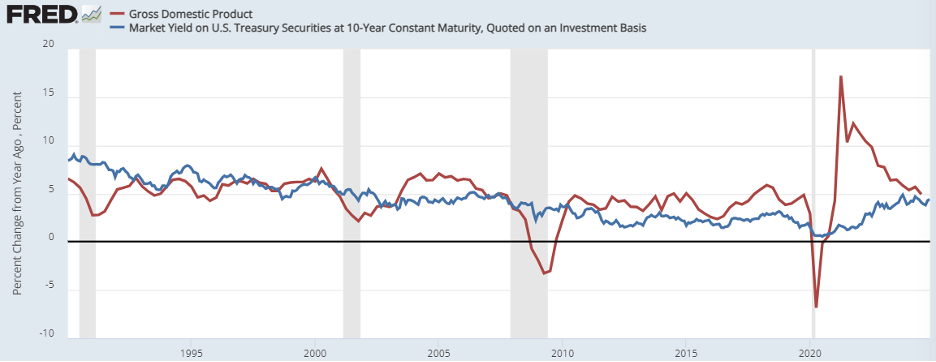
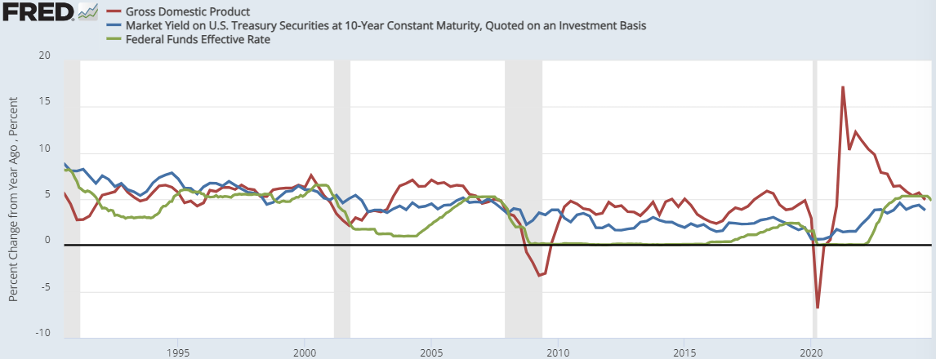
Source: Federal Reserve Bank of St. Louis https://fred.stlouisfed.org/graph/fredgraph.png?g=1CNHc

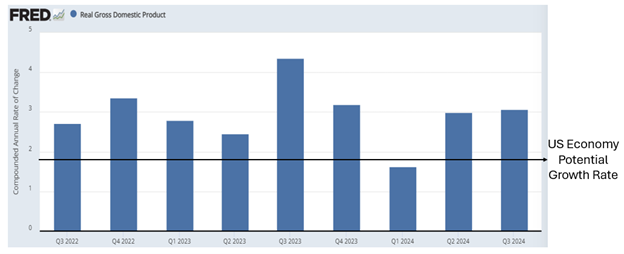
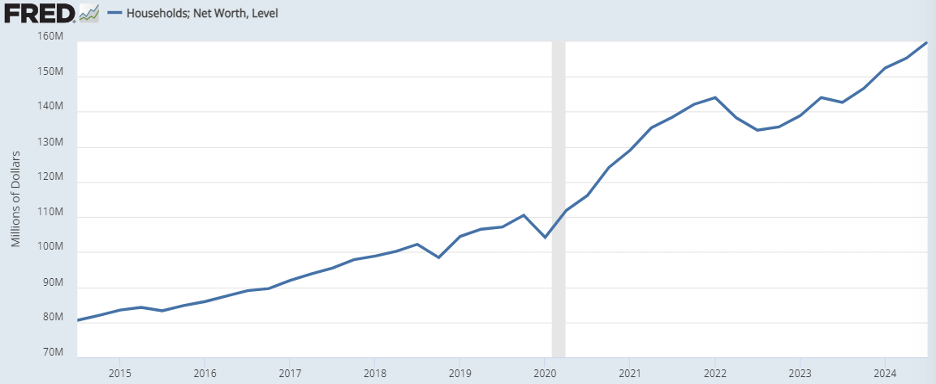
The Fed projects US economic growth potential lies around 1.8%.  Over the last nine quarters, the US economy has averaged GDP growth of nearly 3%.  Government largess can explain some of this, but technological productivity enhancements can as well.  What we don’t know is how Trump’s expansionary fiscal policy will affect our economic growth rate that’s performing well above potential.  Any acceleration could reignite inflation fears.  Any deceleration could reignite recession fears or goad Trump into doubling down on stimulus measures. 

Oh, and just to confuse things further, the Fed continues to sell down its balance sheet to tighten monetary conditions.  The market expects them to conclude the program mid-year, but given the conditions highlighted above, they may not, further complicating rate projections.  In sum, until we gain greater clarity on Trump’s legislative intentions, monetary policy’s 2025 contribution/deduction from GDP is largely… unknowable.

Currency Policy?

I will save a longer form of this discussion for our upcoming annual outlook, but as a preview, the largest and most important market in the world isn’t the equity or bond market, but the currency market.  Trump’s tariff agenda infers a stronger dollar.  Trump’s vocal agenda demands a weaker dollar.  Clearly, Trump wants to raise revenues from offshore sources to finance lower fiscal deficits.  What he hasn’t discussed – but his Treasury secretary nominee certainly understands – is that if you want foreign tax receipts and a weaker currency, you don’t tax foreign goods; you tax foreign investment.  But doing that disincentivizes foreign fund flows into the US, which we need to finance our deficits. 

For now, the markets have decided that the MAGA agenda is a strong dollar agenda, but this could change quickly.  In sum, until we gain greater clarity on Trump’s legislative intentions, currency policy is largely… unknowable.

Enjoy the rest of your weekend!

-David

Sources: LSEG Datastream and Yardeni Research, Federal Reserve Bank of St. Louis, CBO and US Dept. of Treasury

This communication and its contents are for informational and educational purposes only and should not be used as the sole basis for any investment decision. The information contained herein is based on publicly available sources believed to be reliable but is not a representation, expressed or implied, as to the accuracy, completeness, or correctness of said information. Past performance does not guarantee future results.

">
January 11, 2025
The Full Story:

The Trump “bump” for the stock market began as betting markets started pricing in Don’s victory. Between early August and late November, the S&P 500 large cap index rallied more than 15% while the Russell 2000 small cap index rallied more than 20%.

Stock markets react quickly. Other markets react more slowly.

This past month, the 10-year Treasury yield rose by 13%, oil prices per barrel rose by 11%, and the US Dollar index rose by 3%.  The “catch-up” appreciations in interest rates, oil, and the US dollar have capped further appreciations for stocks. I know of very few reliable truths in investing, but when interest rates, oil, and the US Dollar rise simultaneously, stocks do not. This explains the recent weakness in equities, making it more of a moment for digestion and less of a moment for apprehension. Nonetheless, 2025 presents more questions than answers for investors. Here are the major ones driving market anxieties:

Fiscal Policy?

Donald Trump swept the ballot box on promises of faster economic growth, lower consumer inflation, and more fiscal accountability. Fiscal policy can either be economically expansionary or contractionary. For 2024, the US government received roughly $5 trillion and spent $7 trillion, driving a fiscal deficit of nearly $2 trillion—that’s more than 6% of our nation’s GDP. Traditionally, US fiscal deficits average around 3% of GDP. At 6%, President Biden’s fiscal policy has been highly expansionary, as our economic growth attests.

Trump campaigned on slashing spending while using tax cuts to increase economic growth even further. These missions seem slightly at odds as tax cuts (in the short run) increase deficits while spending cuts reduce them. Depending on the relative size of both reductions the deficit could either expand (stimulus) or contract (constraint).  Relying on foreign tax receipts through tariffs may neatly solve the math problem, but historically, spirited tariff tournaments have created several others.

It’s unclear, at this moment, what legislation will follow and, therefore, whether we will have fiscal expansion or fiscal contraction.  But we do have some Trump budget experience to draw upon. During the first Trump administration, the fiscal deficit rose from 3.4% of GDP to 4.6% of GDP (pre-COVID). This was decidedly expansionary, even as inflation fell. Unfortunately, this time around, fiscal expansion would start with deficit levels at 6%+. Bond markets could protest deeper deficits with Treasury downgrades and/or higher yield demands on Treasury issuance. This could weigh on economic growth prospects just as reductions in deficits at the hands of the DOGE committee might.

Until we gain greater clarity on Trump’s legislative intentions, fiscal policy’s 2025 contribution/deduction from GDP is largely… unknowable.    

Monetary Policy?                              

This time last year, the US Federal Reserve projected that the overnight US interest rate would end 2025 at 3.6%. In their most recent summary of economic projections, they forecast year-end rates of 3.9%. Clearly, the Fed has become more dovishly hawkish with most of the attitude adjustment arriving recently. Note that just a few months ago, investors forecast nearly 10 rate cuts for 2025 , compared with expectations for 1.5 rate cuts today:

Is this an inflation warning? Not really. Inflation expectations have risen marginally, but the 5-year breakeven rate forecasting future inflation levels sits well within its normal range between 2 and 2.5%. What this reversal of Fed cut forecasts likely signals is higher levels of confidence in US economic growth prospects. Consider the following:

Source: Federal Reserve Bank of St. Louis https://fred.stlouisfed.org/graph/fredgraph.png?g=1CNHc

The Fed projects US economic growth potential lies around 1.8%.  Over the last nine quarters, the US economy has averaged GDP growth of nearly 3%.  Government largess can explain some of this, but technological productivity enhancements can as well.  What we don’t know is how Trump’s expansionary fiscal policy will affect our economic growth rate that’s performing well above potential.  Any acceleration could reignite inflation fears.  Any deceleration could reignite recession fears or goad Trump into doubling down on stimulus measures. 

Oh, and just to confuse things further, the Fed continues to sell down its balance sheet to tighten monetary conditions.  The market expects them to conclude the program mid-year, but given the conditions highlighted above, they may not, further complicating rate projections.  In sum, until we gain greater clarity on Trump’s legislative intentions, monetary policy’s 2025 contribution/deduction from GDP is largely… unknowable.

Currency Policy?

I will save a longer form of this discussion for our upcoming annual outlook, but as a preview, the largest and most important market in the world isn’t the equity or bond market, but the currency market.  Trump’s tariff agenda infers a stronger dollar.  Trump’s vocal agenda demands a weaker dollar.  Clearly, Trump wants to raise revenues from offshore sources to finance lower fiscal deficits.  What he hasn’t discussed – but his Treasury secretary nominee certainly understands – is that if you want foreign tax receipts and a weaker currency, you don’t tax foreign goods; you tax foreign investment.  But doing that disincentivizes foreign fund flows into the US, which we need to finance our deficits. 

For now, the markets have decided that the MAGA agenda is a strong dollar agenda, but this could change quickly.  In sum, until we gain greater clarity on Trump’s legislative intentions, currency policy is largely… unknowable.

Enjoy the rest of your weekend!

-David

Sources: LSEG Datastream and Yardeni Research, Federal Reserve Bank of St. Louis, CBO and US Dept. of Treasury

This communication and its contents are for informational and educational purposes only and should not be used as the sole basis for any investment decision. The information contained herein is based on publicly available sources believed to be reliable but is not a representation, expressed or implied, as to the accuracy, completeness, or correctness of said information. Past performance does not guarantee future results.

">2025 Hasn’t Started Yet
The Full Story:

The Trump “bump” for the stock market began as betting markets started pricing in Don’s victory. Between early August and late November, the S&P 500 large cap index rallied more than 15% while the Russell 2000 small cap index rallied more than 20%.

Stock markets react quickly. Other markets react more slowly.

This past month, the 10-year Treasury yield rose by 13%, oil prices per barrel rose by 11%, and the US Dollar index rose by 3%.  The “catch-up” appreciations in interest rates, oil, and the US dollar have capped further appreciations for stocks. I know of very few reliable truths in investing, but when interest rates, oil, and the US Dollar rise simultaneously, stocks do not. This explains the recent weakness in equities, making it more of a moment for digestion and less of a moment for apprehension. Nonetheless, 2025 presents more questions than answers for investors. Here are the major ones driving market anxieties:

Fiscal Policy?

Donald Trump swept the ballot box on promises of faster economic growth, lower consumer inflation, and more fiscal accountability. Fiscal policy can either be economically expansionary or contractionary. For 2024, the US government received roughly $5 trillion and spent $7 trillion, driving a fiscal deficit of nearly $2 trillion—that’s more than 6% of our nation’s GDP. Traditionally, US fiscal deficits average around 3% of GDP. At 6%, President Biden’s fiscal policy has been highly expansionary, as our economic growth attests.

Trump campaigned on slashing spending while using tax cuts to increase economic growth even further. These missions seem slightly at odds as tax cuts (in the short run) increase deficits while spending cuts reduce them. Depending on the relative size of both reductions the deficit could either expand (stimulus) or contract (constraint).  Relying on foreign tax receipts through tariffs may neatly solve the math problem, but historically, spirited tariff tournaments have created several others.

It’s unclear, at this moment, what legislation will follow and, therefore, whether we will have fiscal expansion or fiscal contraction.  But we do have some Trump budget experience to draw upon. During the first Trump administration, the fiscal deficit rose from 3.4% of GDP to 4.6% of GDP (pre-COVID). This was decidedly expansionary, even as inflation fell. Unfortunately, this time around, fiscal expansion would start with deficit levels at 6%+. Bond markets could protest deeper deficits with Treasury downgrades and/or higher yield demands on Treasury issuance. This could weigh on economic growth prospects just as reductions in deficits at the hands of the DOGE committee might.

Until we gain greater clarity on Trump’s legislative intentions, fiscal policy’s 2025 contribution/deduction from GDP is largely… unknowable.    

Monetary Policy?                              

This time last year, the US Federal Reserve projected that the overnight US interest rate would end 2025 at 3.6%. In their most recent summary of economic projections, they forecast year-end rates of 3.9%. Clearly, the Fed has become more dovishly hawkish with most of the attitude adjustment arriving recently. Note that just a few months ago, investors forecast nearly 10 rate cuts for 2025 , compared with expectations for 1.5 rate cuts today:

Is this an inflation warning? Not really. Inflation expectations have risen marginally, but the 5-year breakeven rate forecasting future inflation levels sits well within its normal range between 2 and 2.5%. What this reversal of Fed cut forecasts likely signals is higher levels of confidence in US economic growth prospects. Consider the following:

Source: Federal Reserve Bank of St. Louis https://fred.stlouisfed.org/graph/fredgraph.png?g=1CNHc

The Fed projects US economic growth potential lies around 1.8%.  Over the last nine quarters, the US economy has averaged GDP growth of nearly 3%.  Government largess can explain some of this, but technological productivity enhancements can as well.  What we don’t know is how Trump’s expansionary fiscal policy will affect our economic growth rate that’s performing well above potential.  Any acceleration could reignite inflation fears.  Any deceleration could reignite recession fears or goad Trump into doubling down on stimulus measures. 

Oh, and just to confuse things further, the Fed continues to sell down its balance sheet to tighten monetary conditions.  The market expects them to conclude the program mid-year, but given the conditions highlighted above, they may not, further complicating rate projections.  In sum, until we gain greater clarity on Trump’s legislative intentions, monetary policy’s 2025 contribution/deduction from GDP is largely… unknowable.

Currency Policy?

I will save a longer form of this discussion for our upcoming annual outlook, but as a preview, the largest and most important market in the world isn’t the equity or bond market, but the currency market.  Trump’s tariff agenda infers a stronger dollar.  Trump’s vocal agenda demands a weaker dollar.  Clearly, Trump wants to raise revenues from offshore sources to finance lower fiscal deficits.  What he hasn’t discussed – but his Treasury secretary nominee certainly understands – is that if you want foreign tax receipts and a weaker currency, you don’t tax foreign goods; you tax foreign investment.  But doing that disincentivizes foreign fund flows into the US, which we need to finance our deficits. 

For now, the markets have decided that the MAGA agenda is a strong dollar agenda, but this could change quickly.  In sum, until we gain greater clarity on Trump’s legislative intentions, currency policy is largely… unknowable.

Enjoy the rest of your weekend!

-David

Sources: LSEG Datastream and Yardeni Research, Federal Reserve Bank of St. Louis, CBO and US Dept. of Treasury

This communication and its contents are for informational and educational purposes only and should not be used as the sole basis for any investment decision. The information contained herein is based on publicly available sources believed to be reliable but is not a representation, expressed or implied, as to the accuracy, completeness, or correctness of said information. Past performance does not guarantee future results.

" class="link-chevron"> Watch Now
At the end of 2022, economic, investor, and consumer sentiment reached some of the lowest levels in history. Economists and business leaders expected a recession while investors expected a bear market. We mused at the time that nothing pleased us more than pessimism because peak pessimism typically signals performance troughs.

We captured this concept in the following slide from our 2023 Outlook presentation which basically concluded that, since we couldn’t find much fundamentally to be optimistic about, the lugubrious consensus likely meant the market would rally smartly:

Chart showing Retail Investor Bullishness and SP 500 Rtns 1 yr later

Indeed, it did. Only 20% of investors entered 2023 expecting the stock market to advance.  Historically, after equivalent levels of pessimism, stocks rose 17% over the following year, on average. On cue, in 2023 the S&P 500 rose roughly 26%, thereby proving our point that pessimism pays!

As we enter 2025, it’s clear that nearly every asset class has hit record highs. Rather than take inventory, we can see the combined results in total household net worth:

Chart showing Household Net Worths

Household net worth in the US has grown from roughly $100 trillion pre-COVID to $160 trillion today. That’s a 60% increase in only four years. It took ten years to accumulate a 60% increase before that. US households have never gotten so rich, so fast.

COVID-inspired fiscal stimulus led to dramatic swings in household income, particularly adjusted for inflation:

Chart showing Real Disposable Personal Income Per Capita

This chart chronicles annual growth in real disposable personal income per capita. In other words, discretionary spending power for consumers. Note the spike higher from stimulus followed by the spike lower from inflation. Today, disposable income levels sit about 9% higher than they were pre-COVID; a healthy complement to the 60% rise in household net worth.

With record net worth and record income, consumer sentiment should be record-breaking as well.  Not quite:

Chart showing Consumer Optimism Index

Consumer sentiment levels have continued to sag, despite rosy household economics. Economists have proposed many theories, but our social media obsessions with politics and conspiracy theories likely explain much of it. Nonetheless, we have seen meaningful advances recently in most measures of consumer confidence, specifically around household finances. Note the post-election small business sentiment surge:

Chart showing NFIB Small Business Optimism Index

And the surge in household expectations for stock market performance over the next 12 months:

Chart showing Cnsumer Confidence Survey

Leading to record inflows for US stock funds:

Chart showing Rolling 9-Week Flows Into US Equity

And record highs for US stocks, as the NASDAQ closed above 20,000 for the first time this week.

In sum, retail investors today are about twice as bullish on the future as they were at the end of 2022. While this removes much of the uplift from positive surprise, this does not necessarily portend a negative outcome for 2025.

Per our initial chart, 40% bullish sentiment historically correlates with 7% to 11% returns over the coming year, on average. After back-to-back 20%+ years, that wouldn’t feel so bad. So, as 2024 comes to a close, don’t feel too bad about feeling good!

Have a great rest of your weekend,

-David

Sources: AAII, FRED, LSEG Database, Yardeni, NFIB, JP Morgan, Goldman Sachs

This communication and its contents are for informational and educational purposes only and should not be used as the sole basis for any investment decision. The information contained herein is based on publicly available sources believed to be reliable but is not a representation, expressed or implied, as to the accuracy, completeness, or correctness of said information. Past performance does not guarantee future results.

">
December 15, 2024
At the end of 2022, economic, investor, and consumer sentiment reached some of the lowest levels in history. Economists and business leaders expected a recession while investors expected a bear market. We mused at the time that nothing pleased us more than pessimism because peak pessimism typically signals performance troughs.

We captured this concept in the following slide from our 2023 Outlook presentation which basically concluded that, since we couldn’t find much fundamentally to be optimistic about, the lugubrious consensus likely meant the market would rally smartly:

Chart showing Retail Investor Bullishness and SP 500 Rtns 1 yr later

Indeed, it did. Only 20% of investors entered 2023 expecting the stock market to advance.  Historically, after equivalent levels of pessimism, stocks rose 17% over the following year, on average. On cue, in 2023 the S&P 500 rose roughly 26%, thereby proving our point that pessimism pays!

As we enter 2025, it’s clear that nearly every asset class has hit record highs. Rather than take inventory, we can see the combined results in total household net worth:

Chart showing Household Net Worths

Household net worth in the US has grown from roughly $100 trillion pre-COVID to $160 trillion today. That’s a 60% increase in only four years. It took ten years to accumulate a 60% increase before that. US households have never gotten so rich, so fast.

COVID-inspired fiscal stimulus led to dramatic swings in household income, particularly adjusted for inflation:

Chart showing Real Disposable Personal Income Per Capita

This chart chronicles annual growth in real disposable personal income per capita. In other words, discretionary spending power for consumers. Note the spike higher from stimulus followed by the spike lower from inflation. Today, disposable income levels sit about 9% higher than they were pre-COVID; a healthy complement to the 60% rise in household net worth.

With record net worth and record income, consumer sentiment should be record-breaking as well.  Not quite:

Chart showing Consumer Optimism Index

Consumer sentiment levels have continued to sag, despite rosy household economics. Economists have proposed many theories, but our social media obsessions with politics and conspiracy theories likely explain much of it. Nonetheless, we have seen meaningful advances recently in most measures of consumer confidence, specifically around household finances. Note the post-election small business sentiment surge:

Chart showing NFIB Small Business Optimism Index

And the surge in household expectations for stock market performance over the next 12 months:

Chart showing Cnsumer Confidence Survey

Leading to record inflows for US stock funds:

Chart showing Rolling 9-Week Flows Into US Equity

And record highs for US stocks, as the NASDAQ closed above 20,000 for the first time this week.

In sum, retail investors today are about twice as bullish on the future as they were at the end of 2022. While this removes much of the uplift from positive surprise, this does not necessarily portend a negative outcome for 2025.

Per our initial chart, 40% bullish sentiment historically correlates with 7% to 11% returns over the coming year, on average. After back-to-back 20%+ years, that wouldn’t feel so bad. So, as 2024 comes to a close, don’t feel too bad about feeling good!

Have a great rest of your weekend,

-David

Sources: AAII, FRED, LSEG Database, Yardeni, NFIB, JP Morgan, Goldman Sachs

This communication and its contents are for informational and educational purposes only and should not be used as the sole basis for any investment decision. The information contained herein is based on publicly available sources believed to be reliable but is not a representation, expressed or implied, as to the accuracy, completeness, or correctness of said information. Past performance does not guarantee future results.

">How You Feelin’??
At the end of 2022, economic, investor, and consumer sentiment reached some of the lowest levels in history. Economists and business leaders expected a recession while investors expected a bear market. We mused at the time that nothing pleased us more than pessimism because peak pessimism typically signals performance troughs.

We captured this concept in the following slide from our 2023 Outlook presentation which basically concluded that, since we couldn’t find much fundamentally to be optimistic about, the lugubrious consensus likely meant the market would rally smartly:

Chart showing Retail Investor Bullishness and SP 500 Rtns 1 yr later

Indeed, it did. Only 20% of investors entered 2023 expecting the stock market to advance.  Historically, after equivalent levels of pessimism, stocks rose 17% over the following year, on average. On cue, in 2023 the S&P 500 rose roughly 26%, thereby proving our point that pessimism pays!

As we enter 2025, it’s clear that nearly every asset class has hit record highs. Rather than take inventory, we can see the combined results in total household net worth:

Chart showing Household Net Worths

Household net worth in the US has grown from roughly $100 trillion pre-COVID to $160 trillion today. That’s a 60% increase in only four years. It took ten years to accumulate a 60% increase before that. US households have never gotten so rich, so fast.

COVID-inspired fiscal stimulus led to dramatic swings in household income, particularly adjusted for inflation:

Chart showing Real Disposable Personal Income Per Capita

This chart chronicles annual growth in real disposable personal income per capita. In other words, discretionary spending power for consumers. Note the spike higher from stimulus followed by the spike lower from inflation. Today, disposable income levels sit about 9% higher than they were pre-COVID; a healthy complement to the 60% rise in household net worth.

With record net worth and record income, consumer sentiment should be record-breaking as well.  Not quite:

Chart showing Consumer Optimism Index

Consumer sentiment levels have continued to sag, despite rosy household economics. Economists have proposed many theories, but our social media obsessions with politics and conspiracy theories likely explain much of it. Nonetheless, we have seen meaningful advances recently in most measures of consumer confidence, specifically around household finances. Note the post-election small business sentiment surge:

Chart showing NFIB Small Business Optimism Index

And the surge in household expectations for stock market performance over the next 12 months:

Chart showing Cnsumer Confidence Survey

Leading to record inflows for US stock funds:

Chart showing Rolling 9-Week Flows Into US Equity

And record highs for US stocks, as the NASDAQ closed above 20,000 for the first time this week.

In sum, retail investors today are about twice as bullish on the future as they were at the end of 2022. While this removes much of the uplift from positive surprise, this does not necessarily portend a negative outcome for 2025.

Per our initial chart, 40% bullish sentiment historically correlates with 7% to 11% returns over the coming year, on average. After back-to-back 20%+ years, that wouldn’t feel so bad. So, as 2024 comes to a close, don’t feel too bad about feeling good!

Have a great rest of your weekend,

-David

Sources: AAII, FRED, LSEG Database, Yardeni, NFIB, JP Morgan, Goldman Sachs

This communication and its contents are for informational and educational purposes only and should not be used as the sole basis for any investment decision. The information contained herein is based on publicly available sources believed to be reliable but is not a representation, expressed or implied, as to the accuracy, completeness, or correctness of said information. Past performance does not guarantee future results.

" class="link-chevron"> Watch Now
Periodically, I spend time in New York meeting with investment managers, channel partners, and media outlets. While I enjoy Zoom meetings and telephone calls, conversations in person always prove far more robust and, sometimes, what happens “off camera” teaches me the most. 

Furthermore, because so much market sentiment and psychology originate with analysts and pundits in New York, it’s important to stay close to the source. This week, I had the privilege of visiting with all-star reporters from Bloomberg, Investment News, Reuters, the Schwab Network and with Charles Payne on Making Money. The available clips from each are linked below. You will find lots of market commentary, musings on Trump, AI, and even thoughts on the booming economy in Tennessee.

Bloomberg Intelligence: Intel CEO Forced Out (scroll to 18:54)

Investment News: Here’s How AI Will Forever Change the Financial Services Industry

Schwab Network: Corporate Profits, Earnings Bullish for 2025 

Fox Business: Making Money with Charles Payne

For those of you who prefer the written word, here are some clarifying thoughts on Trump’s tariff agenda and why it’s critical to his deficit reduction pledge that the currency markets cooperate.

Trump’s Tariffs

The US government runs a $7 trillion budget. Of that, only $1 trillion is truly discretionary. $2 trillion goes to defense and interest payments and the rest to services entitlement programs. Our current deficit is approximately $2 trillion. Trump has committed to cutting the deficit in half (from 6% of GDP to 3%), requiring a $1 trillion pickup in revenues and/or cost savings. Let’s consider the revenue opportunities first:

Higher growth historically leads to higher tax revenues. The Trump 1.0 (pre-COVID) economy grew at a 2.8% real GDP pace, well over our 2% potential. Total tax revenues rose from $1.9 trillion initially to $2.2 trillion, even with Trump’s historic tax cut passed in late 2017. Most of the incremental tax gains came from individuals as more income and more capital gains led to more taxes paid, offsetting less corporate tax (corporations are just pass-through entities). This policy strategy will likely surface again, considering corporate tax revenues have risen well above their pre-cut levels and Trump has signaled dropping them from 21% to 15%. Trump also doubled tariff tax revenue from $40 billion to $80 billion beginning in 2018 (note the continuation and expansion under Biden):

Chart showing Federal Government Current Tax Receipts

This time, Trump wants to impose 10-20% tariffs across the board (a dramatic increase from the 2-3% today). With imports of $4 trillion, this implies tax receipts of between $400 and $800 billion, diligently chipping away at the $1 trillion needed to halve the deficit. However, as we learned in our economics classes, tariffs axiomatically lead to offshore price hikes which ricochet back to the American consumer as inflation. But—this ignores currency effects. Note the US Dollar’s reaction to Trump 2.0:

Chart showing ICE US Dollar Index % Change

Trump’s election initially led to a 7% rise in the value of the US dollar. This currency strength would have neutralized an equal amount of tariff. A 10% appreciation in the dollar would, therefore, offset the inflationary consequences of a 10% tariff. Obviously, there are unintended consequences to consider, and nothing is ever this simple, but this explains why Trump so strongly favors tariffs as the primary financing vehicle for deficit reduction.

Lastly, Elon, Vivek, and friends have their erasers out and their eyeshades on. I am still foggy on how much they can cut out of the Federal budget, but they will cut something. The combination of growth-stoked tax receipts, currency-neutralized tariffs and DOGE belt-tightening directives form the foundation of Trump’s austerity agenda. However, with entitlement spending growing faster than the economy, ignoring them makes long-term deficit containment impossible… But try getting elected on that!    

Enjoy your week,

-David

Sources: FRED, YCharts, Federal Reserve Bank of Atlanta, U.S. Bureau of Labor Statistics, Institute of Supply Management

The above communications and contents are for informational and educational purposes only and should not be used as the sole basis for any investment decision. The information contained herein is based on the publicly available sources listed below. These sources are believed to be reliable but are not a representation, expressed or implied, as to the accuracy, completeness, or correctness of said information. Past performance does not guarantee future results.

">
December 8, 2024
Periodically, I spend time in New York meeting with investment managers, channel partners, and media outlets. While I enjoy Zoom meetings and telephone calls, conversations in person always prove far more robust and, sometimes, what happens “off camera” teaches me the most. 

Furthermore, because so much market sentiment and psychology originate with analysts and pundits in New York, it’s important to stay close to the source. This week, I had the privilege of visiting with all-star reporters from Bloomberg, Investment News, Reuters, the Schwab Network and with Charles Payne on Making Money. The available clips from each are linked below. You will find lots of market commentary, musings on Trump, AI, and even thoughts on the booming economy in Tennessee.

Bloomberg Intelligence: Intel CEO Forced Out (scroll to 18:54)

Investment News: Here’s How AI Will Forever Change the Financial Services Industry

Schwab Network: Corporate Profits, Earnings Bullish for 2025 

Fox Business: Making Money with Charles Payne

For those of you who prefer the written word, here are some clarifying thoughts on Trump’s tariff agenda and why it’s critical to his deficit reduction pledge that the currency markets cooperate.

Trump’s Tariffs

The US government runs a $7 trillion budget. Of that, only $1 trillion is truly discretionary. $2 trillion goes to defense and interest payments and the rest to services entitlement programs. Our current deficit is approximately $2 trillion. Trump has committed to cutting the deficit in half (from 6% of GDP to 3%), requiring a $1 trillion pickup in revenues and/or cost savings. Let’s consider the revenue opportunities first:

Higher growth historically leads to higher tax revenues. The Trump 1.0 (pre-COVID) economy grew at a 2.8% real GDP pace, well over our 2% potential. Total tax revenues rose from $1.9 trillion initially to $2.2 trillion, even with Trump’s historic tax cut passed in late 2017. Most of the incremental tax gains came from individuals as more income and more capital gains led to more taxes paid, offsetting less corporate tax (corporations are just pass-through entities). This policy strategy will likely surface again, considering corporate tax revenues have risen well above their pre-cut levels and Trump has signaled dropping them from 21% to 15%. Trump also doubled tariff tax revenue from $40 billion to $80 billion beginning in 2018 (note the continuation and expansion under Biden):

Chart showing Federal Government Current Tax Receipts

This time, Trump wants to impose 10-20% tariffs across the board (a dramatic increase from the 2-3% today). With imports of $4 trillion, this implies tax receipts of between $400 and $800 billion, diligently chipping away at the $1 trillion needed to halve the deficit. However, as we learned in our economics classes, tariffs axiomatically lead to offshore price hikes which ricochet back to the American consumer as inflation. But—this ignores currency effects. Note the US Dollar’s reaction to Trump 2.0:

Chart showing ICE US Dollar Index % Change

Trump’s election initially led to a 7% rise in the value of the US dollar. This currency strength would have neutralized an equal amount of tariff. A 10% appreciation in the dollar would, therefore, offset the inflationary consequences of a 10% tariff. Obviously, there are unintended consequences to consider, and nothing is ever this simple, but this explains why Trump so strongly favors tariffs as the primary financing vehicle for deficit reduction.

Lastly, Elon, Vivek, and friends have their erasers out and their eyeshades on. I am still foggy on how much they can cut out of the Federal budget, but they will cut something. The combination of growth-stoked tax receipts, currency-neutralized tariffs and DOGE belt-tightening directives form the foundation of Trump’s austerity agenda. However, with entitlement spending growing faster than the economy, ignoring them makes long-term deficit containment impossible… But try getting elected on that!    

Enjoy your week,

-David

Sources: FRED, YCharts, Federal Reserve Bank of Atlanta, U.S. Bureau of Labor Statistics, Institute of Supply Management

The above communications and contents are for informational and educational purposes only and should not be used as the sole basis for any investment decision. The information contained herein is based on the publicly available sources listed below. These sources are believed to be reliable but are not a representation, expressed or implied, as to the accuracy, completeness, or correctness of said information. Past performance does not guarantee future results.

">Insights from NYC: Trump’s Tariff Strategy, Market Trends, and 2025 Investment Outlook Periodically, I spend time in New York meeting with investment managers, channel partners, and media outlets. While I enjoy Zoom meetings and telephone calls, conversations in person always prove far more robust and, sometimes, what happens “off camera” teaches me the most. 

Furthermore, because so much market sentiment and psychology originate with analysts and pundits in New York, it’s important to stay close to the source. This week, I had the privilege of visiting with all-star reporters from Bloomberg, Investment News, Reuters, the Schwab Network and with Charles Payne on Making Money. The available clips from each are linked below. You will find lots of market commentary, musings on Trump, AI, and even thoughts on the booming economy in Tennessee.

Bloomberg Intelligence: Intel CEO Forced Out (scroll to 18:54)

Investment News: Here’s How AI Will Forever Change the Financial Services Industry

Schwab Network: Corporate Profits, Earnings Bullish for 2025 

Fox Business: Making Money with Charles Payne

For those of you who prefer the written word, here are some clarifying thoughts on Trump’s tariff agenda and why it’s critical to his deficit reduction pledge that the currency markets cooperate.

Trump’s Tariffs

The US government runs a $7 trillion budget. Of that, only $1 trillion is truly discretionary. $2 trillion goes to defense and interest payments and the rest to services entitlement programs. Our current deficit is approximately $2 trillion. Trump has committed to cutting the deficit in half (from 6% of GDP to 3%), requiring a $1 trillion pickup in revenues and/or cost savings. Let’s consider the revenue opportunities first:

Higher growth historically leads to higher tax revenues. The Trump 1.0 (pre-COVID) economy grew at a 2.8% real GDP pace, well over our 2% potential. Total tax revenues rose from $1.9 trillion initially to $2.2 trillion, even with Trump’s historic tax cut passed in late 2017. Most of the incremental tax gains came from individuals as more income and more capital gains led to more taxes paid, offsetting less corporate tax (corporations are just pass-through entities). This policy strategy will likely surface again, considering corporate tax revenues have risen well above their pre-cut levels and Trump has signaled dropping them from 21% to 15%. Trump also doubled tariff tax revenue from $40 billion to $80 billion beginning in 2018 (note the continuation and expansion under Biden):

Chart showing Federal Government Current Tax Receipts

This time, Trump wants to impose 10-20% tariffs across the board (a dramatic increase from the 2-3% today). With imports of $4 trillion, this implies tax receipts of between $400 and $800 billion, diligently chipping away at the $1 trillion needed to halve the deficit. However, as we learned in our economics classes, tariffs axiomatically lead to offshore price hikes which ricochet back to the American consumer as inflation. But—this ignores currency effects. Note the US Dollar’s reaction to Trump 2.0:

Chart showing ICE US Dollar Index % Change

Trump’s election initially led to a 7% rise in the value of the US dollar. This currency strength would have neutralized an equal amount of tariff. A 10% appreciation in the dollar would, therefore, offset the inflationary consequences of a 10% tariff. Obviously, there are unintended consequences to consider, and nothing is ever this simple, but this explains why Trump so strongly favors tariffs as the primary financing vehicle for deficit reduction.

Lastly, Elon, Vivek, and friends have their erasers out and their eyeshades on. I am still foggy on how much they can cut out of the Federal budget, but they will cut something. The combination of growth-stoked tax receipts, currency-neutralized tariffs and DOGE belt-tightening directives form the foundation of Trump’s austerity agenda. However, with entitlement spending growing faster than the economy, ignoring them makes long-term deficit containment impossible… But try getting elected on that!    

Enjoy your week,

-David

Sources: FRED, YCharts, Federal Reserve Bank of Atlanta, U.S. Bureau of Labor Statistics, Institute of Supply Management

The above communications and contents are for informational and educational purposes only and should not be used as the sole basis for any investment decision. The information contained herein is based on the publicly available sources listed below. These sources are believed to be reliable but are not a representation, expressed or implied, as to the accuracy, completeness, or correctness of said information. Past performance does not guarantee future results.

" class="link-chevron"> Watch Now
While politics may be polarizing, investors must dispassionately adapt to all environmental shifts. On Tuesday of last week, the United States voted to overhaul our Federal Government. To accomplish President Trump’s ambitious reform agenda, his administration must de-bureaucratize the system, reduce regulatory burdens, and open rapid legislative throughputs.

Historically, trifecta governments tend to perish with subsequent mid-terms as they did under Obama, Trump 1.0, and Biden, so the Trump team has only two years assured. Given Trump’s presidential experience, action-oriented appointees, and tireless work ethic, expect high legislative volume. Many initiatives will pass quickly, like the extension of the Trump Tax cuts, while others, like the ones soon to be proposed by the DOGE committee, will undoubtedly stoke more debate. Nonetheless, the environment over the next two years will likely feel frenetic and uncomfortable for investors. But that does not make it unknowable.

Conservatism

Margaret Thatcher rose to power in 1979 after an extended period of slow growth and high inflation across the British economy. Thatcher promoted a bold reform agenda that included significant privatization of state-owned industries, major restrictions on unionization, dramatic deregulation of the financial markets, massive tax cuts, and revolutionary housing reforms. Many of her privatization pursuits drew spirited political rebuke as the Government’s share of GDP shrank significantly over her tenure. For investors, however, it was a time of plenty. Fueled by “Thatcherism,” the UK stock market index grew five-fold between 1979 and 1990 without a single down year.

Pragmatism

China’s model for economic success under Deng Xiaoping drew inspiration from Lee Kuan Yew’s model for economic success in Singapore. Lee Kuan Yew ascended to power in 1959, pledging to apply “common sense” to a senseless Government. At the time, Singapore was mired in infighting, overly export reliant, and notoriously corrupt.

LKY demanded pragmatic “results” from the Government. He recruited the brightest minds into critical positions and overpaid them. This greatly increased governing competence while greatly decreasing government corruption. He used strategic planning, incentives, human capital development programs, and performance measurement to transition the Singaporean economy away from relying on cheap exports to developing high-value industries.

Under LKY’s leadership, per-capita GDP rose from $400 in 1959 to $14,500 by the time he stepped aside in 1991. He created the Singapore stock exchange in 1960 and, by 1990, it housed companies with a total market capitalization of $36 billion. Today, Singapore has a higher per capita GDP than the United States.

Radicalism

Argentina elected Javier Milei president of Argentina in 2023 with 56% of the vote amidst widespread desire for radical change. Corruption, economic mismanagement, runaway inflation, and currency devaluation eroded public trust in the incumbent political system. Firebrand Javier Milei promised to “blow up” the system and used images of a chainsaw to communicate his budget balancing intentions.

Milei’s first act as president was to eliminate nine governmental ministries (departments). He also signed a major deregulatory decree and has eliminated an estimated 25,000 of the Government’s 300,000+ jobs. Union protests have erupted, but populist support remains strong. The budget is now in surplus, the trade balance is now in surplus, and monthly inflation has fallen into the low single digits.

Argentina remains mired in recession, but confidence in Milei has grown. He faces his own midterms in 2025. Should his party pick up seats, his agenda will embolden. Since his election, the Argentinian stock market has appreciated 54% vs. the S&P 500’s 31%.

In summary, it’s unclear whether Donald Trump, his cabinet, or his policies will prove legislatively viable, economically effective, or politically pleasing, but—as anxious investors search for environmental analogs, the real results of conservative Margaret Thatcher, pragmatic Lee Kuan Yew and radical Javier Milei should offer context—and comfort.

Chart showing ARGT vs SPY Total Returns

Have a fantastic week!

-David

Source: YCharts

This communication and its contents are for informational and educational purposes only and should not be used as the sole basis for any investment decision. The information contained herein is based on publicly available sources believed to be reliable but is not a representation, expressed or implied, as to the accuracy, completeness, or correctness of said information. Past performance does not guarantee future results.

">
November 17, 2024
While politics may be polarizing, investors must dispassionately adapt to all environmental shifts. On Tuesday of last week, the United States voted to overhaul our Federal Government. To accomplish President Trump’s ambitious reform agenda, his administration must de-bureaucratize the system, reduce regulatory burdens, and open rapid legislative throughputs.

Historically, trifecta governments tend to perish with subsequent mid-terms as they did under Obama, Trump 1.0, and Biden, so the Trump team has only two years assured. Given Trump’s presidential experience, action-oriented appointees, and tireless work ethic, expect high legislative volume. Many initiatives will pass quickly, like the extension of the Trump Tax cuts, while others, like the ones soon to be proposed by the DOGE committee, will undoubtedly stoke more debate. Nonetheless, the environment over the next two years will likely feel frenetic and uncomfortable for investors. But that does not make it unknowable.

Conservatism

Margaret Thatcher rose to power in 1979 after an extended period of slow growth and high inflation across the British economy. Thatcher promoted a bold reform agenda that included significant privatization of state-owned industries, major restrictions on unionization, dramatic deregulation of the financial markets, massive tax cuts, and revolutionary housing reforms. Many of her privatization pursuits drew spirited political rebuke as the Government’s share of GDP shrank significantly over her tenure. For investors, however, it was a time of plenty. Fueled by “Thatcherism,” the UK stock market index grew five-fold between 1979 and 1990 without a single down year.

Pragmatism

China’s model for economic success under Deng Xiaoping drew inspiration from Lee Kuan Yew’s model for economic success in Singapore. Lee Kuan Yew ascended to power in 1959, pledging to apply “common sense” to a senseless Government. At the time, Singapore was mired in infighting, overly export reliant, and notoriously corrupt.

LKY demanded pragmatic “results” from the Government. He recruited the brightest minds into critical positions and overpaid them. This greatly increased governing competence while greatly decreasing government corruption. He used strategic planning, incentives, human capital development programs, and performance measurement to transition the Singaporean economy away from relying on cheap exports to developing high-value industries.

Under LKY’s leadership, per-capita GDP rose from $400 in 1959 to $14,500 by the time he stepped aside in 1991. He created the Singapore stock exchange in 1960 and, by 1990, it housed companies with a total market capitalization of $36 billion. Today, Singapore has a higher per capita GDP than the United States.

Radicalism

Argentina elected Javier Milei president of Argentina in 2023 with 56% of the vote amidst widespread desire for radical change. Corruption, economic mismanagement, runaway inflation, and currency devaluation eroded public trust in the incumbent political system. Firebrand Javier Milei promised to “blow up” the system and used images of a chainsaw to communicate his budget balancing intentions.

Milei’s first act as president was to eliminate nine governmental ministries (departments). He also signed a major deregulatory decree and has eliminated an estimated 25,000 of the Government’s 300,000+ jobs. Union protests have erupted, but populist support remains strong. The budget is now in surplus, the trade balance is now in surplus, and monthly inflation has fallen into the low single digits.

Argentina remains mired in recession, but confidence in Milei has grown. He faces his own midterms in 2025. Should his party pick up seats, his agenda will embolden. Since his election, the Argentinian stock market has appreciated 54% vs. the S&P 500’s 31%.

In summary, it’s unclear whether Donald Trump, his cabinet, or his policies will prove legislatively viable, economically effective, or politically pleasing, but—as anxious investors search for environmental analogs, the real results of conservative Margaret Thatcher, pragmatic Lee Kuan Yew and radical Javier Milei should offer context—and comfort.

Chart showing ARGT vs SPY Total Returns

Have a fantastic week!

-David

Source: YCharts

This communication and its contents are for informational and educational purposes only and should not be used as the sole basis for any investment decision. The information contained herein is based on publicly available sources believed to be reliable but is not a representation, expressed or implied, as to the accuracy, completeness, or correctness of said information. Past performance does not guarantee future results.

">Investors: Use Historical Context for Increased Comfort
While politics may be polarizing, investors must dispassionately adapt to all environmental shifts. On Tuesday of last week, the United States voted to overhaul our Federal Government. To accomplish President Trump’s ambitious reform agenda, his administration must de-bureaucratize the system, reduce regulatory burdens, and open rapid legislative throughputs.

Historically, trifecta governments tend to perish with subsequent mid-terms as they did under Obama, Trump 1.0, and Biden, so the Trump team has only two years assured. Given Trump’s presidential experience, action-oriented appointees, and tireless work ethic, expect high legislative volume. Many initiatives will pass quickly, like the extension of the Trump Tax cuts, while others, like the ones soon to be proposed by the DOGE committee, will undoubtedly stoke more debate. Nonetheless, the environment over the next two years will likely feel frenetic and uncomfortable for investors. But that does not make it unknowable.

Conservatism

Margaret Thatcher rose to power in 1979 after an extended period of slow growth and high inflation across the British economy. Thatcher promoted a bold reform agenda that included significant privatization of state-owned industries, major restrictions on unionization, dramatic deregulation of the financial markets, massive tax cuts, and revolutionary housing reforms. Many of her privatization pursuits drew spirited political rebuke as the Government’s share of GDP shrank significantly over her tenure. For investors, however, it was a time of plenty. Fueled by “Thatcherism,” the UK stock market index grew five-fold between 1979 and 1990 without a single down year.

Pragmatism

China’s model for economic success under Deng Xiaoping drew inspiration from Lee Kuan Yew’s model for economic success in Singapore. Lee Kuan Yew ascended to power in 1959, pledging to apply “common sense” to a senseless Government. At the time, Singapore was mired in infighting, overly export reliant, and notoriously corrupt.

LKY demanded pragmatic “results” from the Government. He recruited the brightest minds into critical positions and overpaid them. This greatly increased governing competence while greatly decreasing government corruption. He used strategic planning, incentives, human capital development programs, and performance measurement to transition the Singaporean economy away from relying on cheap exports to developing high-value industries.

Under LKY’s leadership, per-capita GDP rose from $400 in 1959 to $14,500 by the time he stepped aside in 1991. He created the Singapore stock exchange in 1960 and, by 1990, it housed companies with a total market capitalization of $36 billion. Today, Singapore has a higher per capita GDP than the United States.

Radicalism

Argentina elected Javier Milei president of Argentina in 2023 with 56% of the vote amidst widespread desire for radical change. Corruption, economic mismanagement, runaway inflation, and currency devaluation eroded public trust in the incumbent political system. Firebrand Javier Milei promised to “blow up” the system and used images of a chainsaw to communicate his budget balancing intentions.

Milei’s first act as president was to eliminate nine governmental ministries (departments). He also signed a major deregulatory decree and has eliminated an estimated 25,000 of the Government’s 300,000+ jobs. Union protests have erupted, but populist support remains strong. The budget is now in surplus, the trade balance is now in surplus, and monthly inflation has fallen into the low single digits.

Argentina remains mired in recession, but confidence in Milei has grown. He faces his own midterms in 2025. Should his party pick up seats, his agenda will embolden. Since his election, the Argentinian stock market has appreciated 54% vs. the S&P 500’s 31%.

In summary, it’s unclear whether Donald Trump, his cabinet, or his policies will prove legislatively viable, economically effective, or politically pleasing, but—as anxious investors search for environmental analogs, the real results of conservative Margaret Thatcher, pragmatic Lee Kuan Yew and radical Javier Milei should offer context—and comfort.

Chart showing ARGT vs SPY Total Returns

Have a fantastic week!

-David

Source: YCharts

This communication and its contents are for informational and educational purposes only and should not be used as the sole basis for any investment decision. The information contained herein is based on publicly available sources believed to be reliable but is not a representation, expressed or implied, as to the accuracy, completeness, or correctness of said information. Past performance does not guarantee future results.

" class="link-chevron"> Watch Now
Investors won after Tuesday’s election as Wednesday produced the highest post-election day returns in history! The S&P 500 large cap index surged 2.5% compared with its average post-election day return of -.4%. The Russell 2000 small cap index surged even more, rising 5.8%. All major market indices hit all-time highs (including Bitcoin), with the gains continuing through week’s end. Here are how the major market indices closed out the week:

Table showing Election Week Returns
The Stealth Tax

This puts the Trump economic agenda on display. With a clear mandate, Trump will have no difficulty extending the 2017 tax cuts. Furthermore, he may lower the corporate tax rate even more from 21% to 15%. Additionally, deregulation reduces a stealth tax that we can argue has an even greater impact on corporate profits.

According to the Government’s own OMB (Office of Management and Budget), compliance with federal regulations costs companies around $300 billion annually, roughly in line with what firms spend on corporate taxes. Furthermore, 40% of the S&P 500 is currently under investigation by the justice department. Anti-trust has also been busy as of late, most notably with its effort to dismantle Google.

The Scales Balance

Trump’s pledge to slash the regulatory burden will free up capital and embolden innovation, especially across smaller companies with less discretionary capital to expend on compliance. For those fearful that Trump’s tough tariff talk will cause inflation, note that tax cuts, regulation cuts, technological advances, and heightened energy production all provide disinflationary offsets.

We have also witnessed this bluster before, yet inflation averaged 1.9% over Trump’s first term, squarely below the Fed’s 2% target. Also, inflation expectation indices finished the week essentially unchanged and Gold, seen as a hedge against inflation and chaos, declined 2%.

Lastly, note that Trump’s America First message led to a sizable differential between onshore and offshore returns as capital quickly immigrated and repatriated into the US. Overall, it was a robust market rally to begin Trump 2.0, but history proffers caution when one party rules them all:

Graph showing Sock Performance Based on Congress Makeup
What Unified Control Means

Between 1951 and 2023, Republicans held unified control for a total of 10 years with S&P 500 returns averaging 6.7%, annualized. For comparison, when the Democrats held unified control for a total of 20 years, the S&P 500 returned 8.6%, annualized. This compares with average annual returns of 14.5% when Congress is split, and 9.9% for the 43 years surveyed as a whole. The lesson? Too much of a good thing for party loyalists has historically meant less of a good thing for investors.

Rate Cuts = Higher Rates

The Fed cut rates again this week, trimming .25% off the overnight rate. For those of you who own money market funds, your yields just dropped. For those of you who hold mortgages, your yields did not. Remember, while the Fed calibrates its rate decisions to achieve 2% inflation and full employment across the economy, the longer end of the yield curve calibrates its rate decisions to nominal GDP growth expectations.

Intuitively, lower short-term interest rates improve longer-term economic growth potential. Additionally, a more growth-centric policy array also improves longer-term economic growth potential. Both apply upward pressure on longer-term yields for the right reasons. Consider the relationship between nominal GDP growth (inflation inclusive) and the 10-year Treasury yield:

Chart showing Gross Domestic Product and Market Tield on Securities

Over the time-period for the dataset above beginning in 1990, nominal GDP (red) averaged 4.8% on a quarterly basis, while the 10 Year Treasury yield averaged 4.2% (blue). Prior to the GFC in 2008 the spread between the 10 Year and nominal GDP averaged .3%. Post GFC, the Fed distorted the interest rate curve with its zero-interest-rate policy, widening that gap, as seen when adding in the Federal Funds rate (green):

Chart showing Gross Domestic Product and Market Tield on Securities and Fed Rate

In the mid-1990’s, the Fed cut rates after raising them aggressively to reduce recession risks and ensure a “soft landing”, making that period the best analog for where we are today. It worked. Nominal GDP rose from 4.6% when they began cutting rates in early 1995 to 6.3% before they started raising them again in 1997. Over that two-year period, the yield on the 10-year Treasury rose from 6% to 7% in sympathy with the higher growth rates, despite Fed rate cuts. Most importantly, household net worth advanced 20%.

Here is my point: Over the past week, I have heard a lot about how the new administration’s policies will lead to higher inflation, Treasury bond auction failures and punitively higher longer-term interest rate levels for mortgage borrowers, leading to another housing crisis and economic collapse. While all of that is possible, we do not see that as probable.

More likely, the uptick in rates seen recently doesn’t reflect US credit quality concerns, but is an acknowledgement that near-term recession risks have fallen, and that long-term nominal GDP growth potential has risen. While you may pay more than you like for a mortgage under this scenario, you will have higher income and a larger net worth to subsidize it—and when a recession does inevitably arise, you can always refinance.

Enjoy your week!

-David

Sources: Yahoo Finance, Carson Investment Research, FactSet, FRED

This communication and its contents are for informational and educational purposes only and should not be used as the sole basis for any investment decision. The information contained herein is based on publicly available sources believed to be reliable but is not a representation, expressed or implied, as to the accuracy, completeness, or correctness of said information. Past performance does not guarantee future results.

">
November 9, 2024
Investors won after Tuesday’s election as Wednesday produced the highest post-election day returns in history! The S&P 500 large cap index surged 2.5% compared with its average post-election day return of -.4%. The Russell 2000 small cap index surged even more, rising 5.8%. All major market indices hit all-time highs (including Bitcoin), with the gains continuing through week’s end. Here are how the major market indices closed out the week:

Table showing Election Week Returns
The Stealth Tax

This puts the Trump economic agenda on display. With a clear mandate, Trump will have no difficulty extending the 2017 tax cuts. Furthermore, he may lower the corporate tax rate even more from 21% to 15%. Additionally, deregulation reduces a stealth tax that we can argue has an even greater impact on corporate profits.

According to the Government’s own OMB (Office of Management and Budget), compliance with federal regulations costs companies around $300 billion annually, roughly in line with what firms spend on corporate taxes. Furthermore, 40% of the S&P 500 is currently under investigation by the justice department. Anti-trust has also been busy as of late, most notably with its effort to dismantle Google.

The Scales Balance

Trump’s pledge to slash the regulatory burden will free up capital and embolden innovation, especially across smaller companies with less discretionary capital to expend on compliance. For those fearful that Trump’s tough tariff talk will cause inflation, note that tax cuts, regulation cuts, technological advances, and heightened energy production all provide disinflationary offsets.

We have also witnessed this bluster before, yet inflation averaged 1.9% over Trump’s first term, squarely below the Fed’s 2% target. Also, inflation expectation indices finished the week essentially unchanged and Gold, seen as a hedge against inflation and chaos, declined 2%.

Lastly, note that Trump’s America First message led to a sizable differential between onshore and offshore returns as capital quickly immigrated and repatriated into the US. Overall, it was a robust market rally to begin Trump 2.0, but history proffers caution when one party rules them all:

Graph showing Sock Performance Based on Congress Makeup
What Unified Control Means

Between 1951 and 2023, Republicans held unified control for a total of 10 years with S&P 500 returns averaging 6.7%, annualized. For comparison, when the Democrats held unified control for a total of 20 years, the S&P 500 returned 8.6%, annualized. This compares with average annual returns of 14.5% when Congress is split, and 9.9% for the 43 years surveyed as a whole. The lesson? Too much of a good thing for party loyalists has historically meant less of a good thing for investors.

Rate Cuts = Higher Rates

The Fed cut rates again this week, trimming .25% off the overnight rate. For those of you who own money market funds, your yields just dropped. For those of you who hold mortgages, your yields did not. Remember, while the Fed calibrates its rate decisions to achieve 2% inflation and full employment across the economy, the longer end of the yield curve calibrates its rate decisions to nominal GDP growth expectations.

Intuitively, lower short-term interest rates improve longer-term economic growth potential. Additionally, a more growth-centric policy array also improves longer-term economic growth potential. Both apply upward pressure on longer-term yields for the right reasons. Consider the relationship between nominal GDP growth (inflation inclusive) and the 10-year Treasury yield:

Chart showing Gross Domestic Product and Market Tield on Securities

Over the time-period for the dataset above beginning in 1990, nominal GDP (red) averaged 4.8% on a quarterly basis, while the 10 Year Treasury yield averaged 4.2% (blue). Prior to the GFC in 2008 the spread between the 10 Year and nominal GDP averaged .3%. Post GFC, the Fed distorted the interest rate curve with its zero-interest-rate policy, widening that gap, as seen when adding in the Federal Funds rate (green):

Chart showing Gross Domestic Product and Market Tield on Securities and Fed Rate

In the mid-1990’s, the Fed cut rates after raising them aggressively to reduce recession risks and ensure a “soft landing”, making that period the best analog for where we are today. It worked. Nominal GDP rose from 4.6% when they began cutting rates in early 1995 to 6.3% before they started raising them again in 1997. Over that two-year period, the yield on the 10-year Treasury rose from 6% to 7% in sympathy with the higher growth rates, despite Fed rate cuts. Most importantly, household net worth advanced 20%.

Here is my point: Over the past week, I have heard a lot about how the new administration’s policies will lead to higher inflation, Treasury bond auction failures and punitively higher longer-term interest rate levels for mortgage borrowers, leading to another housing crisis and economic collapse. While all of that is possible, we do not see that as probable.

More likely, the uptick in rates seen recently doesn’t reflect US credit quality concerns, but is an acknowledgement that near-term recession risks have fallen, and that long-term nominal GDP growth potential has risen. While you may pay more than you like for a mortgage under this scenario, you will have higher income and a larger net worth to subsidize it—and when a recession does inevitably arise, you can always refinance.

Enjoy your week!

-David

Sources: Yahoo Finance, Carson Investment Research, FactSet, FRED

This communication and its contents are for informational and educational purposes only and should not be used as the sole basis for any investment decision. The information contained herein is based on publicly available sources believed to be reliable but is not a representation, expressed or implied, as to the accuracy, completeness, or correctness of said information. Past performance does not guarantee future results.

">Ready, Set, Rally!
Investors won after Tuesday’s election as Wednesday produced the highest post-election day returns in history! The S&P 500 large cap index surged 2.5% compared with its average post-election day return of -.4%. The Russell 2000 small cap index surged even more, rising 5.8%. All major market indices hit all-time highs (including Bitcoin), with the gains continuing through week’s end. Here are how the major market indices closed out the week:

Table showing Election Week Returns
The Stealth Tax

This puts the Trump economic agenda on display. With a clear mandate, Trump will have no difficulty extending the 2017 tax cuts. Furthermore, he may lower the corporate tax rate even more from 21% to 15%. Additionally, deregulation reduces a stealth tax that we can argue has an even greater impact on corporate profits.

According to the Government’s own OMB (Office of Management and Budget), compliance with federal regulations costs companies around $300 billion annually, roughly in line with what firms spend on corporate taxes. Furthermore, 40% of the S&P 500 is currently under investigation by the justice department. Anti-trust has also been busy as of late, most notably with its effort to dismantle Google.

The Scales Balance

Trump’s pledge to slash the regulatory burden will free up capital and embolden innovation, especially across smaller companies with less discretionary capital to expend on compliance. For those fearful that Trump’s tough tariff talk will cause inflation, note that tax cuts, regulation cuts, technological advances, and heightened energy production all provide disinflationary offsets.

We have also witnessed this bluster before, yet inflation averaged 1.9% over Trump’s first term, squarely below the Fed’s 2% target. Also, inflation expectation indices finished the week essentially unchanged and Gold, seen as a hedge against inflation and chaos, declined 2%.

Lastly, note that Trump’s America First message led to a sizable differential between onshore and offshore returns as capital quickly immigrated and repatriated into the US. Overall, it was a robust market rally to begin Trump 2.0, but history proffers caution when one party rules them all:

Graph showing Sock Performance Based on Congress Makeup
What Unified Control Means

Between 1951 and 2023, Republicans held unified control for a total of 10 years with S&P 500 returns averaging 6.7%, annualized. For comparison, when the Democrats held unified control for a total of 20 years, the S&P 500 returned 8.6%, annualized. This compares with average annual returns of 14.5% when Congress is split, and 9.9% for the 43 years surveyed as a whole. The lesson? Too much of a good thing for party loyalists has historically meant less of a good thing for investors.

Rate Cuts = Higher Rates

The Fed cut rates again this week, trimming .25% off the overnight rate. For those of you who own money market funds, your yields just dropped. For those of you who hold mortgages, your yields did not. Remember, while the Fed calibrates its rate decisions to achieve 2% inflation and full employment across the economy, the longer end of the yield curve calibrates its rate decisions to nominal GDP growth expectations.

Intuitively, lower short-term interest rates improve longer-term economic growth potential. Additionally, a more growth-centric policy array also improves longer-term economic growth potential. Both apply upward pressure on longer-term yields for the right reasons. Consider the relationship between nominal GDP growth (inflation inclusive) and the 10-year Treasury yield:

Chart showing Gross Domestic Product and Market Tield on Securities

Over the time-period for the dataset above beginning in 1990, nominal GDP (red) averaged 4.8% on a quarterly basis, while the 10 Year Treasury yield averaged 4.2% (blue). Prior to the GFC in 2008 the spread between the 10 Year and nominal GDP averaged .3%. Post GFC, the Fed distorted the interest rate curve with its zero-interest-rate policy, widening that gap, as seen when adding in the Federal Funds rate (green):

Chart showing Gross Domestic Product and Market Tield on Securities and Fed Rate

In the mid-1990’s, the Fed cut rates after raising them aggressively to reduce recession risks and ensure a “soft landing”, making that period the best analog for where we are today. It worked. Nominal GDP rose from 4.6% when they began cutting rates in early 1995 to 6.3% before they started raising them again in 1997. Over that two-year period, the yield on the 10-year Treasury rose from 6% to 7% in sympathy with the higher growth rates, despite Fed rate cuts. Most importantly, household net worth advanced 20%.

Here is my point: Over the past week, I have heard a lot about how the new administration’s policies will lead to higher inflation, Treasury bond auction failures and punitively higher longer-term interest rate levels for mortgage borrowers, leading to another housing crisis and economic collapse. While all of that is possible, we do not see that as probable.

More likely, the uptick in rates seen recently doesn’t reflect US credit quality concerns, but is an acknowledgement that near-term recession risks have fallen, and that long-term nominal GDP growth potential has risen. While you may pay more than you like for a mortgage under this scenario, you will have higher income and a larger net worth to subsidize it—and when a recession does inevitably arise, you can always refinance.

Enjoy your week!

-David

Sources: Yahoo Finance, Carson Investment Research, FactSet, FRED

This communication and its contents are for informational and educational purposes only and should not be used as the sole basis for any investment decision. The information contained herein is based on publicly available sources believed to be reliable but is not a representation, expressed or implied, as to the accuracy, completeness, or correctness of said information. Past performance does not guarantee future results.

" class="link-chevron"> Watch Now
While attention fixates on the difference-maker in a hotly contested election, investors shouldn’t overlook the true October surprise this year. For the month of October, the S&P 500 traded within a 2.5% range and ended the month down less than 1%.

A Spooky History

October has a history of spooky market behavior. General volatility levels rank 34% higher in October compared to the other months and three of the last four trading days with losses of more than 10% occurred in the month of October. With Trump vs. Harris worldviews overheating social media feeds, conflicts raging worldwide, and a mixed bag of economic data, conditions were set for a potentially red October. So why the lullaby? First, while Trump and Harris seem far apart, neither of their economic policies seem to be causing much concern:

Chart showing Monthly US Economic Policy Uncertainty Index

Perhaps that’s due to expectations of a divided Congress, or recognition that Presidents themselves have much less influence over economic growth than widely assumed. Consider the GDP growth rates listed below (Trump rates are pre-COVID):

Bar chart showing Annual Economic Growth by Presidential Term
The Truth About the Market and Elections

Outside of Obama’s first-term clunker, the US economy has grown 2%+ under every president dating back to Herbert Hoover. Turning to the stock market, the performance differentials between presidential administrations are just as inconclusive:

Table showing DIJA Returns Under US Presidents Since 1900

Looking at the price returns for the Dow Jones Industrial Average going back to 1900, Republican Presidents have rewarded investors with 6.6% annualized gains while Democrat Presidents have rewarded investors with 7.2% annualized gains. I haven’t done the statistical work, but I suspect that the -30% return under Hoover accounts for the differential. How did the Dow perform under President Trump? It rose 50%. How did the Dow perform under President Biden? It rose 50%.

We Invest in Companies, not Governments

I do not know who will win the Oval Office on Tuesday. I do know that I have received a flood of queries surrounding the implications for investors. Based on the history presented above, the implications are immaterial. What powers the US economy and investor returns is not presidential policies, but trillions of micro decisions made by an industrious, ingenious, and innovative population. Our hard-coded system of laws, property rights, and protections provides 338 million Americans with the incentives to pursue prosperity and retain the rewards. So, stress less about Tuesday. We invest our client assets in companies, not governments, and with our dynamic, ever-growing economy, earnings continually rising, and AI contributions just beginning, the future is bright no matter who takes Tuesday.

Happy November!

-David

Sources: Economic Policy Index, Department of Commerce, Bespoke

This communication and its contents are for informational and educational purposes only and should not be used as the sole basis for any investment decision. The information contained herein is based on publicly available sources believed to be reliable but is not a representation, expressed or implied, as to the accuracy, completeness, or correctness of said information. Past performance does not guarantee future results.

">
November 1, 2024
While attention fixates on the difference-maker in a hotly contested election, investors shouldn’t overlook the true October surprise this year. For the month of October, the S&P 500 traded within a 2.5% range and ended the month down less than 1%.

A Spooky History

October has a history of spooky market behavior. General volatility levels rank 34% higher in October compared to the other months and three of the last four trading days with losses of more than 10% occurred in the month of October. With Trump vs. Harris worldviews overheating social media feeds, conflicts raging worldwide, and a mixed bag of economic data, conditions were set for a potentially red October. So why the lullaby? First, while Trump and Harris seem far apart, neither of their economic policies seem to be causing much concern:

Chart showing Monthly US Economic Policy Uncertainty Index

Perhaps that’s due to expectations of a divided Congress, or recognition that Presidents themselves have much less influence over economic growth than widely assumed. Consider the GDP growth rates listed below (Trump rates are pre-COVID):

Bar chart showing Annual Economic Growth by Presidential Term
The Truth About the Market and Elections

Outside of Obama’s first-term clunker, the US economy has grown 2%+ under every president dating back to Herbert Hoover. Turning to the stock market, the performance differentials between presidential administrations are just as inconclusive:

Table showing DIJA Returns Under US Presidents Since 1900

Looking at the price returns for the Dow Jones Industrial Average going back to 1900, Republican Presidents have rewarded investors with 6.6% annualized gains while Democrat Presidents have rewarded investors with 7.2% annualized gains. I haven’t done the statistical work, but I suspect that the -30% return under Hoover accounts for the differential. How did the Dow perform under President Trump? It rose 50%. How did the Dow perform under President Biden? It rose 50%.

We Invest in Companies, not Governments

I do not know who will win the Oval Office on Tuesday. I do know that I have received a flood of queries surrounding the implications for investors. Based on the history presented above, the implications are immaterial. What powers the US economy and investor returns is not presidential policies, but trillions of micro decisions made by an industrious, ingenious, and innovative population. Our hard-coded system of laws, property rights, and protections provides 338 million Americans with the incentives to pursue prosperity and retain the rewards. So, stress less about Tuesday. We invest our client assets in companies, not governments, and with our dynamic, ever-growing economy, earnings continually rising, and AI contributions just beginning, the future is bright no matter who takes Tuesday.

Happy November!

-David

Sources: Economic Policy Index, Department of Commerce, Bespoke

This communication and its contents are for informational and educational purposes only and should not be used as the sole basis for any investment decision. The information contained herein is based on publicly available sources believed to be reliable but is not a representation, expressed or implied, as to the accuracy, completeness, or correctness of said information. Past performance does not guarantee future results.

">The Real October Surprise
While attention fixates on the difference-maker in a hotly contested election, investors shouldn’t overlook the true October surprise this year. For the month of October, the S&P 500 traded within a 2.5% range and ended the month down less than 1%.

A Spooky History

October has a history of spooky market behavior. General volatility levels rank 34% higher in October compared to the other months and three of the last four trading days with losses of more than 10% occurred in the month of October. With Trump vs. Harris worldviews overheating social media feeds, conflicts raging worldwide, and a mixed bag of economic data, conditions were set for a potentially red October. So why the lullaby? First, while Trump and Harris seem far apart, neither of their economic policies seem to be causing much concern:

Chart showing Monthly US Economic Policy Uncertainty Index

Perhaps that’s due to expectations of a divided Congress, or recognition that Presidents themselves have much less influence over economic growth than widely assumed. Consider the GDP growth rates listed below (Trump rates are pre-COVID):

Bar chart showing Annual Economic Growth by Presidential Term
The Truth About the Market and Elections

Outside of Obama’s first-term clunker, the US economy has grown 2%+ under every president dating back to Herbert Hoover. Turning to the stock market, the performance differentials between presidential administrations are just as inconclusive:

Table showing DIJA Returns Under US Presidents Since 1900

Looking at the price returns for the Dow Jones Industrial Average going back to 1900, Republican Presidents have rewarded investors with 6.6% annualized gains while Democrat Presidents have rewarded investors with 7.2% annualized gains. I haven’t done the statistical work, but I suspect that the -30% return under Hoover accounts for the differential. How did the Dow perform under President Trump? It rose 50%. How did the Dow perform under President Biden? It rose 50%.

We Invest in Companies, not Governments

I do not know who will win the Oval Office on Tuesday. I do know that I have received a flood of queries surrounding the implications for investors. Based on the history presented above, the implications are immaterial. What powers the US economy and investor returns is not presidential policies, but trillions of micro decisions made by an industrious, ingenious, and innovative population. Our hard-coded system of laws, property rights, and protections provides 338 million Americans with the incentives to pursue prosperity and retain the rewards. So, stress less about Tuesday. We invest our client assets in companies, not governments, and with our dynamic, ever-growing economy, earnings continually rising, and AI contributions just beginning, the future is bright no matter who takes Tuesday.

Happy November!

-David

Sources: Economic Policy Index, Department of Commerce, Bespoke

This communication and its contents are for informational and educational purposes only and should not be used as the sole basis for any investment decision. The information contained herein is based on publicly available sources believed to be reliable but is not a representation, expressed or implied, as to the accuracy, completeness, or correctness of said information. Past performance does not guarantee future results.

" class="link-chevron"> Watch Now