Resources

Your Life, Your Legacy, Our Guidance

Resources to help individuals, families, business owners, and institutions pursue their financial goals and secure their legacy

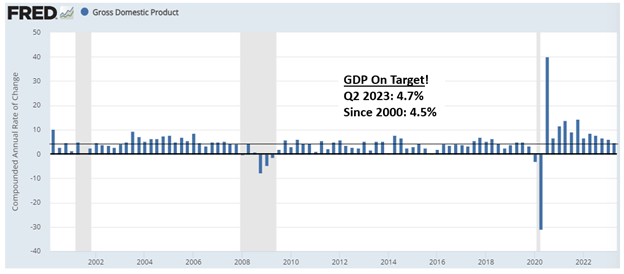
This certainly seems counterproductive, with the Fed summoning lower GDP growth to lower inflation. However, for a true appraisal of economic velocity, we must look at the pace of GDP without inflation adjustments (nominal GDP):

Nominal GDP has fallen consistently over the past year. This paints a much more comforting picture for the Fed as the nominal economy has slowed at a measured pace, assisting with its disinflation agenda. In fact, Q2 nominal GDP grew by 4.7%, roughly in line with its 20-year average of 4.5%. Normal nominal GDP levels should help normalize everything else.

Normal Inflation

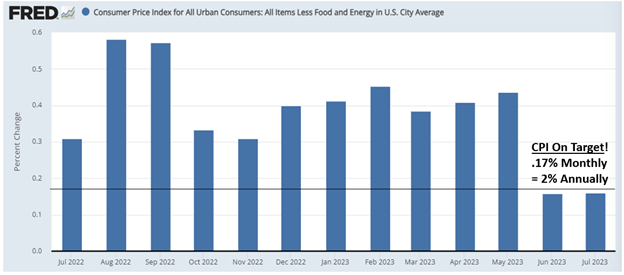
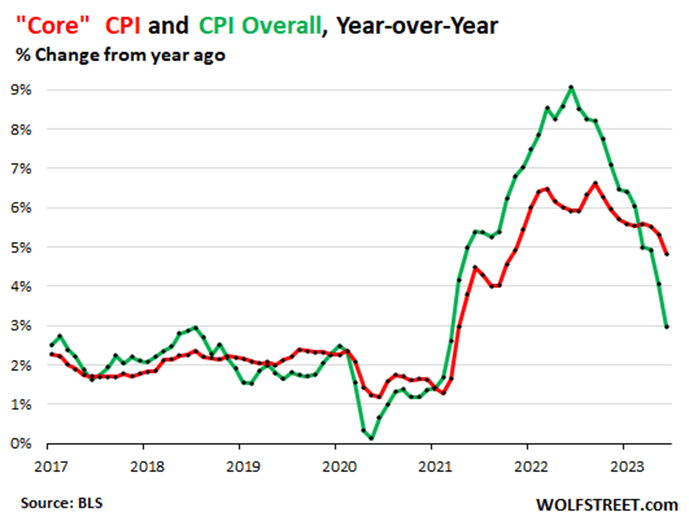
On Thursday, we received further evidence of inflation’s descent as the Consumer Price Index for July rose .16% for the month. Multiply .16% by 12, and the annualized inflation rate falls below 2%. Most inflation reporting uses year-over-year numbers, which simply aggregate monthly movements. For July, the monthly move was .16% (encouraging), but the year-over-year change was 4.7% (discouraging). Don’t fret! Of the 12 monthly changes that aggregate into the annual number, August and September of 2022 caused most of the trouble:

August and September will fall off the rolls in the upcoming months. The elimination of these “base effect” distortions will lead to a cascade lower in core inflation from 4.7% today to below 3.5% by year-end.

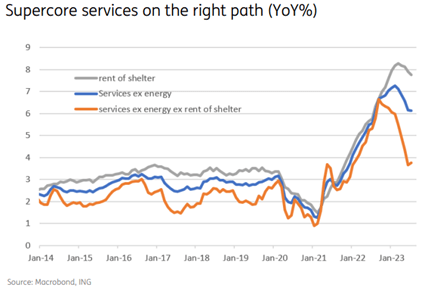
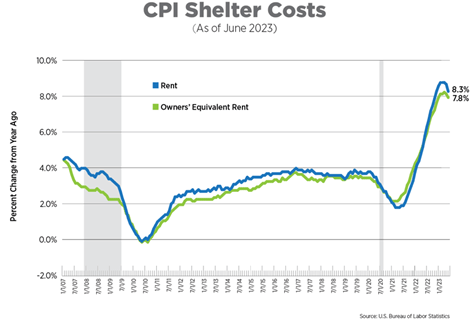
Lastly, housing inflation accounted for 90% of the monthly increase in July. As we have discussed, housing disinflation lags because renters and homeowners infrequently vacate and reprice properties. The Fed acknowledged this dynamic early on by directing attention to “supercore” inflation (services inflation less food, energy, and housing). For July, “supercore” inflation advanced .2% as well and will benefit from the same base effect evaporation as core inflation as we approach year-end.

Altogether, we remain convicted that the Fed should not, and will not, raise rates further and that inflation has locked onto a glide path toward normal.

Normal Rates

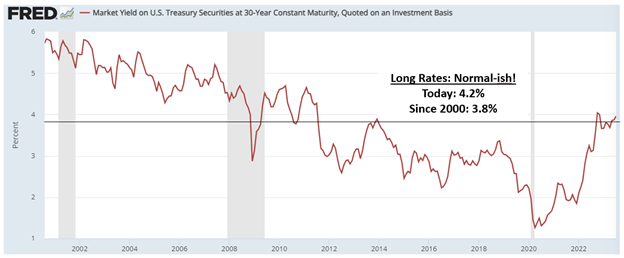
Just as inflation changes have distorted GDP measurement, they have also distorted interest rate behavior. Remember, near-term interest rates key off Fed policy decisions, while longer-dated maturities key off economic expectations. Pandemic inflation forced the Fed to raise near-term rates to 5.25%, a 22-year high! But longer-term rates reside within normal ranges:

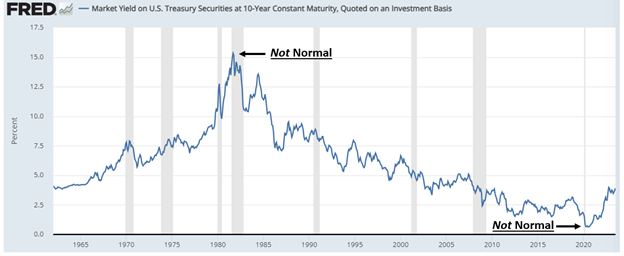
For most observers, a 4% interest rate on ten or 30-year Treasury bonds feels abnormal. But in truth, 4% is far more normal than the negative interest rate world we inhabited last decade:

In fact, for most of our history prior to shunning the Gold Standard (designed to eliminate inflation), long-term US interest rates vacillated around 4%. So, while 4% may not feel normal to us today, it feels quite normal to history.

The pandemic economic era is winding down, and major economic indicators are resuming normal operations. While recency bias may keep investors on edge for some time, normal levels of economic activity should result in more normal levels of market activity… and less abnormal anxiety for investors!

Have a great weekend!

David S. Waddell  

CEO, Chief Investment Strategist

Sources: Blue Chip Economic Indicators and Blue Chip Financial Forecasts, FRED, Macrobond, ING
">
August 11, 2023

This certainly seems counterproductive, with the Fed summoning lower GDP growth to lower inflation. However, for a true appraisal of economic velocity, we must look at the pace of GDP without inflation adjustments (nominal GDP):

Nominal GDP has fallen consistently over the past year. This paints a much more comforting picture for the Fed as the nominal economy has slowed at a measured pace, assisting with its disinflation agenda. In fact, Q2 nominal GDP grew by 4.7%, roughly in line with its 20-year average of 4.5%. Normal nominal GDP levels should help normalize everything else.

Normal Inflation

On Thursday, we received further evidence of inflation’s descent as the Consumer Price Index for July rose .16% for the month. Multiply .16% by 12, and the annualized inflation rate falls below 2%. Most inflation reporting uses year-over-year numbers, which simply aggregate monthly movements. For July, the monthly move was .16% (encouraging), but the year-over-year change was 4.7% (discouraging). Don’t fret! Of the 12 monthly changes that aggregate into the annual number, August and September of 2022 caused most of the trouble:

August and September will fall off the rolls in the upcoming months. The elimination of these “base effect” distortions will lead to a cascade lower in core inflation from 4.7% today to below 3.5% by year-end.

Lastly, housing inflation accounted for 90% of the monthly increase in July. As we have discussed, housing disinflation lags because renters and homeowners infrequently vacate and reprice properties. The Fed acknowledged this dynamic early on by directing attention to “supercore” inflation (services inflation less food, energy, and housing). For July, “supercore” inflation advanced .2% as well and will benefit from the same base effect evaporation as core inflation as we approach year-end.

Altogether, we remain convicted that the Fed should not, and will not, raise rates further and that inflation has locked onto a glide path toward normal.

Normal Rates

Just as inflation changes have distorted GDP measurement, they have also distorted interest rate behavior. Remember, near-term interest rates key off Fed policy decisions, while longer-dated maturities key off economic expectations. Pandemic inflation forced the Fed to raise near-term rates to 5.25%, a 22-year high! But longer-term rates reside within normal ranges:

For most observers, a 4% interest rate on ten or 30-year Treasury bonds feels abnormal. But in truth, 4% is far more normal than the negative interest rate world we inhabited last decade:

In fact, for most of our history prior to shunning the Gold Standard (designed to eliminate inflation), long-term US interest rates vacillated around 4%. So, while 4% may not feel normal to us today, it feels quite normal to history.

The pandemic economic era is winding down, and major economic indicators are resuming normal operations. While recency bias may keep investors on edge for some time, normal levels of economic activity should result in more normal levels of market activity… and less abnormal anxiety for investors!

Have a great weekend!

David S. Waddell  

CEO, Chief Investment Strategist

Sources: Blue Chip Economic Indicators and Blue Chip Financial Forecasts, FRED, Macrobond, ING
">Inoculating Pandemic Economics

This certainly seems counterproductive, with the Fed summoning lower GDP growth to lower inflation. However, for a true appraisal of economic velocity, we must look at the pace of GDP without inflation adjustments (nominal GDP):

Nominal GDP has fallen consistently over the past year. This paints a much more comforting picture for the Fed as the nominal economy has slowed at a measured pace, assisting with its disinflation agenda. In fact, Q2 nominal GDP grew by 4.7%, roughly in line with its 20-year average of 4.5%. Normal nominal GDP levels should help normalize everything else.

Normal Inflation

On Thursday, we received further evidence of inflation’s descent as the Consumer Price Index for July rose .16% for the month. Multiply .16% by 12, and the annualized inflation rate falls below 2%. Most inflation reporting uses year-over-year numbers, which simply aggregate monthly movements. For July, the monthly move was .16% (encouraging), but the year-over-year change was 4.7% (discouraging). Don’t fret! Of the 12 monthly changes that aggregate into the annual number, August and September of 2022 caused most of the trouble:

August and September will fall off the rolls in the upcoming months. The elimination of these “base effect” distortions will lead to a cascade lower in core inflation from 4.7% today to below 3.5% by year-end.

Lastly, housing inflation accounted for 90% of the monthly increase in July. As we have discussed, housing disinflation lags because renters and homeowners infrequently vacate and reprice properties. The Fed acknowledged this dynamic early on by directing attention to “supercore” inflation (services inflation less food, energy, and housing). For July, “supercore” inflation advanced .2% as well and will benefit from the same base effect evaporation as core inflation as we approach year-end.

Altogether, we remain convicted that the Fed should not, and will not, raise rates further and that inflation has locked onto a glide path toward normal.

Normal Rates

Just as inflation changes have distorted GDP measurement, they have also distorted interest rate behavior. Remember, near-term interest rates key off Fed policy decisions, while longer-dated maturities key off economic expectations. Pandemic inflation forced the Fed to raise near-term rates to 5.25%, a 22-year high! But longer-term rates reside within normal ranges:

For most observers, a 4% interest rate on ten or 30-year Treasury bonds feels abnormal. But in truth, 4% is far more normal than the negative interest rate world we inhabited last decade:

In fact, for most of our history prior to shunning the Gold Standard (designed to eliminate inflation), long-term US interest rates vacillated around 4%. So, while 4% may not feel normal to us today, it feels quite normal to history.

The pandemic economic era is winding down, and major economic indicators are resuming normal operations. While recency bias may keep investors on edge for some time, normal levels of economic activity should result in more normal levels of market activity… and less abnormal anxiety for investors!

Have a great weekend!

David S. Waddell  

CEO, Chief Investment Strategist

Sources: Blue Chip Economic Indicators and Blue Chip Financial Forecasts, FRED, Macrobond, ING
" class="link-chevron"> Watch Now

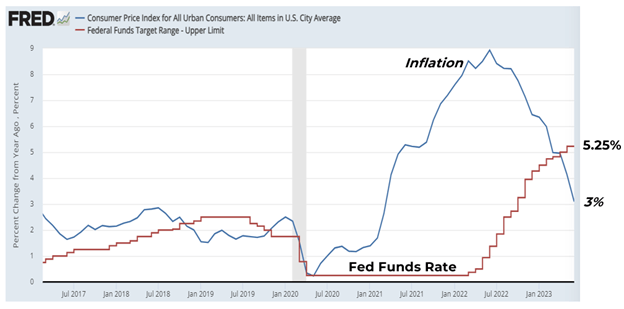
Recognizing the cost of their delay, the Fed increased the benchmark interest rate by 5% over the next 15 months in one of the most aggressive monetary tightening cycles in history. The combination of natural disinflationary forces and monetary austerity has driven dramatic results. On Wednesday, the US Bureau of Labor Statistics released the June Consumer Price Index report showing headline inflation has declined from 9% last June to 3% this June.  Markets rallied strongly on the news as less inflation means less Fed and less Fed means less recession.  Given the Fed’s 2% inflation target and the clear downward momentum within the report, it’s right to ask, is the Fed finished?

Gimmie Shelter Disinflation

While headline inflation rose a comforting 3% over the past year, it’s core inflation that discomforts the Fed.  Core inflation lies well above the Fed’s 2% comfort zone at 4.8%.  Therefore, to divine what’s in the Fed’s head, we must become conversant with the core.

Core inflation represents 80% of headline inflation and contains everything households purchase besides food and energy.  Of the 80%, housing inflation accounts for roughly half of the total, with new and used vehicles accounting for the next highest contribution at only 7%.  The rest of the components consist of everything from household appliances to wine (at home and away from home).  For those who prefer the trees to the forest, you can find the itemized report here.

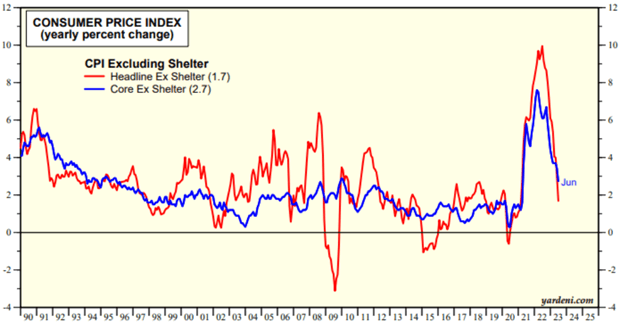
Within the CPI report, housing-related inflation ticked slightly lower but remains 8% higher than year-ago levels.  Given the outsized role of shelter within CPI, the vast majority of inflation within the report was housing related.  In fact, if you strip out housing, headline inflation falls to 1.7%, and core inflation falls to 2.7%, well within the Fed’s target range.  This chart depicts just how dramatically overall inflation has risen and fallen when excluding shelter inflation:

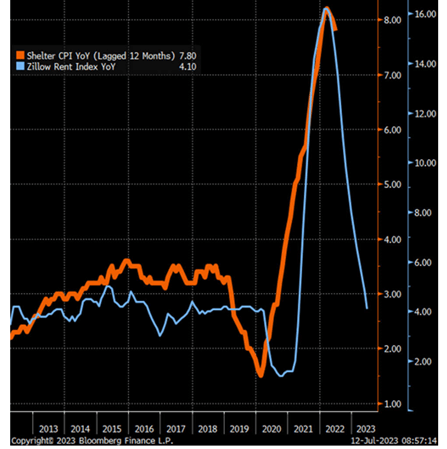
To further illustrate the rapid fall in price levels afoot, 45% of the items measured in June experienced outright deflation!  With shelter sheltering inflation, when will these levels leg lower?  Unfortunately, shelter inflation calculations in the CPI report arrive with considerable lags.  Considering that the three-month rolling average shelter inflation rate is 6% and the June monthly rate annualizes at 4.4%, shelter inflation could fall more quickly than anticipated.  Economists often reference more real-time gauges of shelter inflation like the Zillow Rent Index.  Some have observed that the Zillow index tends to front-run the CPI shelter index by about one year.  The Zillow index peaked early last year and recently reported rent inflation of 4% in June.  The following chart harmonizes the two inflation indices and adjusts for the 12-month lag:

Well, isn’t that encouraging?!

If these proportions hold, shelter inflation within the Consumer Price Index could return to the Fed’s target levels within 12 months.  With shelter’s outsized influence, shelter disinflation means deflating recession conviction at the Fed.  Furthermore, stocks historically return three times more for investors when CPI falls than when it rises.

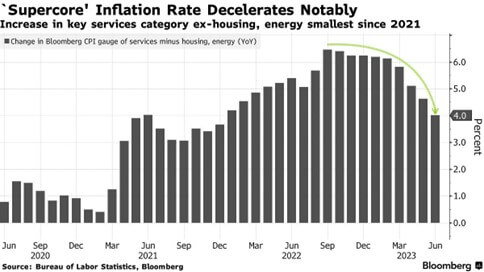
So, will this report keep the Fed at bay?  Likely not.  They have set expectations that they will raise rates another .25% on July 26th.  Powell will undoubtedly site elevated wage inflation and “supercore” inflation that remains well above the 2% target.  But even that fallback measure has lost momentum, as seen below:

In sum, we expect one more face-saving hike from the Fed with empty threats of doing more.  Remember, while the Fed may have a 2% target for the rise in general price levels, the long-term inflation CPI inflation rate for the USA is 3.5%, above where we are today.  The Fed may remain a problem, but only if they fail to recognize that inflation no longer is.

Have a great weekend!

David S. Waddell  

CEO, Chief Investment Strategist

Sources:  FRED, U.S. Bureau of Labor Statistics, Bloomberg L.P., Yardeni Research, BLS
">
July 15, 2023

Recognizing the cost of their delay, the Fed increased the benchmark interest rate by 5% over the next 15 months in one of the most aggressive monetary tightening cycles in history. The combination of natural disinflationary forces and monetary austerity has driven dramatic results. On Wednesday, the US Bureau of Labor Statistics released the June Consumer Price Index report showing headline inflation has declined from 9% last June to 3% this June.  Markets rallied strongly on the news as less inflation means less Fed and less Fed means less recession.  Given the Fed’s 2% inflation target and the clear downward momentum within the report, it’s right to ask, is the Fed finished?

Gimmie Shelter Disinflation

While headline inflation rose a comforting 3% over the past year, it’s core inflation that discomforts the Fed.  Core inflation lies well above the Fed’s 2% comfort zone at 4.8%.  Therefore, to divine what’s in the Fed’s head, we must become conversant with the core.

Core inflation represents 80% of headline inflation and contains everything households purchase besides food and energy.  Of the 80%, housing inflation accounts for roughly half of the total, with new and used vehicles accounting for the next highest contribution at only 7%.  The rest of the components consist of everything from household appliances to wine (at home and away from home).  For those who prefer the trees to the forest, you can find the itemized report here.

Within the CPI report, housing-related inflation ticked slightly lower but remains 8% higher than year-ago levels.  Given the outsized role of shelter within CPI, the vast majority of inflation within the report was housing related.  In fact, if you strip out housing, headline inflation falls to 1.7%, and core inflation falls to 2.7%, well within the Fed’s target range.  This chart depicts just how dramatically overall inflation has risen and fallen when excluding shelter inflation:

To further illustrate the rapid fall in price levels afoot, 45% of the items measured in June experienced outright deflation!  With shelter sheltering inflation, when will these levels leg lower?  Unfortunately, shelter inflation calculations in the CPI report arrive with considerable lags.  Considering that the three-month rolling average shelter inflation rate is 6% and the June monthly rate annualizes at 4.4%, shelter inflation could fall more quickly than anticipated.  Economists often reference more real-time gauges of shelter inflation like the Zillow Rent Index.  Some have observed that the Zillow index tends to front-run the CPI shelter index by about one year.  The Zillow index peaked early last year and recently reported rent inflation of 4% in June.  The following chart harmonizes the two inflation indices and adjusts for the 12-month lag:

Well, isn’t that encouraging?!

If these proportions hold, shelter inflation within the Consumer Price Index could return to the Fed’s target levels within 12 months.  With shelter’s outsized influence, shelter disinflation means deflating recession conviction at the Fed.  Furthermore, stocks historically return three times more for investors when CPI falls than when it rises.

So, will this report keep the Fed at bay?  Likely not.  They have set expectations that they will raise rates another .25% on July 26th.  Powell will undoubtedly site elevated wage inflation and “supercore” inflation that remains well above the 2% target.  But even that fallback measure has lost momentum, as seen below:

In sum, we expect one more face-saving hike from the Fed with empty threats of doing more.  Remember, while the Fed may have a 2% target for the rise in general price levels, the long-term inflation CPI inflation rate for the USA is 3.5%, above where we are today.  The Fed may remain a problem, but only if they fail to recognize that inflation no longer is.

Have a great weekend!

David S. Waddell  

CEO, Chief Investment Strategist

Sources:  FRED, U.S. Bureau of Labor Statistics, Bloomberg L.P., Yardeni Research, BLS
">Heaven Sent 3%!

Recognizing the cost of their delay, the Fed increased the benchmark interest rate by 5% over the next 15 months in one of the most aggressive monetary tightening cycles in history. The combination of natural disinflationary forces and monetary austerity has driven dramatic results. On Wednesday, the US Bureau of Labor Statistics released the June Consumer Price Index report showing headline inflation has declined from 9% last June to 3% this June.  Markets rallied strongly on the news as less inflation means less Fed and less Fed means less recession.  Given the Fed’s 2% inflation target and the clear downward momentum within the report, it’s right to ask, is the Fed finished?

Gimmie Shelter Disinflation

While headline inflation rose a comforting 3% over the past year, it’s core inflation that discomforts the Fed.  Core inflation lies well above the Fed’s 2% comfort zone at 4.8%.  Therefore, to divine what’s in the Fed’s head, we must become conversant with the core.

Core inflation represents 80% of headline inflation and contains everything households purchase besides food and energy.  Of the 80%, housing inflation accounts for roughly half of the total, with new and used vehicles accounting for the next highest contribution at only 7%.  The rest of the components consist of everything from household appliances to wine (at home and away from home).  For those who prefer the trees to the forest, you can find the itemized report here.

Within the CPI report, housing-related inflation ticked slightly lower but remains 8% higher than year-ago levels.  Given the outsized role of shelter within CPI, the vast majority of inflation within the report was housing related.  In fact, if you strip out housing, headline inflation falls to 1.7%, and core inflation falls to 2.7%, well within the Fed’s target range.  This chart depicts just how dramatically overall inflation has risen and fallen when excluding shelter inflation:

To further illustrate the rapid fall in price levels afoot, 45% of the items measured in June experienced outright deflation!  With shelter sheltering inflation, when will these levels leg lower?  Unfortunately, shelter inflation calculations in the CPI report arrive with considerable lags.  Considering that the three-month rolling average shelter inflation rate is 6% and the June monthly rate annualizes at 4.4%, shelter inflation could fall more quickly than anticipated.  Economists often reference more real-time gauges of shelter inflation like the Zillow Rent Index.  Some have observed that the Zillow index tends to front-run the CPI shelter index by about one year.  The Zillow index peaked early last year and recently reported rent inflation of 4% in June.  The following chart harmonizes the two inflation indices and adjusts for the 12-month lag:

Well, isn’t that encouraging?!

If these proportions hold, shelter inflation within the Consumer Price Index could return to the Fed’s target levels within 12 months.  With shelter’s outsized influence, shelter disinflation means deflating recession conviction at the Fed.  Furthermore, stocks historically return three times more for investors when CPI falls than when it rises.

So, will this report keep the Fed at bay?  Likely not.  They have set expectations that they will raise rates another .25% on July 26th.  Powell will undoubtedly site elevated wage inflation and “supercore” inflation that remains well above the 2% target.  But even that fallback measure has lost momentum, as seen below:

In sum, we expect one more face-saving hike from the Fed with empty threats of doing more.  Remember, while the Fed may have a 2% target for the rise in general price levels, the long-term inflation CPI inflation rate for the USA is 3.5%, above where we are today.  The Fed may remain a problem, but only if they fail to recognize that inflation no longer is.

Have a great weekend!

David S. Waddell  

CEO, Chief Investment Strategist

Sources:  FRED, U.S. Bureau of Labor Statistics, Bloomberg L.P., Yardeni Research, BLS
" class="link-chevron"> Watch Now

Bank Credit (Assets):

Banks categorize credit at granular levels, but to assess macro conditions, let’s focus on loans to the government, businesses, personal real estate, commercial real estate, and consumers.  Banks also loan to each other and use funds for in-house trading accounts, etc., but these “other” categories have idiosyncratic drivers, so we’ve excluded them.

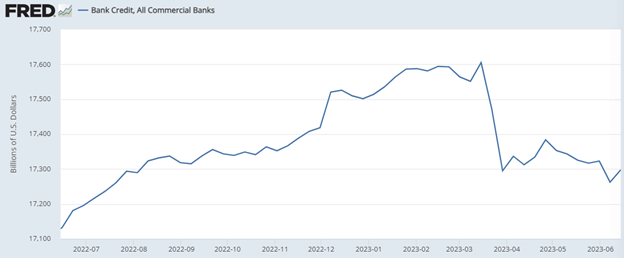
First, let’s look at the trend in bank credit values overall:

As seen above, total bank credit has declined from $17.6 trillion prior to the failure of Silicon Valley Bank to $17.3 trillion today.  Let’s now evaluate each sub-category to locate the sources of reduction:

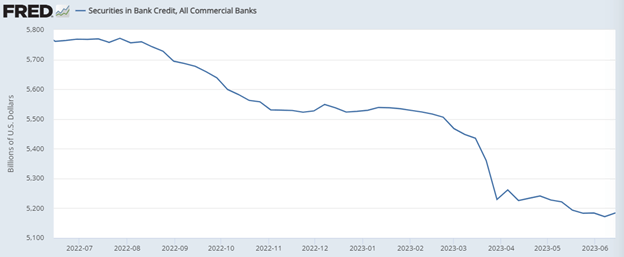
Loans to Government (Securities):

Over the past year, as the Federal Reserve increased interest rates to battle inflation, the value of securities on bank balance sheets (mostly Treasuries) fell significantly.  Since the SVB failure, banks have shed $250 billion in securities asset value accounting for 80% of credit reduction.

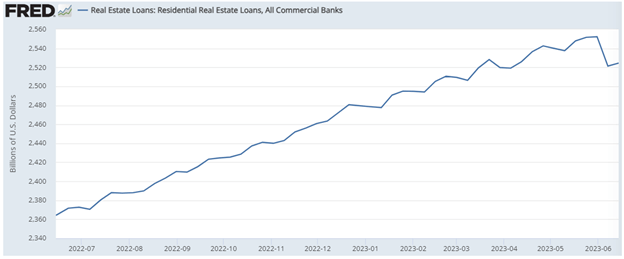
Loans for Personal Real Estate (Consumer Real Estate Loans):

Despite the relentless rise in interest rates, credit remains robust for residential real estate.

Loans for Business (Commercial and Industrial):

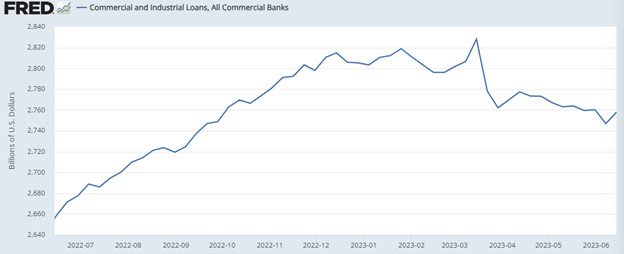
Here we do see more credit reticence post SVB.  This comports with the tightening of lending standards on commercial and industrial loans often cited by economists and marginally higher delinquency rates.  However, business lending only accounts for 16% of credit overall, making the post-SVB drawdown of $70 billion manageable.

Loans for Business Real Estate (Commercial Real Estate):

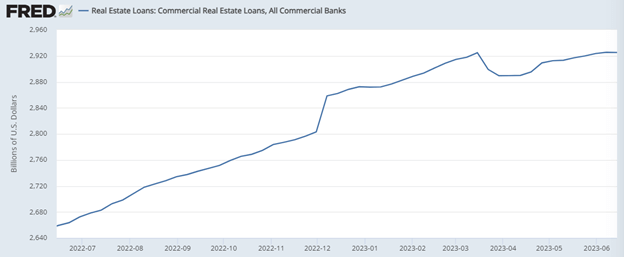
Surprised?  Yes, since the failure of SVB, total credit values for commercial real estate have RISEN.  While many have concerns about credit conditions beneath commercial real estate (particularly office and urban core retail), banks have underwritten these lines very conservatively.  Before the housing crisis, banks underwrote nearly all the acquisition costs for homebuyers… remember the No Income, No Job, NINJA loans?!  Any decrease in value left the homeowner with negative equity and banks positioned to absorb the losses.  Today, banks require real estate developers to contribute significant levels of equity, insulating them from sizable losses.  To underscore this point, the Fed’s recent stress test marked commercial real estate holdings down 40%, far more than the markdowns seen during the Great Financial Crisis, and yet, all the banks tested passed.

Loans for Consumers (Consumer Loans):

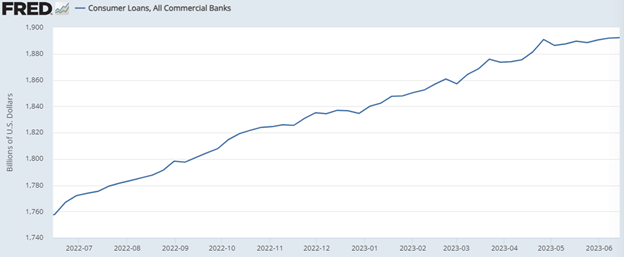
Consistent with the credit conditions for personal real estate, the taps remain wide open for consumers.  This makes sense given the excess savings, low unemployment rates, and rising real disposable incomes for US households.  While rates have risen, debt service levels for US consumers stand 27% below where they stood before the great recession, making today’s consumers much more creditworthy.

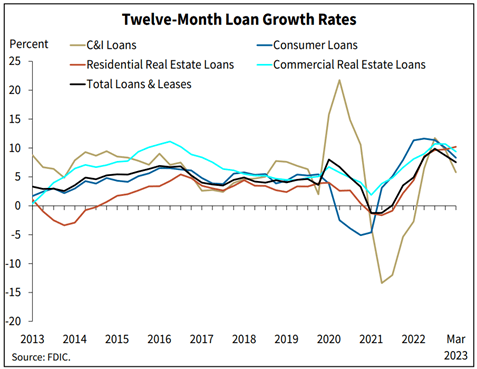
In sum, while bank assets (loans) have declined by $308 billion since the failure of SVB, the declines reside within loans to the government ($251 billion) and loans to businesses ($71 billion).  Credit values for consumers and private and commercial real estate remain robust, and loan growth rates remain above pre-crisis levels… providing continued ballast beneath the US economy.

Have a great weekend!

David S. Waddell  

CEO, Chief Investment Strategist

Sources:  FRED, FDIC
">
July 2, 2023

Bank Credit (Assets):

Banks categorize credit at granular levels, but to assess macro conditions, let’s focus on loans to the government, businesses, personal real estate, commercial real estate, and consumers.  Banks also loan to each other and use funds for in-house trading accounts, etc., but these “other” categories have idiosyncratic drivers, so we’ve excluded them.

First, let’s look at the trend in bank credit values overall:

As seen above, total bank credit has declined from $17.6 trillion prior to the failure of Silicon Valley Bank to $17.3 trillion today.  Let’s now evaluate each sub-category to locate the sources of reduction:

Loans to Government (Securities):

Over the past year, as the Federal Reserve increased interest rates to battle inflation, the value of securities on bank balance sheets (mostly Treasuries) fell significantly.  Since the SVB failure, banks have shed $250 billion in securities asset value accounting for 80% of credit reduction.

Loans for Personal Real Estate (Consumer Real Estate Loans):

Despite the relentless rise in interest rates, credit remains robust for residential real estate.

Loans for Business (Commercial and Industrial):

Here we do see more credit reticence post SVB.  This comports with the tightening of lending standards on commercial and industrial loans often cited by economists and marginally higher delinquency rates.  However, business lending only accounts for 16% of credit overall, making the post-SVB drawdown of $70 billion manageable.

Loans for Business Real Estate (Commercial Real Estate):

Surprised?  Yes, since the failure of SVB, total credit values for commercial real estate have RISEN.  While many have concerns about credit conditions beneath commercial real estate (particularly office and urban core retail), banks have underwritten these lines very conservatively.  Before the housing crisis, banks underwrote nearly all the acquisition costs for homebuyers… remember the No Income, No Job, NINJA loans?!  Any decrease in value left the homeowner with negative equity and banks positioned to absorb the losses.  Today, banks require real estate developers to contribute significant levels of equity, insulating them from sizable losses.  To underscore this point, the Fed’s recent stress test marked commercial real estate holdings down 40%, far more than the markdowns seen during the Great Financial Crisis, and yet, all the banks tested passed.

Loans for Consumers (Consumer Loans):

Consistent with the credit conditions for personal real estate, the taps remain wide open for consumers.  This makes sense given the excess savings, low unemployment rates, and rising real disposable incomes for US households.  While rates have risen, debt service levels for US consumers stand 27% below where they stood before the great recession, making today’s consumers much more creditworthy.

In sum, while bank assets (loans) have declined by $308 billion since the failure of SVB, the declines reside within loans to the government ($251 billion) and loans to businesses ($71 billion).  Credit values for consumers and private and commercial real estate remain robust, and loan growth rates remain above pre-crisis levels… providing continued ballast beneath the US economy.

Have a great weekend!

David S. Waddell  

CEO, Chief Investment Strategist

Sources:  FRED, FDIC
">To Lend or Not to Lend?

Bank Credit (Assets):

Banks categorize credit at granular levels, but to assess macro conditions, let’s focus on loans to the government, businesses, personal real estate, commercial real estate, and consumers.  Banks also loan to each other and use funds for in-house trading accounts, etc., but these “other” categories have idiosyncratic drivers, so we’ve excluded them.

First, let’s look at the trend in bank credit values overall:

As seen above, total bank credit has declined from $17.6 trillion prior to the failure of Silicon Valley Bank to $17.3 trillion today.  Let’s now evaluate each sub-category to locate the sources of reduction:

Loans to Government (Securities):

Over the past year, as the Federal Reserve increased interest rates to battle inflation, the value of securities on bank balance sheets (mostly Treasuries) fell significantly.  Since the SVB failure, banks have shed $250 billion in securities asset value accounting for 80% of credit reduction.

Loans for Personal Real Estate (Consumer Real Estate Loans):

Despite the relentless rise in interest rates, credit remains robust for residential real estate.

Loans for Business (Commercial and Industrial):

Here we do see more credit reticence post SVB.  This comports with the tightening of lending standards on commercial and industrial loans often cited by economists and marginally higher delinquency rates.  However, business lending only accounts for 16% of credit overall, making the post-SVB drawdown of $70 billion manageable.

Loans for Business Real Estate (Commercial Real Estate):

Surprised?  Yes, since the failure of SVB, total credit values for commercial real estate have RISEN.  While many have concerns about credit conditions beneath commercial real estate (particularly office and urban core retail), banks have underwritten these lines very conservatively.  Before the housing crisis, banks underwrote nearly all the acquisition costs for homebuyers… remember the No Income, No Job, NINJA loans?!  Any decrease in value left the homeowner with negative equity and banks positioned to absorb the losses.  Today, banks require real estate developers to contribute significant levels of equity, insulating them from sizable losses.  To underscore this point, the Fed’s recent stress test marked commercial real estate holdings down 40%, far more than the markdowns seen during the Great Financial Crisis, and yet, all the banks tested passed.

Loans for Consumers (Consumer Loans):

Consistent with the credit conditions for personal real estate, the taps remain wide open for consumers.  This makes sense given the excess savings, low unemployment rates, and rising real disposable incomes for US households.  While rates have risen, debt service levels for US consumers stand 27% below where they stood before the great recession, making today’s consumers much more creditworthy.

In sum, while bank assets (loans) have declined by $308 billion since the failure of SVB, the declines reside within loans to the government ($251 billion) and loans to businesses ($71 billion).  Credit values for consumers and private and commercial real estate remain robust, and loan growth rates remain above pre-crisis levels… providing continued ballast beneath the US economy.

Have a great weekend!

David S. Waddell  

CEO, Chief Investment Strategist

Sources:  FRED, FDIC
" class="link-chevron"> Watch Now
https://www.wealthstrategists.com/wp-content/uploads/2023/06/WSI_6_18_23.mp3

The Full Story:

This week the Federal Reserve paused its interest rate hiking campaign while tightening its rhetoric. The algorithms sold the bark aggressively, with immediacy, while the humans bought the lack of bite aggressively, with delay. By the end of the week, the S&P stood 3% above where it began. For investors clinging to their pessimism like rosary beads, this rally has become excruciating.

The second quarter ends in two weeks with the S&P now up 16% on the year. Clients will open statements expecting returns. Pressures will mount upon pessimistic professionals to either double down on their pessimistic forecasts or capitulate. Within the past two weeks, the economy has shown resilience, inflation has slowed substantially, the Fed has hit pause, and forward earnings estimates are rising. While this market has become highly technically overbought, pullbacks will provide cover for capitulators, likely limiting their severity. But where will the money go?

Beyond the Hype

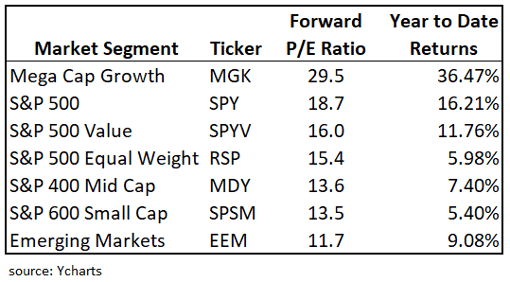
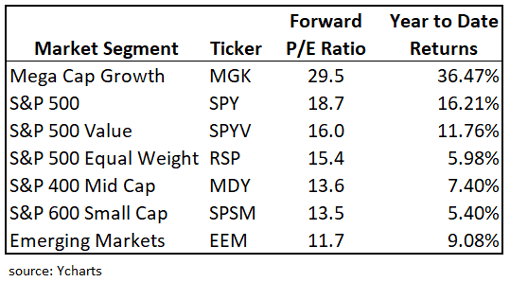
Despite the hype, those now entering the stock market supermarket will find some surprising bargains. They will not find them in the AI aisle, but they will find them nearly everywhere else. Consider the following valuations across investable market segments along with their year-to-date returns:

A chart listing PE Ratios and Year to Date Returns on Market Segments

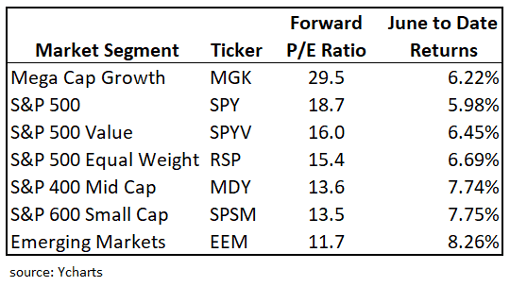
The valuation and performance differential between the mega cap driven S&P 500 and the non-S&P 500 segments provide ample mean reversion opportunities. For the mean to revert, either the megas need to catch down, or the rest of the market needs to catch up. Given the revival in economic and earnings confidence over the past couple of weeks, the catch-up trade has cause and traction. Note the June performance for the groups above:

A chart listing PE Ratios and Year to Date Returns on Market Segments

For those who feel they may have “missed it”, the valuations and trailing returns for the non-S&P 500 segments appear anything but frothy. Should recession severity fears abate, the rise of the rest provides plenty of opportunity for capitulators to get involved.

The Dis-Inflation Motivation

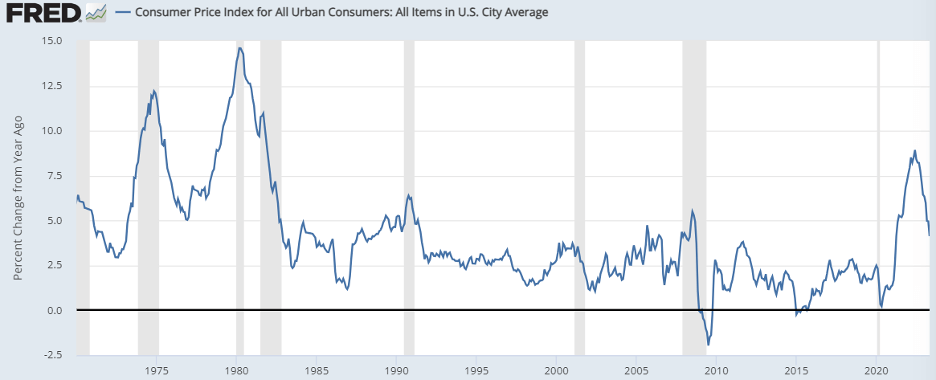
Tuesday’s Consumer Price Index release buoyed the market and cemented the Fed. As a huge fan of symmetry, I thought I would share this chart:

A chart showing the consumer price index for all urban consumers since the 1970s

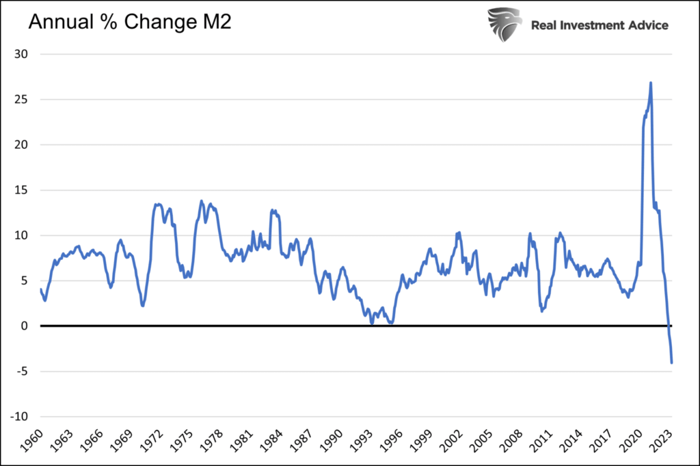
This chart chronicles the annual change for the Consumer Price Index over the last 50 years. Note that inflation never tends to hang around at highly elevated levels. On their own, higher prices crush demand which, in turn, leads to lower prices. Additionally, the Federal Reserve has a constitutional obligation to vigorously manage price levels. The combination of the two makes the persistently elevated inflation called for by the pessimists unlikely and historically unprecedented. Even in the 1970’s when the Fed had no experience managing money due to the recently terminated gold standard, peak inflation levels led to symmetrical troughs. The chart below chronicles the annual change in money supply (M2) going back to 1960:

Chart showing annual change in money supply since 1960

Note the roughly 10% annual growth for US money supply in the 1970’s. This monetary mismanagement led to higher-than-average inflation rates for a decade. Even still, while average levels were higher, the inflationary spikes seen in 1975 and 1979 corrected symmetrically. Fast forward to today. COVID stimulus policies led to an astounding 30% growth rate for US money supply. But unlike in the 1970’s, this policy profligacy rapidly reversed.

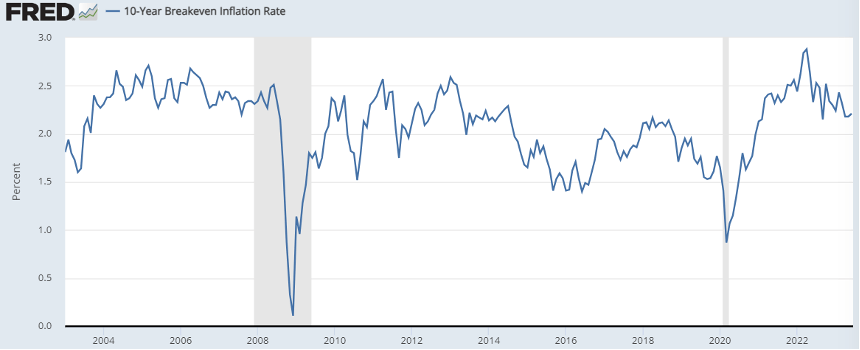
US money supply is now shrinking for the first time since the Great Depression. As a result, inflation has fallen even faster than it climbed. It took 14 months for this cycle’s inflation to climb from 4.1% to 9% and only 11 months for inflation to fall from 9% back to 4.1%. We will likely see 3% inflation in June, a level we haven’t seen since March of 2021. And just to further validate my simplistic “what goes up must come down” inflation hypothesis, markets agree, placing the 10 year forward inflation breakeven rate right at the Fed’s target of 2.2%:

A chart showing the 10 year breakeven inflation rate going back to 2004.

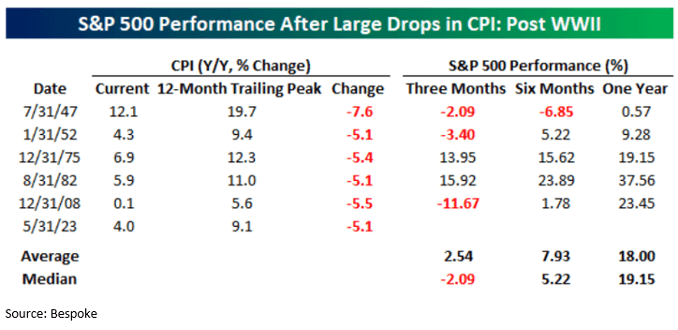
My point here is that inflation’s downward momentum has taken hold and inflation will continue to fall. It’s both science and policy at this point. And historically, periods of rapid disinflation have been followed by periods of robust investor returns:

A chart showing S&P Performance after large drops in CPI post WWII

Have a great weekend

David S. Waddell  

CEO, Chief Investment Strategist

Sources:  FRED, YCharts, Bespoke
">
June 18, 2023
https://www.wealthstrategists.com/wp-content/uploads/2023/06/WSI_6_18_23.mp3

The Full Story:

This week the Federal Reserve paused its interest rate hiking campaign while tightening its rhetoric. The algorithms sold the bark aggressively, with immediacy, while the humans bought the lack of bite aggressively, with delay. By the end of the week, the S&P stood 3% above where it began. For investors clinging to their pessimism like rosary beads, this rally has become excruciating.

The second quarter ends in two weeks with the S&P now up 16% on the year. Clients will open statements expecting returns. Pressures will mount upon pessimistic professionals to either double down on their pessimistic forecasts or capitulate. Within the past two weeks, the economy has shown resilience, inflation has slowed substantially, the Fed has hit pause, and forward earnings estimates are rising. While this market has become highly technically overbought, pullbacks will provide cover for capitulators, likely limiting their severity. But where will the money go?

Beyond the Hype

Despite the hype, those now entering the stock market supermarket will find some surprising bargains. They will not find them in the AI aisle, but they will find them nearly everywhere else. Consider the following valuations across investable market segments along with their year-to-date returns:

A chart listing PE Ratios and Year to Date Returns on Market Segments

The valuation and performance differential between the mega cap driven S&P 500 and the non-S&P 500 segments provide ample mean reversion opportunities. For the mean to revert, either the megas need to catch down, or the rest of the market needs to catch up. Given the revival in economic and earnings confidence over the past couple of weeks, the catch-up trade has cause and traction. Note the June performance for the groups above:

A chart listing PE Ratios and Year to Date Returns on Market Segments

For those who feel they may have “missed it”, the valuations and trailing returns for the non-S&P 500 segments appear anything but frothy. Should recession severity fears abate, the rise of the rest provides plenty of opportunity for capitulators to get involved.

The Dis-Inflation Motivation

Tuesday’s Consumer Price Index release buoyed the market and cemented the Fed. As a huge fan of symmetry, I thought I would share this chart:

A chart showing the consumer price index for all urban consumers since the 1970s

This chart chronicles the annual change for the Consumer Price Index over the last 50 years. Note that inflation never tends to hang around at highly elevated levels. On their own, higher prices crush demand which, in turn, leads to lower prices. Additionally, the Federal Reserve has a constitutional obligation to vigorously manage price levels. The combination of the two makes the persistently elevated inflation called for by the pessimists unlikely and historically unprecedented. Even in the 1970’s when the Fed had no experience managing money due to the recently terminated gold standard, peak inflation levels led to symmetrical troughs. The chart below chronicles the annual change in money supply (M2) going back to 1960:

Chart showing annual change in money supply since 1960

Note the roughly 10% annual growth for US money supply in the 1970’s. This monetary mismanagement led to higher-than-average inflation rates for a decade. Even still, while average levels were higher, the inflationary spikes seen in 1975 and 1979 corrected symmetrically. Fast forward to today. COVID stimulus policies led to an astounding 30% growth rate for US money supply. But unlike in the 1970’s, this policy profligacy rapidly reversed.

US money supply is now shrinking for the first time since the Great Depression. As a result, inflation has fallen even faster than it climbed. It took 14 months for this cycle’s inflation to climb from 4.1% to 9% and only 11 months for inflation to fall from 9% back to 4.1%. We will likely see 3% inflation in June, a level we haven’t seen since March of 2021. And just to further validate my simplistic “what goes up must come down” inflation hypothesis, markets agree, placing the 10 year forward inflation breakeven rate right at the Fed’s target of 2.2%:

A chart showing the 10 year breakeven inflation rate going back to 2004.

My point here is that inflation’s downward momentum has taken hold and inflation will continue to fall. It’s both science and policy at this point. And historically, periods of rapid disinflation have been followed by periods of robust investor returns:

A chart showing S&P Performance after large drops in CPI post WWII

Have a great weekend

David S. Waddell  

CEO, Chief Investment Strategist

Sources:  FRED, YCharts, Bespoke
">The Rally of the Rest https://www.wealthstrategists.com/wp-content/uploads/2023/06/WSI_6_18_23.mp3

The Full Story:

This week the Federal Reserve paused its interest rate hiking campaign while tightening its rhetoric. The algorithms sold the bark aggressively, with immediacy, while the humans bought the lack of bite aggressively, with delay. By the end of the week, the S&P stood 3% above where it began. For investors clinging to their pessimism like rosary beads, this rally has become excruciating.

The second quarter ends in two weeks with the S&P now up 16% on the year. Clients will open statements expecting returns. Pressures will mount upon pessimistic professionals to either double down on their pessimistic forecasts or capitulate. Within the past two weeks, the economy has shown resilience, inflation has slowed substantially, the Fed has hit pause, and forward earnings estimates are rising. While this market has become highly technically overbought, pullbacks will provide cover for capitulators, likely limiting their severity. But where will the money go?

Beyond the Hype

Despite the hype, those now entering the stock market supermarket will find some surprising bargains. They will not find them in the AI aisle, but they will find them nearly everywhere else. Consider the following valuations across investable market segments along with their year-to-date returns:

A chart listing PE Ratios and Year to Date Returns on Market Segments

The valuation and performance differential between the mega cap driven S&P 500 and the non-S&P 500 segments provide ample mean reversion opportunities. For the mean to revert, either the megas need to catch down, or the rest of the market needs to catch up. Given the revival in economic and earnings confidence over the past couple of weeks, the catch-up trade has cause and traction. Note the June performance for the groups above:

A chart listing PE Ratios and Year to Date Returns on Market Segments

For those who feel they may have “missed it”, the valuations and trailing returns for the non-S&P 500 segments appear anything but frothy. Should recession severity fears abate, the rise of the rest provides plenty of opportunity for capitulators to get involved.

The Dis-Inflation Motivation

Tuesday’s Consumer Price Index release buoyed the market and cemented the Fed. As a huge fan of symmetry, I thought I would share this chart:

A chart showing the consumer price index for all urban consumers since the 1970s

This chart chronicles the annual change for the Consumer Price Index over the last 50 years. Note that inflation never tends to hang around at highly elevated levels. On their own, higher prices crush demand which, in turn, leads to lower prices. Additionally, the Federal Reserve has a constitutional obligation to vigorously manage price levels. The combination of the two makes the persistently elevated inflation called for by the pessimists unlikely and historically unprecedented. Even in the 1970’s when the Fed had no experience managing money due to the recently terminated gold standard, peak inflation levels led to symmetrical troughs. The chart below chronicles the annual change in money supply (M2) going back to 1960:

Chart showing annual change in money supply since 1960

Note the roughly 10% annual growth for US money supply in the 1970’s. This monetary mismanagement led to higher-than-average inflation rates for a decade. Even still, while average levels were higher, the inflationary spikes seen in 1975 and 1979 corrected symmetrically. Fast forward to today. COVID stimulus policies led to an astounding 30% growth rate for US money supply. But unlike in the 1970’s, this policy profligacy rapidly reversed.

US money supply is now shrinking for the first time since the Great Depression. As a result, inflation has fallen even faster than it climbed. It took 14 months for this cycle’s inflation to climb from 4.1% to 9% and only 11 months for inflation to fall from 9% back to 4.1%. We will likely see 3% inflation in June, a level we haven’t seen since March of 2021. And just to further validate my simplistic “what goes up must come down” inflation hypothesis, markets agree, placing the 10 year forward inflation breakeven rate right at the Fed’s target of 2.2%:

A chart showing the 10 year breakeven inflation rate going back to 2004.

My point here is that inflation’s downward momentum has taken hold and inflation will continue to fall. It’s both science and policy at this point. And historically, periods of rapid disinflation have been followed by periods of robust investor returns:

A chart showing S&P Performance after large drops in CPI post WWII

Have a great weekend

David S. Waddell  

CEO, Chief Investment Strategist

Sources:  FRED, YCharts, Bespoke
" class="link-chevron"> Watch Now

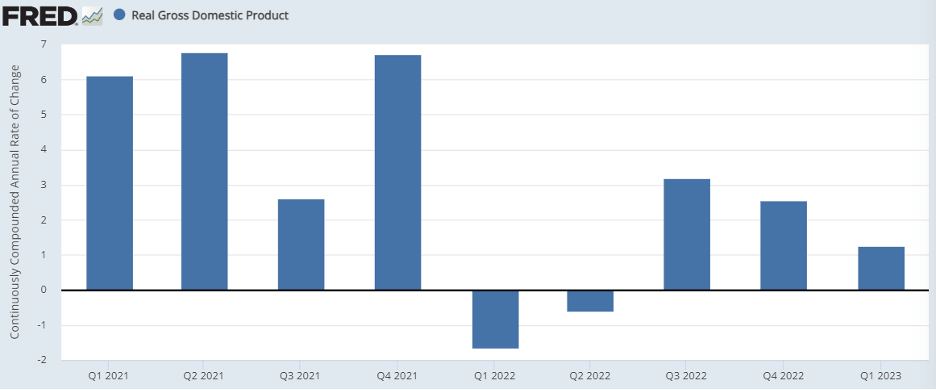
US GDP grew 6% in 2021, fueled by stimulus and cabin fever after the COVID growth collapse. Entering 2022, the economy contracted in real terms as inflation growth rates exceeded economic growth rates. Economists did not consider this an “official” recession due to the robust employment market and high consumer spending levels. Nonetheless, the two consecutive quarters of negative GDP met the traditional “recession” rule of thumb.

The reason I cite this is that the three-recession sequence isn’t as bewildering if you credit the economy with recessing early in 2022. Since then, however, inflation growth rates have fallen faster than economic growth rates leading to a rebound in real GDP growth, up 3.2% in Q322, 2.6% in Q422, 1.3% in Q123  and on pace for another lower, yet positive reading for Q223. Taken collectively, the US economy has achieved less than a 1% growth rate over the last six quarters. While we have yet to officially enter recession, we wouldn’t have to slow much to enter one. Remember, the Federal Reserve called for recession as the antidote for our inflation infection. With recession as policy, no one would be surprised by its arrival… and in fact, in some ways we have already accounted for it… as follows.

Market Recession

Stock market performance today reflects investor projections of the future. When the Fed declared its war on inflation a year ago, investors had to incorporate recession projections into market prices. Historically, over the last 12 recessions, the S&P 500 fell 24% at the median. Consequently, between January and October of 2022, investors marked down US stock prices 25%. Mission accomplished! With the market recession accomplished, the market recovery could begin. Referring back to history, following those recessions, stocks rose 26%, at the median, over the next 12 months. As of Thursday’s close, the S&P stands 23% above its intraday October low. Mission nearly accomplished! While the economic recession hasn’t occurred yet, the market recession already has.

Earnings Recession

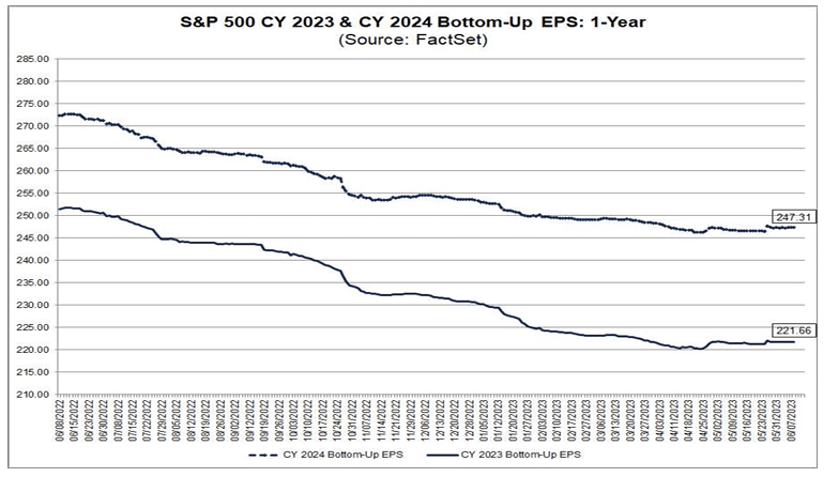
Once the Fed declared recession as a policy, analysts began marking down earnings expectations. Non-inflation-adjusted earnings (the only way they are reported) peaked in Q222. Typically, in recessions, S&P 500 earnings fall 13%, at the median. Knowing this, analysts quickly marked down earnings expectations 10% off of those peak levels. While earnings have declined, the declines have been more minor than feared. In fact, last quarter could mark the nadir with earnings contracting only 6%. Analysts peering into next year see earnings rising 12.4%. Perhaps those numbers are too high as the future is hard to predict. However, it’s the trend that spends and analysts have been raising forecasts, further underpinning this market rally:

Line graph depicting S and P 500 CY 2023 and CY 2024 Bottom-Up EPS 1 Year

While still within an earnings recession, analysts believe we are closer to the end than the beginning.

Enjoy your Sunday!

David S. Waddell  

CEO, Chief Investment Strategist

Sources:  FRED, FactSet
">
June 9, 2023

US GDP grew 6% in 2021, fueled by stimulus and cabin fever after the COVID growth collapse. Entering 2022, the economy contracted in real terms as inflation growth rates exceeded economic growth rates. Economists did not consider this an “official” recession due to the robust employment market and high consumer spending levels. Nonetheless, the two consecutive quarters of negative GDP met the traditional “recession” rule of thumb.

The reason I cite this is that the three-recession sequence isn’t as bewildering if you credit the economy with recessing early in 2022. Since then, however, inflation growth rates have fallen faster than economic growth rates leading to a rebound in real GDP growth, up 3.2% in Q322, 2.6% in Q422, 1.3% in Q123  and on pace for another lower, yet positive reading for Q223. Taken collectively, the US economy has achieved less than a 1% growth rate over the last six quarters. While we have yet to officially enter recession, we wouldn’t have to slow much to enter one. Remember, the Federal Reserve called for recession as the antidote for our inflation infection. With recession as policy, no one would be surprised by its arrival… and in fact, in some ways we have already accounted for it… as follows.

Market Recession

Stock market performance today reflects investor projections of the future. When the Fed declared its war on inflation a year ago, investors had to incorporate recession projections into market prices. Historically, over the last 12 recessions, the S&P 500 fell 24% at the median. Consequently, between January and October of 2022, investors marked down US stock prices 25%. Mission accomplished! With the market recession accomplished, the market recovery could begin. Referring back to history, following those recessions, stocks rose 26%, at the median, over the next 12 months. As of Thursday’s close, the S&P stands 23% above its intraday October low. Mission nearly accomplished! While the economic recession hasn’t occurred yet, the market recession already has.

Earnings Recession

Once the Fed declared recession as a policy, analysts began marking down earnings expectations. Non-inflation-adjusted earnings (the only way they are reported) peaked in Q222. Typically, in recessions, S&P 500 earnings fall 13%, at the median. Knowing this, analysts quickly marked down earnings expectations 10% off of those peak levels. While earnings have declined, the declines have been more minor than feared. In fact, last quarter could mark the nadir with earnings contracting only 6%. Analysts peering into next year see earnings rising 12.4%. Perhaps those numbers are too high as the future is hard to predict. However, it’s the trend that spends and analysts have been raising forecasts, further underpinning this market rally:

Line graph depicting S and P 500 CY 2023 and CY 2024 Bottom-Up EPS 1 Year

While still within an earnings recession, analysts believe we are closer to the end than the beginning.

Enjoy your Sunday!

David S. Waddell  

CEO, Chief Investment Strategist

Sources:  FRED, FactSet
">The Three Recessions

US GDP grew 6% in 2021, fueled by stimulus and cabin fever after the COVID growth collapse. Entering 2022, the economy contracted in real terms as inflation growth rates exceeded economic growth rates. Economists did not consider this an “official” recession due to the robust employment market and high consumer spending levels. Nonetheless, the two consecutive quarters of negative GDP met the traditional “recession” rule of thumb.

The reason I cite this is that the three-recession sequence isn’t as bewildering if you credit the economy with recessing early in 2022. Since then, however, inflation growth rates have fallen faster than economic growth rates leading to a rebound in real GDP growth, up 3.2% in Q322, 2.6% in Q422, 1.3% in Q123  and on pace for another lower, yet positive reading for Q223. Taken collectively, the US economy has achieved less than a 1% growth rate over the last six quarters. While we have yet to officially enter recession, we wouldn’t have to slow much to enter one. Remember, the Federal Reserve called for recession as the antidote for our inflation infection. With recession as policy, no one would be surprised by its arrival… and in fact, in some ways we have already accounted for it… as follows.

Market Recession

Stock market performance today reflects investor projections of the future. When the Fed declared its war on inflation a year ago, investors had to incorporate recession projections into market prices. Historically, over the last 12 recessions, the S&P 500 fell 24% at the median. Consequently, between January and October of 2022, investors marked down US stock prices 25%. Mission accomplished! With the market recession accomplished, the market recovery could begin. Referring back to history, following those recessions, stocks rose 26%, at the median, over the next 12 months. As of Thursday’s close, the S&P stands 23% above its intraday October low. Mission nearly accomplished! While the economic recession hasn’t occurred yet, the market recession already has.

Earnings Recession

Once the Fed declared recession as a policy, analysts began marking down earnings expectations. Non-inflation-adjusted earnings (the only way they are reported) peaked in Q222. Typically, in recessions, S&P 500 earnings fall 13%, at the median. Knowing this, analysts quickly marked down earnings expectations 10% off of those peak levels. While earnings have declined, the declines have been more minor than feared. In fact, last quarter could mark the nadir with earnings contracting only 6%. Analysts peering into next year see earnings rising 12.4%. Perhaps those numbers are too high as the future is hard to predict. However, it’s the trend that spends and analysts have been raising forecasts, further underpinning this market rally:

Line graph depicting S and P 500 CY 2023 and CY 2024 Bottom-Up EPS 1 Year

While still within an earnings recession, analysts believe we are closer to the end than the beginning.

Enjoy your Sunday!

David S. Waddell  

CEO, Chief Investment Strategist

Sources:  FRED, FactSet
" class="link-chevron"> Watch Now

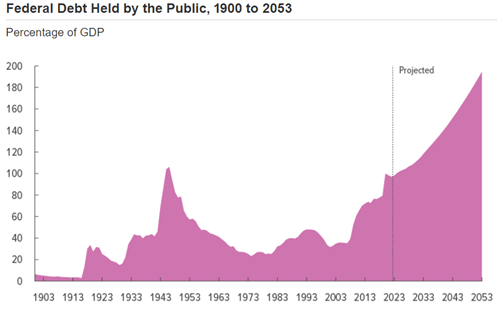
And just to further salt the wound, here is CBO’s estimate of total government debt to GDP over the next 30 years:

Great job, guys!

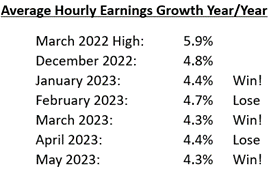
Friday’s unemployment report contained many contradictions. While US employers reported adding 339,000 new employees, US households reported their unemployment status deteriorated from 3.4% unemployed to 3.7% unemployed. This divergence has led to intense head-scratching, but for our purposes, it’s academic. They use two different survey methods that periodically disagree. What matters most to the Fed is the trajectory of wages. As we entered 2023, we anointed average hourly earnings as the most important data point for the year. With 12 months in the year, that means 12 innings in our Wage Bowl (yes, I realized I mixed metaphors, hang with me). The Fed declared wage inflation the root cause of persistent inflation and, therefore, the target of their tightening. Should wages fall more than they rise, Fed policy will loosen… WIN. Should wages rise more than they fall, Fed policy will tighten… LOSE. It’s binary. Now, let’s check the score!

Wages have fallen sequentially in three of the reports while rising in two, for a slim advantage. However, the current level of 4.3% stands .5% below the December season opener for a wage inflation decline of 10%. Furthermore, the 4.3% level matches the lowest level since July of 2021, before all of this inflation consternation began. The Fed wants this number to fall to 3%. At the current pace, that would occur in about a year, assuming economic growth remained at this level. Any deceleration in the economy would lead to a further slowdown in wage inflation. So, if the Fed is in a hurry, they can force recession, but why be in a hurry when the trend is your friend?  This reinforces the case for a rate pause in June. The market agrees as the odds of a June rate hike have fallen to 35%. If that proves true, it’s time to dust off our “what happens historically when the Fed pauses” playbook:

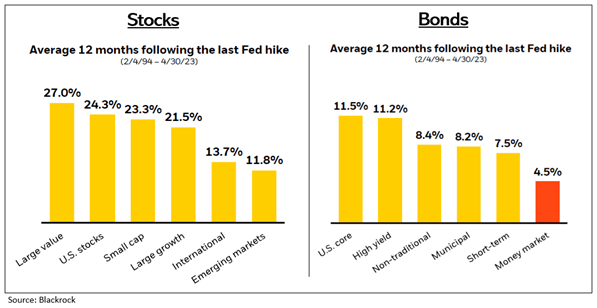
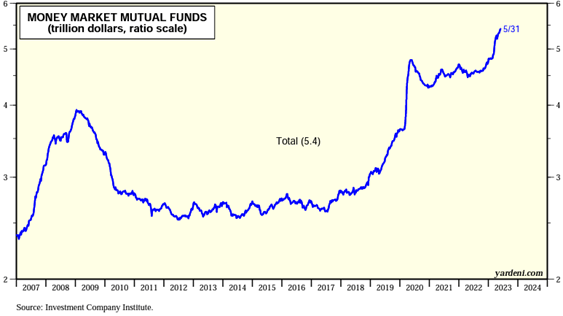
Over the last 30 years of data, rate pauses have proven highly profitable for investors. US stock investors have seen 24% average gains, while US bond investors have seen 11% gains. Both of these well exceed the historical return on money market funds over the time period. That’s something to ponder with Money Market Funds currently at historic levels:

They say history doesn’t repeat itself, but if it rhymes, this rally has plenty of fuel to burn.

Have a great weekend!

David S. Waddell  

CEO, Chief Investment Strategist

Sources:  Yardeni, Blackrock, CBO.gov
">
June 2, 2023

And just to further salt the wound, here is CBO’s estimate of total government debt to GDP over the next 30 years:

Great job, guys!

Friday’s unemployment report contained many contradictions. While US employers reported adding 339,000 new employees, US households reported their unemployment status deteriorated from 3.4% unemployed to 3.7% unemployed. This divergence has led to intense head-scratching, but for our purposes, it’s academic. They use two different survey methods that periodically disagree. What matters most to the Fed is the trajectory of wages. As we entered 2023, we anointed average hourly earnings as the most important data point for the year. With 12 months in the year, that means 12 innings in our Wage Bowl (yes, I realized I mixed metaphors, hang with me). The Fed declared wage inflation the root cause of persistent inflation and, therefore, the target of their tightening. Should wages fall more than they rise, Fed policy will loosen… WIN. Should wages rise more than they fall, Fed policy will tighten… LOSE. It’s binary. Now, let’s check the score!

Wages have fallen sequentially in three of the reports while rising in two, for a slim advantage. However, the current level of 4.3% stands .5% below the December season opener for a wage inflation decline of 10%. Furthermore, the 4.3% level matches the lowest level since July of 2021, before all of this inflation consternation began. The Fed wants this number to fall to 3%. At the current pace, that would occur in about a year, assuming economic growth remained at this level. Any deceleration in the economy would lead to a further slowdown in wage inflation. So, if the Fed is in a hurry, they can force recession, but why be in a hurry when the trend is your friend?  This reinforces the case for a rate pause in June. The market agrees as the odds of a June rate hike have fallen to 35%. If that proves true, it’s time to dust off our “what happens historically when the Fed pauses” playbook:

Over the last 30 years of data, rate pauses have proven highly profitable for investors. US stock investors have seen 24% average gains, while US bond investors have seen 11% gains. Both of these well exceed the historical return on money market funds over the time period. That’s something to ponder with Money Market Funds currently at historic levels:

They say history doesn’t repeat itself, but if it rhymes, this rally has plenty of fuel to burn.

Have a great weekend!

David S. Waddell  

CEO, Chief Investment Strategist

Sources:  Yardeni, Blackrock, CBO.gov
">Wage Bowl!

And just to further salt the wound, here is CBO’s estimate of total government debt to GDP over the next 30 years:

Great job, guys!

Friday’s unemployment report contained many contradictions. While US employers reported adding 339,000 new employees, US households reported their unemployment status deteriorated from 3.4% unemployed to 3.7% unemployed. This divergence has led to intense head-scratching, but for our purposes, it’s academic. They use two different survey methods that periodically disagree. What matters most to the Fed is the trajectory of wages. As we entered 2023, we anointed average hourly earnings as the most important data point for the year. With 12 months in the year, that means 12 innings in our Wage Bowl (yes, I realized I mixed metaphors, hang with me). The Fed declared wage inflation the root cause of persistent inflation and, therefore, the target of their tightening. Should wages fall more than they rise, Fed policy will loosen… WIN. Should wages rise more than they fall, Fed policy will tighten… LOSE. It’s binary. Now, let’s check the score!

Wages have fallen sequentially in three of the reports while rising in two, for a slim advantage. However, the current level of 4.3% stands .5% below the December season opener for a wage inflation decline of 10%. Furthermore, the 4.3% level matches the lowest level since July of 2021, before all of this inflation consternation began. The Fed wants this number to fall to 3%. At the current pace, that would occur in about a year, assuming economic growth remained at this level. Any deceleration in the economy would lead to a further slowdown in wage inflation. So, if the Fed is in a hurry, they can force recession, but why be in a hurry when the trend is your friend?  This reinforces the case for a rate pause in June. The market agrees as the odds of a June rate hike have fallen to 35%. If that proves true, it’s time to dust off our “what happens historically when the Fed pauses” playbook:

Over the last 30 years of data, rate pauses have proven highly profitable for investors. US stock investors have seen 24% average gains, while US bond investors have seen 11% gains. Both of these well exceed the historical return on money market funds over the time period. That’s something to ponder with Money Market Funds currently at historic levels:

They say history doesn’t repeat itself, but if it rhymes, this rally has plenty of fuel to burn.

Have a great weekend!

David S. Waddell  

CEO, Chief Investment Strategist

Sources:  Yardeni, Blackrock, CBO.gov
" class="link-chevron"> Watch Now
https://www.wealthstrategists.com/wp-content/uploads/2023/05/WSI_5_21_23.mp3

The Full Story:

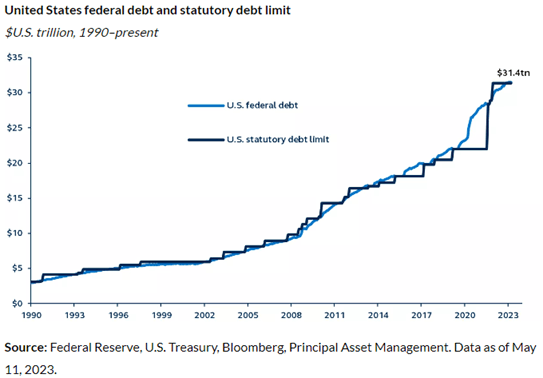
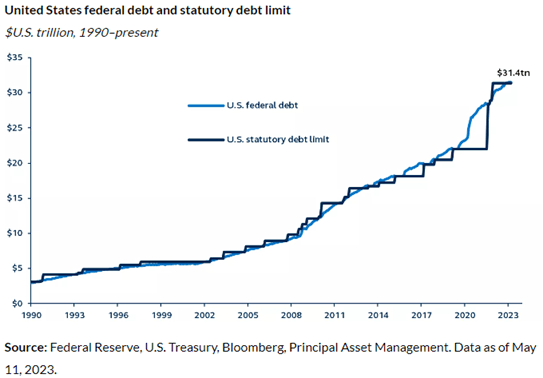
In 2008 and 2009, the Government took unprecedented actions to offset the Great Financial Crisis. Congress authorized the distribution of nearly $1 trillion in fiscal stimulus, while the Federal Reserve cut interest rates to zero and printed and injected $1 trillion+ in quantitative easing. This level of Government intervention in reaction to a “100-year economic event” shocked many market observers. Books filled shelves with writings about fiscal recklessness, financial profiteering, and Government overreach. Bailout Nation, Contagion, Endgame, The Big Short, The Sellout, and countless more sit on my shelves in a strong rebuke to what led to and what prevented the GFC. Occupy Wall Street Protests hit the streets, and the Tea Party hit the hill. Suddenly everyone became hyper-aware and hyper-sensitive to the Government deficits and accumulated debt. Warnings of hyperinflation, record interest rates, and collapsing dollars captivated audiences and nurtured the public animus that metastasized into the Obama vs. Tea Party debt limit stalemate in 2011. Ultimately, the parties found common ground, but not before Standard and Poor’s downgraded US Treasury debt, not upon fundamental merits, but in recognition of legislative dysfunction. Therein lies the crux. The chart below captures not only how much debt the US has accumulated since 1990 but also how many times legislators have fought and agreed to raise the limit.

Therefore, as the post-COVID debt ceiling crisis rages, the right question to ask is… does the US have a debt problem or a legislative problem?

The Fiat Effect

President Nixon closed the gold window in 1971, effectively ending the US Dollar’s convertibility into gold. This removed many legislative and monetary restraints and forced the Federal Reserve and Congress into the fiat backstop role gold had played to date. Unsurprisingly, the stock of accumulated debt rose significantly over the next 50 years. In fact, when Nixon closed the gold window, the US Treasury owed bondholders $400 million versus $31 trillion today. Over the same period, US GDP grew from $1 trillion to $25 trillion. Therefore, while the economy grew by 25x, US Treasury debt grew 82x. This should have profoundly impacted currency values, inflation rates, and interest rates, as widely espoused. But did it?

The US Dollar

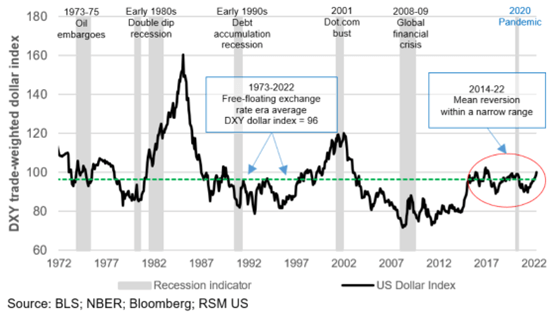
While US debt climbed 82x over the period, the US Dollar vacillated within a range of 60% higher to 30% lower. Today, the dollar sits slightly below its 1971 divorce from gold level and right at its 50-year average.

US Inflation Rates

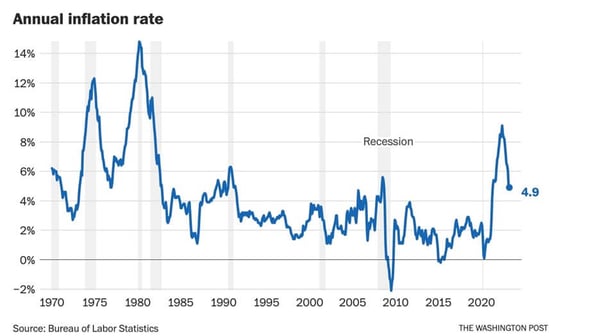
While COVID profligacy led to a recent spike in inflation, the Consumer Price Index today sits well below its 1970 comparison. So, while US Treasury debt levels climbed 82x over the period, average US inflation rates have fallen significantly.

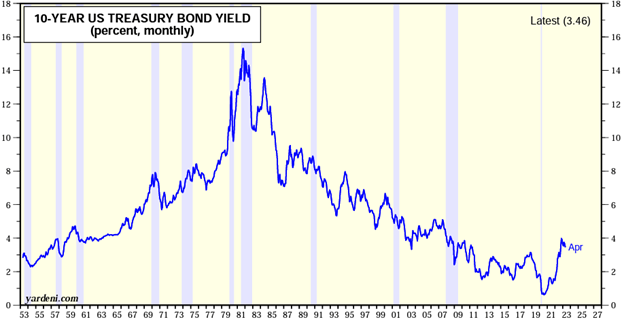
In alignment with the trajectory of US inflation rates, US interest rates have fallen since the 1970s, interrupted only by the COVID stimulus shock. So, while US Treasury debt levels climbed 82x over the period, US Treasury rates have fallen significantly.

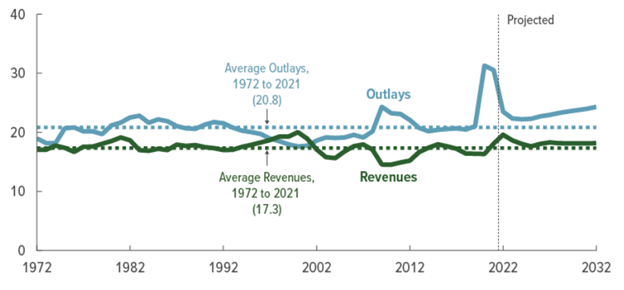
Remember, US Treasury debt grows only if the government spends more than it receives in tax revenues. Surprisingly, the percentage of each stream when compared with the size of the economy hasn’t changed that much since the 1970s:

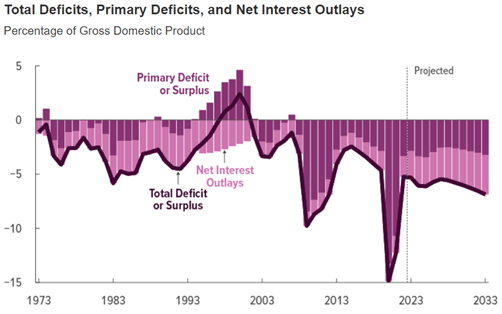
As you can see, tax revenues have hugged their long-term average for the last 50 years. In fact, under Bill Clinton and Newt Gingrich (remember that shutdown?), the US ran a budget surplus into the year 2000. Since then, most of the debt accumulation has occurred in reaction to the GFC and COVID. Going forward, the CBO does project spending will rise more than revenues as Medicare, Medicaid, and Social Security consume more of Federal finances without scope for equivalent offsets in discretionary spending. These programs require reform to adhere to our fiscal norms of 3% average deficits, which get conveniently erased by 3% average inflation.

In summary, the 82x spike in US Treasury debt has negative cognitive consequences but few obvious economic ones. The US Dollar has vacillated higher and lower within a range but sits at its long-term, post-gold-standard average today. US inflation rates have fallen from 6% in 1970 to 4.9% today on their way back to their pre-COVID 2% levels. US interest rates have fallen from 7.5% in 1970 to 3.5% today on their way back to their pre-COVID 2.5-3% levels. Meanwhile, the US economy grew 25x. Arguments can certainly be made that more Government means less productivity and that crowding out the private sector has societal consequences, and I believe that narrative. Still, it’s virtually impossible in economics to prove “what would have been.” Will the US Government reach a point where the global financial markets capitulate, expel the US dollar from their reserves, drive inflation to Weimar levels, and drive interest rates stratospheric? Maybe. But consider that Japan has a debt-to-GDP ratio of 230% versus our 130%, and issues 10-year Government bonds with interest rates of .4%. US Government debt dynamics do not resemble household debt dynamics. Our Grecian moment may exist… but it’s a long way from here.

So, while economists largely agree that the long-term path for US debt accumulation is “unsustainable,” no one knows where the limit lies. Furthermore, while the debt limit fosters annual political conflicts over sustainability, the debt limit always rises and will continue without sweeping entitlement reform. In reaction to political pressures, President Obama tasked the Simpson-Bowles Commission with designing a fiscal path to stabilize the debt. They did just that. Unfortunately, the political will did not exist at the time to turn the recommendations into legislation. But someday, this may change either through courage or through crisis. But for now, the US debt load causes more political problems than economic ones.

Have a great Sunday!

David S. Waddell  

CEO, Chief Investment Strategist

Sources:  Yardeni, The Washington Post, Bloomberg
">
May 20, 2023
https://www.wealthstrategists.com/wp-content/uploads/2023/05/WSI_5_21_23.mp3

The Full Story:

In 2008 and 2009, the Government took unprecedented actions to offset the Great Financial Crisis. Congress authorized the distribution of nearly $1 trillion in fiscal stimulus, while the Federal Reserve cut interest rates to zero and printed and injected $1 trillion+ in quantitative easing. This level of Government intervention in reaction to a “100-year economic event” shocked many market observers. Books filled shelves with writings about fiscal recklessness, financial profiteering, and Government overreach. Bailout Nation, Contagion, Endgame, The Big Short, The Sellout, and countless more sit on my shelves in a strong rebuke to what led to and what prevented the GFC. Occupy Wall Street Protests hit the streets, and the Tea Party hit the hill. Suddenly everyone became hyper-aware and hyper-sensitive to the Government deficits and accumulated debt. Warnings of hyperinflation, record interest rates, and collapsing dollars captivated audiences and nurtured the public animus that metastasized into the Obama vs. Tea Party debt limit stalemate in 2011. Ultimately, the parties found common ground, but not before Standard and Poor’s downgraded US Treasury debt, not upon fundamental merits, but in recognition of legislative dysfunction. Therein lies the crux. The chart below captures not only how much debt the US has accumulated since 1990 but also how many times legislators have fought and agreed to raise the limit.

Therefore, as the post-COVID debt ceiling crisis rages, the right question to ask is… does the US have a debt problem or a legislative problem?

The Fiat Effect

President Nixon closed the gold window in 1971, effectively ending the US Dollar’s convertibility into gold. This removed many legislative and monetary restraints and forced the Federal Reserve and Congress into the fiat backstop role gold had played to date. Unsurprisingly, the stock of accumulated debt rose significantly over the next 50 years. In fact, when Nixon closed the gold window, the US Treasury owed bondholders $400 million versus $31 trillion today. Over the same period, US GDP grew from $1 trillion to $25 trillion. Therefore, while the economy grew by 25x, US Treasury debt grew 82x. This should have profoundly impacted currency values, inflation rates, and interest rates, as widely espoused. But did it?

The US Dollar

While US debt climbed 82x over the period, the US Dollar vacillated within a range of 60% higher to 30% lower. Today, the dollar sits slightly below its 1971 divorce from gold level and right at its 50-year average.

US Inflation Rates

While COVID profligacy led to a recent spike in inflation, the Consumer Price Index today sits well below its 1970 comparison. So, while US Treasury debt levels climbed 82x over the period, average US inflation rates have fallen significantly.

In alignment with the trajectory of US inflation rates, US interest rates have fallen since the 1970s, interrupted only by the COVID stimulus shock. So, while US Treasury debt levels climbed 82x over the period, US Treasury rates have fallen significantly.

Remember, US Treasury debt grows only if the government spends more than it receives in tax revenues. Surprisingly, the percentage of each stream when compared with the size of the economy hasn’t changed that much since the 1970s:

As you can see, tax revenues have hugged their long-term average for the last 50 years. In fact, under Bill Clinton and Newt Gingrich (remember that shutdown?), the US ran a budget surplus into the year 2000. Since then, most of the debt accumulation has occurred in reaction to the GFC and COVID. Going forward, the CBO does project spending will rise more than revenues as Medicare, Medicaid, and Social Security consume more of Federal finances without scope for equivalent offsets in discretionary spending. These programs require reform to adhere to our fiscal norms of 3% average deficits, which get conveniently erased by 3% average inflation.

In summary, the 82x spike in US Treasury debt has negative cognitive consequences but few obvious economic ones. The US Dollar has vacillated higher and lower within a range but sits at its long-term, post-gold-standard average today. US inflation rates have fallen from 6% in 1970 to 4.9% today on their way back to their pre-COVID 2% levels. US interest rates have fallen from 7.5% in 1970 to 3.5% today on their way back to their pre-COVID 2.5-3% levels. Meanwhile, the US economy grew 25x. Arguments can certainly be made that more Government means less productivity and that crowding out the private sector has societal consequences, and I believe that narrative. Still, it’s virtually impossible in economics to prove “what would have been.” Will the US Government reach a point where the global financial markets capitulate, expel the US dollar from their reserves, drive inflation to Weimar levels, and drive interest rates stratospheric? Maybe. But consider that Japan has a debt-to-GDP ratio of 230% versus our 130%, and issues 10-year Government bonds with interest rates of .4%. US Government debt dynamics do not resemble household debt dynamics. Our Grecian moment may exist… but it’s a long way from here.

So, while economists largely agree that the long-term path for US debt accumulation is “unsustainable,” no one knows where the limit lies. Furthermore, while the debt limit fosters annual political conflicts over sustainability, the debt limit always rises and will continue without sweeping entitlement reform. In reaction to political pressures, President Obama tasked the Simpson-Bowles Commission with designing a fiscal path to stabilize the debt. They did just that. Unfortunately, the political will did not exist at the time to turn the recommendations into legislation. But someday, this may change either through courage or through crisis. But for now, the US debt load causes more political problems than economic ones.

Have a great Sunday!

David S. Waddell  

CEO, Chief Investment Strategist

Sources:  Yardeni, The Washington Post, Bloomberg
">The Debt Threat! https://www.wealthstrategists.com/wp-content/uploads/2023/05/WSI_5_21_23.mp3

The Full Story:

In 2008 and 2009, the Government took unprecedented actions to offset the Great Financial Crisis. Congress authorized the distribution of nearly $1 trillion in fiscal stimulus, while the Federal Reserve cut interest rates to zero and printed and injected $1 trillion+ in quantitative easing. This level of Government intervention in reaction to a “100-year economic event” shocked many market observers. Books filled shelves with writings about fiscal recklessness, financial profiteering, and Government overreach. Bailout Nation, Contagion, Endgame, The Big Short, The Sellout, and countless more sit on my shelves in a strong rebuke to what led to and what prevented the GFC. Occupy Wall Street Protests hit the streets, and the Tea Party hit the hill. Suddenly everyone became hyper-aware and hyper-sensitive to the Government deficits and accumulated debt. Warnings of hyperinflation, record interest rates, and collapsing dollars captivated audiences and nurtured the public animus that metastasized into the Obama vs. Tea Party debt limit stalemate in 2011. Ultimately, the parties found common ground, but not before Standard and Poor’s downgraded US Treasury debt, not upon fundamental merits, but in recognition of legislative dysfunction. Therein lies the crux. The chart below captures not only how much debt the US has accumulated since 1990 but also how many times legislators have fought and agreed to raise the limit.

Therefore, as the post-COVID debt ceiling crisis rages, the right question to ask is… does the US have a debt problem or a legislative problem?

The Fiat Effect

President Nixon closed the gold window in 1971, effectively ending the US Dollar’s convertibility into gold. This removed many legislative and monetary restraints and forced the Federal Reserve and Congress into the fiat backstop role gold had played to date. Unsurprisingly, the stock of accumulated debt rose significantly over the next 50 years. In fact, when Nixon closed the gold window, the US Treasury owed bondholders $400 million versus $31 trillion today. Over the same period, US GDP grew from $1 trillion to $25 trillion. Therefore, while the economy grew by 25x, US Treasury debt grew 82x. This should have profoundly impacted currency values, inflation rates, and interest rates, as widely espoused. But did it?

The US Dollar

While US debt climbed 82x over the period, the US Dollar vacillated within a range of 60% higher to 30% lower. Today, the dollar sits slightly below its 1971 divorce from gold level and right at its 50-year average.

US Inflation Rates

While COVID profligacy led to a recent spike in inflation, the Consumer Price Index today sits well below its 1970 comparison. So, while US Treasury debt levels climbed 82x over the period, average US inflation rates have fallen significantly.

In alignment with the trajectory of US inflation rates, US interest rates have fallen since the 1970s, interrupted only by the COVID stimulus shock. So, while US Treasury debt levels climbed 82x over the period, US Treasury rates have fallen significantly.

Remember, US Treasury debt grows only if the government spends more than it receives in tax revenues. Surprisingly, the percentage of each stream when compared with the size of the economy hasn’t changed that much since the 1970s:

As you can see, tax revenues have hugged their long-term average for the last 50 years. In fact, under Bill Clinton and Newt Gingrich (remember that shutdown?), the US ran a budget surplus into the year 2000. Since then, most of the debt accumulation has occurred in reaction to the GFC and COVID. Going forward, the CBO does project spending will rise more than revenues as Medicare, Medicaid, and Social Security consume more of Federal finances without scope for equivalent offsets in discretionary spending. These programs require reform to adhere to our fiscal norms of 3% average deficits, which get conveniently erased by 3% average inflation.

In summary, the 82x spike in US Treasury debt has negative cognitive consequences but few obvious economic ones. The US Dollar has vacillated higher and lower within a range but sits at its long-term, post-gold-standard average today. US inflation rates have fallen from 6% in 1970 to 4.9% today on their way back to their pre-COVID 2% levels. US interest rates have fallen from 7.5% in 1970 to 3.5% today on their way back to their pre-COVID 2.5-3% levels. Meanwhile, the US economy grew 25x. Arguments can certainly be made that more Government means less productivity and that crowding out the private sector has societal consequences, and I believe that narrative. Still, it’s virtually impossible in economics to prove “what would have been.” Will the US Government reach a point where the global financial markets capitulate, expel the US dollar from their reserves, drive inflation to Weimar levels, and drive interest rates stratospheric? Maybe. But consider that Japan has a debt-to-GDP ratio of 230% versus our 130%, and issues 10-year Government bonds with interest rates of .4%. US Government debt dynamics do not resemble household debt dynamics. Our Grecian moment may exist… but it’s a long way from here.

So, while economists largely agree that the long-term path for US debt accumulation is “unsustainable,” no one knows where the limit lies. Furthermore, while the debt limit fosters annual political conflicts over sustainability, the debt limit always rises and will continue without sweeping entitlement reform. In reaction to political pressures, President Obama tasked the Simpson-Bowles Commission with designing a fiscal path to stabilize the debt. They did just that. Unfortunately, the political will did not exist at the time to turn the recommendations into legislation. But someday, this may change either through courage or through crisis. But for now, the US debt load causes more political problems than economic ones.

Have a great Sunday!

David S. Waddell  

CEO, Chief Investment Strategist

Sources:  Yardeni, The Washington Post, Bloomberg
" class="link-chevron"> Watch Now


Friday’s report should reinforce expectations that the Fed will accelerate the tapering of Quantitative Easing at its meeting this next week and potentially raise rates as soon as June 2022. Naturally, some investors fear equity market volatility as the Fed starts to reduce liquidity injections into the system and embarks on a rate-hiking cycle; however, equities historically have held up well during tapering and the start of Fed rate hikes. It is only toward the end of Fed cycles that we tend to get more serious volatility, which is unlikely to be in the next 18 months.


I also think it’s noteworthy that Jerome Powell started his term as Fed Chair in February 2018 and presided over the last cycle of rate hikes including the overtightening and resulting stock market correction during the fourth quarter of 2018. I’m hopeful that lessons were learned.


Omicron


The Omicron variant of Covid-19 first became a news headline and market concern on the day after Thanksgiving and the following week. The S&P 500 saw its worst 2-day performance in over a year and the Volatility Index rose to above 30 for the first time since February. Also, that same week in testimony before Congress, Fed Chair Jerome Powell suggested that inflation was no longer transitory and that the pace of tapering might be accelerated at the Fed’s December meeting. Both contributed to market stress and the risk-off selling mentioned previously.


Thankfully, Omicron-induced pressure has been slightly easing. On Friday, the CDC released a report on the first studied cases in the U.S. and many of the omicron variant infections appear to be mild. They did note that it was a very small sample size (43 cases), it can take several days or weeks before severe symptoms appear in some individuals, and symptoms would be expected to be milder in infected vaccinated people and in those with a previous coronavirus infection.


The CDC report aligns with similar early reports from South Africa. The South African Medical Research Council reported that most hospitalized patients who tested positive did not need supplemental oxygen, few developed pneumonia, few required high-level care, and few were admitted to intensive care. The average length of hospital stays was below 3 days, compared to 8.5 days over the last 18 months.


BioNTech and Pfizer expect to deliver an Omicron-specific vaccine by March 2022. The companies also reported that in laboratory tests, a three-shot regimen (including the booster) may be just as effective in neutralizing the new Omicron variant as their original two-shot regimen was in neutralizing Alpha.


While it seems highly unlikely that we were ever headed back into a lockdown, social distancing restrictions impacting hospitality, leisure, food & beverage, and entertainment industries as well as the availability of workers all have real economic impacts.


Have a great Sunday!


Timothy W. Ellis, Jr., CPA/PFS, CFP®

Senior Investment Strategist, Wealth Strategist


Sources: JPMorgan, Edward Jones, Bloomberg
">
May 16, 2023


Friday’s report should reinforce expectations that the Fed will accelerate the tapering of Quantitative Easing at its meeting this next week and potentially raise rates as soon as June 2022. Naturally, some investors fear equity market volatility as the Fed starts to reduce liquidity injections into the system and embarks on a rate-hiking cycle; however, equities historically have held up well during tapering and the start of Fed rate hikes. It is only toward the end of Fed cycles that we tend to get more serious volatility, which is unlikely to be in the next 18 months.


I also think it’s noteworthy that Jerome Powell started his term as Fed Chair in February 2018 and presided over the last cycle of rate hikes including the overtightening and resulting stock market correction during the fourth quarter of 2018. I’m hopeful that lessons were learned.


Omicron


The Omicron variant of Covid-19 first became a news headline and market concern on the day after Thanksgiving and the following week. The S&P 500 saw its worst 2-day performance in over a year and the Volatility Index rose to above 30 for the first time since February. Also, that same week in testimony before Congress, Fed Chair Jerome Powell suggested that inflation was no longer transitory and that the pace of tapering might be accelerated at the Fed’s December meeting. Both contributed to market stress and the risk-off selling mentioned previously.


Thankfully, Omicron-induced pressure has been slightly easing. On Friday, the CDC released a report on the first studied cases in the U.S. and many of the omicron variant infections appear to be mild. They did note that it was a very small sample size (43 cases), it can take several days or weeks before severe symptoms appear in some individuals, and symptoms would be expected to be milder in infected vaccinated people and in those with a previous coronavirus infection.


The CDC report aligns with similar early reports from South Africa. The South African Medical Research Council reported that most hospitalized patients who tested positive did not need supplemental oxygen, few developed pneumonia, few required high-level care, and few were admitted to intensive care. The average length of hospital stays was below 3 days, compared to 8.5 days over the last 18 months.


BioNTech and Pfizer expect to deliver an Omicron-specific vaccine by March 2022. The companies also reported that in laboratory tests, a three-shot regimen (including the booster) may be just as effective in neutralizing the new Omicron variant as their original two-shot regimen was in neutralizing Alpha.


While it seems highly unlikely that we were ever headed back into a lockdown, social distancing restrictions impacting hospitality, leisure, food & beverage, and entertainment industries as well as the availability of workers all have real economic impacts.


Have a great Sunday!


Timothy W. Ellis, Jr., CPA/PFS, CFP®

Senior Investment Strategist, Wealth Strategist


Sources: JPMorgan, Edward Jones, Bloomberg
">Behind the Camera


Friday’s report should reinforce expectations that the Fed will accelerate the tapering of Quantitative Easing at its meeting this next week and potentially raise rates as soon as June 2022. Naturally, some investors fear equity market volatility as the Fed starts to reduce liquidity injections into the system and embarks on a rate-hiking cycle; however, equities historically have held up well during tapering and the start of Fed rate hikes. It is only toward the end of Fed cycles that we tend to get more serious volatility, which is unlikely to be in the next 18 months.


I also think it’s noteworthy that Jerome Powell started his term as Fed Chair in February 2018 and presided over the last cycle of rate hikes including the overtightening and resulting stock market correction during the fourth quarter of 2018. I’m hopeful that lessons were learned.


Omicron


The Omicron variant of Covid-19 first became a news headline and market concern on the day after Thanksgiving and the following week. The S&P 500 saw its worst 2-day performance in over a year and the Volatility Index rose to above 30 for the first time since February. Also, that same week in testimony before Congress, Fed Chair Jerome Powell suggested that inflation was no longer transitory and that the pace of tapering might be accelerated at the Fed’s December meeting. Both contributed to market stress and the risk-off selling mentioned previously.


Thankfully, Omicron-induced pressure has been slightly easing. On Friday, the CDC released a report on the first studied cases in the U.S. and many of the omicron variant infections appear to be mild. They did note that it was a very small sample size (43 cases), it can take several days or weeks before severe symptoms appear in some individuals, and symptoms would be expected to be milder in infected vaccinated people and in those with a previous coronavirus infection.


The CDC report aligns with similar early reports from South Africa. The South African Medical Research Council reported that most hospitalized patients who tested positive did not need supplemental oxygen, few developed pneumonia, few required high-level care, and few were admitted to intensive care. The average length of hospital stays was below 3 days, compared to 8.5 days over the last 18 months.


BioNTech and Pfizer expect to deliver an Omicron-specific vaccine by March 2022. The companies also reported that in laboratory tests, a three-shot regimen (including the booster) may be just as effective in neutralizing the new Omicron variant as their original two-shot regimen was in neutralizing Alpha.


While it seems highly unlikely that we were ever headed back into a lockdown, social distancing restrictions impacting hospitality, leisure, food & beverage, and entertainment industries as well as the availability of workers all have real economic impacts.


Have a great Sunday!


Timothy W. Ellis, Jr., CPA/PFS, CFP®

Senior Investment Strategist, Wealth Strategist


Sources: JPMorgan, Edward Jones, Bloomberg
" class="link-chevron"> Watch Now
Click here to watch the Yahoo! Finance Live Interview

The Full Story:

Before every media appearance, I take time to distill my thoughts down into digestible soundbites.  On Friday, I appeared on Yahoo! Finance Live with Rachelle Akuffo.  To mix things up in this week’s Strategic Insight, I thought I would invite you into the green room and simply share the notes I created to prepare for that segment.  Ready… Action!

Talking Points for 5/12/23 Yahoo! Finance Appearance

Markets have gone nowhere over the past year.  S&P 500 closed at 3930 on May 12th of 2022 and trades at 4105 today.  Entering seasonally weak period (May – October) with the Fed tight, recession on delivery, and politics disorderly.  Using a stoplight analogy, the government is flashing red, the economy is flashing yellow, while corporate earnings are flashing green, thanks to executive acumen.  It’s a good thing we invest in companies and not governments!

The Fed:

Interest rate hikes now on pause – without conviction

Quantitative tightening now on pause – without conviction

($400B in QE after SVB programs announced, $200B QT since)

Debt Limit:

Biden and friends will need to deal with the debt ceiling within the next 5 days while everyone is in DC.  Using the 14th Amendment to claim the debt ceiling is unconstitutional would create a constitutional crisis.  Not happening.  Deal or delay to the fall for budget season are the only options.

The deficit ran $1.9 trillion over the past 12 months.  After June 1(?) spending will be restricted to tax receipts which are plenty to cover interest payments… therefore no default on tap, just rationing elsewhere.

2011 Analog: Tea Party ran over Obama with the Budget Control Act which cut spending by $100 billion over the following few quarters.  Spending didn’t rise above the pre-Act level until 2014.  S&P 500 fell 15% in Q3, erasing the gains for the year, and finished the year flat—not because of the credit downgrade everyone remembers, but because of the tight fiscal conditions triggered by the austerity Act.

Inflation:

Now surprising to the downside

CPI:

April .4% monthly number weaker than whispered, 4.9% annual less than 5%.

Shelter, Used Cars & Vehicle Insurance drove the advance, otherwise the number would have been close to 0% month over month.  Vehicle inflation a bit of a head-scratcher with all of the incentives on offer and price downticks at major auctions.  Housing really drove the number… but it lags badly.

Supercore:

Fed favorite core services ex-housing measure has decelerated by half since

January, now running about 2.8% annualized… pretty close to target.

PPI:

Running 2.3% annualized, lowest level since January 2021.

No June Hike!

2-year yield peaked at 5.05% on March 8th, sits at 3.9% today.

Futures pricing in less than 10% chance of a hike in June.

Economy:

Clearly decelerating, with the bank credit crunch draining the micro economy… year-to-date bankruptcies are now the highest they have been since 2010.  The macro economy dealing with wall street financing faring better… but credit tightening will bite there too. This is what the Fed wants.  The US money supply is down 5% over the past year, that’s the opposite of money creation.  Initial Jobless claims surprising higher.  The labor market is clearly softening.

Earnings:

According to the analysts, this quarter represents the trough for absolute earnings after peaking in Q2 of 2022.  The drawdown estimated to be 11% from the top has proven to be only 7% at this point.  Companies have done a MUCH BETTER job managing profit margins through this period than analysts expected!

If that continues and the economy rebounds after a shallow recession, S&P 500 earnings could hit $250 in 2024.  Additionally, falling inflation and interest rates would support a higher P/E multiple (19x up from 18x).  The two combined get us to 4750.  We are at 4100 today.

Then consider what’s possible further out as corporate reorganizations, labor rationalizations and AI installations contribute to big operating leverage.  Analysts predict $275 for 2025…multiply that by 19 and you get to 5225, or 27% higher than today.  Which is well within the range of average post-recession returns.

S&P 500 Earnings Results/Estimates:

Q1: -2% actual earnings growth vs. -7% estimates. 80% of reporting companies beat estimates. Those that beat had upside surprise of 7% Even with only 3.9% Revenue growth – weakest since Q4 2020

Q2e: -5.7%

Q3e: 1.2%

Q4e: 8.5%

2023e: 2.3%, Estimates have RISEN lately.

2024e: 10.3%, Estimates have RISEN lately.

Technicals:

Just entered the historically weakest 6 months period of May through October.

Outside of Big Cap, tech-boosting headline indices, 2023 returns are essentially zero.

Likely due to a 5-10% pullback for the S&P somewhere over the next few months as tech tires out and recession arrives.  Once we get a rise in the unemployment rate or a cut in interest rates, the recovery rally should begin in earnest.

Valuations:

S&P 500: 18.0x

S&P 400: 13.2x

S&P 600: 12.5x

World Ex-USA: 12.8x

Sentiment:

30% of retail investors bullish, neutral territory and above my “get excited” level of 20%.

Enjoy your Sunday!

David S. Waddell  

CEO, Chief Investment Strategist

">
May 13, 2023
Click here to watch the Yahoo! Finance Live Interview

The Full Story:

Before every media appearance, I take time to distill my thoughts down into digestible soundbites.  On Friday, I appeared on Yahoo! Finance Live with Rachelle Akuffo.  To mix things up in this week’s Strategic Insight, I thought I would invite you into the green room and simply share the notes I created to prepare for that segment.  Ready… Action!

Talking Points for 5/12/23 Yahoo! Finance Appearance

Markets have gone nowhere over the past year.  S&P 500 closed at 3930 on May 12th of 2022 and trades at 4105 today.  Entering seasonally weak period (May – October) with the Fed tight, recession on delivery, and politics disorderly.  Using a stoplight analogy, the government is flashing red, the economy is flashing yellow, while corporate earnings are flashing green, thanks to executive acumen.  It’s a good thing we invest in companies and not governments!

The Fed:

Interest rate hikes now on pause – without conviction

Quantitative tightening now on pause – without conviction

($400B in QE after SVB programs announced, $200B QT since)

Debt Limit:

Biden and friends will need to deal with the debt ceiling within the next 5 days while everyone is in DC.  Using the 14th Amendment to claim the debt ceiling is unconstitutional would create a constitutional crisis.  Not happening.  Deal or delay to the fall for budget season are the only options.

The deficit ran $1.9 trillion over the past 12 months.  After June 1(?) spending will be restricted to tax receipts which are plenty to cover interest payments… therefore no default on tap, just rationing elsewhere.

2011 Analog: Tea Party ran over Obama with the Budget Control Act which cut spending by $100 billion over the following few quarters.  Spending didn’t rise above the pre-Act level until 2014.  S&P 500 fell 15% in Q3, erasing the gains for the year, and finished the year flat—not because of the credit downgrade everyone remembers, but because of the tight fiscal conditions triggered by the austerity Act.

Inflation:

Now surprising to the downside

CPI:

April .4% monthly number weaker than whispered, 4.9% annual less than 5%.

Shelter, Used Cars & Vehicle Insurance drove the advance, otherwise the number would have been close to 0% month over month.  Vehicle inflation a bit of a head-scratcher with all of the incentives on offer and price downticks at major auctions.  Housing really drove the number… but it lags badly.

Supercore:

Fed favorite core services ex-housing measure has decelerated by half since

January, now running about 2.8% annualized… pretty close to target.

PPI:

Running 2.3% annualized, lowest level since January 2021.

No June Hike!

2-year yield peaked at 5.05% on March 8th, sits at 3.9% today.

Futures pricing in less than 10% chance of a hike in June.

Economy:

Clearly decelerating, with the bank credit crunch draining the micro economy… year-to-date bankruptcies are now the highest they have been since 2010.  The macro economy dealing with wall street financing faring better… but credit tightening will bite there too. This is what the Fed wants.  The US money supply is down 5% over the past year, that’s the opposite of money creation.  Initial Jobless claims surprising higher.  The labor market is clearly softening.

Earnings:

According to the analysts, this quarter represents the trough for absolute earnings after peaking in Q2 of 2022.  The drawdown estimated to be 11% from the top has proven to be only 7% at this point.  Companies have done a MUCH BETTER job managing profit margins through this period than analysts expected!

If that continues and the economy rebounds after a shallow recession, S&P 500 earnings could hit $250 in 2024.  Additionally, falling inflation and interest rates would support a higher P/E multiple (19x up from 18x).  The two combined get us to 4750.  We are at 4100 today.

Then consider what’s possible further out as corporate reorganizations, labor rationalizations and AI installations contribute to big operating leverage.  Analysts predict $275 for 2025…multiply that by 19 and you get to 5225, or 27% higher than today.  Which is well within the range of average post-recession returns.

S&P 500 Earnings Results/Estimates:

Q1: -2% actual earnings growth vs. -7% estimates. 80% of reporting companies beat estimates. Those that beat had upside surprise of 7% Even with only 3.9% Revenue growth – weakest since Q4 2020

Q2e: -5.7%

Q3e: 1.2%

Q4e: 8.5%

2023e: 2.3%, Estimates have RISEN lately.

2024e: 10.3%, Estimates have RISEN lately.

Technicals:

Just entered the historically weakest 6 months period of May through October.

Outside of Big Cap, tech-boosting headline indices, 2023 returns are essentially zero.

Likely due to a 5-10% pullback for the S&P somewhere over the next few months as tech tires out and recession arrives.  Once we get a rise in the unemployment rate or a cut in interest rates, the recovery rally should begin in earnest.

Valuations:

S&P 500: 18.0x

S&P 400: 13.2x

S&P 600: 12.5x

World Ex-USA: 12.8x

Sentiment:

30% of retail investors bullish, neutral territory and above my “get excited” level of 20%.

Enjoy your Sunday!

David S. Waddell  

CEO, Chief Investment Strategist

">Behind the Camera Click here to watch the Yahoo! Finance Live Interview

The Full Story:

Before every media appearance, I take time to distill my thoughts down into digestible soundbites.  On Friday, I appeared on Yahoo! Finance Live with Rachelle Akuffo.  To mix things up in this week’s Strategic Insight, I thought I would invite you into the green room and simply share the notes I created to prepare for that segment.  Ready… Action!

Talking Points for 5/12/23 Yahoo! Finance Appearance

Markets have gone nowhere over the past year.  S&P 500 closed at 3930 on May 12th of 2022 and trades at 4105 today.  Entering seasonally weak period (May – October) with the Fed tight, recession on delivery, and politics disorderly.  Using a stoplight analogy, the government is flashing red, the economy is flashing yellow, while corporate earnings are flashing green, thanks to executive acumen.  It’s a good thing we invest in companies and not governments!

The Fed:

Interest rate hikes now on pause – without conviction

Quantitative tightening now on pause – without conviction

($400B in QE after SVB programs announced, $200B QT since)

Debt Limit:

Biden and friends will need to deal with the debt ceiling within the next 5 days while everyone is in DC.  Using the 14th Amendment to claim the debt ceiling is unconstitutional would create a constitutional crisis.  Not happening.  Deal or delay to the fall for budget season are the only options.

The deficit ran $1.9 trillion over the past 12 months.  After June 1(?) spending will be restricted to tax receipts which are plenty to cover interest payments… therefore no default on tap, just rationing elsewhere.

2011 Analog: Tea Party ran over Obama with the Budget Control Act which cut spending by $100 billion over the following few quarters.  Spending didn’t rise above the pre-Act level until 2014.  S&P 500 fell 15% in Q3, erasing the gains for the year, and finished the year flat—not because of the credit downgrade everyone remembers, but because of the tight fiscal conditions triggered by the austerity Act.

Inflation:

Now surprising to the downside

CPI:

April .4% monthly number weaker than whispered, 4.9% annual less than 5%.

Shelter, Used Cars & Vehicle Insurance drove the advance, otherwise the number would have been close to 0% month over month.  Vehicle inflation a bit of a head-scratcher with all of the incentives on offer and price downticks at major auctions.  Housing really drove the number… but it lags badly.

Supercore:

Fed favorite core services ex-housing measure has decelerated by half since

January, now running about 2.8% annualized… pretty close to target.

PPI:

Running 2.3% annualized, lowest level since January 2021.

No June Hike!

2-year yield peaked at 5.05% on March 8th, sits at 3.9% today.

Futures pricing in less than 10% chance of a hike in June.

Economy:

Clearly decelerating, with the bank credit crunch draining the micro economy… year-to-date bankruptcies are now the highest they have been since 2010.  The macro economy dealing with wall street financing faring better… but credit tightening will bite there too. This is what the Fed wants.  The US money supply is down 5% over the past year, that’s the opposite of money creation.  Initial Jobless claims surprising higher.  The labor market is clearly softening.

Earnings:

According to the analysts, this quarter represents the trough for absolute earnings after peaking in Q2 of 2022.  The drawdown estimated to be 11% from the top has proven to be only 7% at this point.  Companies have done a MUCH BETTER job managing profit margins through this period than analysts expected!

If that continues and the economy rebounds after a shallow recession, S&P 500 earnings could hit $250 in 2024.  Additionally, falling inflation and interest rates would support a higher P/E multiple (19x up from 18x).  The two combined get us to 4750.  We are at 4100 today.

Then consider what’s possible further out as corporate reorganizations, labor rationalizations and AI installations contribute to big operating leverage.  Analysts predict $275 for 2025…multiply that by 19 and you get to 5225, or 27% higher than today.  Which is well within the range of average post-recession returns.

S&P 500 Earnings Results/Estimates:

Q1: -2% actual earnings growth vs. -7% estimates. 80% of reporting companies beat estimates. Those that beat had upside surprise of 7% Even with only 3.9% Revenue growth – weakest since Q4 2020

Q2e: -5.7%

Q3e: 1.2%

Q4e: 8.5%

2023e: 2.3%, Estimates have RISEN lately.

2024e: 10.3%, Estimates have RISEN lately.

Technicals:

Just entered the historically weakest 6 months period of May through October.

Outside of Big Cap, tech-boosting headline indices, 2023 returns are essentially zero.

Likely due to a 5-10% pullback for the S&P somewhere over the next few months as tech tires out and recession arrives.  Once we get a rise in the unemployment rate or a cut in interest rates, the recovery rally should begin in earnest.

Valuations:

S&P 500: 18.0x

S&P 400: 13.2x

S&P 600: 12.5x

World Ex-USA: 12.8x

Sentiment:

30% of retail investors bullish, neutral territory and above my “get excited” level of 20%.

Enjoy your Sunday!

David S. Waddell  

CEO, Chief Investment Strategist

" class="link-chevron"> Watch Now


Friday’s report should reinforce expectations that the Fed will accelerate the tapering of Quantitative Easing at its meeting this next week and potentially raise rates as soon as June 2022. Naturally, some investors fear equity market volatility as the Fed starts to reduce liquidity injections into the system and embarks on a rate-hiking cycle; however, equities historically have held up well during tapering and the start of Fed rate hikes. It is only toward the end of Fed cycles that we tend to get more serious volatility, which is unlikely to be in the next 18 months.


I also think it’s noteworthy that Jerome Powell started his term as Fed Chair in February 2018 and presided over the last cycle of rate hikes including the overtightening and resulting stock market correction during the fourth quarter of 2018. I’m hopeful that lessons were learned.


Omicron


The Omicron variant of Covid-19 first became a news headline and market concern on the day after Thanksgiving and the following week. The S&P 500 saw its worst 2-day performance in over a year and the Volatility Index rose to above 30 for the first time since February. Also, that same week in testimony before Congress, Fed Chair Jerome Powell suggested that inflation was no longer transitory and that the pace of tapering might be accelerated at the Fed’s December meeting. Both contributed to market stress and the risk-off selling mentioned previously.


Thankfully, Omicron-induced pressure has been slightly easing. On Friday, the CDC released a report on the first studied cases in the U.S. and many of the omicron variant infections appear to be mild. They did note that it was a very small sample size (43 cases), it can take several days or weeks before severe symptoms appear in some individuals, and symptoms would be expected to be milder in infected vaccinated people and in those with a previous coronavirus infection.


The CDC report aligns with similar early reports from South Africa. The South African Medical Research Council reported that most hospitalized patients who tested positive did not need supplemental oxygen, few developed pneumonia, few required high-level care, and few were admitted to intensive care. The average length of hospital stays was below 3 days, compared to 8.5 days over the last 18 months.


BioNTech and Pfizer expect to deliver an Omicron-specific vaccine by March 2022. The companies also reported that in laboratory tests, a three-shot regimen (including the booster) may be just as effective in neutralizing the new Omicron variant as their original two-shot regimen was in neutralizing Alpha.


While it seems highly unlikely that we were ever headed back into a lockdown, social distancing restrictions impacting hospitality, leisure, food & beverage, and entertainment industries as well as the availability of workers all have real economic impacts.


Have a great Sunday!


Timothy W. Ellis, Jr., CPA/PFS, CFP®

Senior Investment Strategist, Wealth Strategist


Sources: JPMorgan, Edward Jones, Bloomberg
">
May 6, 2023


Friday’s report should reinforce expectations that the Fed will accelerate the tapering of Quantitative Easing at its meeting this next week and potentially raise rates as soon as June 2022. Naturally, some investors fear equity market volatility as the Fed starts to reduce liquidity injections into the system and embarks on a rate-hiking cycle; however, equities historically have held up well during tapering and the start of Fed rate hikes. It is only toward the end of Fed cycles that we tend to get more serious volatility, which is unlikely to be in the next 18 months.


I also think it’s noteworthy that Jerome Powell started his term as Fed Chair in February 2018 and presided over the last cycle of rate hikes including the overtightening and resulting stock market correction during the fourth quarter of 2018. I’m hopeful that lessons were learned.


Omicron


The Omicron variant of Covid-19 first became a news headline and market concern on the day after Thanksgiving and the following week. The S&P 500 saw its worst 2-day performance in over a year and the Volatility Index rose to above 30 for the first time since February. Also, that same week in testimony before Congress, Fed Chair Jerome Powell suggested that inflation was no longer transitory and that the pace of tapering might be accelerated at the Fed’s December meeting. Both contributed to market stress and the risk-off selling mentioned previously.


Thankfully, Omicron-induced pressure has been slightly easing. On Friday, the CDC released a report on the first studied cases in the U.S. and many of the omicron variant infections appear to be mild. They did note that it was a very small sample size (43 cases), it can take several days or weeks before severe symptoms appear in some individuals, and symptoms would be expected to be milder in infected vaccinated people and in those with a previous coronavirus infection.


The CDC report aligns with similar early reports from South Africa. The South African Medical Research Council reported that most hospitalized patients who tested positive did not need supplemental oxygen, few developed pneumonia, few required high-level care, and few were admitted to intensive care. The average length of hospital stays was below 3 days, compared to 8.5 days over the last 18 months.


BioNTech and Pfizer expect to deliver an Omicron-specific vaccine by March 2022. The companies also reported that in laboratory tests, a three-shot regimen (including the booster) may be just as effective in neutralizing the new Omicron variant as their original two-shot regimen was in neutralizing Alpha.


While it seems highly unlikely that we were ever headed back into a lockdown, social distancing restrictions impacting hospitality, leisure, food & beverage, and entertainment industries as well as the availability of workers all have real economic impacts.


Have a great Sunday!


Timothy W. Ellis, Jr., CPA/PFS, CFP®

Senior Investment Strategist, Wealth Strategist


Sources: JPMorgan, Edward Jones, Bloomberg
">Boring is Better


Friday’s report should reinforce expectations that the Fed will accelerate the tapering of Quantitative Easing at its meeting this next week and potentially raise rates as soon as June 2022. Naturally, some investors fear equity market volatility as the Fed starts to reduce liquidity injections into the system and embarks on a rate-hiking cycle; however, equities historically have held up well during tapering and the start of Fed rate hikes. It is only toward the end of Fed cycles that we tend to get more serious volatility, which is unlikely to be in the next 18 months.


I also think it’s noteworthy that Jerome Powell started his term as Fed Chair in February 2018 and presided over the last cycle of rate hikes including the overtightening and resulting stock market correction during the fourth quarter of 2018. I’m hopeful that lessons were learned.


Omicron


The Omicron variant of Covid-19 first became a news headline and market concern on the day after Thanksgiving and the following week. The S&P 500 saw its worst 2-day performance in over a year and the Volatility Index rose to above 30 for the first time since February. Also, that same week in testimony before Congress, Fed Chair Jerome Powell suggested that inflation was no longer transitory and that the pace of tapering might be accelerated at the Fed’s December meeting. Both contributed to market stress and the risk-off selling mentioned previously.


Thankfully, Omicron-induced pressure has been slightly easing. On Friday, the CDC released a report on the first studied cases in the U.S. and many of the omicron variant infections appear to be mild. They did note that it was a very small sample size (43 cases), it can take several days or weeks before severe symptoms appear in some individuals, and symptoms would be expected to be milder in infected vaccinated people and in those with a previous coronavirus infection.


The CDC report aligns with similar early reports from South Africa. The South African Medical Research Council reported that most hospitalized patients who tested positive did not need supplemental oxygen, few developed pneumonia, few required high-level care, and few were admitted to intensive care. The average length of hospital stays was below 3 days, compared to 8.5 days over the last 18 months.


BioNTech and Pfizer expect to deliver an Omicron-specific vaccine by March 2022. The companies also reported that in laboratory tests, a three-shot regimen (including the booster) may be just as effective in neutralizing the new Omicron variant as their original two-shot regimen was in neutralizing Alpha.


While it seems highly unlikely that we were ever headed back into a lockdown, social distancing restrictions impacting hospitality, leisure, food & beverage, and entertainment industries as well as the availability of workers all have real economic impacts.


Have a great Sunday!


Timothy W. Ellis, Jr., CPA/PFS, CFP®

Senior Investment Strategist, Wealth Strategist


Sources: JPMorgan, Edward Jones, Bloomberg
" class="link-chevron"> Watch Now