



%20(1).png?width=508&height=121&name=flourish-primary-logo@2x%20(1)%20(1).png)


Markets slid sideways this week lacking meaningful catalysts. Earnings season has ended. Inflation data arrived as expected. Sentiment levels sit at neutral levels. Interest rates considered moving higher but lacked conviction and returned to base. It may be a tad early to say… but cue the summer doldrums! To entertain you nonetheless, I thought it might be fun to take a trip around the globe to see how global markets are comparing:
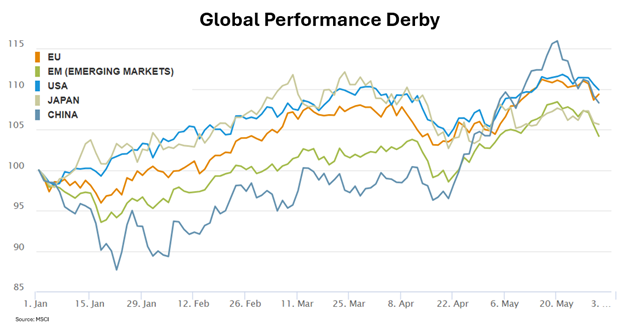
Using MSCI data, I have indexed each of our contestant markets back to 100 to start the year. As you may recall, the Japanese market jumped out to an early lead with the Nikkei index reaching a new all-time high after a 34-year hiatus. The US followed closely behind as Nvidia and its AI friends powered indices higher. The European Union constituents nearly maintained pace as unlikely members like Italy and Spain contributed solid results. The emerging markets stumbled with China to begin the year, but stimulus efforts and housing support fueled an April advance that lifted China briefly into first place. All told, with 5 months in the books, the USA takes first place with a 9.9% gain, the EU takes second with a 9.4% gain, China takes third with an 8.3% gain, Japan takes fourth with a 5.6% gain, and the emerging markets takes fifth with a 4.2% gain. However…
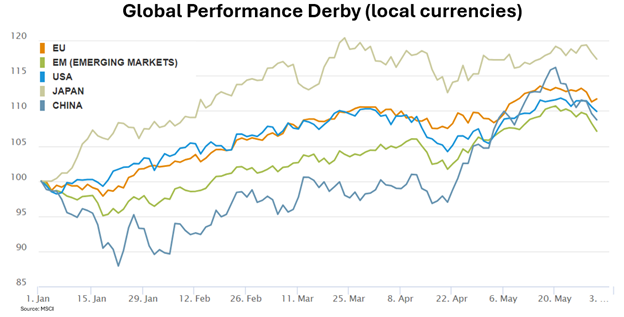
When evaluating performance removing US dollar movements, the leaderboard changes. Using local currencies, Japan places first with a 17.3% gain, the EU places second with an 11.7% gain, the US places third with a 9.9% gain, China fourth with an 8.7% gain, and the emerging markets fifth with a 7.1% gain. Clearly, movements in the US dollar explain a great deal of non-US returns for US investors. Many investors view international markets as “inferior” return generators, but that’s not necessarily true. Much of the return differential stems from the relative strength in the US dollar:
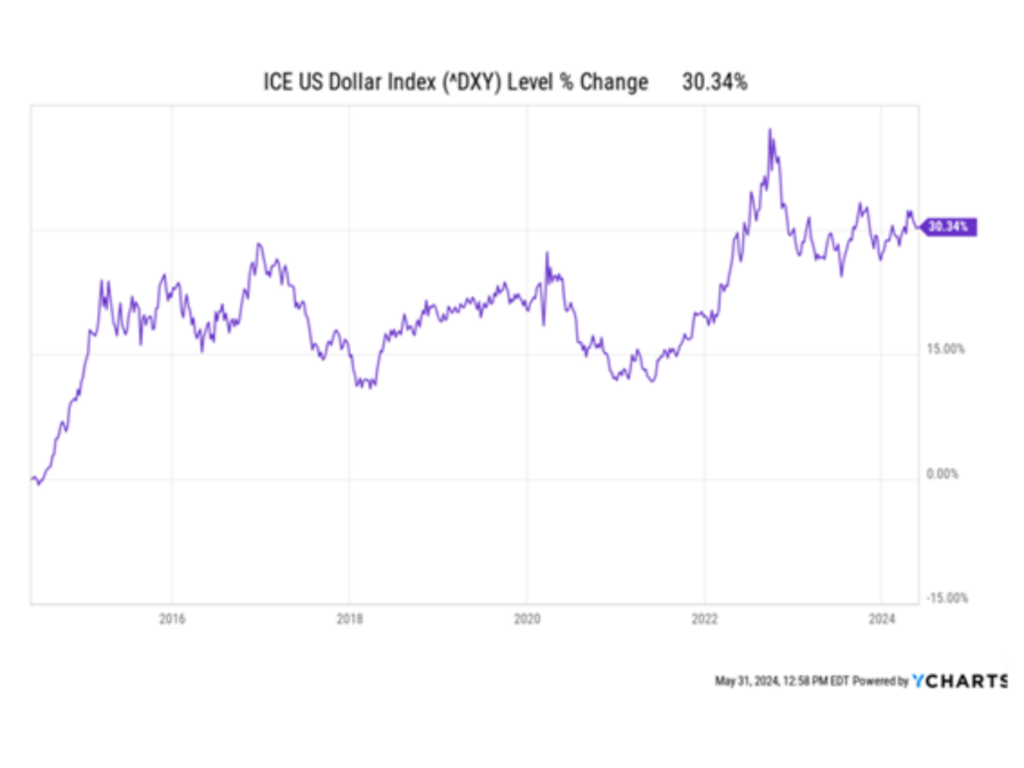
Over the past 10 years, the US dollar has appreciated 30% against its international peer group. That adds a 30% tailwind for US dollar investors at home and a 30% headwind for US investors abroad. Consider the influence of dollar direction on the following asset classes:
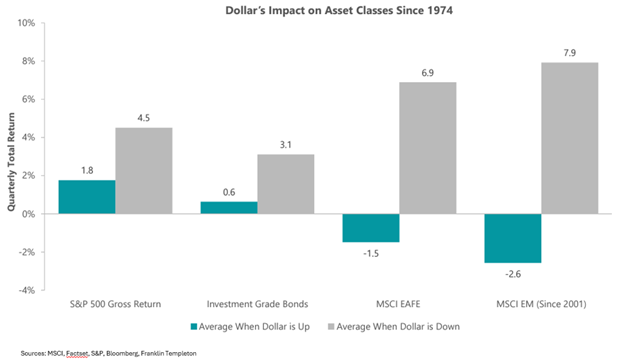
In periods going back to 1974 when the US dollar rose, US equities gained 1.8%, while developed market international equities lost 1.5%, and emerging market equities lost 2.6%. In periods when the US dollar fell, US equities gained 4.5%, while developed market international equities gained 6.9% and emerging market equities gained 7.9%. Clearly, all markets prefer a weaker US currency for reasons I’ll reserve for another email, but international equities enjoy outsized returns.
Year-to-date the US dollar has gained 3.3%. It peaked with a near 5% gain mid-April. With the Fed closing in on cutting rates, record amounts of US treasury issuance, Chinese stimulus impacts, periodic currency interventions, and surprisingly good economic data coming out of Europe, the dollar could continue its glidepath lower through the second half of 2024. If so, the second derby chart may make a better bet than the first.
Have a great weekend!
-David
Sources: MSCI, YCharts, Factset, S&P, Bloomberg, Franklin Templeton
This communication and its contents are for informational and educational purposes only and should not be used as the sole basis for any investment decision. The information contained herein is based on publicly available sources believed to be reliable but is not a representation, expressed or implied, as to the accuracy, completeness, or correctness of said information. Past performance does not guarantee future results.
">Place Your (Dollar & Non-Dollar) Bets!
Markets slid sideways this week lacking meaningful catalysts. Earnings season has ended. Inflation data arrived as expected. Sentiment levels sit at neutral levels. Interest rates considered moving higher but lacked conviction and returned to base. It may be a tad early to say… but cue the summer doldrums! To entertain you nonetheless, I thought it might be fun to take a trip around the globe to see how global markets are comparing:
Using MSCI data, I have indexed each of our contestant markets back to 100 to start the year. As you may recall, the Japanese market jumped out to an early lead with the Nikkei index reaching a new all-time high after a 34-year hiatus. The US followed closely behind as Nvidia and its AI friends powered indices higher. The European Union constituents nearly maintained pace as unlikely members like Italy and Spain contributed solid results. The emerging markets stumbled with China to begin the year, but stimulus efforts and housing support fueled an April advance that lifted China briefly into first place. All told, with 5 months in the books, the USA takes first place with a 9.9% gain, the EU takes second with a 9.4% gain, China takes third with an 8.3% gain, Japan takes fourth with a 5.6% gain, and the emerging markets takes fifth with a 4.2% gain. However…
When evaluating performance removing US dollar movements, the leaderboard changes. Using local currencies, Japan places first with a 17.3% gain, the EU places second with an 11.7% gain, the US places third with a 9.9% gain, China fourth with an 8.7% gain, and the emerging markets fifth with a 7.1% gain. Clearly, movements in the US dollar explain a great deal of non-US returns for US investors. Many investors view international markets as “inferior” return generators, but that’s not necessarily true. Much of the return differential stems from the relative strength in the US dollar:
Over the past 10 years, the US dollar has appreciated 30% against its international peer group. That adds a 30% tailwind for US dollar investors at home and a 30% headwind for US investors abroad. Consider the influence of dollar direction on the following asset classes:
In periods going back to 1974 when the US dollar rose, US equities gained 1.8%, while developed market international equities lost 1.5%, and emerging market equities lost 2.6%. In periods when the US dollar fell, US equities gained 4.5%, while developed market international equities gained 6.9% and emerging market equities gained 7.9%. Clearly, all markets prefer a weaker US currency for reasons I’ll reserve for another email, but international equities enjoy outsized returns.
Year-to-date the US dollar has gained 3.3%. It peaked with a near 5% gain mid-April. With the Fed closing in on cutting rates, record amounts of US treasury issuance, Chinese stimulus impacts, periodic currency interventions, and surprisingly good economic data coming out of Europe, the dollar could continue its glidepath lower through the second half of 2024. If so, the second derby chart may make a better bet than the first.
Have a great weekend!
-David
Sources: MSCI, YCharts, Factset, S&P, Bloomberg, Franklin Templeton
This communication and its contents are for informational and educational purposes only and should not be used as the sole basis for any investment decision. The information contained herein is based on publicly available sources believed to be reliable but is not a representation, expressed or implied, as to the accuracy, completeness, or correctness of said information. Past performance does not guarantee future results.
" class="link-chevron">
AI chip maker NVIDIA reported superlative quarterly results this week with sales leaping 260%, earnings leaping 460% and the stock leaping to a 100% gain on the year. I cannot recall a company dominating a megatrend as completely as NVIDIA. Analysts have drawn parallels to the rise of Cisco in the late 90s, but Cisco did not have nearly as firm fundamentals as NVIDIA, nearly as defensible technology, or nearly as durable a customer base. For those unfamiliar, NVIDIA makes the chips that power the data centers that power AI. Amazon, Meta, Microsoft, and Alphabet represent 40% of revenue, and each has copious cash flow and insatiable demand for NVIDIA’s GPU (Graphics Processing Unit) chips. Note the recent surge in demand from these providers as they incorporate AI, machine learning, and high-performance computing infrastructure within their data centers:
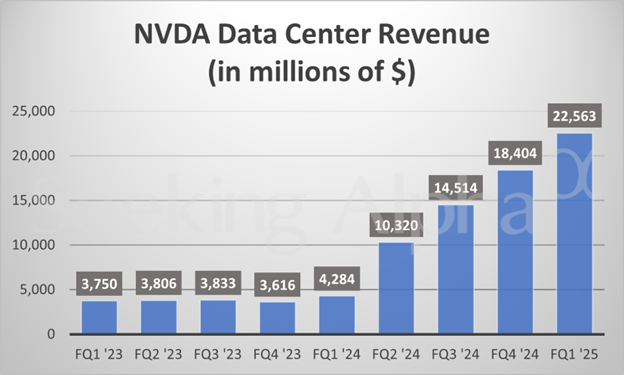
According to CEO Jensen Huang, the world currently has $1 trillion worth of installed data centers (that need GPU upgrading) and will need to add another $1 trillion over the next 4-5 years. In other words, the AI transformation and installation cycle has just begun. This project will require a lot of financing. That’s good for banks. These server farms will require a lot of real estate. That’s good for property owners. These data centers will require a lot of power. That’s good for utilities. NVIDIA isn’t the only beneficiary of this tech moon shot. Consider the performance of some other AI enablers:
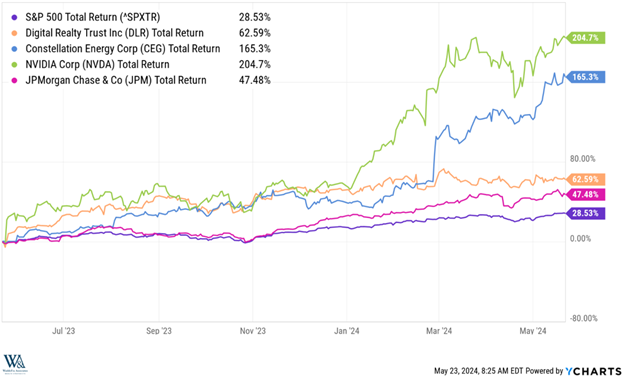
Over the past year, the S&P 500 has advanced 28%. JP Morgan (a bank) has advanced 47%, Digital Realty Trust (a data center real estate developer) has advanced 63%, while Constellation Energy Corp (an electricity provider) has advanced 165%. Yes, NVIDIA has outperformed, rising 204% over the time frame, but my point is that they are just one vendor in this historic buildout.
Taking the theme a step further, if there is this much demand for suppliers of AI infrastructure, there must be widespread demand from AI consumers. In fact, according to AI overlord and NVIDIA CEO Jensen Huang, we will see four distinct progressions of AI adoption:
Wave One: Initial training and infrastructure build-out (where we are now).
Wave Two: Widespread enterprise adoption using AI agents (bots do the programming).
Wave Three: AI usage in heavy industries (manufacturing, energy, etc.).
Wave Four: Sovereign AI (every government relies on AI).
So first they build it, then EVERYONE uses it. But since we are all economic actors, we wouldn’t use AI unless we profited from AI. And according to analyst earnings forecasts, everyone will:
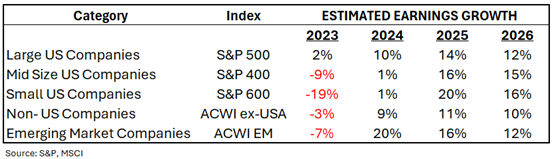
Note the double-digit earnings growth expectations moving forward from large, mid, and small sized US companies, but also companies located offshore and within the emerging markets. So, while NVIDIA’s economic performance has been breathtaking, it is just a preview of what is to come economy-wide and globally. Here is another chart that caught my eye this week, demonstrating the upcoming earnings proliferation beyond NVIDIA:
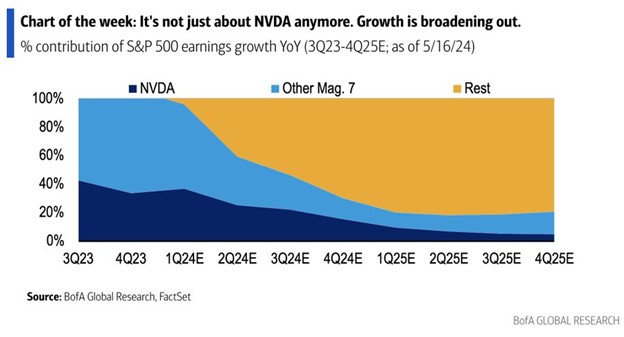
This is the story beneath the resilience of this market rally. NVIDIA’s awesome… but what it is previewing for everyone else is even awesome-ER.
Bonus Section: I need to do more work on this, and I will, but all this upcoming investment and economic activity requires lots of money. The Fed has been deliberately shrinking money supply to battle inflation. For this massive global buildout, too little money supply could limit its speed and breadth. With inflation whipped (core ex-housing CPI = 2.1%), shrinking the money supply further could prove economically limiting and destructive. Fortunately, money supply:
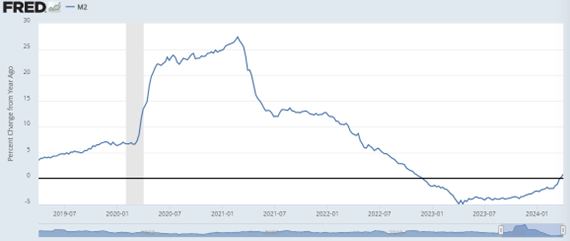
… and money velocity:
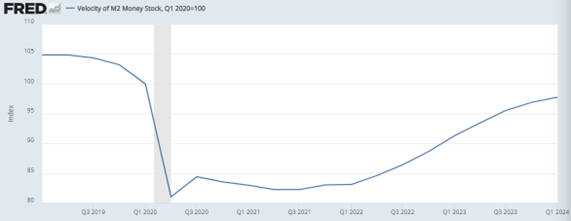
… have resumed their growth trajectories, providing more monetary supply for the project. Inflation hawks may find this alarming, but just as data centers need electricity… technological revolutions require cash!
Have a great holiday weekend!
-David
Sources: Seeking Alpha, https://seekingalpha.com/news/4109616-nvidia-in-charts-data-center-revenue-surges-427-from-last-year, FRED, YCharts, Waddell & Associates, S&P, MSCI, BofA Global Research, FactSet
This communication and its contents are for informational and educational purposes only and should not be used as the sole basis for any investment decision. The information contained herein is based on publicly available sources believed to be reliable but is not a representation, expressed or implied, as to the accuracy, completeness, or correctness of said information. Past performance does not guarantee future results.
">What’s Awesome-ER than NVIDIA?
AI chip maker NVIDIA reported superlative quarterly results this week with sales leaping 260%, earnings leaping 460% and the stock leaping to a 100% gain on the year. I cannot recall a company dominating a megatrend as completely as NVIDIA. Analysts have drawn parallels to the rise of Cisco in the late 90s, but Cisco did not have nearly as firm fundamentals as NVIDIA, nearly as defensible technology, or nearly as durable a customer base. For those unfamiliar, NVIDIA makes the chips that power the data centers that power AI. Amazon, Meta, Microsoft, and Alphabet represent 40% of revenue, and each has copious cash flow and insatiable demand for NVIDIA’s GPU (Graphics Processing Unit) chips. Note the recent surge in demand from these providers as they incorporate AI, machine learning, and high-performance computing infrastructure within their data centers:
According to CEO Jensen Huang, the world currently has $1 trillion worth of installed data centers (that need GPU upgrading) and will need to add another $1 trillion over the next 4-5 years. In other words, the AI transformation and installation cycle has just begun. This project will require a lot of financing. That’s good for banks. These server farms will require a lot of real estate. That’s good for property owners. These data centers will require a lot of power. That’s good for utilities. NVIDIA isn’t the only beneficiary of this tech moon shot. Consider the performance of some other AI enablers:
Over the past year, the S&P 500 has advanced 28%. JP Morgan (a bank) has advanced 47%, Digital Realty Trust (a data center real estate developer) has advanced 63%, while Constellation Energy Corp (an electricity provider) has advanced 165%. Yes, NVIDIA has outperformed, rising 204% over the time frame, but my point is that they are just one vendor in this historic buildout.
Taking the theme a step further, if there is this much demand for suppliers of AI infrastructure, there must be widespread demand from AI consumers. In fact, according to AI overlord and NVIDIA CEO Jensen Huang, we will see four distinct progressions of AI adoption:
Wave One: Initial training and infrastructure build-out (where we are now).
Wave Two: Widespread enterprise adoption using AI agents (bots do the programming).
Wave Three: AI usage in heavy industries (manufacturing, energy, etc.).
Wave Four: Sovereign AI (every government relies on AI).
So first they build it, then EVERYONE uses it. But since we are all economic actors, we wouldn’t use AI unless we profited from AI. And according to analyst earnings forecasts, everyone will:
Note the double-digit earnings growth expectations moving forward from large, mid, and small sized US companies, but also companies located offshore and within the emerging markets. So, while NVIDIA’s economic performance has been breathtaking, it is just a preview of what is to come economy-wide and globally. Here is another chart that caught my eye this week, demonstrating the upcoming earnings proliferation beyond NVIDIA:
This is the story beneath the resilience of this market rally. NVIDIA’s awesome… but what it is previewing for everyone else is even awesome-ER.
Bonus Section: I need to do more work on this, and I will, but all this upcoming investment and economic activity requires lots of money. The Fed has been deliberately shrinking money supply to battle inflation. For this massive global buildout, too little money supply could limit its speed and breadth. With inflation whipped (core ex-housing CPI = 2.1%), shrinking the money supply further could prove economically limiting and destructive. Fortunately, money supply:
… and money velocity:
… have resumed their growth trajectories, providing more monetary supply for the project. Inflation hawks may find this alarming, but just as data centers need electricity… technological revolutions require cash!
Have a great holiday weekend!
-David
Sources: Seeking Alpha, https://seekingalpha.com/news/4109616-nvidia-in-charts-data-center-revenue-surges-427-from-last-year, FRED, YCharts, Waddell & Associates, S&P, MSCI, BofA Global Research, FactSet
This communication and its contents are for informational and educational purposes only and should not be used as the sole basis for any investment decision. The information contained herein is based on publicly available sources believed to be reliable but is not a representation, expressed or implied, as to the accuracy, completeness, or correctness of said information. Past performance does not guarantee future results.
" class="link-chevron">
Each day investors receive stock market valuation inputs: Fed decisions, economic data releases, fiscal policy changes, sentiment squiggles, weather reports, Superbowl winners, etc. Yet only four times a year do investors receive the meaningful output from all these disparate inputs: corporate earnings data. With first-quarter earnings season nearly over, let’s review the numbers to assess the current health of this market, and the outlook for its longevity.
Know the Grow
460 of the 500 companies within the S&P 500 have now reported their first-quarter earnings. Overall, for the reporting companies, earnings grew 5.4% last quarter. That’s the highest quarterly earnings growth rate since Q2 of 2022. Revenue grew less at 4.1%, but that means profit margins expanded, a healthy harbinger of earnings persistence. Not only were these numbers solid, but analysts were also solidly surprised:
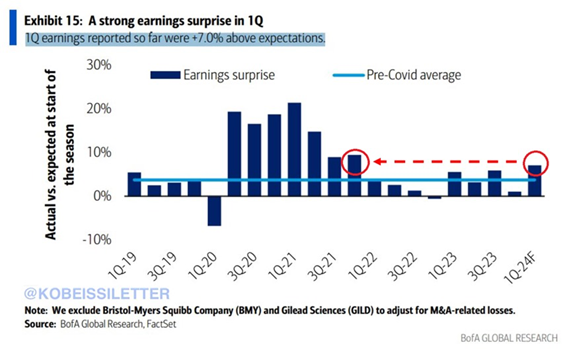
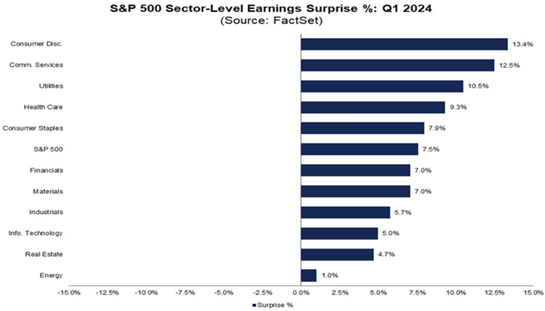
On average, companies reported earnings 7%+ higher than analysts expected entering the quarter. This is the highest “positive surprise” level since the 4th quarter of 2021 and well above the pre-COVID average of 5%. And while averages can be misleading, each of the 11 sectors within the index reported surprisingly better than expected results:
Better than expected trailing earnings results, at high margins of surprise, should increase confidence in, and degree of, future earnings growth. To wit, full-year earnings estimates for 2024, 2025, and 2026 have all risen throughout this earnings season:
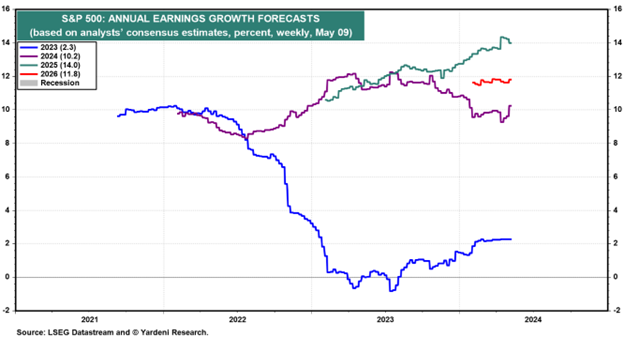
This chart requires orientation. Focus on the Blue line. This line represents consensus earnings estimates for 2023. Analysts began contemplating 2023 earnings back in 2021 at which point they projected earnings would grow by 10%. Unfortunately, as time progressed and the Fed hiked rates aggressively, 2023 earnings estimates collapsed into June of 2022. Earnings estimates recovered from there, but full-year earnings ended 2023 merely 2.3% higher, far short of the 10% initially projected.
Now look at the purple line. Analysts began contemplating 2024 earnings early in 2022, again projecting 10% growth. As time progressed, analysts raised their estimates to compensate for the large drawdown in 2023 earnings expectations. As 2023’s prospects improved, analysts trimmed their 2024 estimates back towards their initial 10%, which is where they sit today.
Now look at the green line which represents analysts’ earnings growth estimates for 2025. Note that this line has risen consistently since its inception. While analysts initially projected 11% growth, expectations now register at 14% growth.
Lastly, look at the red line. This represents analysts’ earnings growth projections for 2026. Note that this line has drifted slightly higher since inception, with growth expectations now nearing 12%.
In sum, analysts have held firm on their expectations that 2024 will deliver 10%+ growth in corporate earnings, they have grown significantly more confident that earnings will grow more quickly next year at 14%, and they have grown slightly more confident that earnings will grow another 11% in 2026. Add it all up, according to analysts, earnings for companies within the S&P 500 will grow 40% by year end 2026. Maybe they will grow less, maybe they will grow more, but that is A LOT of earnings growth for this market to consider as it inches ever closer to all-time highs.
Happy Mother’s Day!
-David
Sources: BofA Global Research, FactSet, LSEG Datastream, Yardeni Research
This communication and its contents are for informational and educational purposes only and should not be used as the sole basis for any investment decision. The information contained herein is based on publicly available sources believed to be reliable but is not a representation, expressed or implied, as to the accuracy, completeness, or correctness of said information. Past performance does not guarantee future results.
">Growing Gains
Each day investors receive stock market valuation inputs: Fed decisions, economic data releases, fiscal policy changes, sentiment squiggles, weather reports, Superbowl winners, etc. Yet only four times a year do investors receive the meaningful output from all these disparate inputs: corporate earnings data. With first-quarter earnings season nearly over, let’s review the numbers to assess the current health of this market, and the outlook for its longevity.
Know the Grow
460 of the 500 companies within the S&P 500 have now reported their first-quarter earnings. Overall, for the reporting companies, earnings grew 5.4% last quarter. That’s the highest quarterly earnings growth rate since Q2 of 2022. Revenue grew less at 4.1%, but that means profit margins expanded, a healthy harbinger of earnings persistence. Not only were these numbers solid, but analysts were also solidly surprised:
On average, companies reported earnings 7%+ higher than analysts expected entering the quarter. This is the highest “positive surprise” level since the 4th quarter of 2021 and well above the pre-COVID average of 5%. And while averages can be misleading, each of the 11 sectors within the index reported surprisingly better than expected results:
Better than expected trailing earnings results, at high margins of surprise, should increase confidence in, and degree of, future earnings growth. To wit, full-year earnings estimates for 2024, 2025, and 2026 have all risen throughout this earnings season:
This chart requires orientation. Focus on the Blue line. This line represents consensus earnings estimates for 2023. Analysts began contemplating 2023 earnings back in 2021 at which point they projected earnings would grow by 10%. Unfortunately, as time progressed and the Fed hiked rates aggressively, 2023 earnings estimates collapsed into June of 2022. Earnings estimates recovered from there, but full-year earnings ended 2023 merely 2.3% higher, far short of the 10% initially projected.
Now look at the purple line. Analysts began contemplating 2024 earnings early in 2022, again projecting 10% growth. As time progressed, analysts raised their estimates to compensate for the large drawdown in 2023 earnings expectations. As 2023’s prospects improved, analysts trimmed their 2024 estimates back towards their initial 10%, which is where they sit today.
Now look at the green line which represents analysts’ earnings growth estimates for 2025. Note that this line has risen consistently since its inception. While analysts initially projected 11% growth, expectations now register at 14% growth.
Lastly, look at the red line. This represents analysts’ earnings growth projections for 2026. Note that this line has drifted slightly higher since inception, with growth expectations now nearing 12%.
In sum, analysts have held firm on their expectations that 2024 will deliver 10%+ growth in corporate earnings, they have grown significantly more confident that earnings will grow more quickly next year at 14%, and they have grown slightly more confident that earnings will grow another 11% in 2026. Add it all up, according to analysts, earnings for companies within the S&P 500 will grow 40% by year end 2026. Maybe they will grow less, maybe they will grow more, but that is A LOT of earnings growth for this market to consider as it inches ever closer to all-time highs.
Happy Mother’s Day!
-David
Sources: BofA Global Research, FactSet, LSEG Datastream, Yardeni Research
This communication and its contents are for informational and educational purposes only and should not be used as the sole basis for any investment decision. The information contained herein is based on publicly available sources believed to be reliable but is not a representation, expressed or implied, as to the accuracy, completeness, or correctness of said information. Past performance does not guarantee future results.
" class="link-chevron">
The US Federal Reserve operates with a dual mandate. Per Congress, they must pursue policies that support “stable price levels” (2% inflation), and full employment (currently estimated at 4.2%). Historically, the Fed has used interest rate policy as an accelerator and a brake on economic activity to influence the labor market and, therefore, price levels in an iterative dance. Over time, the relationship between the labor market and inflation has declined. GDP has grown faster than employment growth (also known as productivity gains), while the labor market has become more fluid and less unionized. When the Fed began its tightening cycle two years ago, we hypothesized that inflation could fall back to target without requiring labor market dislocations and recession. We expected white-collar layoffs to offset blue-collar hirings as companies struggled to hire and fund front-line workers while rightsizing bloated corporate bureaucracies to preserve earnings. This labor force reallocation suggested that price levels could “stabilize” despite employment levels remaining “full”, a near impossibility according to my economic textbooks. And yet… that is what has happened since inflation peaked in June of 2022:
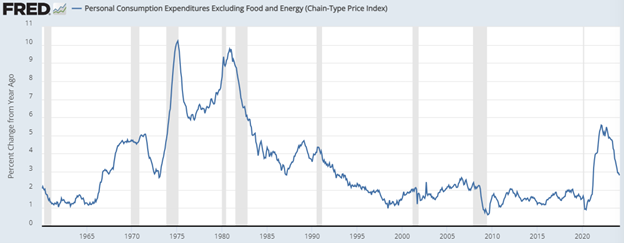
Notice that historically, inflation (the blue line) only fell meaningfully during recessionary periods (the shaded areas). This go-round, inflation has fallen without triggering recession thanks to increasing economic supply rather than Fed-forced decreases in economic demand. The economic supply expansion hasn’t just reopened supply lanes and post COVID production expansion, it has also included labor and energy supply expansions. For example, note the growth in size of the foreign-born US labor force:
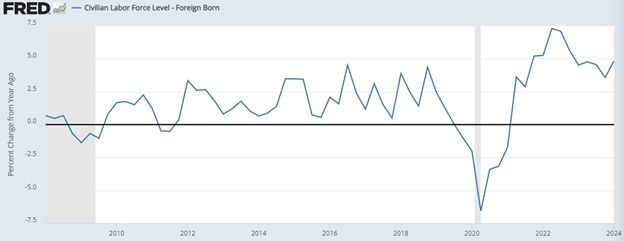
While I am not suggesting that a porous southern border is an anti-inflation policy decision, the 5% growth in immigrant labor does double previous expansion levels and has helped satiate elevated labor demand. Additionally, US oil production has quietly reached record levels:
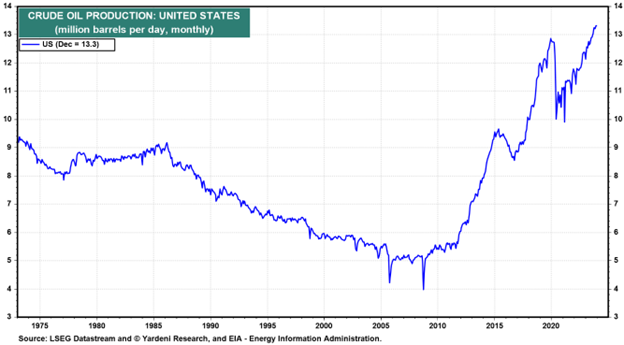
While I am not suggesting that increasing oil production is an anti-inflation policy decision, the half a million more barrels per day than pre-COVID levels (mostly on Federally leased land) has added more energy supply to help satiate elevated energy demand, but I digress.
Refocusing on labor conditions, we received two reports this week that strengthened the case for the uncommon pairing of disinflation with full employment. First, the JOLTS report offered this encouraging data point:
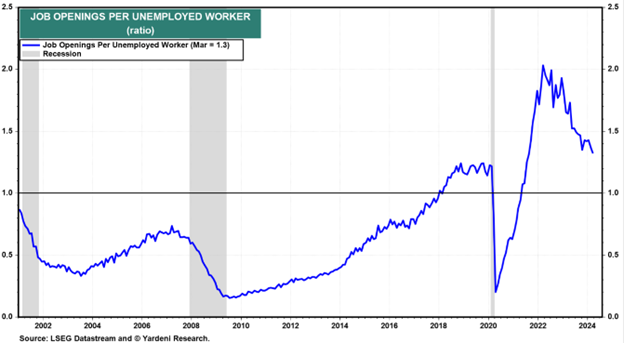
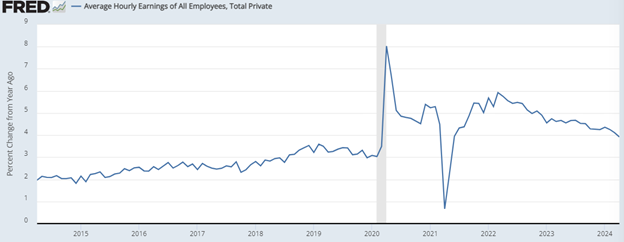
While the US economy continues to have 1.3 job openings per unemployed worker (implying a labor shortage), that number has fallen back toward pre-COVID levels from its peak. This rebalancing of labor supply and demand should theoretically reduce wage pressures and overall inflationary pressures. Per the Bureau of Labor Statistics jobs report delivered Friday, average hourly earnings dropped to the lowest level seen since March of 2021 and within striking distance of pre-COVID levels:
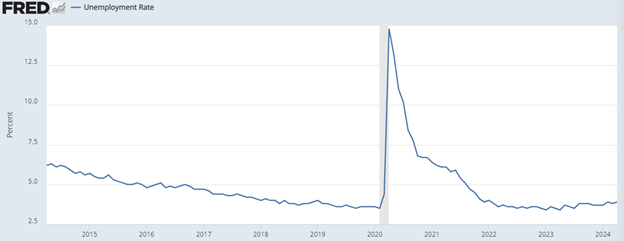
All of this has happened concurrently with a US unemployment rate continuing to register below the Fed’s 4.2% target:
In sum, the economic supply additions to the US economy combined with advanced technology integrations and corporate labor restructurings have produced welcome disinflation without recession. Chairman Powell acknowledged this unusual relationship earlier in the week at his FOMC presser, expressing confidence that these goldilocks dynamics will continue. Markets rallied in response, then rallied even further as Friday’s jobs report validated his optimistic perspective. The S&P 500 now stands within 2.5% of its closing high. Just as economic textbooks require revision given the extraordinary pairing of disinflation with full employment, investment textbooks also require revision to change their sell in May maxim to… don’t sell in May!
Have a great week!
-David
Sources: FRED, LSEG Datastream and Yardeni Research, and EIA – Energy Information Administration
This communication and its contents are for informational and educational purposes only and should not be used as the sole basis for any investment decision. The information contained herein is based on publicly available sources believed to be reliable but is not a representation, expressed or implied, as to the accuracy, completeness, or correctness of said information. Past performance does not guarantee future results.
">Don’t Sell in May!
The US Federal Reserve operates with a dual mandate. Per Congress, they must pursue policies that support “stable price levels” (2% inflation), and full employment (currently estimated at 4.2%). Historically, the Fed has used interest rate policy as an accelerator and a brake on economic activity to influence the labor market and, therefore, price levels in an iterative dance. Over time, the relationship between the labor market and inflation has declined. GDP has grown faster than employment growth (also known as productivity gains), while the labor market has become more fluid and less unionized. When the Fed began its tightening cycle two years ago, we hypothesized that inflation could fall back to target without requiring labor market dislocations and recession. We expected white-collar layoffs to offset blue-collar hirings as companies struggled to hire and fund front-line workers while rightsizing bloated corporate bureaucracies to preserve earnings. This labor force reallocation suggested that price levels could “stabilize” despite employment levels remaining “full”, a near impossibility according to my economic textbooks. And yet… that is what has happened since inflation peaked in June of 2022:
Notice that historically, inflation (the blue line) only fell meaningfully during recessionary periods (the shaded areas). This go-round, inflation has fallen without triggering recession thanks to increasing economic supply rather than Fed-forced decreases in economic demand. The economic supply expansion hasn’t just reopened supply lanes and post COVID production expansion, it has also included labor and energy supply expansions. For example, note the growth in size of the foreign-born US labor force:
While I am not suggesting that a porous southern border is an anti-inflation policy decision, the 5% growth in immigrant labor does double previous expansion levels and has helped satiate elevated labor demand. Additionally, US oil production has quietly reached record levels:
While I am not suggesting that increasing oil production is an anti-inflation policy decision, the half a million more barrels per day than pre-COVID levels (mostly on Federally leased land) has added more energy supply to help satiate elevated energy demand, but I digress.
Refocusing on labor conditions, we received two reports this week that strengthened the case for the uncommon pairing of disinflation with full employment. First, the JOLTS report offered this encouraging data point:
While the US economy continues to have 1.3 job openings per unemployed worker (implying a labor shortage), that number has fallen back toward pre-COVID levels from its peak. This rebalancing of labor supply and demand should theoretically reduce wage pressures and overall inflationary pressures. Per the Bureau of Labor Statistics jobs report delivered Friday, average hourly earnings dropped to the lowest level seen since March of 2021 and within striking distance of pre-COVID levels:
All of this has happened concurrently with a US unemployment rate continuing to register below the Fed’s 4.2% target:
In sum, the economic supply additions to the US economy combined with advanced technology integrations and corporate labor restructurings have produced welcome disinflation without recession. Chairman Powell acknowledged this unusual relationship earlier in the week at his FOMC presser, expressing confidence that these goldilocks dynamics will continue. Markets rallied in response, then rallied even further as Friday’s jobs report validated his optimistic perspective. The S&P 500 now stands within 2.5% of its closing high. Just as economic textbooks require revision given the extraordinary pairing of disinflation with full employment, investment textbooks also require revision to change their sell in May maxim to… don’t sell in May!
Have a great week!
-David
Sources: FRED, LSEG Datastream and Yardeni Research, and EIA – Energy Information Administration
This communication and its contents are for informational and educational purposes only and should not be used as the sole basis for any investment decision. The information contained herein is based on publicly available sources believed to be reliable but is not a representation, expressed or implied, as to the accuracy, completeness, or correctness of said information. Past performance does not guarantee future results.
" class="link-chevron">
In keeping with our current framework that interest rate wiggles are noise for traders, while economic and earnings growth are news for investors, this week provided cacophonies for both. Earnings lifted markets to begin the week after two weeks of souring sentiment, only to have Thursday’s hotter-than-expected inflation report within a cooler-than-expected GDP report trigger reflexive selling. The week settled out with gains, as we expected it would, but the combination of crosscurrents left many disoriented. Stagflation narratives resurfaced. The 10-year hit its highest yield of the year. Volatility levels collapsed. Meta beat earnings and its stock plunged while Telsa missed earnings and its stock soared. In moments like these when data and commentary swirl, it is useful to read recent return data and let the patterns post the headlines themselves:
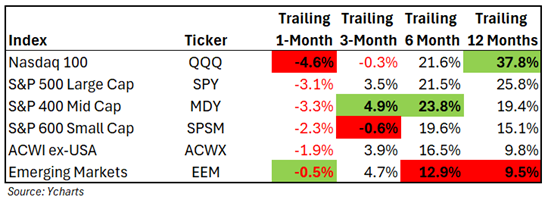
I recognize this is a lot of data so we will take it slow. I have listed the major market indices here with their trailing return data over the last month, three-month, six-month, and twelve-month periods. I have also highlighted the period winners in green and the losers in red. Over the past 12 months, the Nasdaq 100 has stolen the show thanks to its 40% weighting to the Magnificent 7. The S&P 500 follows suit given its 30% weighting to the Magnificent 7. Those indices that lack mega tech exposure returned around half as much. For the international indices, a stronger dollar over the last year deducted about 5%, making the currency-hedged versions closer to the 15% mark. When we adjust our time period to the trailing six-month interval, shifts appear. The Nasdaq 100 and the S&P 500 tie, indicating some Magnificent 7 leadership loss. In fact, both indices trail the S&P 400 mid-cap index, which has zero exposure to the Magnificent 7. Meanwhile, small caps and internationals reduce their performance gaps significantly indicating a market that has broadened participation. Over the past three months, this trend gathered more conviction as mid-caps won once again and internationals overcame currency headwinds to outperform the S&P 500 as well. Small caps experienced losses (easily explained by rising interest rates), while the NASDAQ 100 lagged badly for the first time in ages. Over the past month, the NASDAQ woes continued while small caps and internationals outperformed. In short, the influence of the Magnificent 7 has shifted from index uplift to index downforce. Let’s look within this vaunted cohort itself for details:
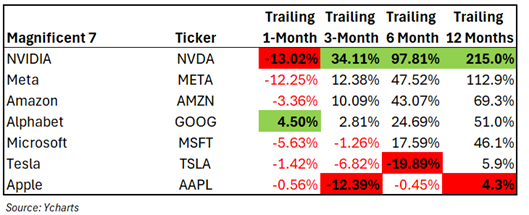
NVIDIA makes the chips that power AI. The leap in AI investment explains the leap in NVIDIA’s stock price. Its 215% gain over the past twelve months, 98% gain over the past six months, and 34% over the past three months has heroically lifted this cohort to superstar status. But what happens when we remove NVIDIA from the team?
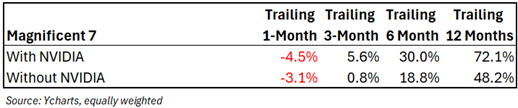
With NVIDIA, the Magnificent 7’s returns dominate every period other than the last month. Without NVIDIA, the Magnificent 7’s returns lag US mid cap and small cap returns over the past six months and even international returns over the last 3 months. Should NVIDIA produce pedestrian returns going forward the Magnificent 7 could simply become the Mediocre 7 leading investors to look elsewhere for return generation.
We entered the year expecting to see a broadening of leadership and participation away from big tech. It is now happening, and it is healthy. Using the analysis above to still the recent data and commentary swirl, the headlines generated bottom-up should read:
“The labor market, the consumer, and the economy remain resilient!”
“Corporate earnings growth will gather momentum and breadth from here!”
“Broadening market participation reflects broadening earnings growth!”
“Disinflation is decelerating… and that’s OK for stocks!”
“The current dip in markets isn’t a drawdown, it’s a redistricting!”
Have a great week!
-David
Sources: Ycharts
This communication and its contents are for informational and educational purposes only and should not be used as the sole basis for any investment decision. The information contained herein is based on publicly available sources believed to be reliable but is not a representation, expressed or implied, as to the accuracy, completeness, or correctness of said information. Past performance does not guarantee future results.
">Redistricting Returns
In keeping with our current framework that interest rate wiggles are noise for traders, while economic and earnings growth are news for investors, this week provided cacophonies for both. Earnings lifted markets to begin the week after two weeks of souring sentiment, only to have Thursday’s hotter-than-expected inflation report within a cooler-than-expected GDP report trigger reflexive selling. The week settled out with gains, as we expected it would, but the combination of crosscurrents left many disoriented. Stagflation narratives resurfaced. The 10-year hit its highest yield of the year. Volatility levels collapsed. Meta beat earnings and its stock plunged while Telsa missed earnings and its stock soared. In moments like these when data and commentary swirl, it is useful to read recent return data and let the patterns post the headlines themselves:
I recognize this is a lot of data so we will take it slow. I have listed the major market indices here with their trailing return data over the last month, three-month, six-month, and twelve-month periods. I have also highlighted the period winners in green and the losers in red. Over the past 12 months, the Nasdaq 100 has stolen the show thanks to its 40% weighting to the Magnificent 7. The S&P 500 follows suit given its 30% weighting to the Magnificent 7. Those indices that lack mega tech exposure returned around half as much. For the international indices, a stronger dollar over the last year deducted about 5%, making the currency-hedged versions closer to the 15% mark. When we adjust our time period to the trailing six-month interval, shifts appear. The Nasdaq 100 and the S&P 500 tie, indicating some Magnificent 7 leadership loss. In fact, both indices trail the S&P 400 mid-cap index, which has zero exposure to the Magnificent 7. Meanwhile, small caps and internationals reduce their performance gaps significantly indicating a market that has broadened participation. Over the past three months, this trend gathered more conviction as mid-caps won once again and internationals overcame currency headwinds to outperform the S&P 500 as well. Small caps experienced losses (easily explained by rising interest rates), while the NASDAQ 100 lagged badly for the first time in ages. Over the past month, the NASDAQ woes continued while small caps and internationals outperformed. In short, the influence of the Magnificent 7 has shifted from index uplift to index downforce. Let’s look within this vaunted cohort itself for details:
NVIDIA makes the chips that power AI. The leap in AI investment explains the leap in NVIDIA’s stock price. Its 215% gain over the past twelve months, 98% gain over the past six months, and 34% over the past three months has heroically lifted this cohort to superstar status. But what happens when we remove NVIDIA from the team?
With NVIDIA, the Magnificent 7’s returns dominate every period other than the last month. Without NVIDIA, the Magnificent 7’s returns lag US mid cap and small cap returns over the past six months and even international returns over the last 3 months. Should NVIDIA produce pedestrian returns going forward the Magnificent 7 could simply become the Mediocre 7 leading investors to look elsewhere for return generation.
We entered the year expecting to see a broadening of leadership and participation away from big tech. It is now happening, and it is healthy. Using the analysis above to still the recent data and commentary swirl, the headlines generated bottom-up should read:
“The labor market, the consumer, and the economy remain resilient!”
“Corporate earnings growth will gather momentum and breadth from here!”
“Broadening market participation reflects broadening earnings growth!”
“Disinflation is decelerating… and that’s OK for stocks!”
“The current dip in markets isn’t a drawdown, it’s a redistricting!”
Have a great week!
-David
Sources: Ycharts
This communication and its contents are for informational and educational purposes only and should not be used as the sole basis for any investment decision. The information contained herein is based on publicly available sources believed to be reliable but is not a representation, expressed or implied, as to the accuracy, completeness, or correctness of said information. Past performance does not guarantee future results.
" class="link-chevron">
Markets sold off this week in reaction to a marginally hotter-than-expected CPI report that marked down the odds of a Fed rate cut in June, marked up the US Dollar, and marked up longer-term US interest rates. Geopolitical tensions in the Middle East also weighed heavily on Friday as traders zeroed out positions ahead of a potentially newsworthy weekend. While these fear factors may have driven the selloff, healthy markets climb a wall of worry, and recent investment sentiment measures read far too worry-free. When assessing sentiment, we refer primarily to the sentiment of professional investors using the Investors Intelligence Survey, and retail investors using the American Association of Individual Investors Survey data. Let’s review each to psychoanalyze the current investor psyche.
INVESTORS INTELLIGENCE
The Investors Intelligence Sentiment Index traces its origins back to the 1960s when Investors Intelligence began surveying investment advisors and newsletter writers. The survey provides insight into the prevailing bullishness or bearishness among investment professionals. The difference between the two percentages forms the basis of the index. Based upon the most recent survey data, investment advisors are four times more bullish than bearish:
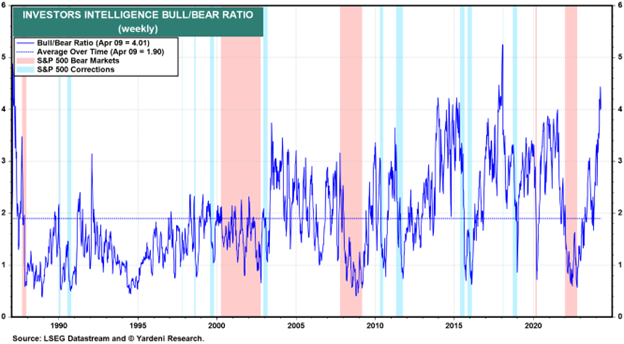
Note that advisor bullishness has rarely exceeded these levels. The typical bull/bear survey ratio ranges between 1-3; we sit at 4 today. Investors should read excessive advisor bullishness as a contrarian indicator, as investable cash has likely already been deployed. Further gains need further fuel, and bullish investors hold less cash. Fortunately, while high bullish levels may restrict further gains, they don’t indicate imminent declines. Note that between 2013 and 2015, the ratio bounced between 3.5 and 4 while the market rose 32%, 13%, and 1%, respectively. So, while the current reading bears considering, it shouldn’t, alone, cause a bear.
AAII BULLS
I find this sentiment measure the most useful for forecasting short-term market movements. Each week since 1987, the American Association of Individual Investors has polled its members to ask whether they are bullish, bearish, or neutral looking six months ahead. Bullish levels above 50% suggest irrational exuberance, while bullish levels below 20% suggest irrational pessimism. Currently, 43% of investors surveyed count themselves as bullish:
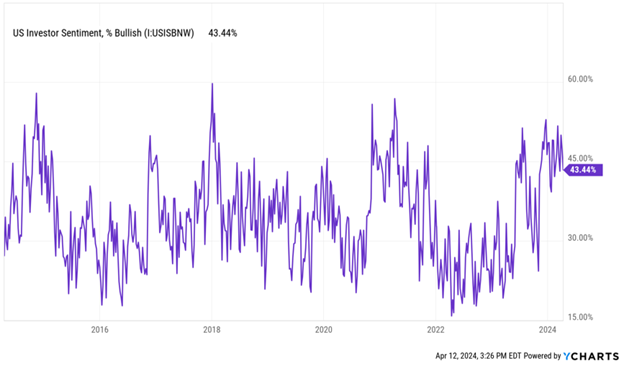
While this seems elevated, retail investor bullishness averages 37.6% over the long run. So, while professional investors seem overly optimistic now, individual investors seem generally optimistic. Nonetheless, returns from this level looking forward historically lag returns at lower levels:
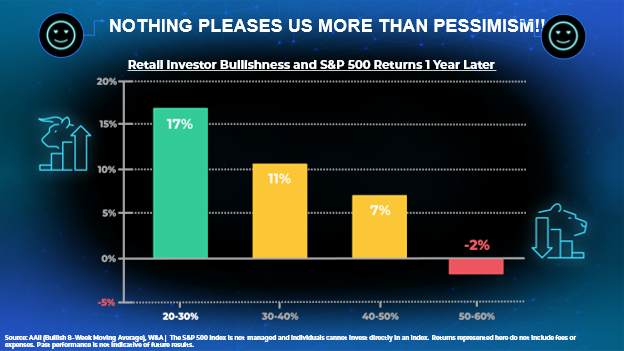
According to the chart above, bullishness between 40-50% correlates with average forward returns of 7%. That’s less than long-term average equity returns of 10%, but still highly profitable. As with the Investors Intelligence index, I don’t find high levels of bullishness a particularly good timing tool. Conversely, I do find low levels of bullishness highly useful. When bullishness sinks below 20%… buy, buy, buy! For now, at 43%, bullish retail investor sentiment isn’t ideal but also not a major rally threat.
VIX
Lastly, the options markets dynamically price volatility assessments within a measure called the VIX index. I haven’t found the VIX particularly useful in predicting forward returns (unless it falls below 10%), but it does provide investors with a useful perspective on anxiety levels.
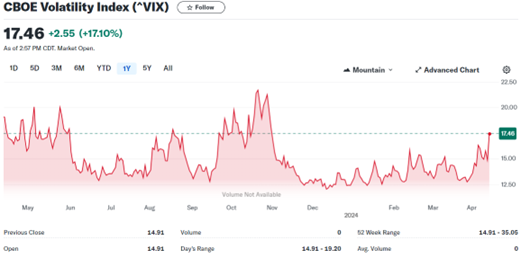
On Friday, The VIX shot up nearly 30% at the high. A move like that doesn’t occur because of a warmer CPI number. This volatility stems from geopolitical tensions between Iran and Israel, creating a demand spike for short-term options strategies. A spike in the VIX can also reflexively fuel broader market sell-offs as options activity aggravates equity activity. Absent a firefight between Israel and Iran over the weekend, I would expect this EKG to descend as next week’s earnings releases return investor attention to more investable considerations.
THE GOOD NEWS ABOUT THE BAD NEWS
Reversals in investor sentiment driven by a slightly hotter inflation report and hotter than usual rhetoric between Israel and Iran will benefit this market. A reversal in sentiment driven by deteriorating economics or earnings decay would prove far more concerning and problematic for investors. Lower sentiment levels without lower economic and earnings levels will only reload the rally for further gains. For those dismayed by this week’s sell-off, remember two things. First, if every quarter this year performed as the first quarter performed, we would end the year up 40%+. Unlikely. Furthermore, even after this week’s downside detour, we remain within 3% of all-time highs. Recognize that pullbacks build bull market character, and expect earnings momentum to rebuild market momentum beginning next week.
Have a great week!
-David
Sources: AAII, Waddell & Associates, YCharts, LSEG Datastream, Yardeni Research
This communication and its contents are for informational and educational purposes only and should not be used as the sole basis for any investment decision. The information contained herein is based on publicly available sources believed to be reliable but is not a representation, expressed or implied, as to the accuracy, completeness, or correctness of said information. Past performance does not guarantee future results.
">Pullbacks Welcome!
Markets sold off this week in reaction to a marginally hotter-than-expected CPI report that marked down the odds of a Fed rate cut in June, marked up the US Dollar, and marked up longer-term US interest rates. Geopolitical tensions in the Middle East also weighed heavily on Friday as traders zeroed out positions ahead of a potentially newsworthy weekend. While these fear factors may have driven the selloff, healthy markets climb a wall of worry, and recent investment sentiment measures read far too worry-free. When assessing sentiment, we refer primarily to the sentiment of professional investors using the Investors Intelligence Survey, and retail investors using the American Association of Individual Investors Survey data. Let’s review each to psychoanalyze the current investor psyche.
INVESTORS INTELLIGENCE
The Investors Intelligence Sentiment Index traces its origins back to the 1960s when Investors Intelligence began surveying investment advisors and newsletter writers. The survey provides insight into the prevailing bullishness or bearishness among investment professionals. The difference between the two percentages forms the basis of the index. Based upon the most recent survey data, investment advisors are four times more bullish than bearish:
Note that advisor bullishness has rarely exceeded these levels. The typical bull/bear survey ratio ranges between 1-3; we sit at 4 today. Investors should read excessive advisor bullishness as a contrarian indicator, as investable cash has likely already been deployed. Further gains need further fuel, and bullish investors hold less cash. Fortunately, while high bullish levels may restrict further gains, they don’t indicate imminent declines. Note that between 2013 and 2015, the ratio bounced between 3.5 and 4 while the market rose 32%, 13%, and 1%, respectively. So, while the current reading bears considering, it shouldn’t, alone, cause a bear.
AAII BULLS
I find this sentiment measure the most useful for forecasting short-term market movements. Each week since 1987, the American Association of Individual Investors has polled its members to ask whether they are bullish, bearish, or neutral looking six months ahead. Bullish levels above 50% suggest irrational exuberance, while bullish levels below 20% suggest irrational pessimism. Currently, 43% of investors surveyed count themselves as bullish:
While this seems elevated, retail investor bullishness averages 37.6% over the long run. So, while professional investors seem overly optimistic now, individual investors seem generally optimistic. Nonetheless, returns from this level looking forward historically lag returns at lower levels:
According to the chart above, bullishness between 40-50% correlates with average forward returns of 7%. That’s less than long-term average equity returns of 10%, but still highly profitable. As with the Investors Intelligence index, I don’t find high levels of bullishness a particularly good timing tool. Conversely, I do find low levels of bullishness highly useful. When bullishness sinks below 20%… buy, buy, buy! For now, at 43%, bullish retail investor sentiment isn’t ideal but also not a major rally threat.
VIX
Lastly, the options markets dynamically price volatility assessments within a measure called the VIX index. I haven’t found the VIX particularly useful in predicting forward returns (unless it falls below 10%), but it does provide investors with a useful perspective on anxiety levels.
On Friday, The VIX shot up nearly 30% at the high. A move like that doesn’t occur because of a warmer CPI number. This volatility stems from geopolitical tensions between Iran and Israel, creating a demand spike for short-term options strategies. A spike in the VIX can also reflexively fuel broader market sell-offs as options activity aggravates equity activity. Absent a firefight between Israel and Iran over the weekend, I would expect this EKG to descend as next week’s earnings releases return investor attention to more investable considerations.
THE GOOD NEWS ABOUT THE BAD NEWS
Reversals in investor sentiment driven by a slightly hotter inflation report and hotter than usual rhetoric between Israel and Iran will benefit this market. A reversal in sentiment driven by deteriorating economics or earnings decay would prove far more concerning and problematic for investors. Lower sentiment levels without lower economic and earnings levels will only reload the rally for further gains. For those dismayed by this week’s sell-off, remember two things. First, if every quarter this year performed as the first quarter performed, we would end the year up 40%+. Unlikely. Furthermore, even after this week’s downside detour, we remain within 3% of all-time highs. Recognize that pullbacks build bull market character, and expect earnings momentum to rebuild market momentum beginning next week.
Have a great week!
-David
Sources: AAII, Waddell & Associates, YCharts, LSEG Datastream, Yardeni Research
This communication and its contents are for informational and educational purposes only and should not be used as the sole basis for any investment decision. The information contained herein is based on publicly available sources believed to be reliable but is not a representation, expressed or implied, as to the accuracy, completeness, or correctness of said information. Past performance does not guarantee future results.
" class="link-chevron">The Noise: Interest Rates
While the Federal Reserve determines the level of short-term interest rates with policy decisions, markets determine the level of long-term interest rates with pricing decisions. Pricing inputs include economic growth assessments, inflation assessments, monetary and fiscal policy assessments, myriad risk assessments, and supply/demand factors, just to name a few.
These inputs alchemize dynamically, in real time, to determine interest rate levels. Currently, the 10-Year U.S. Treasury yields 4.40%, up from 3.87% at the beginning of the year. That’s an absolute rise of .53% and a percentage rise of 13%. Yikes! Wall Street has adopted a belief that higher rates equal lower stock prices. Therefore, shouldn’t the market be lower? And if the Fed chooses to hold policy rates “higher for longer”, then stock prices should be “lower for longer”, shouldn’t they? Maybe, but historically… no. Consider the following 10-year Treasury yield levels and the corresponding stock market returns, based upon calendar years:
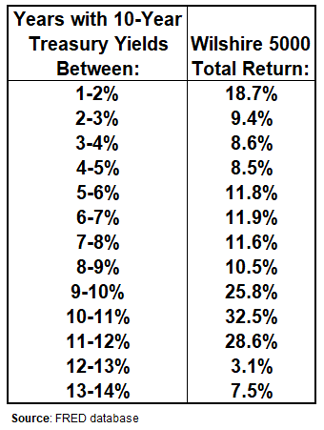
Today, the 10-Year Treasury yields between 4-5%, a range where the stock market has averaged returns of 8.5% since the early 1970s. Historically, a climb in yields up to a range of 5-6% actually improved average returns to 11.8%. Even more confounding for the modern narrative that higher rates lead to lower returns, the highest cluster of investor returns occurred when yields ranged between 9-12%. Why so? Because higher rates correspond with higher nominal GDP growth and higher nominal GDP drives higher earnings growth. In sum, interest rates are the noise. Earnings growth rates are the news.
The News: Earnings Growth
Historically, S&P 500 earnings grow by 7-8% a year. Tack on a 2-3% dividend yield and you arrive quickly at the 10% long-term return projection for equities. Periodically, however, breakthrough technology periods accelerate earnings growth rates. The last time we experienced a fully distributed breakthrough technology cycle was the proliferation of the internet between around 1994 and 2006. During that cycle, earnings growth averaged 11% per year—for 12 years!
That period also included a 30% earnings crash in 2001 coincident with the NASDAQ stock market crash. If we remove 2001 and isolate 1994-2000 (I think of this as the internet installation period), earnings grew 11.25%, annually. If we isolate 2002-2006 (I think of this as the internet integration period), earnings grew 18%, annually.
Now, consider the earnings impact potential of AI. If you believe that AI adoption holds at least as much promise for corporate profit enhancement as internet adoption, you should baseline your earnings growth assumption over the next decade at 11% as well. While professional analysts typically don’t look out that far, they do publish their expectations for the next 5 years. Here is their current collective view:
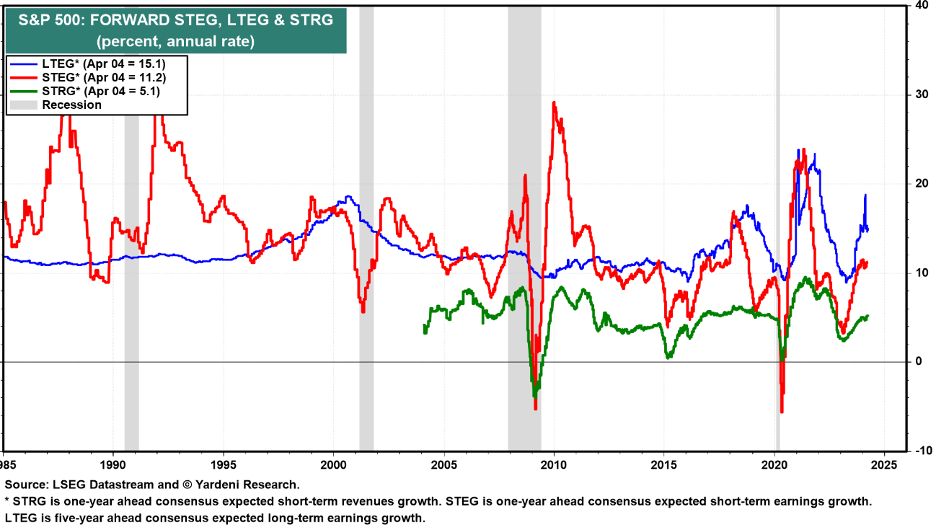
According to analysts, the STEG rate (Short-Term Earnings Growth – 1 year ahead) for the S&P 500 is 11.2%. The LTEG rate (Long-Term Earnings Growth – 5 years ahead) is 15.1%. Translating that into investor returns, the S&P 500 closed today (April 5th, 2024) at 5200. Should the S&P 500 simply track corporate earnings higher over the next 5 years, at those rates, the S&P 500 will hit 10,000 by 2029. Add in reinvested dividends and that number climbs higher still.
Now… I am not predicting this; I am just highlighting the potential, given that the AI technology breakthrough feels like the internet breakthrough on steroids. So, tune out the interest rate noise.
Earnings are the news!
-David
Sources: FRED, Yardeni
This communication and its contents are for informational and educational purposes only and should not be used as the sole basis for any investment decision. The information contained herein is based on publicly available sources believed to be reliable but is not a representation, expressed or implied, as to the accuracy, completeness, or correctness of said information. Past performance does not guarantee future results.
">
As markets gyrated this week between “will they” or “won’t they” June rate cut debates, I withdrew to focus on larger and more important questions. First, if the Fed decides rates need to be “higher for longer”, can this market rally continue? Second, using the dotcom tech cycle as an analog, will the AI tech cycle make earnings and investor returns “higher for longer”?
The Noise: Interest Rates
While the Federal Reserve determines the level of short-term interest rates with policy decisions, markets determine the level of long-term interest rates with pricing decisions. Pricing inputs include economic growth assessments, inflation assessments, monetary and fiscal policy assessments, myriad risk assessments, and supply/demand factors, just to name a few.
These inputs alchemize dynamically, in real time, to determine interest rate levels. Currently, the 10-Year U.S. Treasury yields 4.40%, up from 3.87% at the beginning of the year. That’s an absolute rise of .53% and a percentage rise of 13%. Yikes! Wall Street has adopted a belief that higher rates equal lower stock prices. Therefore, shouldn’t the market be lower? And if the Fed chooses to hold policy rates “higher for longer”, then stock prices should be “lower for longer”, shouldn’t they? Maybe, but historically… no. Consider the following 10-year Treasury yield levels and the corresponding stock market returns, based upon calendar years:
Today, the 10-Year Treasury yields between 4-5%, a range where the stock market has averaged returns of 8.5% since the early 1970s. Historically, a climb in yields up to a range of 5-6% actually improved average returns to 11.8%. Even more confounding for the modern narrative that higher rates lead to lower returns, the highest cluster of investor returns occurred when yields ranged between 9-12%. Why so? Because higher rates correspond with higher nominal GDP growth and higher nominal GDP drives higher earnings growth. In sum, interest rates are the noise. Earnings growth rates are the news.
The News: Earnings Growth
Historically, S&P 500 earnings grow by 7-8% a year. Tack on a 2-3% dividend yield and you arrive quickly at the 10% long-term return projection for equities. Periodically, however, breakthrough technology periods accelerate earnings growth rates. The last time we experienced a fully distributed breakthrough technology cycle was the proliferation of the internet between around 1994 and 2006. During that cycle, earnings growth averaged 11% per year—for 12 years!
That period also included a 30% earnings crash in 2001 coincident with the NASDAQ stock market crash. If we remove 2001 and isolate 1994-2000 (I think of this as the internet installation period), earnings grew 11.25%, annually. If we isolate 2002-2006 (I think of this as the internet integration period), earnings grew 18%, annually.
Now, consider the earnings impact potential of AI. If you believe that AI adoption holds at least as much promise for corporate profit enhancement as internet adoption, you should baseline your earnings growth assumption over the next decade at 11% as well. While professional analysts typically don’t look out that far, they do publish their expectations for the next 5 years. Here is their current collective view:
According to analysts, the STEG rate (Short-Term Earnings Growth – 1 year ahead) for the S&P 500 is 11.2%. The LTEG rate (Long-Term Earnings Growth – 5 years ahead) is 15.1%. Translating that into investor returns, the S&P 500 closed today (April 5th, 2024) at 5200. Should the S&P 500 simply track corporate earnings higher over the next 5 years, at those rates, the S&P 500 will hit 10,000 by 2029. Add in reinvested dividends and that number climbs higher still.
Now… I am not predicting this; I am just highlighting the potential, given that the AI technology breakthrough feels like the internet breakthrough on steroids. So, tune out the interest rate noise.
Earnings are the news!
-David
Sources: FRED, Yardeni
This communication and its contents are for informational and educational purposes only and should not be used as the sole basis for any investment decision. The information contained herein is based on publicly available sources believed to be reliable but is not a representation, expressed or implied, as to the accuracy, completeness, or correctness of said information. Past performance does not guarantee future results.
">“Hey AI, How Much Money Will You Make?” As markets gyrated this week between “will they” or “won’t they” June rate cut debates, I withdrew to focus on larger and more important questions. First, if the Fed decides rates need to be “higher for longer”, can this market rally continue? Second, using the dotcom tech cycle as an analog, will the AI tech cycle make earnings and investor returns “higher for longer”?The Noise: Interest Rates
While the Federal Reserve determines the level of short-term interest rates with policy decisions, markets determine the level of long-term interest rates with pricing decisions. Pricing inputs include economic growth assessments, inflation assessments, monetary and fiscal policy assessments, myriad risk assessments, and supply/demand factors, just to name a few.
These inputs alchemize dynamically, in real time, to determine interest rate levels. Currently, the 10-Year U.S. Treasury yields 4.40%, up from 3.87% at the beginning of the year. That’s an absolute rise of .53% and a percentage rise of 13%. Yikes! Wall Street has adopted a belief that higher rates equal lower stock prices. Therefore, shouldn’t the market be lower? And if the Fed chooses to hold policy rates “higher for longer”, then stock prices should be “lower for longer”, shouldn’t they? Maybe, but historically… no. Consider the following 10-year Treasury yield levels and the corresponding stock market returns, based upon calendar years:
Today, the 10-Year Treasury yields between 4-5%, a range where the stock market has averaged returns of 8.5% since the early 1970s. Historically, a climb in yields up to a range of 5-6% actually improved average returns to 11.8%. Even more confounding for the modern narrative that higher rates lead to lower returns, the highest cluster of investor returns occurred when yields ranged between 9-12%. Why so? Because higher rates correspond with higher nominal GDP growth and higher nominal GDP drives higher earnings growth. In sum, interest rates are the noise. Earnings growth rates are the news.
The News: Earnings Growth
Historically, S&P 500 earnings grow by 7-8% a year. Tack on a 2-3% dividend yield and you arrive quickly at the 10% long-term return projection for equities. Periodically, however, breakthrough technology periods accelerate earnings growth rates. The last time we experienced a fully distributed breakthrough technology cycle was the proliferation of the internet between around 1994 and 2006. During that cycle, earnings growth averaged 11% per year—for 12 years!
That period also included a 30% earnings crash in 2001 coincident with the NASDAQ stock market crash. If we remove 2001 and isolate 1994-2000 (I think of this as the internet installation period), earnings grew 11.25%, annually. If we isolate 2002-2006 (I think of this as the internet integration period), earnings grew 18%, annually.
Now, consider the earnings impact potential of AI. If you believe that AI adoption holds at least as much promise for corporate profit enhancement as internet adoption, you should baseline your earnings growth assumption over the next decade at 11% as well. While professional analysts typically don’t look out that far, they do publish their expectations for the next 5 years. Here is their current collective view:
According to analysts, the STEG rate (Short-Term Earnings Growth – 1 year ahead) for the S&P 500 is 11.2%. The LTEG rate (Long-Term Earnings Growth – 5 years ahead) is 15.1%. Translating that into investor returns, the S&P 500 closed today (April 5th, 2024) at 5200. Should the S&P 500 simply track corporate earnings higher over the next 5 years, at those rates, the S&P 500 will hit 10,000 by 2029. Add in reinvested dividends and that number climbs higher still.
Now… I am not predicting this; I am just highlighting the potential, given that the AI technology breakthrough feels like the internet breakthrough on steroids. So, tune out the interest rate noise.
Earnings are the news!
-David
Sources: FRED, Yardeni
This communication and its contents are for informational and educational purposes only and should not be used as the sole basis for any investment decision. The information contained herein is based on publicly available sources believed to be reliable but is not a representation, expressed or implied, as to the accuracy, completeness, or correctness of said information. Past performance does not guarantee future results.
" class="link-chevron">Let’s start first with the Fed’s GDP outlook:
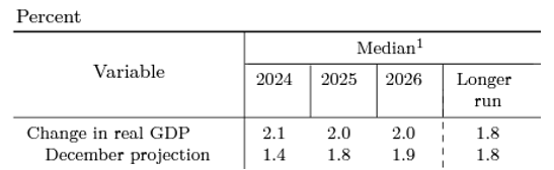
Note the column on the far-right that projects long-run GDP growth for the U.S. economy at 1.8%. That’s the number the Fed considers our domestic economic growth “potential.” Now note that the Fed believes the U.S. economy will grow “above potential” over 2024, 2025, and 2026 at 2.1%, 2.0% and 2.0%, respectively. That’s good news!
The Fed also upgraded its growth projections from December’s SEP release by .7% in 2024 (2.1%-1.4%), .2% in 2025 (2.0%-1.8%), and .1% in 2026 (2.0%-1.9%). That’s a 20% increase in growth expectations over the full three-year period, and a 50% increase in growth expectations over the coming year. That’s really good news!
Now let’s examine the Fed’s inflation outlook:
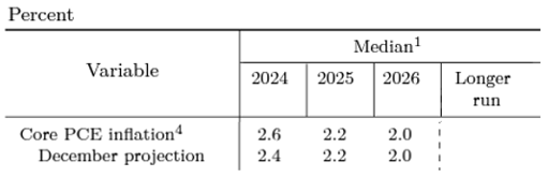
This is the Fed’s preferred inflation measure that they use to set policy. While they didn’t pencil in a longer-run inflation estimate, the Fed targets 2%. Therefore, the Fed estimates that inflation will run above target for 2024 and 2025 at 2.6% and 2.2%, respectively, before returning to their 2% target in 2026. That’s bad news. The Fed also increased its inflation expectations by .2% for the three-year period—also bad news.
However, in percentage terms, the additional .2% inflation expected only amounts to a 3% increase over the three-year period and an 8% increase over the coming year. On its own, maybe that’s bad news, but when you consider GDP upgrades of 50% for this year and 20% over the next three years versus an inflation upgrade of 8% for this year and 3% over the next three years… that’s great news!!!
Per the data, the Fed believes the U.S. economy has entered an upgrade cycle where it can produce more economic growth per unit of inflation. This may be an early acknowledgment of the AI technology cycle just entered, or at least the anticipated benefits.
On Friday, I had lunch with an entrepreneurial friend and client. He works for a company that reads through large corporate databases to find useful litigation information. He explained to me that by using AI to scan millions of documents for an upcoming project, they were able to lower their proposal price by 66%. That’s an astounding reduction. Imagine the disinflationary power of applying generative AI economy-wide. This alone could explain the Fed’s newfound optimism.
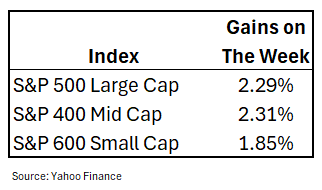
Consider this, if the Federal Reserve believes that upcoming productivity gains will produce higher growth with lower inflation, then investors should believe in profitability gains that will produce higher returns. As per the following gains on the week, apparently… they do:
Enjoy the week!
-David
Sources: U.S. Federal Reserve, Yahoo Finance
This communication and its contents are for informational and educational purposes only and should not be used as the sole basis for any investment decision. The information contained herein is based on publicly available sources believed to be reliable but is not a representation, expressed or implied, as to the accuracy, completeness, or correctness of said information. Past performance does not guarantee future results.
">
Markets leapt to new record highs this week as Chairman Powell and the FOMC left rates unchanged, maintained their outlook for three cuts in 2024, and released a very buoyant Summary of Economic Projections (SEP) survey. The decision not to cut rates wasn’t a market mover. The continued three rate cut forecast, rather than two, definitely contributed, but the big lift came from the dramatic increase in the Fed’s overall economic assessment, as shared below:
Let’s start first with the Fed’s GDP outlook:
Note the column on the far-right that projects long-run GDP growth for the U.S. economy at 1.8%. That’s the number the Fed considers our domestic economic growth “potential.” Now note that the Fed believes the U.S. economy will grow “above potential” over 2024, 2025, and 2026 at 2.1%, 2.0% and 2.0%, respectively. That’s good news!
The Fed also upgraded its growth projections from December’s SEP release by .7% in 2024 (2.1%-1.4%), .2% in 2025 (2.0%-1.8%), and .1% in 2026 (2.0%-1.9%). That’s a 20% increase in growth expectations over the full three-year period, and a 50% increase in growth expectations over the coming year. That’s really good news!
Now let’s examine the Fed’s inflation outlook:
This is the Fed’s preferred inflation measure that they use to set policy. While they didn’t pencil in a longer-run inflation estimate, the Fed targets 2%. Therefore, the Fed estimates that inflation will run above target for 2024 and 2025 at 2.6% and 2.2%, respectively, before returning to their 2% target in 2026. That’s bad news. The Fed also increased its inflation expectations by .2% for the three-year period—also bad news.
However, in percentage terms, the additional .2% inflation expected only amounts to a 3% increase over the three-year period and an 8% increase over the coming year. On its own, maybe that’s bad news, but when you consider GDP upgrades of 50% for this year and 20% over the next three years versus an inflation upgrade of 8% for this year and 3% over the next three years… that’s great news!!!
Per the data, the Fed believes the U.S. economy has entered an upgrade cycle where it can produce more economic growth per unit of inflation. This may be an early acknowledgment of the AI technology cycle just entered, or at least the anticipated benefits.
On Friday, I had lunch with an entrepreneurial friend and client. He works for a company that reads through large corporate databases to find useful litigation information. He explained to me that by using AI to scan millions of documents for an upcoming project, they were able to lower their proposal price by 66%. That’s an astounding reduction. Imagine the disinflationary power of applying generative AI economy-wide. This alone could explain the Fed’s newfound optimism.
Consider this, if the Federal Reserve believes that upcoming productivity gains will produce higher growth with lower inflation, then investors should believe in profitability gains that will produce higher returns. As per the following gains on the week, apparently… they do:
Enjoy the week!
-David
Sources: U.S. Federal Reserve, Yahoo Finance
This communication and its contents are for informational and educational purposes only and should not be used as the sole basis for any investment decision. The information contained herein is based on publicly available sources believed to be reliable but is not a representation, expressed or implied, as to the accuracy, completeness, or correctness of said information. Past performance does not guarantee future results.
">Pow Pow Powell! Markets leapt to new record highs this week as Chairman Powell and the FOMC left rates unchanged, maintained their outlook for three cuts in 2024, and released a very buoyant Summary of Economic Projections (SEP) survey. The decision not to cut rates wasn’t a market mover. The continued three rate cut forecast, rather than two, definitely contributed, but the big lift came from the dramatic increase in the Fed’s overall economic assessment, as shared below:Let’s start first with the Fed’s GDP outlook:
Note the column on the far-right that projects long-run GDP growth for the U.S. economy at 1.8%. That’s the number the Fed considers our domestic economic growth “potential.” Now note that the Fed believes the U.S. economy will grow “above potential” over 2024, 2025, and 2026 at 2.1%, 2.0% and 2.0%, respectively. That’s good news!
The Fed also upgraded its growth projections from December’s SEP release by .7% in 2024 (2.1%-1.4%), .2% in 2025 (2.0%-1.8%), and .1% in 2026 (2.0%-1.9%). That’s a 20% increase in growth expectations over the full three-year period, and a 50% increase in growth expectations over the coming year. That’s really good news!
Now let’s examine the Fed’s inflation outlook:
This is the Fed’s preferred inflation measure that they use to set policy. While they didn’t pencil in a longer-run inflation estimate, the Fed targets 2%. Therefore, the Fed estimates that inflation will run above target for 2024 and 2025 at 2.6% and 2.2%, respectively, before returning to their 2% target in 2026. That’s bad news. The Fed also increased its inflation expectations by .2% for the three-year period—also bad news.
However, in percentage terms, the additional .2% inflation expected only amounts to a 3% increase over the three-year period and an 8% increase over the coming year. On its own, maybe that’s bad news, but when you consider GDP upgrades of 50% for this year and 20% over the next three years versus an inflation upgrade of 8% for this year and 3% over the next three years… that’s great news!!!
Per the data, the Fed believes the U.S. economy has entered an upgrade cycle where it can produce more economic growth per unit of inflation. This may be an early acknowledgment of the AI technology cycle just entered, or at least the anticipated benefits.
On Friday, I had lunch with an entrepreneurial friend and client. He works for a company that reads through large corporate databases to find useful litigation information. He explained to me that by using AI to scan millions of documents for an upcoming project, they were able to lower their proposal price by 66%. That’s an astounding reduction. Imagine the disinflationary power of applying generative AI economy-wide. This alone could explain the Fed’s newfound optimism.
Consider this, if the Federal Reserve believes that upcoming productivity gains will produce higher growth with lower inflation, then investors should believe in profitability gains that will produce higher returns. As per the following gains on the week, apparently… they do:
Enjoy the week!
-David
Sources: U.S. Federal Reserve, Yahoo Finance
This communication and its contents are for informational and educational purposes only and should not be used as the sole basis for any investment decision. The information contained herein is based on publicly available sources believed to be reliable but is not a representation, expressed or implied, as to the accuracy, completeness, or correctness of said information. Past performance does not guarantee future results.
" class="link-chevron">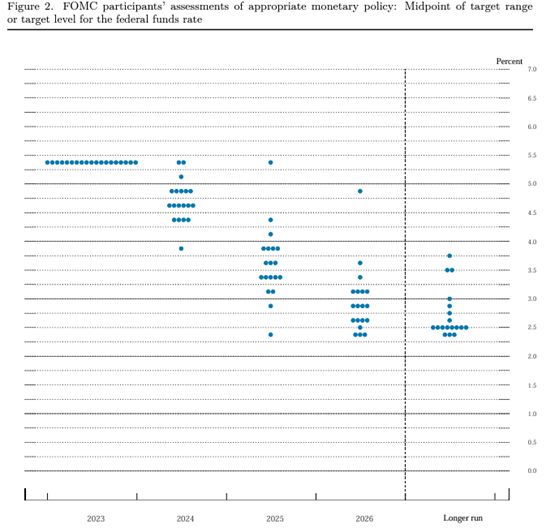
I recognize that for the unfamiliar, this chart looks particularly daunting, so I will spend some time interpreting it. For orientation, the horizontal base offers forecast timeframes: 2023, 2024, 2025, 2026, and the long run (also known as the neutral rate). The vertical access provides a range for the Federal Funds rate from 0% to 7%. The dots you see represent the interest rate predictions of up to 19 Federal Reserve officials, seven from the board of Governors and 12 from the regional banks. The Fed first released this survey in the wake of the financial crisis as Ben Bernanke wanted to provide markets with more insight into Fed policy direction after extreme policy actions. Ben also favored policy transparency which differed meaningfully from Alan Greenspan’s bias towards policy obfuscation. As market participants, we appreciate a more transparent Fed and view the “dot plot” as a powerful investment strategy tool. For example, based on the dots above, none of the survey participants foresaw any further interest rate hikes for the cycle. Two of the most “hawkish” participants predicted no change in the Federal Funds rate for 2024, thereby signaling their belief that the economy and inflation will grow more than consensus. One “dovish” member predicted the Fed would need to cut interest rates six times next year down to 4%, seemingly in response to a collapse in inflation or an economic recession. However, overall, the median forecast projected a total of three rate cuts for 2024, and while the potential range widens in 2025 from 2.4% to 5.4%, the median predicted another four rate cuts in 2025, suggesting seven rate cuts over the next two years. Whether the Fed cuts once, twice, thrice, or seven times will draw debate and scrutiny as the new “dot plot” arrives next week. However, from an investment strategy standpoint, direction matters more than degree, and the collective bias for interest rate policy is lower.
Armed with this information, investors should refer to history in search of winning investment strategies during rate cut regimes. Historically, once the Fed cuts, small company stocks dramatically outperform large company stocks:
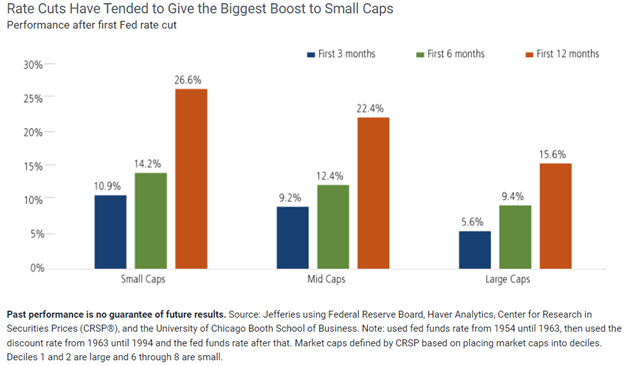
Since 1954, over the first three months after a rate cut, small caps have averaged 10.9% returns versus 5.6% for large caps. Over the first six months after a rate cut, it’s 14.2% versus 9.4%, and over the first year, it’s 26.6% versus 15.6%. Why such performance disparity? Small companies rely much more heavily on debt to fund operations:
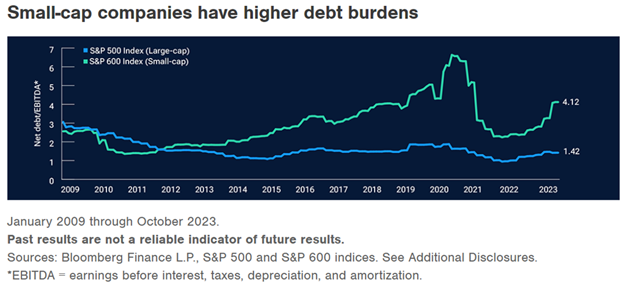
In fact, according to the data shown above, small caps carry nearly three times the amount of debt to earnings as large caps. Therefore, any reduction in interest rates should incite a surge in small cap earnings.
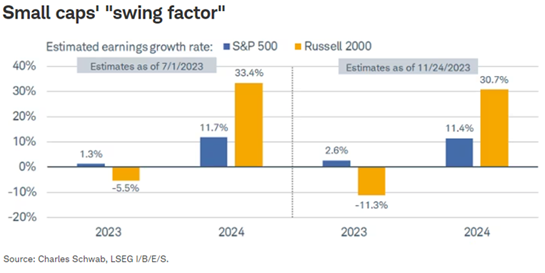
As seen above, analysts expect small cap earnings will rally 30% in 2024 compared to an 11% rise for large cap earnings. Of course, these estimates largely depend on a lower interest rate regime from the Fed, making small cap stocks particularly sensitive to any hot inflation headlines or hawkish speak from Federal Reserve officials. Year-to-date, small cap outperformance has been intermittent, and headline driven. Wall Street forecasters have scaled down rate cut expectations from six to three, which has advantaged large cap performance overall. However, we have seen a recent performance shift down the capitalization spectrum as the equal-weight S&P 500 (all 500 stocks get .2%) has recently outperformed the capitalization-weighted S&P 500 (the top 10 stocks get 30%+) despite hotter than expected inflation data in January and February:
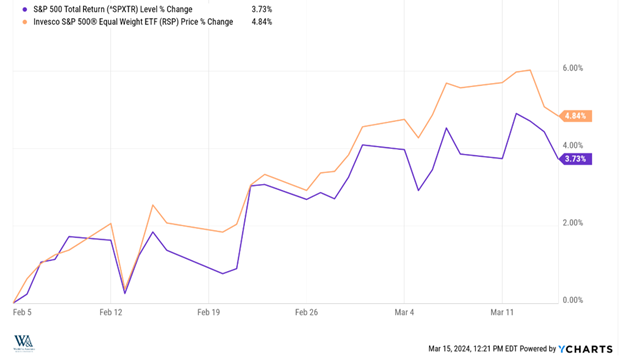
Since Early February the S&P Equal Weight index has not only performed the S&P Capitalization Weighted index (4.84% vs 3.73%), but it’s also outperformed the Magnificent 7 index (4.84% vs. 4.09%). Even more suggestive, the small cap Russell 2000 index outperformed all of them over the same period, returning 5.27% vs 3.73% for the large cap S&P 500.
In sum, the mere suggestion of interest rate cuts forthcoming in the Fed’s “dot plot” has drawn investor attention to the potential of outperformance from small caps, and algorithms have been programmed accordingly. Inflation headlines and Fed speak instantly trigger return advantages and disadvantages anticipating the probability, timing, and degree of rate cuts. More recently, however, we have seen more durable small cap outperformances, suggesting that investors, rather than traders, may be increasing allocations. With the Fed broadcasting rate cuts, small cap earnings expectations high and relative valuations low, small caps appear poised to run. Furthermore, performance breakdowns among the Magnificent 7 stocks create selling and reallocations. If this money studies the “dot plot” and market history, it will follow us down the capitalization spectrum and boost our returns.
Remember, you get paid if you are early…and you get played if you are late!
Have a great week!
-David
Sources: FOMC, Charles Schwab LSEG I/B/E/S, Waddell & Associates, Y Charts, Bloomberg Finance L.P., S&P 500 and S&P 600 indices, Jefferies using Federal Reserve Board, Haver Analytics.
">
Once a quarter, the Federal Reserve releases its Summary of Economic Projections (SEP). This report contains FOMC member projections for the unemployment rate, inflation, and GDP. The Fed also includes an anonymous depiction of each member’s federal funds rate forecast within a “dot plot,” as seen below in December’s SEP:
I recognize that for the unfamiliar, this chart looks particularly daunting, so I will spend some time interpreting it. For orientation, the horizontal base offers forecast timeframes: 2023, 2024, 2025, 2026, and the long run (also known as the neutral rate). The vertical access provides a range for the Federal Funds rate from 0% to 7%. The dots you see represent the interest rate predictions of up to 19 Federal Reserve officials, seven from the board of Governors and 12 from the regional banks. The Fed first released this survey in the wake of the financial crisis as Ben Bernanke wanted to provide markets with more insight into Fed policy direction after extreme policy actions. Ben also favored policy transparency which differed meaningfully from Alan Greenspan’s bias towards policy obfuscation. As market participants, we appreciate a more transparent Fed and view the “dot plot” as a powerful investment strategy tool. For example, based on the dots above, none of the survey participants foresaw any further interest rate hikes for the cycle. Two of the most “hawkish” participants predicted no change in the Federal Funds rate for 2024, thereby signaling their belief that the economy and inflation will grow more than consensus. One “dovish” member predicted the Fed would need to cut interest rates six times next year down to 4%, seemingly in response to a collapse in inflation or an economic recession. However, overall, the median forecast projected a total of three rate cuts for 2024, and while the potential range widens in 2025 from 2.4% to 5.4%, the median predicted another four rate cuts in 2025, suggesting seven rate cuts over the next two years. Whether the Fed cuts once, twice, thrice, or seven times will draw debate and scrutiny as the new “dot plot” arrives next week. However, from an investment strategy standpoint, direction matters more than degree, and the collective bias for interest rate policy is lower.
Armed with this information, investors should refer to history in search of winning investment strategies during rate cut regimes. Historically, once the Fed cuts, small company stocks dramatically outperform large company stocks:
Since 1954, over the first three months after a rate cut, small caps have averaged 10.9% returns versus 5.6% for large caps. Over the first six months after a rate cut, it’s 14.2% versus 9.4%, and over the first year, it’s 26.6% versus 15.6%. Why such performance disparity? Small companies rely much more heavily on debt to fund operations:
In fact, according to the data shown above, small caps carry nearly three times the amount of debt to earnings as large caps. Therefore, any reduction in interest rates should incite a surge in small cap earnings.
As seen above, analysts expect small cap earnings will rally 30% in 2024 compared to an 11% rise for large cap earnings. Of course, these estimates largely depend on a lower interest rate regime from the Fed, making small cap stocks particularly sensitive to any hot inflation headlines or hawkish speak from Federal Reserve officials. Year-to-date, small cap outperformance has been intermittent, and headline driven. Wall Street forecasters have scaled down rate cut expectations from six to three, which has advantaged large cap performance overall. However, we have seen a recent performance shift down the capitalization spectrum as the equal-weight S&P 500 (all 500 stocks get .2%) has recently outperformed the capitalization-weighted S&P 500 (the top 10 stocks get 30%+) despite hotter than expected inflation data in January and February:
Since Early February the S&P Equal Weight index has not only performed the S&P Capitalization Weighted index (4.84% vs 3.73%), but it’s also outperformed the Magnificent 7 index (4.84% vs. 4.09%). Even more suggestive, the small cap Russell 2000 index outperformed all of them over the same period, returning 5.27% vs 3.73% for the large cap S&P 500.
In sum, the mere suggestion of interest rate cuts forthcoming in the Fed’s “dot plot” has drawn investor attention to the potential of outperformance from small caps, and algorithms have been programmed accordingly. Inflation headlines and Fed speak instantly trigger return advantages and disadvantages anticipating the probability, timing, and degree of rate cuts. More recently, however, we have seen more durable small cap outperformances, suggesting that investors, rather than traders, may be increasing allocations. With the Fed broadcasting rate cuts, small cap earnings expectations high and relative valuations low, small caps appear poised to run. Furthermore, performance breakdowns among the Magnificent 7 stocks create selling and reallocations. If this money studies the “dot plot” and market history, it will follow us down the capitalization spectrum and boost our returns.
Remember, you get paid if you are early…and you get played if you are late!
Have a great week!
-David
Sources: FOMC, Charles Schwab LSEG I/B/E/S, Waddell & Associates, Y Charts, Bloomberg Finance L.P., S&P 500 and S&P 600 indices, Jefferies using Federal Reserve Board, Haver Analytics.
">Dot Plot Plotting Once a quarter, the Federal Reserve releases its Summary of Economic Projections (SEP). This report contains FOMC member projections for the unemployment rate, inflation, and GDP. The Fed also includes an anonymous depiction of each member’s federal funds rate forecast within a “dot plot,” as seen below in December’s SEP:
I recognize that for the unfamiliar, this chart looks particularly daunting, so I will spend some time interpreting it. For orientation, the horizontal base offers forecast timeframes: 2023, 2024, 2025, 2026, and the long run (also known as the neutral rate). The vertical access provides a range for the Federal Funds rate from 0% to 7%. The dots you see represent the interest rate predictions of up to 19 Federal Reserve officials, seven from the board of Governors and 12 from the regional banks. The Fed first released this survey in the wake of the financial crisis as Ben Bernanke wanted to provide markets with more insight into Fed policy direction after extreme policy actions. Ben also favored policy transparency which differed meaningfully from Alan Greenspan’s bias towards policy obfuscation. As market participants, we appreciate a more transparent Fed and view the “dot plot” as a powerful investment strategy tool. For example, based on the dots above, none of the survey participants foresaw any further interest rate hikes for the cycle. Two of the most “hawkish” participants predicted no change in the Federal Funds rate for 2024, thereby signaling their belief that the economy and inflation will grow more than consensus. One “dovish” member predicted the Fed would need to cut interest rates six times next year down to 4%, seemingly in response to a collapse in inflation or an economic recession. However, overall, the median forecast projected a total of three rate cuts for 2024, and while the potential range widens in 2025 from 2.4% to 5.4%, the median predicted another four rate cuts in 2025, suggesting seven rate cuts over the next two years. Whether the Fed cuts once, twice, thrice, or seven times will draw debate and scrutiny as the new “dot plot” arrives next week. However, from an investment strategy standpoint, direction matters more than degree, and the collective bias for interest rate policy is lower.
Armed with this information, investors should refer to history in search of winning investment strategies during rate cut regimes. Historically, once the Fed cuts, small company stocks dramatically outperform large company stocks:
Since 1954, over the first three months after a rate cut, small caps have averaged 10.9% returns versus 5.6% for large caps. Over the first six months after a rate cut, it’s 14.2% versus 9.4%, and over the first year, it’s 26.6% versus 15.6%. Why such performance disparity? Small companies rely much more heavily on debt to fund operations:
In fact, according to the data shown above, small caps carry nearly three times the amount of debt to earnings as large caps. Therefore, any reduction in interest rates should incite a surge in small cap earnings.
As seen above, analysts expect small cap earnings will rally 30% in 2024 compared to an 11% rise for large cap earnings. Of course, these estimates largely depend on a lower interest rate regime from the Fed, making small cap stocks particularly sensitive to any hot inflation headlines or hawkish speak from Federal Reserve officials. Year-to-date, small cap outperformance has been intermittent, and headline driven. Wall Street forecasters have scaled down rate cut expectations from six to three, which has advantaged large cap performance overall. However, we have seen a recent performance shift down the capitalization spectrum as the equal-weight S&P 500 (all 500 stocks get .2%) has recently outperformed the capitalization-weighted S&P 500 (the top 10 stocks get 30%+) despite hotter than expected inflation data in January and February:
Since Early February the S&P Equal Weight index has not only performed the S&P Capitalization Weighted index (4.84% vs 3.73%), but it’s also outperformed the Magnificent 7 index (4.84% vs. 4.09%). Even more suggestive, the small cap Russell 2000 index outperformed all of them over the same period, returning 5.27% vs 3.73% for the large cap S&P 500.
In sum, the mere suggestion of interest rate cuts forthcoming in the Fed’s “dot plot” has drawn investor attention to the potential of outperformance from small caps, and algorithms have been programmed accordingly. Inflation headlines and Fed speak instantly trigger return advantages and disadvantages anticipating the probability, timing, and degree of rate cuts. More recently, however, we have seen more durable small cap outperformances, suggesting that investors, rather than traders, may be increasing allocations. With the Fed broadcasting rate cuts, small cap earnings expectations high and relative valuations low, small caps appear poised to run. Furthermore, performance breakdowns among the Magnificent 7 stocks create selling and reallocations. If this money studies the “dot plot” and market history, it will follow us down the capitalization spectrum and boost our returns.
Remember, you get paid if you are early…and you get played if you are late!
Have a great week!
-David
Sources: FOMC, Charles Schwab LSEG I/B/E/S, Waddell & Associates, Y Charts, Bloomberg Finance L.P., S&P 500 and S&P 600 indices, Jefferies using Federal Reserve Board, Haver Analytics.
" class="link-chevron">
Inflation re-acceleration poses the most significant risk to our optimistic outlook for 2024. This places market moving weight on each CPI, PCE and PPI inflation release. This week, we received the January read on core PCE inflation, which is the Fed’s preferred inflation measure and the one they ascribe their 2% target to. The number came in high, as January numbers tend to do, but as expected, and still directionally lower:
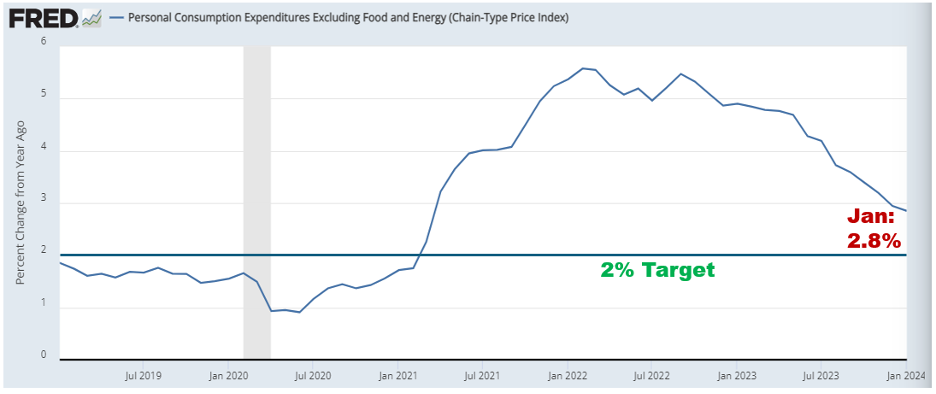
Markets took the measure in stride as rates remained subdued and stock prices rose further into record territory. Some commentators suggested that the hotter January monthly data indicated a break in trend and a risk to further stock market gains. We don’t think so.
Remember that inflation involves price negotiations between buyers and sellers. I specifically remember a post-COVID conversation I had with a close friend in a very large company. Global supply chains collapsed, economic shutdowns created systematic shortages and stimulus money flooded consumers with cash. My advice to him: “RAISE YOUR PRICES A LOT! You will never have another opportunity like this! A massive increase in demand paired with a massive decrease in supply gives you generational cover to increase your prices. Once things calm down you may have to lower them to protect market share, but your base prices will be much higher by that point.”
I was certainly not alone in providing this advice and they did raise prices a lot, because they could, and people expected it. That situation no longer exists:
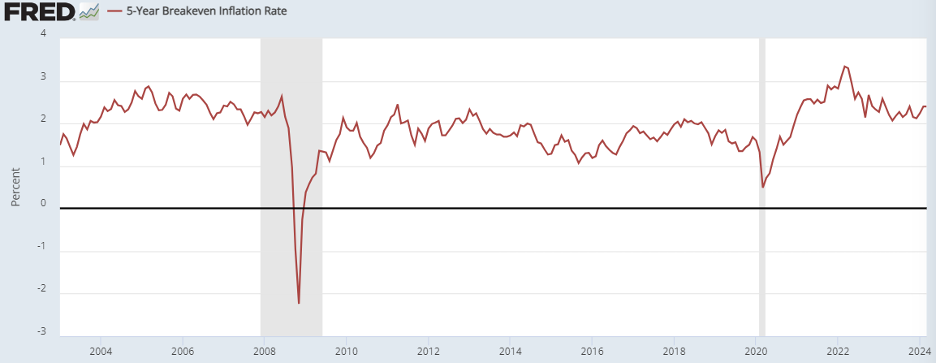
This chart chronicles the 5-year breakeven inflation rate within markets. At 2.4%, we sit right at the pre-GFC crisis level and only slightly above the pre-COVID level. Markets largely believe inflation has passed.
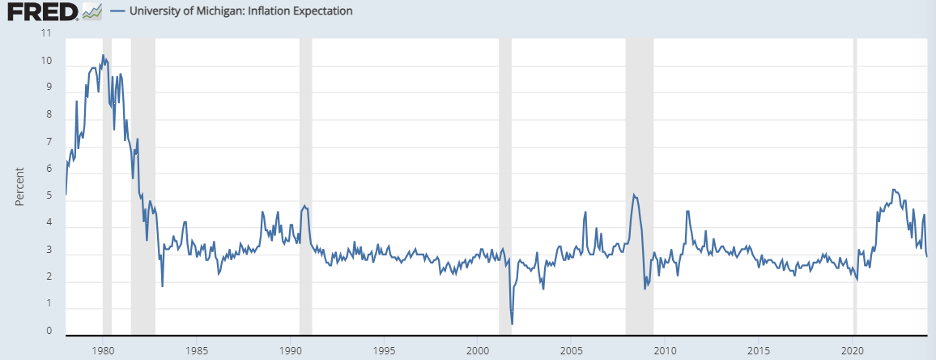
This chart chronicles the Michigan Inflation Expectations index which recounts consumer inflation expectations over the upcoming year. At 3%, we sit right at the long-term average, down significantly from the post-COVID surge. Consumers largely believe inflation has passed.
The reason I share this perspective is that, while the Fed monitors the numbers and the markets react to every release, price takers no longer see inflation as a major concern and, as such, will not willingly accept price hikes.
Within the economy, pricing power has rebalanced from the sellers to the buyers. Marketplace psychology will help further guide inflation toward the Fed’s 2% target, absent some exogenous event that allows companies to capitalize on confusion.
The February inflation release falls on March 12th. This number could be hotter as well, considering seasonality distorts early-month readings as new-year price schedules post. Markets may react, but interest rates side with us as seen in the movement of the 10-Year Treasury yield, despite the potential January/February jump:
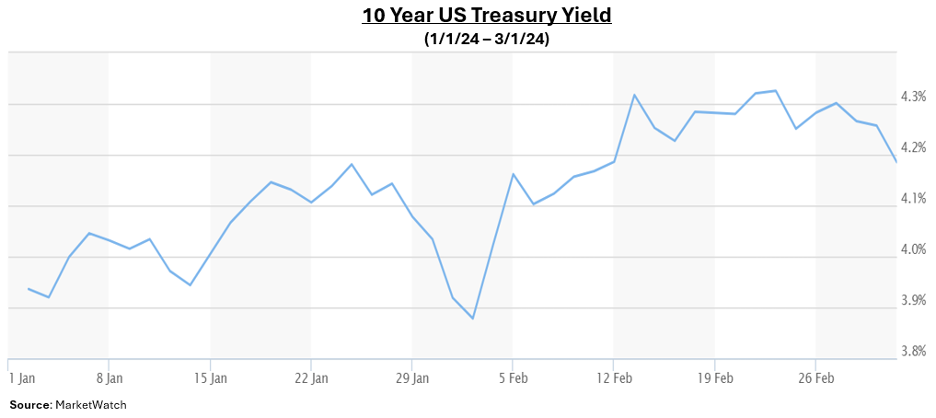
Lastly, if disinflation maintains course, rates remain subdued, earnings keep climbing, and the Fed continues signaling rate cuts, this rally should broaden well beyond the Magnificent 7. And so, it has:
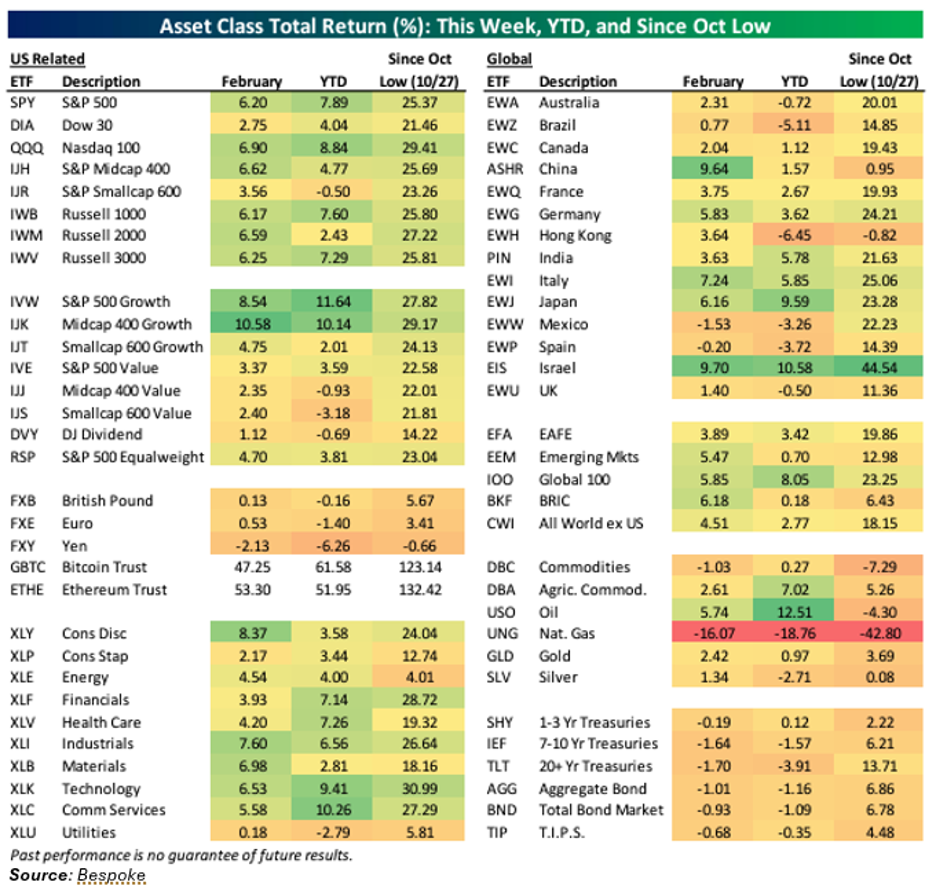
Note that, for the month of February, small cap stocks (Russell 2000) outperformed large cap stocks (S&P 500), industrials outperformed technology, and China outperformed the U.S. At this pace, markets would rise 50% this year. Unlikely. It may be time for a breather, but as long as the inflationary trend maintains course… this rally should also.
Have a great week!
Sources: FRED, Marketwatch, Bespoke
">Appreciate the Appreciation!
Inflation re-acceleration poses the most significant risk to our optimistic outlook for 2024. This places market moving weight on each CPI, PCE and PPI inflation release. This week, we received the January read on core PCE inflation, which is the Fed’s preferred inflation measure and the one they ascribe their 2% target to. The number came in high, as January numbers tend to do, but as expected, and still directionally lower:
Markets took the measure in stride as rates remained subdued and stock prices rose further into record territory. Some commentators suggested that the hotter January monthly data indicated a break in trend and a risk to further stock market gains. We don’t think so.
Remember that inflation involves price negotiations between buyers and sellers. I specifically remember a post-COVID conversation I had with a close friend in a very large company. Global supply chains collapsed, economic shutdowns created systematic shortages and stimulus money flooded consumers with cash. My advice to him: “RAISE YOUR PRICES A LOT! You will never have another opportunity like this! A massive increase in demand paired with a massive decrease in supply gives you generational cover to increase your prices. Once things calm down you may have to lower them to protect market share, but your base prices will be much higher by that point.”
I was certainly not alone in providing this advice and they did raise prices a lot, because they could, and people expected it. That situation no longer exists:
This chart chronicles the 5-year breakeven inflation rate within markets. At 2.4%, we sit right at the pre-GFC crisis level and only slightly above the pre-COVID level. Markets largely believe inflation has passed.
This chart chronicles the Michigan Inflation Expectations index which recounts consumer inflation expectations over the upcoming year. At 3%, we sit right at the long-term average, down significantly from the post-COVID surge. Consumers largely believe inflation has passed.
The reason I share this perspective is that, while the Fed monitors the numbers and the markets react to every release, price takers no longer see inflation as a major concern and, as such, will not willingly accept price hikes.
Within the economy, pricing power has rebalanced from the sellers to the buyers. Marketplace psychology will help further guide inflation toward the Fed’s 2% target, absent some exogenous event that allows companies to capitalize on confusion.
The February inflation release falls on March 12th. This number could be hotter as well, considering seasonality distorts early-month readings as new-year price schedules post. Markets may react, but interest rates side with us as seen in the movement of the 10-Year Treasury yield, despite the potential January/February jump:
Lastly, if disinflation maintains course, rates remain subdued, earnings keep climbing, and the Fed continues signaling rate cuts, this rally should broaden well beyond the Magnificent 7. And so, it has:
Note that, for the month of February, small cap stocks (Russell 2000) outperformed large cap stocks (S&P 500), industrials outperformed technology, and China outperformed the U.S. At this pace, markets would rise 50% this year. Unlikely. It may be time for a breather, but as long as the inflationary trend maintains course… this rally should also.
Have a great week!
Sources: FRED, Marketwatch, Bespoke
" class="link-chevron">