



%20(1).png?width=508&height=121&name=flourish-primary-logo@2x%20(1)%20(1).png)


At the end of 2022, economic, investor, and consumer sentiment reached some of the lowest levels in history. Economists and business leaders expected a recession while investors expected a bear market. We mused at the time that nothing pleased us more than pessimism because peak pessimism typically signals performance troughs.
We captured this concept in the following slide from our 2023 Outlook presentation which basically concluded that, since we couldn’t find much fundamentally to be optimistic about, the lugubrious consensus likely meant the market would rally smartly:
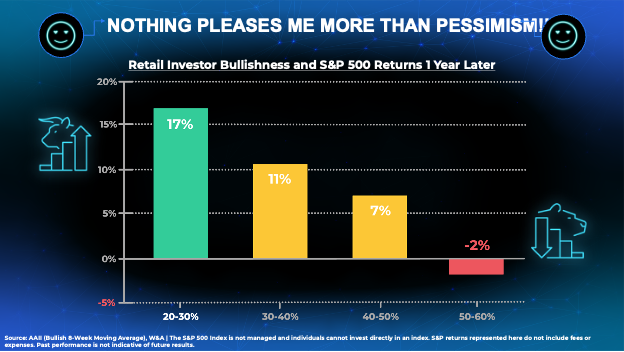
Indeed, it did. Only 20% of investors entered 2023 expecting the stock market to advance. Historically, after equivalent levels of pessimism, stocks rose 17% over the following year, on average. On cue, in 2023 the S&P 500 rose roughly 26%, thereby proving our point that pessimism pays!
As we enter 2025, it’s clear that nearly every asset class has hit record highs. Rather than take inventory, we can see the combined results in total household net worth:
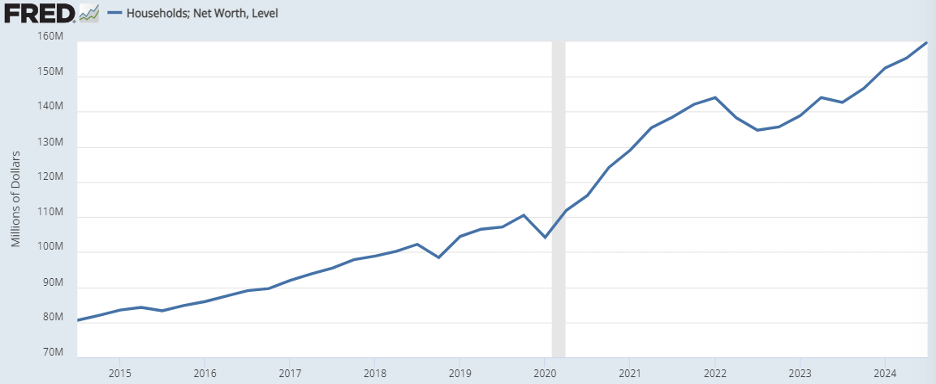
Household net worth in the US has grown from roughly $100 trillion pre-COVID to $160 trillion today. That’s a 60% increase in only four years. It took ten years to accumulate a 60% increase before that. US households have never gotten so rich, so fast.
COVID-inspired fiscal stimulus led to dramatic swings in household income, particularly adjusted for inflation:
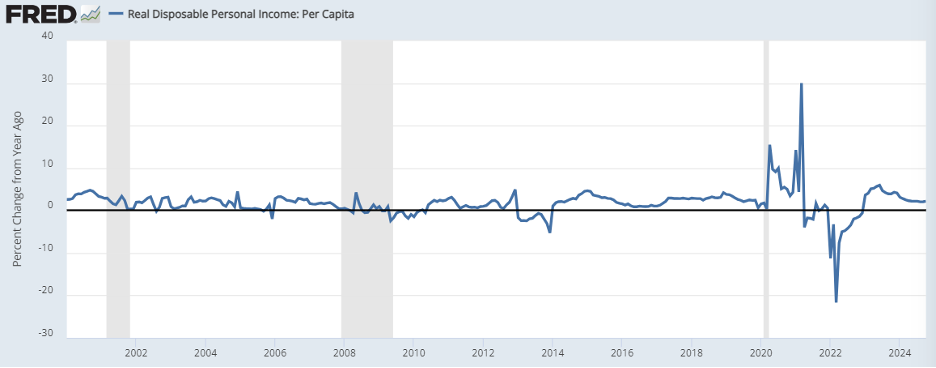
This chart chronicles annual growth in real disposable personal income per capita. In other words, discretionary spending power for consumers. Note the spike higher from stimulus followed by the spike lower from inflation. Today, disposable income levels sit about 9% higher than they were pre-COVID; a healthy complement to the 60% rise in household net worth.
With record net worth and record income, consumer sentiment should be record-breaking as well. Not quite:
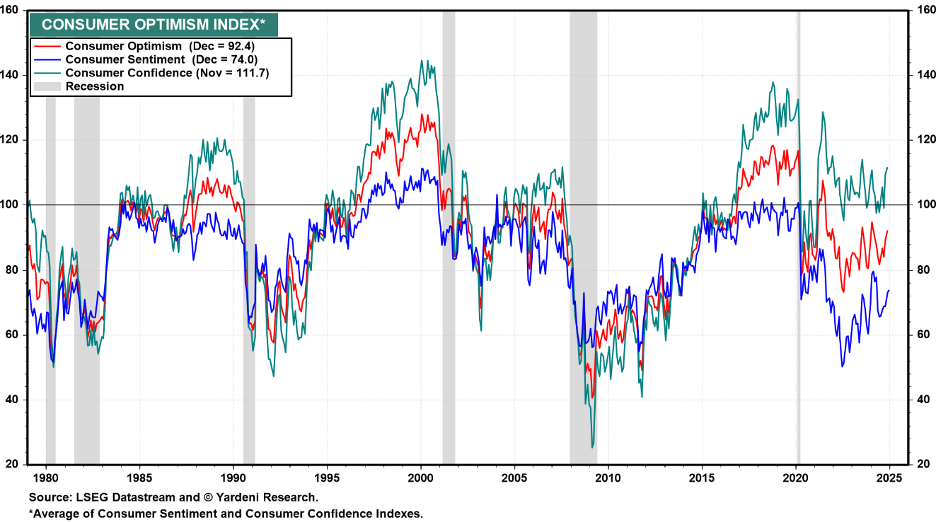
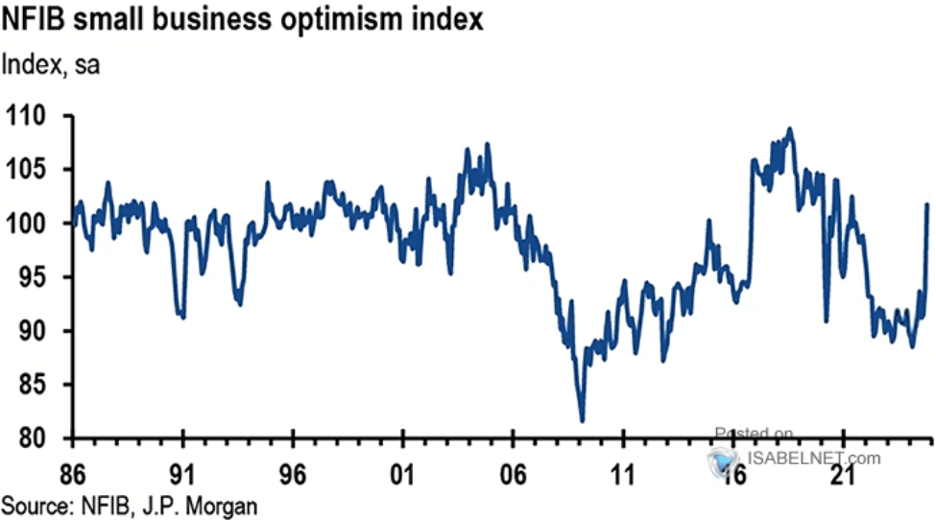
Consumer sentiment levels have continued to sag, despite rosy household economics. Economists have proposed many theories, but our social media obsessions with politics and conspiracy theories likely explain much of it. Nonetheless, we have seen meaningful advances recently in most measures of consumer confidence, specifically around household finances. Note the post-election small business sentiment surge:
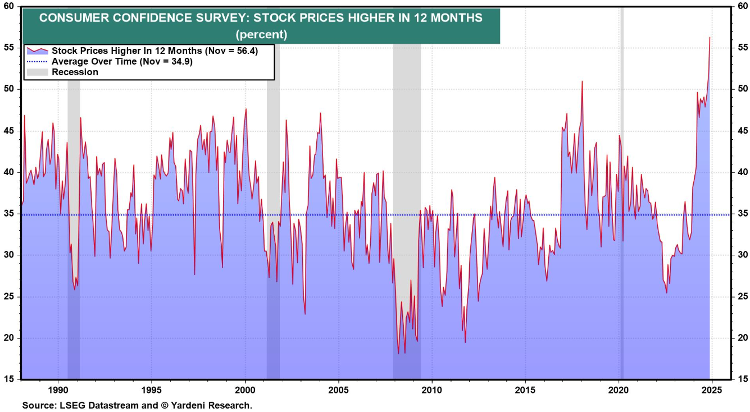
And the surge in household expectations for stock market performance over the next 12 months:
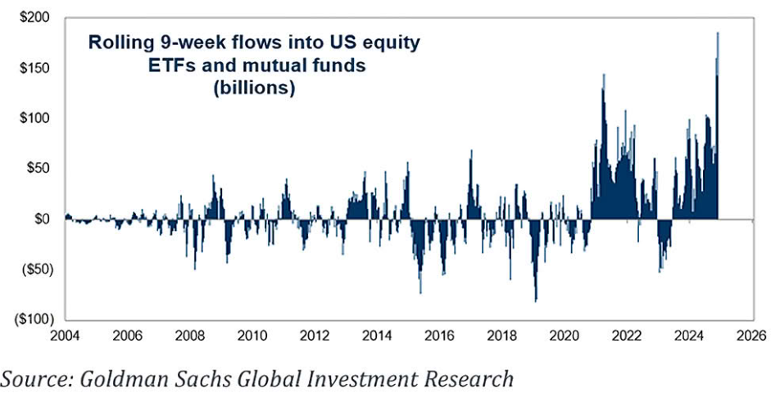
Leading to record inflows for US stock funds:
And record highs for US stocks, as the NASDAQ closed above 20,000 for the first time this week.
In sum, retail investors today are about twice as bullish on the future as they were at the end of 2022. While this removes much of the uplift from positive surprise, this does not necessarily portend a negative outcome for 2025.
Per our initial chart, 40% bullish sentiment historically correlates with 7% to 11% returns over the coming year, on average. After back-to-back 20%+ years, that wouldn’t feel so bad. So, as 2024 comes to a close, don’t feel too bad about feeling good!
Have a great rest of your weekend,
-David
Sources: AAII, FRED, LSEG Database, Yardeni, NFIB, JP Morgan, Goldman Sachs
This communication and its contents are for informational and educational purposes only and should not be used as the sole basis for any investment decision. The information contained herein is based on publicly available sources believed to be reliable but is not a representation, expressed or implied, as to the accuracy, completeness, or correctness of said information. Past performance does not guarantee future results.
">How You Feelin’??
At the end of 2022, economic, investor, and consumer sentiment reached some of the lowest levels in history. Economists and business leaders expected a recession while investors expected a bear market. We mused at the time that nothing pleased us more than pessimism because peak pessimism typically signals performance troughs.
We captured this concept in the following slide from our 2023 Outlook presentation which basically concluded that, since we couldn’t find much fundamentally to be optimistic about, the lugubrious consensus likely meant the market would rally smartly:
Indeed, it did. Only 20% of investors entered 2023 expecting the stock market to advance. Historically, after equivalent levels of pessimism, stocks rose 17% over the following year, on average. On cue, in 2023 the S&P 500 rose roughly 26%, thereby proving our point that pessimism pays!
As we enter 2025, it’s clear that nearly every asset class has hit record highs. Rather than take inventory, we can see the combined results in total household net worth:
Household net worth in the US has grown from roughly $100 trillion pre-COVID to $160 trillion today. That’s a 60% increase in only four years. It took ten years to accumulate a 60% increase before that. US households have never gotten so rich, so fast.
COVID-inspired fiscal stimulus led to dramatic swings in household income, particularly adjusted for inflation:
This chart chronicles annual growth in real disposable personal income per capita. In other words, discretionary spending power for consumers. Note the spike higher from stimulus followed by the spike lower from inflation. Today, disposable income levels sit about 9% higher than they were pre-COVID; a healthy complement to the 60% rise in household net worth.
With record net worth and record income, consumer sentiment should be record-breaking as well. Not quite:
Consumer sentiment levels have continued to sag, despite rosy household economics. Economists have proposed many theories, but our social media obsessions with politics and conspiracy theories likely explain much of it. Nonetheless, we have seen meaningful advances recently in most measures of consumer confidence, specifically around household finances. Note the post-election small business sentiment surge:
And the surge in household expectations for stock market performance over the next 12 months:
Leading to record inflows for US stock funds:
And record highs for US stocks, as the NASDAQ closed above 20,000 for the first time this week.
In sum, retail investors today are about twice as bullish on the future as they were at the end of 2022. While this removes much of the uplift from positive surprise, this does not necessarily portend a negative outcome for 2025.
Per our initial chart, 40% bullish sentiment historically correlates with 7% to 11% returns over the coming year, on average. After back-to-back 20%+ years, that wouldn’t feel so bad. So, as 2024 comes to a close, don’t feel too bad about feeling good!
Have a great rest of your weekend,
-David
Sources: AAII, FRED, LSEG Database, Yardeni, NFIB, JP Morgan, Goldman Sachs
This communication and its contents are for informational and educational purposes only and should not be used as the sole basis for any investment decision. The information contained herein is based on publicly available sources believed to be reliable but is not a representation, expressed or implied, as to the accuracy, completeness, or correctness of said information. Past performance does not guarantee future results.
" class="link-chevron">


Furthermore, because so much market sentiment and psychology originate with analysts and pundits in New York, it’s important to stay close to the source. This week, I had the privilege of visiting with all-star reporters from Bloomberg, Investment News, Reuters, the Schwab Network and with Charles Payne on Making Money. The available clips from each are linked below. You will find lots of market commentary, musings on Trump, AI, and even thoughts on the booming economy in Tennessee.
Bloomberg Intelligence: Intel CEO Forced Out (scroll to 18:54)
Investment News: Here’s How AI Will Forever Change the Financial Services Industry
Schwab Network: Corporate Profits, Earnings Bullish for 2025
Fox Business: Making Money with Charles Payne
For those of you who prefer the written word, here are some clarifying thoughts on Trump’s tariff agenda and why it’s critical to his deficit reduction pledge that the currency markets cooperate.
Trump’s Tariffs
The US government runs a $7 trillion budget. Of that, only $1 trillion is truly discretionary. $2 trillion goes to defense and interest payments and the rest to services entitlement programs. Our current deficit is approximately $2 trillion. Trump has committed to cutting the deficit in half (from 6% of GDP to 3%), requiring a $1 trillion pickup in revenues and/or cost savings. Let’s consider the revenue opportunities first:
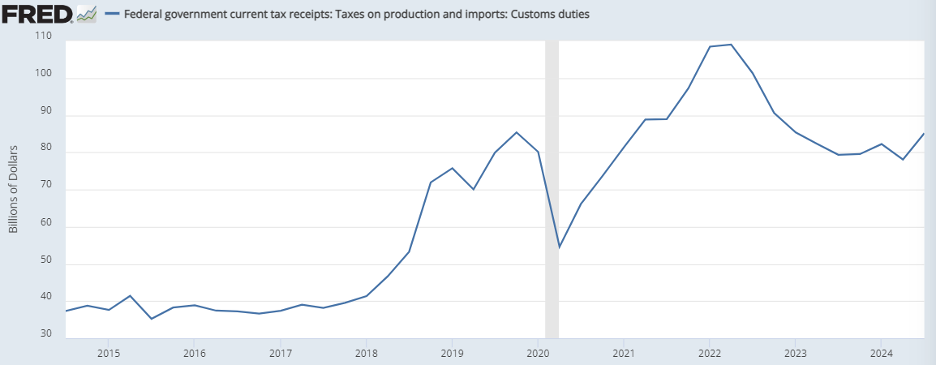
Higher growth historically leads to higher tax revenues. The Trump 1.0 (pre-COVID) economy grew at a 2.8% real GDP pace, well over our 2% potential. Total tax revenues rose from $1.9 trillion initially to $2.2 trillion, even with Trump’s historic tax cut passed in late 2017. Most of the incremental tax gains came from individuals as more income and more capital gains led to more taxes paid, offsetting less corporate tax (corporations are just pass-through entities). This policy strategy will likely surface again, considering corporate tax revenues have risen well above their pre-cut levels and Trump has signaled dropping them from 21% to 15%. Trump also doubled tariff tax revenue from $40 billion to $80 billion beginning in 2018 (note the continuation and expansion under Biden):
This time, Trump wants to impose 10-20% tariffs across the board (a dramatic increase from the 2-3% today). With imports of $4 trillion, this implies tax receipts of between $400 and $800 billion, diligently chipping away at the $1 trillion needed to halve the deficit. However, as we learned in our economics classes, tariffs axiomatically lead to offshore price hikes which ricochet back to the American consumer as inflation. But—this ignores currency effects. Note the US Dollar’s reaction to Trump 2.0:
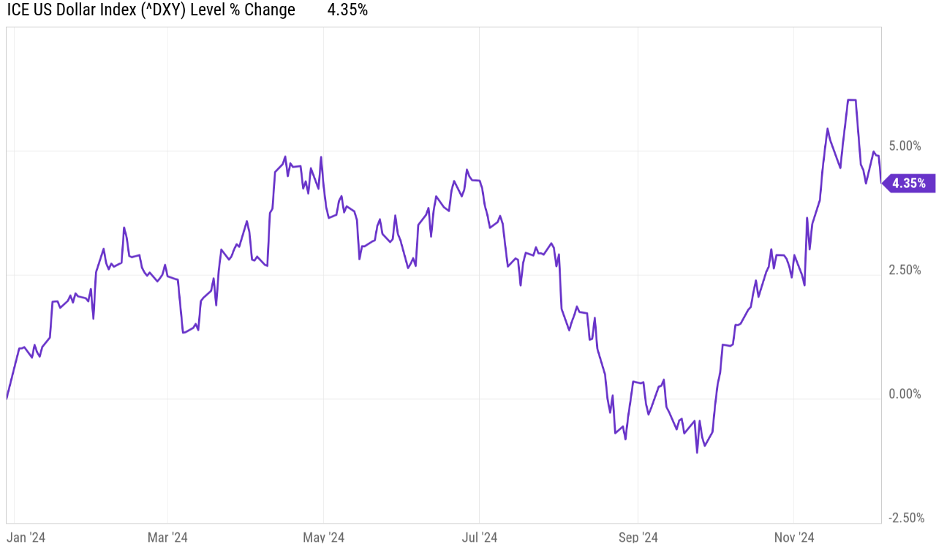
Trump’s election initially led to a 7% rise in the value of the US dollar. This currency strength would have neutralized an equal amount of tariff. A 10% appreciation in the dollar would, therefore, offset the inflationary consequences of a 10% tariff. Obviously, there are unintended consequences to consider, and nothing is ever this simple, but this explains why Trump so strongly favors tariffs as the primary financing vehicle for deficit reduction.
Lastly, Elon, Vivek, and friends have their erasers out and their eyeshades on. I am still foggy on how much they can cut out of the Federal budget, but they will cut something. The combination of growth-stoked tax receipts, currency-neutralized tariffs and DOGE belt-tightening directives form the foundation of Trump’s austerity agenda. However, with entitlement spending growing faster than the economy, ignoring them makes long-term deficit containment impossible… But try getting elected on that!
Enjoy your week,
-David
Sources: FRED, YCharts, Federal Reserve Bank of Atlanta, U.S. Bureau of Labor Statistics, Institute of Supply Management
The above communications and contents are for informational and educational purposes only and should not be used as the sole basis for any investment decision. The information contained herein is based on the publicly available sources listed below. These sources are believed to be reliable but are not a representation, expressed or implied, as to the accuracy, completeness, or correctness of said information. Past performance does not guarantee future results.
">
Periodically, I spend time in New York meeting with investment managers, channel partners, and media outlets. While I enjoy Zoom meetings and telephone calls, conversations in person always prove far more robust and, sometimes, what happens “off camera” teaches me the most.
Furthermore, because so much market sentiment and psychology originate with analysts and pundits in New York, it’s important to stay close to the source. This week, I had the privilege of visiting with all-star reporters from Bloomberg, Investment News, Reuters, the Schwab Network and with Charles Payne on Making Money. The available clips from each are linked below. You will find lots of market commentary, musings on Trump, AI, and even thoughts on the booming economy in Tennessee.
Bloomberg Intelligence: Intel CEO Forced Out (scroll to 18:54)
Investment News: Here’s How AI Will Forever Change the Financial Services Industry
Schwab Network: Corporate Profits, Earnings Bullish for 2025
Fox Business: Making Money with Charles Payne
For those of you who prefer the written word, here are some clarifying thoughts on Trump’s tariff agenda and why it’s critical to his deficit reduction pledge that the currency markets cooperate.
Trump’s Tariffs
The US government runs a $7 trillion budget. Of that, only $1 trillion is truly discretionary. $2 trillion goes to defense and interest payments and the rest to services entitlement programs. Our current deficit is approximately $2 trillion. Trump has committed to cutting the deficit in half (from 6% of GDP to 3%), requiring a $1 trillion pickup in revenues and/or cost savings. Let’s consider the revenue opportunities first:
Higher growth historically leads to higher tax revenues. The Trump 1.0 (pre-COVID) economy grew at a 2.8% real GDP pace, well over our 2% potential. Total tax revenues rose from $1.9 trillion initially to $2.2 trillion, even with Trump’s historic tax cut passed in late 2017. Most of the incremental tax gains came from individuals as more income and more capital gains led to more taxes paid, offsetting less corporate tax (corporations are just pass-through entities). This policy strategy will likely surface again, considering corporate tax revenues have risen well above their pre-cut levels and Trump has signaled dropping them from 21% to 15%. Trump also doubled tariff tax revenue from $40 billion to $80 billion beginning in 2018 (note the continuation and expansion under Biden):
This time, Trump wants to impose 10-20% tariffs across the board (a dramatic increase from the 2-3% today). With imports of $4 trillion, this implies tax receipts of between $400 and $800 billion, diligently chipping away at the $1 trillion needed to halve the deficit. However, as we learned in our economics classes, tariffs axiomatically lead to offshore price hikes which ricochet back to the American consumer as inflation. But—this ignores currency effects. Note the US Dollar’s reaction to Trump 2.0:
Trump’s election initially led to a 7% rise in the value of the US dollar. This currency strength would have neutralized an equal amount of tariff. A 10% appreciation in the dollar would, therefore, offset the inflationary consequences of a 10% tariff. Obviously, there are unintended consequences to consider, and nothing is ever this simple, but this explains why Trump so strongly favors tariffs as the primary financing vehicle for deficit reduction.
Lastly, Elon, Vivek, and friends have their erasers out and their eyeshades on. I am still foggy on how much they can cut out of the Federal budget, but they will cut something. The combination of growth-stoked tax receipts, currency-neutralized tariffs and DOGE belt-tightening directives form the foundation of Trump’s austerity agenda. However, with entitlement spending growing faster than the economy, ignoring them makes long-term deficit containment impossible… But try getting elected on that!
Enjoy your week,
-David
Sources: FRED, YCharts, Federal Reserve Bank of Atlanta, U.S. Bureau of Labor Statistics, Institute of Supply Management
The above communications and contents are for informational and educational purposes only and should not be used as the sole basis for any investment decision. The information contained herein is based on the publicly available sources listed below. These sources are believed to be reliable but are not a representation, expressed or implied, as to the accuracy, completeness, or correctness of said information. Past performance does not guarantee future results.
">Insights from NYC: Trump’s Tariff Strategy, Market Trends, and 2025 Investment Outlook Periodically, I spend time in New York meeting with investment managers, channel partners, and media outlets. While I enjoy Zoom meetings and telephone calls, conversations in person always prove far more robust and, sometimes, what happens “off camera” teaches me the most.
Furthermore, because so much market sentiment and psychology originate with analysts and pundits in New York, it’s important to stay close to the source. This week, I had the privilege of visiting with all-star reporters from Bloomberg, Investment News, Reuters, the Schwab Network and with Charles Payne on Making Money. The available clips from each are linked below. You will find lots of market commentary, musings on Trump, AI, and even thoughts on the booming economy in Tennessee.
Bloomberg Intelligence: Intel CEO Forced Out (scroll to 18:54)
Investment News: Here’s How AI Will Forever Change the Financial Services Industry
Schwab Network: Corporate Profits, Earnings Bullish for 2025
Fox Business: Making Money with Charles Payne
For those of you who prefer the written word, here are some clarifying thoughts on Trump’s tariff agenda and why it’s critical to his deficit reduction pledge that the currency markets cooperate.
Trump’s Tariffs
The US government runs a $7 trillion budget. Of that, only $1 trillion is truly discretionary. $2 trillion goes to defense and interest payments and the rest to services entitlement programs. Our current deficit is approximately $2 trillion. Trump has committed to cutting the deficit in half (from 6% of GDP to 3%), requiring a $1 trillion pickup in revenues and/or cost savings. Let’s consider the revenue opportunities first:
Higher growth historically leads to higher tax revenues. The Trump 1.0 (pre-COVID) economy grew at a 2.8% real GDP pace, well over our 2% potential. Total tax revenues rose from $1.9 trillion initially to $2.2 trillion, even with Trump’s historic tax cut passed in late 2017. Most of the incremental tax gains came from individuals as more income and more capital gains led to more taxes paid, offsetting less corporate tax (corporations are just pass-through entities). This policy strategy will likely surface again, considering corporate tax revenues have risen well above their pre-cut levels and Trump has signaled dropping them from 21% to 15%. Trump also doubled tariff tax revenue from $40 billion to $80 billion beginning in 2018 (note the continuation and expansion under Biden):
This time, Trump wants to impose 10-20% tariffs across the board (a dramatic increase from the 2-3% today). With imports of $4 trillion, this implies tax receipts of between $400 and $800 billion, diligently chipping away at the $1 trillion needed to halve the deficit. However, as we learned in our economics classes, tariffs axiomatically lead to offshore price hikes which ricochet back to the American consumer as inflation. But—this ignores currency effects. Note the US Dollar’s reaction to Trump 2.0:
Trump’s election initially led to a 7% rise in the value of the US dollar. This currency strength would have neutralized an equal amount of tariff. A 10% appreciation in the dollar would, therefore, offset the inflationary consequences of a 10% tariff. Obviously, there are unintended consequences to consider, and nothing is ever this simple, but this explains why Trump so strongly favors tariffs as the primary financing vehicle for deficit reduction.
Lastly, Elon, Vivek, and friends have their erasers out and their eyeshades on. I am still foggy on how much they can cut out of the Federal budget, but they will cut something. The combination of growth-stoked tax receipts, currency-neutralized tariffs and DOGE belt-tightening directives form the foundation of Trump’s austerity agenda. However, with entitlement spending growing faster than the economy, ignoring them makes long-term deficit containment impossible… But try getting elected on that!
Enjoy your week,
-David
Sources: FRED, YCharts, Federal Reserve Bank of Atlanta, U.S. Bureau of Labor Statistics, Institute of Supply Management
The above communications and contents are for informational and educational purposes only and should not be used as the sole basis for any investment decision. The information contained herein is based on the publicly available sources listed below. These sources are believed to be reliable but are not a representation, expressed or implied, as to the accuracy, completeness, or correctness of said information. Past performance does not guarantee future results.
" class="link-chevron">
Thanksgiving week is upon us, and with it comes a uniquely American opportunity to pause, reflect, and appreciate all that we have. For many, Thanksgiving also brings traditions that go beyond the turkey and family gatherings. If you’re a football fan like me, Thanksgiving Day is forever synonymous with the NFL and the majestic voice of legendary John Madden. One of John’s best Thanksgiving Day traditions was handing out a turkey leg for a top player’s game performance. For investors in 2024, we have much to appreciate, so in the spirit of John Madden, we’re handing out our inaugural W&A Thanksgiving Turkey Leg award for 2024— market-style!
And the award goes to…
Madden’s tradition of giving out turkey legs began back in November 1989 when Eagles fans enjoyed a 27-0 win over the Cowboys. Then Eagles lineman Reggie White sacked Troy Aikman once and led the defense to earn the first-ever Madden turkey leg award. With it, a new tradition was born. This year, the inaugural W&A Thanksgiving Turkey Leg award winner is… the US economy! Let’s review the recent data and the stat lines, which suggest a healthier and more robust US economy than expected. Last Monday, Atlanta Fed estimates for Q4 GDP ticked up to an annualized 2.6%, following what has been a steady rise in the estimate throughout November:
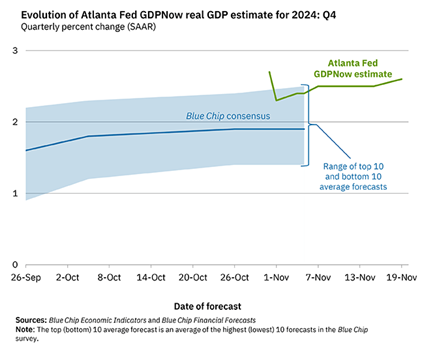
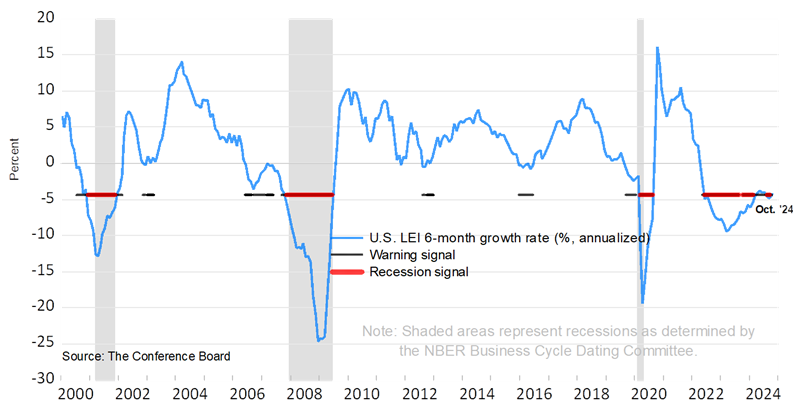
Further, the Conference Board Leading Economic Index® (LEI), which tracks a range of economic indicators to predict future economic activity, is no longer forecasting a recession for the first time since early 2022! No one indicator is perfect, but this shift reflects stronger-than-expected economic resilience, including robust consumer spending, steady labor market conditions, and a normalizing yield curve. While risks remain, the updated outlook suggests a more stable economic trajectory in the near term:
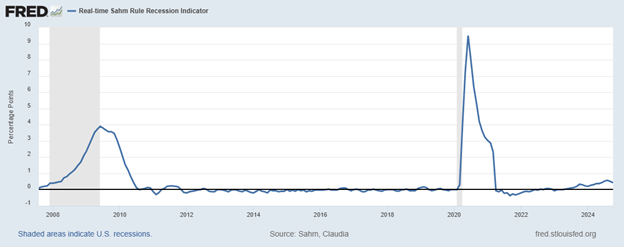
Next, you might remember reading about the ‘Sahm Rule’ back in July and August. Economist Claudia Sahm created the metric to help identify the onset of economic recessions in real-time by monitoring short-term trends in unemployment rates. Historically, a reading above 0.5 and rising has been a reliable indicator of ongoing recessions. The Sahm Rule was triggered in August when it reached a cycle high of 0.57. This sparked attention in the financial media, with many quickly pointing out its significance, and predicting a concurrent, ongoing recession. However, since most financial media won’t revisit previous play calls that went sideways, investors should know the two Sahm Rule readings since August have dropped to 0.5 in September and now 0.43 in October!
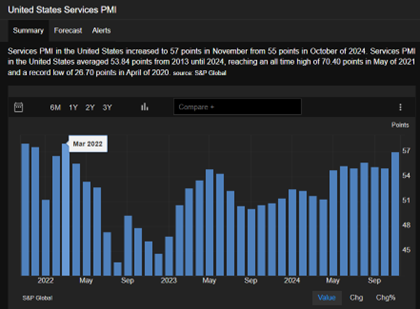
Additionally, Friday morning saw a big upside win in the US Services PMI, reading a 57 handle versus 55 in October, the prior month. As a refresher on PMIs, a level of 50 indicates no change over the prior reading, while readings above and below 50 indicate an acceleration or deceleration, respectively. As you can see in the chart below, this month’s reading represents the largest number since March 2022.
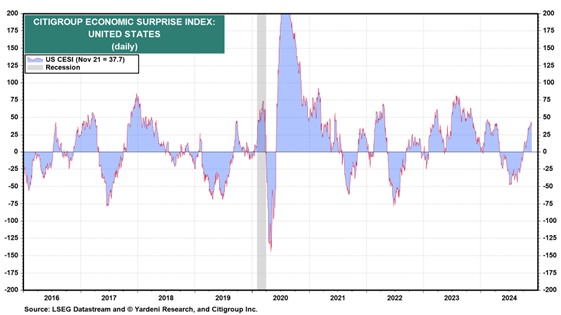
Lastly, a quick peek at the Citigroup Economic Surprise Index reflects the current assessment that the recent US economic data has been improving and surprising to the upside. All told, the US economy continues to recover, evolve, grow, and most importantly, has not yet descended into a recession even with restrictive fed monetary policy.
Congrats, US economy!
Have a great week!
-Matt
Sources: Yardeni, FRED, S&P Global, Federal Reserve, The Conference Board
This communication and its contents are for informational and educational purposes only and should not be used as the sole basis for any investment decision. The information contained herein is based on publicly available sources believed to be reliable but is not a representation, expressed or implied, as to the accuracy, completeness, or correctness of said information. Past performance does not guarantee future results.
">W&A Thanksgiving Turkey Leg Award!
Thanksgiving week is upon us, and with it comes a uniquely American opportunity to pause, reflect, and appreciate all that we have. For many, Thanksgiving also brings traditions that go beyond the turkey and family gatherings. If you’re a football fan like me, Thanksgiving Day is forever synonymous with the NFL and the majestic voice of legendary John Madden. One of John’s best Thanksgiving Day traditions was handing out a turkey leg for a top player’s game performance. For investors in 2024, we have much to appreciate, so in the spirit of John Madden, we’re handing out our inaugural W&A Thanksgiving Turkey Leg award for 2024— market-style!
And the award goes to…
Madden’s tradition of giving out turkey legs began back in November 1989 when Eagles fans enjoyed a 27-0 win over the Cowboys. Then Eagles lineman Reggie White sacked Troy Aikman once and led the defense to earn the first-ever Madden turkey leg award. With it, a new tradition was born. This year, the inaugural W&A Thanksgiving Turkey Leg award winner is… the US economy! Let’s review the recent data and the stat lines, which suggest a healthier and more robust US economy than expected. Last Monday, Atlanta Fed estimates for Q4 GDP ticked up to an annualized 2.6%, following what has been a steady rise in the estimate throughout November:
Further, the Conference Board Leading Economic Index® (LEI), which tracks a range of economic indicators to predict future economic activity, is no longer forecasting a recession for the first time since early 2022! No one indicator is perfect, but this shift reflects stronger-than-expected economic resilience, including robust consumer spending, steady labor market conditions, and a normalizing yield curve. While risks remain, the updated outlook suggests a more stable economic trajectory in the near term:
Next, you might remember reading about the ‘Sahm Rule’ back in July and August. Economist Claudia Sahm created the metric to help identify the onset of economic recessions in real-time by monitoring short-term trends in unemployment rates. Historically, a reading above 0.5 and rising has been a reliable indicator of ongoing recessions. The Sahm Rule was triggered in August when it reached a cycle high of 0.57. This sparked attention in the financial media, with many quickly pointing out its significance, and predicting a concurrent, ongoing recession. However, since most financial media won’t revisit previous play calls that went sideways, investors should know the two Sahm Rule readings since August have dropped to 0.5 in September and now 0.43 in October!
Additionally, Friday morning saw a big upside win in the US Services PMI, reading a 57 handle versus 55 in October, the prior month. As a refresher on PMIs, a level of 50 indicates no change over the prior reading, while readings above and below 50 indicate an acceleration or deceleration, respectively. As you can see in the chart below, this month’s reading represents the largest number since March 2022.
Lastly, a quick peek at the Citigroup Economic Surprise Index reflects the current assessment that the recent US economic data has been improving and surprising to the upside. All told, the US economy continues to recover, evolve, grow, and most importantly, has not yet descended into a recession even with restrictive fed monetary policy.
Congrats, US economy!
Have a great week!
-Matt
Sources: Yardeni, FRED, S&P Global, Federal Reserve, The Conference Board
This communication and its contents are for informational and educational purposes only and should not be used as the sole basis for any investment decision. The information contained herein is based on publicly available sources believed to be reliable but is not a representation, expressed or implied, as to the accuracy, completeness, or correctness of said information. Past performance does not guarantee future results.
" class="link-chevron">
While politics may be polarizing, investors must dispassionately adapt to all environmental shifts. On Tuesday of last week, the United States voted to overhaul our Federal Government. To accomplish President Trump’s ambitious reform agenda, his administration must de-bureaucratize the system, reduce regulatory burdens, and open rapid legislative throughputs.
Historically, trifecta governments tend to perish with subsequent mid-terms as they did under Obama, Trump 1.0, and Biden, so the Trump team has only two years assured. Given Trump’s presidential experience, action-oriented appointees, and tireless work ethic, expect high legislative volume. Many initiatives will pass quickly, like the extension of the Trump Tax cuts, while others, like the ones soon to be proposed by the DOGE committee, will undoubtedly stoke more debate. Nonetheless, the environment over the next two years will likely feel frenetic and uncomfortable for investors. But that does not make it unknowable.
Conservatism
Margaret Thatcher rose to power in 1979 after an extended period of slow growth and high inflation across the British economy. Thatcher promoted a bold reform agenda that included significant privatization of state-owned industries, major restrictions on unionization, dramatic deregulation of the financial markets, massive tax cuts, and revolutionary housing reforms. Many of her privatization pursuits drew spirited political rebuke as the Government’s share of GDP shrank significantly over her tenure. For investors, however, it was a time of plenty. Fueled by “Thatcherism,” the UK stock market index grew five-fold between 1979 and 1990 without a single down year.
Pragmatism
China’s model for economic success under Deng Xiaoping drew inspiration from Lee Kuan Yew’s model for economic success in Singapore. Lee Kuan Yew ascended to power in 1959, pledging to apply “common sense” to a senseless Government. At the time, Singapore was mired in infighting, overly export reliant, and notoriously corrupt.
LKY demanded pragmatic “results” from the Government. He recruited the brightest minds into critical positions and overpaid them. This greatly increased governing competence while greatly decreasing government corruption. He used strategic planning, incentives, human capital development programs, and performance measurement to transition the Singaporean economy away from relying on cheap exports to developing high-value industries.
Under LKY’s leadership, per-capita GDP rose from $400 in 1959 to $14,500 by the time he stepped aside in 1991. He created the Singapore stock exchange in 1960 and, by 1990, it housed companies with a total market capitalization of $36 billion. Today, Singapore has a higher per capita GDP than the United States.
Radicalism
Argentina elected Javier Milei president of Argentina in 2023 with 56% of the vote amidst widespread desire for radical change. Corruption, economic mismanagement, runaway inflation, and currency devaluation eroded public trust in the incumbent political system. Firebrand Javier Milei promised to “blow up” the system and used images of a chainsaw to communicate his budget balancing intentions.
Milei’s first act as president was to eliminate nine governmental ministries (departments). He also signed a major deregulatory decree and has eliminated an estimated 25,000 of the Government’s 300,000+ jobs. Union protests have erupted, but populist support remains strong. The budget is now in surplus, the trade balance is now in surplus, and monthly inflation has fallen into the low single digits.
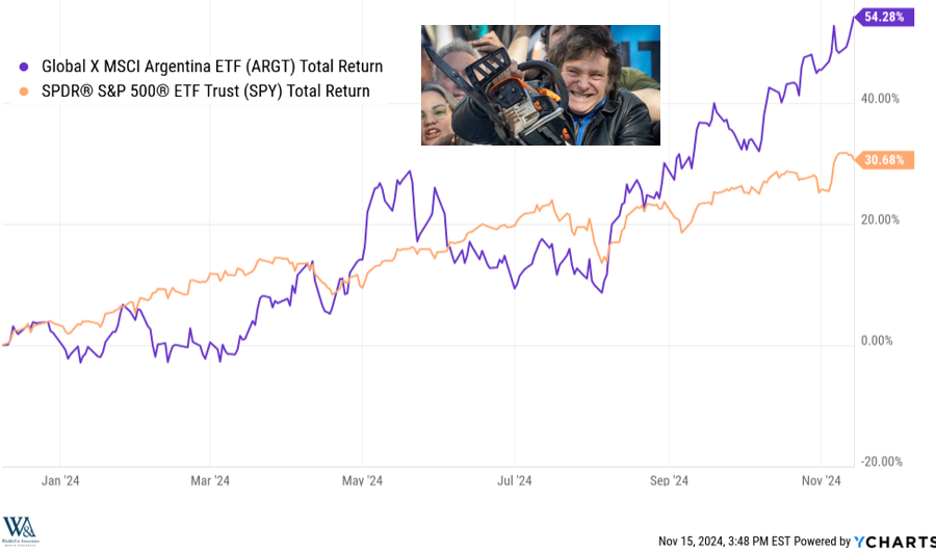
Argentina remains mired in recession, but confidence in Milei has grown. He faces his own midterms in 2025. Should his party pick up seats, his agenda will embolden. Since his election, the Argentinian stock market has appreciated 54% vs. the S&P 500’s 31%.
In summary, it’s unclear whether Donald Trump, his cabinet, or his policies will prove legislatively viable, economically effective, or politically pleasing, but—as anxious investors search for environmental analogs, the real results of conservative Margaret Thatcher, pragmatic Lee Kuan Yew and radical Javier Milei should offer context—and comfort.
Have a fantastic week!
-David
Source: YCharts
This communication and its contents are for informational and educational purposes only and should not be used as the sole basis for any investment decision. The information contained herein is based on publicly available sources believed to be reliable but is not a representation, expressed or implied, as to the accuracy, completeness, or correctness of said information. Past performance does not guarantee future results.
">Investors: Use Historical Context for Increased Comfort
While politics may be polarizing, investors must dispassionately adapt to all environmental shifts. On Tuesday of last week, the United States voted to overhaul our Federal Government. To accomplish President Trump’s ambitious reform agenda, his administration must de-bureaucratize the system, reduce regulatory burdens, and open rapid legislative throughputs.
Historically, trifecta governments tend to perish with subsequent mid-terms as they did under Obama, Trump 1.0, and Biden, so the Trump team has only two years assured. Given Trump’s presidential experience, action-oriented appointees, and tireless work ethic, expect high legislative volume. Many initiatives will pass quickly, like the extension of the Trump Tax cuts, while others, like the ones soon to be proposed by the DOGE committee, will undoubtedly stoke more debate. Nonetheless, the environment over the next two years will likely feel frenetic and uncomfortable for investors. But that does not make it unknowable.
Conservatism
Margaret Thatcher rose to power in 1979 after an extended period of slow growth and high inflation across the British economy. Thatcher promoted a bold reform agenda that included significant privatization of state-owned industries, major restrictions on unionization, dramatic deregulation of the financial markets, massive tax cuts, and revolutionary housing reforms. Many of her privatization pursuits drew spirited political rebuke as the Government’s share of GDP shrank significantly over her tenure. For investors, however, it was a time of plenty. Fueled by “Thatcherism,” the UK stock market index grew five-fold between 1979 and 1990 without a single down year.
Pragmatism
China’s model for economic success under Deng Xiaoping drew inspiration from Lee Kuan Yew’s model for economic success in Singapore. Lee Kuan Yew ascended to power in 1959, pledging to apply “common sense” to a senseless Government. At the time, Singapore was mired in infighting, overly export reliant, and notoriously corrupt.
LKY demanded pragmatic “results” from the Government. He recruited the brightest minds into critical positions and overpaid them. This greatly increased governing competence while greatly decreasing government corruption. He used strategic planning, incentives, human capital development programs, and performance measurement to transition the Singaporean economy away from relying on cheap exports to developing high-value industries.
Under LKY’s leadership, per-capita GDP rose from $400 in 1959 to $14,500 by the time he stepped aside in 1991. He created the Singapore stock exchange in 1960 and, by 1990, it housed companies with a total market capitalization of $36 billion. Today, Singapore has a higher per capita GDP than the United States.
Radicalism
Argentina elected Javier Milei president of Argentina in 2023 with 56% of the vote amidst widespread desire for radical change. Corruption, economic mismanagement, runaway inflation, and currency devaluation eroded public trust in the incumbent political system. Firebrand Javier Milei promised to “blow up” the system and used images of a chainsaw to communicate his budget balancing intentions.
Milei’s first act as president was to eliminate nine governmental ministries (departments). He also signed a major deregulatory decree and has eliminated an estimated 25,000 of the Government’s 300,000+ jobs. Union protests have erupted, but populist support remains strong. The budget is now in surplus, the trade balance is now in surplus, and monthly inflation has fallen into the low single digits.
Argentina remains mired in recession, but confidence in Milei has grown. He faces his own midterms in 2025. Should his party pick up seats, his agenda will embolden. Since his election, the Argentinian stock market has appreciated 54% vs. the S&P 500’s 31%.
In summary, it’s unclear whether Donald Trump, his cabinet, or his policies will prove legislatively viable, economically effective, or politically pleasing, but—as anxious investors search for environmental analogs, the real results of conservative Margaret Thatcher, pragmatic Lee Kuan Yew and radical Javier Milei should offer context—and comfort.
Have a fantastic week!
-David
Source: YCharts
This communication and its contents are for informational and educational purposes only and should not be used as the sole basis for any investment decision. The information contained herein is based on publicly available sources believed to be reliable but is not a representation, expressed or implied, as to the accuracy, completeness, or correctness of said information. Past performance does not guarantee future results.
" class="link-chevron">
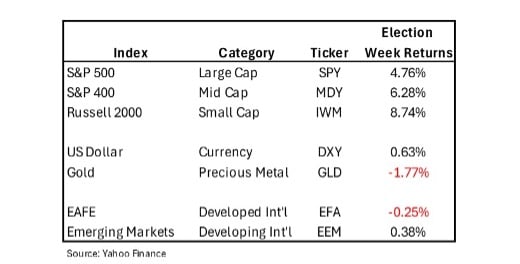
Investors won after Tuesday’s election as Wednesday produced the highest post-election day returns in history! The S&P 500 large cap index surged 2.5% compared with its average post-election day return of -.4%. The Russell 2000 small cap index surged even more, rising 5.8%. All major market indices hit all-time highs (including Bitcoin), with the gains continuing through week’s end. Here are how the major market indices closed out the week:
The Stealth Tax
This puts the Trump economic agenda on display. With a clear mandate, Trump will have no difficulty extending the 2017 tax cuts. Furthermore, he may lower the corporate tax rate even more from 21% to 15%. Additionally, deregulation reduces a stealth tax that we can argue has an even greater impact on corporate profits.
According to the Government’s own OMB (Office of Management and Budget), compliance with federal regulations costs companies around $300 billion annually, roughly in line with what firms spend on corporate taxes. Furthermore, 40% of the S&P 500 is currently under investigation by the justice department. Anti-trust has also been busy as of late, most notably with its effort to dismantle Google.
The Scales Balance
Trump’s pledge to slash the regulatory burden will free up capital and embolden innovation, especially across smaller companies with less discretionary capital to expend on compliance. For those fearful that Trump’s tough tariff talk will cause inflation, note that tax cuts, regulation cuts, technological advances, and heightened energy production all provide disinflationary offsets.
We have also witnessed this bluster before, yet inflation averaged 1.9% over Trump’s first term, squarely below the Fed’s 2% target. Also, inflation expectation indices finished the week essentially unchanged and Gold, seen as a hedge against inflation and chaos, declined 2%.
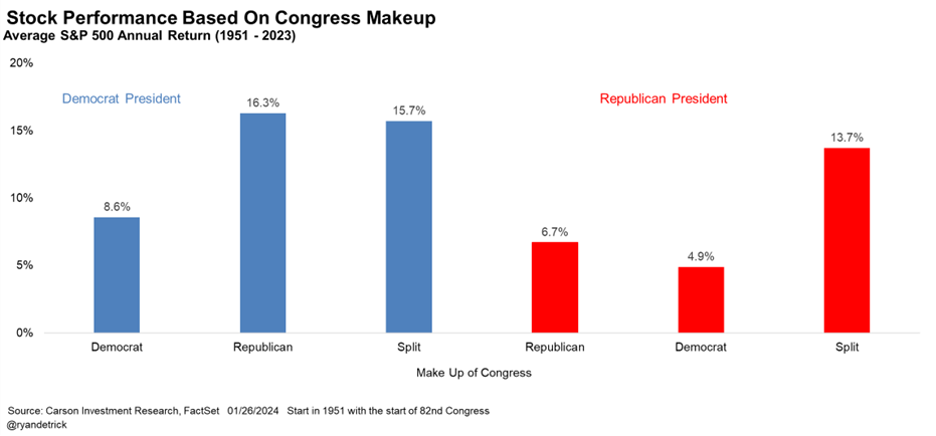
Lastly, note that Trump’s America First message led to a sizable differential between onshore and offshore returns as capital quickly immigrated and repatriated into the US. Overall, it was a robust market rally to begin Trump 2.0, but history proffers caution when one party rules them all:
What Unified Control Means
Between 1951 and 2023, Republicans held unified control for a total of 10 years with S&P 500 returns averaging 6.7%, annualized. For comparison, when the Democrats held unified control for a total of 20 years, the S&P 500 returned 8.6%, annualized. This compares with average annual returns of 14.5% when Congress is split, and 9.9% for the 43 years surveyed as a whole. The lesson? Too much of a good thing for party loyalists has historically meant less of a good thing for investors.
Rate Cuts = Higher Rates
The Fed cut rates again this week, trimming .25% off the overnight rate. For those of you who own money market funds, your yields just dropped. For those of you who hold mortgages, your yields did not. Remember, while the Fed calibrates its rate decisions to achieve 2% inflation and full employment across the economy, the longer end of the yield curve calibrates its rate decisions to nominal GDP growth expectations.
Intuitively, lower short-term interest rates improve longer-term economic growth potential. Additionally, a more growth-centric policy array also improves longer-term economic growth potential. Both apply upward pressure on longer-term yields for the right reasons. Consider the relationship between nominal GDP growth (inflation inclusive) and the 10-year Treasury yield:
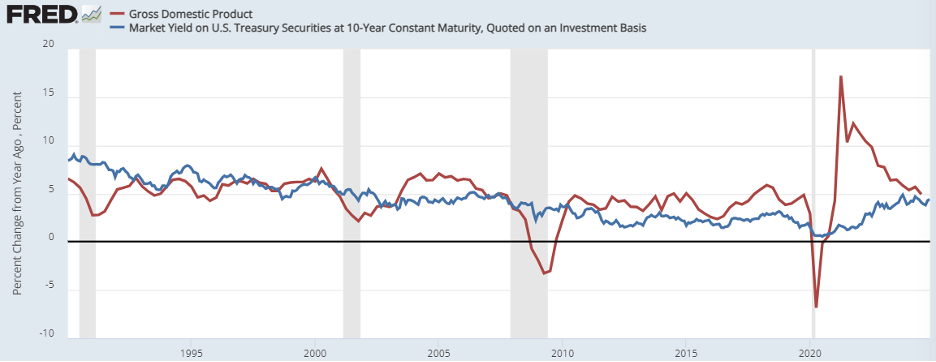
Over the time-period for the dataset above beginning in 1990, nominal GDP (red) averaged 4.8% on a quarterly basis, while the 10 Year Treasury yield averaged 4.2% (blue). Prior to the GFC in 2008 the spread between the 10 Year and nominal GDP averaged .3%. Post GFC, the Fed distorted the interest rate curve with its zero-interest-rate policy, widening that gap, as seen when adding in the Federal Funds rate (green):
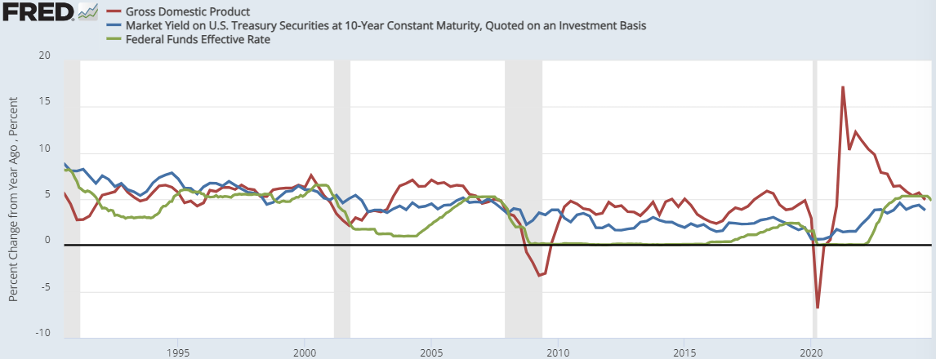
In the mid-1990’s, the Fed cut rates after raising them aggressively to reduce recession risks and ensure a “soft landing”, making that period the best analog for where we are today. It worked. Nominal GDP rose from 4.6% when they began cutting rates in early 1995 to 6.3% before they started raising them again in 1997. Over that two-year period, the yield on the 10-year Treasury rose from 6% to 7% in sympathy with the higher growth rates, despite Fed rate cuts. Most importantly, household net worth advanced 20%.
Here is my point: Over the past week, I have heard a lot about how the new administration’s policies will lead to higher inflation, Treasury bond auction failures and punitively higher longer-term interest rate levels for mortgage borrowers, leading to another housing crisis and economic collapse. While all of that is possible, we do not see that as probable.
More likely, the uptick in rates seen recently doesn’t reflect US credit quality concerns, but is an acknowledgement that near-term recession risks have fallen, and that long-term nominal GDP growth potential has risen. While you may pay more than you like for a mortgage under this scenario, you will have higher income and a larger net worth to subsidize it—and when a recession does inevitably arise, you can always refinance.
Enjoy your week!
-David
Sources: Yahoo Finance, Carson Investment Research, FactSet, FRED
This communication and its contents are for informational and educational purposes only and should not be used as the sole basis for any investment decision. The information contained herein is based on publicly available sources believed to be reliable but is not a representation, expressed or implied, as to the accuracy, completeness, or correctness of said information. Past performance does not guarantee future results.
">Ready, Set, Rally!
Investors won after Tuesday’s election as Wednesday produced the highest post-election day returns in history! The S&P 500 large cap index surged 2.5% compared with its average post-election day return of -.4%. The Russell 2000 small cap index surged even more, rising 5.8%. All major market indices hit all-time highs (including Bitcoin), with the gains continuing through week’s end. Here are how the major market indices closed out the week:
The Stealth Tax
This puts the Trump economic agenda on display. With a clear mandate, Trump will have no difficulty extending the 2017 tax cuts. Furthermore, he may lower the corporate tax rate even more from 21% to 15%. Additionally, deregulation reduces a stealth tax that we can argue has an even greater impact on corporate profits.
According to the Government’s own OMB (Office of Management and Budget), compliance with federal regulations costs companies around $300 billion annually, roughly in line with what firms spend on corporate taxes. Furthermore, 40% of the S&P 500 is currently under investigation by the justice department. Anti-trust has also been busy as of late, most notably with its effort to dismantle Google.
The Scales Balance
Trump’s pledge to slash the regulatory burden will free up capital and embolden innovation, especially across smaller companies with less discretionary capital to expend on compliance. For those fearful that Trump’s tough tariff talk will cause inflation, note that tax cuts, regulation cuts, technological advances, and heightened energy production all provide disinflationary offsets.
We have also witnessed this bluster before, yet inflation averaged 1.9% over Trump’s first term, squarely below the Fed’s 2% target. Also, inflation expectation indices finished the week essentially unchanged and Gold, seen as a hedge against inflation and chaos, declined 2%.
Lastly, note that Trump’s America First message led to a sizable differential between onshore and offshore returns as capital quickly immigrated and repatriated into the US. Overall, it was a robust market rally to begin Trump 2.0, but history proffers caution when one party rules them all:
What Unified Control Means
Between 1951 and 2023, Republicans held unified control for a total of 10 years with S&P 500 returns averaging 6.7%, annualized. For comparison, when the Democrats held unified control for a total of 20 years, the S&P 500 returned 8.6%, annualized. This compares with average annual returns of 14.5% when Congress is split, and 9.9% for the 43 years surveyed as a whole. The lesson? Too much of a good thing for party loyalists has historically meant less of a good thing for investors.
Rate Cuts = Higher Rates
The Fed cut rates again this week, trimming .25% off the overnight rate. For those of you who own money market funds, your yields just dropped. For those of you who hold mortgages, your yields did not. Remember, while the Fed calibrates its rate decisions to achieve 2% inflation and full employment across the economy, the longer end of the yield curve calibrates its rate decisions to nominal GDP growth expectations.
Intuitively, lower short-term interest rates improve longer-term economic growth potential. Additionally, a more growth-centric policy array also improves longer-term economic growth potential. Both apply upward pressure on longer-term yields for the right reasons. Consider the relationship between nominal GDP growth (inflation inclusive) and the 10-year Treasury yield:
Over the time-period for the dataset above beginning in 1990, nominal GDP (red) averaged 4.8% on a quarterly basis, while the 10 Year Treasury yield averaged 4.2% (blue). Prior to the GFC in 2008 the spread between the 10 Year and nominal GDP averaged .3%. Post GFC, the Fed distorted the interest rate curve with its zero-interest-rate policy, widening that gap, as seen when adding in the Federal Funds rate (green):
In the mid-1990’s, the Fed cut rates after raising them aggressively to reduce recession risks and ensure a “soft landing”, making that period the best analog for where we are today. It worked. Nominal GDP rose from 4.6% when they began cutting rates in early 1995 to 6.3% before they started raising them again in 1997. Over that two-year period, the yield on the 10-year Treasury rose from 6% to 7% in sympathy with the higher growth rates, despite Fed rate cuts. Most importantly, household net worth advanced 20%.
Here is my point: Over the past week, I have heard a lot about how the new administration’s policies will lead to higher inflation, Treasury bond auction failures and punitively higher longer-term interest rate levels for mortgage borrowers, leading to another housing crisis and economic collapse. While all of that is possible, we do not see that as probable.
More likely, the uptick in rates seen recently doesn’t reflect US credit quality concerns, but is an acknowledgement that near-term recession risks have fallen, and that long-term nominal GDP growth potential has risen. While you may pay more than you like for a mortgage under this scenario, you will have higher income and a larger net worth to subsidize it—and when a recession does inevitably arise, you can always refinance.
Enjoy your week!
-David
Sources: Yahoo Finance, Carson Investment Research, FactSet, FRED
This communication and its contents are for informational and educational purposes only and should not be used as the sole basis for any investment decision. The information contained herein is based on publicly available sources believed to be reliable but is not a representation, expressed or implied, as to the accuracy, completeness, or correctness of said information. Past performance does not guarantee future results.
" class="link-chevron">
While attention fixates on the difference-maker in a hotly contested election, investors shouldn’t overlook the true October surprise this year. For the month of October, the S&P 500 traded within a 2.5% range and ended the month down less than 1%.
A Spooky History
October has a history of spooky market behavior. General volatility levels rank 34% higher in October compared to the other months and three of the last four trading days with losses of more than 10% occurred in the month of October. With Trump vs. Harris worldviews overheating social media feeds, conflicts raging worldwide, and a mixed bag of economic data, conditions were set for a potentially red October. So why the lullaby? First, while Trump and Harris seem far apart, neither of their economic policies seem to be causing much concern:
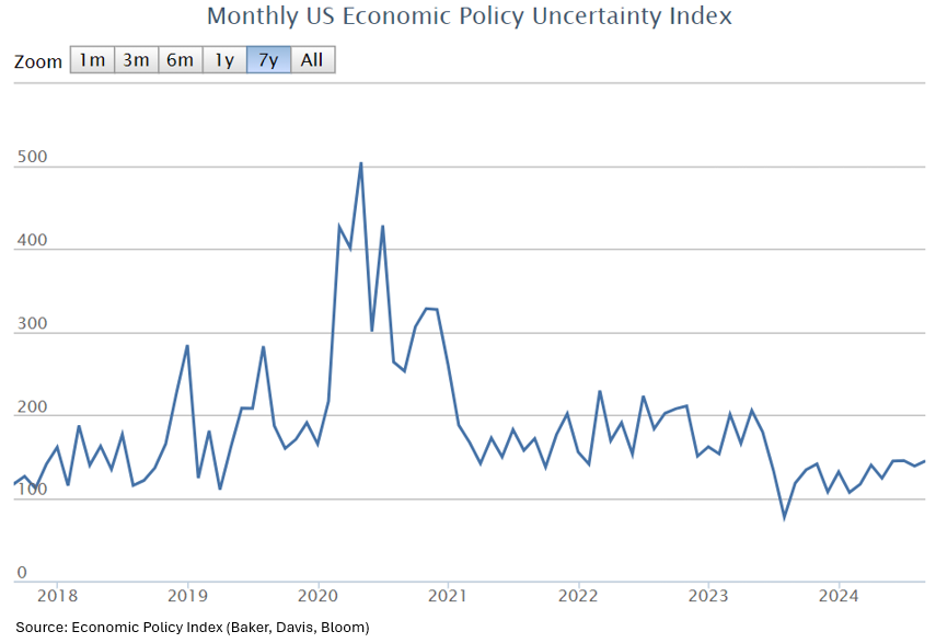
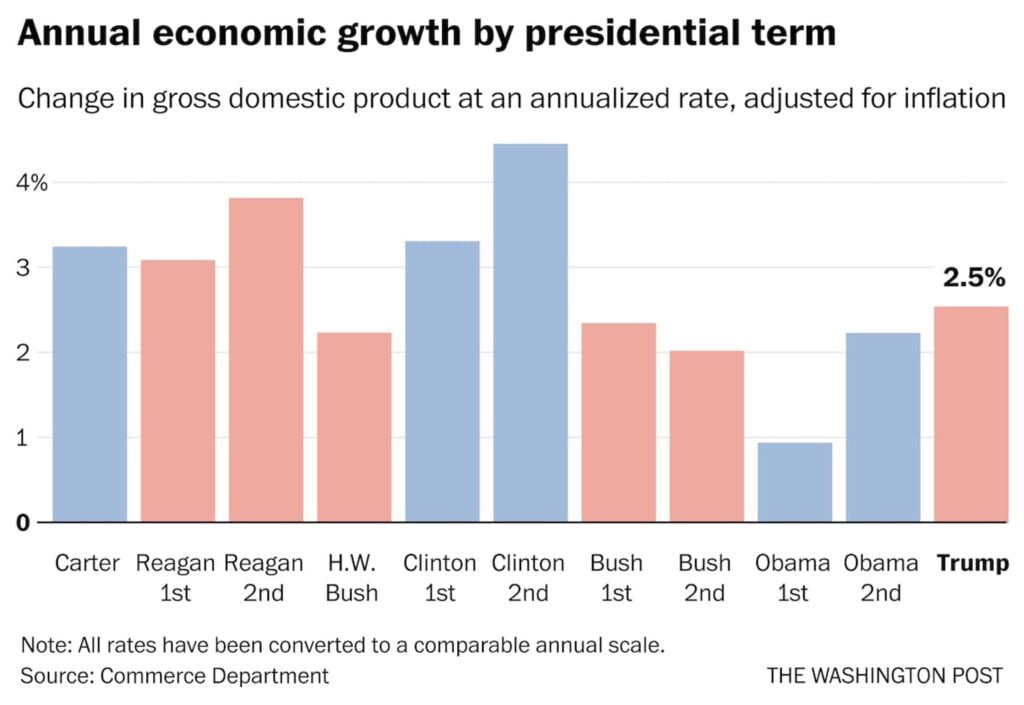
Perhaps that’s due to expectations of a divided Congress, or recognition that Presidents themselves have much less influence over economic growth than widely assumed. Consider the GDP growth rates listed below (Trump rates are pre-COVID):
The Truth About the Market and Elections
Outside of Obama’s first-term clunker, the US economy has grown 2%+ under every president dating back to Herbert Hoover. Turning to the stock market, the performance differentials between presidential administrations are just as inconclusive:
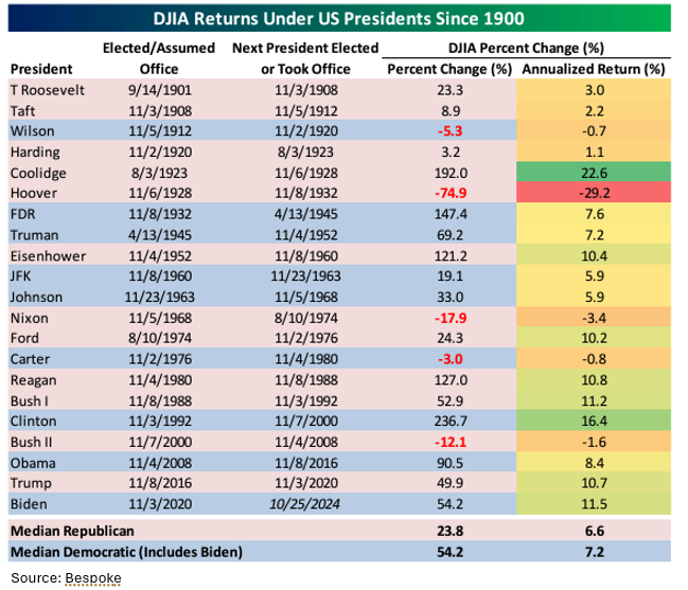
Looking at the price returns for the Dow Jones Industrial Average going back to 1900, Republican Presidents have rewarded investors with 6.6% annualized gains while Democrat Presidents have rewarded investors with 7.2% annualized gains. I haven’t done the statistical work, but I suspect that the -30% return under Hoover accounts for the differential. How did the Dow perform under President Trump? It rose 50%. How did the Dow perform under President Biden? It rose 50%.
We Invest in Companies, not Governments
I do not know who will win the Oval Office on Tuesday. I do know that I have received a flood of queries surrounding the implications for investors. Based on the history presented above, the implications are immaterial. What powers the US economy and investor returns is not presidential policies, but trillions of micro decisions made by an industrious, ingenious, and innovative population. Our hard-coded system of laws, property rights, and protections provides 338 million Americans with the incentives to pursue prosperity and retain the rewards. So, stress less about Tuesday. We invest our client assets in companies, not governments, and with our dynamic, ever-growing economy, earnings continually rising, and AI contributions just beginning, the future is bright no matter who takes Tuesday.
Happy November!
-David
Sources: Economic Policy Index, Department of Commerce, Bespoke
This communication and its contents are for informational and educational purposes only and should not be used as the sole basis for any investment decision. The information contained herein is based on publicly available sources believed to be reliable but is not a representation, expressed or implied, as to the accuracy, completeness, or correctness of said information. Past performance does not guarantee future results.
">The Real October Surprise
While attention fixates on the difference-maker in a hotly contested election, investors shouldn’t overlook the true October surprise this year. For the month of October, the S&P 500 traded within a 2.5% range and ended the month down less than 1%.
A Spooky History
October has a history of spooky market behavior. General volatility levels rank 34% higher in October compared to the other months and three of the last four trading days with losses of more than 10% occurred in the month of October. With Trump vs. Harris worldviews overheating social media feeds, conflicts raging worldwide, and a mixed bag of economic data, conditions were set for a potentially red October. So why the lullaby? First, while Trump and Harris seem far apart, neither of their economic policies seem to be causing much concern:
Perhaps that’s due to expectations of a divided Congress, or recognition that Presidents themselves have much less influence over economic growth than widely assumed. Consider the GDP growth rates listed below (Trump rates are pre-COVID):
The Truth About the Market and Elections
Outside of Obama’s first-term clunker, the US economy has grown 2%+ under every president dating back to Herbert Hoover. Turning to the stock market, the performance differentials between presidential administrations are just as inconclusive:
Looking at the price returns for the Dow Jones Industrial Average going back to 1900, Republican Presidents have rewarded investors with 6.6% annualized gains while Democrat Presidents have rewarded investors with 7.2% annualized gains. I haven’t done the statistical work, but I suspect that the -30% return under Hoover accounts for the differential. How did the Dow perform under President Trump? It rose 50%. How did the Dow perform under President Biden? It rose 50%.
We Invest in Companies, not Governments
I do not know who will win the Oval Office on Tuesday. I do know that I have received a flood of queries surrounding the implications for investors. Based on the history presented above, the implications are immaterial. What powers the US economy and investor returns is not presidential policies, but trillions of micro decisions made by an industrious, ingenious, and innovative population. Our hard-coded system of laws, property rights, and protections provides 338 million Americans with the incentives to pursue prosperity and retain the rewards. So, stress less about Tuesday. We invest our client assets in companies, not governments, and with our dynamic, ever-growing economy, earnings continually rising, and AI contributions just beginning, the future is bright no matter who takes Tuesday.
Happy November!
-David
Sources: Economic Policy Index, Department of Commerce, Bespoke
This communication and its contents are for informational and educational purposes only and should not be used as the sole basis for any investment decision. The information contained herein is based on publicly available sources believed to be reliable but is not a representation, expressed or implied, as to the accuracy, completeness, or correctness of said information. Past performance does not guarantee future results.
" class="link-chevron">
Halloween is coming up on Thursday, and that means it’s time to take the kids out to go trick or treating. As a dad of three young children, Halloween is such a fun and unique time together, but getting the kids to sleep after countless chocolate bars is usually the spooky part of the night! As for investors, Halloween night need not be so scary. I touched on the volatility setup a few weeks ago, but let’s run the tapes and review how investors can benefit from other market participants acting fearful.
Earning our candy!
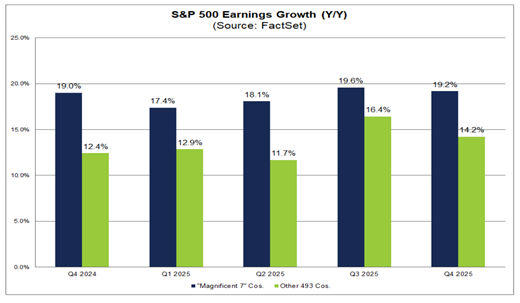
As David mentioned in last week’s blog, it is Q3 earnings season, and further equity market upside will need to be supported by accelerating earnings growth. So far, third-quarter earnings growth for the S&P500 sits at 3.4%, taking year-over-year earnings growth to 12.4%. Of the S&P500 constituents, the magnificent seven are expected to lead the pack this quarter and in the foreseeable future, even accelerating their earnings growth into the second half of 2025. The positive earnings momentum is constructive for further equity market price appreciation, but companies will still need to deliver.
Price movement, past and present
One of the most interesting yet boring things I like to read and talk about is market structure. How markets operate is both a function of the rules of the game and the players playing. Knowing and understanding the dynamics of all players and their decisions can help investors navigate and understand short-term price movements.
Let’s break down the volatility setup as it relates to the Q3 earnings season. Equity volatility can be quoted in realized and implied terms—these are fancy Wall Street terms for what volatility has been in the past, i.e. realized, and what the market is expecting volatility to be in the future, i.e. implied. This is a vital part of market structure. Big traders like hedge funds and institutions utilize short-term options contracts to hedge their positions against future moves in price. So, in advance of events where there is a higher probability of a larger range of price movement, institutions buy protection in the form of put options against positions in their portfolios. Did I mention it’s earnings season?
Single stock price moves post earnings announcements can vary wildly. However, as of Friday, of the S&P 500 companies that have released Q3 earnings, their respective share prices have moved in +-3% range post-announcement, and importantly, it’s the options market that prices the expected volatility of the underlying share prices in advance of the release. But who cares, and what can we do about implied volatility?
“Be greedy when others are fearful.” – Warren Buffett
Capitalize on the fear! An important part of market dynamics is understanding when market participants are inefficiently expecting more volatility than what is likely to materialize from a statistical probability perspective.
Let’s look at this past week. Throughout most of the week, the 30-day implied volatility of the S&P500 index sat around 18.7, while the 30-day realized volatility sat around 9.2. This represents a 100%+ premium of expected to actual volatility. Over the last three years, that amount of premium is over two standard deviations from the mean, which, in a typical bell curve, we know only occurs about 5% of the time. An outlier!
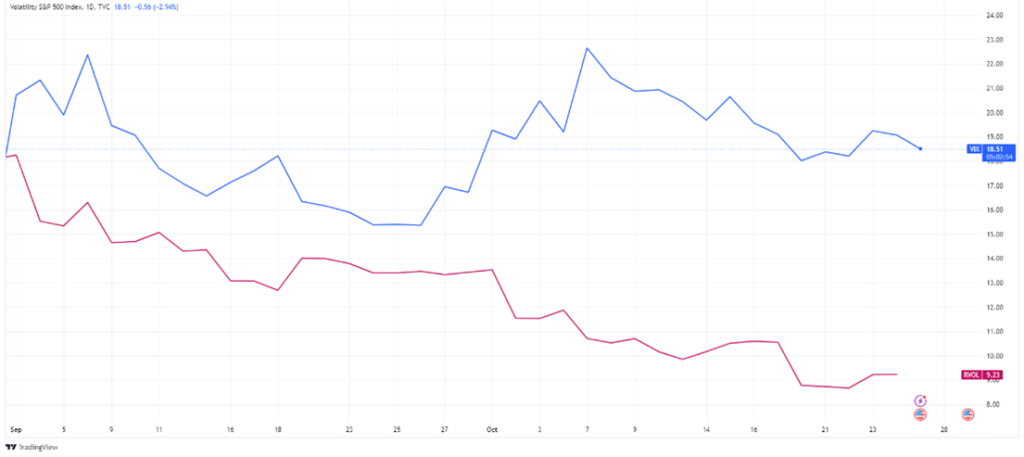
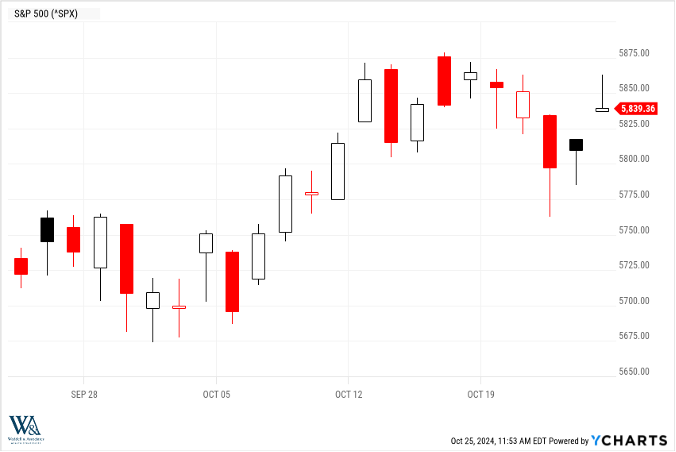
All told, by understanding short-term volatility structure and the premiums paid by institutions to hedge their portfolios from Q3 earnings announcements, investors can capitalize in the short-term by deploying capital on irrational downward movements in price, like the middle of last week:
Have a great weekend!
-Matt
Sources: Factset, YCharts, Hedgeye Risk Management, TradingView, Cboe Exchange
This communication and its contents are for informational and educational purposes only and should not be used as the sole basis for any investment decision. The information contained herein is based on publicly available sources believed to be reliable but is not a representation, expressed or implied, as to the accuracy, completeness, or correctness of said information. Past performance does not guarantee future results.
">Trick-or-Treat!
Halloween is coming up on Thursday, and that means it’s time to take the kids out to go trick or treating. As a dad of three young children, Halloween is such a fun and unique time together, but getting the kids to sleep after countless chocolate bars is usually the spooky part of the night! As for investors, Halloween night need not be so scary. I touched on the volatility setup a few weeks ago, but let’s run the tapes and review how investors can benefit from other market participants acting fearful.
Earning our candy!
As David mentioned in last week’s blog, it is Q3 earnings season, and further equity market upside will need to be supported by accelerating earnings growth. So far, third-quarter earnings growth for the S&P500 sits at 3.4%, taking year-over-year earnings growth to 12.4%. Of the S&P500 constituents, the magnificent seven are expected to lead the pack this quarter and in the foreseeable future, even accelerating their earnings growth into the second half of 2025. The positive earnings momentum is constructive for further equity market price appreciation, but companies will still need to deliver.
Price movement, past and present
One of the most interesting yet boring things I like to read and talk about is market structure. How markets operate is both a function of the rules of the game and the players playing. Knowing and understanding the dynamics of all players and their decisions can help investors navigate and understand short-term price movements.
Let’s break down the volatility setup as it relates to the Q3 earnings season. Equity volatility can be quoted in realized and implied terms—these are fancy Wall Street terms for what volatility has been in the past, i.e. realized, and what the market is expecting volatility to be in the future, i.e. implied. This is a vital part of market structure. Big traders like hedge funds and institutions utilize short-term options contracts to hedge their positions against future moves in price. So, in advance of events where there is a higher probability of a larger range of price movement, institutions buy protection in the form of put options against positions in their portfolios. Did I mention it’s earnings season?
Single stock price moves post earnings announcements can vary wildly. However, as of Friday, of the S&P 500 companies that have released Q3 earnings, their respective share prices have moved in +-3% range post-announcement, and importantly, it’s the options market that prices the expected volatility of the underlying share prices in advance of the release. But who cares, and what can we do about implied volatility?
“Be greedy when others are fearful.” – Warren Buffett
Capitalize on the fear! An important part of market dynamics is understanding when market participants are inefficiently expecting more volatility than what is likely to materialize from a statistical probability perspective.
Let’s look at this past week. Throughout most of the week, the 30-day implied volatility of the S&P500 index sat around 18.7, while the 30-day realized volatility sat around 9.2. This represents a 100%+ premium of expected to actual volatility. Over the last three years, that amount of premium is over two standard deviations from the mean, which, in a typical bell curve, we know only occurs about 5% of the time. An outlier!
All told, by understanding short-term volatility structure and the premiums paid by institutions to hedge their portfolios from Q3 earnings announcements, investors can capitalize in the short-term by deploying capital on irrational downward movements in price, like the middle of last week:
Have a great weekend!
-Matt
Sources: Factset, YCharts, Hedgeye Risk Management, TradingView, Cboe Exchange
This communication and its contents are for informational and educational purposes only and should not be used as the sole basis for any investment decision. The information contained herein is based on publicly available sources believed to be reliable but is not a representation, expressed or implied, as to the accuracy, completeness, or correctness of said information. Past performance does not guarantee future results.
" class="link-chevron">
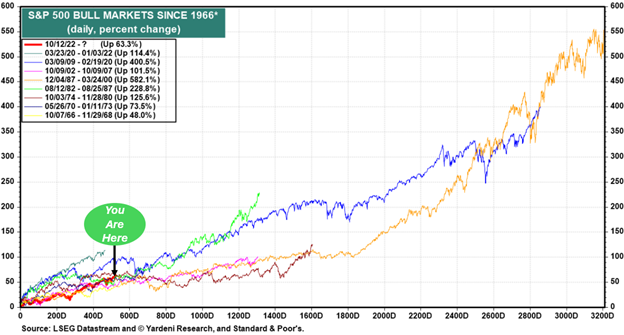
This current bull market turned two years old this week. Over the last 24 months, the S&P 500 has climbed over 60% without experiencing a correction of more than 10%. While this may sound superlative amidst the backdrop of disinflation, AI breakthroughs, solid GDP growth, and Federal Reserve support, these returns within the first two years of a new bull market are astoundingly average:
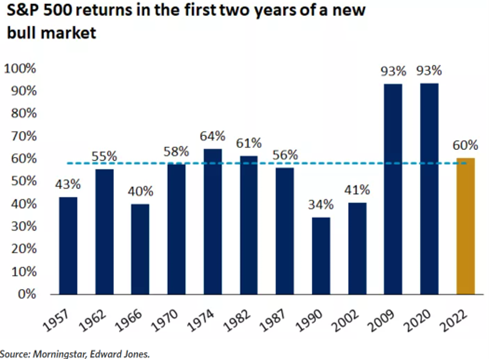
Fortunately, if this bull turns out to be simply “average”, then it’s quite young with further to run. The average duration of the bull markets profiled above was just under five years, with an average gain of 164%.
But this doesn’t mean there weren’t any down years. Remember, bull markets continue, by definition, until drawdowns exceed 20%. In the full bull markets for the set above, 14.6% of the bull market years were down years. Fears around growth, war, policy, etc., can threaten bull markets, but it takes larger economic forces to end them, i.e., the COVID recession, the GFC recession, or the Dot Com recession.
Within this current bull, GDP growth has averaged nearly 3%. Analysts project GDP growth for the quarter ended at 3%. While some economic indicators have softened recently, so has the Fed, activating an economic insurance policy.
Economists expect continued economic growth over the coming quarters, heartened by the prospect of further rate cuts. With economic growth intact, the larger bull should remain intact. However, the bull run to date has benefited from rising sentiment, rising valuations, and rising earnings. Things could get a little trickier from here.
We Feel Good!
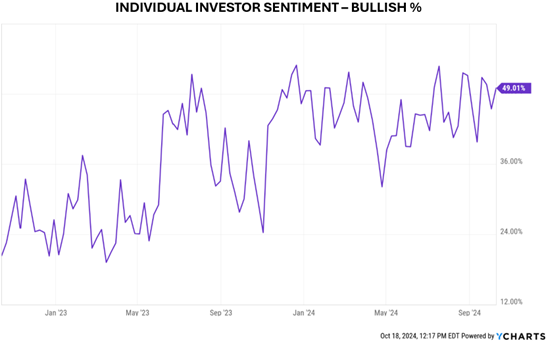
When this bull market began two years ago, only 20% of individual investors polled counted themselves as “bullish,” meaning 80% were “not bullish,” amounting to an extremely pessimistic environment. However, as sentiment levels inevitably rise, so do investment levels, making low levels of optimism highly opportune for investors.
Two years into this bull market, individual investors count themselves as 49% bullish, a level of euphoria rarely seen. Over the last ten years, only 7% of weekly sentiment readings have registered above 50%. Pessimism has squarely become optimism, limiting further uplift from gains in sentiment alone.
We Pay More!
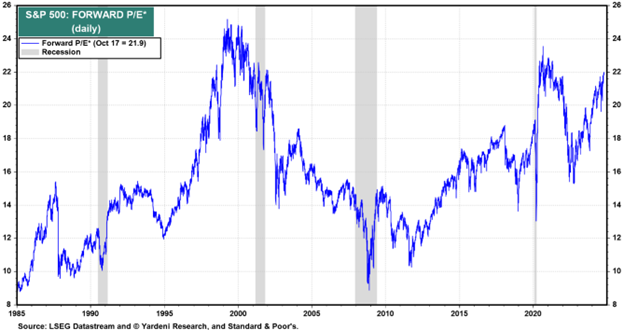
When this current bull market began, pessimistic investors were only willing to pay 15x for S&P 500 earnings. Today, optimistic investors are willing to pay 22x for S&P 500 earnings.
Like sentiment, we have seen levels above the current levels, but not often. During the Dot Com melt-up, the forward P/E on the S&P 500 topped out over 25x, leaving little comparable headway for multiple expansions today unless the current AI melt-up mimics the Dot Com melt-up of the late ’90s. Fortunately, lower interest rates support higher valuations, so while rate cuts from the Fed likely won’t lift valuations further, they do help fortify them. Nonetheless, the multiple expansion portion of this current bull market appears complete, limiting further uplift from valuation expansion alone.
Show me the money!
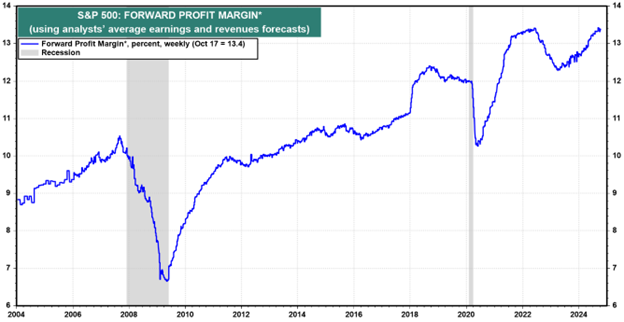
With investor sentiment and valuations at or near peak levels, further rally heights require earnings escalation. Fortunately, we find broad-based earnings promise. Real GDP running 2%+ with inflation running 2%+ creates a revenue environment for corporations of 4%+. Additionally, as companies utilize AI and other advanced technologies to drive efficiencies, investors should see profit margins expand… and indeed, they are:
With revenues growing briskly and profit margins expanding, earnings should be rising rapidly… and indeed, they are:
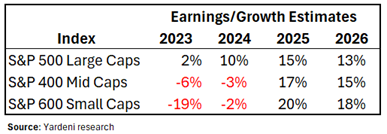
Analysts expected a 3.5% earnings growth rate for the current quarter for S&P 500. Based on initial releases, the final tally will likely double that. Since this bull began, analysts have consistently undershot their economic growth projections, their earnings growth projections, and their stock market performance projections. Many will say that this market appears toppy given peak sentiment and peak valuations. They may be right in the short run, but if corporate earnings arrive anywhere near expectations over the next couple of years, this middle-aged bull has plenty of pep left. Happy Birthday Baby Bull!
Enjoy the rest of your weekend!
-David
Sources: LSEG Datastream, @Yardeni Research, Standard & Poor’s, Y Charts, Morningstar, Edward Jones
This communication and its contents are for informational and educational purposes only and should not be used as the sole basis for any investment decision. The information contained herein is based on publicly available sources believed to be reliable but is not a representation, expressed or implied, as to the accuracy, completeness, or correctness of said information. Past performance does not guarantee future results.
">Happy Birthday, Baby Bull!
This current bull market turned two years old this week. Over the last 24 months, the S&P 500 has climbed over 60% without experiencing a correction of more than 10%. While this may sound superlative amidst the backdrop of disinflation, AI breakthroughs, solid GDP growth, and Federal Reserve support, these returns within the first two years of a new bull market are astoundingly average:
Fortunately, if this bull turns out to be simply “average”, then it’s quite young with further to run. The average duration of the bull markets profiled above was just under five years, with an average gain of 164%.
But this doesn’t mean there weren’t any down years. Remember, bull markets continue, by definition, until drawdowns exceed 20%. In the full bull markets for the set above, 14.6% of the bull market years were down years. Fears around growth, war, policy, etc., can threaten bull markets, but it takes larger economic forces to end them, i.e., the COVID recession, the GFC recession, or the Dot Com recession.
Within this current bull, GDP growth has averaged nearly 3%. Analysts project GDP growth for the quarter ended at 3%. While some economic indicators have softened recently, so has the Fed, activating an economic insurance policy.
Economists expect continued economic growth over the coming quarters, heartened by the prospect of further rate cuts. With economic growth intact, the larger bull should remain intact. However, the bull run to date has benefited from rising sentiment, rising valuations, and rising earnings. Things could get a little trickier from here.
We Feel Good!
When this bull market began two years ago, only 20% of individual investors polled counted themselves as “bullish,” meaning 80% were “not bullish,” amounting to an extremely pessimistic environment. However, as sentiment levels inevitably rise, so do investment levels, making low levels of optimism highly opportune for investors.
Two years into this bull market, individual investors count themselves as 49% bullish, a level of euphoria rarely seen. Over the last ten years, only 7% of weekly sentiment readings have registered above 50%. Pessimism has squarely become optimism, limiting further uplift from gains in sentiment alone.
We Pay More!
When this current bull market began, pessimistic investors were only willing to pay 15x for S&P 500 earnings. Today, optimistic investors are willing to pay 22x for S&P 500 earnings.
Like sentiment, we have seen levels above the current levels, but not often. During the Dot Com melt-up, the forward P/E on the S&P 500 topped out over 25x, leaving little comparable headway for multiple expansions today unless the current AI melt-up mimics the Dot Com melt-up of the late ’90s. Fortunately, lower interest rates support higher valuations, so while rate cuts from the Fed likely won’t lift valuations further, they do help fortify them. Nonetheless, the multiple expansion portion of this current bull market appears complete, limiting further uplift from valuation expansion alone.
Show me the money!
With investor sentiment and valuations at or near peak levels, further rally heights require earnings escalation. Fortunately, we find broad-based earnings promise. Real GDP running 2%+ with inflation running 2%+ creates a revenue environment for corporations of 4%+. Additionally, as companies utilize AI and other advanced technologies to drive efficiencies, investors should see profit margins expand… and indeed, they are:
With revenues growing briskly and profit margins expanding, earnings should be rising rapidly… and indeed, they are:
Analysts expected a 3.5% earnings growth rate for the current quarter for S&P 500. Based on initial releases, the final tally will likely double that. Since this bull began, analysts have consistently undershot their economic growth projections, their earnings growth projections, and their stock market performance projections. Many will say that this market appears toppy given peak sentiment and peak valuations. They may be right in the short run, but if corporate earnings arrive anywhere near expectations over the next couple of years, this middle-aged bull has plenty of pep left. Happy Birthday Baby Bull!
Enjoy the rest of your weekend!
-David
Sources: LSEG Datastream, @Yardeni Research, Standard & Poor’s, Y Charts, Morningstar, Edward Jones
This communication and its contents are for informational and educational purposes only and should not be used as the sole basis for any investment decision. The information contained herein is based on publicly available sources believed to be reliable but is not a representation, expressed or implied, as to the accuracy, completeness, or correctness of said information. Past performance does not guarantee future results.
" class="link-chevron">
Since we flipped the calendar to October, American baseball is at the peak of its glory. It doesn’t get much better than playoff baseball, especially after waiting since April for it to get here. Recently, all-time hits leader and controversial figure Pete Rose sadly passed away. Having spent a few of my formative years in Cincinnati, I thought it appropriate to pay respects to a generational talent. Understanding that Pete was ultimately a numbers guy, let’s take the score of the game as we slide headfirst into year-end.
“Am I still in uniform? Then I ain’t retired.” – Pete Rose
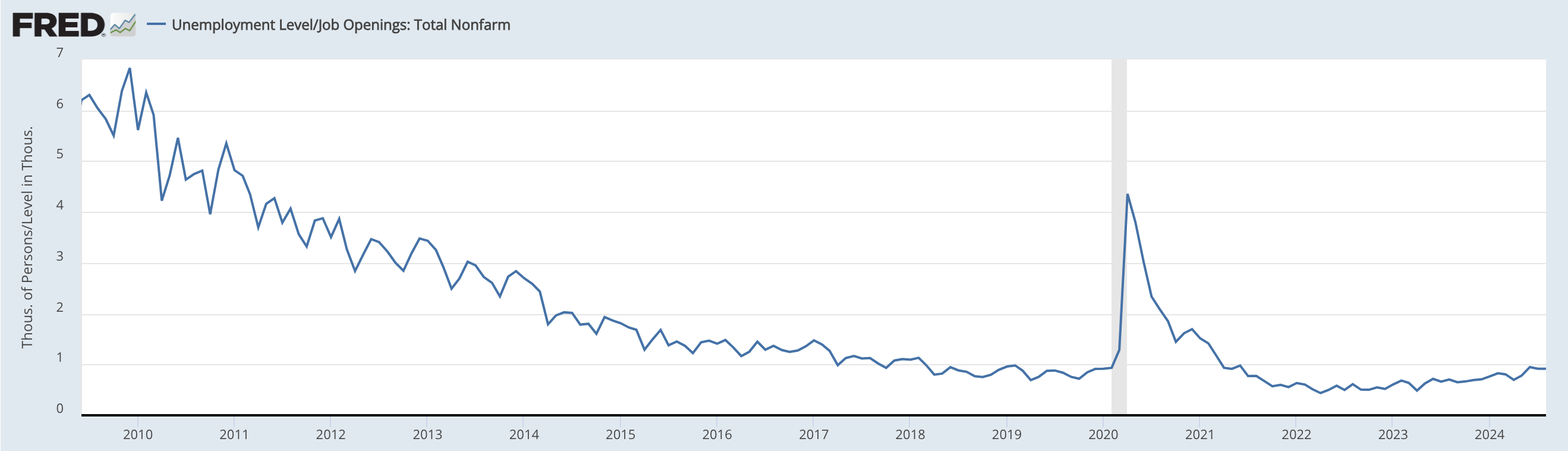
In last week’s blog, we highlighted the latest US payroll data, which showed nonfarm payrolls adding 254,000 jobs in September—almost 70% more than expected. This week, we received the latest jobless claims data, which increased by 33,000 over the previous period. However, seasonal trends and two life-altering hurricanes are the culprit in what amounts to noisy data. Overall, US job creation and employment gains have been healthy, and notably, the number of unemployed per job opening is normalizing and only returning to pre-covid levels:
“I’d walk through hell in a gasoline suit to play baseball.” – Pete Rose
The other “job” of the Fed is to achieve stable prices, so let’s read through the latest CPI data from this week. The good news: year over year headline inflation is now down to 2.4% as of Thursday’s data, closing in on the Fed’s 2% target. However, inflation ex-food and energy showed an acceleration year-over-year of 3.3%. If you look at the numbers behind the headline percentage change, you will see that although inflation is lower year-over-year, it comes with the tremendous help of falling gasoline and oil prices in August and September:
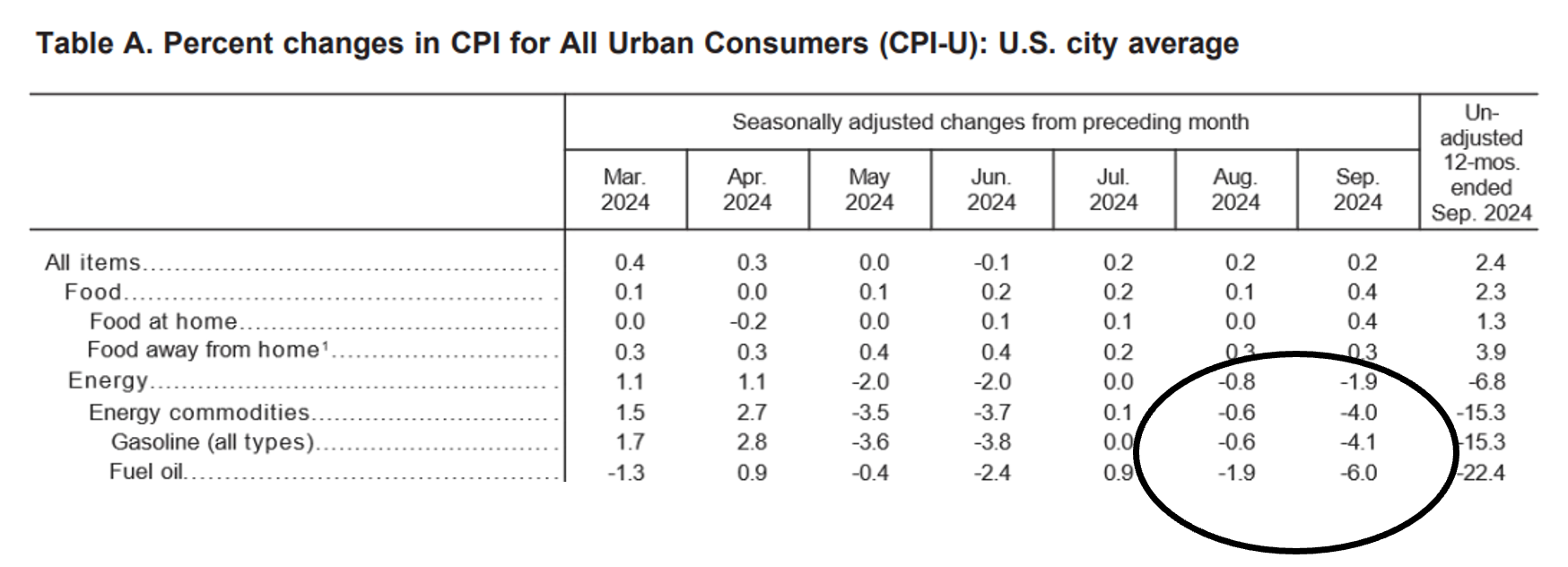
Why is this important? Well, since Brent Crude Oil prices approached their cycle lows on September 10th, prices are back up almost 16%! This comes alongside a breakout in other commodity prices (though not directly captured in the CPI calculations) which will be felt throughout markets and investor pockets. In sum, what has been a helpful offset to headline inflation numbers might now be additive going forward.
7th Inning Stretch
A lot of times, we can lose ourselves in the middle of an inning and lose sight of the score of the game. In investing terms—dive too deep into the day-to-day and lose sight of the longer-term secular trends. With all the noise last week about the upside surprise employment data and similar surprise this week in inflation data, US equity and bond markets day-to-day have been more volatile than usual.
For example, the MOVE index is a measure of US bond market volatility. Since the fed rate cut on September 18th, the MOVE index has ramped almost 30% (!), one of the largest moves since 2020. Similarly, US equity market volatility measured by the VIX remains at near 21, which is elevated enough for markets to remain choppy.
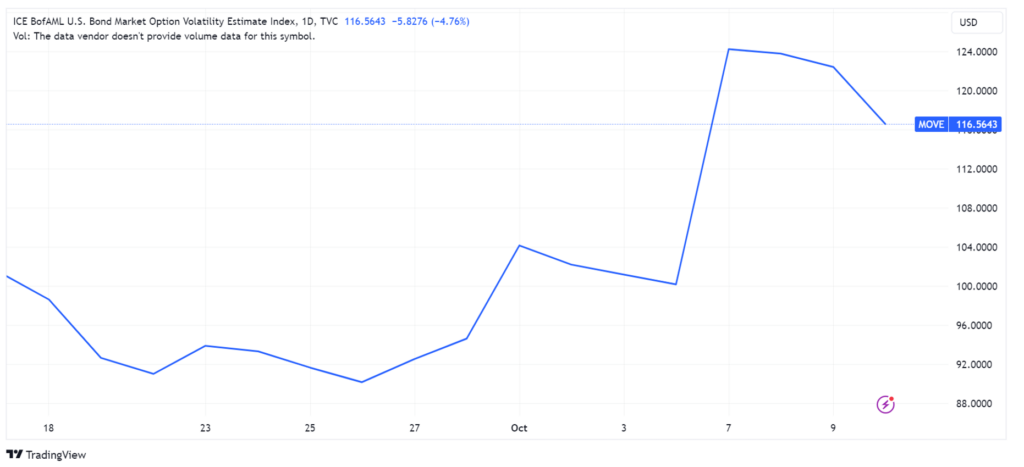
Let’s drown out all the noise and take the score of the game with year-to-date returns of major asset classes:
Index
YTD
S&P 500 Total Return
23%
MSCI ACWI
19%
MSCI Emerging Markets Total Return
16%
MSCI EAFE Total Return
11%
Bloomberg US Aggregate
3%
Data as of 10/10/2024
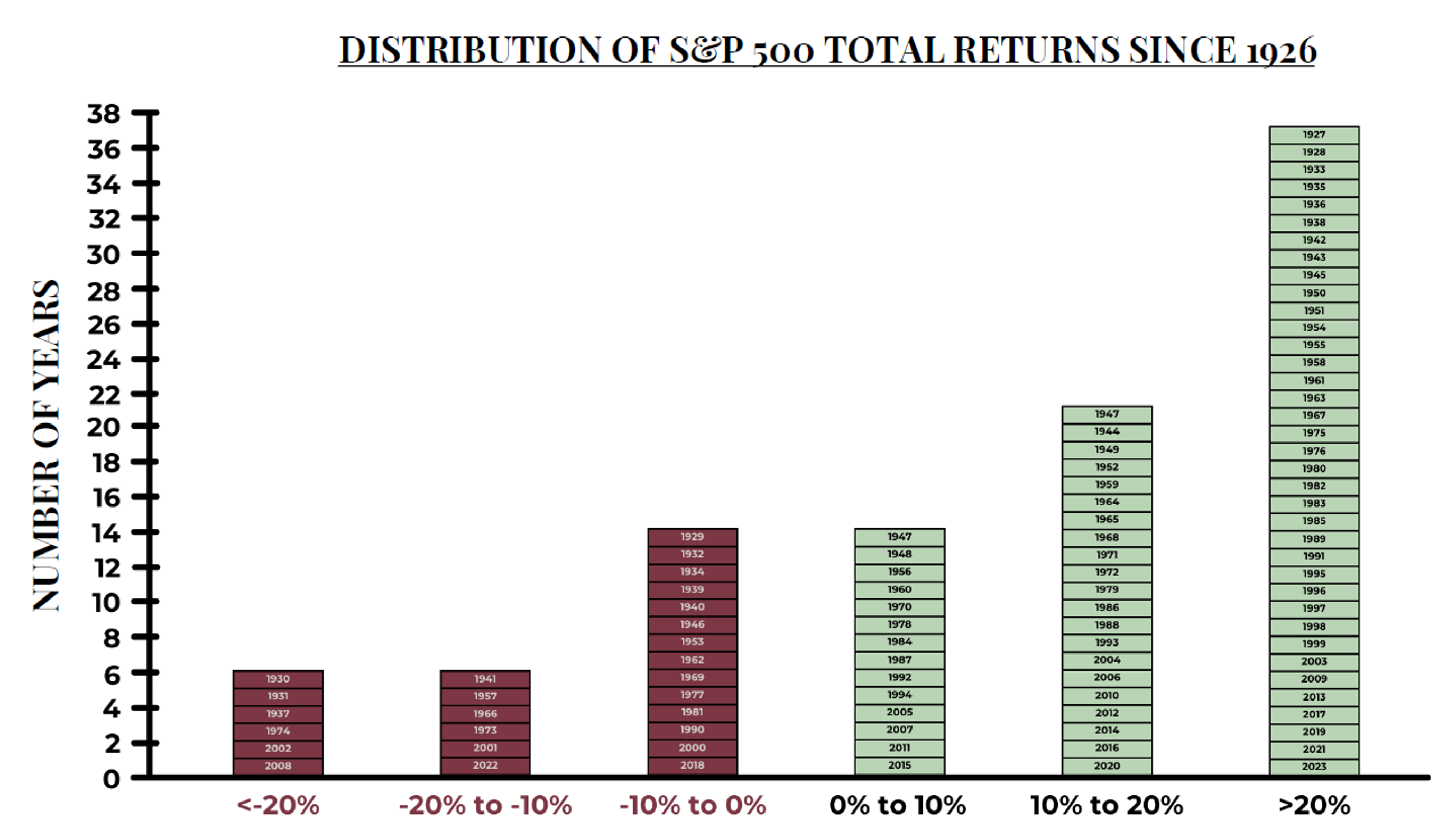
US equity markets led by the S&P 500 are well ahead as we enter into the final earnings season of the calendar year. It’s a good reminder that annual US equity market returns are more often greater than 20% than they are negative!
Have a great rest of your weekend,
Matt Gentzkow, Investment Strategist
Sources: FRED, Bureau of Labor Statistics, Trading View, YCharts, FactSet, S&P
This communication and its contents are for informational and educational purposes only and should not be used as the sole basis for any investment decision. The information contained herein is based on publicly available sources believed to be reliable but is not a representation, expressed or implied, as to the accuracy, completeness, or correctness of said information. Past performance does not guarantee future results.
">Charlie Hustle: Sliding Into Year-End
Since we flipped the calendar to October, American baseball is at the peak of its glory. It doesn’t get much better than playoff baseball, especially after waiting since April for it to get here. Recently, all-time hits leader and controversial figure Pete Rose sadly passed away. Having spent a few of my formative years in Cincinnati, I thought it appropriate to pay respects to a generational talent. Understanding that Pete was ultimately a numbers guy, let’s take the score of the game as we slide headfirst into year-end.
| Index | YTD |
| S&P 500 Total Return | 23% |
| MSCI ACWI | 19% |
| MSCI Emerging Markets Total Return | 16% |
| MSCI EAFE Total Return | 11% |
| Bloomberg US Aggregate | 3% |
“Am I still in uniform? Then I ain’t retired.” – Pete Rose
In last week’s blog, we highlighted the latest US payroll data, which showed nonfarm payrolls adding 254,000 jobs in September—almost 70% more than expected. This week, we received the latest jobless claims data, which increased by 33,000 over the previous period. However, seasonal trends and two life-altering hurricanes are the culprit in what amounts to noisy data. Overall, US job creation and employment gains have been healthy, and notably, the number of unemployed per job opening is normalizing and only returning to pre-covid levels:
“I’d walk through hell in a gasoline suit to play baseball.” – Pete Rose
The other “job” of the Fed is to achieve stable prices, so let’s read through the latest CPI data from this week. The good news: year over year headline inflation is now down to 2.4% as of Thursday’s data, closing in on the Fed’s 2% target. However, inflation ex-food and energy showed an acceleration year-over-year of 3.3%. If you look at the numbers behind the headline percentage change, you will see that although inflation is lower year-over-year, it comes with the tremendous help of falling gasoline and oil prices in August and September:
Why is this important? Well, since Brent Crude Oil prices approached their cycle lows on September 10th, prices are back up almost 16%! This comes alongside a breakout in other commodity prices (though not directly captured in the CPI calculations) which will be felt throughout markets and investor pockets. In sum, what has been a helpful offset to headline inflation numbers might now be additive going forward.
7th Inning Stretch
A lot of times, we can lose ourselves in the middle of an inning and lose sight of the score of the game. In investing terms—dive too deep into the day-to-day and lose sight of the longer-term secular trends. With all the noise last week about the upside surprise employment data and similar surprise this week in inflation data, US equity and bond markets day-to-day have been more volatile than usual.
For example, the MOVE index is a measure of US bond market volatility. Since the fed rate cut on September 18th, the MOVE index has ramped almost 30% (!), one of the largest moves since 2020. Similarly, US equity market volatility measured by the VIX remains at near 21, which is elevated enough for markets to remain choppy.
Let’s drown out all the noise and take the score of the game with year-to-date returns of major asset classes:
| Index | YTD |
| S&P 500 Total Return | 23% |
| MSCI ACWI | 19% |
| MSCI Emerging Markets Total Return | 16% |
| MSCI EAFE Total Return | 11% |
| Bloomberg US Aggregate | 3% |
US equity markets led by the S&P 500 are well ahead as we enter into the final earnings season of the calendar year. It’s a good reminder that annual US equity market returns are more often greater than 20% than they are negative!
Have a great rest of your weekend,
Matt Gentzkow, Investment Strategist
Sources: FRED, Bureau of Labor Statistics, Trading View, YCharts, FactSet, S&P
This communication and its contents are for informational and educational purposes only and should not be used as the sole basis for any investment decision. The information contained herein is based on publicly available sources believed to be reliable but is not a representation, expressed or implied, as to the accuracy, completeness, or correctness of said information. Past performance does not guarantee future results.
" class="link-chevron">
As we have discussed recently, the Fed’s directive and therefore the market’s attention, has pivoted from fighting inflation to fighting recession. This creates data response inversions for investors. For example, previously stronger-than-expected labor market reports flamed inflationary fears, resulting in market declines. Today, stronger-than-expected labor market reports dispel recession fears, resulting in market advances. Same report, inverted response. The game has changed. Welcome to the prize fight between the Recessionists and the Expansionists. Let’s survey the September data reported this week and see who’s ahead.
GDP Tenacity
On September 26th, the government revised its estimate of U.S. GDP growth upward by 1.3%, revealing a more robust economy than previously reported:
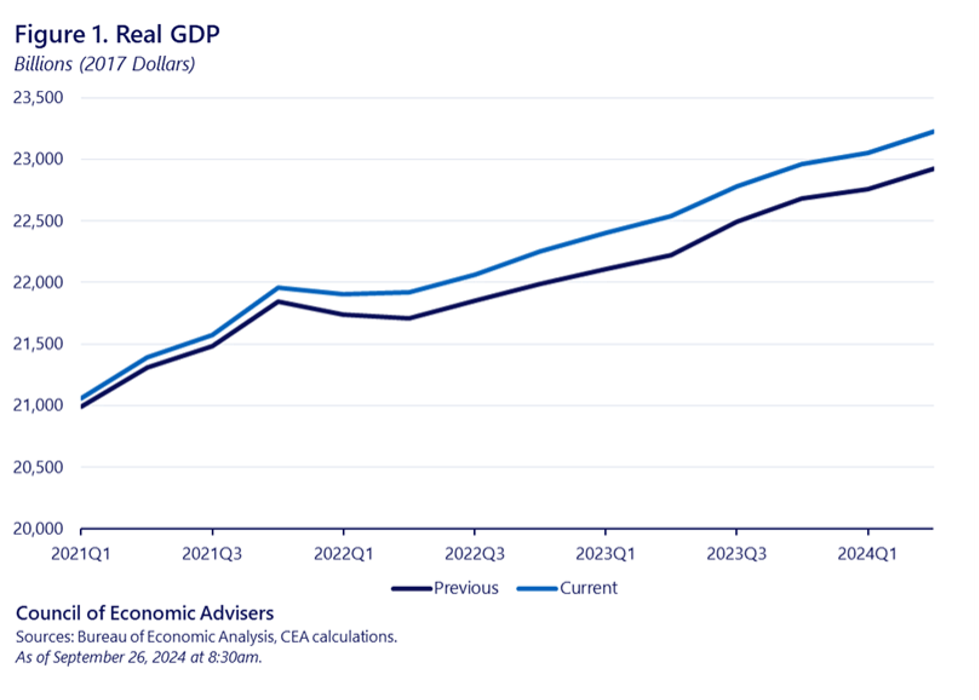
Additionally, the Government reaffirmed its 3% read on second quarter GDP growth. Taken together, these revisions depict an economy with even more momentum and resilience than previously assumed. This momentum also carried over into the third quarter as the Fed’s GDPNow tracker projects a 2.5% growth rate for the quarter, well above the 1.8% “neutral” growth rate projected for the economy:
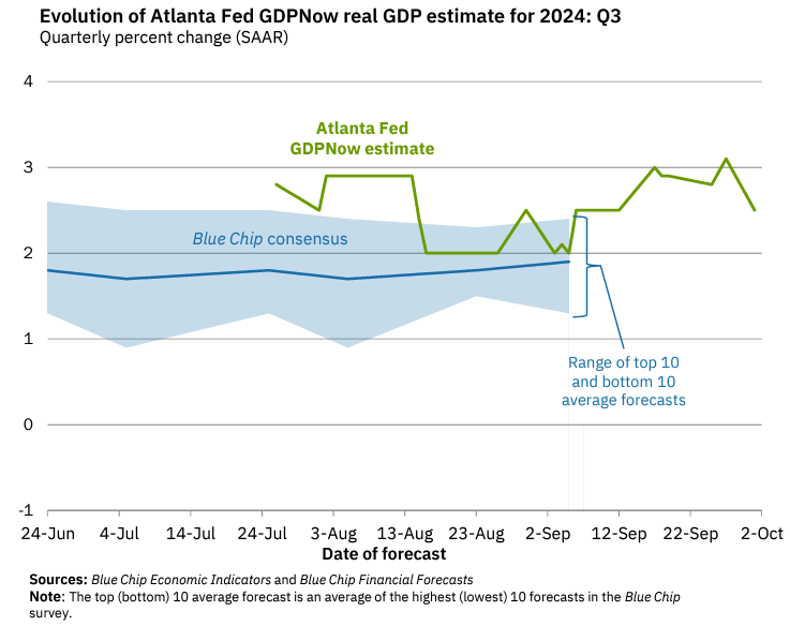
Reinforcing the rosy economic projections for the 3rd quarter, recent economic data releases have been surprising to the upside as seen in the Citigroup Economic Surprise Index:
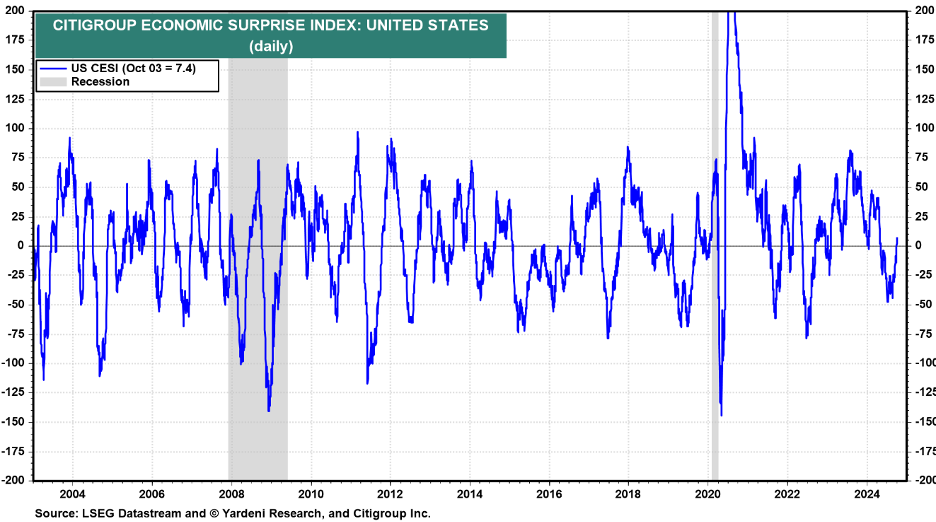
Labor Market Merriment
The Fed views recessions through the lens of labor market weakness. Therefore, the pivot towards recession watch equates to a pivot towards labor market watch, making the weekly unemployment claims and monthly labor reports the most important data releases for the markets now. While we did see an uptick in unemployment claims between May and August, the trend has since reversed, underscoring labor market resilience:
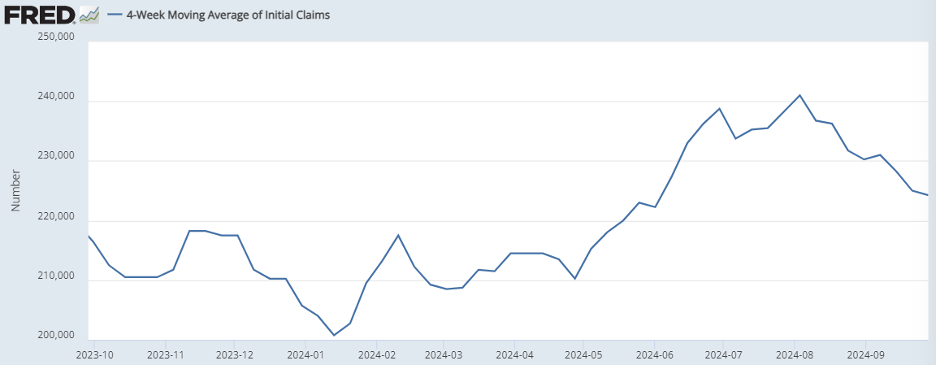
Furthermore, as per Friday’s jobs data, the U.S. not only added many more jobs than expected in September, but the BLS also revised August higher by 17,000 and July higher by 55,000:
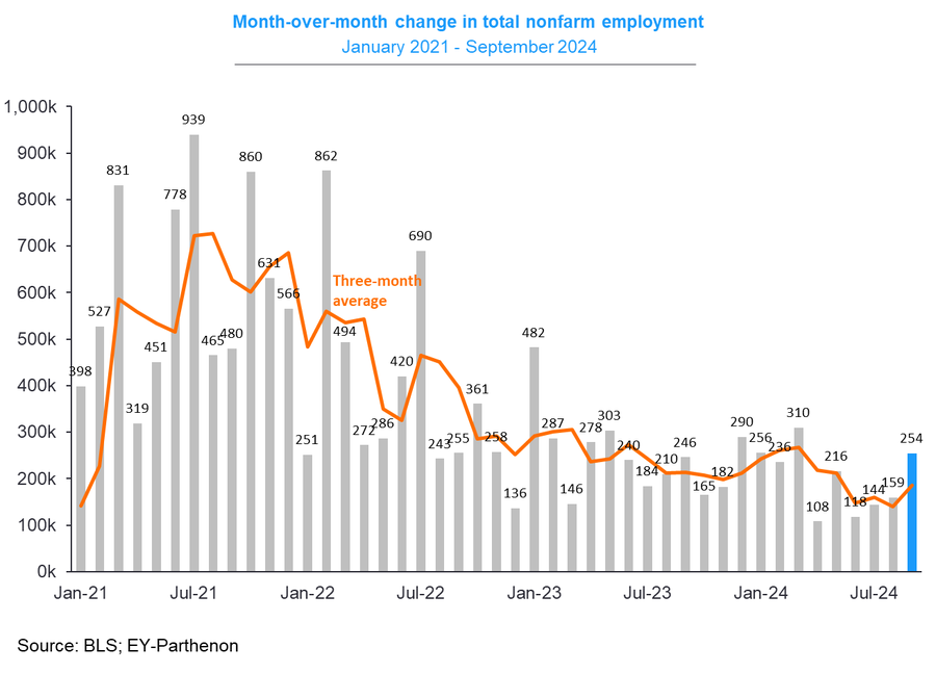
Fortunately, while the stronger-than-expected release and revisions depict a robust labor market, wage growth continues to slowly “normalize”:
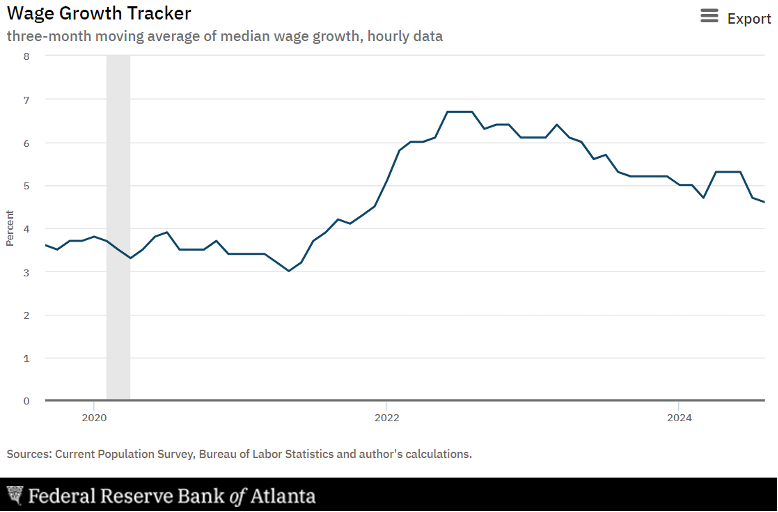
In sum, a labor market performing above trend compensates consumers above trend, leading to consumption above trend, supporting GDP growth above trend. No signs of recession here.
For extra credit, two additional indicators we track closely for recession suggestion align with continued GDP expansion. The ISM Services index which tracks services related businesses (70% of the U.S. GDP) registered 55 in September, well over the 50-level signifying growth. This was the highest reading since February 2023.
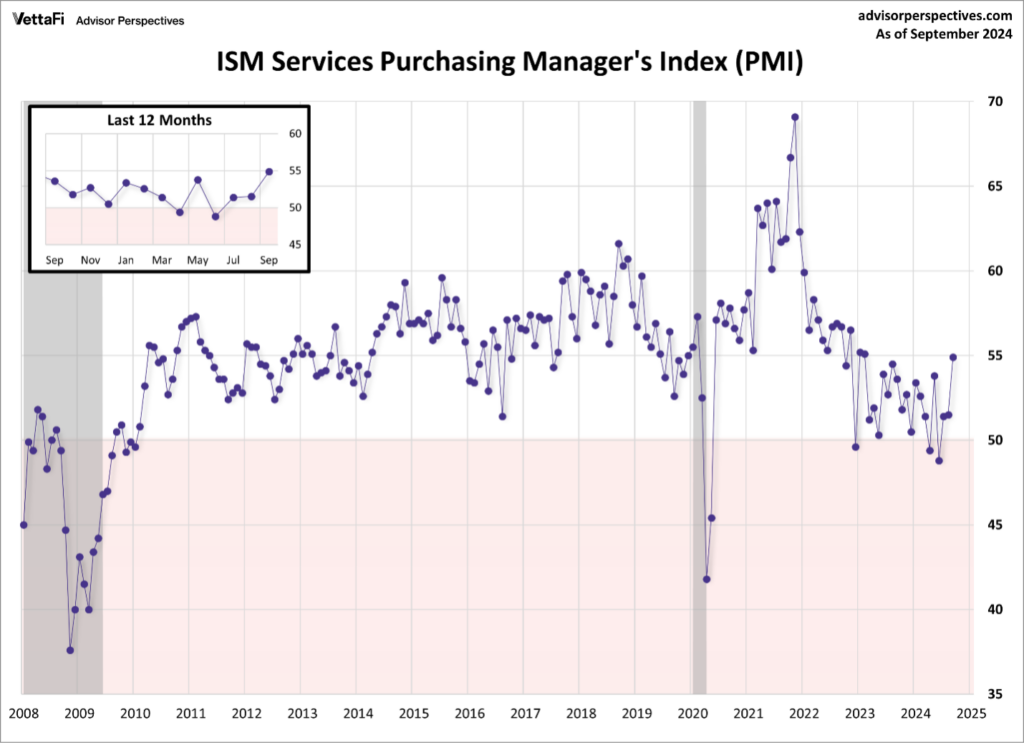
Lastly, The Fed’s recent interest rate reduction didn’t lower longer-term mortgage rates, but did lower shorter-term rates builders rely more heavily on for housing construction. August posted a substantial rebound in housing starts that likely carried into September given the interest rate tailwinds and improvement in homebuilder sentiment for the first time since May:
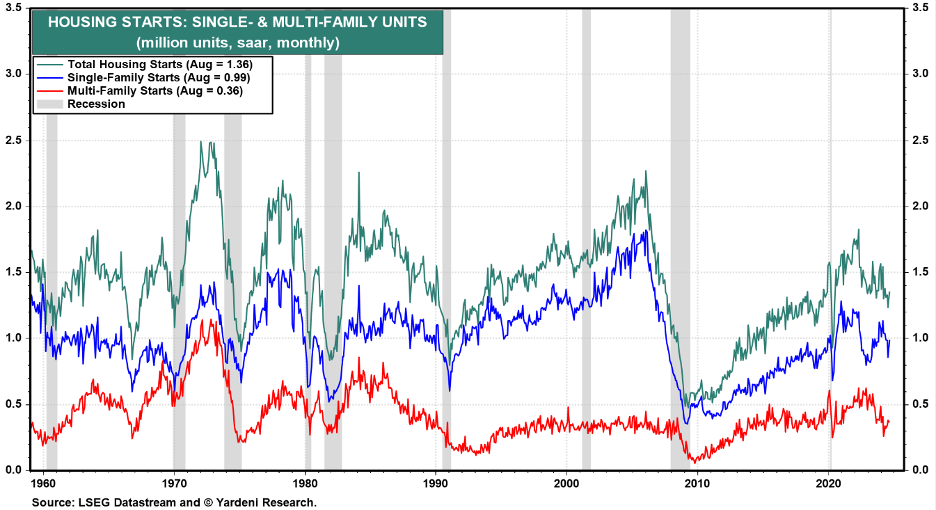
We suspect that residential investment will contribute to GDP growth in Q3 when numbers are released on October 30th, a highly reassuring signal that the U.S. economy isn’t on the cusp of recession.
Small Cap Confirmation
Markets do an excellent job of synthesizing data. Because smaller companies bear the brunt of recessionary conditions, the direction of the Russell 2000 small cap index provides the best arbiter of investor recession anxieties. Over the past three months, the Russell 2000 has gained 9.48%, vs. the more stalwart S&P 500, which returned 3.24%. Advantage small caps. And therefore, overall thus far in our prize fight… advantage Expansionists!
Enjoy your weekend!
-David
Sources: U.S. Bureau of Economic Analysis, Blue Chip Economic Indicators, LSEG Datastream, Yardeni, Citigroup, FRED, Bureau of Labor Statistics, EY-Parthenon, Current Population Survey, Federal Reserve Bank of America Calculations
This communication and its contents are for informational and educational purposes only and should not be used as the sole basis for any investment decision. The information contained herein is based on publicly available sources believed to be reliable but is not a representation, expressed or implied, as to the accuracy, completeness, or correctness of said information. Past performance does not guarantee future results.
">Gloves Up!
As we have discussed recently, the Fed’s directive and therefore the market’s attention, has pivoted from fighting inflation to fighting recession. This creates data response inversions for investors. For example, previously stronger-than-expected labor market reports flamed inflationary fears, resulting in market declines. Today, stronger-than-expected labor market reports dispel recession fears, resulting in market advances. Same report, inverted response. The game has changed. Welcome to the prize fight between the Recessionists and the Expansionists. Let’s survey the September data reported this week and see who’s ahead.
GDP Tenacity
On September 26th, the government revised its estimate of U.S. GDP growth upward by 1.3%, revealing a more robust economy than previously reported:
Additionally, the Government reaffirmed its 3% read on second quarter GDP growth. Taken together, these revisions depict an economy with even more momentum and resilience than previously assumed. This momentum also carried over into the third quarter as the Fed’s GDPNow tracker projects a 2.5% growth rate for the quarter, well above the 1.8% “neutral” growth rate projected for the economy:
Reinforcing the rosy economic projections for the 3rd quarter, recent economic data releases have been surprising to the upside as seen in the Citigroup Economic Surprise Index:
Labor Market Merriment
The Fed views recessions through the lens of labor market weakness. Therefore, the pivot towards recession watch equates to a pivot towards labor market watch, making the weekly unemployment claims and monthly labor reports the most important data releases for the markets now. While we did see an uptick in unemployment claims between May and August, the trend has since reversed, underscoring labor market resilience:
Furthermore, as per Friday’s jobs data, the U.S. not only added many more jobs than expected in September, but the BLS also revised August higher by 17,000 and July higher by 55,000:
Fortunately, while the stronger-than-expected release and revisions depict a robust labor market, wage growth continues to slowly “normalize”:
In sum, a labor market performing above trend compensates consumers above trend, leading to consumption above trend, supporting GDP growth above trend. No signs of recession here.
For extra credit, two additional indicators we track closely for recession suggestion align with continued GDP expansion. The ISM Services index which tracks services related businesses (70% of the U.S. GDP) registered 55 in September, well over the 50-level signifying growth. This was the highest reading since February 2023.
Lastly, The Fed’s recent interest rate reduction didn’t lower longer-term mortgage rates, but did lower shorter-term rates builders rely more heavily on for housing construction. August posted a substantial rebound in housing starts that likely carried into September given the interest rate tailwinds and improvement in homebuilder sentiment for the first time since May:
We suspect that residential investment will contribute to GDP growth in Q3 when numbers are released on October 30th, a highly reassuring signal that the U.S. economy isn’t on the cusp of recession.
Small Cap Confirmation
Markets do an excellent job of synthesizing data. Because smaller companies bear the brunt of recessionary conditions, the direction of the Russell 2000 small cap index provides the best arbiter of investor recession anxieties. Over the past three months, the Russell 2000 has gained 9.48%, vs. the more stalwart S&P 500, which returned 3.24%. Advantage small caps. And therefore, overall thus far in our prize fight… advantage Expansionists!
Enjoy your weekend!
-David
Sources: U.S. Bureau of Economic Analysis, Blue Chip Economic Indicators, LSEG Datastream, Yardeni, Citigroup, FRED, Bureau of Labor Statistics, EY-Parthenon, Current Population Survey, Federal Reserve Bank of America Calculations
This communication and its contents are for informational and educational purposes only and should not be used as the sole basis for any investment decision. The information contained herein is based on publicly available sources believed to be reliable but is not a representation, expressed or implied, as to the accuracy, completeness, or correctness of said information. Past performance does not guarantee future results.
" class="link-chevron">