Resources

Your Life, Your Legacy, Our Guidance

Resources to help individuals, families, business owners, and institutions pursue their financial goals and secure their legacy

President Trump delivered his State of the Union address last week. It was long, and like most political speeches, it requires nuance. Rather than dissect the entire presentation, I want to focus on one specific item that matters to investors: the investment commitments secured from around the globe.

The flow of new capital is critical. When new money enters an economy and is deployed productively, it can increase economic output, improve productivity, raise wages, and ultimately support corporate earnings.

Let’s dive in.

Market Check-In

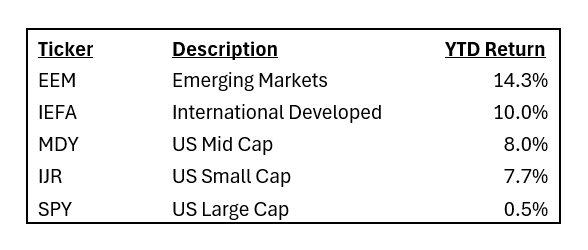
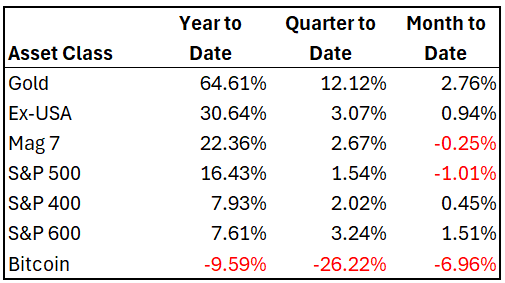
Before we turn to policy, a quick look at markets. If markets feel non-directional, you are right! The S&P500 has traded within just a 3% trading range the entire first two months of the year, or roughly 225 points. It sits flat on the year. However, under the hood and across the globe, things are quite different. Dispersion across US equities is at extreme highs. A trader’s paradise. Here is a table of year-to-date returns across the globe:

US Small caps, mid-caps, internationals, and emerging markets have enjoyed great success so far this year, while the S&P 500 is treading water. Good news for investors that own globally diversified portfolios!

Investment Commitments

Markets and economies are mostly efficient. Stock prices generally reflect known information and expectations about future earnings, but government policy can alter the environment these companies operate within. Interest rates, taxes, trade policy, and regulations all influence capital flows. One of my favorite quotes from Trump last week on financial commitments:

“In 12 months, I secured commitments for more than $18 trillion pouring in from all over the globe.” – Donald Trump, 2026 State of the Union Address

A big number, but let’s try to quantify and qualify the impact for investors. A review of the White House website shows a tally closer to $9.7 trillion. Within that number are large commitments from U.S.-based companies such as Meta, Apple, and Amazon. While important, those are domestic capital expenditures. The ones important to US investors are those called Foreign Direct Investments, which can improve a receiving country’s economy.

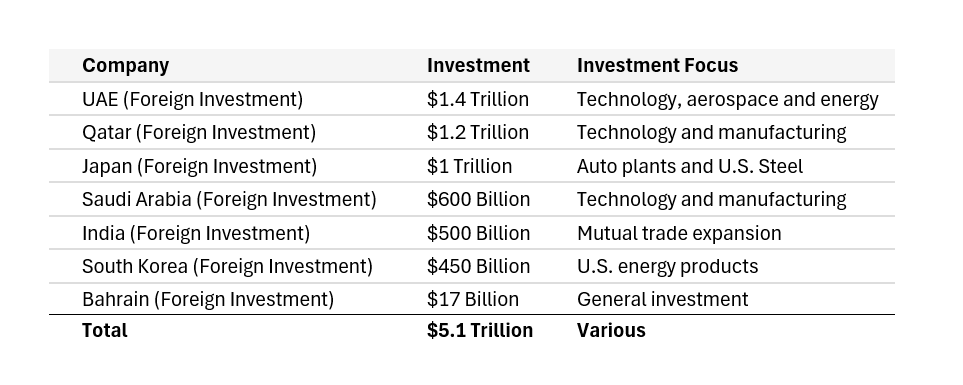
Strip out the U.S.-based commitments and you are left with $5.1 trillion in foreign investment commitments according to the White House. Here’s the breakdown:

Still a substantial sum! But here’s the key: not all capital inflows are created equal.

The Multiplier Effect

For foreign investment to materially impact GDP, it must create productivity, not simply change ownership of assets. Building factories, expanding infrastructure, constructing facilities, and increasing domestic production create what economists call a multiplier effect. The multiplier reflects how one dollar spent can generate multiple dollars of economic activity.

For clarity, let’s say Japan spends their $1 trillion commitment on constructing new auto-plants across the US. A company like Vulcan Materials supplies stone, sand, and gravel to construct the plant thereby increasing their revenues. Their workers earn wages. Shareholders receive increased dividend payments. Their workers spend income in their communities. The finished plants create thousands of long-term jobs. Ongoing production generates additional output year after year.

That initial dollar investment circulates through the economy repeatedly.

For simplicity, assume a multiplier of 3x. Under that framework, $1 trillion dollars in direct investment could create $3 trillion in cumulative economic output over time. If the full $5.1 trillion were deployed into productivity-enhancing projects, the impact could be meaningful. U.S. annual GDP is approximately $30 trillion, so $5.1 trillion represents roughly 17% of annual GDP. Any multiplier effect applied to that base would be economically significant.

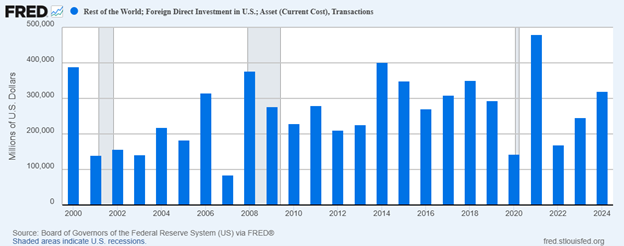
Consider the historical context. Here is the last twenty years of annual foreign direct investment in US.

The average and median are much closer to $200 billion per year, much less than the potential $5.1 trillion secured by Trump. That’s the contrast.

But commitments are not GDP. They become GDP only when factories are built, equipment is installed, workers are hired, and supply chains are activated. However, if even a portion of the $5.1 trillion materializes as productivity-boosting investment, it would represent a multiple of typical foreign investment inflows and materially impact GDP to the positive ultimately paying investors a multiplier effect going forward!  

Have a great week!

-Matt

Sources: Whitehouse.gov, Federal Reserve Bank of St. Louis, Ycharts

This communication and its contents are for informational and educational purposes only and should not be used as the sole basis for any investment decision. The information contained herein is based on publicly available sources believed to be reliable but is not a representation, expressed or implied, as to the accuracy, completeness, or correctness of said information. References to political figures or policies are for informational purposes only and do not represent an endorsement by Waddell & Associates. Any forward-looking statements reflect current opinions and assumptions and are subject to change without notice; actual results may differ materially. Past performance does not guarantee future results. Waddell & Associates may use artificial intelligence tools to help generate or summarize content; all outputs are reviewed by our team for accuracy and relevance.

">
March 1, 2026
President Trump delivered his State of the Union address last week. It was long, and like most political speeches, it requires nuance. Rather than dissect the entire presentation, I want to focus on one specific item that matters to investors: the investment commitments secured from around the globe.

The flow of new capital is critical. When new money enters an economy and is deployed productively, it can increase economic output, improve productivity, raise wages, and ultimately support corporate earnings.

Let’s dive in.

Market Check-In

Before we turn to policy, a quick look at markets. If markets feel non-directional, you are right! The S&P500 has traded within just a 3% trading range the entire first two months of the year, or roughly 225 points. It sits flat on the year. However, under the hood and across the globe, things are quite different. Dispersion across US equities is at extreme highs. A trader’s paradise. Here is a table of year-to-date returns across the globe:

US Small caps, mid-caps, internationals, and emerging markets have enjoyed great success so far this year, while the S&P 500 is treading water. Good news for investors that own globally diversified portfolios!

Investment Commitments

Markets and economies are mostly efficient. Stock prices generally reflect known information and expectations about future earnings, but government policy can alter the environment these companies operate within. Interest rates, taxes, trade policy, and regulations all influence capital flows. One of my favorite quotes from Trump last week on financial commitments:

“In 12 months, I secured commitments for more than $18 trillion pouring in from all over the globe.” – Donald Trump, 2026 State of the Union Address

A big number, but let’s try to quantify and qualify the impact for investors. A review of the White House website shows a tally closer to $9.7 trillion. Within that number are large commitments from U.S.-based companies such as Meta, Apple, and Amazon. While important, those are domestic capital expenditures. The ones important to US investors are those called Foreign Direct Investments, which can improve a receiving country’s economy.

Strip out the U.S.-based commitments and you are left with $5.1 trillion in foreign investment commitments according to the White House. Here’s the breakdown:

Still a substantial sum! But here’s the key: not all capital inflows are created equal.

The Multiplier Effect

For foreign investment to materially impact GDP, it must create productivity, not simply change ownership of assets. Building factories, expanding infrastructure, constructing facilities, and increasing domestic production create what economists call a multiplier effect. The multiplier reflects how one dollar spent can generate multiple dollars of economic activity.

For clarity, let’s say Japan spends their $1 trillion commitment on constructing new auto-plants across the US. A company like Vulcan Materials supplies stone, sand, and gravel to construct the plant thereby increasing their revenues. Their workers earn wages. Shareholders receive increased dividend payments. Their workers spend income in their communities. The finished plants create thousands of long-term jobs. Ongoing production generates additional output year after year.

That initial dollar investment circulates through the economy repeatedly.

For simplicity, assume a multiplier of 3x. Under that framework, $1 trillion dollars in direct investment could create $3 trillion in cumulative economic output over time. If the full $5.1 trillion were deployed into productivity-enhancing projects, the impact could be meaningful. U.S. annual GDP is approximately $30 trillion, so $5.1 trillion represents roughly 17% of annual GDP. Any multiplier effect applied to that base would be economically significant.

Consider the historical context. Here is the last twenty years of annual foreign direct investment in US.

The average and median are much closer to $200 billion per year, much less than the potential $5.1 trillion secured by Trump. That’s the contrast.

But commitments are not GDP. They become GDP only when factories are built, equipment is installed, workers are hired, and supply chains are activated. However, if even a portion of the $5.1 trillion materializes as productivity-boosting investment, it would represent a multiple of typical foreign investment inflows and materially impact GDP to the positive ultimately paying investors a multiplier effect going forward!  

Have a great week!

-Matt

Sources: Whitehouse.gov, Federal Reserve Bank of St. Louis, Ycharts

This communication and its contents are for informational and educational purposes only and should not be used as the sole basis for any investment decision. The information contained herein is based on publicly available sources believed to be reliable but is not a representation, expressed or implied, as to the accuracy, completeness, or correctness of said information. References to political figures or policies are for informational purposes only and do not represent an endorsement by Waddell & Associates. Any forward-looking statements reflect current opinions and assumptions and are subject to change without notice; actual results may differ materially. Past performance does not guarantee future results. Waddell & Associates may use artificial intelligence tools to help generate or summarize content; all outputs are reviewed by our team for accuracy and relevance.

">The $5.1 Trillion Multiplier
President Trump delivered his State of the Union address last week. It was long, and like most political speeches, it requires nuance. Rather than dissect the entire presentation, I want to focus on one specific item that matters to investors: the investment commitments secured from around the globe.

The flow of new capital is critical. When new money enters an economy and is deployed productively, it can increase economic output, improve productivity, raise wages, and ultimately support corporate earnings.

Let’s dive in.

Market Check-In

Before we turn to policy, a quick look at markets. If markets feel non-directional, you are right! The S&P500 has traded within just a 3% trading range the entire first two months of the year, or roughly 225 points. It sits flat on the year. However, under the hood and across the globe, things are quite different. Dispersion across US equities is at extreme highs. A trader’s paradise. Here is a table of year-to-date returns across the globe:

US Small caps, mid-caps, internationals, and emerging markets have enjoyed great success so far this year, while the S&P 500 is treading water. Good news for investors that own globally diversified portfolios!

Investment Commitments

Markets and economies are mostly efficient. Stock prices generally reflect known information and expectations about future earnings, but government policy can alter the environment these companies operate within. Interest rates, taxes, trade policy, and regulations all influence capital flows. One of my favorite quotes from Trump last week on financial commitments:

“In 12 months, I secured commitments for more than $18 trillion pouring in from all over the globe.” – Donald Trump, 2026 State of the Union Address

A big number, but let’s try to quantify and qualify the impact for investors. A review of the White House website shows a tally closer to $9.7 trillion. Within that number are large commitments from U.S.-based companies such as Meta, Apple, and Amazon. While important, those are domestic capital expenditures. The ones important to US investors are those called Foreign Direct Investments, which can improve a receiving country’s economy.

Strip out the U.S.-based commitments and you are left with $5.1 trillion in foreign investment commitments according to the White House. Here’s the breakdown:

Still a substantial sum! But here’s the key: not all capital inflows are created equal.

The Multiplier Effect

For foreign investment to materially impact GDP, it must create productivity, not simply change ownership of assets. Building factories, expanding infrastructure, constructing facilities, and increasing domestic production create what economists call a multiplier effect. The multiplier reflects how one dollar spent can generate multiple dollars of economic activity.

For clarity, let’s say Japan spends their $1 trillion commitment on constructing new auto-plants across the US. A company like Vulcan Materials supplies stone, sand, and gravel to construct the plant thereby increasing their revenues. Their workers earn wages. Shareholders receive increased dividend payments. Their workers spend income in their communities. The finished plants create thousands of long-term jobs. Ongoing production generates additional output year after year.

That initial dollar investment circulates through the economy repeatedly.

For simplicity, assume a multiplier of 3x. Under that framework, $1 trillion dollars in direct investment could create $3 trillion in cumulative economic output over time. If the full $5.1 trillion were deployed into productivity-enhancing projects, the impact could be meaningful. U.S. annual GDP is approximately $30 trillion, so $5.1 trillion represents roughly 17% of annual GDP. Any multiplier effect applied to that base would be economically significant.

Consider the historical context. Here is the last twenty years of annual foreign direct investment in US.

The average and median are much closer to $200 billion per year, much less than the potential $5.1 trillion secured by Trump. That’s the contrast.

But commitments are not GDP. They become GDP only when factories are built, equipment is installed, workers are hired, and supply chains are activated. However, if even a portion of the $5.1 trillion materializes as productivity-boosting investment, it would represent a multiple of typical foreign investment inflows and materially impact GDP to the positive ultimately paying investors a multiplier effect going forward!  

Have a great week!

-Matt

Sources: Whitehouse.gov, Federal Reserve Bank of St. Louis, Ycharts

This communication and its contents are for informational and educational purposes only and should not be used as the sole basis for any investment decision. The information contained herein is based on publicly available sources believed to be reliable but is not a representation, expressed or implied, as to the accuracy, completeness, or correctness of said information. References to political figures or policies are for informational purposes only and do not represent an endorsement by Waddell & Associates. Any forward-looking statements reflect current opinions and assumptions and are subject to change without notice; actual results may differ materially. Past performance does not guarantee future results. Waddell & Associates may use artificial intelligence tools to help generate or summarize content; all outputs are reviewed by our team for accuracy and relevance.

" class="link-chevron"> Watch Now
Congratulations to the US Women’s Hockey team for their stunning defeat of Team Canada in Thursday afternoon’s gold medal game. Electric!

Throughout the Olympic Games this year, every American hockey goal was followed by Lynyrd Skynyrd’s “Free Bird”, the official Team USA hockey goal song at the 2026 Winter Olympics in Milan-Cortina. A fitting choice, symbolic of our beloved bald eagle. The beauty of the ‘free bird’ is its ability to go where it wants, when it wants, unrestricted in choice. For the last several years, America’s largest technology companies have operated with similar freedom in the form of free cash flow; but that bird might be soon landing. Let’s explore.

Cash is King

Over the last several years, big tech has generated extraordinary amounts of free cash flow. What is that? In simple terms, it is the cash a company generates after operating expenses and capital expenditures. In plain English, its money left over that companies can re-deploy towards shareholder dividends, new capital ventures, share buybacks, and more. Free cash flow is what gives companies strategic flexibility on their financial futures. For big technology companies like Microsoft, Alphabet, Amazon, META, and Oracle, that flexibility has historically been enormous with trailing twelve-month free cash flow totaling a combined $200 billion. But that freedom is now being tested.

The AI Investment Surge

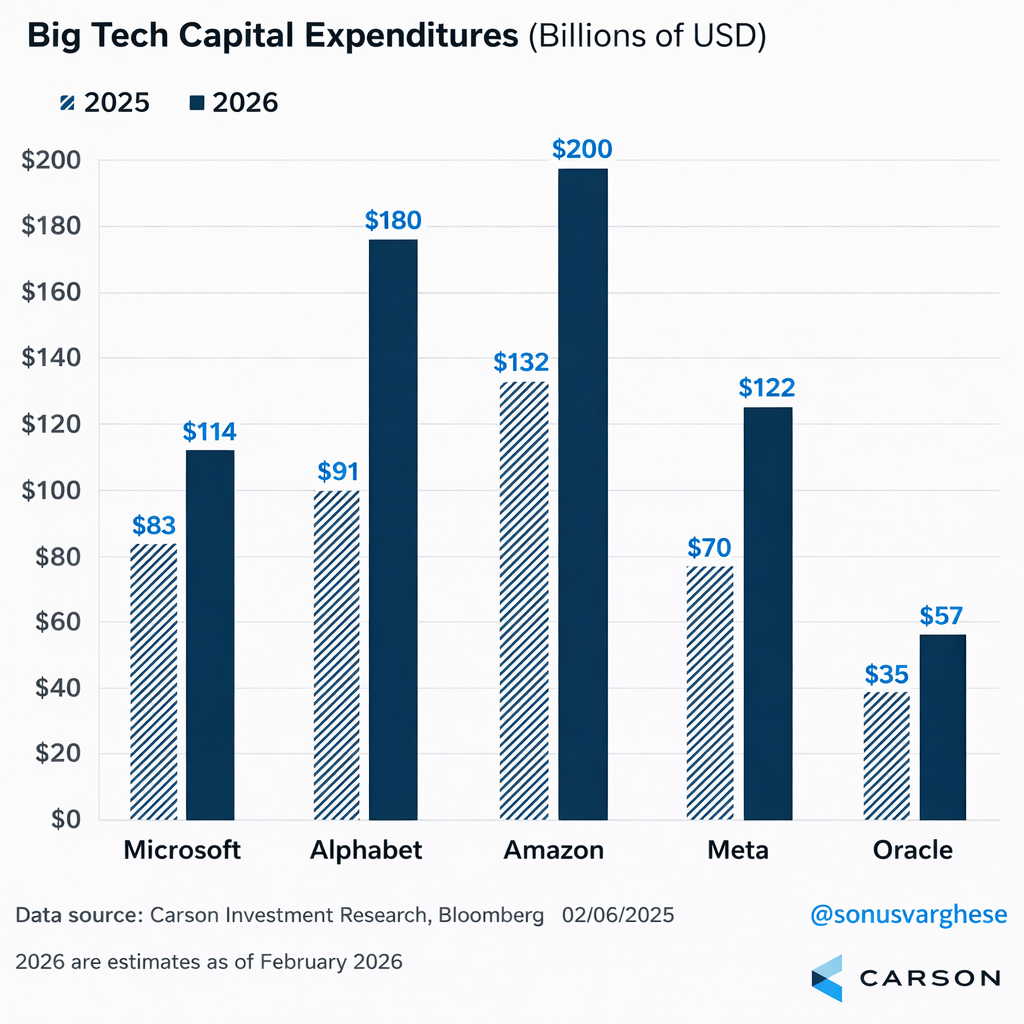
These same companies are committing that free cash flow towards capital expenditures to build out their artificial intelligence advantages, including data centers, semiconductors, infrastructure, model training, and more. The scale and projected spending increase over last year is significant:

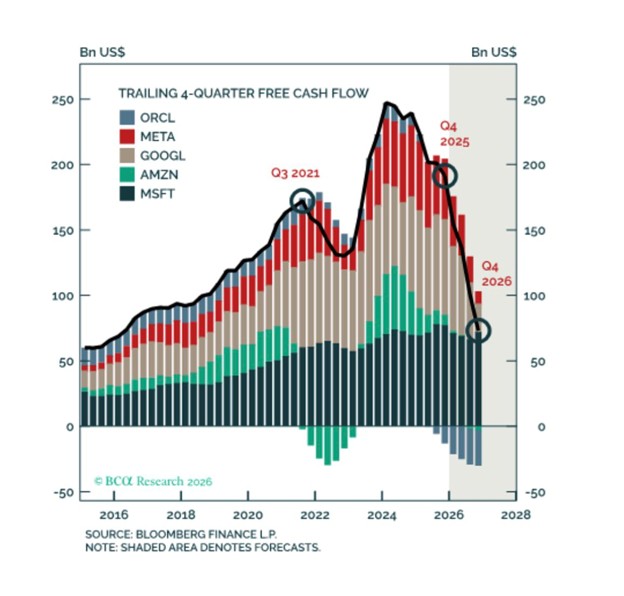
We don’t know what rate of return these investments will ultimately earn. We do know the surge in spending is projected to eat away at what made these companies so valuable over the last several years: near term free cash flow. The chart below depicts the impact of expected capital expenditure amounts on trailing free cash flow of these same companies:

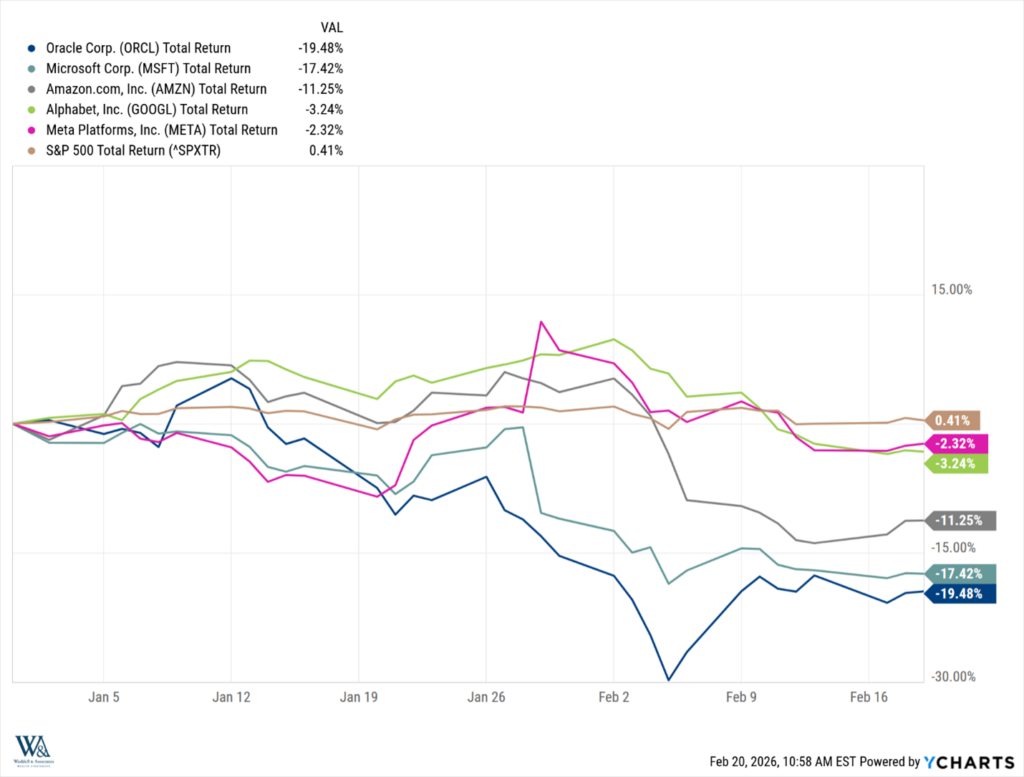
These forward estimates suggest net free cash flow declining 50% in just over a year. Meaningful. For years, ample free cash flow fueled aggressive share repurchase programs that offset dilution and improved shareholder value. But now, that free cash flow is being redirected and the market is taking notice. Below are the year-to-date returns of the same constituents reflecting investor recalibration as capital allocation priorities evolve amongst big tech.

A small sample size, yes. Earnings are still projected to grow significantly. It doesn’t represent a downshift in profitability, but it does represent a strategic decision which ultimately will improve, or erode, future shareholder value.

Apple, By Contrast

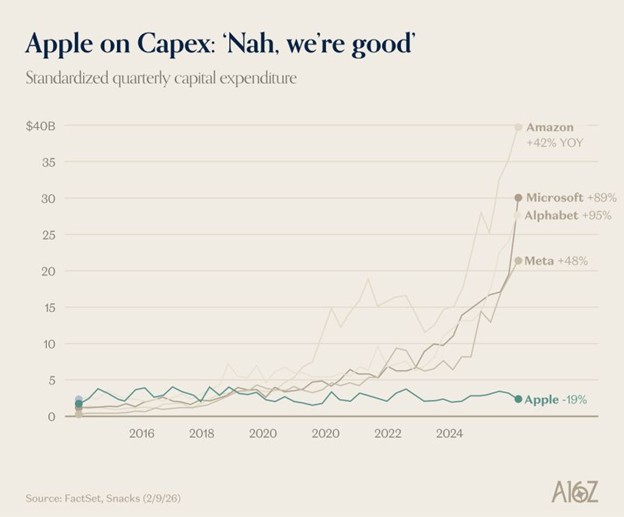
But not everyone is partaking in the spending spree. Apple has lagged its peers considerably in their growth (or lack thereof) in Capex spending, noted below.

This raises an important strategic question. Is Apple demonstrating discipline or risking a “Kodak Moment”? For context, Eastman Kodak famously chose not to adopt new digital photo technology, opting to stay in its profitable film photography lane. Digital photography ultimately won the technological cycle, and Kodak lost their competitive moat in film photography.

This technological inflection point will reward decisive and disciplined capital allocation, and we’ll look back on this someday with clear hindsight as to the winners and losers. Big tech has operated like a financial free bird generating excess cash far beyond their recent reinvestment needs. That era of surplus is transitioning into intentional investment in the artificial intelligence buildout. The question is no longer how much free cash flow these companies generate, but how effectively they allocate it, and what return that capital ultimately generates for investors!

Have a great week!

-Matt

Sources: Ycharts, BCA Research, Carson Investment Research, Factset, Andreessen Horowitz

This communication and its contents are for informational and educational purposes only and should not be used as the sole basis for any investment decision. The information contained herein is based on publicly available sources believed to be reliable but is not a representation, expressed or implied, as to the accuracy, completeness, or correctness of said information. References to political figures or policies are for informational purposes only and do not represent an endorsement by Waddell & Associates. Any forward-looking statements reflect current opinions and assumptions and are subject to change without notice; actual results may differ materially. Past performance does not guarantee future results. Waddell & Associates may use artificial intelligence tools to help generate or summarize content; all outputs are reviewed by our team for accuracy and relevance.

">
February 20, 2026
Congratulations to the US Women’s Hockey team for their stunning defeat of Team Canada in Thursday afternoon’s gold medal game. Electric!

Throughout the Olympic Games this year, every American hockey goal was followed by Lynyrd Skynyrd’s “Free Bird”, the official Team USA hockey goal song at the 2026 Winter Olympics in Milan-Cortina. A fitting choice, symbolic of our beloved bald eagle. The beauty of the ‘free bird’ is its ability to go where it wants, when it wants, unrestricted in choice. For the last several years, America’s largest technology companies have operated with similar freedom in the form of free cash flow; but that bird might be soon landing. Let’s explore.

Cash is King

Over the last several years, big tech has generated extraordinary amounts of free cash flow. What is that? In simple terms, it is the cash a company generates after operating expenses and capital expenditures. In plain English, its money left over that companies can re-deploy towards shareholder dividends, new capital ventures, share buybacks, and more. Free cash flow is what gives companies strategic flexibility on their financial futures. For big technology companies like Microsoft, Alphabet, Amazon, META, and Oracle, that flexibility has historically been enormous with trailing twelve-month free cash flow totaling a combined $200 billion. But that freedom is now being tested.

The AI Investment Surge

These same companies are committing that free cash flow towards capital expenditures to build out their artificial intelligence advantages, including data centers, semiconductors, infrastructure, model training, and more. The scale and projected spending increase over last year is significant:

We don’t know what rate of return these investments will ultimately earn. We do know the surge in spending is projected to eat away at what made these companies so valuable over the last several years: near term free cash flow. The chart below depicts the impact of expected capital expenditure amounts on trailing free cash flow of these same companies:

These forward estimates suggest net free cash flow declining 50% in just over a year. Meaningful. For years, ample free cash flow fueled aggressive share repurchase programs that offset dilution and improved shareholder value. But now, that free cash flow is being redirected and the market is taking notice. Below are the year-to-date returns of the same constituents reflecting investor recalibration as capital allocation priorities evolve amongst big tech.

A small sample size, yes. Earnings are still projected to grow significantly. It doesn’t represent a downshift in profitability, but it does represent a strategic decision which ultimately will improve, or erode, future shareholder value.

Apple, By Contrast

But not everyone is partaking in the spending spree. Apple has lagged its peers considerably in their growth (or lack thereof) in Capex spending, noted below.

This raises an important strategic question. Is Apple demonstrating discipline or risking a “Kodak Moment”? For context, Eastman Kodak famously chose not to adopt new digital photo technology, opting to stay in its profitable film photography lane. Digital photography ultimately won the technological cycle, and Kodak lost their competitive moat in film photography.

This technological inflection point will reward decisive and disciplined capital allocation, and we’ll look back on this someday with clear hindsight as to the winners and losers. Big tech has operated like a financial free bird generating excess cash far beyond their recent reinvestment needs. That era of surplus is transitioning into intentional investment in the artificial intelligence buildout. The question is no longer how much free cash flow these companies generate, but how effectively they allocate it, and what return that capital ultimately generates for investors!

Have a great week!

-Matt

Sources: Ycharts, BCA Research, Carson Investment Research, Factset, Andreessen Horowitz

This communication and its contents are for informational and educational purposes only and should not be used as the sole basis for any investment decision. The information contained herein is based on publicly available sources believed to be reliable but is not a representation, expressed or implied, as to the accuracy, completeness, or correctness of said information. References to political figures or policies are for informational purposes only and do not represent an endorsement by Waddell & Associates. Any forward-looking statements reflect current opinions and assumptions and are subject to change without notice; actual results may differ materially. Past performance does not guarantee future results. Waddell & Associates may use artificial intelligence tools to help generate or summarize content; all outputs are reviewed by our team for accuracy and relevance.

">Free Bird!
Congratulations to the US Women’s Hockey team for their stunning defeat of Team Canada in Thursday afternoon’s gold medal game. Electric!

Throughout the Olympic Games this year, every American hockey goal was followed by Lynyrd Skynyrd’s “Free Bird”, the official Team USA hockey goal song at the 2026 Winter Olympics in Milan-Cortina. A fitting choice, symbolic of our beloved bald eagle. The beauty of the ‘free bird’ is its ability to go where it wants, when it wants, unrestricted in choice. For the last several years, America’s largest technology companies have operated with similar freedom in the form of free cash flow; but that bird might be soon landing. Let’s explore.

Cash is King

Over the last several years, big tech has generated extraordinary amounts of free cash flow. What is that? In simple terms, it is the cash a company generates after operating expenses and capital expenditures. In plain English, its money left over that companies can re-deploy towards shareholder dividends, new capital ventures, share buybacks, and more. Free cash flow is what gives companies strategic flexibility on their financial futures. For big technology companies like Microsoft, Alphabet, Amazon, META, and Oracle, that flexibility has historically been enormous with trailing twelve-month free cash flow totaling a combined $200 billion. But that freedom is now being tested.

The AI Investment Surge

These same companies are committing that free cash flow towards capital expenditures to build out their artificial intelligence advantages, including data centers, semiconductors, infrastructure, model training, and more. The scale and projected spending increase over last year is significant:

We don’t know what rate of return these investments will ultimately earn. We do know the surge in spending is projected to eat away at what made these companies so valuable over the last several years: near term free cash flow. The chart below depicts the impact of expected capital expenditure amounts on trailing free cash flow of these same companies:

These forward estimates suggest net free cash flow declining 50% in just over a year. Meaningful. For years, ample free cash flow fueled aggressive share repurchase programs that offset dilution and improved shareholder value. But now, that free cash flow is being redirected and the market is taking notice. Below are the year-to-date returns of the same constituents reflecting investor recalibration as capital allocation priorities evolve amongst big tech.

A small sample size, yes. Earnings are still projected to grow significantly. It doesn’t represent a downshift in profitability, but it does represent a strategic decision which ultimately will improve, or erode, future shareholder value.

Apple, By Contrast

But not everyone is partaking in the spending spree. Apple has lagged its peers considerably in their growth (or lack thereof) in Capex spending, noted below.

This raises an important strategic question. Is Apple demonstrating discipline or risking a “Kodak Moment”? For context, Eastman Kodak famously chose not to adopt new digital photo technology, opting to stay in its profitable film photography lane. Digital photography ultimately won the technological cycle, and Kodak lost their competitive moat in film photography.

This technological inflection point will reward decisive and disciplined capital allocation, and we’ll look back on this someday with clear hindsight as to the winners and losers. Big tech has operated like a financial free bird generating excess cash far beyond their recent reinvestment needs. That era of surplus is transitioning into intentional investment in the artificial intelligence buildout. The question is no longer how much free cash flow these companies generate, but how effectively they allocate it, and what return that capital ultimately generates for investors!

Have a great week!

-Matt

Sources: Ycharts, BCA Research, Carson Investment Research, Factset, Andreessen Horowitz

This communication and its contents are for informational and educational purposes only and should not be used as the sole basis for any investment decision. The information contained herein is based on publicly available sources believed to be reliable but is not a representation, expressed or implied, as to the accuracy, completeness, or correctness of said information. References to political figures or policies are for informational purposes only and do not represent an endorsement by Waddell & Associates. Any forward-looking statements reflect current opinions and assumptions and are subject to change without notice; actual results may differ materially. Past performance does not guarantee future results. Waddell & Associates may use artificial intelligence tools to help generate or summarize content; all outputs are reviewed by our team for accuracy and relevance.

" class="link-chevron"> Watch Now
W&A clients will soon see confirmations of two rotational trades within our equity portfolios that better align portfolios with our 2026 Outlook (register for our live webinar here). While the SEC will not let us discuss specific trade details within this format, we can discuss general strategic decisions. For more insight and information on the specific transactions, feel free to call your W&A advisor.

Emerging Markets Rotation

We have always approached the emerging markets with a value bias, seeing exposure to the segment as growthy enough. Small cap emerging market names can provide additional downside insurance as they trade far less frequently than their larger cap peers, leading to less performance volatility driven by low conviction capital volatility. In uncertain periods we will hold small cap exposure to avoid capital whipsaws. Unfortunately, just as the low trading volumes limit selling pressure, low trading volumes also limit buying pressure. With conviction growing in the durability of emerging market outperformance, after twenty years of underperformance, we have chosen to swap our emerging markets small cap passive position for a larger cap active position that will benefit more from incoming capital flows. Our selected manager prioritizes dividend paying companies, maintaining our quality bias, while also aligning with our “prove it” financial bias at this point in the cycle. Consider the following factors supporting our Emerging Market exposure:

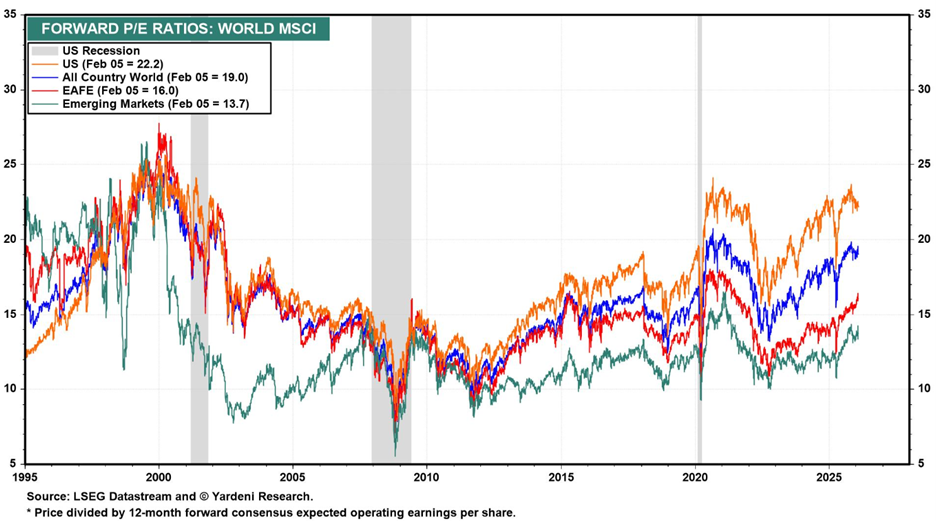
  1. Note the valuation differential when comparing the Emerging Market stock market index with other world indices:

The emerging market complex trades at 13.7x forward earnings within the midpoint of its historical range, while the US trades at 22x, near the top of its historical range.

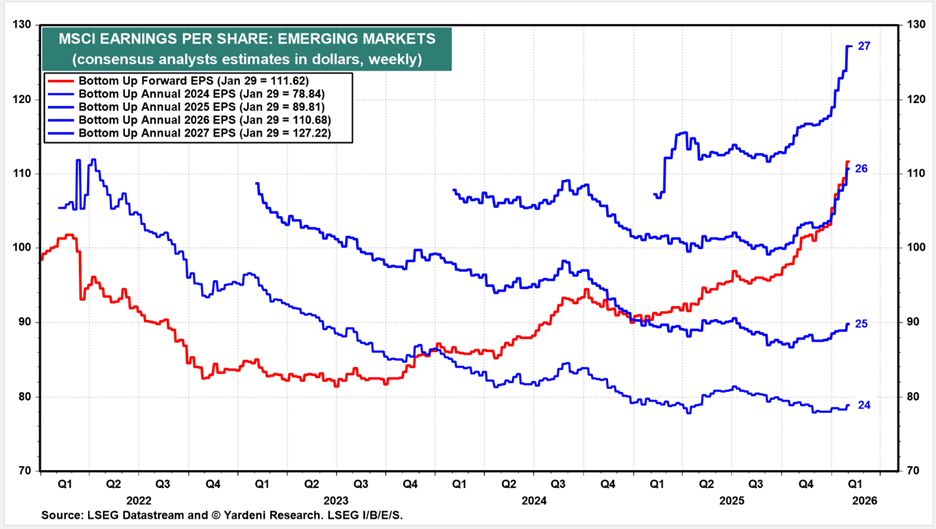
2. Consider the earnings momentum that “Re-globalization”, technological adoption, and voracious demand for materials and components have unlocked:

While analysts expect US earnings to grow 15% and 16% in 2026 and 2027 respectively, they forecast 23% and 15% earnings growth within Emerging Markets.

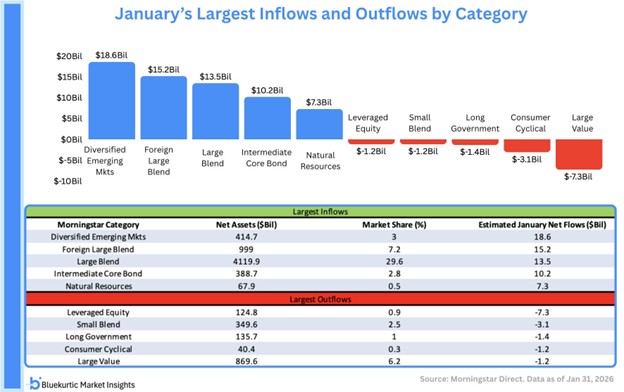
3. Consider money flows into Emerging Markets from January alone:

How long can these catalytic money flows persist? Lower valuations and improving earnings momentum paired with Mag-7 fatigue and institutional under allocation to the asset class could fuel relative outperformance for years. 

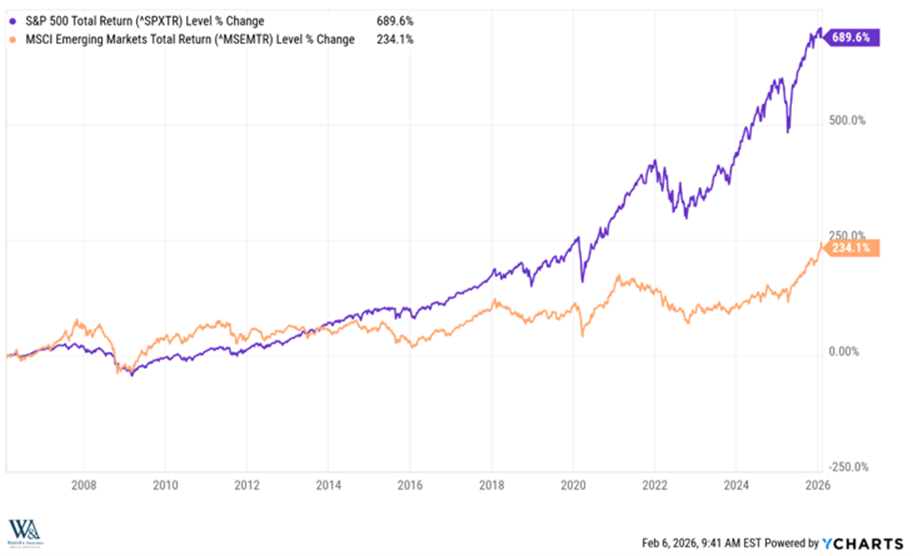
4. Consider the last twenty years of relative underperformance and the spread available for recapture:

In this year alone, the Emerging Markets index has advanced 7% while the S&P 500 has declined 1%. Last year, the Emerging Markets index outperformed the S&P 500 by 16.5%. Relative performance ebbs and flows, but after two decades of neglect, the revival of the Emerging Markets seems well overdue and fundamentally defensible.

Large Value Rotation

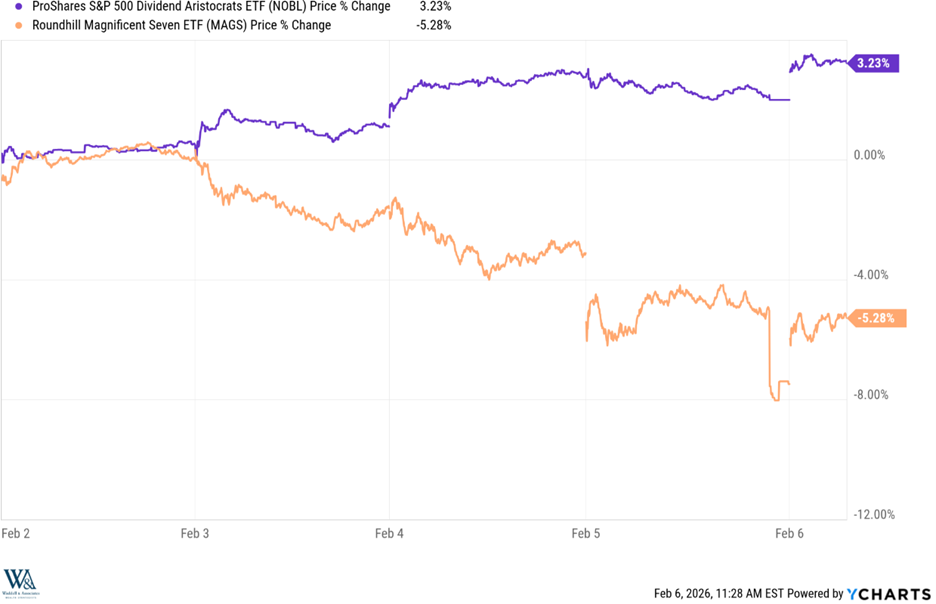
Over the past week, panic attacks incited by fears of AI capex overallocation, infighting among the Mag 7, and the threat of AI agents cannibalizing the software sector created dramatic deleveraging and a flight to quality within the markets. Consider the performance divergence between the Mag-7 complex and the S&P 500 Dividend Aristocrats index over the past week alone:

It’s highly unusual to see an 8% performance spread between such large weightings over a short amount of time, but it validates our thinking. While AI deployment will benefit some technology providers, it will benefit all who utilize it. Therefore, while the tech sector becomes more capital intensive to produce AI, traditionally capital-intensive businesses will become less capital intensive through utilizing AI. Additionally, the historic capex cycle we find ourselves in building out virtual AI, and ultimately physical AI, will require all forms of financing, including massive debt issuance. Much of this bloat can hide in circular financing structures and private debt markets, making investors unsure of true creditworthiness within the marketplace. This reveals the Achilles’ heel for this fast-paced economic cycle. While we are not concerned about an imminent credit event, we are attuned to rising investor skittishness as displayed last week. This drives part of our decision to rotate out of an agnostic deep value manager into another more dividend focused manager, finding comfort in the “prove it” attributes of tangible cash distributions. We expect to see more dividend payer appetite as the debt cycle enlarges, which means more demand, and higher prices for dividend centric strategies.     

When Trump won the election in November, the US dollar strengthened. In theory, the orderly deployment of a tariff agenda should increase exports (purchases of dollars) and decrease imports (sales of dollars), supporting currency strength. In recognition, we repatriated a portion of our international exposure to avoid potential currency drag. 

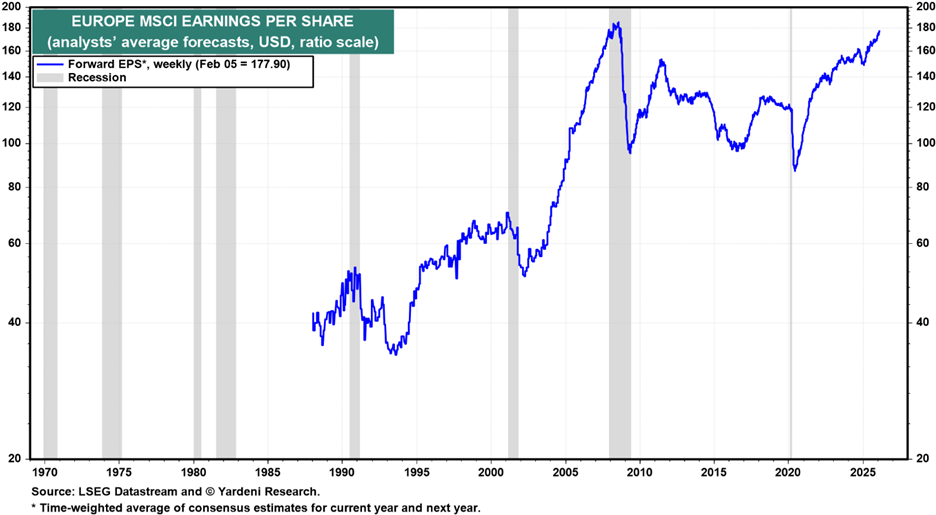
Trump’s tariff agenda was anything but orderly, overriding the economics and inciting dollar debasement benefiting Gold, Silver, etc. With Kevin Warsh’s appointment, we have less clarity on the dollar’s direction, but we do see Europe starting to consider economic growth as national security in a disorderly political environment. Increased military spending, fiscal deficit expansion, resumption of energy production, and whispers of deregulation should lift profit margins and earnings. We already see this in rising earnings expectations across Europe:

The combination of “prove it” cash flows and additional developed world international exposure informed our search and selection of a new value focused large cap manager screening for high free cash flows and juicy dividends, worldwide.

Fortunately, the remainder of our holdings properly calibrate with our worldview, which we will reveal next Thursday. Position changes from here will likely be situational (tax trades) rather than strategic, unless our worldview changes significantly. Remember, history shows a clear inverse relationship between frequent trading and investment returns!

Have a great week!

-David

Sources: Yardeni Research

This communication and its contents are for informational and educational purposes only and should not be used as the sole basis for any investment decision. The information contained herein is based on publicly available sources believed to be reliable but is not a representation, expressed or implied, as to the accuracy, completeness, or correctness of said information. References to political figures or policies are for informational purposes only and do not represent an endorsement by Waddell & Associates. Any forward-looking statements reflect current opinions and assumptions and are subject to change without notice; actual results may differ materially. Past performance does not guarantee future results. Waddell & Associates may use artificial intelligence tools to help generate or summarize content; all outputs are reviewed by our team for accuracy and relevance.

">
February 7, 2026
W&A clients will soon see confirmations of two rotational trades within our equity portfolios that better align portfolios with our 2026 Outlook (register for our live webinar here). While the SEC will not let us discuss specific trade details within this format, we can discuss general strategic decisions. For more insight and information on the specific transactions, feel free to call your W&A advisor.

Emerging Markets Rotation

We have always approached the emerging markets with a value bias, seeing exposure to the segment as growthy enough. Small cap emerging market names can provide additional downside insurance as they trade far less frequently than their larger cap peers, leading to less performance volatility driven by low conviction capital volatility. In uncertain periods we will hold small cap exposure to avoid capital whipsaws. Unfortunately, just as the low trading volumes limit selling pressure, low trading volumes also limit buying pressure. With conviction growing in the durability of emerging market outperformance, after twenty years of underperformance, we have chosen to swap our emerging markets small cap passive position for a larger cap active position that will benefit more from incoming capital flows. Our selected manager prioritizes dividend paying companies, maintaining our quality bias, while also aligning with our “prove it” financial bias at this point in the cycle. Consider the following factors supporting our Emerging Market exposure:

  1. Note the valuation differential when comparing the Emerging Market stock market index with other world indices:

The emerging market complex trades at 13.7x forward earnings within the midpoint of its historical range, while the US trades at 22x, near the top of its historical range.

2. Consider the earnings momentum that “Re-globalization”, technological adoption, and voracious demand for materials and components have unlocked:

While analysts expect US earnings to grow 15% and 16% in 2026 and 2027 respectively, they forecast 23% and 15% earnings growth within Emerging Markets.

3. Consider money flows into Emerging Markets from January alone:

How long can these catalytic money flows persist? Lower valuations and improving earnings momentum paired with Mag-7 fatigue and institutional under allocation to the asset class could fuel relative outperformance for years. 

4. Consider the last twenty years of relative underperformance and the spread available for recapture:

In this year alone, the Emerging Markets index has advanced 7% while the S&P 500 has declined 1%. Last year, the Emerging Markets index outperformed the S&P 500 by 16.5%. Relative performance ebbs and flows, but after two decades of neglect, the revival of the Emerging Markets seems well overdue and fundamentally defensible.

Large Value Rotation

Over the past week, panic attacks incited by fears of AI capex overallocation, infighting among the Mag 7, and the threat of AI agents cannibalizing the software sector created dramatic deleveraging and a flight to quality within the markets. Consider the performance divergence between the Mag-7 complex and the S&P 500 Dividend Aristocrats index over the past week alone:

It’s highly unusual to see an 8% performance spread between such large weightings over a short amount of time, but it validates our thinking. While AI deployment will benefit some technology providers, it will benefit all who utilize it. Therefore, while the tech sector becomes more capital intensive to produce AI, traditionally capital-intensive businesses will become less capital intensive through utilizing AI. Additionally, the historic capex cycle we find ourselves in building out virtual AI, and ultimately physical AI, will require all forms of financing, including massive debt issuance. Much of this bloat can hide in circular financing structures and private debt markets, making investors unsure of true creditworthiness within the marketplace. This reveals the Achilles’ heel for this fast-paced economic cycle. While we are not concerned about an imminent credit event, we are attuned to rising investor skittishness as displayed last week. This drives part of our decision to rotate out of an agnostic deep value manager into another more dividend focused manager, finding comfort in the “prove it” attributes of tangible cash distributions. We expect to see more dividend payer appetite as the debt cycle enlarges, which means more demand, and higher prices for dividend centric strategies.     

When Trump won the election in November, the US dollar strengthened. In theory, the orderly deployment of a tariff agenda should increase exports (purchases of dollars) and decrease imports (sales of dollars), supporting currency strength. In recognition, we repatriated a portion of our international exposure to avoid potential currency drag. 

Trump’s tariff agenda was anything but orderly, overriding the economics and inciting dollar debasement benefiting Gold, Silver, etc. With Kevin Warsh’s appointment, we have less clarity on the dollar’s direction, but we do see Europe starting to consider economic growth as national security in a disorderly political environment. Increased military spending, fiscal deficit expansion, resumption of energy production, and whispers of deregulation should lift profit margins and earnings. We already see this in rising earnings expectations across Europe:

The combination of “prove it” cash flows and additional developed world international exposure informed our search and selection of a new value focused large cap manager screening for high free cash flows and juicy dividends, worldwide.

Fortunately, the remainder of our holdings properly calibrate with our worldview, which we will reveal next Thursday. Position changes from here will likely be situational (tax trades) rather than strategic, unless our worldview changes significantly. Remember, history shows a clear inverse relationship between frequent trading and investment returns!

Have a great week!

-David

Sources: Yardeni Research

This communication and its contents are for informational and educational purposes only and should not be used as the sole basis for any investment decision. The information contained herein is based on publicly available sources believed to be reliable but is not a representation, expressed or implied, as to the accuracy, completeness, or correctness of said information. References to political figures or policies are for informational purposes only and do not represent an endorsement by Waddell & Associates. Any forward-looking statements reflect current opinions and assumptions and are subject to change without notice; actual results may differ materially. Past performance does not guarantee future results. Waddell & Associates may use artificial intelligence tools to help generate or summarize content; all outputs are reviewed by our team for accuracy and relevance.

">Trade Alerts! W&A clients will soon see confirmations of two rotational trades within our equity portfolios that better align portfolios with our 2026 Outlook (register for our live webinar here). While the SEC will not let us discuss specific trade details within this format, we can discuss general strategic decisions. For more insight and information on the specific transactions, feel free to call your W&A advisor.

Emerging Markets Rotation

We have always approached the emerging markets with a value bias, seeing exposure to the segment as growthy enough. Small cap emerging market names can provide additional downside insurance as they trade far less frequently than their larger cap peers, leading to less performance volatility driven by low conviction capital volatility. In uncertain periods we will hold small cap exposure to avoid capital whipsaws. Unfortunately, just as the low trading volumes limit selling pressure, low trading volumes also limit buying pressure. With conviction growing in the durability of emerging market outperformance, after twenty years of underperformance, we have chosen to swap our emerging markets small cap passive position for a larger cap active position that will benefit more from incoming capital flows. Our selected manager prioritizes dividend paying companies, maintaining our quality bias, while also aligning with our “prove it” financial bias at this point in the cycle. Consider the following factors supporting our Emerging Market exposure:

  1. Note the valuation differential when comparing the Emerging Market stock market index with other world indices:

The emerging market complex trades at 13.7x forward earnings within the midpoint of its historical range, while the US trades at 22x, near the top of its historical range.

2. Consider the earnings momentum that “Re-globalization”, technological adoption, and voracious demand for materials and components have unlocked:

While analysts expect US earnings to grow 15% and 16% in 2026 and 2027 respectively, they forecast 23% and 15% earnings growth within Emerging Markets.

3. Consider money flows into Emerging Markets from January alone:

How long can these catalytic money flows persist? Lower valuations and improving earnings momentum paired with Mag-7 fatigue and institutional under allocation to the asset class could fuel relative outperformance for years. 

4. Consider the last twenty years of relative underperformance and the spread available for recapture:

In this year alone, the Emerging Markets index has advanced 7% while the S&P 500 has declined 1%. Last year, the Emerging Markets index outperformed the S&P 500 by 16.5%. Relative performance ebbs and flows, but after two decades of neglect, the revival of the Emerging Markets seems well overdue and fundamentally defensible.

Large Value Rotation

Over the past week, panic attacks incited by fears of AI capex overallocation, infighting among the Mag 7, and the threat of AI agents cannibalizing the software sector created dramatic deleveraging and a flight to quality within the markets. Consider the performance divergence between the Mag-7 complex and the S&P 500 Dividend Aristocrats index over the past week alone:

It’s highly unusual to see an 8% performance spread between such large weightings over a short amount of time, but it validates our thinking. While AI deployment will benefit some technology providers, it will benefit all who utilize it. Therefore, while the tech sector becomes more capital intensive to produce AI, traditionally capital-intensive businesses will become less capital intensive through utilizing AI. Additionally, the historic capex cycle we find ourselves in building out virtual AI, and ultimately physical AI, will require all forms of financing, including massive debt issuance. Much of this bloat can hide in circular financing structures and private debt markets, making investors unsure of true creditworthiness within the marketplace. This reveals the Achilles’ heel for this fast-paced economic cycle. While we are not concerned about an imminent credit event, we are attuned to rising investor skittishness as displayed last week. This drives part of our decision to rotate out of an agnostic deep value manager into another more dividend focused manager, finding comfort in the “prove it” attributes of tangible cash distributions. We expect to see more dividend payer appetite as the debt cycle enlarges, which means more demand, and higher prices for dividend centric strategies.     

When Trump won the election in November, the US dollar strengthened. In theory, the orderly deployment of a tariff agenda should increase exports (purchases of dollars) and decrease imports (sales of dollars), supporting currency strength. In recognition, we repatriated a portion of our international exposure to avoid potential currency drag. 

Trump’s tariff agenda was anything but orderly, overriding the economics and inciting dollar debasement benefiting Gold, Silver, etc. With Kevin Warsh’s appointment, we have less clarity on the dollar’s direction, but we do see Europe starting to consider economic growth as national security in a disorderly political environment. Increased military spending, fiscal deficit expansion, resumption of energy production, and whispers of deregulation should lift profit margins and earnings. We already see this in rising earnings expectations across Europe:

The combination of “prove it” cash flows and additional developed world international exposure informed our search and selection of a new value focused large cap manager screening for high free cash flows and juicy dividends, worldwide.

Fortunately, the remainder of our holdings properly calibrate with our worldview, which we will reveal next Thursday. Position changes from here will likely be situational (tax trades) rather than strategic, unless our worldview changes significantly. Remember, history shows a clear inverse relationship between frequent trading and investment returns!

Have a great week!

-David

Sources: Yardeni Research

This communication and its contents are for informational and educational purposes only and should not be used as the sole basis for any investment decision. The information contained herein is based on publicly available sources believed to be reliable but is not a representation, expressed or implied, as to the accuracy, completeness, or correctness of said information. References to political figures or policies are for informational purposes only and do not represent an endorsement by Waddell & Associates. Any forward-looking statements reflect current opinions and assumptions and are subject to change without notice; actual results may differ materially. Past performance does not guarantee future results. Waddell & Associates may use artificial intelligence tools to help generate or summarize content; all outputs are reviewed by our team for accuracy and relevance.

" class="link-chevron"> Watch Now
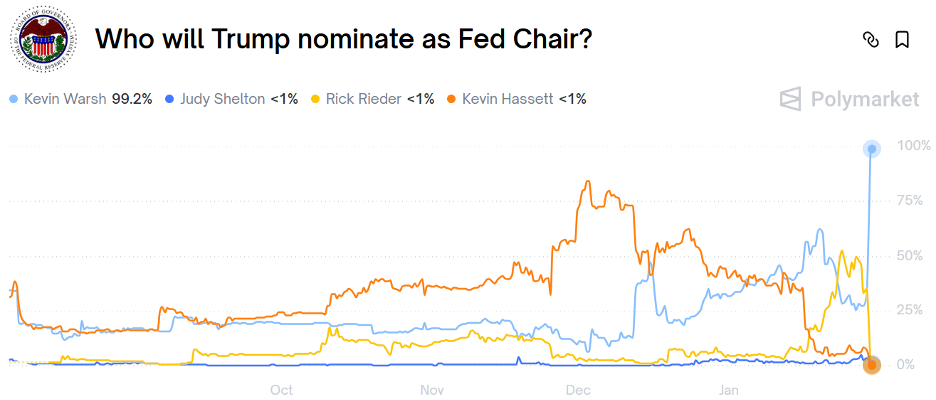
Chart showing belief about who Trump will nominate as Fed Chair over the months

Fifteen months of speculation have now ended. Donald Trump has nominated Kevin Warsh as the 17th Chairman of the Federal Reserve. Warsh has pedigree credentials with degrees from Stanford, Harvard, and MIT. He began his career as a Wall Street investment banker before transferring to K Street as an economic policy advisor under President Bush. In 2006, he became the youngest person ever appointed to the Federal Reserve Board of Governors at age 35 and played an active role during the Great Financial Crisis as an emissary between policy makers and market participants.

Following his tenure at the Fed, he lectured at Stanford’s business school, invested alongside Stan Druckenmiller within his family office, and maintained policy influence within the Congressional Budget Office. He also managed to marry Jane Lauder, the heiress to the Estée Lauder fortune. Kevin has built an impressive career with exceptional accomplishments within both the public and private domains.

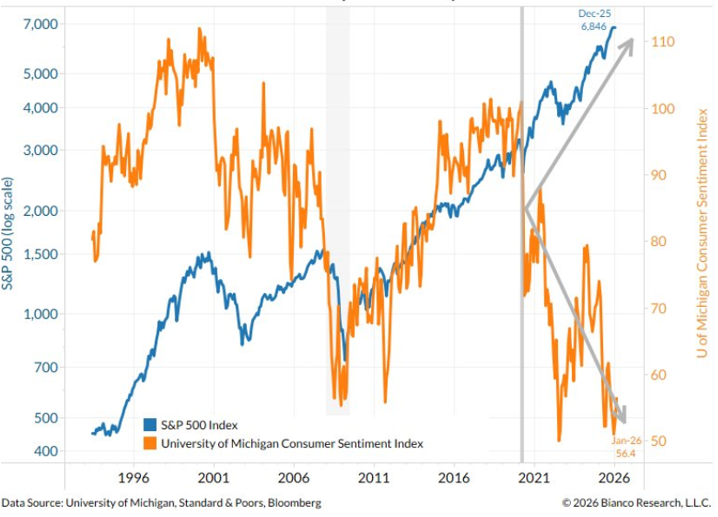
Interestingly, Kevin trailed in the prediction markets for most of the campaign cycle, largely because he seemed the least sycophantic and least dovish of the potential nominees. Why would Trump choose a more hawkish candidate? That’s the right question to ask and only Donald knows why Donald does, but I will offer my best guess: Trump’s biggest issue is not economic growth. The economy has grown substantially since Trump took office—and markets trade near all-time highs—yet consumer sentiment languishes near record lows as seen in the chart below:

Chart showing S&P 500 index vs consumer sentiment over the years

Although Trump’s policies have boosted economic and wealth creation, they have not relieved inflation agitations. Consumer prices stand 27% higher today than pre-COVID levels. Inflation rates have drifted lower, but remain well above the Fed’s 2% target.

While Chairman-to-Be Warsh appears to favor lower interest rates, he also favors shrinking the Fed’s balance sheet, philosophically blaming quantitative easing policies for the post-Covid inflation, not lower rate policies. Therefore, Warsh believes that the Fed can lower interest rates without raising inflation. If he is right, his policy combo of lowering rates while tightening money supply could provide lower rates, lower inflation, and perhaps—most importantly to Trump—happier voters! 

Trump’s nomination still requires Senate confirmation. Warsh will not simply replace Powell, as Powell has three years remaining on the board post-Chairmanship and has not yet indicated whether he intends to step down or not. Therefore, to attain a seat on the board, Warsh must apply for Stephen Miran’s seat as well as the Chairman’s role. This makes the process a little clumsier, but we expect Powell will retire and Warsh will attain Senate confirmation.

Overall, we view this as a solid choice that de-risks the politicization of the Fed and increases the odds of supportive rate cuts while also lowering the threat of re-inflation. Markets clearly agree, as the US Dollar rallied nearly 1% following the announcement, and safe-haven metals tarnished substantially.

Markets will test Kevin in the months to come, as they always do, but he’s battle-hardened and resilient. While Trump’s tactics often destabilize, his appointment of Kevin Warsh should provide bankable stability at the Fed.

Enjoy your week!

-David

Sources: Bianco Research, Polymarket

This communication and its contents are for informational and educational purposes only and should not be used as the sole basis for any investment decision. The information contained herein is based on publicly available sources believed to be reliable but is not a representation, expressed or implied, as to the accuracy, completeness, or correctness of said information. References to political figures or policies are for informational purposes only and do not represent an endorsement by Waddell & Associates. Any forward-looking statements reflect current opinions and assumptions and are subject to change without notice; actual results may differ materially. Past performance does not guarantee future results. Waddell & Associates may use artificial intelligence tools to help generate or summarize content; all outputs are reviewed by our team for accuracy and relevance.

">
February 1, 2026
Chart showing belief about who Trump will nominate as Fed Chair over the months

Fifteen months of speculation have now ended. Donald Trump has nominated Kevin Warsh as the 17th Chairman of the Federal Reserve. Warsh has pedigree credentials with degrees from Stanford, Harvard, and MIT. He began his career as a Wall Street investment banker before transferring to K Street as an economic policy advisor under President Bush. In 2006, he became the youngest person ever appointed to the Federal Reserve Board of Governors at age 35 and played an active role during the Great Financial Crisis as an emissary between policy makers and market participants.

Following his tenure at the Fed, he lectured at Stanford’s business school, invested alongside Stan Druckenmiller within his family office, and maintained policy influence within the Congressional Budget Office. He also managed to marry Jane Lauder, the heiress to the Estée Lauder fortune. Kevin has built an impressive career with exceptional accomplishments within both the public and private domains.

Interestingly, Kevin trailed in the prediction markets for most of the campaign cycle, largely because he seemed the least sycophantic and least dovish of the potential nominees. Why would Trump choose a more hawkish candidate? That’s the right question to ask and only Donald knows why Donald does, but I will offer my best guess: Trump’s biggest issue is not economic growth. The economy has grown substantially since Trump took office—and markets trade near all-time highs—yet consumer sentiment languishes near record lows as seen in the chart below:

Chart showing S&P 500 index vs consumer sentiment over the years

Although Trump’s policies have boosted economic and wealth creation, they have not relieved inflation agitations. Consumer prices stand 27% higher today than pre-COVID levels. Inflation rates have drifted lower, but remain well above the Fed’s 2% target.

While Chairman-to-Be Warsh appears to favor lower interest rates, he also favors shrinking the Fed’s balance sheet, philosophically blaming quantitative easing policies for the post-Covid inflation, not lower rate policies. Therefore, Warsh believes that the Fed can lower interest rates without raising inflation. If he is right, his policy combo of lowering rates while tightening money supply could provide lower rates, lower inflation, and perhaps—most importantly to Trump—happier voters! 

Trump’s nomination still requires Senate confirmation. Warsh will not simply replace Powell, as Powell has three years remaining on the board post-Chairmanship and has not yet indicated whether he intends to step down or not. Therefore, to attain a seat on the board, Warsh must apply for Stephen Miran’s seat as well as the Chairman’s role. This makes the process a little clumsier, but we expect Powell will retire and Warsh will attain Senate confirmation.

Overall, we view this as a solid choice that de-risks the politicization of the Fed and increases the odds of supportive rate cuts while also lowering the threat of re-inflation. Markets clearly agree, as the US Dollar rallied nearly 1% following the announcement, and safe-haven metals tarnished substantially.

Markets will test Kevin in the months to come, as they always do, but he’s battle-hardened and resilient. While Trump’s tactics often destabilize, his appointment of Kevin Warsh should provide bankable stability at the Fed.

Enjoy your week!

-David

Sources: Bianco Research, Polymarket

This communication and its contents are for informational and educational purposes only and should not be used as the sole basis for any investment decision. The information contained herein is based on publicly available sources believed to be reliable but is not a representation, expressed or implied, as to the accuracy, completeness, or correctness of said information. References to political figures or policies are for informational purposes only and do not represent an endorsement by Waddell & Associates. Any forward-looking statements reflect current opinions and assumptions and are subject to change without notice; actual results may differ materially. Past performance does not guarantee future results. Waddell & Associates may use artificial intelligence tools to help generate or summarize content; all outputs are reviewed by our team for accuracy and relevance.

">Meet the New Fed Head
Chart showing belief about who Trump will nominate as Fed Chair over the months

Fifteen months of speculation have now ended. Donald Trump has nominated Kevin Warsh as the 17th Chairman of the Federal Reserve. Warsh has pedigree credentials with degrees from Stanford, Harvard, and MIT. He began his career as a Wall Street investment banker before transferring to K Street as an economic policy advisor under President Bush. In 2006, he became the youngest person ever appointed to the Federal Reserve Board of Governors at age 35 and played an active role during the Great Financial Crisis as an emissary between policy makers and market participants.

Following his tenure at the Fed, he lectured at Stanford’s business school, invested alongside Stan Druckenmiller within his family office, and maintained policy influence within the Congressional Budget Office. He also managed to marry Jane Lauder, the heiress to the Estée Lauder fortune. Kevin has built an impressive career with exceptional accomplishments within both the public and private domains.

Interestingly, Kevin trailed in the prediction markets for most of the campaign cycle, largely because he seemed the least sycophantic and least dovish of the potential nominees. Why would Trump choose a more hawkish candidate? That’s the right question to ask and only Donald knows why Donald does, but I will offer my best guess: Trump’s biggest issue is not economic growth. The economy has grown substantially since Trump took office—and markets trade near all-time highs—yet consumer sentiment languishes near record lows as seen in the chart below:

Chart showing S&P 500 index vs consumer sentiment over the years

Although Trump’s policies have boosted economic and wealth creation, they have not relieved inflation agitations. Consumer prices stand 27% higher today than pre-COVID levels. Inflation rates have drifted lower, but remain well above the Fed’s 2% target.

While Chairman-to-Be Warsh appears to favor lower interest rates, he also favors shrinking the Fed’s balance sheet, philosophically blaming quantitative easing policies for the post-Covid inflation, not lower rate policies. Therefore, Warsh believes that the Fed can lower interest rates without raising inflation. If he is right, his policy combo of lowering rates while tightening money supply could provide lower rates, lower inflation, and perhaps—most importantly to Trump—happier voters! 

Trump’s nomination still requires Senate confirmation. Warsh will not simply replace Powell, as Powell has three years remaining on the board post-Chairmanship and has not yet indicated whether he intends to step down or not. Therefore, to attain a seat on the board, Warsh must apply for Stephen Miran’s seat as well as the Chairman’s role. This makes the process a little clumsier, but we expect Powell will retire and Warsh will attain Senate confirmation.

Overall, we view this as a solid choice that de-risks the politicization of the Fed and increases the odds of supportive rate cuts while also lowering the threat of re-inflation. Markets clearly agree, as the US Dollar rallied nearly 1% following the announcement, and safe-haven metals tarnished substantially.

Markets will test Kevin in the months to come, as they always do, but he’s battle-hardened and resilient. While Trump’s tactics often destabilize, his appointment of Kevin Warsh should provide bankable stability at the Fed.

Enjoy your week!

-David

Sources: Bianco Research, Polymarket

This communication and its contents are for informational and educational purposes only and should not be used as the sole basis for any investment decision. The information contained herein is based on publicly available sources believed to be reliable but is not a representation, expressed or implied, as to the accuracy, completeness, or correctness of said information. References to political figures or policies are for informational purposes only and do not represent an endorsement by Waddell & Associates. Any forward-looking statements reflect current opinions and assumptions and are subject to change without notice; actual results may differ materially. Past performance does not guarantee future results. Waddell & Associates may use artificial intelligence tools to help generate or summarize content; all outputs are reviewed by our team for accuracy and relevance.

" class="link-chevron"> Watch Now
The Indiana Hoosiers are national champions… in football. Yes, that Indiana. If I woke up with my head sewn to the carpet, I wouldn’t be more surprised than I am typing that sentence today. Congratulations to Hoosier Nation!

Indiana’s improbable run didn’t just produce a trophy, it produced a handful of quips from head coach Curt Cignetti that resonated beyond football. Over the past few weeks, Cignetti’s mindset, priorities, and emphasis on process and fundamentals have stuck with me because they apply just as directly to investing and financial planning as they do to building a championship program. Let’s explore.

Discipline & Process

“I tell my team all the time: the process will take care of the scoreboard.” – Curt Cignetti

Markets reminded investors this week once again that short-term noise is unavoidable. Earlier last week, news out of the White House of a forceful Greenland acquisition and additional tariff threats triggered a sharp 2% broad equity sell-off. A few days later, at the World Economic Forum in Davos, President Trump softened his rhetoric on acquiring Greenland and walked back sweeping 10% tariffs across Europe. By Thursday afternoon, the entire sell-off had been retraced leading to another fruitful week of returns for investors.

Daily swings like these are part of the investment process. The critical question is how investors respond. Indiana didn’t win because it had the most talented roster in the country. It won because it made fewer mistakes. Penalties were limited. Assignments were executed. Adjustments were made early, not after problems snowballed. In investing, discipline is the edge most people underestimate. You don’t need to predict every headline, policy shift, or market turn. What you do need is a well-constructed investment allocation and appropriate diversification aligned with your broader financial plan. Great investors focus less on being right and more on avoiding catastrophic mistakes. Indiana’s championship run was built on the same principle: a sound process consistently applied.

Patience Pays

“There are no shortcuts. Winning takes time, discipline, and perseverance.” – Curt Cignetti

National championships aren’t built overnight. From the beginning, Cignetti emphasized patience and consistency over flash. That mindset is especially relevant for investors. One destructive behavior can be abandoning a sound strategy simply because results haven’t appeared yet. Compounding requires time, and time requires patience. Pulling the plug during periods of market stress can lock in losses and forfeit future gains. Indiana’s rise wasn’t about winning every quarter. It was about executing each day correctly, over, and over, until the accumulation of small advantages produced a championship season. Successful investing works the same way. You don’t win by reacting to every data point or market swing. You win by consistently doing the right things even when they feel boring or temporarily unrewarding.

As Curt Cignetti and the Hoosiers just proved, championships are rarely won by brilliant individualism alone. They’re won by doing the fundamentals well, day after day, until success becomes inevitable!

Have a great week!

-Matt

Sources: IUHoosiers.com, Tony Dragna, YCharts

This communication and its contents are for informational and educational purposes only and should not be used as the sole basis for any investment decision. The information contained herein is based on publicly available sources believed to be reliable but is not a representation, expressed or implied, as to the accuracy, completeness, or correctness of said information. References to political figures or policies are for informational purposes only and do not represent an endorsement by Waddell & Associates. Any forward-looking statements reflect current opinions and assumptions and are subject to change without notice; actual results may differ materially. Past performance does not guarantee future results. Waddell & Associates may use artificial intelligence tools to help generate or summarize content; all outputs are reviewed by our team for accuracy and relevance.

">
January 23, 2026
The Indiana Hoosiers are national champions… in football. Yes, that Indiana. If I woke up with my head sewn to the carpet, I wouldn’t be more surprised than I am typing that sentence today. Congratulations to Hoosier Nation!

Indiana’s improbable run didn’t just produce a trophy, it produced a handful of quips from head coach Curt Cignetti that resonated beyond football. Over the past few weeks, Cignetti’s mindset, priorities, and emphasis on process and fundamentals have stuck with me because they apply just as directly to investing and financial planning as they do to building a championship program. Let’s explore.

Discipline & Process

“I tell my team all the time: the process will take care of the scoreboard.” – Curt Cignetti

Markets reminded investors this week once again that short-term noise is unavoidable. Earlier last week, news out of the White House of a forceful Greenland acquisition and additional tariff threats triggered a sharp 2% broad equity sell-off. A few days later, at the World Economic Forum in Davos, President Trump softened his rhetoric on acquiring Greenland and walked back sweeping 10% tariffs across Europe. By Thursday afternoon, the entire sell-off had been retraced leading to another fruitful week of returns for investors.

Daily swings like these are part of the investment process. The critical question is how investors respond. Indiana didn’t win because it had the most talented roster in the country. It won because it made fewer mistakes. Penalties were limited. Assignments were executed. Adjustments were made early, not after problems snowballed. In investing, discipline is the edge most people underestimate. You don’t need to predict every headline, policy shift, or market turn. What you do need is a well-constructed investment allocation and appropriate diversification aligned with your broader financial plan. Great investors focus less on being right and more on avoiding catastrophic mistakes. Indiana’s championship run was built on the same principle: a sound process consistently applied.

Patience Pays

“There are no shortcuts. Winning takes time, discipline, and perseverance.” – Curt Cignetti

National championships aren’t built overnight. From the beginning, Cignetti emphasized patience and consistency over flash. That mindset is especially relevant for investors. One destructive behavior can be abandoning a sound strategy simply because results haven’t appeared yet. Compounding requires time, and time requires patience. Pulling the plug during periods of market stress can lock in losses and forfeit future gains. Indiana’s rise wasn’t about winning every quarter. It was about executing each day correctly, over, and over, until the accumulation of small advantages produced a championship season. Successful investing works the same way. You don’t win by reacting to every data point or market swing. You win by consistently doing the right things even when they feel boring or temporarily unrewarding.

As Curt Cignetti and the Hoosiers just proved, championships are rarely won by brilliant individualism alone. They’re won by doing the fundamentals well, day after day, until success becomes inevitable!

Have a great week!

-Matt

Sources: IUHoosiers.com, Tony Dragna, YCharts

This communication and its contents are for informational and educational purposes only and should not be used as the sole basis for any investment decision. The information contained herein is based on publicly available sources believed to be reliable but is not a representation, expressed or implied, as to the accuracy, completeness, or correctness of said information. References to political figures or policies are for informational purposes only and do not represent an endorsement by Waddell & Associates. Any forward-looking statements reflect current opinions and assumptions and are subject to change without notice; actual results may differ materially. Past performance does not guarantee future results. Waddell & Associates may use artificial intelligence tools to help generate or summarize content; all outputs are reviewed by our team for accuracy and relevance.

">Championship Investing: What Indiana Football Teaches About Market Success
The Indiana Hoosiers are national champions… in football. Yes, that Indiana. If I woke up with my head sewn to the carpet, I wouldn’t be more surprised than I am typing that sentence today. Congratulations to Hoosier Nation!

Indiana’s improbable run didn’t just produce a trophy, it produced a handful of quips from head coach Curt Cignetti that resonated beyond football. Over the past few weeks, Cignetti’s mindset, priorities, and emphasis on process and fundamentals have stuck with me because they apply just as directly to investing and financial planning as they do to building a championship program. Let’s explore.

Discipline & Process

“I tell my team all the time: the process will take care of the scoreboard.” – Curt Cignetti

Markets reminded investors this week once again that short-term noise is unavoidable. Earlier last week, news out of the White House of a forceful Greenland acquisition and additional tariff threats triggered a sharp 2% broad equity sell-off. A few days later, at the World Economic Forum in Davos, President Trump softened his rhetoric on acquiring Greenland and walked back sweeping 10% tariffs across Europe. By Thursday afternoon, the entire sell-off had been retraced leading to another fruitful week of returns for investors.

Daily swings like these are part of the investment process. The critical question is how investors respond. Indiana didn’t win because it had the most talented roster in the country. It won because it made fewer mistakes. Penalties were limited. Assignments were executed. Adjustments were made early, not after problems snowballed. In investing, discipline is the edge most people underestimate. You don’t need to predict every headline, policy shift, or market turn. What you do need is a well-constructed investment allocation and appropriate diversification aligned with your broader financial plan. Great investors focus less on being right and more on avoiding catastrophic mistakes. Indiana’s championship run was built on the same principle: a sound process consistently applied.

Patience Pays

“There are no shortcuts. Winning takes time, discipline, and perseverance.” – Curt Cignetti

National championships aren’t built overnight. From the beginning, Cignetti emphasized patience and consistency over flash. That mindset is especially relevant for investors. One destructive behavior can be abandoning a sound strategy simply because results haven’t appeared yet. Compounding requires time, and time requires patience. Pulling the plug during periods of market stress can lock in losses and forfeit future gains. Indiana’s rise wasn’t about winning every quarter. It was about executing each day correctly, over, and over, until the accumulation of small advantages produced a championship season. Successful investing works the same way. You don’t win by reacting to every data point or market swing. You win by consistently doing the right things even when they feel boring or temporarily unrewarding.

As Curt Cignetti and the Hoosiers just proved, championships are rarely won by brilliant individualism alone. They’re won by doing the fundamentals well, day after day, until success becomes inevitable!

Have a great week!

-Matt

Sources: IUHoosiers.com, Tony Dragna, YCharts

This communication and its contents are for informational and educational purposes only and should not be used as the sole basis for any investment decision. The information contained herein is based on publicly available sources believed to be reliable but is not a representation, expressed or implied, as to the accuracy, completeness, or correctness of said information. References to political figures or policies are for informational purposes only and do not represent an endorsement by Waddell & Associates. Any forward-looking statements reflect current opinions and assumptions and are subject to change without notice; actual results may differ materially. Past performance does not guarantee future results. Waddell & Associates may use artificial intelligence tools to help generate or summarize content; all outputs are reviewed by our team for accuracy and relevance.

" class="link-chevron"> Watch Now
As fourth quarter earnings season gets underway, investor attention is again split between earnings expectations and reported realities. Earnings estimates for 2026 point to another great year, but valuation metrics and recent relative performance tell a more nuanced story across the small, mid, and large cap equities. Let’s explore.

Although final fourth quarter earnings results will be announced over the next several weeks, examining 2026 earnings expectations relative to full-year 2025 results provides clarity on the recent relative performance we’ve seen across various segments of the equity market.

Overall, analysts are forecasting S&P500 earnings growth of 15% in 2026, well above the trailing 10-year average growth rate of 8.6%. In response, market forecasters have published their year-end 2026 targets for the S&P 500, with consensus expectations near 7,555, implying a roughly 10% return for the index this year.  

A bar chart showing S&P 500: Wall Street's 2026 year-end price targets as forecasted in Dec 2025

Looking beneath the surface, earnings for the Magnificent 7 are expected to grow by 22.7% in 2026, in line with their estimated 22.3% growth in 2025. Meanwhile, analysts project the remaining 493 companies will generate 12.5% earnings growth for 2026, well above the estimated 9.4% growth for 2025. The difference lies not in the nominal number, but the pace of change in the growth itself. Advantage to the 493. As it stands, earnings for the 493 are set to accelerate by 33% versus 1.8% for the Mag 7:

Table showing Mag 7 and other 493 Earnings Growth in 2025 and 2026

It’s a significant trend and it is already appearing in market performance. The chart below highlights trailing 1, 3, and 6-month returns of large, mid, and small cap US equity indices illustrating the growing participation beyond the largest companies.

Table showing Index Trailing Total Returns over the months

While calendar year performance is one way to measure results, investment cycles rarely move on a set schedule. This serves as a healthy reminder to investors that maintaining a broadly diversified equity allocation across market capitalizations is important to portfolio resilience and long-term financial plans.

To that point, consider the following chart, which illustrates the relative performance ratio of the Russell 2000 and S&P500 total return dating back to 1989. As the indices move in relative performance, so does the line. As illustrated, the Russell 2000 enjoyed significant outperformance from about 2000-2010 but has lagged since 2021. However, this suggests the tide is turning, and history shows these cycles often have further room to run!

Chart showing Russell 2000 Total Return over the years

Happy Martin Luther King Jr. Day, and have a great week!

-Matt

Sources: Yardeni Research, Factset, Ycharts

This communication and its contents are for informational and educational purposes only and should not be used as the sole basis for any investment decision. The information contained herein is based on publicly available sources believed to be reliable but is not a representation, expressed or implied, as to the accuracy, completeness, or correctness of said information. References to political figures or policies are for informational purposes only and do not represent an endorsement by Waddell & Associates. Any forward-looking statements reflect current opinions and assumptions and are subject to change without notice; actual results may differ materially. Past performance does not guarantee future results. Waddell & Associates may use artificial intelligence tools to help generate or summarize content; all outputs are reviewed by our team for accuracy and relevance.

">
January 18, 2026
As fourth quarter earnings season gets underway, investor attention is again split between earnings expectations and reported realities. Earnings estimates for 2026 point to another great year, but valuation metrics and recent relative performance tell a more nuanced story across the small, mid, and large cap equities. Let’s explore.

Although final fourth quarter earnings results will be announced over the next several weeks, examining 2026 earnings expectations relative to full-year 2025 results provides clarity on the recent relative performance we’ve seen across various segments of the equity market.

Overall, analysts are forecasting S&P500 earnings growth of 15% in 2026, well above the trailing 10-year average growth rate of 8.6%. In response, market forecasters have published their year-end 2026 targets for the S&P 500, with consensus expectations near 7,555, implying a roughly 10% return for the index this year.  

A bar chart showing S&P 500: Wall Street's 2026 year-end price targets as forecasted in Dec 2025

Looking beneath the surface, earnings for the Magnificent 7 are expected to grow by 22.7% in 2026, in line with their estimated 22.3% growth in 2025. Meanwhile, analysts project the remaining 493 companies will generate 12.5% earnings growth for 2026, well above the estimated 9.4% growth for 2025. The difference lies not in the nominal number, but the pace of change in the growth itself. Advantage to the 493. As it stands, earnings for the 493 are set to accelerate by 33% versus 1.8% for the Mag 7:

Table showing Mag 7 and other 493 Earnings Growth in 2025 and 2026

It’s a significant trend and it is already appearing in market performance. The chart below highlights trailing 1, 3, and 6-month returns of large, mid, and small cap US equity indices illustrating the growing participation beyond the largest companies.

Table showing Index Trailing Total Returns over the months

While calendar year performance is one way to measure results, investment cycles rarely move on a set schedule. This serves as a healthy reminder to investors that maintaining a broadly diversified equity allocation across market capitalizations is important to portfolio resilience and long-term financial plans.

To that point, consider the following chart, which illustrates the relative performance ratio of the Russell 2000 and S&P500 total return dating back to 1989. As the indices move in relative performance, so does the line. As illustrated, the Russell 2000 enjoyed significant outperformance from about 2000-2010 but has lagged since 2021. However, this suggests the tide is turning, and history shows these cycles often have further room to run!

Chart showing Russell 2000 Total Return over the years

Happy Martin Luther King Jr. Day, and have a great week!

-Matt

Sources: Yardeni Research, Factset, Ycharts

This communication and its contents are for informational and educational purposes only and should not be used as the sole basis for any investment decision. The information contained herein is based on publicly available sources believed to be reliable but is not a representation, expressed or implied, as to the accuracy, completeness, or correctness of said information. References to political figures or policies are for informational purposes only and do not represent an endorsement by Waddell & Associates. Any forward-looking statements reflect current opinions and assumptions and are subject to change without notice; actual results may differ materially. Past performance does not guarantee future results. Waddell & Associates may use artificial intelligence tools to help generate or summarize content; all outputs are reviewed by our team for accuracy and relevance.

">Earnings Accelerator
As fourth quarter earnings season gets underway, investor attention is again split between earnings expectations and reported realities. Earnings estimates for 2026 point to another great year, but valuation metrics and recent relative performance tell a more nuanced story across the small, mid, and large cap equities. Let’s explore.

Although final fourth quarter earnings results will be announced over the next several weeks, examining 2026 earnings expectations relative to full-year 2025 results provides clarity on the recent relative performance we’ve seen across various segments of the equity market.

Overall, analysts are forecasting S&P500 earnings growth of 15% in 2026, well above the trailing 10-year average growth rate of 8.6%. In response, market forecasters have published their year-end 2026 targets for the S&P 500, with consensus expectations near 7,555, implying a roughly 10% return for the index this year.  

A bar chart showing S&P 500: Wall Street's 2026 year-end price targets as forecasted in Dec 2025

Looking beneath the surface, earnings for the Magnificent 7 are expected to grow by 22.7% in 2026, in line with their estimated 22.3% growth in 2025. Meanwhile, analysts project the remaining 493 companies will generate 12.5% earnings growth for 2026, well above the estimated 9.4% growth for 2025. The difference lies not in the nominal number, but the pace of change in the growth itself. Advantage to the 493. As it stands, earnings for the 493 are set to accelerate by 33% versus 1.8% for the Mag 7:

Table showing Mag 7 and other 493 Earnings Growth in 2025 and 2026

It’s a significant trend and it is already appearing in market performance. The chart below highlights trailing 1, 3, and 6-month returns of large, mid, and small cap US equity indices illustrating the growing participation beyond the largest companies.

Table showing Index Trailing Total Returns over the months

While calendar year performance is one way to measure results, investment cycles rarely move on a set schedule. This serves as a healthy reminder to investors that maintaining a broadly diversified equity allocation across market capitalizations is important to portfolio resilience and long-term financial plans.

To that point, consider the following chart, which illustrates the relative performance ratio of the Russell 2000 and S&P500 total return dating back to 1989. As the indices move in relative performance, so does the line. As illustrated, the Russell 2000 enjoyed significant outperformance from about 2000-2010 but has lagged since 2021. However, this suggests the tide is turning, and history shows these cycles often have further room to run!

Chart showing Russell 2000 Total Return over the years

Happy Martin Luther King Jr. Day, and have a great week!

-Matt

Sources: Yardeni Research, Factset, Ycharts

This communication and its contents are for informational and educational purposes only and should not be used as the sole basis for any investment decision. The information contained herein is based on publicly available sources believed to be reliable but is not a representation, expressed or implied, as to the accuracy, completeness, or correctness of said information. References to political figures or policies are for informational purposes only and do not represent an endorsement by Waddell & Associates. Any forward-looking statements reflect current opinions and assumptions and are subject to change without notice; actual results may differ materially. Past performance does not guarantee future results. Waddell & Associates may use artificial intelligence tools to help generate or summarize content; all outputs are reviewed by our team for accuracy and relevance.

" class="link-chevron"> Watch Now
Markets have certainly wished investors Happy New Year with roaring returns over the first 5 days of 2026. This may sound novel but returns over the first five days provide the first of many indicators for strategists formulating full year outlooks. Specifically, the S&P 500 rose 1.1% over the first five days hitting new intra-day highs and closing highs along the way. Let’s consider the historical outcomes after first 5-day periods:

Starting from the left, markets tend to rise 73% of the time in an average year by close to 10%. When the first 5 days are higher, positive return odds jump to 82% and average returns jump to over 14%. When the first 5 days are lower, positive return odds fall to 56% and average returns fall to 1.1%. However, the proper data set for our current situation is first 5 days with greater than 1% returns. When the first 5 days rise more than 1%, positive return odds rise to 87% and average returns climb to nearly 16%. While we find this encouraging, it’s less encouraging than what happened over the first 5 days beyond the S&P 500. 

Rise of the Rest

At the end of 2025 the total market capitalization of the Magnificent 7 stocks equaled $21.5 trillion dollars. We have argued that any investor migration away from the overinvestment in the Magnificent 7 cohort into underinvested corners of the market would create surprising results due to disproportionate market capitalizations. Let’s consider the below:

At the end of 2025, global investors allocated $21.5 trillion to the Magnificent 7 accounting for nearly 40% of the entire capitalization for the S&P 500. In contrast, investors only allocated $3.4 trillion and $1.6 trillion to the S&P 400 mid cap and S&P 600 small cap indices. Outside of the US, the MSCI All-Cap World ex-US held $33.5 trillion or roughly 36% of total world market capitalization, near a record low. Examining performance, it’s clear that the slight repositioning of disproportionate capital away from the Magnificent 7 sparked disproportionate gains in underinvested indices with the smallest of the market caps (S&P 600) generating the largest returns. Moral of the story, when it comes to smaller market cap indices, a little capital migration sure goes a long way!

The #1 Thing

If the promise of AI holds true, it will appear in economic productivity data. Productivity measures the economic output per worker. Economies with low technological advancement have low productivity measures. Economies with high technological advancements have high productivity measures. While productivity gains accompany “creative destruction” for some, higher productivity also drives higher earnings for corporations and higher lifestyle levels for consumers overall as inflation pressures abate as well. This week we received blockbuster productivity data for Q3. Productivity rose 4.9% as overall output rose 5.4% while hours worked increased .5%. Over a longer lookback, it’s clear that US productivity has upshifted rapidly:

We usually see surges in productivity like this during recessions as companies shed workforce faster than output falls. It hasn’t been since the mid-nineties that we have seen productivity figures this high during expansion. We suspect that this predates the lift from AI as employers have undoubtedly been hiring less in anticipation of benefits to come. Therefore, high productivity levels could prove persistent, taking the US economy, US earnings and US quality of life measures even higher. The abundance this generates benefits not only the producers of AI (the Mag 7) but also the consumers of AI (the Rest).  The more investors believe in this continuing productivity boom, the more money investors will make as the superlative returns for the leading Mag 7 become the superlative returns for the lagging Rest.

Have a great week!

-David

Sources: Carson Investment Research, Yardeni Research, YCharts

This communication and its contents are for informational and educational purposes only and should not be used as the sole basis for any investment decision. The information contained herein is based on publicly available sources believed to be reliable but is not a representation, expressed or implied, as to the accuracy, completeness, or correctness of said information. References to political figures or policies are for informational purposes only and do not represent an endorsement by Waddell & Associates. Any forward-looking statements reflect current opinions and assumptions and are subject to change without notice; actual results may differ materially. Past performance does not guarantee future results. Waddell & Associates may use artificial intelligence tools to help generate or summarize content; all outputs are reviewed by our team for accuracy and relevance.

">
January 10, 2026
Markets have certainly wished investors Happy New Year with roaring returns over the first 5 days of 2026. This may sound novel but returns over the first five days provide the first of many indicators for strategists formulating full year outlooks. Specifically, the S&P 500 rose 1.1% over the first five days hitting new intra-day highs and closing highs along the way. Let’s consider the historical outcomes after first 5-day periods:

Starting from the left, markets tend to rise 73% of the time in an average year by close to 10%. When the first 5 days are higher, positive return odds jump to 82% and average returns jump to over 14%. When the first 5 days are lower, positive return odds fall to 56% and average returns fall to 1.1%. However, the proper data set for our current situation is first 5 days with greater than 1% returns. When the first 5 days rise more than 1%, positive return odds rise to 87% and average returns climb to nearly 16%. While we find this encouraging, it’s less encouraging than what happened over the first 5 days beyond the S&P 500. 

Rise of the Rest

At the end of 2025 the total market capitalization of the Magnificent 7 stocks equaled $21.5 trillion dollars. We have argued that any investor migration away from the overinvestment in the Magnificent 7 cohort into underinvested corners of the market would create surprising results due to disproportionate market capitalizations. Let’s consider the below:

At the end of 2025, global investors allocated $21.5 trillion to the Magnificent 7 accounting for nearly 40% of the entire capitalization for the S&P 500. In contrast, investors only allocated $3.4 trillion and $1.6 trillion to the S&P 400 mid cap and S&P 600 small cap indices. Outside of the US, the MSCI All-Cap World ex-US held $33.5 trillion or roughly 36% of total world market capitalization, near a record low. Examining performance, it’s clear that the slight repositioning of disproportionate capital away from the Magnificent 7 sparked disproportionate gains in underinvested indices with the smallest of the market caps (S&P 600) generating the largest returns. Moral of the story, when it comes to smaller market cap indices, a little capital migration sure goes a long way!

The #1 Thing

If the promise of AI holds true, it will appear in economic productivity data. Productivity measures the economic output per worker. Economies with low technological advancement have low productivity measures. Economies with high technological advancements have high productivity measures. While productivity gains accompany “creative destruction” for some, higher productivity also drives higher earnings for corporations and higher lifestyle levels for consumers overall as inflation pressures abate as well. This week we received blockbuster productivity data for Q3. Productivity rose 4.9% as overall output rose 5.4% while hours worked increased .5%. Over a longer lookback, it’s clear that US productivity has upshifted rapidly:

We usually see surges in productivity like this during recessions as companies shed workforce faster than output falls. It hasn’t been since the mid-nineties that we have seen productivity figures this high during expansion. We suspect that this predates the lift from AI as employers have undoubtedly been hiring less in anticipation of benefits to come. Therefore, high productivity levels could prove persistent, taking the US economy, US earnings and US quality of life measures even higher. The abundance this generates benefits not only the producers of AI (the Mag 7) but also the consumers of AI (the Rest).  The more investors believe in this continuing productivity boom, the more money investors will make as the superlative returns for the leading Mag 7 become the superlative returns for the lagging Rest.

Have a great week!

-David

Sources: Carson Investment Research, Yardeni Research, YCharts

This communication and its contents are for informational and educational purposes only and should not be used as the sole basis for any investment decision. The information contained herein is based on publicly available sources believed to be reliable but is not a representation, expressed or implied, as to the accuracy, completeness, or correctness of said information. References to political figures or policies are for informational purposes only and do not represent an endorsement by Waddell & Associates. Any forward-looking statements reflect current opinions and assumptions and are subject to change without notice; actual results may differ materially. Past performance does not guarantee future results. Waddell & Associates may use artificial intelligence tools to help generate or summarize content; all outputs are reviewed by our team for accuracy and relevance.

">Place Your Bets!
Markets have certainly wished investors Happy New Year with roaring returns over the first 5 days of 2026. This may sound novel but returns over the first five days provide the first of many indicators for strategists formulating full year outlooks. Specifically, the S&P 500 rose 1.1% over the first five days hitting new intra-day highs and closing highs along the way. Let’s consider the historical outcomes after first 5-day periods:

Starting from the left, markets tend to rise 73% of the time in an average year by close to 10%. When the first 5 days are higher, positive return odds jump to 82% and average returns jump to over 14%. When the first 5 days are lower, positive return odds fall to 56% and average returns fall to 1.1%. However, the proper data set for our current situation is first 5 days with greater than 1% returns. When the first 5 days rise more than 1%, positive return odds rise to 87% and average returns climb to nearly 16%. While we find this encouraging, it’s less encouraging than what happened over the first 5 days beyond the S&P 500. 

Rise of the Rest

At the end of 2025 the total market capitalization of the Magnificent 7 stocks equaled $21.5 trillion dollars. We have argued that any investor migration away from the overinvestment in the Magnificent 7 cohort into underinvested corners of the market would create surprising results due to disproportionate market capitalizations. Let’s consider the below:

At the end of 2025, global investors allocated $21.5 trillion to the Magnificent 7 accounting for nearly 40% of the entire capitalization for the S&P 500. In contrast, investors only allocated $3.4 trillion and $1.6 trillion to the S&P 400 mid cap and S&P 600 small cap indices. Outside of the US, the MSCI All-Cap World ex-US held $33.5 trillion or roughly 36% of total world market capitalization, near a record low. Examining performance, it’s clear that the slight repositioning of disproportionate capital away from the Magnificent 7 sparked disproportionate gains in underinvested indices with the smallest of the market caps (S&P 600) generating the largest returns. Moral of the story, when it comes to smaller market cap indices, a little capital migration sure goes a long way!

The #1 Thing

If the promise of AI holds true, it will appear in economic productivity data. Productivity measures the economic output per worker. Economies with low technological advancement have low productivity measures. Economies with high technological advancements have high productivity measures. While productivity gains accompany “creative destruction” for some, higher productivity also drives higher earnings for corporations and higher lifestyle levels for consumers overall as inflation pressures abate as well. This week we received blockbuster productivity data for Q3. Productivity rose 4.9% as overall output rose 5.4% while hours worked increased .5%. Over a longer lookback, it’s clear that US productivity has upshifted rapidly:

We usually see surges in productivity like this during recessions as companies shed workforce faster than output falls. It hasn’t been since the mid-nineties that we have seen productivity figures this high during expansion. We suspect that this predates the lift from AI as employers have undoubtedly been hiring less in anticipation of benefits to come. Therefore, high productivity levels could prove persistent, taking the US economy, US earnings and US quality of life measures even higher. The abundance this generates benefits not only the producers of AI (the Mag 7) but also the consumers of AI (the Rest).  The more investors believe in this continuing productivity boom, the more money investors will make as the superlative returns for the leading Mag 7 become the superlative returns for the lagging Rest.

Have a great week!

-David

Sources: Carson Investment Research, Yardeni Research, YCharts

This communication and its contents are for informational and educational purposes only and should not be used as the sole basis for any investment decision. The information contained herein is based on publicly available sources believed to be reliable but is not a representation, expressed or implied, as to the accuracy, completeness, or correctness of said information. References to political figures or policies are for informational purposes only and do not represent an endorsement by Waddell & Associates. Any forward-looking statements reflect current opinions and assumptions and are subject to change without notice; actual results may differ materially. Past performance does not guarantee future results. Waddell & Associates may use artificial intelligence tools to help generate or summarize content; all outputs are reviewed by our team for accuracy and relevance.

" class="link-chevron"> Watch Now
Because when your wealth goes international, your legacy protection strategy should, too.
The Bottom Line:
  • Can global market downturns ever actually help my estate plan? Yes. Volatility can create opportunities to transfer wealth at lower valuations, which may potentially save significant estate taxes.
  • How does estate planning work if I own assets in multiple countries? Different jurisdictions have conflicting laws about inheritance, ownership structures, and taxation, which can make professional coordination across borders essential.
  • Do I need to worry about currencies when planning my legacy on a global scale? Absolutely. Currency fluctuations can affect everything from daily expenses abroad to your estate’s eventual settlement.
The Full Story:

You have a vacation home on the French Riviera, a business operating across three continents, and your estate attorney just asked: “Where exactly are all your international accounts domiciled?”

This can be the reality of cross-border wealth, where success unlocks even greater financial complexities—and opportunities—in your legacy planning.

Whether you own international holdings, are planning a retirement abroad, or are already navigating wealth across multiple countries, the need for strategic coordination remains the same.

As your Chief Strategy Officer, we help identify these variables before they become problems, and structure your wealth so you’re positioned to act when opportunity windows open. If you or your wealth has gone global (or you’re planning a move that will take it there), we’re here to help ensure your legacy protection is aligned appropriately across borders as strategically as you are.

Navigating Global Market Volatility: How International Downturns Can Become Gifting Opportunities

When people see global markets drop 30-40%, many feel anxiety about their portfolio—and that’s completely normal.

But, depending on the situation, we may see an opportunity to transfer international assets to the next generation, potentially at significantly lower valuations and tax costs.

Let’s say you’re worth $100 million, with assets spread across U.S. markets, European real estate, and international holdings. You’ve determined you need about $30 million for your lifestyle and security. Suddenly, global markets drop 40%, and your portfolio sits at $60 million. You’re understandably unsettled.

But look at what just became possible: You could transfer $10 million in assets (perhaps that French property) to your children or grandchildren right now. Because your total estate is temporarily valued lower, that $10 million gift represents roughly 17% of your estate moving to the next generation. If you make that same $10 million gift at the higher valuation, it only represents 10% of your estate.

Finding Your Window of Opportunity

It’s important to note that this strategy only works if we’ve already discussed it before markets drop and if we’ve structured your international assets to allow clean transfers.

When global markets plummet, many people freeze. That’s completely human. But if we haven’t already walked through projections showing you’ll still have more than enough, coordinated with your international tax specialists, and structured your overseas holdings appropriately, the moment passes. You stay frozen until markets recover, and the opportunity closes.

This is why legacy protection for global wealth isn’t static. We need to know where your assets are, how they’re structured across jurisdictions, and what you want to accomplish—well before opportunity windows open.

Related: Why Financial Plans (Not Market Headlines) Should Drive Asset Allocation

Living Abroad: What Makes Cross-Border Estate Planning Different?

Beyond timing market opportunities, the structural differences in how countries handle estates create another layer of complexity, one that catches many people off guard.

Unfortunately, international estate planning doesn’t always transfer smoothly. Different jurisdictions have fundamentally different rules about who inherits what, how assets can be owned, and what taxes apply:

Inheritance laws can override your wishes. For example, forced-heirship laws in France often dictate that property goes directly to children regardless of what your U.S. will specifies. Your intent doesn’t automatically travel with your assets. Ownership structure shapes your options. How you hold an overseas home or bank account affects both taxes and inheritance. The structure you choose (individual ownership versus holding assets through an entity) raises different questions about coordination with your overall estate plan.
Banking regulations vary by jurisdiction. Access, reporting requirements, and estate settlement processes differ across regions, which can create friction when your family needs funds or when settling your estate. Tax treaties are specific, not universal. Some protect you from double taxation, others don’t. It depends on the countries involved and the type of asset.
How We Approach It

When you’re moving assets across borders, we start by mapping what’s actually changing. Your 401(k) stays put—it doesn’t travel well, and it passes outside your estate with listed beneficiaries anyway. But property purchases abroad or new international bank accounts need additional planning.

Take that vacation home in France, for instance. Individual ownership means French inheritance law applies, and French law has opinions about who inherits property, regardless of what your U.S. will says. Setting up an entity to hold the property might give you more control and cleaner estate administration. But which entity? Formed where? And how does it coordinate with your existing U.S. estate plan and tax situation?

We coordinate with your network of specialists, including U.S.-based CPAs and estate attorneys, international tax professionals, and local experts in your destination countries, to answer these questions. Together, we can orchestrate how all these pieces interact to best meet your goals.

The Currency Question Most People Don’t Think to Ask

Once we’ve sorted the legal and tax structures, there’s a practical element that affects your day-to-day life abroad, and eventually, your estate settlement. If you’re living in Spain but most of your wealth is in U.S. dollars, how do you pay for healthcare or property taxes without constantly losing money to exchange rates?

Currency markets operate around the clock, constantly shifting, and the practical questions matter:

  • Which currencies should you hold based on where you’re spending money and where your assets are invested?
  • Where should you bank to minimize conversion fees and maximize accessibility?
  • How do you handle everyday expenses without watching exchange rates erode your purchasing power?

These decisions affect both your daily life and your estate’s eventual settlement. If your beneficiaries need to access funds held in multiple currencies across different countries, poor planning can mean significant losses during an already difficult time.

We help you think through which currencies to hold, where to maintain accounts, and how to structure things so your family isn’t navigating currency conversion logistics while settling your estate.

Looking Ahead: What’s Changing (and What’s Not)

The variables we’ve walked through (market conditions, international regulations, ownership structures, currency fluctuations) won’t stay static. That’s not a flaw in the planning; it’s the reality of managing wealth that crosses borders.

Markets may create new volatility and new opportunity. Countries will adjust their estate and tax laws. Digital assets will continue evolving, with governments still figuring out how crypto and other holdings move across borders and what reporting will be required.

Related: The Strategic Questions Every Sophisticated Investor Should Ask Right Now

This is why legacy protection for global wealth is an ongoing partnership, not a one-time plan. Your wealth is dynamic. The regulations governing it are dynamic. Having someone who sees how these pieces interact and when they matter to you specifically means you don’t carry that complexity yourself.

Working Together on Cross-Border Complexity

International considerations and market volatility add complexity to estate planning, but they also create opportunities. The key is having a partner who sees both and who can help you act on opportunities while avoiding pitfalls.

If this raised any new questions about your estate planning or global wealth strategies, we’re always here to talk. We can review your current structure, so you have a clearer understanding of how your financial plan is structured.

If you’re not yet working with us but want guidance on managing wealth across borders, we welcome a conversation. Reach out to learn more about the Waddell & Associates Difference, and how we serve as your Chief Strategy Officer for every aspect of your financial life.

Sources: IRS.gov

This content is for informational purposes only and should not be considered legal, tax, or investment advice. Opinions are those of the author and may change. Waddell & Associates is an SEC-registered investment adviser. Registration does not imply a certain level of skill. Past performance is not indicative of future results. Please consult your professional advisors before making financial decisions.

">
January 9, 2026
Because when your wealth goes international, your legacy protection strategy should, too.
The Bottom Line:
  • Can global market downturns ever actually help my estate plan? Yes. Volatility can create opportunities to transfer wealth at lower valuations, which may potentially save significant estate taxes.
  • How does estate planning work if I own assets in multiple countries? Different jurisdictions have conflicting laws about inheritance, ownership structures, and taxation, which can make professional coordination across borders essential.
  • Do I need to worry about currencies when planning my legacy on a global scale? Absolutely. Currency fluctuations can affect everything from daily expenses abroad to your estate’s eventual settlement.
The Full Story:

You have a vacation home on the French Riviera, a business operating across three continents, and your estate attorney just asked: “Where exactly are all your international accounts domiciled?”

This can be the reality of cross-border wealth, where success unlocks even greater financial complexities—and opportunities—in your legacy planning.

Whether you own international holdings, are planning a retirement abroad, or are already navigating wealth across multiple countries, the need for strategic coordination remains the same.

As your Chief Strategy Officer, we help identify these variables before they become problems, and structure your wealth so you’re positioned to act when opportunity windows open. If you or your wealth has gone global (or you’re planning a move that will take it there), we’re here to help ensure your legacy protection is aligned appropriately across borders as strategically as you are.

Navigating Global Market Volatility: How International Downturns Can Become Gifting Opportunities

When people see global markets drop 30-40%, many feel anxiety about their portfolio—and that’s completely normal.

But, depending on the situation, we may see an opportunity to transfer international assets to the next generation, potentially at significantly lower valuations and tax costs.

Let’s say you’re worth $100 million, with assets spread across U.S. markets, European real estate, and international holdings. You’ve determined you need about $30 million for your lifestyle and security. Suddenly, global markets drop 40%, and your portfolio sits at $60 million. You’re understandably unsettled.

But look at what just became possible: You could transfer $10 million in assets (perhaps that French property) to your children or grandchildren right now. Because your total estate is temporarily valued lower, that $10 million gift represents roughly 17% of your estate moving to the next generation. If you make that same $10 million gift at the higher valuation, it only represents 10% of your estate.

Finding Your Window of Opportunity

It’s important to note that this strategy only works if we’ve already discussed it before markets drop and if we’ve structured your international assets to allow clean transfers.

When global markets plummet, many people freeze. That’s completely human. But if we haven’t already walked through projections showing you’ll still have more than enough, coordinated with your international tax specialists, and structured your overseas holdings appropriately, the moment passes. You stay frozen until markets recover, and the opportunity closes.

This is why legacy protection for global wealth isn’t static. We need to know where your assets are, how they’re structured across jurisdictions, and what you want to accomplish—well before opportunity windows open.

Related: Why Financial Plans (Not Market Headlines) Should Drive Asset Allocation

Living Abroad: What Makes Cross-Border Estate Planning Different?

Beyond timing market opportunities, the structural differences in how countries handle estates create another layer of complexity, one that catches many people off guard.

Unfortunately, international estate planning doesn’t always transfer smoothly. Different jurisdictions have fundamentally different rules about who inherits what, how assets can be owned, and what taxes apply:

Inheritance laws can override your wishes. For example, forced-heirship laws in France often dictate that property goes directly to children regardless of what your U.S. will specifies. Your intent doesn’t automatically travel with your assets. Ownership structure shapes your options. How you hold an overseas home or bank account affects both taxes and inheritance. The structure you choose (individual ownership versus holding assets through an entity) raises different questions about coordination with your overall estate plan.
Banking regulations vary by jurisdiction. Access, reporting requirements, and estate settlement processes differ across regions, which can create friction when your family needs funds or when settling your estate. Tax treaties are specific, not universal. Some protect you from double taxation, others don’t. It depends on the countries involved and the type of asset.
How We Approach It

When you’re moving assets across borders, we start by mapping what’s actually changing. Your 401(k) stays put—it doesn’t travel well, and it passes outside your estate with listed beneficiaries anyway. But property purchases abroad or new international bank accounts need additional planning.

Take that vacation home in France, for instance. Individual ownership means French inheritance law applies, and French law has opinions about who inherits property, regardless of what your U.S. will says. Setting up an entity to hold the property might give you more control and cleaner estate administration. But which entity? Formed where? And how does it coordinate with your existing U.S. estate plan and tax situation?

We coordinate with your network of specialists, including U.S.-based CPAs and estate attorneys, international tax professionals, and local experts in your destination countries, to answer these questions. Together, we can orchestrate how all these pieces interact to best meet your goals.

The Currency Question Most People Don’t Think to Ask

Once we’ve sorted the legal and tax structures, there’s a practical element that affects your day-to-day life abroad, and eventually, your estate settlement. If you’re living in Spain but most of your wealth is in U.S. dollars, how do you pay for healthcare or property taxes without constantly losing money to exchange rates?

Currency markets operate around the clock, constantly shifting, and the practical questions matter:

  • Which currencies should you hold based on where you’re spending money and where your assets are invested?
  • Where should you bank to minimize conversion fees and maximize accessibility?
  • How do you handle everyday expenses without watching exchange rates erode your purchasing power?

These decisions affect both your daily life and your estate’s eventual settlement. If your beneficiaries need to access funds held in multiple currencies across different countries, poor planning can mean significant losses during an already difficult time.

We help you think through which currencies to hold, where to maintain accounts, and how to structure things so your family isn’t navigating currency conversion logistics while settling your estate.

Looking Ahead: What’s Changing (and What’s Not)

The variables we’ve walked through (market conditions, international regulations, ownership structures, currency fluctuations) won’t stay static. That’s not a flaw in the planning; it’s the reality of managing wealth that crosses borders.

Markets may create new volatility and new opportunity. Countries will adjust their estate and tax laws. Digital assets will continue evolving, with governments still figuring out how crypto and other holdings move across borders and what reporting will be required.

Related: The Strategic Questions Every Sophisticated Investor Should Ask Right Now

This is why legacy protection for global wealth is an ongoing partnership, not a one-time plan. Your wealth is dynamic. The regulations governing it are dynamic. Having someone who sees how these pieces interact and when they matter to you specifically means you don’t carry that complexity yourself.

Working Together on Cross-Border Complexity

International considerations and market volatility add complexity to estate planning, but they also create opportunities. The key is having a partner who sees both and who can help you act on opportunities while avoiding pitfalls.

If this raised any new questions about your estate planning or global wealth strategies, we’re always here to talk. We can review your current structure, so you have a clearer understanding of how your financial plan is structured.

If you’re not yet working with us but want guidance on managing wealth across borders, we welcome a conversation. Reach out to learn more about the Waddell & Associates Difference, and how we serve as your Chief Strategy Officer for every aspect of your financial life.

Sources: IRS.gov

This content is for informational purposes only and should not be considered legal, tax, or investment advice. Opinions are those of the author and may change. Waddell & Associates is an SEC-registered investment adviser. Registration does not imply a certain level of skill. Past performance is not indicative of future results. Please consult your professional advisors before making financial decisions.

">Estate Plans and Global Markets: Protecting Your Legacy Across Borders Because when your wealth goes international, your legacy protection strategy should, too.
The Bottom Line:
  • Can global market downturns ever actually help my estate plan? Yes. Volatility can create opportunities to transfer wealth at lower valuations, which may potentially save significant estate taxes.
  • How does estate planning work if I own assets in multiple countries? Different jurisdictions have conflicting laws about inheritance, ownership structures, and taxation, which can make professional coordination across borders essential.
  • Do I need to worry about currencies when planning my legacy on a global scale? Absolutely. Currency fluctuations can affect everything from daily expenses abroad to your estate’s eventual settlement.
The Full Story:

You have a vacation home on the French Riviera, a business operating across three continents, and your estate attorney just asked: “Where exactly are all your international accounts domiciled?”

This can be the reality of cross-border wealth, where success unlocks even greater financial complexities—and opportunities—in your legacy planning.

Whether you own international holdings, are planning a retirement abroad, or are already navigating wealth across multiple countries, the need for strategic coordination remains the same.

As your Chief Strategy Officer, we help identify these variables before they become problems, and structure your wealth so you’re positioned to act when opportunity windows open. If you or your wealth has gone global (or you’re planning a move that will take it there), we’re here to help ensure your legacy protection is aligned appropriately across borders as strategically as you are.

Navigating Global Market Volatility: How International Downturns Can Become Gifting Opportunities

When people see global markets drop 30-40%, many feel anxiety about their portfolio—and that’s completely normal.

But, depending on the situation, we may see an opportunity to transfer international assets to the next generation, potentially at significantly lower valuations and tax costs.

Let’s say you’re worth $100 million, with assets spread across U.S. markets, European real estate, and international holdings. You’ve determined you need about $30 million for your lifestyle and security. Suddenly, global markets drop 40%, and your portfolio sits at $60 million. You’re understandably unsettled.

But look at what just became possible: You could transfer $10 million in assets (perhaps that French property) to your children or grandchildren right now. Because your total estate is temporarily valued lower, that $10 million gift represents roughly 17% of your estate moving to the next generation. If you make that same $10 million gift at the higher valuation, it only represents 10% of your estate.

Finding Your Window of Opportunity

It’s important to note that this strategy only works if we’ve already discussed it before markets drop and if we’ve structured your international assets to allow clean transfers.

When global markets plummet, many people freeze. That’s completely human. But if we haven’t already walked through projections showing you’ll still have more than enough, coordinated with your international tax specialists, and structured your overseas holdings appropriately, the moment passes. You stay frozen until markets recover, and the opportunity closes.

This is why legacy protection for global wealth isn’t static. We need to know where your assets are, how they’re structured across jurisdictions, and what you want to accomplish—well before opportunity windows open.

Related: Why Financial Plans (Not Market Headlines) Should Drive Asset Allocation

Living Abroad: What Makes Cross-Border Estate Planning Different?

Beyond timing market opportunities, the structural differences in how countries handle estates create another layer of complexity, one that catches many people off guard.

Unfortunately, international estate planning doesn’t always transfer smoothly. Different jurisdictions have fundamentally different rules about who inherits what, how assets can be owned, and what taxes apply:

Inheritance laws can override your wishes. For example, forced-heirship laws in France often dictate that property goes directly to children regardless of what your U.S. will specifies. Your intent doesn’t automatically travel with your assets. Ownership structure shapes your options. How you hold an overseas home or bank account affects both taxes and inheritance. The structure you choose (individual ownership versus holding assets through an entity) raises different questions about coordination with your overall estate plan.
Banking regulations vary by jurisdiction. Access, reporting requirements, and estate settlement processes differ across regions, which can create friction when your family needs funds or when settling your estate. Tax treaties are specific, not universal. Some protect you from double taxation, others don’t. It depends on the countries involved and the type of asset.
How We Approach It

When you’re moving assets across borders, we start by mapping what’s actually changing. Your 401(k) stays put—it doesn’t travel well, and it passes outside your estate with listed beneficiaries anyway. But property purchases abroad or new international bank accounts need additional planning.

Take that vacation home in France, for instance. Individual ownership means French inheritance law applies, and French law has opinions about who inherits property, regardless of what your U.S. will says. Setting up an entity to hold the property might give you more control and cleaner estate administration. But which entity? Formed where? And how does it coordinate with your existing U.S. estate plan and tax situation?

We coordinate with your network of specialists, including U.S.-based CPAs and estate attorneys, international tax professionals, and local experts in your destination countries, to answer these questions. Together, we can orchestrate how all these pieces interact to best meet your goals.

The Currency Question Most People Don’t Think to Ask

Once we’ve sorted the legal and tax structures, there’s a practical element that affects your day-to-day life abroad, and eventually, your estate settlement. If you’re living in Spain but most of your wealth is in U.S. dollars, how do you pay for healthcare or property taxes without constantly losing money to exchange rates?

Currency markets operate around the clock, constantly shifting, and the practical questions matter:

  • Which currencies should you hold based on where you’re spending money and where your assets are invested?
  • Where should you bank to minimize conversion fees and maximize accessibility?
  • How do you handle everyday expenses without watching exchange rates erode your purchasing power?

These decisions affect both your daily life and your estate’s eventual settlement. If your beneficiaries need to access funds held in multiple currencies across different countries, poor planning can mean significant losses during an already difficult time.

We help you think through which currencies to hold, where to maintain accounts, and how to structure things so your family isn’t navigating currency conversion logistics while settling your estate.

Looking Ahead: What’s Changing (and What’s Not)

The variables we’ve walked through (market conditions, international regulations, ownership structures, currency fluctuations) won’t stay static. That’s not a flaw in the planning; it’s the reality of managing wealth that crosses borders.

Markets may create new volatility and new opportunity. Countries will adjust their estate and tax laws. Digital assets will continue evolving, with governments still figuring out how crypto and other holdings move across borders and what reporting will be required.

Related: The Strategic Questions Every Sophisticated Investor Should Ask Right Now

This is why legacy protection for global wealth is an ongoing partnership, not a one-time plan. Your wealth is dynamic. The regulations governing it are dynamic. Having someone who sees how these pieces interact and when they matter to you specifically means you don’t carry that complexity yourself.

Working Together on Cross-Border Complexity

International considerations and market volatility add complexity to estate planning, but they also create opportunities. The key is having a partner who sees both and who can help you act on opportunities while avoiding pitfalls.

If this raised any new questions about your estate planning or global wealth strategies, we’re always here to talk. We can review your current structure, so you have a clearer understanding of how your financial plan is structured.

If you’re not yet working with us but want guidance on managing wealth across borders, we welcome a conversation. Reach out to learn more about the Waddell & Associates Difference, and how we serve as your Chief Strategy Officer for every aspect of your financial life.

Sources: IRS.gov

This content is for informational purposes only and should not be considered legal, tax, or investment advice. Opinions are those of the author and may change. Waddell & Associates is an SEC-registered investment adviser. Registration does not imply a certain level of skill. Past performance is not indicative of future results. Please consult your professional advisors before making financial decisions.

" class="link-chevron"> Watch Now
As we come to the end of the year, markets have fixated on two primary narratives. First, will the AI trade and Magnificent-7 (Apple, Amazon, Google, META, Microsoft, NVIDIA & Tesla) continue outperforming in 2026, and second, will economic reacceleration lead to outperformance in all new market quadrants? Good questions! Let’s explore.

2025: The Old Magnificents

2025 will certainly be remembered as a breakout year for technology. While the S&P 500 has provided investors with 16% returns, the Technology and Communication Services sectors provided the highest returns among the investable sectors with 22% and 21% returns, respectively. Likewise, the Magnificent-7 had another year of outperformance as a cohort delivering 22% returns. By all measures, another pleasurable year for Tech investors. However, if we disaggregate the group the narrative becomes less convincing:

Google’s newfound favor with its latest Gemini launch vaulted its share price up 60% on the year, NVIDIA’s chip dominance powered its 30% return, Tesla just squeaked ahead of the S&P, but the remaining Magnificent 4 lagged in 2025 with Apple and Amazon in single digits. Overall, the median return for the group lagged the S&P 500. Furthermore, while the S&P 500 has recently made new highs, many tech stocks remain well below theirs, with NVIDIA and META 16% below their recent highs. Lastly, the margin of outperformance for the Mags vs. the non-Mags declined significantly in 2025:

In 2023, the Mag-7 outperformed the Non-Mags by 65%; in 2024, by 34%; and in 2025, by 8%. And if we use rolling returns and look back over the last 12 months, the Mag-7 have only outperformed by 2.4%, continuing this diminishing trend. With all the concerns about circular financing and credit issuance, it’s right for investors to question the Mag-7’s continued dominance and begin disaggregating the components to assess their individual merits. We suspect these dynamics will continue to disinflate the excess returns of these Old Magnificents.

The New Magnificents

Gold shined brightest this year as the “debasement” of the US Dollar narrative and expansion of Central Bank gold holdings attracted sizable flows into a non-sizable asset class. While the Mag-7 and the S&P 500 delivered shiny results of their own, US equity returns lagged Ex-US equities. Developed and emerging equities provided investors with 30% returns, outperforming domestic stock markets even when adjusted for currency impacts. Low valuations, surprising fundamental strength, and FX tailwinds provided the lift which could persist into 2026. Here at home, small (S&P 600) and midcap (S&P 400) markets lagged again this year, but they have outperformed the Mag-7 and the S&P 500 since September, aided by rate cuts and rising earnings trajectories. The composition of these indices differs greatly from the composition of the S&P 500 with much greater exposure across economically sensitive sectors:

Note that while Technology receives a 34% weight within the S&P 500, it only occupies 12% and 14% of the mid-cap and small-cap indices. Furthermore, while industrials only occupy 8% of the S&P 500, they comprise 18% and 17% of the mid-cap and small-cap indices. As I have said before, 2025 was about putting the Trump policies in place, 2026 will be about putting them into practice. If we do see the economic reacceleration anticipated by many economists and the Fed, the smaller, lagging, but more economically sensitive sectors of this market could become… the New Magnificents!

Have a wonderful week and a very Merry Christmas!

– David

Sources: YCharts, JP Morgan Asset Management

This communication and its contents are for informational and educational purposes only and should not be used as the sole basis for any investment decision. The information contained herein is based on publicly available sources believed to be reliable but is not a representation, expressed or implied, as to the accuracy, completeness, or correctness of said information. References to political figures or policies are for informational purposes only and do not represent an endorsement by Waddell & Associates. Any forward-looking statements reflect current opinions and assumptions and are subject to change without notice; actual results may differ materially. Past performance does not guarantee future results. Waddell & Associates may use artificial intelligence tools to help generate or summarize content; all outputs are reviewed by our team for accuracy and relevance.

">
December 20, 2025
As we come to the end of the year, markets have fixated on two primary narratives. First, will the AI trade and Magnificent-7 (Apple, Amazon, Google, META, Microsoft, NVIDIA & Tesla) continue outperforming in 2026, and second, will economic reacceleration lead to outperformance in all new market quadrants? Good questions! Let’s explore.

2025: The Old Magnificents

2025 will certainly be remembered as a breakout year for technology. While the S&P 500 has provided investors with 16% returns, the Technology and Communication Services sectors provided the highest returns among the investable sectors with 22% and 21% returns, respectively. Likewise, the Magnificent-7 had another year of outperformance as a cohort delivering 22% returns. By all measures, another pleasurable year for Tech investors. However, if we disaggregate the group the narrative becomes less convincing:

Google’s newfound favor with its latest Gemini launch vaulted its share price up 60% on the year, NVIDIA’s chip dominance powered its 30% return, Tesla just squeaked ahead of the S&P, but the remaining Magnificent 4 lagged in 2025 with Apple and Amazon in single digits. Overall, the median return for the group lagged the S&P 500. Furthermore, while the S&P 500 has recently made new highs, many tech stocks remain well below theirs, with NVIDIA and META 16% below their recent highs. Lastly, the margin of outperformance for the Mags vs. the non-Mags declined significantly in 2025:

In 2023, the Mag-7 outperformed the Non-Mags by 65%; in 2024, by 34%; and in 2025, by 8%. And if we use rolling returns and look back over the last 12 months, the Mag-7 have only outperformed by 2.4%, continuing this diminishing trend. With all the concerns about circular financing and credit issuance, it’s right for investors to question the Mag-7’s continued dominance and begin disaggregating the components to assess their individual merits. We suspect these dynamics will continue to disinflate the excess returns of these Old Magnificents.

The New Magnificents

Gold shined brightest this year as the “debasement” of the US Dollar narrative and expansion of Central Bank gold holdings attracted sizable flows into a non-sizable asset class. While the Mag-7 and the S&P 500 delivered shiny results of their own, US equity returns lagged Ex-US equities. Developed and emerging equities provided investors with 30% returns, outperforming domestic stock markets even when adjusted for currency impacts. Low valuations, surprising fundamental strength, and FX tailwinds provided the lift which could persist into 2026. Here at home, small (S&P 600) and midcap (S&P 400) markets lagged again this year, but they have outperformed the Mag-7 and the S&P 500 since September, aided by rate cuts and rising earnings trajectories. The composition of these indices differs greatly from the composition of the S&P 500 with much greater exposure across economically sensitive sectors:

Note that while Technology receives a 34% weight within the S&P 500, it only occupies 12% and 14% of the mid-cap and small-cap indices. Furthermore, while industrials only occupy 8% of the S&P 500, they comprise 18% and 17% of the mid-cap and small-cap indices. As I have said before, 2025 was about putting the Trump policies in place, 2026 will be about putting them into practice. If we do see the economic reacceleration anticipated by many economists and the Fed, the smaller, lagging, but more economically sensitive sectors of this market could become… the New Magnificents!

Have a wonderful week and a very Merry Christmas!

– David

Sources: YCharts, JP Morgan Asset Management

This communication and its contents are for informational and educational purposes only and should not be used as the sole basis for any investment decision. The information contained herein is based on publicly available sources believed to be reliable but is not a representation, expressed or implied, as to the accuracy, completeness, or correctness of said information. References to political figures or policies are for informational purposes only and do not represent an endorsement by Waddell & Associates. Any forward-looking statements reflect current opinions and assumptions and are subject to change without notice; actual results may differ materially. Past performance does not guarantee future results. Waddell & Associates may use artificial intelligence tools to help generate or summarize content; all outputs are reviewed by our team for accuracy and relevance.

">Meet the New Magnificents
As we come to the end of the year, markets have fixated on two primary narratives. First, will the AI trade and Magnificent-7 (Apple, Amazon, Google, META, Microsoft, NVIDIA & Tesla) continue outperforming in 2026, and second, will economic reacceleration lead to outperformance in all new market quadrants? Good questions! Let’s explore.

2025: The Old Magnificents

2025 will certainly be remembered as a breakout year for technology. While the S&P 500 has provided investors with 16% returns, the Technology and Communication Services sectors provided the highest returns among the investable sectors with 22% and 21% returns, respectively. Likewise, the Magnificent-7 had another year of outperformance as a cohort delivering 22% returns. By all measures, another pleasurable year for Tech investors. However, if we disaggregate the group the narrative becomes less convincing:

Google’s newfound favor with its latest Gemini launch vaulted its share price up 60% on the year, NVIDIA’s chip dominance powered its 30% return, Tesla just squeaked ahead of the S&P, but the remaining Magnificent 4 lagged in 2025 with Apple and Amazon in single digits. Overall, the median return for the group lagged the S&P 500. Furthermore, while the S&P 500 has recently made new highs, many tech stocks remain well below theirs, with NVIDIA and META 16% below their recent highs. Lastly, the margin of outperformance for the Mags vs. the non-Mags declined significantly in 2025:

In 2023, the Mag-7 outperformed the Non-Mags by 65%; in 2024, by 34%; and in 2025, by 8%. And if we use rolling returns and look back over the last 12 months, the Mag-7 have only outperformed by 2.4%, continuing this diminishing trend. With all the concerns about circular financing and credit issuance, it’s right for investors to question the Mag-7’s continued dominance and begin disaggregating the components to assess their individual merits. We suspect these dynamics will continue to disinflate the excess returns of these Old Magnificents.

The New Magnificents

Gold shined brightest this year as the “debasement” of the US Dollar narrative and expansion of Central Bank gold holdings attracted sizable flows into a non-sizable asset class. While the Mag-7 and the S&P 500 delivered shiny results of their own, US equity returns lagged Ex-US equities. Developed and emerging equities provided investors with 30% returns, outperforming domestic stock markets even when adjusted for currency impacts. Low valuations, surprising fundamental strength, and FX tailwinds provided the lift which could persist into 2026. Here at home, small (S&P 600) and midcap (S&P 400) markets lagged again this year, but they have outperformed the Mag-7 and the S&P 500 since September, aided by rate cuts and rising earnings trajectories. The composition of these indices differs greatly from the composition of the S&P 500 with much greater exposure across economically sensitive sectors:

Note that while Technology receives a 34% weight within the S&P 500, it only occupies 12% and 14% of the mid-cap and small-cap indices. Furthermore, while industrials only occupy 8% of the S&P 500, they comprise 18% and 17% of the mid-cap and small-cap indices. As I have said before, 2025 was about putting the Trump policies in place, 2026 will be about putting them into practice. If we do see the economic reacceleration anticipated by many economists and the Fed, the smaller, lagging, but more economically sensitive sectors of this market could become… the New Magnificents!

Have a wonderful week and a very Merry Christmas!

– David

Sources: YCharts, JP Morgan Asset Management

This communication and its contents are for informational and educational purposes only and should not be used as the sole basis for any investment decision. The information contained herein is based on publicly available sources believed to be reliable but is not a representation, expressed or implied, as to the accuracy, completeness, or correctness of said information. References to political figures or policies are for informational purposes only and do not represent an endorsement by Waddell & Associates. Any forward-looking statements reflect current opinions and assumptions and are subject to change without notice; actual results may differ materially. Past performance does not guarantee future results. Waddell & Associates may use artificial intelligence tools to help generate or summarize content; all outputs are reviewed by our team for accuracy and relevance.

" class="link-chevron"> Watch Now
Discover the framework designed to help keep you invested through uncertainty and protect what you’ve built
The Bottom Line:
  • Should I change my portfolio allocation after a market run? Only if your financial plan has changed materially. Otherwise, we typically use rebalancing to de-risk appropriately.
  • What is Waddell & Associate’s “red button” hedge strategy? A prepared emergency allocation we can employ that may help reduce risk exposure if a recession appears imminent, helping limit major downturns.
  • Why focus on financial plan probability instead of returns? Because what matters most isn’t stock market performance; it’s whether your life plans stay on track.
The Full Story:

I know what many of you are thinking as we close out another year of record market highs: This feels a little unsettling. Should we be doing something?


We’ve hit so many new highs this year that I’ve honestly lost count. And anytime we get a run like this, the same questions surface: Is this a bubble? Should we de-risk? Are we being smart or are we just lucky?


That gut reaction is completely normal. It’s also not a particularly good reason to change your portfolio allocation.
As a client of W&A, your asset allocation was built around your financial plan. If nothing material has changed in your life (you haven’t retired early, sold your business, or are suddenly sending three kids to college next year), then there’s likely no real reason to overhaul your long-term investment strategy.


So, what do we do about it? How do we acknowledge legitimate concerns without making emotional decisions we’ll regret later? We have a framework for exactly this situation, and I want to walk you through it.

Watching the Right Scoreboard

Many people watch the stock market like it’s a scoreboard for their entire financial life. When it’s up, they feel great. When it’s down, anxiety sets in.

But the stock market isn’t your “scoreboard.” Your real benchmark for success is the probability that your financial plan “works” across different scenarios.

Every financial plan we build already contemplates market declines. For example, if you have about a third of your total net worth invested in stocks, and the market suddenly drops 10%, your overall wealth likely dips just 3%. That’s not comfortable, but it’s also not catastrophic. And frankly, it’s exactly what a well-built plan was designed to handle. This is why we keep coming back to your plan—not to be repetitive, but because it’s the one thing you can control.

Related: Why Financial Plans (Not Market Headlines) Should Drive Asset Allocation

Managing Risk in 2026: Three Levers We Can Pull (and When We Pull Them)

As we head into 2026, it’s natural to feel a mix of optimism and unease. The markets have delivered another remarkable run, one that feels both exciting and worthy of thoughtful attention.

At Waddell & Associates, our portfolio allocation strategy for 2026 is designed around discipline, not prediction. We don’t chase trends or react to headlines. Instead, we rely on a clear framework with three built-in levers we can pull when conditions warrant. Each one helps protect your long-term plan while keeping you meaningfully invested.

Lever One: Rebalancing

In a strong market (like the one we’ve seen through 2025), stocks often outpace everything else, which means your portfolio can quietly become riskier than intended. You might start the year with 60% in stocks but end up with 70% just because equities have climbed so much. That extra 10% may not sound like much, but it can significantly increase volatility when the market turns. That’s when we turn to Lever One: rebalancing.

Rebalancing is a quiet form of risk management that we do at set intervals and whenever markets move significantly enough to shift allocations beyond tolerance bands. It forces us to “sell high” on what’s overextended and “buy low” where opportunity remains. As we head into 2026, that means we’ll likely be trimming gains from equities and redeploying into underweighted areas like bonds or alternatives.

What is Rebalancing?

Rebalancing is the process of realigning your portfolio back to its intended mix of assets (stocks, bonds, and other investments). When one part of the portfolio grows faster than others, we trim it back and reinvest in areas that have lagged.

Lever Two: Shifting Within Your Stock Portfolio

Sometimes the right move isn’t to reduce your overall stock exposure but to adjust where that exposure lives. Within equities, we can move between sectors, regions, or company sizes to position the portfolio for the environment ahead.

After a long bull market, certain areas (like the so-called “Magnificent Seven” tech giants) can become crowded and expensive. At the same time, other parts of the market may offer better balance and long-term opportunity. That’s why we’re staying bullish but cautious by leaning more toward value and quality.*

By shifting within equities, we’re not trying to time the market; we’re simply helping to ensure your portfolio isn’t overexposed to sectors that have already had an extraordinary run.

Heading into 2026, we’re paying close attention to earnings trends, interest rate paths, and valuation spreads between sectors. If we see signs that leadership is broadening or that defensive characteristics are being rewarded, we can gradually adjust further toward more insulated parts of the market.

Lever Three: The “Red Button” Hedge

The best time to prepare for market stress is before it happens. By having a clearly defined hedge strategy in place, we can move decisively if conditions warrant, without scrambling or reacting emotionally.

Our “red button” hedge is a pre-defined, evidence-based allocation designed to protect client portfolios only if forward indicators signal a genuine recessionary threat. Our portfolios are designed to reduce equity exposure by up to 40% if conditions warrant.**

We only consider the red button when key recession indicators align, as only recessionary markets provide enough durable downside risk to justify hedging. It’s not about what we feel the market might do; it’s about what the data says. Heading into the new year, that readiness is what allows you to stay invested through uncertainty with confidence.

What This Means as We Head Into 2026

In a historic bull market, it’s natural to want to actively manage what’s working. But the truth is, thoughtful portfolio management isn’t about reacting to every move the market makes. It’s about knowing which moves matter, and when to make them.

Our three levers—rebalancing, shifting within equities, and the red button—exist so you can stay focused on what actually matters: the probability your plan succeeds. As we move into 2026, that remains our true scoreboard.

Related: The Strategic Questions Every Sophisticated Investor Should Ask Right Now

What if You Have an Especially Complex Portfolio?

If your balance sheet includes company stock, rental properties, or private business interests, you might be wondering if this framework applies to you. Short answer: it absolutely does, we just look at the whole picture first.

Complex portfolios often look diversified but can be heavily correlated in downturns. By coordinating across all accounts (personal, business, and trust), we manage to your plan’s overall probability of success.

Our three levers still apply here:

  • Rebalancing keeps your total exposure in check, not just your portfolio weights.
  • Shifting within equities helps offset risks tied to your industry or business.
  • The “red button” hedge protects both personal and business liquidity if recession risk rises.

Our 2026 approach starts by viewing your whole balance sheet as one ecosystem, so we can manage risk across all parts of your wealth, not just your market holdings.

If your company stock or private business already carries growth risk, for instance, we might balance that with more stable, liquid assets. If real estate is a major holding, we might dial back cyclical or income-sensitive investments. The goal is to ensure no single area dominates your financial future.

Starting 2026 With Clarity

Successful portfolio allocation isn’t about reacting to what’s loudest. It’s about staying aligned to what’s lasting. The markets will shift, leadership will rotate, and volatility will return. Through it all, the constant is your plan and the discipline behind it.

The truth is, no two clients enter 2026 from the same place. Some of you are thinking about succession planning. Others are watching interest rates or considering a business exit. Whatever’s on your radar, we’d love to hear about it.

If anything in this conversation raised new questions about your portfolio or you’re anticipating any upcoming life changes in the new year, let’s connect. Even small updates can shift how your plan or allocation should evolve heading into 2026.

And if you’re not yet working with our team and are looking for a wealth partner who blends data-driven discipline with deeply personal planning, we invite you to learn more about the W&A difference. Our approach helps clients face markets like this one with clarity, confidence, and a plan built to last.

*These observations are for illustrative purposes and not intended as specific sector or security recommendations.

**The “red button” hedge is not a guarantee against loss, but a disciplined framework that may be activated if economic data signals elevated risk.

This content is for informational and educational purposes only and should not be construed as investment, legal, or tax advice. Waddell & Associates, Inc. is an SEC-registered investment adviser. Registration does not imply a certain level of skill or training.

The strategies and examples discussed are illustrative only and may not be appropriate for every individual. All investments and planning decisions involve risk, including the possible loss of principal.

Please consult your financial advisor, attorney, or tax professional before making any decisions related to retirement, estate, or healthcare planning.


">
December 19, 2025
Discover the framework designed to help keep you invested through uncertainty and protect what you’ve built
The Bottom Line:
  • Should I change my portfolio allocation after a market run? Only if your financial plan has changed materially. Otherwise, we typically use rebalancing to de-risk appropriately.
  • What is Waddell & Associate’s “red button” hedge strategy? A prepared emergency allocation we can employ that may help reduce risk exposure if a recession appears imminent, helping limit major downturns.
  • Why focus on financial plan probability instead of returns? Because what matters most isn’t stock market performance; it’s whether your life plans stay on track.
The Full Story:

I know what many of you are thinking as we close out another year of record market highs: This feels a little unsettling. Should we be doing something?


We’ve hit so many new highs this year that I’ve honestly lost count. And anytime we get a run like this, the same questions surface: Is this a bubble? Should we de-risk? Are we being smart or are we just lucky?


That gut reaction is completely normal. It’s also not a particularly good reason to change your portfolio allocation.
As a client of W&A, your asset allocation was built around your financial plan. If nothing material has changed in your life (you haven’t retired early, sold your business, or are suddenly sending three kids to college next year), then there’s likely no real reason to overhaul your long-term investment strategy.


So, what do we do about it? How do we acknowledge legitimate concerns without making emotional decisions we’ll regret later? We have a framework for exactly this situation, and I want to walk you through it.

Watching the Right Scoreboard

Many people watch the stock market like it’s a scoreboard for their entire financial life. When it’s up, they feel great. When it’s down, anxiety sets in.

But the stock market isn’t your “scoreboard.” Your real benchmark for success is the probability that your financial plan “works” across different scenarios.

Every financial plan we build already contemplates market declines. For example, if you have about a third of your total net worth invested in stocks, and the market suddenly drops 10%, your overall wealth likely dips just 3%. That’s not comfortable, but it’s also not catastrophic. And frankly, it’s exactly what a well-built plan was designed to handle. This is why we keep coming back to your plan—not to be repetitive, but because it’s the one thing you can control.

Related: Why Financial Plans (Not Market Headlines) Should Drive Asset Allocation

Managing Risk in 2026: Three Levers We Can Pull (and When We Pull Them)

As we head into 2026, it’s natural to feel a mix of optimism and unease. The markets have delivered another remarkable run, one that feels both exciting and worthy of thoughtful attention.

At Waddell & Associates, our portfolio allocation strategy for 2026 is designed around discipline, not prediction. We don’t chase trends or react to headlines. Instead, we rely on a clear framework with three built-in levers we can pull when conditions warrant. Each one helps protect your long-term plan while keeping you meaningfully invested.

Lever One: Rebalancing

In a strong market (like the one we’ve seen through 2025), stocks often outpace everything else, which means your portfolio can quietly become riskier than intended. You might start the year with 60% in stocks but end up with 70% just because equities have climbed so much. That extra 10% may not sound like much, but it can significantly increase volatility when the market turns. That’s when we turn to Lever One: rebalancing.

Rebalancing is a quiet form of risk management that we do at set intervals and whenever markets move significantly enough to shift allocations beyond tolerance bands. It forces us to “sell high” on what’s overextended and “buy low” where opportunity remains. As we head into 2026, that means we’ll likely be trimming gains from equities and redeploying into underweighted areas like bonds or alternatives.

What is Rebalancing?

Rebalancing is the process of realigning your portfolio back to its intended mix of assets (stocks, bonds, and other investments). When one part of the portfolio grows faster than others, we trim it back and reinvest in areas that have lagged.

Lever Two: Shifting Within Your Stock Portfolio

Sometimes the right move isn’t to reduce your overall stock exposure but to adjust where that exposure lives. Within equities, we can move between sectors, regions, or company sizes to position the portfolio for the environment ahead.

After a long bull market, certain areas (like the so-called “Magnificent Seven” tech giants) can become crowded and expensive. At the same time, other parts of the market may offer better balance and long-term opportunity. That’s why we’re staying bullish but cautious by leaning more toward value and quality.*

By shifting within equities, we’re not trying to time the market; we’re simply helping to ensure your portfolio isn’t overexposed to sectors that have already had an extraordinary run.

Heading into 2026, we’re paying close attention to earnings trends, interest rate paths, and valuation spreads between sectors. If we see signs that leadership is broadening or that defensive characteristics are being rewarded, we can gradually adjust further toward more insulated parts of the market.

Lever Three: The “Red Button” Hedge

The best time to prepare for market stress is before it happens. By having a clearly defined hedge strategy in place, we can move decisively if conditions warrant, without scrambling or reacting emotionally.

Our “red button” hedge is a pre-defined, evidence-based allocation designed to protect client portfolios only if forward indicators signal a genuine recessionary threat. Our portfolios are designed to reduce equity exposure by up to 40% if conditions warrant.**

We only consider the red button when key recession indicators align, as only recessionary markets provide enough durable downside risk to justify hedging. It’s not about what we feel the market might do; it’s about what the data says. Heading into the new year, that readiness is what allows you to stay invested through uncertainty with confidence.

What This Means as We Head Into 2026

In a historic bull market, it’s natural to want to actively manage what’s working. But the truth is, thoughtful portfolio management isn’t about reacting to every move the market makes. It’s about knowing which moves matter, and when to make them.

Our three levers—rebalancing, shifting within equities, and the red button—exist so you can stay focused on what actually matters: the probability your plan succeeds. As we move into 2026, that remains our true scoreboard.

Related: The Strategic Questions Every Sophisticated Investor Should Ask Right Now

What if You Have an Especially Complex Portfolio?

If your balance sheet includes company stock, rental properties, or private business interests, you might be wondering if this framework applies to you. Short answer: it absolutely does, we just look at the whole picture first.

Complex portfolios often look diversified but can be heavily correlated in downturns. By coordinating across all accounts (personal, business, and trust), we manage to your plan’s overall probability of success.

Our three levers still apply here:

  • Rebalancing keeps your total exposure in check, not just your portfolio weights.
  • Shifting within equities helps offset risks tied to your industry or business.
  • The “red button” hedge protects both personal and business liquidity if recession risk rises.

Our 2026 approach starts by viewing your whole balance sheet as one ecosystem, so we can manage risk across all parts of your wealth, not just your market holdings.

If your company stock or private business already carries growth risk, for instance, we might balance that with more stable, liquid assets. If real estate is a major holding, we might dial back cyclical or income-sensitive investments. The goal is to ensure no single area dominates your financial future.

Starting 2026 With Clarity

Successful portfolio allocation isn’t about reacting to what’s loudest. It’s about staying aligned to what’s lasting. The markets will shift, leadership will rotate, and volatility will return. Through it all, the constant is your plan and the discipline behind it.

The truth is, no two clients enter 2026 from the same place. Some of you are thinking about succession planning. Others are watching interest rates or considering a business exit. Whatever’s on your radar, we’d love to hear about it.

If anything in this conversation raised new questions about your portfolio or you’re anticipating any upcoming life changes in the new year, let’s connect. Even small updates can shift how your plan or allocation should evolve heading into 2026.

And if you’re not yet working with our team and are looking for a wealth partner who blends data-driven discipline with deeply personal planning, we invite you to learn more about the W&A difference. Our approach helps clients face markets like this one with clarity, confidence, and a plan built to last.

*These observations are for illustrative purposes and not intended as specific sector or security recommendations.

**The “red button” hedge is not a guarantee against loss, but a disciplined framework that may be activated if economic data signals elevated risk.

This content is for informational and educational purposes only and should not be construed as investment, legal, or tax advice. Waddell & Associates, Inc. is an SEC-registered investment adviser. Registration does not imply a certain level of skill or training.

The strategies and examples discussed are illustrative only and may not be appropriate for every individual. All investments and planning decisions involve risk, including the possible loss of principal.

Please consult your financial advisor, attorney, or tax professional before making any decisions related to retirement, estate, or healthcare planning.

">Portfolio Allocation Strategies for 2026: Three Levers for Managing Risk in a Historic Bull Market Discover the framework designed to help keep you invested through uncertainty and protect what you’ve built
The Bottom Line:
  • Should I change my portfolio allocation after a market run? Only if your financial plan has changed materially. Otherwise, we typically use rebalancing to de-risk appropriately.
  • What is Waddell & Associate’s “red button” hedge strategy? A prepared emergency allocation we can employ that may help reduce risk exposure if a recession appears imminent, helping limit major downturns.
  • Why focus on financial plan probability instead of returns? Because what matters most isn’t stock market performance; it’s whether your life plans stay on track.
The Full Story:

I know what many of you are thinking as we close out another year of record market highs: This feels a little unsettling. Should we be doing something?


We’ve hit so many new highs this year that I’ve honestly lost count. And anytime we get a run like this, the same questions surface: Is this a bubble? Should we de-risk? Are we being smart or are we just lucky?


That gut reaction is completely normal. It’s also not a particularly good reason to change your portfolio allocation.
As a client of W&A, your asset allocation was built around your financial plan. If nothing material has changed in your life (you haven’t retired early, sold your business, or are suddenly sending three kids to college next year), then there’s likely no real reason to overhaul your long-term investment strategy.


So, what do we do about it? How do we acknowledge legitimate concerns without making emotional decisions we’ll regret later? We have a framework for exactly this situation, and I want to walk you through it.

Watching the Right Scoreboard

Many people watch the stock market like it’s a scoreboard for their entire financial life. When it’s up, they feel great. When it’s down, anxiety sets in.

But the stock market isn’t your “scoreboard.” Your real benchmark for success is the probability that your financial plan “works” across different scenarios.

Every financial plan we build already contemplates market declines. For example, if you have about a third of your total net worth invested in stocks, and the market suddenly drops 10%, your overall wealth likely dips just 3%. That’s not comfortable, but it’s also not catastrophic. And frankly, it’s exactly what a well-built plan was designed to handle. This is why we keep coming back to your plan—not to be repetitive, but because it’s the one thing you can control.

Related: Why Financial Plans (Not Market Headlines) Should Drive Asset Allocation

Managing Risk in 2026: Three Levers We Can Pull (and When We Pull Them)

As we head into 2026, it’s natural to feel a mix of optimism and unease. The markets have delivered another remarkable run, one that feels both exciting and worthy of thoughtful attention.

At Waddell & Associates, our portfolio allocation strategy for 2026 is designed around discipline, not prediction. We don’t chase trends or react to headlines. Instead, we rely on a clear framework with three built-in levers we can pull when conditions warrant. Each one helps protect your long-term plan while keeping you meaningfully invested.

Lever One: Rebalancing

In a strong market (like the one we’ve seen through 2025), stocks often outpace everything else, which means your portfolio can quietly become riskier than intended. You might start the year with 60% in stocks but end up with 70% just because equities have climbed so much. That extra 10% may not sound like much, but it can significantly increase volatility when the market turns. That’s when we turn to Lever One: rebalancing.

Rebalancing is a quiet form of risk management that we do at set intervals and whenever markets move significantly enough to shift allocations beyond tolerance bands. It forces us to “sell high” on what’s overextended and “buy low” where opportunity remains. As we head into 2026, that means we’ll likely be trimming gains from equities and redeploying into underweighted areas like bonds or alternatives.

What is Rebalancing?

Rebalancing is the process of realigning your portfolio back to its intended mix of assets (stocks, bonds, and other investments). When one part of the portfolio grows faster than others, we trim it back and reinvest in areas that have lagged.

Lever Two: Shifting Within Your Stock Portfolio

Sometimes the right move isn’t to reduce your overall stock exposure but to adjust where that exposure lives. Within equities, we can move between sectors, regions, or company sizes to position the portfolio for the environment ahead.

After a long bull market, certain areas (like the so-called “Magnificent Seven” tech giants) can become crowded and expensive. At the same time, other parts of the market may offer better balance and long-term opportunity. That’s why we’re staying bullish but cautious by leaning more toward value and quality.*

By shifting within equities, we’re not trying to time the market; we’re simply helping to ensure your portfolio isn’t overexposed to sectors that have already had an extraordinary run.

Heading into 2026, we’re paying close attention to earnings trends, interest rate paths, and valuation spreads between sectors. If we see signs that leadership is broadening or that defensive characteristics are being rewarded, we can gradually adjust further toward more insulated parts of the market.

Lever Three: The “Red Button” Hedge

The best time to prepare for market stress is before it happens. By having a clearly defined hedge strategy in place, we can move decisively if conditions warrant, without scrambling or reacting emotionally.

Our “red button” hedge is a pre-defined, evidence-based allocation designed to protect client portfolios only if forward indicators signal a genuine recessionary threat. Our portfolios are designed to reduce equity exposure by up to 40% if conditions warrant.**

We only consider the red button when key recession indicators align, as only recessionary markets provide enough durable downside risk to justify hedging. It’s not about what we feel the market might do; it’s about what the data says. Heading into the new year, that readiness is what allows you to stay invested through uncertainty with confidence.

What This Means as We Head Into 2026

In a historic bull market, it’s natural to want to actively manage what’s working. But the truth is, thoughtful portfolio management isn’t about reacting to every move the market makes. It’s about knowing which moves matter, and when to make them.

Our three levers—rebalancing, shifting within equities, and the red button—exist so you can stay focused on what actually matters: the probability your plan succeeds. As we move into 2026, that remains our true scoreboard.

Related: The Strategic Questions Every Sophisticated Investor Should Ask Right Now

What if You Have an Especially Complex Portfolio?

If your balance sheet includes company stock, rental properties, or private business interests, you might be wondering if this framework applies to you. Short answer: it absolutely does, we just look at the whole picture first.

Complex portfolios often look diversified but can be heavily correlated in downturns. By coordinating across all accounts (personal, business, and trust), we manage to your plan’s overall probability of success.

Our three levers still apply here:

  • Rebalancing keeps your total exposure in check, not just your portfolio weights.
  • Shifting within equities helps offset risks tied to your industry or business.
  • The “red button” hedge protects both personal and business liquidity if recession risk rises.

Our 2026 approach starts by viewing your whole balance sheet as one ecosystem, so we can manage risk across all parts of your wealth, not just your market holdings.

If your company stock or private business already carries growth risk, for instance, we might balance that with more stable, liquid assets. If real estate is a major holding, we might dial back cyclical or income-sensitive investments. The goal is to ensure no single area dominates your financial future.

Starting 2026 With Clarity

Successful portfolio allocation isn’t about reacting to what’s loudest. It’s about staying aligned to what’s lasting. The markets will shift, leadership will rotate, and volatility will return. Through it all, the constant is your plan and the discipline behind it.

The truth is, no two clients enter 2026 from the same place. Some of you are thinking about succession planning. Others are watching interest rates or considering a business exit. Whatever’s on your radar, we’d love to hear about it.

If anything in this conversation raised new questions about your portfolio or you’re anticipating any upcoming life changes in the new year, let’s connect. Even small updates can shift how your plan or allocation should evolve heading into 2026.

And if you’re not yet working with our team and are looking for a wealth partner who blends data-driven discipline with deeply personal planning, we invite you to learn more about the W&A difference. Our approach helps clients face markets like this one with clarity, confidence, and a plan built to last.

*These observations are for illustrative purposes and not intended as specific sector or security recommendations.

**The “red button” hedge is not a guarantee against loss, but a disciplined framework that may be activated if economic data signals elevated risk.

This content is for informational and educational purposes only and should not be construed as investment, legal, or tax advice. Waddell & Associates, Inc. is an SEC-registered investment adviser. Registration does not imply a certain level of skill or training.

The strategies and examples discussed are illustrative only and may not be appropriate for every individual. All investments and planning decisions involve risk, including the possible loss of principal.

Please consult your financial advisor, attorney, or tax professional before making any decisions related to retirement, estate, or healthcare planning.

" class="link-chevron"> Watch Now