



%20(1).png?width=508&height=121&name=flourish-primary-logo@2x%20(1)%20(1).png)


On Wednesday of this past week, the Federal Reserve concluded their eighth and final FOMC meeting of the year. With a record Government shutdown suspending vital data releases (inflation, GDP, and job creation), the official statement, the summary of economic projections and Powell’s presser took on outsized significance. This week we will dig into each, translate, and determine whether the brew adds fuel to Santa’s sleigh.
The Official Statement
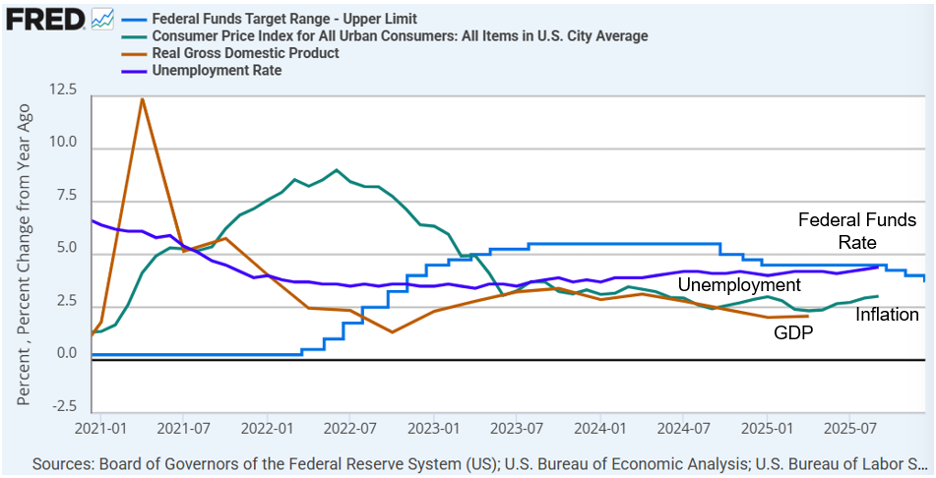
The Federal Open Market Committee sees economic growth expending at a moderate pace, though the unemployment rate has drifted higher. Inflation remains stubborn and elevated above the 2% target but of lower risk than rising unemployment. As such, they lowered the target federal funds rate by .25% from 4% to 3.75%. The committee remains open to further cuts, as justified by incoming data patterns, as shown below:
The committee also noted signs of stress in short-term funding markets and committed to purchasing short-term treasuries to inject additional liquidity.
Translation:
Rates have now fallen 1.75% from their high point. This significant reduction has occurred while economic growth and inflation remain within acceptable ranges. However, worries about the labor market have increased warranting an interest rate cut for “insurance”. More cuts are possible but need firmer justification from upcoming data releases. Concern about market liquidity measures prompted additional monetary easing in the form of treasury purchases.
Market impact:
Rate cuts mean cheaper money, higher earnings, and higher valuations. The market expected the rate cut, but the official statement eliminated any doubt. The market did not expect the Fed to begin immediate Treasury bill purchases to shore up short-term funding markets. The certainty of the rate cut and the positive surprise of additional liquidity added uplift to the rally and support for its continuation.
The Summary of Economic Projections
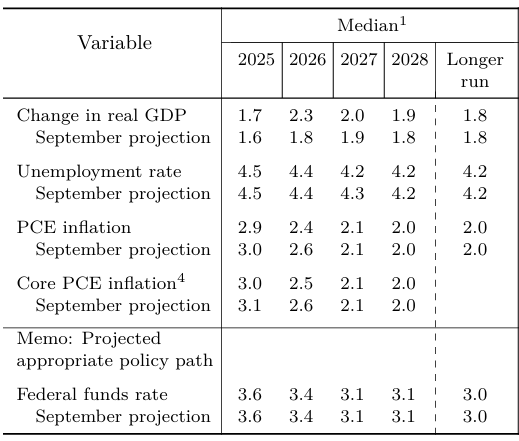
For full year 2025, the FOMC survey participants raised their GDP growth expectation by .1% while lowering their core inflation projection by .1%, compared with the September survey. For 2026, the FOMC survey participants raised their GDP growth expectation by .5% while lowering their core inflation projection by .1%. Expectations for the unemployment rate falling from 4.5% to 4.4% went unchanged. Expectations for lowering the Federal funds rate another .25% also remained in place.
Translation:
The Fed raised its expectations for both a stronger economy and a lower inflation rate, while maintaining its intention to cut interest rates further in 2026. The magnitude by which the Fed revised its GDP growth expectations upward provided further rally fuel for markets, as higher GDP equals higher revenues, while lower inflation equals higher profit margins and higher earnings. For equity investors, their SEP forecast couldn’t have been better, adding even more resolute rally support.
Powell’s Press Conference
Here are the most material quotes from Powell’s press conference:
On Growth:
“Fiscal policy is going to be supportive. AI spending will continue. The consumer continues to spend. So it looks like the baseline would be solid growth next year.”
On Inflation:
“The story with inflation is that…if you get away from tariffs, inflation is in the low 2’s.”
On Labor:
“The downside risks to employment appear to have risen in recent months.” “Surveys of households and businesses both show declining supply and demand for workers.”
On AI:
“I never thought I would see a time when we had 5-6 years of 2 percent productivity growth. This is higher. This is definitively higher”
On Rate Cuts:
“We are at the high-end range of neutral, I would say.”
Translation:
Powell expects inflation to fall materially over the next six months as one-time tariff adjustments flow through. He has concerns about the labor market being softer than it appears. This shifts the balance toward further rate cuts as Powell himself sees us at the high end of the neutral range.
Powell also seems fascinated by the tech-enabled upgrades to productivity. This unlocks higher growth and lower inflation—the opposite of the Stagflation people feared entering 2025. For those who thought Powell would provide hawkish testimony on Wednesday, the opposite occurred. Powell believes the productivity gains within the economy will boost growth and temper inflation, and he expects rates to fall further. With this additional Powell promotion, the Dow, S&P 500, and Russell 2000 index all hit… all-time highs.
Have a great week!
—David
Sources: Federal Reserve Bank of St. Louis, Federal Reserve Board of Governors, Summary of Economic Projections
This communication and its contents are for informational and educational purposes only and should not be used as the sole basis for any investment decision. The information contained herein is based on publicly available sources believed to be reliable but is not a representation, expressed or implied, as to the accuracy, completeness, or correctness of said information. References to political figures or policies are for informational purposes only and do not represent an endorsement by Waddell & Associates. Any forward-looking statements reflect current opinions and assumptions and are subject to change without notice; actual results may differ materially. Past performance does not guarantee future results. Waddell & Associates may use artificial intelligence tools to help generate or summarize content; all outputs are reviewed by our team for accuracy and relevance.
">Fed Unwraps Holiday Highs
On Wednesday of this past week, the Federal Reserve concluded their eighth and final FOMC meeting of the year. With a record Government shutdown suspending vital data releases (inflation, GDP, and job creation), the official statement, the summary of economic projections and Powell’s presser took on outsized significance. This week we will dig into each, translate, and determine whether the brew adds fuel to Santa’s sleigh.
Sources: Federal Reserve Bank of St. Louis, Federal Reserve Board of Governors, Summary of Economic Projections
The Official Statement
The Federal Open Market Committee sees economic growth expending at a moderate pace, though the unemployment rate has drifted higher. Inflation remains stubborn and elevated above the 2% target but of lower risk than rising unemployment. As such, they lowered the target federal funds rate by .25% from 4% to 3.75%. The committee remains open to further cuts, as justified by incoming data patterns, as shown below:
The committee also noted signs of stress in short-term funding markets and committed to purchasing short-term treasuries to inject additional liquidity.
Translation:
Rates have now fallen 1.75% from their high point. This significant reduction has occurred while economic growth and inflation remain within acceptable ranges. However, worries about the labor market have increased warranting an interest rate cut for “insurance”. More cuts are possible but need firmer justification from upcoming data releases. Concern about market liquidity measures prompted additional monetary easing in the form of treasury purchases.
Market impact:
Rate cuts mean cheaper money, higher earnings, and higher valuations. The market expected the rate cut, but the official statement eliminated any doubt. The market did not expect the Fed to begin immediate Treasury bill purchases to shore up short-term funding markets. The certainty of the rate cut and the positive surprise of additional liquidity added uplift to the rally and support for its continuation.
The Summary of Economic Projections
For full year 2025, the FOMC survey participants raised their GDP growth expectation by .1% while lowering their core inflation projection by .1%, compared with the September survey. For 2026, the FOMC survey participants raised their GDP growth expectation by .5% while lowering their core inflation projection by .1%. Expectations for the unemployment rate falling from 4.5% to 4.4% went unchanged. Expectations for lowering the Federal funds rate another .25% also remained in place.
Translation:
The Fed raised its expectations for both a stronger economy and a lower inflation rate, while maintaining its intention to cut interest rates further in 2026. The magnitude by which the Fed revised its GDP growth expectations upward provided further rally fuel for markets, as higher GDP equals higher revenues, while lower inflation equals higher profit margins and higher earnings. For equity investors, their SEP forecast couldn’t have been better, adding even more resolute rally support.
Powell’s Press Conference
Here are the most material quotes from Powell’s press conference:
On Growth:
“Fiscal policy is going to be supportive. AI spending will continue. The consumer continues to spend. So it looks like the baseline would be solid growth next year.”
On Inflation:
“The story with inflation is that…if you get away from tariffs, inflation is in the low 2’s.”
On Labor:
“The downside risks to employment appear to have risen in recent months.” “Surveys of households and businesses both show declining supply and demand for workers.”
On AI:
“I never thought I would see a time when we had 5-6 years of 2 percent productivity growth. This is higher. This is definitively higher”
On Rate Cuts:
“We are at the high-end range of neutral, I would say.”
Translation:
Powell expects inflation to fall materially over the next six months as one-time tariff adjustments flow through. He has concerns about the labor market being softer than it appears. This shifts the balance toward further rate cuts as Powell himself sees us at the high end of the neutral range.
Powell also seems fascinated by the tech-enabled upgrades to productivity. This unlocks higher growth and lower inflation—the opposite of the Stagflation people feared entering 2025. For those who thought Powell would provide hawkish testimony on Wednesday, the opposite occurred. Powell believes the productivity gains within the economy will boost growth and temper inflation, and he expects rates to fall further. With this additional Powell promotion, the Dow, S&P 500, and Russell 2000 index all hit… all-time highs.
Have a great week!
—David
Sources: Federal Reserve Bank of St. Louis, Federal Reserve Board of Governors, Summary of Economic Projections
This communication and its contents are for informational and educational purposes only and should not be used as the sole basis for any investment decision. The information contained herein is based on publicly available sources believed to be reliable but is not a representation, expressed or implied, as to the accuracy, completeness, or correctness of said information. References to political figures or policies are for informational purposes only and do not represent an endorsement by Waddell & Associates. Any forward-looking statements reflect current opinions and assumptions and are subject to change without notice; actual results may differ materially. Past performance does not guarantee future results. Waddell & Associates may use artificial intelligence tools to help generate or summarize content; all outputs are reviewed by our team for accuracy and relevance.
" class="link-chevron">The Bottom Line:
- What’s the cost of long-term care? A semi-private nursing home can exceed $100,000 annually, and full-time in-home care can cost several hundred thousand dollars each year depending on your location. These figures can dramatically impact even well-funded retirement plans.
- Should I consider long-term care insurance? It depends on your portfolio’s ability to self-insure and the timing of when you start planning.
- Why should I bring my family into these decisions? Open discussions about health scenarios and care preferences today can help prevent difficult decisions later.
The Full Story:
Facing the reality of deteriorating health is never easy, and talking about it can be even harder.
No one wants to picture needing help one day. Yet we’ve seen time and time again that when clients address that possibility early, they give themselves something powerful: choice.
The choice to stay where they feel most comfortable. The choice to relieve their families from difficult, last-minute decisions. The choice to live on their own terms, even when life feels most restricting.
At Waddell & Associates, we think of this as part of your overarching wealth strategy. Because planning for your future care isn’t about expecting loss or crunching numbers; it’s about protecting your independence and ensuring your decisions remain your own.
Healthcare Costs for Future “You”: Why This Matters More Than You Might Think
Most people understand that healthcare is expensive. What’s surprising is how quickly those costs can reshape an otherwise solid retirement plan. Nearly 70% of people turning 65 today will need some form of long-term care, and around-the-clock support can exceed $100,000 per year.
These expenses often hit at a vulnerable moment, when your earning years are behind you and your options are more limited due to:
- Insurance challenges. Long-term care insurance can become prohibitively expensive or difficult to qualify for later in life.
- Portfolio strain. Self-insuring requires a portfolio strong enough to weather years of withdrawals without compromising your spouse’s security or your legacy.
- Emotional stress. When families face sudden care decisions without a plan, it can create tension and confusion at the worst possible time.
Thoughtful planning can replace these uncertainties with clarity, allowing everyone involved to focus on what matters: care and alignment.
Related: Click here to read “The Strategic Questions Every Sophisticated Investor Should Ask Right Now”
The Long-Term Care Question: To Insure or Not to Insure?
Over the past decade, the insurance landscape has evolved dramatically. Older policies often failed to deliver on their original promises, while newer ones may be more flexible but also more complex. Our role is to help you analyze what truly aligns with your current and long-term goals:
- Can your assets sustain several years of high care expenses without compromising other priorities?
- Does history suggest a higher likelihood of care needs later in life?
- Would you prefer to hold liquidity and self-insure, or share the cost through a hybrid policy?
Recently, we worked with a family who had done this planning early. When the mother’s health changed unexpectedly, the daughter already knew what steps to take. Together, we had already reviewed facilities, modeled costs, and clarified financial guardrails. When care quickly became necessary, decisions felt informed rather than rushed.
Making it a Family Matter
Talking about aging, health, and finances with family can feel uncomfortable, but early communication nearly always prevents hardship later. From our experience, families who speak openly about these topics tend to move through transitions with less conflict and more unity.
Here’s what we’ve seen work well:
- Start the conversation before there’s urgency. Frame it not as “here’s what to do when I get sick,” but rather as “here’s the plan we have in place, and here’s your role in it.” It takes some of the emotional weight out of the discussion.
- Be specific about what you want. Do you want to stay in your home as long as possible? Are you open to a family member providing care? Would you prefer a facility that offers progressive levels of support? These preferences matter, and they affect the financial planning.
- Identify who will step in if decisions need to be made. Who has power of attorney? Who will coordinate with your financial team? Making these decisions now, while everyone’s calm and thinking clearly, helps to prevent family conflicts later.
These discussions don’t just prepare your family; they bring relief. Parents feel relieved that someone else understands the plan, and children feel prepared and less anxious about the future. Together, we can make sure the whole family is aligned on what happens in the worst-case scenarios.
Building a Health Strategy That Works
Healthcare planning is not separate from retirement and estate planning; it’s a critical part of both. We take a customized, detail-oriented approach to integrate all three into your broader strategy:
We run the stress tests.
We build a baseline financial plan first: Here’s where you are, here’s your projected growth, and here’s your spending. Then we add scenarios. What if one spouse needs five years of memory care starting at age 80? What if both spouses have overlapping care needs? Does the plan still work?
We consider your family health patterns.
If dementia runs in your family, or if multiple relatives needed extended care, we factor that into your planning. It doesn’t mean it will happen to you, but it’s a possibility worth planning for.
We evaluate long-term care options now.
Even if you decide not to purchase insurance, we help you understand options available in your area. What do facilities cost? How much does in-home care run? What would you actually want if you needed help?
We help you keep liquidity accessible.
Care needs can arise suddenly. Having cash or easily liquidated assets available means you’re not forced to sell investments at an inopportune time to cover immediate costs.
We review your plan with you regularly.
Your health strategy isn’t static. As you age, your portfolio changes, and as the care landscape evolves, your plan should adapt. We check that your powers of attorney are current, ensure your healthcare directives are clear, and help you keep your family informed about where important documents are located.
The Value of Planning Ahead
Once clients address these questions, they often describe feeling lighter. The unknown becomes defined, and the path forward becomes visible. Their families gain alignment and understanding. Their finances reflect both optimism and realism.
And ultimately, that’s what this is about. Yes, we’re talking about money, healthcare, and long-term care costs. But underneath it all, we’re talking about protecting what matters most: your independence, your choices, your family’s wellbeing, and the legacy you want to leave.
If this article surfaced new questions or if anything in your family situation has changed since you last met with your wealth strategist, let’s talk. Maybe there’s a health development you’re navigating, or perhaps you’re ready to have that conversation with your adult children. Whatever’s on your mind, we’re here.
And if you’re new here and thinking, “I wish someone was thinking through all of this with me,” that’s the signal it might be time for a conversation. Learn about the Waddell & Associates difference and explore how you can work with us. We’d love to hear from you.
Sources: Administration for Community Living (ACL). “How Much Care Will You Need?” U.S. Department of Health and Human Services. https://acl.gov/ltc/basic-needs/how-much-care-will-you-need. Long Term Care Federal Employees Insurance Program. “Long-Term Care Costs.” U.S. Office of Personnel Management. https://www.ltcfeds.gov/long-term-care/costs
This content is for informational and educational purposes only and should not be construed as investment, legal, or tax advice. Waddell & Associates, Inc. is an SEC-registered investment adviser. Registration does not imply a certain level of skill or training.
The strategies and examples discussed are illustrative only and may not be appropriate for every individual. All investments and planning decisions involve risk, including the possible loss of principal.
Please consult your financial advisor, attorney, or tax professional before making any decisions related to retirement, estate, or healthcare planning.
">
Nobody wants to imagine themselves needing help, but planning for it now can help protect you, your future, and the people you love most.
The Bottom Line:
- What’s the cost of long-term care? A semi-private nursing home can exceed $100,000 annually, and full-time in-home care can cost several hundred thousand dollars each year depending on your location. These figures can dramatically impact even well-funded retirement plans.
- Should I consider long-term care insurance? It depends on your portfolio’s ability to self-insure and the timing of when you start planning.
- Why should I bring my family into these decisions? Open discussions about health scenarios and care preferences today can help prevent difficult decisions later.
The Full Story:
Facing the reality of deteriorating health is never easy, and talking about it can be even harder.
No one wants to picture needing help one day. Yet we’ve seen time and time again that when clients address that possibility early, they give themselves something powerful: choice.
The choice to stay where they feel most comfortable. The choice to relieve their families from difficult, last-minute decisions. The choice to live on their own terms, even when life feels most restricting.
At Waddell & Associates, we think of this as part of your overarching wealth strategy. Because planning for your future care isn’t about expecting loss or crunching numbers; it’s about protecting your independence and ensuring your decisions remain your own.
Healthcare Costs for Future “You”: Why This Matters More Than You Might Think
Most people understand that healthcare is expensive. What’s surprising is how quickly those costs can reshape an otherwise solid retirement plan. Nearly 70% of people turning 65 today will need some form of long-term care, and around-the-clock support can exceed $100,000 per year.
These expenses often hit at a vulnerable moment, when your earning years are behind you and your options are more limited due to:
- Insurance challenges. Long-term care insurance can become prohibitively expensive or difficult to qualify for later in life.
- Portfolio strain. Self-insuring requires a portfolio strong enough to weather years of withdrawals without compromising your spouse’s security or your legacy.
- Emotional stress. When families face sudden care decisions without a plan, it can create tension and confusion at the worst possible time.
Thoughtful planning can replace these uncertainties with clarity, allowing everyone involved to focus on what matters: care and alignment.
Related: Click here to read “The Strategic Questions Every Sophisticated Investor Should Ask Right Now”
The Long-Term Care Question: To Insure or Not to Insure?
Over the past decade, the insurance landscape has evolved dramatically. Older policies often failed to deliver on their original promises, while newer ones may be more flexible but also more complex. Our role is to help you analyze what truly aligns with your current and long-term goals:
- Can your assets sustain several years of high care expenses without compromising other priorities?
- Does history suggest a higher likelihood of care needs later in life?
- Would you prefer to hold liquidity and self-insure, or share the cost through a hybrid policy?
Recently, we worked with a family who had done this planning early. When the mother’s health changed unexpectedly, the daughter already knew what steps to take. Together, we had already reviewed facilities, modeled costs, and clarified financial guardrails. When care quickly became necessary, decisions felt informed rather than rushed.
Making it a Family Matter
Talking about aging, health, and finances with family can feel uncomfortable, but early communication nearly always prevents hardship later. From our experience, families who speak openly about these topics tend to move through transitions with less conflict and more unity.
Here’s what we’ve seen work well:
- Start the conversation before there’s urgency. Frame it not as “here’s what to do when I get sick,” but rather as “here’s the plan we have in place, and here’s your role in it.” It takes some of the emotional weight out of the discussion.
- Be specific about what you want. Do you want to stay in your home as long as possible? Are you open to a family member providing care? Would you prefer a facility that offers progressive levels of support? These preferences matter, and they affect the financial planning.
- Identify who will step in if decisions need to be made. Who has power of attorney? Who will coordinate with your financial team? Making these decisions now, while everyone’s calm and thinking clearly, helps to prevent family conflicts later.
These discussions don’t just prepare your family; they bring relief. Parents feel relieved that someone else understands the plan, and children feel prepared and less anxious about the future. Together, we can make sure the whole family is aligned on what happens in the worst-case scenarios.
Building a Health Strategy That Works
Healthcare planning is not separate from retirement and estate planning; it’s a critical part of both. We take a customized, detail-oriented approach to integrate all three into your broader strategy:
We run the stress tests.
We build a baseline financial plan first: Here’s where you are, here’s your projected growth, and here’s your spending. Then we add scenarios. What if one spouse needs five years of memory care starting at age 80? What if both spouses have overlapping care needs? Does the plan still work?
We consider your family health patterns.
If dementia runs in your family, or if multiple relatives needed extended care, we factor that into your planning. It doesn’t mean it will happen to you, but it’s a possibility worth planning for.
We evaluate long-term care options now.
Even if you decide not to purchase insurance, we help you understand options available in your area. What do facilities cost? How much does in-home care run? What would you actually want if you needed help?
We help you keep liquidity accessible.
Care needs can arise suddenly. Having cash or easily liquidated assets available means you’re not forced to sell investments at an inopportune time to cover immediate costs.
We review your plan with you regularly.
Your health strategy isn’t static. As you age, your portfolio changes, and as the care landscape evolves, your plan should adapt. We check that your powers of attorney are current, ensure your healthcare directives are clear, and help you keep your family informed about where important documents are located.
The Value of Planning Ahead
Once clients address these questions, they often describe feeling lighter. The unknown becomes defined, and the path forward becomes visible. Their families gain alignment and understanding. Their finances reflect both optimism and realism.
And ultimately, that’s what this is about. Yes, we’re talking about money, healthcare, and long-term care costs. But underneath it all, we’re talking about protecting what matters most: your independence, your choices, your family’s wellbeing, and the legacy you want to leave.
If this article surfaced new questions or if anything in your family situation has changed since you last met with your wealth strategist, let’s talk. Maybe there’s a health development you’re navigating, or perhaps you’re ready to have that conversation with your adult children. Whatever’s on your mind, we’re here.
And if you’re new here and thinking, “I wish someone was thinking through all of this with me,” that’s the signal it might be time for a conversation. Learn about the Waddell & Associates difference and explore how you can work with us. We’d love to hear from you.
Sources: Administration for Community Living (ACL). “How Much Care Will You Need?” U.S. Department of Health and Human Services. https://acl.gov/ltc/basic-needs/how-much-care-will-you-need. Long Term Care Federal Employees Insurance Program. “Long-Term Care Costs.” U.S. Office of Personnel Management. https://www.ltcfeds.gov/long-term-care/costs
This content is for informational and educational purposes only and should not be construed as investment, legal, or tax advice. Waddell & Associates, Inc. is an SEC-registered investment adviser. Registration does not imply a certain level of skill or training.
The strategies and examples discussed are illustrative only and may not be appropriate for every individual. All investments and planning decisions involve risk, including the possible loss of principal.
Please consult your financial advisor, attorney, or tax professional before making any decisions related to retirement, estate, or healthcare planning.
">The Hidden Costs of Healthcare in Retirement Planning and Estate Planning Nobody wants to imagine themselves needing help, but planning for it now can help protect you, your future, and the people you love most.The Bottom Line:
- What’s the cost of long-term care? A semi-private nursing home can exceed $100,000 annually, and full-time in-home care can cost several hundred thousand dollars each year depending on your location. These figures can dramatically impact even well-funded retirement plans.
- Should I consider long-term care insurance? It depends on your portfolio’s ability to self-insure and the timing of when you start planning.
- Why should I bring my family into these decisions? Open discussions about health scenarios and care preferences today can help prevent difficult decisions later.
The Full Story:
Facing the reality of deteriorating health is never easy, and talking about it can be even harder.
No one wants to picture needing help one day. Yet we’ve seen time and time again that when clients address that possibility early, they give themselves something powerful: choice.
The choice to stay where they feel most comfortable. The choice to relieve their families from difficult, last-minute decisions. The choice to live on their own terms, even when life feels most restricting.
At Waddell & Associates, we think of this as part of your overarching wealth strategy. Because planning for your future care isn’t about expecting loss or crunching numbers; it’s about protecting your independence and ensuring your decisions remain your own.
Healthcare Costs for Future “You”: Why This Matters More Than You Might Think
Most people understand that healthcare is expensive. What’s surprising is how quickly those costs can reshape an otherwise solid retirement plan. Nearly 70% of people turning 65 today will need some form of long-term care, and around-the-clock support can exceed $100,000 per year.
These expenses often hit at a vulnerable moment, when your earning years are behind you and your options are more limited due to:
- Insurance challenges. Long-term care insurance can become prohibitively expensive or difficult to qualify for later in life.
- Portfolio strain. Self-insuring requires a portfolio strong enough to weather years of withdrawals without compromising your spouse’s security or your legacy.
- Emotional stress. When families face sudden care decisions without a plan, it can create tension and confusion at the worst possible time.
Thoughtful planning can replace these uncertainties with clarity, allowing everyone involved to focus on what matters: care and alignment.
Related: Click here to read “The Strategic Questions Every Sophisticated Investor Should Ask Right Now”
The Long-Term Care Question: To Insure or Not to Insure?
Over the past decade, the insurance landscape has evolved dramatically. Older policies often failed to deliver on their original promises, while newer ones may be more flexible but also more complex. Our role is to help you analyze what truly aligns with your current and long-term goals:
- Can your assets sustain several years of high care expenses without compromising other priorities?
- Does history suggest a higher likelihood of care needs later in life?
- Would you prefer to hold liquidity and self-insure, or share the cost through a hybrid policy?
Recently, we worked with a family who had done this planning early. When the mother’s health changed unexpectedly, the daughter already knew what steps to take. Together, we had already reviewed facilities, modeled costs, and clarified financial guardrails. When care quickly became necessary, decisions felt informed rather than rushed.
Making it a Family Matter
Talking about aging, health, and finances with family can feel uncomfortable, but early communication nearly always prevents hardship later. From our experience, families who speak openly about these topics tend to move through transitions with less conflict and more unity.
Here’s what we’ve seen work well:
- Start the conversation before there’s urgency. Frame it not as “here’s what to do when I get sick,” but rather as “here’s the plan we have in place, and here’s your role in it.” It takes some of the emotional weight out of the discussion.
- Be specific about what you want. Do you want to stay in your home as long as possible? Are you open to a family member providing care? Would you prefer a facility that offers progressive levels of support? These preferences matter, and they affect the financial planning.
- Identify who will step in if decisions need to be made. Who has power of attorney? Who will coordinate with your financial team? Making these decisions now, while everyone’s calm and thinking clearly, helps to prevent family conflicts later.
These discussions don’t just prepare your family; they bring relief. Parents feel relieved that someone else understands the plan, and children feel prepared and less anxious about the future. Together, we can make sure the whole family is aligned on what happens in the worst-case scenarios.
Building a Health Strategy That Works
Healthcare planning is not separate from retirement and estate planning; it’s a critical part of both. We take a customized, detail-oriented approach to integrate all three into your broader strategy:
We run the stress tests.
We build a baseline financial plan first: Here’s where you are, here’s your projected growth, and here’s your spending. Then we add scenarios. What if one spouse needs five years of memory care starting at age 80? What if both spouses have overlapping care needs? Does the plan still work?
We consider your family health patterns.
If dementia runs in your family, or if multiple relatives needed extended care, we factor that into your planning. It doesn’t mean it will happen to you, but it’s a possibility worth planning for.
We evaluate long-term care options now.
Even if you decide not to purchase insurance, we help you understand options available in your area. What do facilities cost? How much does in-home care run? What would you actually want if you needed help?
We help you keep liquidity accessible.
Care needs can arise suddenly. Having cash or easily liquidated assets available means you’re not forced to sell investments at an inopportune time to cover immediate costs.
We review your plan with you regularly.
Your health strategy isn’t static. As you age, your portfolio changes, and as the care landscape evolves, your plan should adapt. We check that your powers of attorney are current, ensure your healthcare directives are clear, and help you keep your family informed about where important documents are located.
The Value of Planning Ahead
Once clients address these questions, they often describe feeling lighter. The unknown becomes defined, and the path forward becomes visible. Their families gain alignment and understanding. Their finances reflect both optimism and realism.
And ultimately, that’s what this is about. Yes, we’re talking about money, healthcare, and long-term care costs. But underneath it all, we’re talking about protecting what matters most: your independence, your choices, your family’s wellbeing, and the legacy you want to leave.
If this article surfaced new questions or if anything in your family situation has changed since you last met with your wealth strategist, let’s talk. Maybe there’s a health development you’re navigating, or perhaps you’re ready to have that conversation with your adult children. Whatever’s on your mind, we’re here.
And if you’re new here and thinking, “I wish someone was thinking through all of this with me,” that’s the signal it might be time for a conversation. Learn about the Waddell & Associates difference and explore how you can work with us. We’d love to hear from you.
Sources: Administration for Community Living (ACL). “How Much Care Will You Need?” U.S. Department of Health and Human Services. https://acl.gov/ltc/basic-needs/how-much-care-will-you-need. Long Term Care Federal Employees Insurance Program. “Long-Term Care Costs.” U.S. Office of Personnel Management. https://www.ltcfeds.gov/long-term-care/costs
This content is for informational and educational purposes only and should not be construed as investment, legal, or tax advice. Waddell & Associates, Inc. is an SEC-registered investment adviser. Registration does not imply a certain level of skill or training.
The strategies and examples discussed are illustrative only and may not be appropriate for every individual. All investments and planning decisions involve risk, including the possible loss of principal.
Please consult your financial advisor, attorney, or tax professional before making any decisions related to retirement, estate, or healthcare planning.
" class="link-chevron">
For the second year in a row, I have the privilege of writing the week leading up to Thanksgiving, a time for family and feasting. Last year, in honor of the late John Madden, we handed out our inaugural Turkey Leg Award to the U.S. economy. This year, we’re back at the carving table. Let’s find out who takes home the trophy!
Last week, we highlighted the incremental rise in equity volatility. The S&P500 is down 5% from the all-time closing high from last month on October 28th. The NASDAQ is down 8% from the same day. Though, even as the market has backtracked, corporate earnings have accelerated higher. Price movement is irrational and non-linear in the short term, but corporate earnings growth drives long-term price appreciation and investor returns. So, for 2025, the Turkey Leg Award goes to… U.S. corporate earnings growth!
Earnings Feasting!
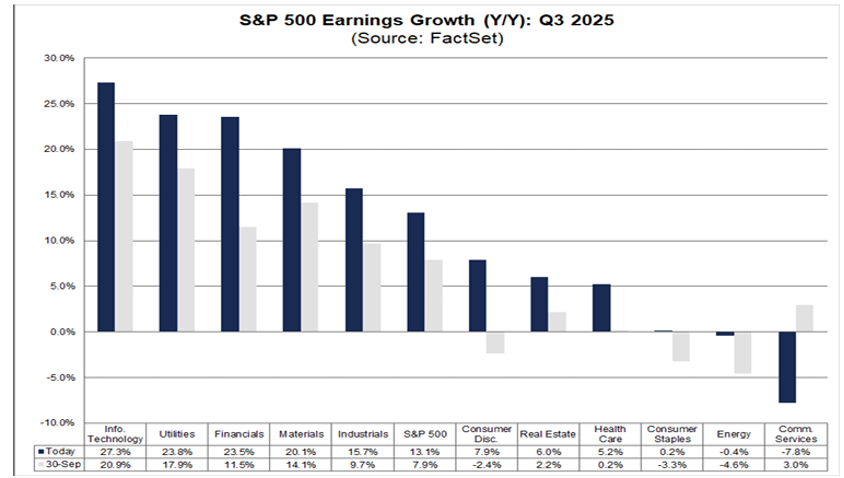
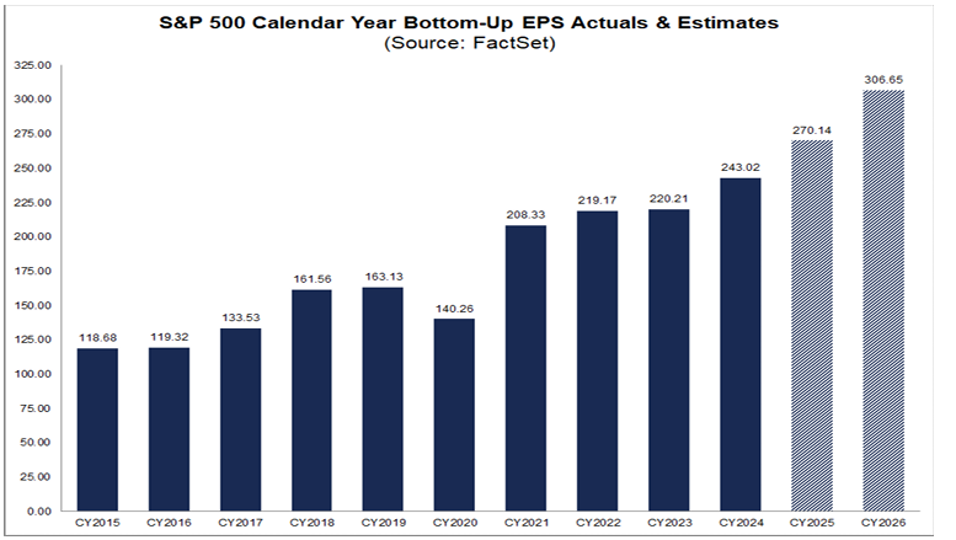
The S&P500 valuation is elevated and the forward question for further upside appreciation in the index was the deliverance of solid earnings and forward guidance. In large caps, over 92% of companies in the S&P500 have reported Q3 earnings and the blended growth rate sits at 13.1%.
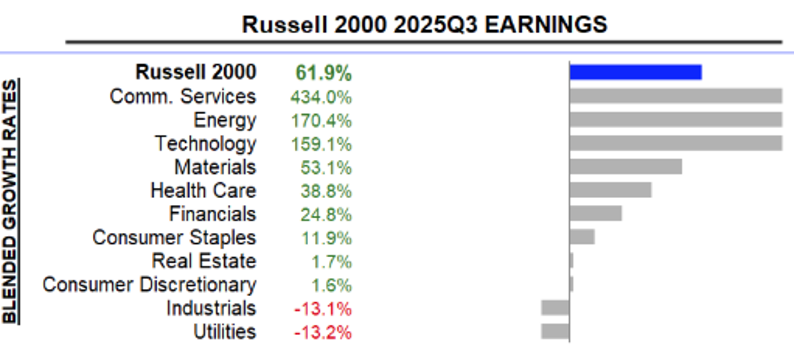
In small caps, over 82% of companies in the Russell 2000 have reported Q3 earnings growth and the blended growth rate sits at 61.9%.
And analysts expect the growth to continue in 2026. In the S&P500, analysts expect another 13.5% growth rate in 2026—all good news for equity investors, but companies will need to deliver on these expectations:
Profit Margins Cooking!
Operating profits are growing too. With the Q3 earnings cycle nearly complete, the net profit margin for the S&P500 sits at 13.1%.
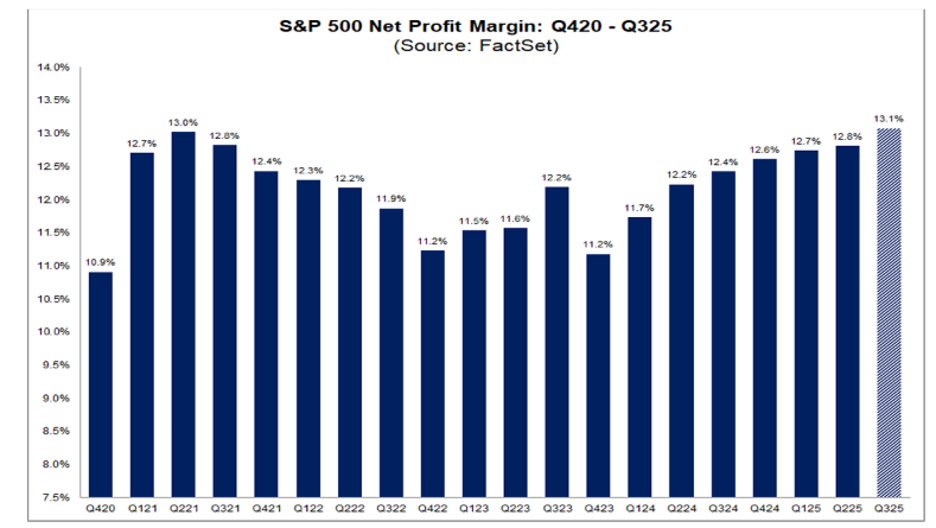
This would represent not only the highest quarterly reading since Q2 202, but a level higher than all readings since at least 2009, when FactSet began tracking the data. That’s a long time!
This quarter also marks the seventh consecutive quarter of margin expansion. Six of eleven sectors are showing year-over-year improvement led by:
- Utilities: 17.2% vs. 14.8%
- Financials: 20.2% vs. 17%
- Tech: 27.7% vs. 17%
Margins aren’t just holding up, they’re widening across multiple sectors.
Final Course
Analysts expect profit growth to accelerate further. Even with tougher quarterly comps ahead, annual profit margins in the S&P500 are expected to close 2025 at 13.3% and accelerate to 14.2% in 2026:
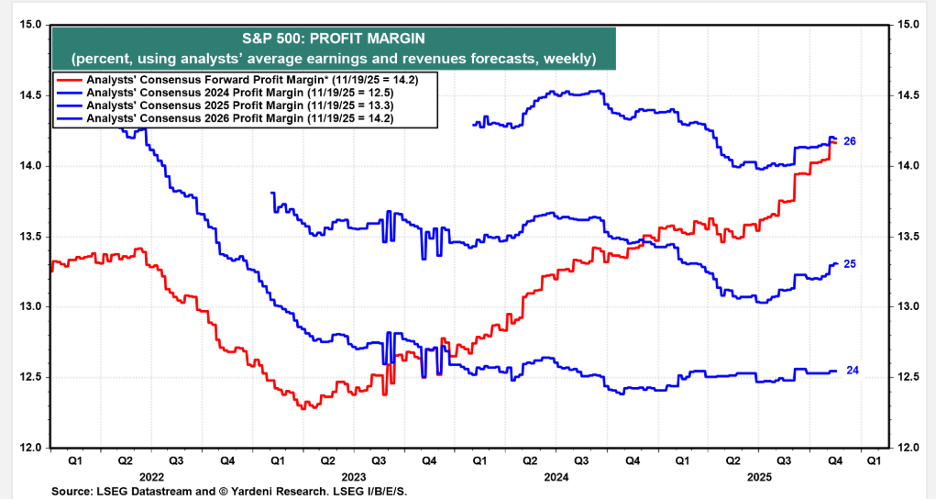
The margin expansion is meaningful. That’s important because margin expansion fuels more than just earnings growth. Stronger profitability boosts free cash flow, enabling companies to:
- Raise dividends.
- Increase share buybacks.
- Reinforce balance sheets.
- Reinvest for long-term growth.
Stronger margins strengthen the entire ecosystem.
Putting it all together
The U.S. corporate profit engine is alive and well, continuing to deliver steady earnings growth, positive surprise relative to expectations, and incrementally improving profitability. This Thanksgiving, raise your turkey leg to corporate earnings, the underlying force powering long-term growth behind the scenes.
From our family to yours, wishing you a Happy Thanksgiving.
Cheers,
Matt
Sources: FactSet, LSEG I/B/E/S, Yardeni Research
This communication and its contents are for informational and educational purposes only and should not be used as the sole basis for any investment decision. The information contained herein is based on publicly available sources believed to be reliable but is not a representation, expressed or implied, as to the accuracy, completeness, or correctness of said information. References to political figures or policies are for informational purposes only and do not represent an endorsement by Waddell & Associates. Any forward-looking statements reflect current opinions and assumptions and are subject to change without notice; actual results may differ materially. Past performance does not guarantee future results. Waddell & Associates may use artificial intelligence tools to help generate or summarize content; all outputs are reviewed by our team for accuracy and relevance.
">Giving Turkey Legs!
For the second year in a row, I have the privilege of writing the week leading up to Thanksgiving, a time for family and feasting. Last year, in honor of the late John Madden, we handed out our inaugural Turkey Leg Award to the U.S. economy. This year, we’re back at the carving table. Let’s find out who takes home the trophy!
This communication and its contents are for informational and educational purposes only and should not be used as the sole basis for any investment decision. The information contained herein is based on publicly available sources believed to be reliable but is not a representation, expressed or implied, as to the accuracy, completeness, or correctness of said information. References to political figures or policies are for informational purposes only and do not represent an endorsement by Waddell & Associates. Any forward-looking statements reflect current opinions and assumptions and are subject to change without notice; actual results may differ materially. Past performance does not guarantee future results. Waddell & Associates may use artificial intelligence tools to help generate or summarize content; all outputs are reviewed by our team for accuracy and relevance.
Last week, we highlighted the incremental rise in equity volatility. The S&P500 is down 5% from the all-time closing high from last month on October 28th. The NASDAQ is down 8% from the same day. Though, even as the market has backtracked, corporate earnings have accelerated higher. Price movement is irrational and non-linear in the short term, but corporate earnings growth drives long-term price appreciation and investor returns. So, for 2025, the Turkey Leg Award goes to… U.S. corporate earnings growth!
Earnings Feasting!
The S&P500 valuation is elevated and the forward question for further upside appreciation in the index was the deliverance of solid earnings and forward guidance. In large caps, over 92% of companies in the S&P500 have reported Q3 earnings and the blended growth rate sits at 13.1%.
In small caps, over 82% of companies in the Russell 2000 have reported Q3 earnings growth and the blended growth rate sits at 61.9%.
And analysts expect the growth to continue in 2026. In the S&P500, analysts expect another 13.5% growth rate in 2026—all good news for equity investors, but companies will need to deliver on these expectations:
Profit Margins Cooking!
Operating profits are growing too. With the Q3 earnings cycle nearly complete, the net profit margin for the S&P500 sits at 13.1%.
This would represent not only the highest quarterly reading since Q2 202, but a level higher than all readings since at least 2009, when FactSet began tracking the data. That’s a long time!
This quarter also marks the seventh consecutive quarter of margin expansion. Six of eleven sectors are showing year-over-year improvement led by:
- Utilities: 17.2% vs. 14.8%
- Financials: 20.2% vs. 17%
- Tech: 27.7% vs. 17%
Margins aren’t just holding up, they’re widening across multiple sectors.
Final Course
Analysts expect profit growth to accelerate further. Even with tougher quarterly comps ahead, annual profit margins in the S&P500 are expected to close 2025 at 13.3% and accelerate to 14.2% in 2026:
The margin expansion is meaningful. That’s important because margin expansion fuels more than just earnings growth. Stronger profitability boosts free cash flow, enabling companies to:
- Raise dividends.
- Increase share buybacks.
- Reinforce balance sheets.
- Reinvest for long-term growth.
Stronger margins strengthen the entire ecosystem.
Putting it all together
The U.S. corporate profit engine is alive and well, continuing to deliver steady earnings growth, positive surprise relative to expectations, and incrementally improving profitability. This Thanksgiving, raise your turkey leg to corporate earnings, the underlying force powering long-term growth behind the scenes.
From our family to yours, wishing you a Happy Thanksgiving.
Cheers,
Matt
Sources: FactSet, LSEG I/B/E/S, Yardeni Research
This communication and its contents are for informational and educational purposes only and should not be used as the sole basis for any investment decision. The information contained herein is based on publicly available sources believed to be reliable but is not a representation, expressed or implied, as to the accuracy, completeness, or correctness of said information. References to political figures or policies are for informational purposes only and do not represent an endorsement by Waddell & Associates. Any forward-looking statements reflect current opinions and assumptions and are subject to change without notice; actual results may differ materially. Past performance does not guarantee future results. Waddell & Associates may use artificial intelligence tools to help generate or summarize content; all outputs are reviewed by our team for accuracy and relevance.

November has brought about a more turbulent stretch for markets. The longest government shutdown in history officially ended this past Wednesday, but not all sources of uncertainty have faded. The Supreme Court is set to hear arguments related to President Trump’s tariff authority over the coming weeks adding a fresh layer of policy risk. Meanwhile, earnings season has largely wrapped up, yet investor attention will be focused on Nvidia’s results Wednesday evening, a spectacle that increasingly serves as a proxy for broader sentiment on AI, capex, and mega-cap leadership.
Taken together, these forces have produced an uptick in equity volatility to start November. But when you look across other indicators of stress, the picture clears. Bond volatility is subdued, credit spreads remain tight, and currency volatility is still near cycle lows. The disconnect is meaningful: it suggests the stress in equities is not being driven by macro fears or financial instability but rather a healthy, if sometimes uncomfortable, hedge of uncertainty.
Stocks, Bonds, and Currencies
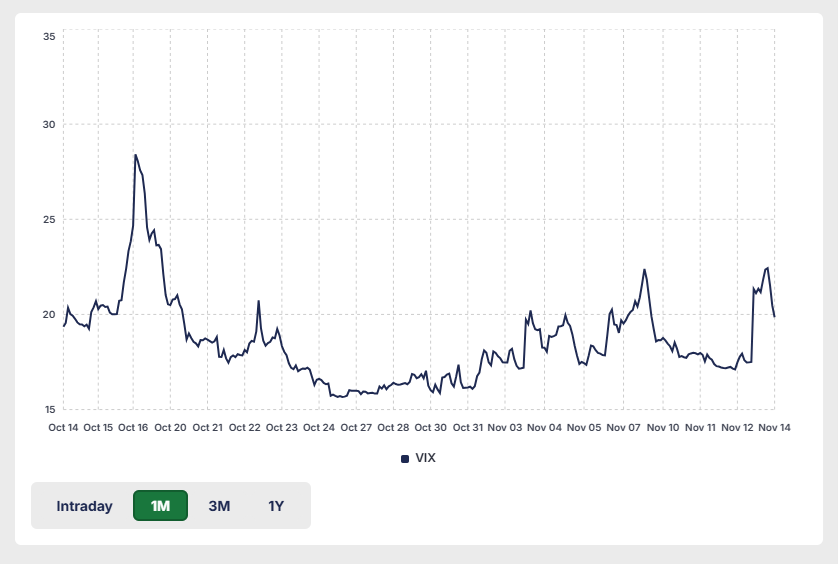
The CBOE Volatility Index (VIX), the market’s most common gauge of near-term S&P 500 volatility, has been steadily climbing since Halloween. We’ve seen two notable 1–2% pullbacks in recent weeks: Friday, Nov. 7 and again Friday morning, Nov. 14, both of which were quickly bought back. This pattern of sharp dips followed by equally sharp recoveries has contributed to a grind higher in equity volatility over the last two weeks.
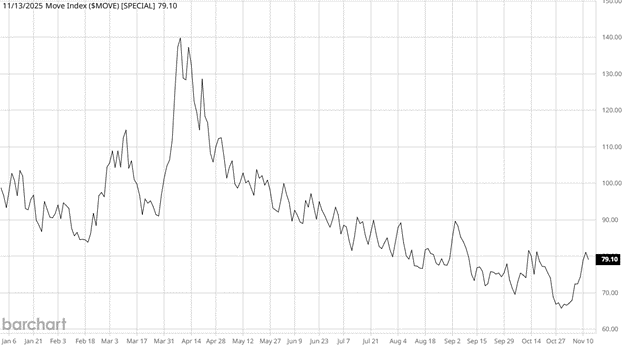
In contrast to equities, Treasury volatility tells a much calmer story. The MOVE Index, the bond-market equivalent of the VIX, has ticked slightly higher but remains near year-to-date lows. When bond volatility stays anchored, it signals that investors are not concerned about recession risk, liquidity, or expect major shifts in Fed policy. Fixed income markets are behaving as if the current bout of equity volatility is noise, not signal.
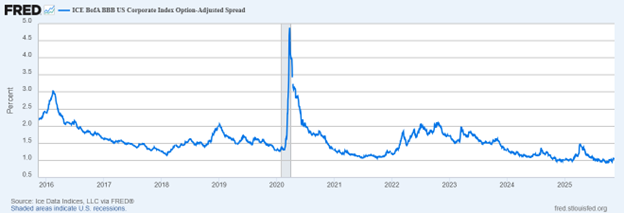
High-yield spreads, another gauge of risk appetite, remain at cycle lows. Tight spreads indicate that credit investors, historically quicker to detect financial fragility, see little to no meaningful deterioration in corporate fundamentals. If there were real macro or earnings-driven stress brewing, spreads would be increasingly widening, but alas, they are not.
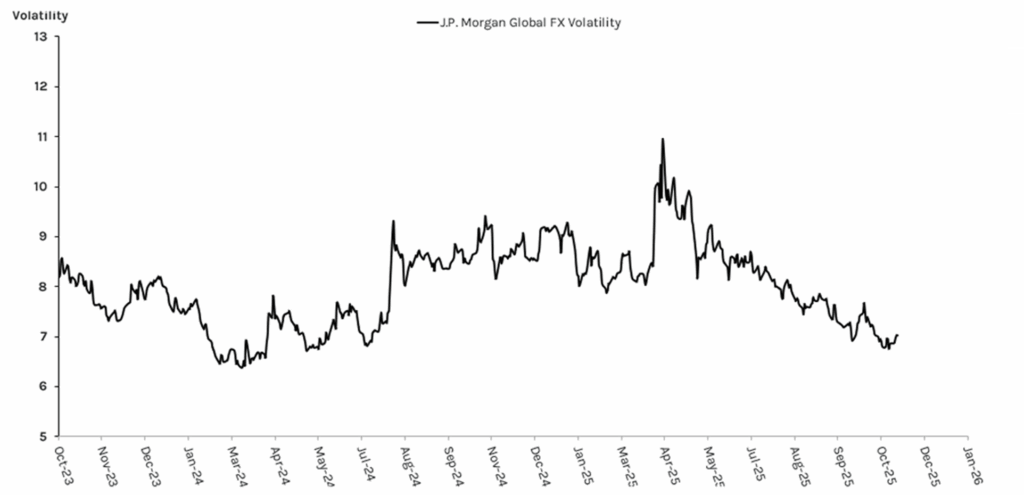
Lastly, global currency volatility remains at very depressed levels. FX or currency markets are the original 24-hour trading markets. They are usually the quickest to react to geopolitical events, liquidity stress, or growth fears. No currency volatility means a lack of financial distress.
In sum, though equity volatility has risen over the last few weeks, the bond, credit, and currency markets say the volatility is episodic, non-trending, and localized to equities rather than a broader risk-off signal.
Have a great week!
-Matt
Sources: YCharts, Hedgeye, Federal Reserve Bank of St. Louis, Barchart, CBOE
This communication and its contents are for informational and educational purposes only and should not be used as the sole basis for any investment decision. The information contained herein is based on publicly available sources believed to be reliable but is not a representation, expressed or implied, as to the accuracy, completeness, or correctness of said information. References to political figures or policies are for informational purposes only and do not represent an endorsement by Waddell & Associates. Any forward-looking statements reflect current opinions and assumptions and are subject to change without notice; actual results may differ materially. Past performance does not guarantee future results. Waddell & Associates may use artificial intelligence tools to help generate or summarize content; all outputs are reviewed by our team for accuracy and relevance.
">The Vol of Fall
November has brought about a more turbulent stretch for markets. The longest government shutdown in history officially ended this past Wednesday, but not all sources of uncertainty have faded. The Supreme Court is set to hear arguments related to President Trump’s tariff authority over the coming weeks adding a fresh layer of policy risk. Meanwhile, earnings season has largely wrapped up, yet investor attention will be focused on Nvidia’s results Wednesday evening, a spectacle that increasingly serves as a proxy for broader sentiment on AI, capex, and mega-cap leadership.
Taken together, these forces have produced an uptick in equity volatility to start November. But when you look across other indicators of stress, the picture clears. Bond volatility is subdued, credit spreads remain tight, and currency volatility is still near cycle lows. The disconnect is meaningful: it suggests the stress in equities is not being driven by macro fears or financial instability but rather a healthy, if sometimes uncomfortable, hedge of uncertainty.
Stocks, Bonds, and Currencies
The CBOE Volatility Index (VIX), the market’s most common gauge of near-term S&P 500 volatility, has been steadily climbing since Halloween. We’ve seen two notable 1–2% pullbacks in recent weeks: Friday, Nov. 7 and again Friday morning, Nov. 14, both of which were quickly bought back. This pattern of sharp dips followed by equally sharp recoveries has contributed to a grind higher in equity volatility over the last two weeks.
In contrast to equities, Treasury volatility tells a much calmer story. The MOVE Index, the bond-market equivalent of the VIX, has ticked slightly higher but remains near year-to-date lows. When bond volatility stays anchored, it signals that investors are not concerned about recession risk, liquidity, or expect major shifts in Fed policy. Fixed income markets are behaving as if the current bout of equity volatility is noise, not signal.
High-yield spreads, another gauge of risk appetite, remain at cycle lows. Tight spreads indicate that credit investors, historically quicker to detect financial fragility, see little to no meaningful deterioration in corporate fundamentals. If there were real macro or earnings-driven stress brewing, spreads would be increasingly widening, but alas, they are not.
Lastly, global currency volatility remains at very depressed levels. FX or currency markets are the original 24-hour trading markets. They are usually the quickest to react to geopolitical events, liquidity stress, or growth fears. No currency volatility means a lack of financial distress.
In sum, though equity volatility has risen over the last few weeks, the bond, credit, and currency markets say the volatility is episodic, non-trending, and localized to equities rather than a broader risk-off signal.
Have a great week!
-Matt
Sources: YCharts, Hedgeye, Federal Reserve Bank of St. Louis, Barchart, CBOE
This communication and its contents are for informational and educational purposes only and should not be used as the sole basis for any investment decision. The information contained herein is based on publicly available sources believed to be reliable but is not a representation, expressed or implied, as to the accuracy, completeness, or correctness of said information. References to political figures or policies are for informational purposes only and do not represent an endorsement by Waddell & Associates. Any forward-looking statements reflect current opinions and assumptions and are subject to change without notice; actual results may differ materially. Past performance does not guarantee future results. Waddell & Associates may use artificial intelligence tools to help generate or summarize content; all outputs are reviewed by our team for accuracy and relevance.
" class="link-chevron">
Corporate culture isn’t something you install, it’s something you express. It’s the fusion of the passions, values, capabilities, and personalities of the people within a firm that radiates outward as identity. I spoke with a reporter earlier this week about which achievement I am most proud of.
As W&A approaches our 40th anniversary, our greatest achievement is not the amount of money that we manage, it’s not the number of clients that we serve, it’s not our geographic expansion into a national footprint, and it’s not the numerous awards that we have received. Our greatest achievement is the continuity of our culture. We enrich lives by providing clarity. We do the right things for the right reasons. We voyage together with our clients, colleagues, and communities. We are always learning, so we are always improving. Our gratitude inspires us to honor your trust and confidence in us with dedicated care.
Phyllis Scruggs joined our firm in 1993 as our 4th member after selling her family business and immersing herself in technology and finance. Her rapid accumulation of academic and professional credentials (MBA, CFA®, CFP®) brought a new level of capabilities—and spirited debate—to our small firm.
My father founded W&A to rebel against a Wall Street culture that often manipulated, mismanaged, and misappropriated investor assets. Simply offering jaded investors with honest and capable money management services provided plenty of marketplace differentiation with which to build a business. W&A was a premium product business built on trustworthiness and investment results.
Phyllis wanted W&A to be a premium service business built on immersive financial planning and continuous client communications. While the asset management business and the financial planning business seem similar, they have vastly different staffing requirements and vastly different profit margins. At that time, the combination of the two disciplines, now known ubiquitously as “wealth management” didn’t really exist.
When I entered the firm in 2000, I settled the debate. We would use the financial planning process to determine the rate of return required for each client to achieve their vision of financial success, and we would use our asset management capabilities to provide the prescribed returns.
We would employ financial planners as relationship managers, not salespeople or stock-pickers, and our investment committee would supply them with portfolios to employ in coordination with client objectives. And because life happens and objectives change, we would communicate with our clients frequently to ensure continuous and proper calibration. This strategic decision evolved our business from a luxury product into a highly bespoke service, combining the best of Duke Waddell with the best of Phyllis Scruggs.
Only 30% of family businesses successfully transition to the second generation. Recognizing this dispiriting reality, succession planning became a priority as soon as I joined the firm. At the time, W&A had three partners: Duke Waddell the investor, Phyllis Scruggs the financial planner, and Bill Wunderlich the relationship developer. Before long, and with lots of courage—and debt, we began transitioning ownership from the founding partners.
When we approached Phyllis, the conversation changed. As a spirited negotiator, we anticipated an impasse, but none occurred. Phyllis wanted to create an ESOP with her shares. She wanted the associates she cared for to remain dedicated to our firm, and to our clients, and she wanted them to participate in W&A’s success through direct ownership.
We worked together, constructed the ESOP, and created a fantastic financial windfall for our associates. Following the transaction, Phyllis remained just as active within the business. She served on our board as Vice Chairman, she served as an active member of our investment committee, and she served her client base with the same professionalism and vigor as always. Phyllis was in it for the money… it just wasn’t her money she focused on.
Phyllis’s client meetings became legendary at W&A. Rarely did a call or a meeting not run for hours. We had to build additional conference rooms as Phyllis would perpetually commandeer one. With Phyllis, there were no small details. Her dedication to mastering her craft paled in comparison with her dedication to mastering her client’s details. She over-prepared and she over-delivered.
She became the standard bearer, not only within W&A but also within our industry. Phyllis served on the board of our local Financial Professional Association which won a national award for excellence in 1998 with Phyllis as Chairman. She served in leadership roles in many other community organizations as well as nationwide, each achieving newfound levels of success with Phyllis on the job.
On Saturday morning, November 1st, Phyllis Scruggs peacefully passed away in the arms of her greatest dedication; her husband of 54 years, David Scruggs. Over the last week, I have spoken with many of her clients. You would expect respect, you would expect sadness, you would expect condolences, but what I received was so much more:
“I am living a life I only dreamed of because of her.”
“She saved me from all of the bad decisions that would have ruined me.”
“She knows more about my financial life than I do.”
“She wasn’t just my financial advisor; she was one of my closest and dearest friends.”
“I don’t think I could have gotten through my mother’s death without her.”
Thank you, Phyllis, for providing our firm direction, for nurturing our associates, and for loving our clients. While you may no longer share your wisdom, you will always share your spirit. It lives within our design, it lives within our culture, and it lives within our hearts.
We will honor you by forever staying true to the values, craftsmanship, and dedication you lived, and instilled in us. For that is the true measure of our success.
Life and career well done, Phyllis. Rest easy.
David

This communication and its contents are for informational and educational purposes only and should not be used as the sole basis for any investment decision. The information contained herein is based on publicly available sources believed to be reliable but is not a representation, expressed or implied, as to the accuracy, completeness, or correctness of said information. References to political figures or policies are for informational purposes only and do not represent an endorsement by Waddell & Associates. Any forward-looking statements reflect current opinions and assumptions and are subject to change without notice; actual results may differ materially. Past performance does not guarantee future results. Waddell & Associates may use artificial intelligence tools to help generate or summarize content; all outputs are reviewed by our team for accuracy and relevance.
">For Phyllis
Corporate culture isn’t something you install, it’s something you express. It’s the fusion of the passions, values, capabilities, and personalities of the people within a firm that radiates outward as identity. I spoke with a reporter earlier this week about which achievement I am most proud of.
As W&A approaches our 40th anniversary, our greatest achievement is not the amount of money that we manage, it’s not the number of clients that we serve, it’s not our geographic expansion into a national footprint, and it’s not the numerous awards that we have received. Our greatest achievement is the continuity of our culture. We enrich lives by providing clarity. We do the right things for the right reasons. We voyage together with our clients, colleagues, and communities. We are always learning, so we are always improving. Our gratitude inspires us to honor your trust and confidence in us with dedicated care.
Phyllis Scruggs joined our firm in 1993 as our 4th member after selling her family business and immersing herself in technology and finance. Her rapid accumulation of academic and professional credentials (MBA, CFA®, CFP®) brought a new level of capabilities—and spirited debate—to our small firm.
My father founded W&A to rebel against a Wall Street culture that often manipulated, mismanaged, and misappropriated investor assets. Simply offering jaded investors with honest and capable money management services provided plenty of marketplace differentiation with which to build a business. W&A was a premium product business built on trustworthiness and investment results.
Phyllis wanted W&A to be a premium service business built on immersive financial planning and continuous client communications. While the asset management business and the financial planning business seem similar, they have vastly different staffing requirements and vastly different profit margins. At that time, the combination of the two disciplines, now known ubiquitously as “wealth management” didn’t really exist.
When I entered the firm in 2000, I settled the debate. We would use the financial planning process to determine the rate of return required for each client to achieve their vision of financial success, and we would use our asset management capabilities to provide the prescribed returns.
We would employ financial planners as relationship managers, not salespeople or stock-pickers, and our investment committee would supply them with portfolios to employ in coordination with client objectives. And because life happens and objectives change, we would communicate with our clients frequently to ensure continuous and proper calibration. This strategic decision evolved our business from a luxury product into a highly bespoke service, combining the best of Duke Waddell with the best of Phyllis Scruggs.
Only 30% of family businesses successfully transition to the second generation. Recognizing this dispiriting reality, succession planning became a priority as soon as I joined the firm. At the time, W&A had three partners: Duke Waddell the investor, Phyllis Scruggs the financial planner, and Bill Wunderlich the relationship developer. Before long, and with lots of courage—and debt, we began transitioning ownership from the founding partners.
When we approached Phyllis, the conversation changed. As a spirited negotiator, we anticipated an impasse, but none occurred. Phyllis wanted to create an ESOP with her shares. She wanted the associates she cared for to remain dedicated to our firm, and to our clients, and she wanted them to participate in W&A’s success through direct ownership.
We worked together, constructed the ESOP, and created a fantastic financial windfall for our associates. Following the transaction, Phyllis remained just as active within the business. She served on our board as Vice Chairman, she served as an active member of our investment committee, and she served her client base with the same professionalism and vigor as always. Phyllis was in it for the money… it just wasn’t her money she focused on.
Phyllis’s client meetings became legendary at W&A. Rarely did a call or a meeting not run for hours. We had to build additional conference rooms as Phyllis would perpetually commandeer one. With Phyllis, there were no small details. Her dedication to mastering her craft paled in comparison with her dedication to mastering her client’s details. She over-prepared and she over-delivered.
She became the standard bearer, not only within W&A but also within our industry. Phyllis served on the board of our local Financial Professional Association which won a national award for excellence in 1998 with Phyllis as Chairman. She served in leadership roles in many other community organizations as well as nationwide, each achieving newfound levels of success with Phyllis on the job.
On Saturday morning, November 1st, Phyllis Scruggs peacefully passed away in the arms of her greatest dedication; her husband of 54 years, David Scruggs. Over the last week, I have spoken with many of her clients. You would expect respect, you would expect sadness, you would expect condolences, but what I received was so much more:
“I am living a life I only dreamed of because of her.”
“She saved me from all of the bad decisions that would have ruined me.”
“She knows more about my financial life than I do.”
“She wasn’t just my financial advisor; she was one of my closest and dearest friends.”
“I don’t think I could have gotten through my mother’s death without her.”
Thank you, Phyllis, for providing our firm direction, for nurturing our associates, and for loving our clients. While you may no longer share your wisdom, you will always share your spirit. It lives within our design, it lives within our culture, and it lives within our hearts.
We will honor you by forever staying true to the values, craftsmanship, and dedication you lived, and instilled in us. For that is the true measure of our success.
Life and career well done, Phyllis. Rest easy.
David
This communication and its contents are for informational and educational purposes only and should not be used as the sole basis for any investment decision. The information contained herein is based on publicly available sources believed to be reliable but is not a representation, expressed or implied, as to the accuracy, completeness, or correctness of said information. References to political figures or policies are for informational purposes only and do not represent an endorsement by Waddell & Associates. Any forward-looking statements reflect current opinions and assumptions and are subject to change without notice; actual results may differ materially. Past performance does not guarantee future results. Waddell & Associates may use artificial intelligence tools to help generate or summarize content; all outputs are reviewed by our team for accuracy and relevance.
" class="link-chevron">
The Full Story:
This week contained a cornucopia of market-moving morsels. Fed action, earnings action, tariff action, and year-end positioning pressed all three major stock market indices to fresh new highs. However, beneath the surface, individual stock performance showed far less conviction. With ten months of the year and 15%+ returns now behind us, will this rally rest…for the rest of 2025?
Powell Says What?
Jerome Powell provided monetary easing by cutting the Federal Funds rate .25%, but also conversational tightening by saying further cuts in December are “not a forgone conclusion” and, in fact, “far from it”. Odds of a December rate cut fell from 95% before the meeting to 60% after. This added some uplift to longer-term yields across the Treasury curve and downforce on more interest-rate sensitive areas of the market like the Ex-Mags and smaller cap stocks. Powell apparently sees more strength in the labor markets and risk of reinflation than markets anticipated. The lack of economic data releases due to the shutdown only exacerbated communication confusion as perhaps Powell knows something we don’t know. Ironically, the impact of the government shutdown should be less growth, less labor strength and lower inflation. Go figure. Stocks struggled with the interpretation, ending Wednesday essentially unchanged due to the dovish cut and hawkish chat. Whether the Fed cuts rates in December or not, they will be cutting rates further in 2026 as each of Trump’s candidates to replace Powell on May 15th have assured.
Friends Again
Donald Trump stylized his meeting with Xi Jinping of China a 12 on a 10-point scale. As a result of the pleasantries and gift exchange, the US agreed to cut tariffs on Chinese goods from 57% to 47% while China agreed they will sell us more rare earth materials, less fentanyl, and will buy more soybeans. This amounts to a tactical trade truce with China for now, removing a key risk factor for the markets. None of this has been papered of course but concerns over a reescalation of trade tensions with China have abated.
How Magnificent!
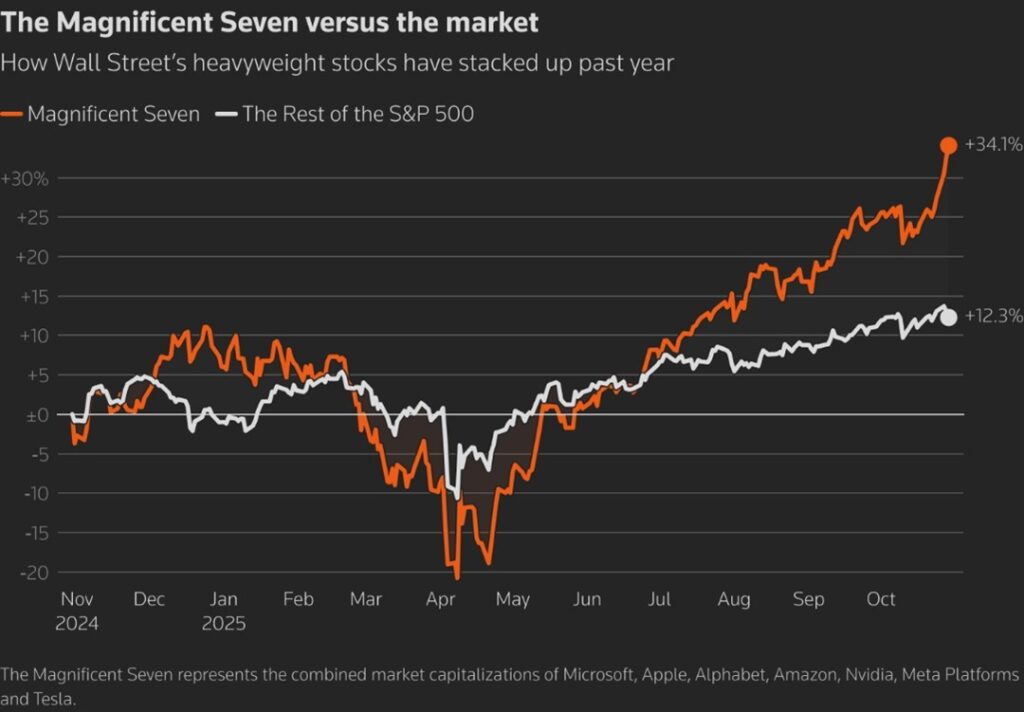
Six of the Mag 7 stocks have now reported their 3rd quarter earnings. Investors praised and rewarded results for Apple, Amazon, and Google, while punishing Tesla, Microsoft, and META. Nvidia matters most but will not report until November 19th. Investments into AI continue to outpace returns on AI for these companies, but their legacy business units continue to perform well and provide cash flow to underwrite the hyper scaling. However, the ratio of cash flow to capex ratio has been declining given the ever-higher level of AI investment. This bears watching as rising financing requirements on unknown outcomes increases risk, but this hasn’t interrupted return trends to date. Overall, the market passed this quarter’s Mag 7 earnings moment (pending Nvidia), and their atmospheric trends as a cohort continue:
Is That You, Santa Claus?
Welcome to November and the potential for a year-end Santa Claus rally. By this point in the year most problematic unknowns have become pacifying knowns. The trade war has effectively ended. The OBBB has passed. The Fed has started its rate reduction campaign. Gaza has a peace plan on paper. Russia’s theatre seems contained (even more so since we re-friended China), and the US border has been sealed without economic distress. The indices have priced this reality in as evidenced by the continuous claims of all-time highs. Traditionally, late October marks the beginning of a year-end rally, but also the completion of a seasonal pullback period:
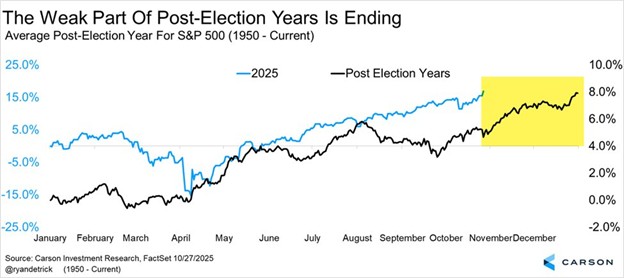
That didn’t happen this year as both September and October provided above average returns. Did Santa come early? Maybe, but historically a strong first 10 months presages a strong last two months as well:
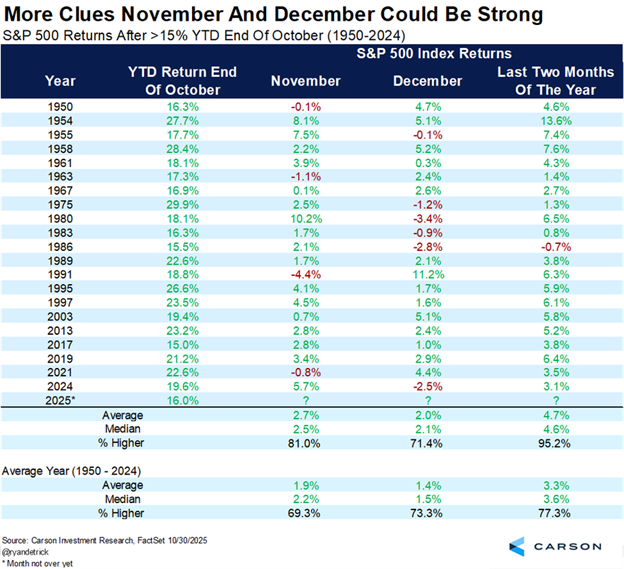
Over the last 75 years, when the S&P 500 has gained more than 15% in the first ten months, it rose another 4.7% on average over the last two. Furthermore, the two-month period over these occurrences delivered positive returns 95% of the time. Markets have a way of embarrassing forecasters, but with strong results for this earnings season, and positive guidance for many earnings seasons to come, Santa may just yet deliver S&P 7,000 by year end, unless interrupted by some unforeseen Grinch. Rally Ho!
Have a great weekend!
-David
Sources: Bloomberg, Carson Investment Research
This communication and its contents are for informational and educational purposes only and should not be used as the sole basis for any investment decision. The information contained herein is based on publicly available sources believed to be reliable but is not a representation, expressed or implied, as to the accuracy, completeness, or correctness of said information. References to political figures or policies are for informational purposes only and do not represent an endorsement by Waddell & Associates. Any forward-looking statements reflect current opinions and assumptions and are subject to change without notice; actual results may differ materially. Past performance does not guarantee future results. Waddell & Associates may use artificial intelligence tools to help generate or summarize content; all outputs are reviewed by our team for accuracy and relevance.
">‘Tis The Season? The Full Story:This week contained a cornucopia of market-moving morsels. Fed action, earnings action, tariff action, and year-end positioning pressed all three major stock market indices to fresh new highs. However, beneath the surface, individual stock performance showed far less conviction. With ten months of the year and 15%+ returns now behind us, will this rally rest…for the rest of 2025?
Powell Says What?
Jerome Powell provided monetary easing by cutting the Federal Funds rate .25%, but also conversational tightening by saying further cuts in December are “not a forgone conclusion” and, in fact, “far from it”. Odds of a December rate cut fell from 95% before the meeting to 60% after. This added some uplift to longer-term yields across the Treasury curve and downforce on more interest-rate sensitive areas of the market like the Ex-Mags and smaller cap stocks. Powell apparently sees more strength in the labor markets and risk of reinflation than markets anticipated. The lack of economic data releases due to the shutdown only exacerbated communication confusion as perhaps Powell knows something we don’t know. Ironically, the impact of the government shutdown should be less growth, less labor strength and lower inflation. Go figure. Stocks struggled with the interpretation, ending Wednesday essentially unchanged due to the dovish cut and hawkish chat. Whether the Fed cuts rates in December or not, they will be cutting rates further in 2026 as each of Trump’s candidates to replace Powell on May 15th have assured.
Friends Again
Donald Trump stylized his meeting with Xi Jinping of China a 12 on a 10-point scale. As a result of the pleasantries and gift exchange, the US agreed to cut tariffs on Chinese goods from 57% to 47% while China agreed they will sell us more rare earth materials, less fentanyl, and will buy more soybeans. This amounts to a tactical trade truce with China for now, removing a key risk factor for the markets. None of this has been papered of course but concerns over a reescalation of trade tensions with China have abated.
How Magnificent!
Six of the Mag 7 stocks have now reported their 3rd quarter earnings. Investors praised and rewarded results for Apple, Amazon, and Google, while punishing Tesla, Microsoft, and META. Nvidia matters most but will not report until November 19th. Investments into AI continue to outpace returns on AI for these companies, but their legacy business units continue to perform well and provide cash flow to underwrite the hyper scaling. However, the ratio of cash flow to capex ratio has been declining given the ever-higher level of AI investment. This bears watching as rising financing requirements on unknown outcomes increases risk, but this hasn’t interrupted return trends to date. Overall, the market passed this quarter’s Mag 7 earnings moment (pending Nvidia), and their atmospheric trends as a cohort continue:
Is That You, Santa Claus?
Welcome to November and the potential for a year-end Santa Claus rally. By this point in the year most problematic unknowns have become pacifying knowns. The trade war has effectively ended. The OBBB has passed. The Fed has started its rate reduction campaign. Gaza has a peace plan on paper. Russia’s theatre seems contained (even more so since we re-friended China), and the US border has been sealed without economic distress. The indices have priced this reality in as evidenced by the continuous claims of all-time highs. Traditionally, late October marks the beginning of a year-end rally, but also the completion of a seasonal pullback period:
That didn’t happen this year as both September and October provided above average returns. Did Santa come early? Maybe, but historically a strong first 10 months presages a strong last two months as well:
Over the last 75 years, when the S&P 500 has gained more than 15% in the first ten months, it rose another 4.7% on average over the last two. Furthermore, the two-month period over these occurrences delivered positive returns 95% of the time. Markets have a way of embarrassing forecasters, but with strong results for this earnings season, and positive guidance for many earnings seasons to come, Santa may just yet deliver S&P 7,000 by year end, unless interrupted by some unforeseen Grinch. Rally Ho!
Have a great weekend!
-David
Sources: Bloomberg, Carson Investment Research
This communication and its contents are for informational and educational purposes only and should not be used as the sole basis for any investment decision. The information contained herein is based on publicly available sources believed to be reliable but is not a representation, expressed or implied, as to the accuracy, completeness, or correctness of said information. References to political figures or policies are for informational purposes only and do not represent an endorsement by Waddell & Associates. Any forward-looking statements reflect current opinions and assumptions and are subject to change without notice; actual results may differ materially. Past performance does not guarantee future results. Waddell & Associates may use artificial intelligence tools to help generate or summarize content; all outputs are reviewed by our team for accuracy and relevance.
" class="link-chevron">A client walked into our office last month with a portfolio that was 90% stocks. He felt pretty good about it given recent market performance.
But here’s what happened when we sat down and built his financial plan together. The analysis suggested a 60% stock allocation could hit every goal he cared about.
This isn’t unusual. Many people think bigger risk equals bigger reward, but that isn’t always the case.
We Start with a Boring Answer That Changes Everything
When we work with clients, we ask one question first: What return do you actually need?
That means looking at your financial plan which is the foundation for every asset allocation decision.
Sometimes you find out you’re taking more risk than necessary. Other times you realize you’re being overly conservative and missing potential opportunities.
Your financial plan should drive every investment decision. Not headlines. Not tips from friends. Not even our latest market forecasts.
Often, clients who come to us with too-aggressive portfolio tell a similar story. They haven’t looked at their financial plan in years. Or they skipped that step entirely and jumped straight to “how do I get rich faster?”
You’re investing your money, so it’s natural to want the highest return possible. But when we dig into what you’re really trying to accomplish, the numbers often tell a different story.
Why take the wild swings of a 90/10 portfolio if a more moderate allocation could get you to retirement just fine? You’re taking on risk without achieving any real benefit.
Take the clients in their late 50s and early 60s who want to retire early. Their portfolios aren’t ready for retirement until they’re 65 or 67, so they’re taking on more risk hoping to compress their timeline. We help them figure out if that’s the right approach for their situation.
When We Actually Recommend More Risk (And the Conversations That Follow)
Sometimes we determine together that you need to take on more risk. If your plan requires higher returns to work, you might need more stocks than bonds have historically delivered.
That’s when we have our most interesting conversations. Do you truly prefer a higher potential return if it means dealing with the volatility? Or would you rather work two more years, but know your allocation has less risk?
Neither choice is wrong. It depends on what matters most to you.
Age can be a factor, but it’s not the only one. Younger clients often have time to recover from market pullbacks, so we can typically build more aggressive allocations. But we also work with some older clients who may have the assets to take on longer time horizons with alternatives because they don’t need that liquidity tomorrow.
It often comes down to liquidity needs and figuring out what makes the most sense for your unique situation.
The Stuff That Doesn’t Show Up in Our Models
Numbers only tell part of the story. The emotional side matters too, and it shows up in ways that tend to surprise people.
We worked with a client who inherited his father’s stock portfolio. One company made up 40% of its investments. A level of concentration that can significantly increase risk.
But when we suggested rebalancing, he hesitated.
His dad had this stock for thirty years, and he said it felt like throwing away part of him.
These moments require more than spreadsheet analysis. We often discuss strategies with clients that find ways to honor what matters emotionally while still building portfolios that make financial sense.
This comes up regularly when parents pass away and leave concentrated positions. There’s sentimental value attached to certain investments. People want to maintain that connection.
But here’s what we’ve learned working with families: you can honor that emotional attachment while still managing risk appropriately. For some, that may mean keeping a smaller tribute position while diversifying the rest. Sometimes it means deeper conversations about what that person would have actually wanted for their family’s financial security.
What We’re Actually Seeing in Portfolios Right Now
Markets have generally recovered since that 2022 pullback. Here’s what we identify and address in client meetings:
Equity allocations have drifted higher than planned.
Strong markets push stock percentages up automatically. When we review portfolios, we often find clients taking more risks than their original plan called for. Time to rebalance.
Many clients are sitting on more cash than makes sense.
For our higher net worth clients especially, we’re considering alternatives that could provide better potential returns when immediate liquidity isn’t needed. But this depends entirely on each situation.
Life keeps changing, so we’re scheduling more frequent check-ins.
Goals shift. Family situations evolve. Business ventures develop. We make sure portfolios keep up.
Our role is to work through these changes with you. We gather information first. The more we understand your situation and concerns, the better plan we can create together.
But plans evolve constantly. What made sense last year might not work today. That’s why we meet regularly to make sure everything still lines up.
Sometimes this means taking advantage of market opportunities. At times, market pull backs may create opportunities to rebalance or apply tax strategies depending on a client’s situation. In certain situations, clients may choose to adjust allocations or explore strategies to improve tax efficiency as part of their overall plan.
We also look at your complete financial picture. Many clients have complex situations like trusts, business interests, real estate holdings, or executive compensation. Asset allocation isn’t just about investment accounts. It’s about how all these pieces work together in your wealth strategy.
The Real Goal Here
When we sit down to review your asset allocation, we’re serving your financial plan. Not reacting to market headlines or chasing benchmarks.
The goal isn’t squeezing every possible return out of your portfolio. The goal is to build a strategy designed to support your goals in a way you can remain comfortable with during different market conditions.
Good investing isn’t about taking the most risk or chasing the highest returns. Effective investing often involves balancing risk appropriately for your specific situation and maintaining an allocation you can stick with through changing environments.
In our experience, the clients who feel the most confident have clear plans, understand why we’ve structured their portfolios the way we have, and trust us to help navigate whatever comes up along the way.
Because complexity always comes up with substantial wealth, we’re here to help you think through the implications and make decisions that align with your vision for your family’s future.
Have questions about how your portfolio aligns with your goals? Please reach out to your W&A wealth strategist with any questions and the opportunity to connect more on this topic.
New here? Learn about the Waddell & Associates difference and explore how you can work with us. We’d love to hear from you.
Robby J. Graham is a Memphis-based wealth strategist focusing on high-net-worth family planning at Waddell & Associates.
This content is for informational purposes only and should not be considered legal, tax, or investment advice. Opinions are those of the author and may change. Waddell & Associates is an SEC-registered investment adviser. Registration does not imply a certain level of skill. Past performance is not indicative of future results. Please consult your professional advisors before making financial decisions.
">
How to Build Portfolios That Serve your Goals Instead of Chasing Returns
A client walked into our office last month with a portfolio that was 90% stocks. He felt pretty good about it given recent market performance.
But here’s what happened when we sat down and built his financial plan together. The analysis suggested a 60% stock allocation could hit every goal he cared about.
This isn’t unusual. Many people think bigger risk equals bigger reward, but that isn’t always the case.
We Start with a Boring Answer That Changes Everything
When we work with clients, we ask one question first: What return do you actually need?
That means looking at your financial plan which is the foundation for every asset allocation decision.
Sometimes you find out you’re taking more risk than necessary. Other times you realize you’re being overly conservative and missing potential opportunities.
Your financial plan should drive every investment decision. Not headlines. Not tips from friends. Not even our latest market forecasts.
Often, clients who come to us with too-aggressive portfolio tell a similar story. They haven’t looked at their financial plan in years. Or they skipped that step entirely and jumped straight to “how do I get rich faster?”
You’re investing your money, so it’s natural to want the highest return possible. But when we dig into what you’re really trying to accomplish, the numbers often tell a different story.
Why take the wild swings of a 90/10 portfolio if a more moderate allocation could get you to retirement just fine? You’re taking on risk without achieving any real benefit.
Take the clients in their late 50s and early 60s who want to retire early. Their portfolios aren’t ready for retirement until they’re 65 or 67, so they’re taking on more risk hoping to compress their timeline. We help them figure out if that’s the right approach for their situation.
When We Actually Recommend More Risk (And the Conversations That Follow)
Sometimes we determine together that you need to take on more risk. If your plan requires higher returns to work, you might need more stocks than bonds have historically delivered.
That’s when we have our most interesting conversations. Do you truly prefer a higher potential return if it means dealing with the volatility? Or would you rather work two more years, but know your allocation has less risk?
Neither choice is wrong. It depends on what matters most to you.
Age can be a factor, but it’s not the only one. Younger clients often have time to recover from market pullbacks, so we can typically build more aggressive allocations. But we also work with some older clients who may have the assets to take on longer time horizons with alternatives because they don’t need that liquidity tomorrow.
It often comes down to liquidity needs and figuring out what makes the most sense for your unique situation.
The Stuff That Doesn’t Show Up in Our Models
Numbers only tell part of the story. The emotional side matters too, and it shows up in ways that tend to surprise people.
We worked with a client who inherited his father’s stock portfolio. One company made up 40% of its investments. A level of concentration that can significantly increase risk.
But when we suggested rebalancing, he hesitated.
His dad had this stock for thirty years, and he said it felt like throwing away part of him.
These moments require more than spreadsheet analysis. We often discuss strategies with clients that find ways to honor what matters emotionally while still building portfolios that make financial sense.
This comes up regularly when parents pass away and leave concentrated positions. There’s sentimental value attached to certain investments. People want to maintain that connection.
But here’s what we’ve learned working with families: you can honor that emotional attachment while still managing risk appropriately. For some, that may mean keeping a smaller tribute position while diversifying the rest. Sometimes it means deeper conversations about what that person would have actually wanted for their family’s financial security.
What We’re Actually Seeing in Portfolios Right Now
Markets have generally recovered since that 2022 pullback. Here’s what we identify and address in client meetings:
Equity allocations have drifted higher than planned.
Strong markets push stock percentages up automatically. When we review portfolios, we often find clients taking more risks than their original plan called for. Time to rebalance.
Many clients are sitting on more cash than makes sense.
For our higher net worth clients especially, we’re considering alternatives that could provide better potential returns when immediate liquidity isn’t needed. But this depends entirely on each situation.
Life keeps changing, so we’re scheduling more frequent check-ins.
Goals shift. Family situations evolve. Business ventures develop. We make sure portfolios keep up.
Our role is to work through these changes with you. We gather information first. The more we understand your situation and concerns, the better plan we can create together.
But plans evolve constantly. What made sense last year might not work today. That’s why we meet regularly to make sure everything still lines up.
Sometimes this means taking advantage of market opportunities. At times, market pull backs may create opportunities to rebalance or apply tax strategies depending on a client’s situation. In certain situations, clients may choose to adjust allocations or explore strategies to improve tax efficiency as part of their overall plan.
We also look at your complete financial picture. Many clients have complex situations like trusts, business interests, real estate holdings, or executive compensation. Asset allocation isn’t just about investment accounts. It’s about how all these pieces work together in your wealth strategy.
The Real Goal Here
When we sit down to review your asset allocation, we’re serving your financial plan. Not reacting to market headlines or chasing benchmarks.
The goal isn’t squeezing every possible return out of your portfolio. The goal is to build a strategy designed to support your goals in a way you can remain comfortable with during different market conditions.
Good investing isn’t about taking the most risk or chasing the highest returns. Effective investing often involves balancing risk appropriately for your specific situation and maintaining an allocation you can stick with through changing environments.
In our experience, the clients who feel the most confident have clear plans, understand why we’ve structured their portfolios the way we have, and trust us to help navigate whatever comes up along the way.
Because complexity always comes up with substantial wealth, we’re here to help you think through the implications and make decisions that align with your vision for your family’s future.
Have questions about how your portfolio aligns with your goals? Please reach out to your W&A wealth strategist with any questions and the opportunity to connect more on this topic.
New here? Learn about the Waddell & Associates difference and explore how you can work with us. We’d love to hear from you.
Robby J. Graham is a Memphis-based wealth strategist focusing on high-net-worth family planning at Waddell & Associates.
This content is for informational purposes only and should not be considered legal, tax, or investment advice. Opinions are those of the author and may change. Waddell & Associates is an SEC-registered investment adviser. Registration does not imply a certain level of skill. Past performance is not indicative of future results. Please consult your professional advisors before making financial decisions.
">Why Financial Plans (Not Market Headlines) Should Drive Asset Allocation How to Build Portfolios That Serve your Goals Instead of Chasing ReturnsA client walked into our office last month with a portfolio that was 90% stocks. He felt pretty good about it given recent market performance.
But here’s what happened when we sat down and built his financial plan together. The analysis suggested a 60% stock allocation could hit every goal he cared about.
This isn’t unusual. Many people think bigger risk equals bigger reward, but that isn’t always the case.
We Start with a Boring Answer That Changes Everything
When we work with clients, we ask one question first: What return do you actually need?
That means looking at your financial plan which is the foundation for every asset allocation decision.
Sometimes you find out you’re taking more risk than necessary. Other times you realize you’re being overly conservative and missing potential opportunities.
Your financial plan should drive every investment decision. Not headlines. Not tips from friends. Not even our latest market forecasts.
Often, clients who come to us with too-aggressive portfolio tell a similar story. They haven’t looked at their financial plan in years. Or they skipped that step entirely and jumped straight to “how do I get rich faster?”
You’re investing your money, so it’s natural to want the highest return possible. But when we dig into what you’re really trying to accomplish, the numbers often tell a different story.
Why take the wild swings of a 90/10 portfolio if a more moderate allocation could get you to retirement just fine? You’re taking on risk without achieving any real benefit.
Take the clients in their late 50s and early 60s who want to retire early. Their portfolios aren’t ready for retirement until they’re 65 or 67, so they’re taking on more risk hoping to compress their timeline. We help them figure out if that’s the right approach for their situation.
When We Actually Recommend More Risk (And the Conversations That Follow)
Sometimes we determine together that you need to take on more risk. If your plan requires higher returns to work, you might need more stocks than bonds have historically delivered.
That’s when we have our most interesting conversations. Do you truly prefer a higher potential return if it means dealing with the volatility? Or would you rather work two more years, but know your allocation has less risk?
Neither choice is wrong. It depends on what matters most to you.
Age can be a factor, but it’s not the only one. Younger clients often have time to recover from market pullbacks, so we can typically build more aggressive allocations. But we also work with some older clients who may have the assets to take on longer time horizons with alternatives because they don’t need that liquidity tomorrow.
It often comes down to liquidity needs and figuring out what makes the most sense for your unique situation.
The Stuff That Doesn’t Show Up in Our Models
Numbers only tell part of the story. The emotional side matters too, and it shows up in ways that tend to surprise people.
We worked with a client who inherited his father’s stock portfolio. One company made up 40% of its investments. A level of concentration that can significantly increase risk.
But when we suggested rebalancing, he hesitated.
His dad had this stock for thirty years, and he said it felt like throwing away part of him.
These moments require more than spreadsheet analysis. We often discuss strategies with clients that find ways to honor what matters emotionally while still building portfolios that make financial sense.
This comes up regularly when parents pass away and leave concentrated positions. There’s sentimental value attached to certain investments. People want to maintain that connection.
But here’s what we’ve learned working with families: you can honor that emotional attachment while still managing risk appropriately. For some, that may mean keeping a smaller tribute position while diversifying the rest. Sometimes it means deeper conversations about what that person would have actually wanted for their family’s financial security.
What We’re Actually Seeing in Portfolios Right Now
Markets have generally recovered since that 2022 pullback. Here’s what we identify and address in client meetings:
Equity allocations have drifted higher than planned.
Strong markets push stock percentages up automatically. When we review portfolios, we often find clients taking more risks than their original plan called for. Time to rebalance.
Many clients are sitting on more cash than makes sense.
For our higher net worth clients especially, we’re considering alternatives that could provide better potential returns when immediate liquidity isn’t needed. But this depends entirely on each situation.
Life keeps changing, so we’re scheduling more frequent check-ins.
Goals shift. Family situations evolve. Business ventures develop. We make sure portfolios keep up.
Our role is to work through these changes with you. We gather information first. The more we understand your situation and concerns, the better plan we can create together.
But plans evolve constantly. What made sense last year might not work today. That’s why we meet regularly to make sure everything still lines up.
Sometimes this means taking advantage of market opportunities. At times, market pull backs may create opportunities to rebalance or apply tax strategies depending on a client’s situation. In certain situations, clients may choose to adjust allocations or explore strategies to improve tax efficiency as part of their overall plan.
We also look at your complete financial picture. Many clients have complex situations like trusts, business interests, real estate holdings, or executive compensation. Asset allocation isn’t just about investment accounts. It’s about how all these pieces work together in your wealth strategy.
The Real Goal Here
When we sit down to review your asset allocation, we’re serving your financial plan. Not reacting to market headlines or chasing benchmarks.
The goal isn’t squeezing every possible return out of your portfolio. The goal is to build a strategy designed to support your goals in a way you can remain comfortable with during different market conditions.
Good investing isn’t about taking the most risk or chasing the highest returns. Effective investing often involves balancing risk appropriately for your specific situation and maintaining an allocation you can stick with through changing environments.
In our experience, the clients who feel the most confident have clear plans, understand why we’ve structured their portfolios the way we have, and trust us to help navigate whatever comes up along the way.
Because complexity always comes up with substantial wealth, we’re here to help you think through the implications and make decisions that align with your vision for your family’s future.
Have questions about how your portfolio aligns with your goals? Please reach out to your W&A wealth strategist with any questions and the opportunity to connect more on this topic.
New here? Learn about the Waddell & Associates difference and explore how you can work with us. We’d love to hear from you.
Robby J. Graham is a Memphis-based wealth strategist focusing on high-net-worth family planning at Waddell & Associates.
This content is for informational purposes only and should not be considered legal, tax, or investment advice. Opinions are those of the author and may change. Waddell & Associates is an SEC-registered investment adviser. Registration does not imply a certain level of skill. Past performance is not indicative of future results. Please consult your professional advisors before making financial decisions.
" class="link-chevron">
As markets climb to new all-time highs, it’s natural to feel a bit uneasy. After all, buying stocks when they’re most expensive feels counterintuitive. Many investors ponder, “Should I wait for a pullback before putting more cash to work?”
It’s a reasonable question—one that surfaces nearly every time the market reaches a new peak. But history tells us a reassuring story: investing at all-time highs is not as scary as it seems. In fact, the data says that investing through new highs has often led to stronger results. Let’s explore!
Time In the Market
Markets never move in a straight line. In the short-term, news and headlines drive price swings. Over the long haul, earnings growth, productivity, and innovation determine direction.
When markets make new highs, new investors often fear buying the peak, and existing investors wrestle with loss aversion, or our tendency to feel the pain of losses more intensely than the joy of like size gains. But time in the market has consistently proven more valuable than trying to time the market. Furthermore, take the chart below. Since 1988, investing on a day when the S&P500 hits a new all-time high has historically produced better cumulative returns than investing on any other day.
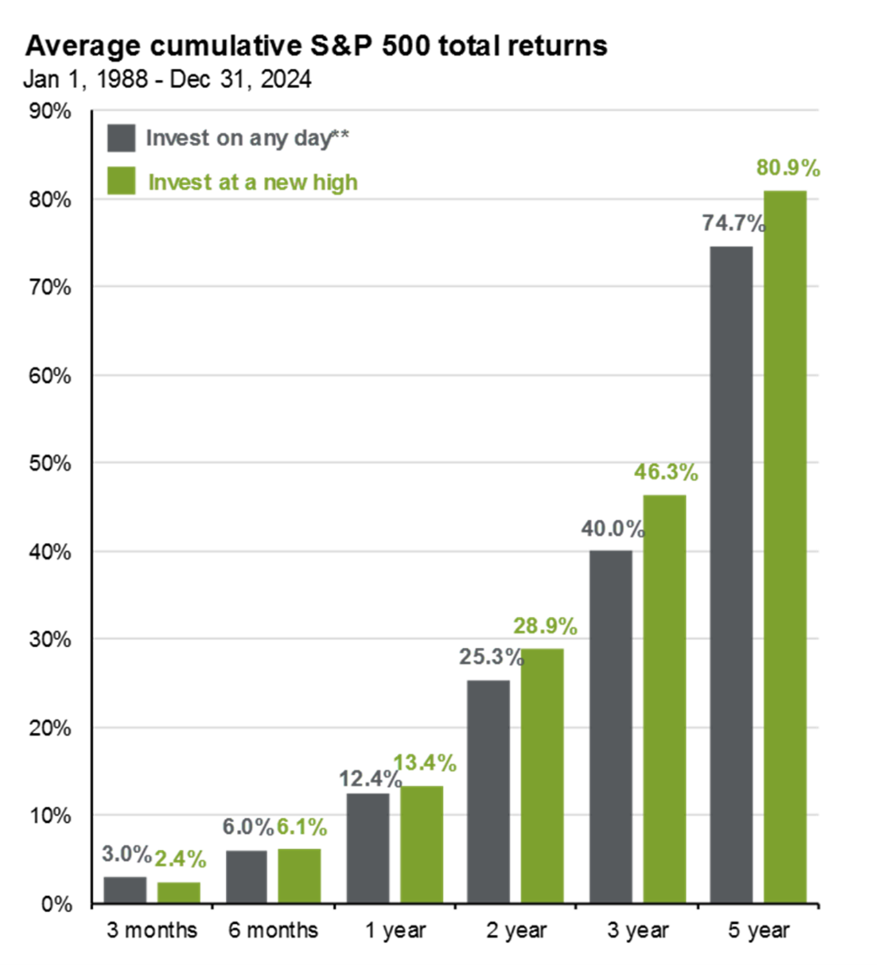
There are a few different factors for this, but the long and short is that new highs tend to perpetuate more, new all-time highs. Growth begets growth. The key takeaway is that new highs typically don’t signal the end of opportunity, but the continuation of it!
What to Do When Markets Feel Expensive
Investing at all-time highs doesn’t mean ignoring the risk but managing it thoughtfully. If investors do feel uneasy with markets at new highs, here are three things to focus on to stay disciplined and strategic:
- Revisit your allocation. After a strong market rally, portfolios may have drifted from a target mix of stocks, bonds, and alternatives. Rebalancing, or selling a bit of what’s grown and adding to what’s lagged, can help maintain discipline and manage risk.
- Have a plan. For new investors, structure matters. Whether one decides to invest in a lump sum or dollar-cost-average investment over a set timeframe, having a defined strategy can reduce the emotional burden of ‘buying the top’.
- Keep perspective. Market pullbacks are normal, even healthy at times. Historically, the S&P500 has averaged an intra-year decline of around 10%, while oftentimes finishing positive despite the decline. Volatility and dips are part of the journey, not the destination!
Further Running of the Bull?
With markets hitting record highs, the question becomes: What could keep this bull market charging further? Two forces stand out today: earnings and pessimism.
Third quarter earnings season kicked off earlier this month and early results have been encouraging. As valuations have increased, earnings must deliver to sustain upward momentum. Of the companies that have reported thus far, 86% have reported a positive earnings surprise. Blended year-over-year earnings growth sits at 8.5%. Looking further ahead, analysts expect earnings growth to broaden beyond the Magnificent 7. Forecasts for 2026 expect Mag 7 earnings to grow but decelerate, while the remaining 493 firms pick up the slack:
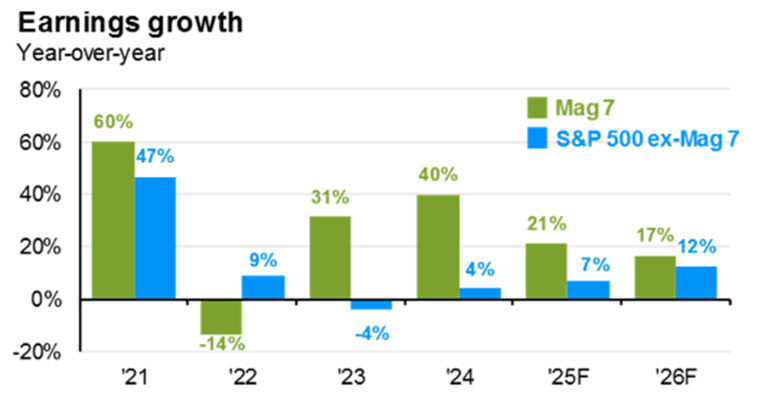
At the same time, consumer and investor sentiment remains remarkably subdued. Surveys of both investors and consumers show confidence at low levels, even as portfolios and household net worths climb higher. The irony is that the pessimism often serves as fuel for future gains. Historically, periods of low sentiment have preceded above average forward returns, as negative expectations leave room for upside surprises!
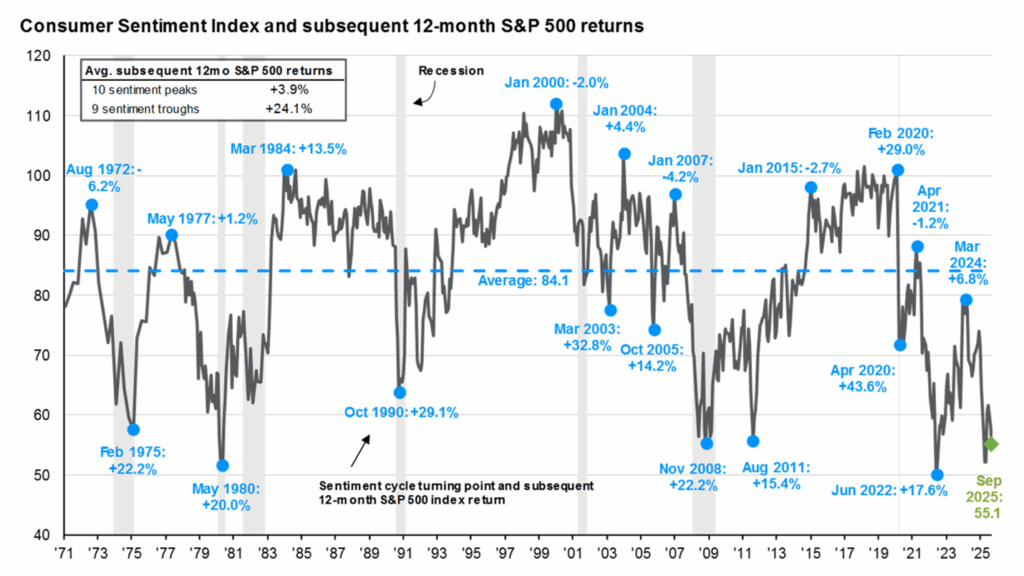
Enjoy the rest of your weekend!
-Matt
Source: JP Morgan Asset Management, Guide to the Markets
This communication and its contents are for informational and educational purposes only and should not be used as the sole basis for any investment decision. The information contained herein is based on publicly available sources believed to be reliable but is not a representation, expressed or implied, as to the accuracy, completeness, or correctness of said information. References to political figures or policies are for informational purposes only and do not represent an endorsement by Waddell & Associates. Any forward-looking statements reflect current opinions and assumptions and are subject to change without notice; actual results may differ materially. Past performance does not guarantee future results. Waddell & Associates may use artificial intelligence tools to help generate or summarize content; all outputs are reviewed by our team for accuracy and relevance.
">All-Time is Long Time
As markets climb to new all-time highs, it’s natural to feel a bit uneasy. After all, buying stocks when they’re most expensive feels counterintuitive. Many investors ponder, “Should I wait for a pullback before putting more cash to work?”
It’s a reasonable question—one that surfaces nearly every time the market reaches a new peak. But history tells us a reassuring story: investing at all-time highs is not as scary as it seems. In fact, the data says that investing through new highs has often led to stronger results. Let’s explore!
Time In the Market
Markets never move in a straight line. In the short-term, news and headlines drive price swings. Over the long haul, earnings growth, productivity, and innovation determine direction.
When markets make new highs, new investors often fear buying the peak, and existing investors wrestle with loss aversion, or our tendency to feel the pain of losses more intensely than the joy of like size gains. But time in the market has consistently proven more valuable than trying to time the market. Furthermore, take the chart below. Since 1988, investing on a day when the S&P500 hits a new all-time high has historically produced better cumulative returns than investing on any other day.
There are a few different factors for this, but the long and short is that new highs tend to perpetuate more, new all-time highs. Growth begets growth. The key takeaway is that new highs typically don’t signal the end of opportunity, but the continuation of it!
What to Do When Markets Feel Expensive
Investing at all-time highs doesn’t mean ignoring the risk but managing it thoughtfully. If investors do feel uneasy with markets at new highs, here are three things to focus on to stay disciplined and strategic:
- Revisit your allocation. After a strong market rally, portfolios may have drifted from a target mix of stocks, bonds, and alternatives. Rebalancing, or selling a bit of what’s grown and adding to what’s lagged, can help maintain discipline and manage risk.
- Have a plan. For new investors, structure matters. Whether one decides to invest in a lump sum or dollar-cost-average investment over a set timeframe, having a defined strategy can reduce the emotional burden of ‘buying the top’.
- Keep perspective. Market pullbacks are normal, even healthy at times. Historically, the S&P500 has averaged an intra-year decline of around 10%, while oftentimes finishing positive despite the decline. Volatility and dips are part of the journey, not the destination!
Further Running of the Bull?
With markets hitting record highs, the question becomes: What could keep this bull market charging further? Two forces stand out today: earnings and pessimism.
Third quarter earnings season kicked off earlier this month and early results have been encouraging. As valuations have increased, earnings must deliver to sustain upward momentum. Of the companies that have reported thus far, 86% have reported a positive earnings surprise. Blended year-over-year earnings growth sits at 8.5%. Looking further ahead, analysts expect earnings growth to broaden beyond the Magnificent 7. Forecasts for 2026 expect Mag 7 earnings to grow but decelerate, while the remaining 493 firms pick up the slack:
At the same time, consumer and investor sentiment remains remarkably subdued. Surveys of both investors and consumers show confidence at low levels, even as portfolios and household net worths climb higher. The irony is that the pessimism often serves as fuel for future gains. Historically, periods of low sentiment have preceded above average forward returns, as negative expectations leave room for upside surprises!
Enjoy the rest of your weekend!
-Matt
Source: JP Morgan Asset Management, Guide to the Markets
This communication and its contents are for informational and educational purposes only and should not be used as the sole basis for any investment decision. The information contained herein is based on publicly available sources believed to be reliable but is not a representation, expressed or implied, as to the accuracy, completeness, or correctness of said information. References to political figures or policies are for informational purposes only and do not represent an endorsement by Waddell & Associates. Any forward-looking statements reflect current opinions and assumptions and are subject to change without notice; actual results may differ materially. Past performance does not guarantee future results. Waddell & Associates may use artificial intelligence tools to help generate or summarize content; all outputs are reviewed by our team for accuracy and relevance.
" class="link-chevron">
Markets have finally fulfilled their seasonal promise of declining as we approach All Hallows Eve. Those who have known us for a long time know that we tend to dollar cost average capital received mid-year into Halloween given typical summer doldrums and early fall apprehensions. We altered our emphasis on seasonality a bit this year given the Trumpian overlay, but historical odds favor September/October swoons that initiate November/December boons. Will that occur this year, or is our only fear the fear itself?
The Fear to Fear
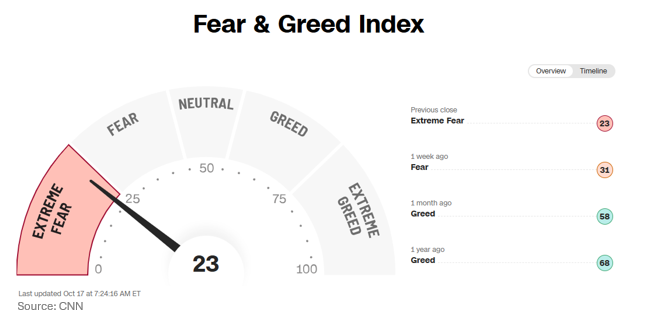
CNN business compiles several sentiment readings into a simple gauge measuring fear and greed. The current level marks the most fearful since Liberation Day. Most underlying factors show short-term shivers driven by recently harrowing headlines, but longer-term measures like market breadth reveal a more concerning rot.
Technically Stanky Breadth
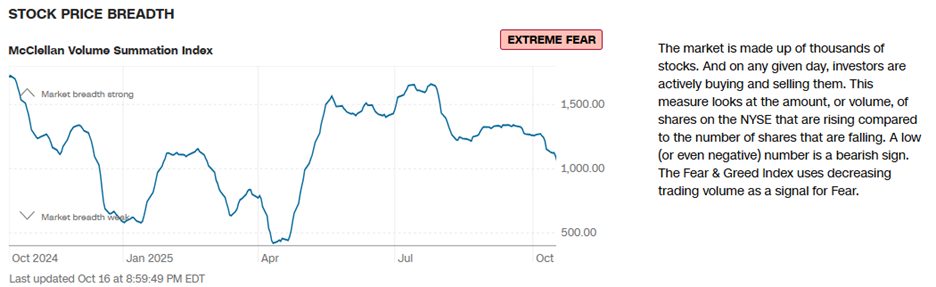
Market breadth measures trader conviction. More confident markets show more bet diversification and higher breadth, while less confident markets show more bet concentration and lower breadth. With the Mag 7 now commanding over 35% of total S&P 500 capitalization, moves higher in that cohort alone can drive indices to new highs despite a sideways drift for the remaining 493, as the chart below indicates:
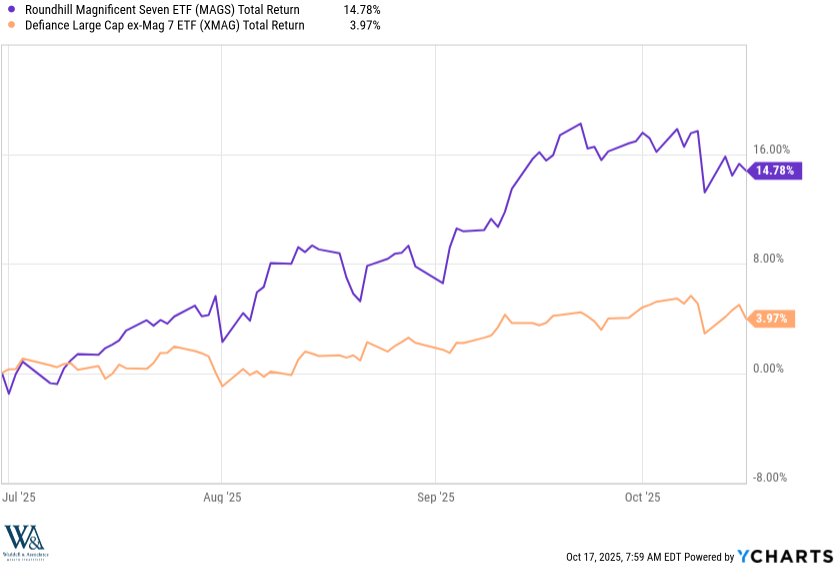
With the 493 trending sideways, any Mag 7 misstep can exacerbate downside dips, which has been the case over the past week. A lack of non-Mag conviction paired with Mag 7 jitters presents the perfect target for a technical sell-off.
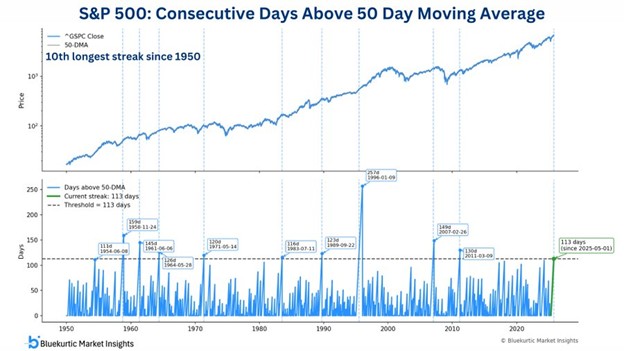
The recent rally off the April lows has strung together a string of superlatives. For instance, the amount of time the S&P 500 has spent above its 50-day moving average rivals some of the longest streaks in last 50 years. The last unblemished rally of this duration occurred nearly 15 years ago making this a rally in search of retraction. Tech bubble blabber, Trumps tariff tantrum, shutdown shutters and credit consternations provide ample kindling for technical burn-off:
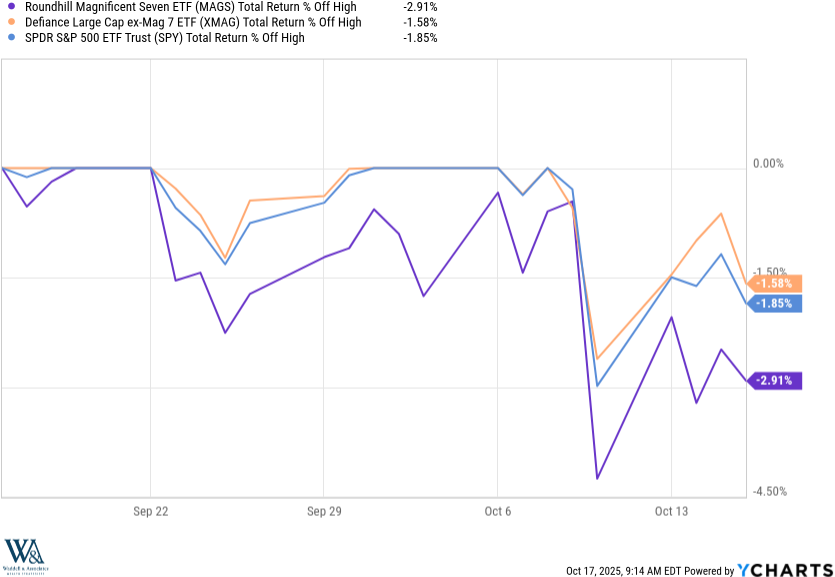
The chart above plots index movement off the highs. While the non-Mags in orange may not have captured the buying momentum of the Mag 7 on the upside, they also didn’t capture the selling momentum on the downside, suggesting fundamental breadth may not be as concerning as technical breadth.
Fundamentally Minty Breadth
As Buffet famously said in referencing sentiment and technical market factors, “in the short run the market is a voting machine, but in the long run it’s a weighing machine.” Translation: markets react to technical influences but ultimately follow the fundamentals.
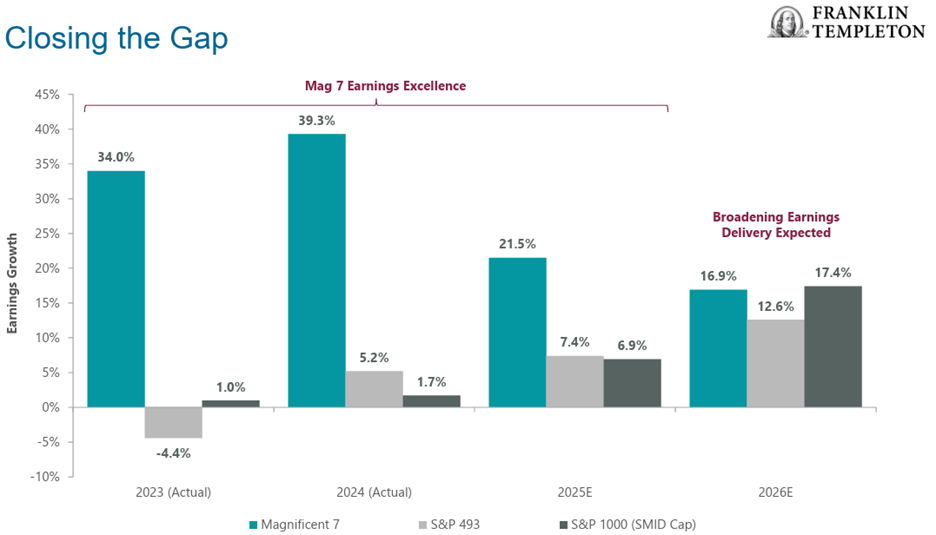
From a fundamental perspective, earnings production for the Magnificent 7 has been otherworldly compared with everything else, making their outperformance since the October 22 lows well-earned. However, as we peer forward, earnings breadth should improve markedly. Note that in 2026, the expected earnings differential between the Mag 7 and non-Mags within the S&P narrows, drawing more attention to the valuation differential of 30x for the Mag 7 vs. 20x for the non-Mags. Advantage non-Mags. Further down the cap spectrum, the S&P 1000 small and midcap index could see even faster earnings growth at a valuation of 15x vs. 30x. Advantage Smidcaps. In fairness, markets have tended to underestimate the strength of Mag 7 earnings growth and overestimate the strength of non-Mag earnings growth since this bull began, but that may be changing:
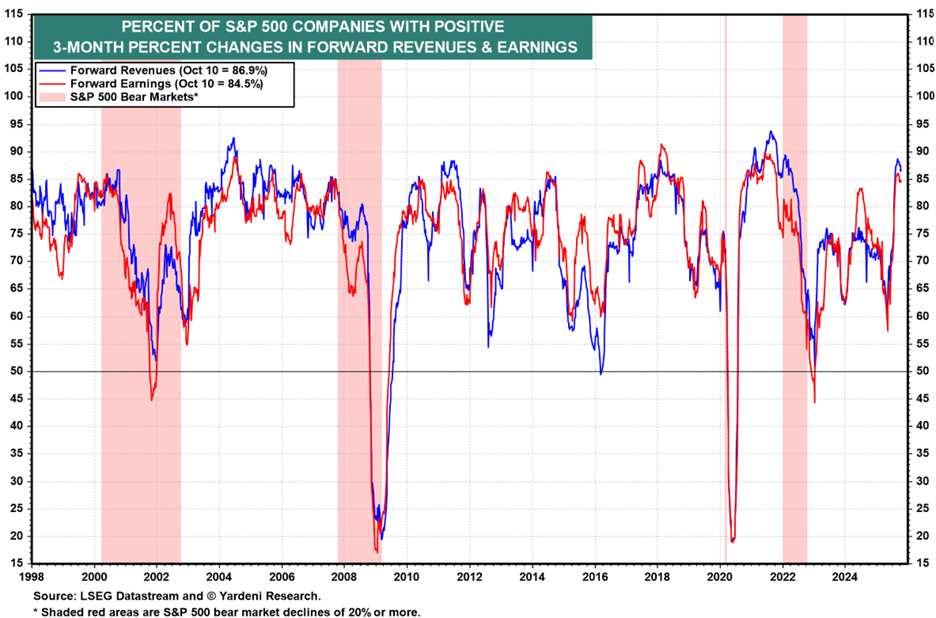
For the first time since 2021, analysts are raising their forward revenue and earnings estimates on over 85% of S&P 500 companies. In our opinion, this accounts for the stimulus smorgasbord of monetary stimulus, fiscal stimulus, de-regulatory stimulus, currency depreciation stimulus, and AI capital expenditure stimulus on approach. That’s a wide array of stimulus programs supporting a wide array of earnings programs as seen in the early reporting this earnings season. Fifty-one of the S&P 500 companies have reported so far with 82% of those outperforming estimates. A third of S&P 500 financial companies have reported earnings, 90% have outperformed estimates, and none are in the Magnificent 7.
Lastly, while the rally in Gold has attracted fascination of late, it’s the rally in Small Caps despite bad technical breadth that deserves it more. While the Mag 7s have well outperformed the non-Mags since July, the Russell 2000 small caps have well outperformed them both:
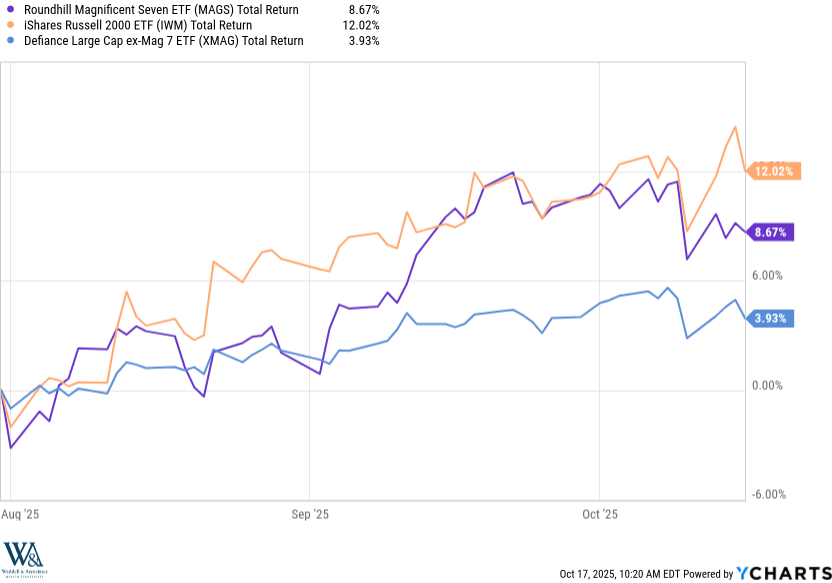
Enjoy your Sunday!
-David
Sources: YCharts, Yardeni Research, Franklin Templeton, Bluekurtic Market Insights, CNN Business
This communication and its contents are for informational and educational purposes only and should not be used as the sole basis for any investment decision. The information contained herein is based on publicly available sources believed to be reliable but is not a representation, expressed or implied, as to the accuracy, completeness, or correctness of said information. References to political figures or policies are for informational purposes only and do not represent an endorsement by Waddell & Associates. Any forward-looking statements reflect current opinions and assumptions and are subject to change without notice; actual results may differ materially. Past performance does not guarantee future results. Waddell & Associates may use artificial intelligence tools to help generate or summarize content; all outputs are reviewed by our team for accuracy and relevance.
">Spooktober
Markets have finally fulfilled their seasonal promise of declining as we approach All Hallows Eve. Those who have known us for a long time know that we tend to dollar cost average capital received mid-year into Halloween given typical summer doldrums and early fall apprehensions. We altered our emphasis on seasonality a bit this year given the Trumpian overlay, but historical odds favor September/October swoons that initiate November/December boons. Will that occur this year, or is our only fear the fear itself?
The Fear to Fear
CNN business compiles several sentiment readings into a simple gauge measuring fear and greed. The current level marks the most fearful since Liberation Day. Most underlying factors show short-term shivers driven by recently harrowing headlines, but longer-term measures like market breadth reveal a more concerning rot.
Technically Stanky Breadth
Market breadth measures trader conviction. More confident markets show more bet diversification and higher breadth, while less confident markets show more bet concentration and lower breadth. With the Mag 7 now commanding over 35% of total S&P 500 capitalization, moves higher in that cohort alone can drive indices to new highs despite a sideways drift for the remaining 493, as the chart below indicates:
With the 493 trending sideways, any Mag 7 misstep can exacerbate downside dips, which has been the case over the past week. A lack of non-Mag conviction paired with Mag 7 jitters presents the perfect target for a technical sell-off.
The recent rally off the April lows has strung together a string of superlatives. For instance, the amount of time the S&P 500 has spent above its 50-day moving average rivals some of the longest streaks in last 50 years. The last unblemished rally of this duration occurred nearly 15 years ago making this a rally in search of retraction. Tech bubble blabber, Trumps tariff tantrum, shutdown shutters and credit consternations provide ample kindling for technical burn-off:
The chart above plots index movement off the highs. While the non-Mags in orange may not have captured the buying momentum of the Mag 7 on the upside, they also didn’t capture the selling momentum on the downside, suggesting fundamental breadth may not be as concerning as technical breadth.
Fundamentally Minty Breadth
As Buffet famously said in referencing sentiment and technical market factors, “in the short run the market is a voting machine, but in the long run it’s a weighing machine.” Translation: markets react to technical influences but ultimately follow the fundamentals.
From a fundamental perspective, earnings production for the Magnificent 7 has been otherworldly compared with everything else, making their outperformance since the October 22 lows well-earned. However, as we peer forward, earnings breadth should improve markedly. Note that in 2026, the expected earnings differential between the Mag 7 and non-Mags within the S&P narrows, drawing more attention to the valuation differential of 30x for the Mag 7 vs. 20x for the non-Mags. Advantage non-Mags. Further down the cap spectrum, the S&P 1000 small and midcap index could see even faster earnings growth at a valuation of 15x vs. 30x. Advantage Smidcaps. In fairness, markets have tended to underestimate the strength of Mag 7 earnings growth and overestimate the strength of non-Mag earnings growth since this bull began, but that may be changing:
For the first time since 2021, analysts are raising their forward revenue and earnings estimates on over 85% of S&P 500 companies. In our opinion, this accounts for the stimulus smorgasbord of monetary stimulus, fiscal stimulus, de-regulatory stimulus, currency depreciation stimulus, and AI capital expenditure stimulus on approach. That’s a wide array of stimulus programs supporting a wide array of earnings programs as seen in the early reporting this earnings season. Fifty-one of the S&P 500 companies have reported so far with 82% of those outperforming estimates. A third of S&P 500 financial companies have reported earnings, 90% have outperformed estimates, and none are in the Magnificent 7.
Lastly, while the rally in Gold has attracted fascination of late, it’s the rally in Small Caps despite bad technical breadth that deserves it more. While the Mag 7s have well outperformed the non-Mags since July, the Russell 2000 small caps have well outperformed them both:
Enjoy your Sunday!
-David
Sources: YCharts, Yardeni Research, Franklin Templeton, Bluekurtic Market Insights, CNN Business
This communication and its contents are for informational and educational purposes only and should not be used as the sole basis for any investment decision. The information contained herein is based on publicly available sources believed to be reliable but is not a representation, expressed or implied, as to the accuracy, completeness, or correctness of said information. References to political figures or policies are for informational purposes only and do not represent an endorsement by Waddell & Associates. Any forward-looking statements reflect current opinions and assumptions and are subject to change without notice; actual results may differ materially. Past performance does not guarantee future results. Waddell & Associates may use artificial intelligence tools to help generate or summarize content; all outputs are reviewed by our team for accuracy and relevance.
" class="link-chevron">
After an Oval Office impasse Tuesday evening leaving the continuing resolution bill unsigned, the US government began furloughing non-essential services and employees. At stake? The Mid-Terms. Democrats want the continuing resolution (CR) bill to continue COVID era subsidies for Obamacare which the Republicans voted to discontinue at year’s end in the OBBB. The 60 votes required in the Senate to pass the CR enable this re-trade as there are only 53 Republican Senators leaving them 7 short. Democrats failed to use this same leverage when passing the March CR, fearing that Trump would use the financial shortfall to permanently gut sacrosanct programs like National Public Radio. Today, the Democrats have the OBBB in hand to cherry pick “heartless” measures like ending healthcare subsidies for the “needy”. Republicans initially seemed resolute, but less so recently, with Trump and JD Vance expressing willingness to negotiate (either before or after passage of the CR). How will this end? Who knows, and from the market’s perspective… Who Cares?
Higher Highs
The S&P 500 has hit new closing highs 30 times this year, including every day this week. Beneath the relentless move higher in stock prices lies the relentless move higher in earnings expectations:
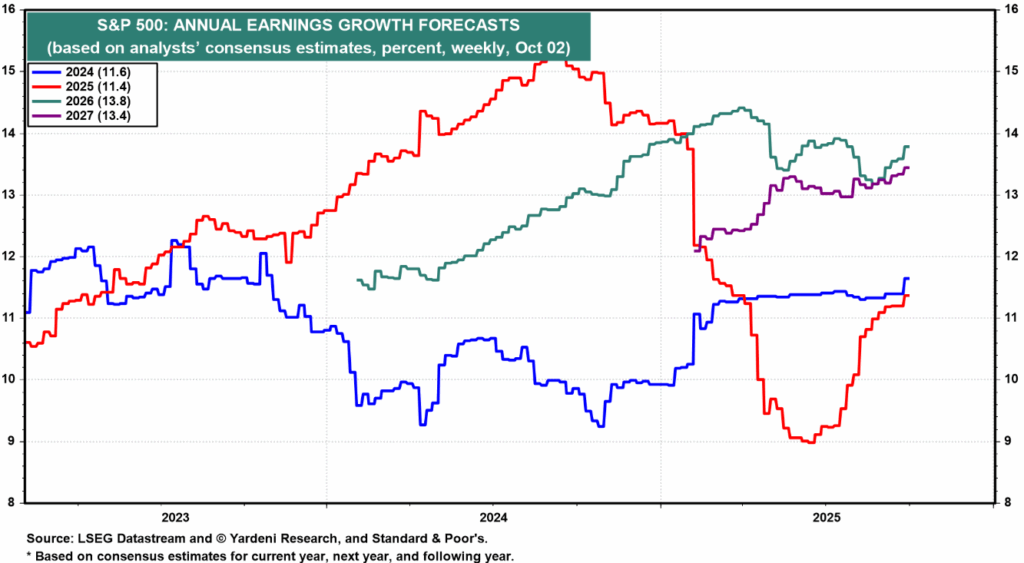
I know it’s a busy chart but let’s digest. The lines move left to right and chronicle analyst earnings projections as time advances. Note the harmonic surge higher in 2025 earnings expectations (red), 2026 earnings expectations (green) and 2027 earnings expectations (purple) over the past few months. This accompanies increases in revenue expectations:
And increases in profit margin expectations:
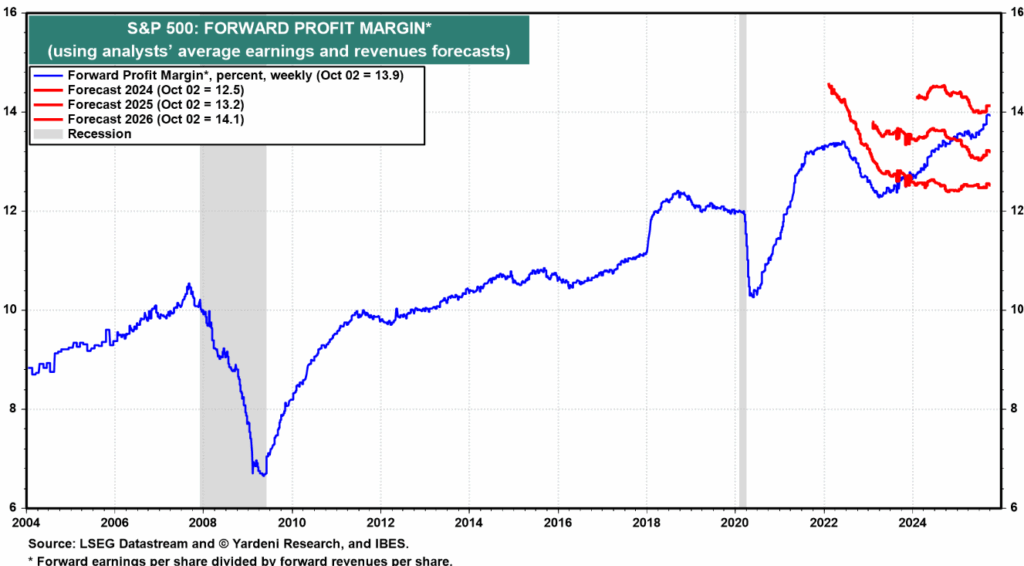
Rising revenues + Rising Profit Margins = Exponential Earnings! As we have noted, the combination of monetary stimulus from rate cuts, fiscal stimulus from tax cuts, currency stimulus from dollar depreciation, and CAPEX stimulus from the AI arms race all combine to boost economic and revenue growth while technology adoptions boost profit margins. While tariffs and shutdowns apply levitation counterweights, they merely amount to strings on the ballon.
In the Absence of Data
Apparently, the Government deems economic data unessential. This hurts our feelings and requires us to construct our own labor market assessments. The Trump labor market differs greatly from the Biden labor market given the immigration halt. Under Biden, the surge of immigrants into the workforce required an addition of 150,000 jobs a month to keep the unemployment rate level. Under Trump, this number has fallen to approximately 40,000 a month in job creation needed to keep the unemployment rate level.
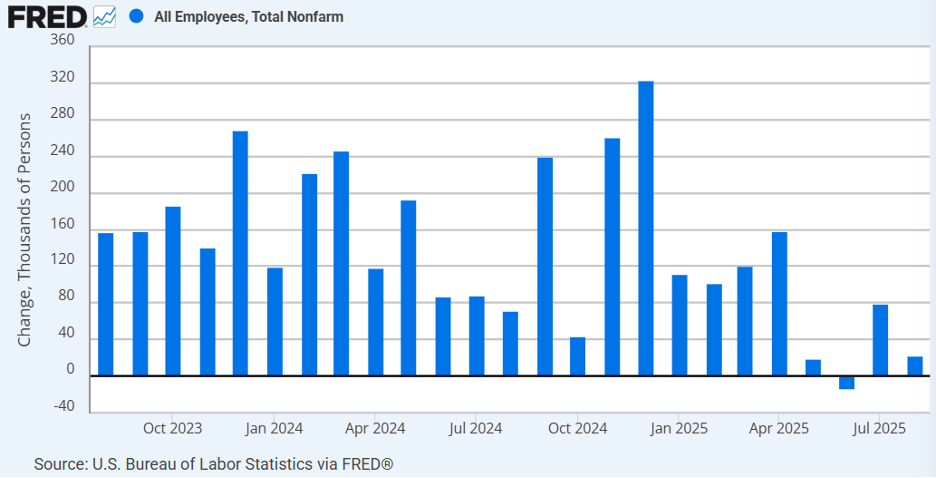
The optics of this chart invite concern as the surge in hiring evident in late 2024 has apparently collapsed into 2025. This has not been lost on the Fed who have noted deteriorating strength in the labor market as evidenced by their .25% rate cut in September and another .25% cut likely on October 28th. A prolonged shutdown only increases odds of further rate reductions with odds of a December reduction of .25% currently at 85%. This aligns with the Feds projections released in September. Only a significantly stronger employment report would derail their intentions, which seems unlikely as the steady state number has fallen and the number of virtual hirings has risen.
Companies today seem to be competing now on how many real people they can replace with AI agents as seen in the following headlines:

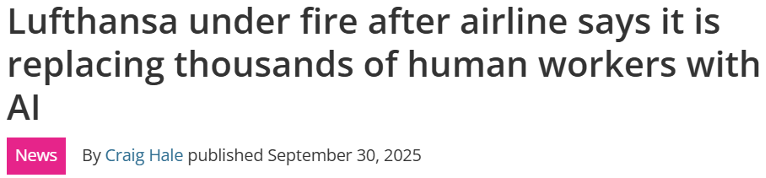
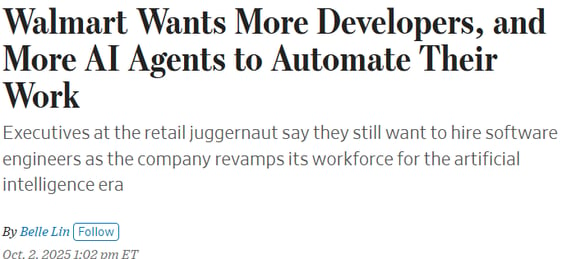
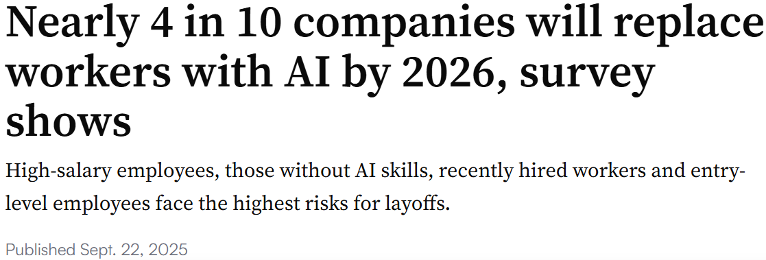
I could go on and on. Also, note the industry diversity represented above. What started out as a tech trend has now metastasized across other industries as well. In traditional economics, a slowdown in hiring accompanies a slowdown in GDP, requiring rate cuts from the Fed. Within this cycle, despite the slowdown in job creation, the US economy grew 3.8% in the 2nd quarter and the Fed’s GDPNow predicts another 3.8% growth in the 3rd quarter.
Welcome to the brave new world. Will Fed rate cuts offset AI driven employment cuts? Unlikely. With less influence over the labor market, perhaps the Fed’s dual mandate becomes a more singular focus on inflation. However, not only does AI suppress hiring, it’s productivity enhancements also suppress inflation. Companies that can do more with less, can afford to charge less. We see this in today’s record profit margins, poised to climb higher. In sum, a slowdown in hiring this time may not accompany a slowdown in growth. The axiomatic Fed rate cuts to support the labor market only reduce the expense of AI investments, further encouraging the labor substitution impacts. This higher growth/lower employment/lower inflation AI paradigm remains theoretical, but evidence is amassing. And if true… it’s not good news for laborers… but it is great news for investors!
Enjoy the rest of your week!
-David
Sources: Yardeni Research, Federal Reserve Bank of St. Louis, Federal Reserve Bank of Atlanta
This communication and its contents are for informational and educational purposes only and should not be used as the sole basis for any investment decision. The information contained herein is based on publicly available sources believed to be reliable but is not a representation, expressed or implied, as to the accuracy, completeness, or correctness of said information. References to political figures or policies are for informational purposes only and do not represent an endorsement by Waddell & Associates. Any forward-looking statements reflect current opinions and assumptions and are subject to change without notice; actual results may differ materially. Past performance does not guarantee future results. Waddell & Associates may use artificial intelligence tools to help generate or summarize content; all outputs are reviewed by our team for accuracy and relevance.
">The Upside to the Shutdown
After an Oval Office impasse Tuesday evening leaving the continuing resolution bill unsigned, the US government began furloughing non-essential services and employees. At stake? The Mid-Terms. Democrats want the continuing resolution (CR) bill to continue COVID era subsidies for Obamacare which the Republicans voted to discontinue at year’s end in the OBBB. The 60 votes required in the Senate to pass the CR enable this re-trade as there are only 53 Republican Senators leaving them 7 short. Democrats failed to use this same leverage when passing the March CR, fearing that Trump would use the financial shortfall to permanently gut sacrosanct programs like National Public Radio. Today, the Democrats have the OBBB in hand to cherry pick “heartless” measures like ending healthcare subsidies for the “needy”. Republicans initially seemed resolute, but less so recently, with Trump and JD Vance expressing willingness to negotiate (either before or after passage of the CR). How will this end? Who knows, and from the market’s perspective… Who Cares?
Higher Highs
The S&P 500 has hit new closing highs 30 times this year, including every day this week. Beneath the relentless move higher in stock prices lies the relentless move higher in earnings expectations:
I know it’s a busy chart but let’s digest. The lines move left to right and chronicle analyst earnings projections as time advances. Note the harmonic surge higher in 2025 earnings expectations (red), 2026 earnings expectations (green) and 2027 earnings expectations (purple) over the past few months. This accompanies increases in revenue expectations:
And increases in profit margin expectations:
Rising revenues + Rising Profit Margins = Exponential Earnings! As we have noted, the combination of monetary stimulus from rate cuts, fiscal stimulus from tax cuts, currency stimulus from dollar depreciation, and CAPEX stimulus from the AI arms race all combine to boost economic and revenue growth while technology adoptions boost profit margins. While tariffs and shutdowns apply levitation counterweights, they merely amount to strings on the ballon.
In the Absence of Data
Apparently, the Government deems economic data unessential. This hurts our feelings and requires us to construct our own labor market assessments. The Trump labor market differs greatly from the Biden labor market given the immigration halt. Under Biden, the surge of immigrants into the workforce required an addition of 150,000 jobs a month to keep the unemployment rate level. Under Trump, this number has fallen to approximately 40,000 a month in job creation needed to keep the unemployment rate level.
The optics of this chart invite concern as the surge in hiring evident in late 2024 has apparently collapsed into 2025. This has not been lost on the Fed who have noted deteriorating strength in the labor market as evidenced by their .25% rate cut in September and another .25% cut likely on October 28th. A prolonged shutdown only increases odds of further rate reductions with odds of a December reduction of .25% currently at 85%. This aligns with the Feds projections released in September. Only a significantly stronger employment report would derail their intentions, which seems unlikely as the steady state number has fallen and the number of virtual hirings has risen.
Companies today seem to be competing now on how many real people they can replace with AI agents as seen in the following headlines:
I could go on and on. Also, note the industry diversity represented above. What started out as a tech trend has now metastasized across other industries as well. In traditional economics, a slowdown in hiring accompanies a slowdown in GDP, requiring rate cuts from the Fed. Within this cycle, despite the slowdown in job creation, the US economy grew 3.8% in the 2nd quarter and the Fed’s GDPNow predicts another 3.8% growth in the 3rd quarter.
Welcome to the brave new world. Will Fed rate cuts offset AI driven employment cuts? Unlikely. With less influence over the labor market, perhaps the Fed’s dual mandate becomes a more singular focus on inflation. However, not only does AI suppress hiring, it’s productivity enhancements also suppress inflation. Companies that can do more with less, can afford to charge less. We see this in today’s record profit margins, poised to climb higher. In sum, a slowdown in hiring this time may not accompany a slowdown in growth. The axiomatic Fed rate cuts to support the labor market only reduce the expense of AI investments, further encouraging the labor substitution impacts. This higher growth/lower employment/lower inflation AI paradigm remains theoretical, but evidence is amassing. And if true… it’s not good news for laborers… but it is great news for investors!
Enjoy the rest of your week!
-David
Sources: Yardeni Research, Federal Reserve Bank of St. Louis, Federal Reserve Bank of Atlanta
This communication and its contents are for informational and educational purposes only and should not be used as the sole basis for any investment decision. The information contained herein is based on publicly available sources believed to be reliable but is not a representation, expressed or implied, as to the accuracy, completeness, or correctness of said information. References to political figures or policies are for informational purposes only and do not represent an endorsement by Waddell & Associates. Any forward-looking statements reflect current opinions and assumptions and are subject to change without notice; actual results may differ materially. Past performance does not guarantee future results. Waddell & Associates may use artificial intelligence tools to help generate or summarize content; all outputs are reviewed by our team for accuracy and relevance.
" class="link-chevron">