Remember that investment returns largely rely on reality exceeding expectations. High economic and investment return expectations at the end of 2024 reduce the odds of positive surprises in 2025 and increase the odds of negative surprises.
Many of Trump’s campaign promises fueled these expectations. Trump promised to “reaccelerate” economic growth. That’s hard to do with economic growth already running well above potential—especially when imposing tariffs, slashing government spending, and reducing labor force growth reduce GDP.
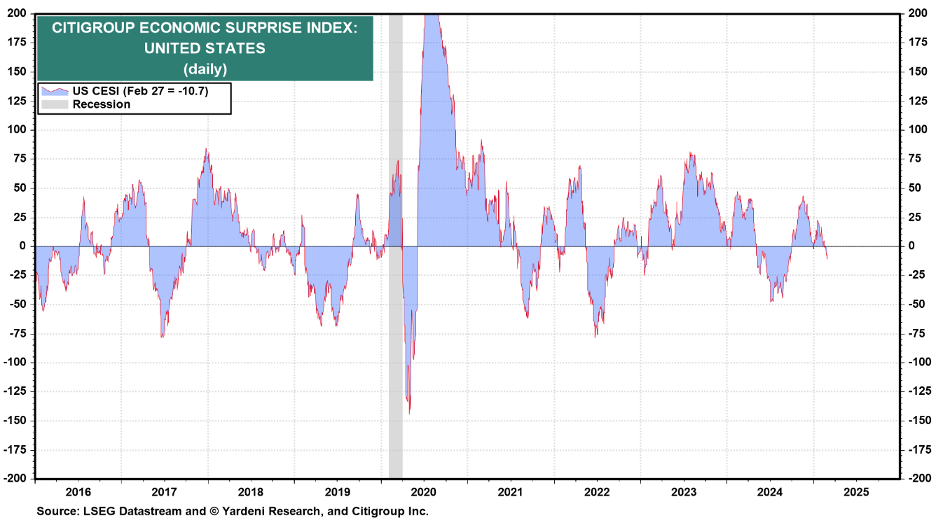
These policies may be good for America as Trump restructures our economy, but in the short term, they act to reduce growth, not accelerate it as seen in the current Citigroup economic surprise index. Positive readings mean economic realities are exceeding expectations, while negative readings mean economic realities are falling below expectations:
Fortunately, as you can see, mismatches between expectations and reality become resolved as expectations adjust. During the middle of 2024, we had a solid growth scare when GDP fell to a 1.6% growth rate in Q1, the unemployment rate rose from 3.7% to 4.5% in July, and the S&P 500 fell 8.5% in August.
Moved by fears of being “behind the curve”, the Fed cut rates in September by 0.5%, clearly unnerved by the deceleration in activity. Fortunately, the growth scare of 2024 didn’t metastasize into a growth collapse as GDP reaccelerated and reality began outperforming lowered expectations as seen in the chart above. By year end, the S&P 500 rallied 13.5% off the August lows.
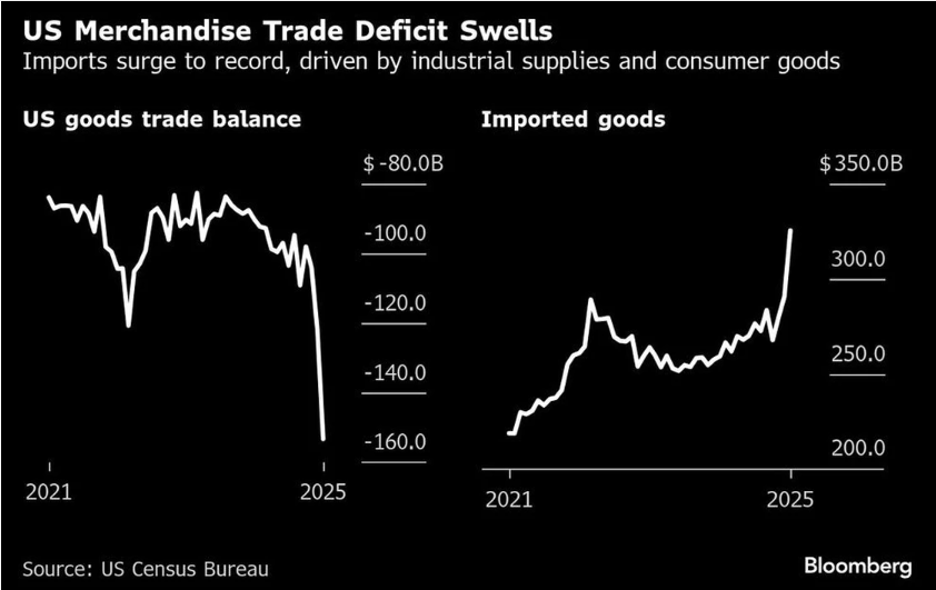
In a market wrestling with so many policy unknowns, moves in activity and sentiment can become exaggerated. For instance, business operators fearful of upcoming tariffs have accelerated offshore purchase orders to stockpile supplies. On Friday, we received a much higher than expected trade deficit report:
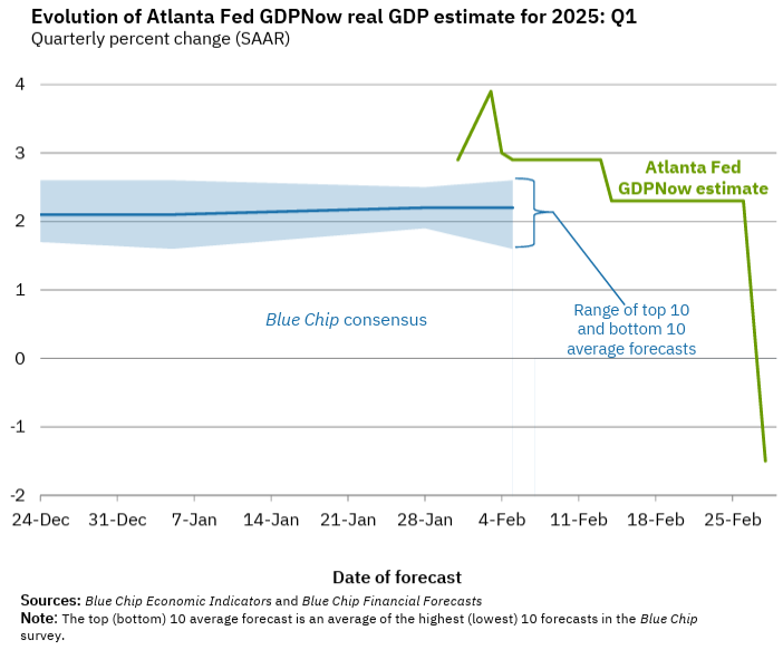
This massive distortion will weigh heavily on first quarter GDP. Import levels rose 12% (negative for GDP) while export levels rose 2% (positive for GDP). Consider the impact on the real-time Federal Reserve’s GDPNow estimate for first quarter GDP:
In the words of the Atlanta Fed:
“The GDPNow model estimate for real GDP growth (seasonally adjusted annual rate) in the first quarter of 2025 is -1.5 percent on February 28, down from 2.3 percent on February 19. After recent releases from the US Bureau of Economic Analysis and the US Census Bureau, the nowcast of the contribution of net exports to first-quarter real GDP growth fell from -0.41 percentage points to -3.70 percentage points.”
I don’t recall an economic report that upended growth estimates this much. And yet, markets rallied Friday morning, comforted by a benign reading from the Fed’s preferred inflation gauge and a stronger-than-expected report on real personal income.
So, if the books closed on Q1 today, precautionary import activity and restrained Government spending could offset positive investment and consumption activity, perhaps producing a negative GDP number. Were the tariffs imposed tomorrow, imports would collapse and entirely reverse the polarity.
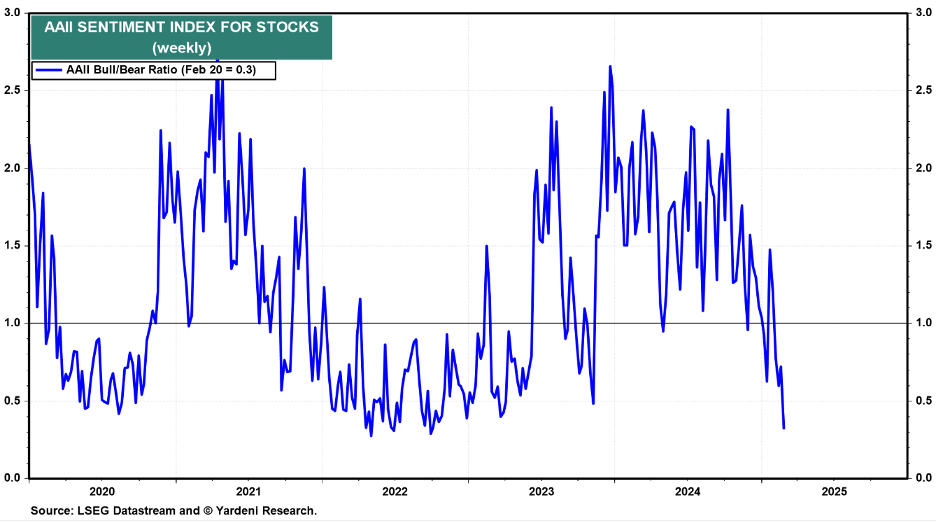
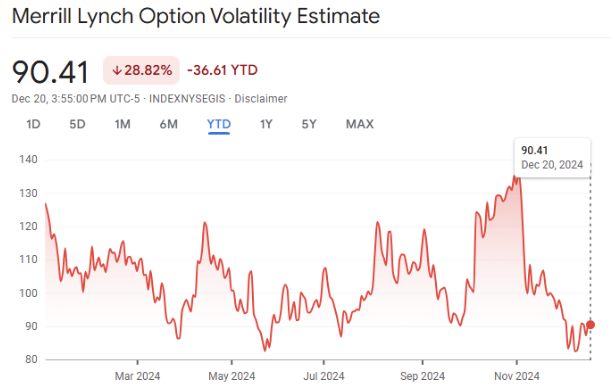
In the following quarter, consumption might collapse under the weight of higher import prices, and investment might accelerate as domestic suppliers ramp up production. Seasick yet? No wonder options volatility levels have spiked and investor sentiment levels have collapsed:
This chart divides the number of retail investors declaring themselves “bullish” by the level of retail investors declaring themselves “bearish”.
Currently. 19.4% of survey respondents count themselves “bullish”, while 60.6% count themselves as “bearish”. These are the most pessimistic numbers we have seen since 2022 and one of the most rapid collapses in sentiment on record.
As a result, market leadership has shifted significantly, with the MAG-7 having declined 8% on the year while healthcare, consumer staples, and utilities have gained 6%, 4%, and 3%, respectively. This “risk off” sentiment calibrates with growth concerns, and with our 2025 outlook predictions.
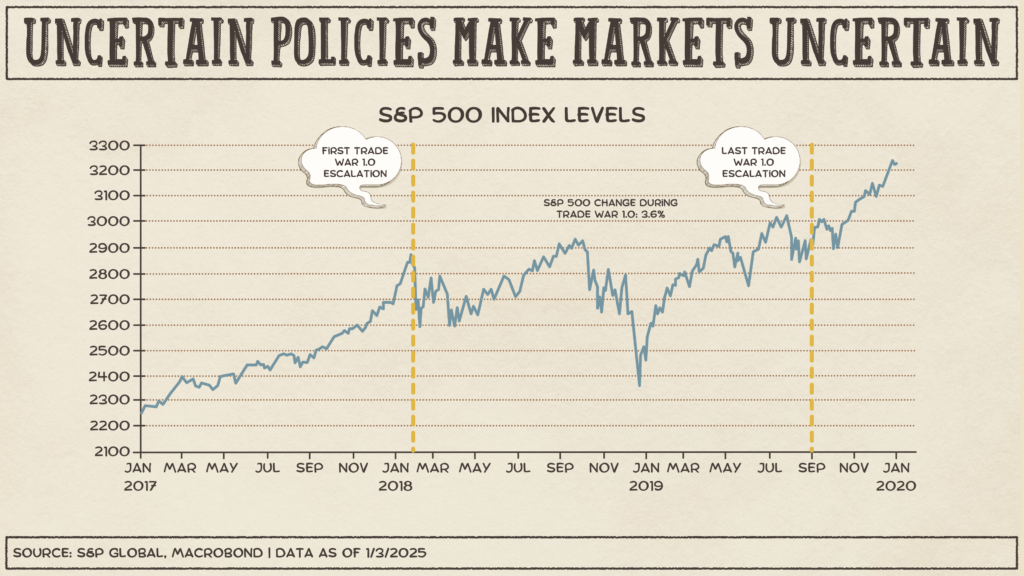
Trump levied his first tariffs on imported goods in January of 2018. Trump concluded his tariff campaign late in 2019. Markets struggled to advance during this period, unsure of the policies and their economic implications:
However, during this volatile period, the late 2018 growth scare led to a fantastic entry point for investors as the Federal Reserve cut rates and confidence reaccelerated. GDP reached the highest growth rate of Trump’s first administration at nearly 5% during the third quarter of 2019, and the S&P advanced nearly 32% on the year.
We expect similar results from the current environment. Expect markets to lack conviction, and trade within a range that has occasional collapses in sentiment. Use these moments to increase risk within portfolios since low expectation extremes create copious opportunities for positive surprises. The current retail investor survey may mark such an entry point worth exploiting, but be patient—we suspect this will not be the only one.
Enjoy your week!
-David
Sources: LSEG Datastream, Yardeni Research, Citigroup, Census Bureau, Blue Chip, Atlanta Fed, S&P Global, Macrobond
This communication and its contents are for informational and educational purposes only and should not be used as the sole basis for any investment decision. The information contained herein is based on publicly available sources believed to be reliable but is not a representation, expressed or implied, as to the accuracy, completeness, or correctness of said information. Past performance does not guarantee future results.

">
Remember that investment returns largely rely on reality exceeding expectations. High economic and investment return expectations at the end of 2024 reduce the odds of positive surprises in 2025 and increase the odds of negative surprises.
Many of Trump’s campaign promises fueled these expectations. Trump promised to “reaccelerate” economic growth. That’s hard to do with economic growth already running well above potential—especially when imposing tariffs, slashing government spending, and reducing labor force growth reduce GDP.
These policies may be good for America as Trump restructures our economy, but in the short term, they act to reduce growth, not accelerate it as seen in the current Citigroup economic surprise index. Positive readings mean economic realities are exceeding expectations, while negative readings mean economic realities are falling below expectations:
Fortunately, as you can see, mismatches between expectations and reality become resolved as expectations adjust. During the middle of 2024, we had a solid growth scare when GDP fell to a 1.6% growth rate in Q1, the unemployment rate rose from 3.7% to 4.5% in July, and the S&P 500 fell 8.5% in August.
Moved by fears of being “behind the curve”, the Fed cut rates in September by 0.5%, clearly unnerved by the deceleration in activity. Fortunately, the growth scare of 2024 didn’t metastasize into a growth collapse as GDP reaccelerated and reality began outperforming lowered expectations as seen in the chart above. By year end, the S&P 500 rallied 13.5% off the August lows.
In a market wrestling with so many policy unknowns, moves in activity and sentiment can become exaggerated. For instance, business operators fearful of upcoming tariffs have accelerated offshore purchase orders to stockpile supplies. On Friday, we received a much higher than expected trade deficit report:
This massive distortion will weigh heavily on first quarter GDP. Import levels rose 12% (negative for GDP) while export levels rose 2% (positive for GDP). Consider the impact on the real-time Federal Reserve’s GDPNow estimate for first quarter GDP:
In the words of the Atlanta Fed:
“The GDPNow model estimate for real GDP growth (seasonally adjusted annual rate) in the first quarter of 2025 is -1.5 percent on February 28, down from 2.3 percent on February 19. After recent releases from the US Bureau of Economic Analysis and the US Census Bureau, the nowcast of the contribution of net exports to first-quarter real GDP growth fell from -0.41 percentage points to -3.70 percentage points.”
I don’t recall an economic report that upended growth estimates this much. And yet, markets rallied Friday morning, comforted by a benign reading from the Fed’s preferred inflation gauge and a stronger-than-expected report on real personal income.
So, if the books closed on Q1 today, precautionary import activity and restrained Government spending could offset positive investment and consumption activity, perhaps producing a negative GDP number. Were the tariffs imposed tomorrow, imports would collapse and entirely reverse the polarity.
In the following quarter, consumption might collapse under the weight of higher import prices, and investment might accelerate as domestic suppliers ramp up production. Seasick yet? No wonder options volatility levels have spiked and investor sentiment levels have collapsed:
This chart divides the number of retail investors declaring themselves “bullish” by the level of retail investors declaring themselves “bearish”.
Currently. 19.4% of survey respondents count themselves “bullish”, while 60.6% count themselves as “bearish”. These are the most pessimistic numbers we have seen since 2022 and one of the most rapid collapses in sentiment on record.
As a result, market leadership has shifted significantly, with the MAG-7 having declined 8% on the year while healthcare, consumer staples, and utilities have gained 6%, 4%, and 3%, respectively. This “risk off” sentiment calibrates with growth concerns, and with our 2025 outlook predictions.
Trump levied his first tariffs on imported goods in January of 2018. Trump concluded his tariff campaign late in 2019. Markets struggled to advance during this period, unsure of the policies and their economic implications:
However, during this volatile period, the late 2018 growth scare led to a fantastic entry point for investors as the Federal Reserve cut rates and confidence reaccelerated. GDP reached the highest growth rate of Trump’s first administration at nearly 5% during the third quarter of 2019, and the S&P advanced nearly 32% on the year.
We expect similar results from the current environment. Expect markets to lack conviction, and trade within a range that has occasional collapses in sentiment. Use these moments to increase risk within portfolios since low expectation extremes create copious opportunities for positive surprises. The current retail investor survey may mark such an entry point worth exploiting, but be patient—we suspect this will not be the only one.
Enjoy your week!
-David
Sources: LSEG Datastream, Yardeni Research, Citigroup, Census Bureau, Blue Chip, Atlanta Fed, S&P Global, Macrobond
This communication and its contents are for informational and educational purposes only and should not be used as the sole basis for any investment decision. The information contained herein is based on publicly available sources believed to be reliable but is not a representation, expressed or implied, as to the accuracy, completeness, or correctness of said information. Past performance does not guarantee future results.

">What to Expect from the Unexpected I hope you have had a chance to watch our 2025 Outlook presentation. If not, click here! In it, we conclude with the notion that high expectations for 2025 will likely lead to lower returns for investors.Remember that investment returns largely rely on reality exceeding expectations. High economic and investment return expectations at the end of 2024 reduce the odds of positive surprises in 2025 and increase the odds of negative surprises.
Many of Trump’s campaign promises fueled these expectations. Trump promised to “reaccelerate” economic growth. That’s hard to do with economic growth already running well above potential—especially when imposing tariffs, slashing government spending, and reducing labor force growth reduce GDP.
These policies may be good for America as Trump restructures our economy, but in the short term, they act to reduce growth, not accelerate it as seen in the current Citigroup economic surprise index. Positive readings mean economic realities are exceeding expectations, while negative readings mean economic realities are falling below expectations:
Fortunately, as you can see, mismatches between expectations and reality become resolved as expectations adjust. During the middle of 2024, we had a solid growth scare when GDP fell to a 1.6% growth rate in Q1, the unemployment rate rose from 3.7% to 4.5% in July, and the S&P 500 fell 8.5% in August.
Moved by fears of being “behind the curve”, the Fed cut rates in September by 0.5%, clearly unnerved by the deceleration in activity. Fortunately, the growth scare of 2024 didn’t metastasize into a growth collapse as GDP reaccelerated and reality began outperforming lowered expectations as seen in the chart above. By year end, the S&P 500 rallied 13.5% off the August lows.
In a market wrestling with so many policy unknowns, moves in activity and sentiment can become exaggerated. For instance, business operators fearful of upcoming tariffs have accelerated offshore purchase orders to stockpile supplies. On Friday, we received a much higher than expected trade deficit report:
This massive distortion will weigh heavily on first quarter GDP. Import levels rose 12% (negative for GDP) while export levels rose 2% (positive for GDP). Consider the impact on the real-time Federal Reserve’s GDPNow estimate for first quarter GDP:
In the words of the Atlanta Fed:
“The GDPNow model estimate for real GDP growth (seasonally adjusted annual rate) in the first quarter of 2025 is -1.5 percent on February 28, down from 2.3 percent on February 19. After recent releases from the US Bureau of Economic Analysis and the US Census Bureau, the nowcast of the contribution of net exports to first-quarter real GDP growth fell from -0.41 percentage points to -3.70 percentage points.”
I don’t recall an economic report that upended growth estimates this much. And yet, markets rallied Friday morning, comforted by a benign reading from the Fed’s preferred inflation gauge and a stronger-than-expected report on real personal income.
So, if the books closed on Q1 today, precautionary import activity and restrained Government spending could offset positive investment and consumption activity, perhaps producing a negative GDP number. Were the tariffs imposed tomorrow, imports would collapse and entirely reverse the polarity.
In the following quarter, consumption might collapse under the weight of higher import prices, and investment might accelerate as domestic suppliers ramp up production. Seasick yet? No wonder options volatility levels have spiked and investor sentiment levels have collapsed:
This chart divides the number of retail investors declaring themselves “bullish” by the level of retail investors declaring themselves “bearish”.
Currently. 19.4% of survey respondents count themselves “bullish”, while 60.6% count themselves as “bearish”. These are the most pessimistic numbers we have seen since 2022 and one of the most rapid collapses in sentiment on record.
As a result, market leadership has shifted significantly, with the MAG-7 having declined 8% on the year while healthcare, consumer staples, and utilities have gained 6%, 4%, and 3%, respectively. This “risk off” sentiment calibrates with growth concerns, and with our 2025 outlook predictions.
Trump levied his first tariffs on imported goods in January of 2018. Trump concluded his tariff campaign late in 2019. Markets struggled to advance during this period, unsure of the policies and their economic implications:
However, during this volatile period, the late 2018 growth scare led to a fantastic entry point for investors as the Federal Reserve cut rates and confidence reaccelerated. GDP reached the highest growth rate of Trump’s first administration at nearly 5% during the third quarter of 2019, and the S&P advanced nearly 32% on the year.
We expect similar results from the current environment. Expect markets to lack conviction, and trade within a range that has occasional collapses in sentiment. Use these moments to increase risk within portfolios since low expectation extremes create copious opportunities for positive surprises. The current retail investor survey may mark such an entry point worth exploiting, but be patient—we suspect this will not be the only one.
Enjoy your week!
-David
Sources: LSEG Datastream, Yardeni Research, Citigroup, Census Bureau, Blue Chip, Atlanta Fed, S&P Global, Macrobond
This communication and its contents are for informational and educational purposes only and should not be used as the sole basis for any investment decision. The information contained herein is based on publicly available sources believed to be reliable but is not a representation, expressed or implied, as to the accuracy, completeness, or correctness of said information. Past performance does not guarantee future results.

" class="link-chevron">I wake up every morning and second guess every portfolio decision we have made. As a portfolio manager, I learned long ago that you must “repurchase” your portfolio every day. Over my first two cups of coffee, I actively self-debate the state of the economy, the prospects for corporate earnings, political risks, monetary risks, investor sentiment levels, the merits of our overall portfolio strategy, and the merits of each one of our individual holdings. Some mornings, I leave the exercise convinced. Some mornings I leave the exercise befuddled, requiring more study and more time for assessment.
Given that there are no certainties in forecasting markets, the investment threshold lies with simply believing one thing more than believing the opposite thing. If I held a press conference every morning to share my tossed salad of thoughts, internal debates and opinions, you might find my process erratic. I assure you that it is not. It’s the process every diligent money manager performs. The more heated the internal debates, the more diligent the research, and the better the decision making. The outcomes certainly benefit our clients, but broadcasting each thought along the way certainly would not.
Over the past four years, Joe Biden held 15 solo press conferences. For the Biden administration, silence was golden. For Trump 2.0, the press seems to have a seat with Trump at a partner’s desk in the Oval Office. Should we invade Panama? Should we abolish FEMA, USAID, and the Department of Education? Should we return to the gold standard? Should we buy Greenland? Should we tariff Canadian and Mexican imports by 25%? Maybe not. Trump seemingly never just thinks his thoughts. This, understandably, leaves observers and investors conditioned under “Hidin’ Biden” feeling anxious and disoriented.
In last week’s missive, we worked to redirect focus away from Trump’s thought experiments back towards observable fundamentals. Is the economy growing? Are earnings growing? Are valuations sustainable? The answers are yes, yes and yes. Recognize that Trump’s “out loud” pontifications don’t neatly result in policies. Also remember that we invest in corporations, not governments. When the outlook for corporations diminishes, we will reduce our risk exposures, but not before. Trying to trade a Trump thought tracker is a money loser. On this, there is no debate.
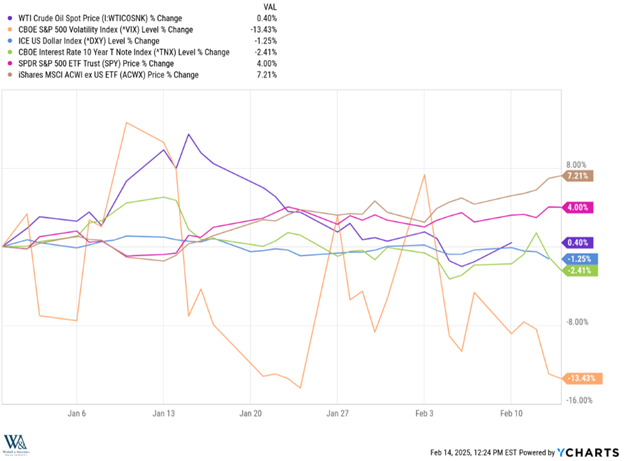
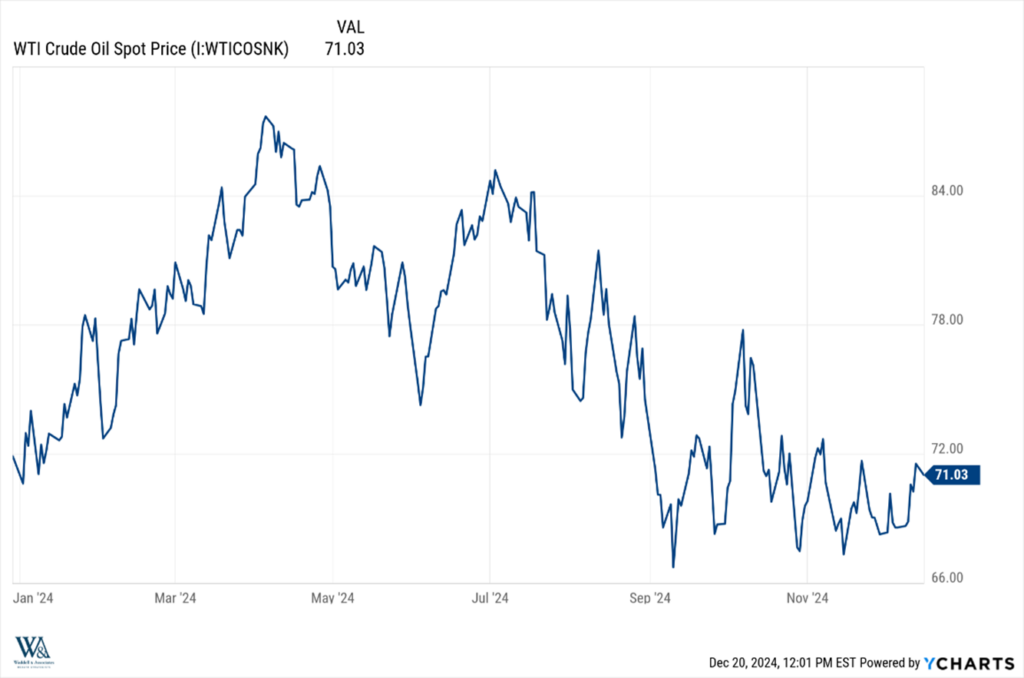
Since the beginning of the year, despite Trump’s vocal volatility, stock market volatility has declined. The VIX volatility index, which measures expectations for market volatility over the next 30 days as calculated by the options market, has fallen 13% year-to-date. Interest rates, as measured by the 10-year Treasury note have fallen 2.6% year-to-date (from 4.57% to 4.45%). Despite all the tough Trump tariff talk, the US dollar has declined 1.25% year-to-date, while oil prices per barrel have flatlined. Concurrently, US equities as measured by the S&P have advanced 4% on the year, while international equities have advanced 7% on the year.
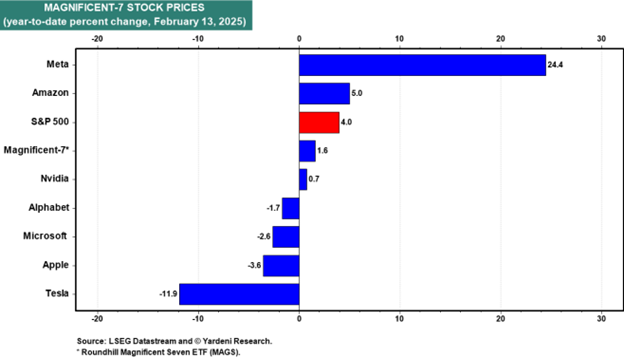
Perhaps the most encouraging reading comes from the highly influential Magnificent 7. Taken together, the market capitalizations of Apple, Amazon, Google, Meta, Microsoft, Nvidia and Tesla account for 30% of the entire S&P 500. For the past two years, the Mag 7 stocks have powered the S&P 500 higher with superlative returns. This year, four of the seven have posted negative returns, turning the Mag 7 into the Lag 7. And yet, the S&P 500 has capably advanced without them:
While it’s unlikely that stocks will maintain this pace of gains throughout the year, it’s clear that Trump’s “out loud” volatility hasn’t translated into downside market volatility.
Enjoy the rest of your weekend!
-David
Sources: LSEG Datastream and Yardeni Research, YCharts
This communication and its contents are for informational and educational purposes only and should not be used as the sole basis for any investment decision. The information contained herein is based on publicly available sources believed to be reliable but is not a representation, expressed or implied, as to the accuracy, completeness, or correctness of said information. Past performance does not guarantee future results.

">
I wake up every morning and second guess every portfolio decision we have made. As a portfolio manager, I learned long ago that you must “repurchase” your portfolio every day. Over my first two cups of coffee, I actively self-debate the state of the economy, the prospects for corporate earnings, political risks, monetary risks, investor sentiment levels, the merits of our overall portfolio strategy, and the merits of each one of our individual holdings. Some mornings, I leave the exercise convinced. Some mornings I leave the exercise befuddled, requiring more study and more time for assessment.
Given that there are no certainties in forecasting markets, the investment threshold lies with simply believing one thing more than believing the opposite thing. If I held a press conference every morning to share my tossed salad of thoughts, internal debates and opinions, you might find my process erratic. I assure you that it is not. It’s the process every diligent money manager performs. The more heated the internal debates, the more diligent the research, and the better the decision making. The outcomes certainly benefit our clients, but broadcasting each thought along the way certainly would not.
Over the past four years, Joe Biden held 15 solo press conferences. For the Biden administration, silence was golden. For Trump 2.0, the press seems to have a seat with Trump at a partner’s desk in the Oval Office. Should we invade Panama? Should we abolish FEMA, USAID, and the Department of Education? Should we return to the gold standard? Should we buy Greenland? Should we tariff Canadian and Mexican imports by 25%? Maybe not. Trump seemingly never just thinks his thoughts. This, understandably, leaves observers and investors conditioned under “Hidin’ Biden” feeling anxious and disoriented.
In last week’s missive, we worked to redirect focus away from Trump’s thought experiments back towards observable fundamentals. Is the economy growing? Are earnings growing? Are valuations sustainable? The answers are yes, yes and yes. Recognize that Trump’s “out loud” pontifications don’t neatly result in policies. Also remember that we invest in corporations, not governments. When the outlook for corporations diminishes, we will reduce our risk exposures, but not before. Trying to trade a Trump thought tracker is a money loser. On this, there is no debate.
Since the beginning of the year, despite Trump’s vocal volatility, stock market volatility has declined. The VIX volatility index, which measures expectations for market volatility over the next 30 days as calculated by the options market, has fallen 13% year-to-date. Interest rates, as measured by the 10-year Treasury note have fallen 2.6% year-to-date (from 4.57% to 4.45%). Despite all the tough Trump tariff talk, the US dollar has declined 1.25% year-to-date, while oil prices per barrel have flatlined. Concurrently, US equities as measured by the S&P have advanced 4% on the year, while international equities have advanced 7% on the year.
Perhaps the most encouraging reading comes from the highly influential Magnificent 7. Taken together, the market capitalizations of Apple, Amazon, Google, Meta, Microsoft, Nvidia and Tesla account for 30% of the entire S&P 500. For the past two years, the Mag 7 stocks have powered the S&P 500 higher with superlative returns. This year, four of the seven have posted negative returns, turning the Mag 7 into the Lag 7. And yet, the S&P 500 has capably advanced without them:
While it’s unlikely that stocks will maintain this pace of gains throughout the year, it’s clear that Trump’s “out loud” volatility hasn’t translated into downside market volatility.
Enjoy the rest of your weekend!
-David
Sources: LSEG Datastream and Yardeni Research, YCharts
This communication and its contents are for informational and educational purposes only and should not be used as the sole basis for any investment decision. The information contained herein is based on publicly available sources believed to be reliable but is not a representation, expressed or implied, as to the accuracy, completeness, or correctness of said information. Past performance does not guarantee future results.
">From ‘Hidin’ Biden’ to ‘Talking Trump’: What It Means for Investors Can you imagine the impact on your family or your business if you thought every thought out loud, just as thought, with emotion and without filters? How cringeworthy!I wake up every morning and second guess every portfolio decision we have made. As a portfolio manager, I learned long ago that you must “repurchase” your portfolio every day. Over my first two cups of coffee, I actively self-debate the state of the economy, the prospects for corporate earnings, political risks, monetary risks, investor sentiment levels, the merits of our overall portfolio strategy, and the merits of each one of our individual holdings. Some mornings, I leave the exercise convinced. Some mornings I leave the exercise befuddled, requiring more study and more time for assessment.
Given that there are no certainties in forecasting markets, the investment threshold lies with simply believing one thing more than believing the opposite thing. If I held a press conference every morning to share my tossed salad of thoughts, internal debates and opinions, you might find my process erratic. I assure you that it is not. It’s the process every diligent money manager performs. The more heated the internal debates, the more diligent the research, and the better the decision making. The outcomes certainly benefit our clients, but broadcasting each thought along the way certainly would not.
Over the past four years, Joe Biden held 15 solo press conferences. For the Biden administration, silence was golden. For Trump 2.0, the press seems to have a seat with Trump at a partner’s desk in the Oval Office. Should we invade Panama? Should we abolish FEMA, USAID, and the Department of Education? Should we return to the gold standard? Should we buy Greenland? Should we tariff Canadian and Mexican imports by 25%? Maybe not. Trump seemingly never just thinks his thoughts. This, understandably, leaves observers and investors conditioned under “Hidin’ Biden” feeling anxious and disoriented.
In last week’s missive, we worked to redirect focus away from Trump’s thought experiments back towards observable fundamentals. Is the economy growing? Are earnings growing? Are valuations sustainable? The answers are yes, yes and yes. Recognize that Trump’s “out loud” pontifications don’t neatly result in policies. Also remember that we invest in corporations, not governments. When the outlook for corporations diminishes, we will reduce our risk exposures, but not before. Trying to trade a Trump thought tracker is a money loser. On this, there is no debate.
Since the beginning of the year, despite Trump’s vocal volatility, stock market volatility has declined. The VIX volatility index, which measures expectations for market volatility over the next 30 days as calculated by the options market, has fallen 13% year-to-date. Interest rates, as measured by the 10-year Treasury note have fallen 2.6% year-to-date (from 4.57% to 4.45%). Despite all the tough Trump tariff talk, the US dollar has declined 1.25% year-to-date, while oil prices per barrel have flatlined. Concurrently, US equities as measured by the S&P have advanced 4% on the year, while international equities have advanced 7% on the year.
Perhaps the most encouraging reading comes from the highly influential Magnificent 7. Taken together, the market capitalizations of Apple, Amazon, Google, Meta, Microsoft, Nvidia and Tesla account for 30% of the entire S&P 500. For the past two years, the Mag 7 stocks have powered the S&P 500 higher with superlative returns. This year, four of the seven have posted negative returns, turning the Mag 7 into the Lag 7. And yet, the S&P 500 has capably advanced without them:
While it’s unlikely that stocks will maintain this pace of gains throughout the year, it’s clear that Trump’s “out loud” volatility hasn’t translated into downside market volatility.
Enjoy the rest of your weekend!
-David
Sources: LSEG Datastream and Yardeni Research, YCharts
This communication and its contents are for informational and educational purposes only and should not be used as the sole basis for any investment decision. The information contained herein is based on publicly available sources believed to be reliable but is not a representation, expressed or implied, as to the accuracy, completeness, or correctness of said information. Past performance does not guarantee future results.
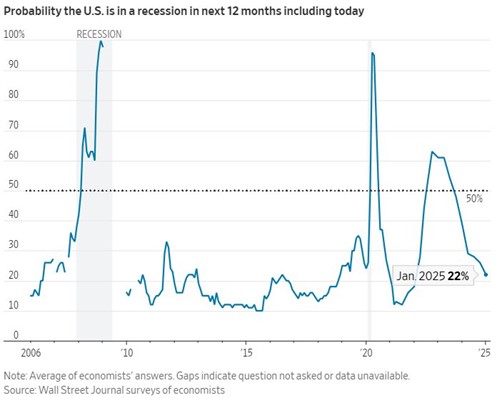
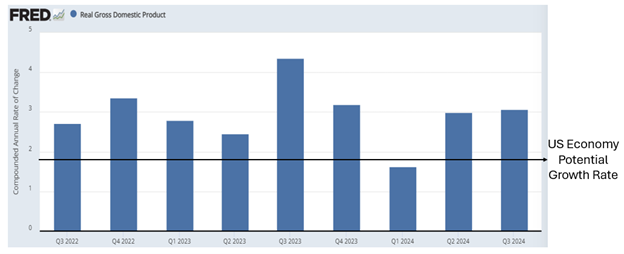
" class="link-chevron">According to the US Federal Reserve, the USA has a long-term potential GDP growth rate of 1.8%. Therefore, anything above 1.8% indicates an economy overperforming and anything less than 1.8% indicates an economy underperforming. While the GDP growth rate descended in the fourth quarter to 2.3%, the US economy advanced 2.8% for the full year, a full percentage point above our potential growth rate and down only slightly from 2023’s 2.9% growth rate. Currently, the Fed’s GDP Now model predicts a 2.9% growth rate for Q1 2025 based on economic data releases to date. For the full year, economists expect the US economy will continue growing above potential while recession odds continue to recede:
Love Trump or hate Trump, the resilient US economy appears poised for another year of above-average growth.
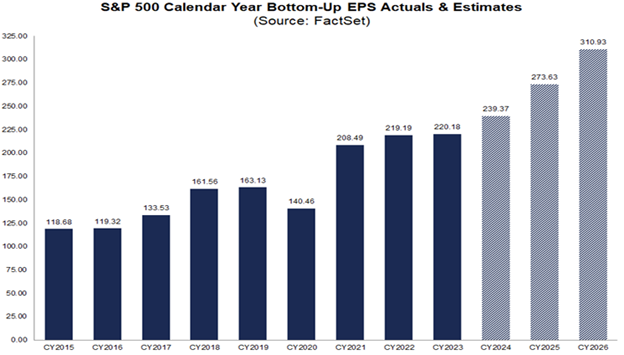
So far, 270 of the S&P 500 companies have reported earnings. Seventy-eight percent have beaten analyst estimates, delivering a 13.5% growth rate overall, exceeding the less than 12% rate expected. For all of 2025, analysts forecast a 13.7% growth rate for S&P 500 earnings, followed by a 14% growth rate in 2026. Should these growth rates materialize, S&P 500 earnings at year-end 2026 will stand a full 30% above year-end 2024 levels. Furthermore, earnings beyond the S&P 500 show even more promise, with S&P 400 companies (mid-caps) expected to grow 32% and S&P 600 companies (small caps) expected to grow 41%.
Source: https://advantage.factset.com/hubfs/Website/Resources%20Section/Research%20Desk/Earnings%20Insight/EarningsInsight_020725A.pdf
Love Trump or hate Trump, US corporations appear poised for another year of above average earnings growth.
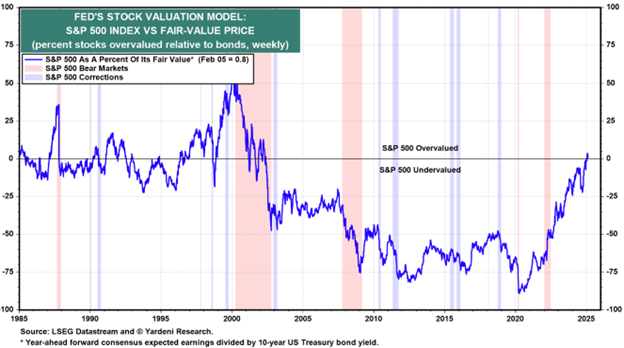
Modern investors pay a disproportionate amount of attention to the short-term Federal Funds rate. While Federal Reserve policy decisions hold high economic influence, most asset prices, and certainly stock prices, rely on longer-term interest rate levels to compute valuation. For simple math, a 3% 10-year Treasury yield supports a P/E level of 33x for the stock market. A 4% 10-year Treasury yield supports a P/E level of 25x for the stock market, and a 5% 10-year Treasury supports a P/E level of 20x for the stock market. With a yield of 4.44% currently, the 10-year Treasury currently supports a P/E level of 22.7x, roughly where the S&P 500 is valued today:
The chart above compares S&P 500 P/E levels with 10-year Treasury yields. After the great financial crisis, the Fed distorted interest rate levels with zero interest rate policies and continuous quantitative easing campaigns. The markets rightly expected these programs to end and didn’t bid stocks up to astronomical valuation levels as a result.
So, ignore the distorted 2000’s and focus instead on the 1985-2000 period. Clearly, stock valuations and bond yields held a tighter relationship until the late 90s when stock valuations overshot, only to earn their comeuppance in the early 2000s. For the first time in over 20 years, stocks and bond valuations have harmonized. Therefore, movements in the 10-year Treasury yield this year will greatly influence market performance. Of the 51 year-end forecasts compiled by Bloomberg, only three expect higher yields than today. On average, the 51 forecasters expect a 4.12% ten-year yield at year-end.
What about tariff-driven inflation? Won’t that drive up yields?
We received our answer this week as Trump’s tariff talk reduced rates rather than raised them. Why? Raising prices 25% happens once, while the downshift in growth persists. Therefore, the downward force on rates from falling growth expectations exceeded the upward force on rates from rising inflation expectations. For rates to rise materially from here, GDP growth rates would need to rise materially from here. Were that to happen, earnings expectations would rise as well, providing a counterbalance.
Lastly, this week, Trump and Treasury Secretary Bessent called for lower interest rates. The media denounced this as Central Bank meddling. The duo then explained they meant the 10-year Treasury rate, not the Fed Funds rate. Economics… they understand.
Love Trump or hate Trump, the 10-year Treasury appears poised to spend the year within a narrow range that supports current valuation levels.
Special Note: W&A clients will notice trade confirmations in their mailboxes next week. Our investment committee decided to reposition two strategic equity holdings to reduce risk and better align with the Trump agenda. The SEC prohibits us from providing details here. For specific information, please contact your advisor directly. For additional rationale, please tune into our 2025 Outlook on February 20th!
Have a great weekend and enjoy the game!
-David
Sources: Wall St. Journal surveys of economists, FactSet, LSEG Datastream and Yardeni Research
This communication and its contents are for informational and educational purposes only and should not be used as the sole basis for any investment decision. The information contained herein is based on publicly available sources believed to be reliable but is not a representation, expressed or implied, as to the accuracy, completeness, or correctness of said information. Past performance does not guarantee future results.
">
According to the US Federal Reserve, the USA has a long-term potential GDP growth rate of 1.8%. Therefore, anything above 1.8% indicates an economy overperforming and anything less than 1.8% indicates an economy underperforming. While the GDP growth rate descended in the fourth quarter to 2.3%, the US economy advanced 2.8% for the full year, a full percentage point above our potential growth rate and down only slightly from 2023’s 2.9% growth rate. Currently, the Fed’s GDP Now model predicts a 2.9% growth rate for Q1 2025 based on economic data releases to date. For the full year, economists expect the US economy will continue growing above potential while recession odds continue to recede:
Love Trump or hate Trump, the resilient US economy appears poised for another year of above-average growth.
So far, 270 of the S&P 500 companies have reported earnings. Seventy-eight percent have beaten analyst estimates, delivering a 13.5% growth rate overall, exceeding the less than 12% rate expected. For all of 2025, analysts forecast a 13.7% growth rate for S&P 500 earnings, followed by a 14% growth rate in 2026. Should these growth rates materialize, S&P 500 earnings at year-end 2026 will stand a full 30% above year-end 2024 levels. Furthermore, earnings beyond the S&P 500 show even more promise, with S&P 400 companies (mid-caps) expected to grow 32% and S&P 600 companies (small caps) expected to grow 41%.
Source: https://advantage.factset.com/hubfs/Website/Resources%20Section/Research%20Desk/Earnings%20Insight/EarningsInsight_020725A.pdf
Love Trump or hate Trump, US corporations appear poised for another year of above average earnings growth.
Modern investors pay a disproportionate amount of attention to the short-term Federal Funds rate. While Federal Reserve policy decisions hold high economic influence, most asset prices, and certainly stock prices, rely on longer-term interest rate levels to compute valuation. For simple math, a 3% 10-year Treasury yield supports a P/E level of 33x for the stock market. A 4% 10-year Treasury yield supports a P/E level of 25x for the stock market, and a 5% 10-year Treasury supports a P/E level of 20x for the stock market. With a yield of 4.44% currently, the 10-year Treasury currently supports a P/E level of 22.7x, roughly where the S&P 500 is valued today:
The chart above compares S&P 500 P/E levels with 10-year Treasury yields. After the great financial crisis, the Fed distorted interest rate levels with zero interest rate policies and continuous quantitative easing campaigns. The markets rightly expected these programs to end and didn’t bid stocks up to astronomical valuation levels as a result.
So, ignore the distorted 2000’s and focus instead on the 1985-2000 period. Clearly, stock valuations and bond yields held a tighter relationship until the late 90s when stock valuations overshot, only to earn their comeuppance in the early 2000s. For the first time in over 20 years, stocks and bond valuations have harmonized. Therefore, movements in the 10-year Treasury yield this year will greatly influence market performance. Of the 51 year-end forecasts compiled by Bloomberg, only three expect higher yields than today. On average, the 51 forecasters expect a 4.12% ten-year yield at year-end.
What about tariff-driven inflation? Won’t that drive up yields?
We received our answer this week as Trump’s tariff talk reduced rates rather than raised them. Why? Raising prices 25% happens once, while the downshift in growth persists. Therefore, the downward force on rates from falling growth expectations exceeded the upward force on rates from rising inflation expectations. For rates to rise materially from here, GDP growth rates would need to rise materially from here. Were that to happen, earnings expectations would rise as well, providing a counterbalance.
Lastly, this week, Trump and Treasury Secretary Bessent called for lower interest rates. The media denounced this as Central Bank meddling. The duo then explained they meant the 10-year Treasury rate, not the Fed Funds rate. Economics… they understand.
Love Trump or hate Trump, the 10-year Treasury appears poised to spend the year within a narrow range that supports current valuation levels.
Special Note: W&A clients will notice trade confirmations in their mailboxes next week. Our investment committee decided to reposition two strategic equity holdings to reduce risk and better align with the Trump agenda. The SEC prohibits us from providing details here. For specific information, please contact your advisor directly. For additional rationale, please tune into our 2025 Outlook on February 20th!
Have a great weekend and enjoy the game!
-David
Sources: Wall St. Journal surveys of economists, FactSet, LSEG Datastream and Yardeni Research
This communication and its contents are for informational and educational purposes only and should not be used as the sole basis for any investment decision. The information contained herein is based on publicly available sources believed to be reliable but is not a representation, expressed or implied, as to the accuracy, completeness, or correctness of said information. Past performance does not guarantee future results.
">Market Signals Amid the Noise: Why Fundamentals Still Rule No one consumes typeset like Donald Trump. Between tariff fire drills, department closures, federal layoffs, and border reversals, Big Don’s executive orders have rendered the media breathless. Expect this to continue, but don’t lose sight of what ultimately drives stock prices: economic growth prospects, earnings growth rates, and interest rates. Let’s review!According to the US Federal Reserve, the USA has a long-term potential GDP growth rate of 1.8%. Therefore, anything above 1.8% indicates an economy overperforming and anything less than 1.8% indicates an economy underperforming. While the GDP growth rate descended in the fourth quarter to 2.3%, the US economy advanced 2.8% for the full year, a full percentage point above our potential growth rate and down only slightly from 2023’s 2.9% growth rate. Currently, the Fed’s GDP Now model predicts a 2.9% growth rate for Q1 2025 based on economic data releases to date. For the full year, economists expect the US economy will continue growing above potential while recession odds continue to recede:
Love Trump or hate Trump, the resilient US economy appears poised for another year of above-average growth.
So far, 270 of the S&P 500 companies have reported earnings. Seventy-eight percent have beaten analyst estimates, delivering a 13.5% growth rate overall, exceeding the less than 12% rate expected. For all of 2025, analysts forecast a 13.7% growth rate for S&P 500 earnings, followed by a 14% growth rate in 2026. Should these growth rates materialize, S&P 500 earnings at year-end 2026 will stand a full 30% above year-end 2024 levels. Furthermore, earnings beyond the S&P 500 show even more promise, with S&P 400 companies (mid-caps) expected to grow 32% and S&P 600 companies (small caps) expected to grow 41%.
Source: https://advantage.factset.com/hubfs/Website/Resources%20Section/Research%20Desk/Earnings%20Insight/EarningsInsight_020725A.pdf
Love Trump or hate Trump, US corporations appear poised for another year of above average earnings growth.
Modern investors pay a disproportionate amount of attention to the short-term Federal Funds rate. While Federal Reserve policy decisions hold high economic influence, most asset prices, and certainly stock prices, rely on longer-term interest rate levels to compute valuation. For simple math, a 3% 10-year Treasury yield supports a P/E level of 33x for the stock market. A 4% 10-year Treasury yield supports a P/E level of 25x for the stock market, and a 5% 10-year Treasury supports a P/E level of 20x for the stock market. With a yield of 4.44% currently, the 10-year Treasury currently supports a P/E level of 22.7x, roughly where the S&P 500 is valued today:
The chart above compares S&P 500 P/E levels with 10-year Treasury yields. After the great financial crisis, the Fed distorted interest rate levels with zero interest rate policies and continuous quantitative easing campaigns. The markets rightly expected these programs to end and didn’t bid stocks up to astronomical valuation levels as a result.
So, ignore the distorted 2000’s and focus instead on the 1985-2000 period. Clearly, stock valuations and bond yields held a tighter relationship until the late 90s when stock valuations overshot, only to earn their comeuppance in the early 2000s. For the first time in over 20 years, stocks and bond valuations have harmonized. Therefore, movements in the 10-year Treasury yield this year will greatly influence market performance. Of the 51 year-end forecasts compiled by Bloomberg, only three expect higher yields than today. On average, the 51 forecasters expect a 4.12% ten-year yield at year-end.
What about tariff-driven inflation? Won’t that drive up yields?
We received our answer this week as Trump’s tariff talk reduced rates rather than raised them. Why? Raising prices 25% happens once, while the downshift in growth persists. Therefore, the downward force on rates from falling growth expectations exceeded the upward force on rates from rising inflation expectations. For rates to rise materially from here, GDP growth rates would need to rise materially from here. Were that to happen, earnings expectations would rise as well, providing a counterbalance.
Lastly, this week, Trump and Treasury Secretary Bessent called for lower interest rates. The media denounced this as Central Bank meddling. The duo then explained they meant the 10-year Treasury rate, not the Fed Funds rate. Economics… they understand.
Love Trump or hate Trump, the 10-year Treasury appears poised to spend the year within a narrow range that supports current valuation levels.
Special Note: W&A clients will notice trade confirmations in their mailboxes next week. Our investment committee decided to reposition two strategic equity holdings to reduce risk and better align with the Trump agenda. The SEC prohibits us from providing details here. For specific information, please contact your advisor directly. For additional rationale, please tune into our 2025 Outlook on February 20th!
Have a great weekend and enjoy the game!
-David
Sources: Wall St. Journal surveys of economists, FactSet, LSEG Datastream and Yardeni Research
This communication and its contents are for informational and educational purposes only and should not be used as the sole basis for any investment decision. The information contained herein is based on publicly available sources believed to be reliable but is not a representation, expressed or implied, as to the accuracy, completeness, or correctness of said information. Past performance does not guarantee future results.
" class="link-chevron">
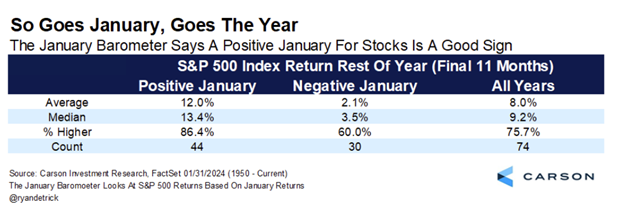
Many in the industry use technical analysis, which is a term for the evaluation of the trend in price and patterns to forecast future price movements. Ironically, it’s called technical analysis, but it’s also behavioral finance: Market participants make future decisions based on price movements. One of the technical indicators used by strategists is the ‘January Effect’: So goes January market performance, so (typically) returns follow the rest of the year. Historically, a positive January return in the S&P 500 index results in a 12% return for the remaining 11 months 86% of the time. If January returns are negative, the average remaining annual return is 2.1% but at only a 60% hit rate. Of course, no one technical signal is the end-all, but it is helpful context for understanding that market strength often begets more strength on a calendar year basis. With the S&P 500 up 2.7% in January, the case for a positive year has only strengthened.
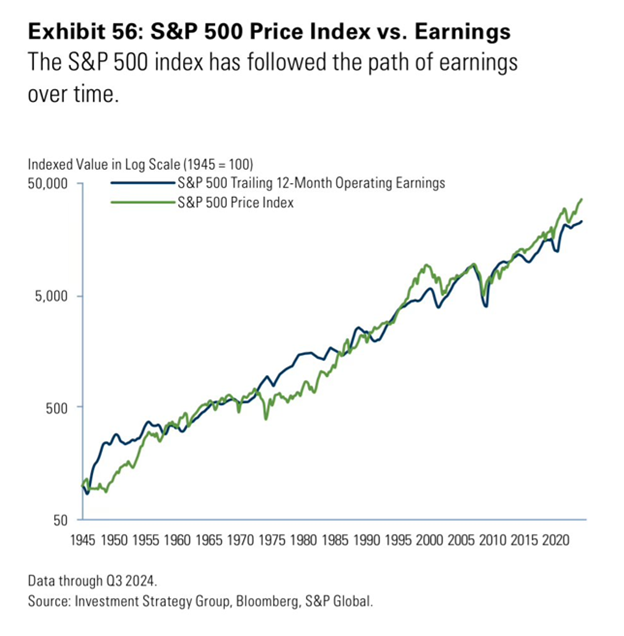
This is a good one. News, fear, and flows guide short-term price action, but it’s underlying corporate earnings that guide long-term price action. A slowing or accelerating rate of change in earnings drives the price. The wisdom here is that time in the market is more important than market timing. There are periods of time where earnings growth outpaces underlying index price growth, and vice versa, but over the long-run, historical earnings matter, and they typically grow over time.
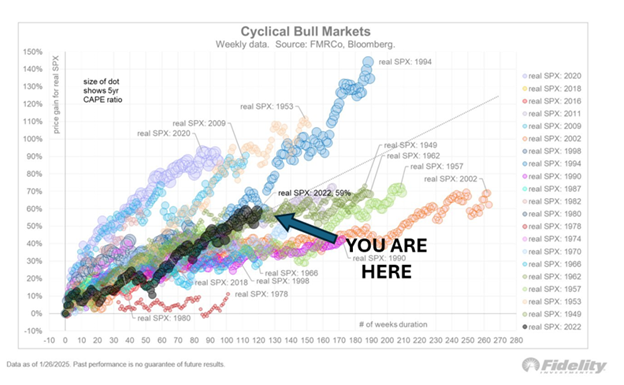
Finally, a historical look at cyclical bull markets and weekly S&P 500 returns therein. As you can see, our current cyclical bull market from the lows of 2022 indicates this bull market is looking historically healthy. Conditions and overall narratives are different across the variety of market timeframes, but the only question is how long this one will last. Yes, cross-sectionally in time, valuations are elevated, and past-performance is no guarantee of future returns, but so far, we are tracking along nicely with previous bull market cycles.
That is all for this week. Enjoy the rest of your weekend!
-Matt
Sources: @Jurrien Timmer, Fidelity Investments, @Ryan Detrick, Carson Investment Research, Bloomberg, S&P Global, YCharts
This communication and its contents are for informational and educational purposes only and should not be used as the sole basis for any investment decision. The information contained herein is based on publicly available sources believed to be reliable but is not a representation, expressed or implied, as to the accuracy, completeness, or correctness of said information. Past performance does not guarantee future results.
">Charts of the Month: Vol. 1
Many in the industry use technical analysis, which is a term for the evaluation of the trend in price and patterns to forecast future price movements. Ironically, it’s called technical analysis, but it’s also behavioral finance: Market participants make future decisions based on price movements. One of the technical indicators used by strategists is the ‘January Effect’: So goes January market performance, so (typically) returns follow the rest of the year. Historically, a positive January return in the S&P 500 index results in a 12% return for the remaining 11 months 86% of the time. If January returns are negative, the average remaining annual return is 2.1% but at only a 60% hit rate. Of course, no one technical signal is the end-all, but it is helpful context for understanding that market strength often begets more strength on a calendar year basis. With the S&P 500 up 2.7% in January, the case for a positive year has only strengthened.
This is a good one. News, fear, and flows guide short-term price action, but it’s underlying corporate earnings that guide long-term price action. A slowing or accelerating rate of change in earnings drives the price. The wisdom here is that time in the market is more important than market timing. There are periods of time where earnings growth outpaces underlying index price growth, and vice versa, but over the long-run, historical earnings matter, and they typically grow over time.
Finally, a historical look at cyclical bull markets and weekly S&P 500 returns therein. As you can see, our current cyclical bull market from the lows of 2022 indicates this bull market is looking historically healthy. Conditions and overall narratives are different across the variety of market timeframes, but the only question is how long this one will last. Yes, cross-sectionally in time, valuations are elevated, and past-performance is no guarantee of future returns, but so far, we are tracking along nicely with previous bull market cycles.
That is all for this week. Enjoy the rest of your weekend!
-Matt
Sources: @Jurrien Timmer, Fidelity Investments, @Ryan Detrick, Carson Investment Research, Bloomberg, S&P Global, YCharts
This communication and its contents are for informational and educational purposes only and should not be used as the sole basis for any investment decision. The information contained herein is based on publicly available sources believed to be reliable but is not a representation, expressed or implied, as to the accuracy, completeness, or correctness of said information. Past performance does not guarantee future results.
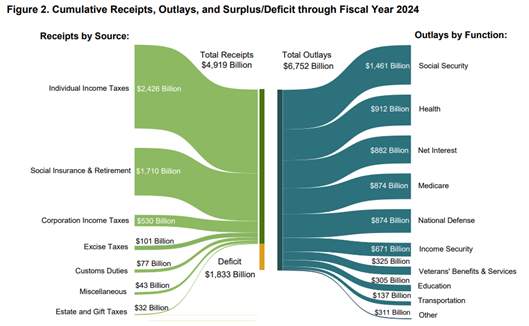
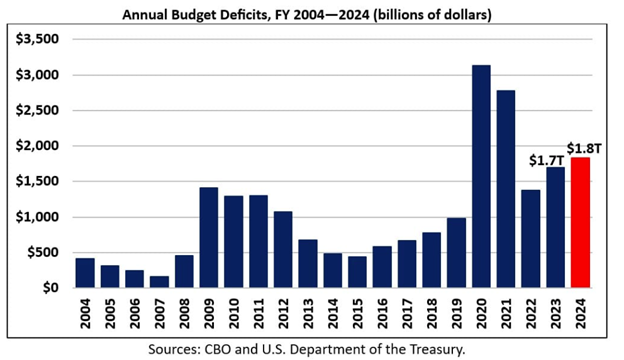
" class="link-chevron">It wasn’t the first thing mentioned during Thursday’s speech, but eventually, Trump quipped that he would “demand interest rates drop immediately after the price of oil comes down.” We can talk later about tariffs, but Trump understands that lowering interest rates is the only meaningful lever to reduce the government deficit (outside of raising taxes on the American people). The US Treasury publishes monthly statements—here’s a chart on the income (receipts) and expenses (outlays), of the US Treasury for fiscal year 2024:
A deficit of over $1.8 trillion. For Trump to reduce the expense side of the budget, it’s very hard to find where the cuts are going to come from. Social security, Medicare, defense spending? Nope. The low-hanging fruit in Trump’s mind here is the net interest expense. Do you remember T-bill and chill? Yep, as interest rates rose in 2022-2023, so did the weighted average interest rate on US government debt. This year, the CBOE projects this line-item expense to be almost 1 trillion dollars (!). This is why Trump is so adamant that interest rates come down. He wants to increase defense spending to over $1.3 Trillion, and cuts to social security and Medicare are non-negotiable because he will need congressional support to lower the corporate tax rate, but more on that later.
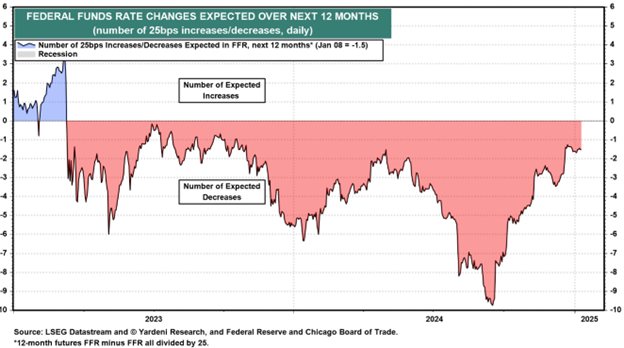
Trump had his ‘return to glory’ last week, but this week the focus will shift to Jerome Powell’s response to Trump’s demand on interest rates. The Fed will convene on January 28-29th, and with Trump’s demand for lower interest rates, it pits him squarely against Jerome Powell and the Fed, who actually hold the power of setting the target federal funds rate. Powell will surely not budge at the President’s call for lowering interest rates. Fighting Trump on interest rate policy could suit Powell’s fancy, thereby setting off a more hawkish Fed. This would put pressure on US equity valuations as long-term interest rates trudge higher under higher-for-longer Fed interest rate policy. Trump has long held an affinity for the stock market and thoroughly enjoys having US equities at all-time highs, and he even rang the bell at the NYSE just last month! However, a fight on interest rates and Fed policy will only intensify from here.
Considering that the expense side of the federal budget will likely increase, let’s look at the income side of the ledger. Trump ran a re-election campaign on the back of tariffs, but so far, there’s been more bark than bite. During his speech at Davos last week, he mentioned his desire for trade with China only to be more equitable and not necessarily overtly in favor of the US. With a week gone by and no additional tariffs levied, it’s increasingly likely that tariffs will be more of a negotiating tactic.
This dovetails with Trump’s call for the US corporate tax-rate to be reduced to 15% from 21%. Trump understands he needs more economic activity to grow both the consumer and corporate tax base. By further lowering the corporate tax rate, Trump’s pitch to company executives is: make your product in the US, where you’ll pay a 15% corporate tax, or continue producing elsewhere and face increasing tariffs. But with no additional tariffs levied last week, it’s more of a negotiating tactic at this point. Trump will rely on companies bringing production facilities to the US, adding jobs and income, and increasing GDP while not passing on price increases to the US consumer through overbearing tariffs. The end game is likely a long and variable lag of increasing productivity and enough corporate onshoring to offset the decrease in the corporate tax rate through sheer volume and the incremental increase in individual tax receipts from the new jobs created.
Most interesting to investors, Trump announced the launch of the Stargate Initiative—a $500 billion private-sector collaboration targeting the expansion of the artificial intelligence infrastructure in the United States. Executives from OpenAI, Oracle, and other leading companies believe the investment will position the US to lead the race in artificial intelligence and quantum computing. The initiative initially will build ten data center facilities, each 500,000 square feet. These data centers and the energy that powers them are crucial to the expansion and acceleration of AI. Without the energy capacity to fulfill the ever-increasing demand for power, a limit is placed on how quickly we can accelerate AI’s growth. A single Chat-GPT search requires 10x the computing power of a simple Google search. You can see how the power demand exponentially grows as the usage increases. Enter the US Government. Trump facilitating the deal amidst a light-handed regulatory environment allows for the energy sector expansion needed to power the arms race, bringing some private sector jobs along with it to construct and manage the data centers.
Have a great week!
-Matt
Sources: https://www.forbes.com/sites/garthfriesen/2025/01/23/trumps-ai-push-understanding-the-500-billion-stargate-initiative/ and Davos 2025 speech: https://www.youtube.com/watch?v=A-DSB13ZWtg
This communication and its contents are for informational and educational purposes only and should not be used as the sole basis for any investment decision. The information contained herein is based on publicly available sources believed to be reliable but is not a representation, expressed or implied, as to the accuracy, completeness, or correctness of said information. Past performance does not guarantee future results.
">
It wasn’t the first thing mentioned during Thursday’s speech, but eventually, Trump quipped that he would “demand interest rates drop immediately after the price of oil comes down.” We can talk later about tariffs, but Trump understands that lowering interest rates is the only meaningful lever to reduce the government deficit (outside of raising taxes on the American people). The US Treasury publishes monthly statements—here’s a chart on the income (receipts) and expenses (outlays), of the US Treasury for fiscal year 2024:
A deficit of over $1.8 trillion. For Trump to reduce the expense side of the budget, it’s very hard to find where the cuts are going to come from. Social security, Medicare, defense spending? Nope. The low-hanging fruit in Trump’s mind here is the net interest expense. Do you remember T-bill and chill? Yep, as interest rates rose in 2022-2023, so did the weighted average interest rate on US government debt. This year, the CBOE projects this line-item expense to be almost 1 trillion dollars (!). This is why Trump is so adamant that interest rates come down. He wants to increase defense spending to over $1.3 Trillion, and cuts to social security and Medicare are non-negotiable because he will need congressional support to lower the corporate tax rate, but more on that later.
Trump had his ‘return to glory’ last week, but this week the focus will shift to Jerome Powell’s response to Trump’s demand on interest rates. The Fed will convene on January 28-29th, and with Trump’s demand for lower interest rates, it pits him squarely against Jerome Powell and the Fed, who actually hold the power of setting the target federal funds rate. Powell will surely not budge at the President’s call for lowering interest rates. Fighting Trump on interest rate policy could suit Powell’s fancy, thereby setting off a more hawkish Fed. This would put pressure on US equity valuations as long-term interest rates trudge higher under higher-for-longer Fed interest rate policy. Trump has long held an affinity for the stock market and thoroughly enjoys having US equities at all-time highs, and he even rang the bell at the NYSE just last month! However, a fight on interest rates and Fed policy will only intensify from here.
Considering that the expense side of the federal budget will likely increase, let’s look at the income side of the ledger. Trump ran a re-election campaign on the back of tariffs, but so far, there’s been more bark than bite. During his speech at Davos last week, he mentioned his desire for trade with China only to be more equitable and not necessarily overtly in favor of the US. With a week gone by and no additional tariffs levied, it’s increasingly likely that tariffs will be more of a negotiating tactic.
This dovetails with Trump’s call for the US corporate tax-rate to be reduced to 15% from 21%. Trump understands he needs more economic activity to grow both the consumer and corporate tax base. By further lowering the corporate tax rate, Trump’s pitch to company executives is: make your product in the US, where you’ll pay a 15% corporate tax, or continue producing elsewhere and face increasing tariffs. But with no additional tariffs levied last week, it’s more of a negotiating tactic at this point. Trump will rely on companies bringing production facilities to the US, adding jobs and income, and increasing GDP while not passing on price increases to the US consumer through overbearing tariffs. The end game is likely a long and variable lag of increasing productivity and enough corporate onshoring to offset the decrease in the corporate tax rate through sheer volume and the incremental increase in individual tax receipts from the new jobs created.
Most interesting to investors, Trump announced the launch of the Stargate Initiative—a $500 billion private-sector collaboration targeting the expansion of the artificial intelligence infrastructure in the United States. Executives from OpenAI, Oracle, and other leading companies believe the investment will position the US to lead the race in artificial intelligence and quantum computing. The initiative initially will build ten data center facilities, each 500,000 square feet. These data centers and the energy that powers them are crucial to the expansion and acceleration of AI. Without the energy capacity to fulfill the ever-increasing demand for power, a limit is placed on how quickly we can accelerate AI’s growth. A single Chat-GPT search requires 10x the computing power of a simple Google search. You can see how the power demand exponentially grows as the usage increases. Enter the US Government. Trump facilitating the deal amidst a light-handed regulatory environment allows for the energy sector expansion needed to power the arms race, bringing some private sector jobs along with it to construct and manage the data centers.
Have a great week!
-Matt
Sources: https://www.forbes.com/sites/garthfriesen/2025/01/23/trumps-ai-push-understanding-the-500-billion-stargate-initiative/ and Davos 2025 speech: https://www.youtube.com/watch?v=A-DSB13ZWtg
This communication and its contents are for informational and educational purposes only and should not be used as the sole basis for any investment decision. The information contained herein is based on publicly available sources believed to be reliable but is not a representation, expressed or implied, as to the accuracy, completeness, or correctness of said information. Past performance does not guarantee future results.
">The “Golden Age of America” We are one week into Trump’s second Presidency, and we can finally begin to separate the wheat from the chaff in terms of the administration’s words and actions. Trump joined the World Economic Forum’s annual meeting on Thursday last week and delivered a speech that dropped some breadcrumbs on what he did and did not action during the first week of his second term that will impact the economy. Trump said during both his inaugural address and his Thursday speech that we are entering the “Golden Age of America.” To do so, his administration will need to support economic growth but also manage the federal deficit and debt load. He needs to increase government revenues, decrease expenses, or, in the best possible outcome, both, but can he thread the needle and deliver on his “Golden Age of America” promise?It wasn’t the first thing mentioned during Thursday’s speech, but eventually, Trump quipped that he would “demand interest rates drop immediately after the price of oil comes down.” We can talk later about tariffs, but Trump understands that lowering interest rates is the only meaningful lever to reduce the government deficit (outside of raising taxes on the American people). The US Treasury publishes monthly statements—here’s a chart on the income (receipts) and expenses (outlays), of the US Treasury for fiscal year 2024:
A deficit of over $1.8 trillion. For Trump to reduce the expense side of the budget, it’s very hard to find where the cuts are going to come from. Social security, Medicare, defense spending? Nope. The low-hanging fruit in Trump’s mind here is the net interest expense. Do you remember T-bill and chill? Yep, as interest rates rose in 2022-2023, so did the weighted average interest rate on US government debt. This year, the CBOE projects this line-item expense to be almost 1 trillion dollars (!). This is why Trump is so adamant that interest rates come down. He wants to increase defense spending to over $1.3 Trillion, and cuts to social security and Medicare are non-negotiable because he will need congressional support to lower the corporate tax rate, but more on that later.
Trump had his ‘return to glory’ last week, but this week the focus will shift to Jerome Powell’s response to Trump’s demand on interest rates. The Fed will convene on January 28-29th, and with Trump’s demand for lower interest rates, it pits him squarely against Jerome Powell and the Fed, who actually hold the power of setting the target federal funds rate. Powell will surely not budge at the President’s call for lowering interest rates. Fighting Trump on interest rate policy could suit Powell’s fancy, thereby setting off a more hawkish Fed. This would put pressure on US equity valuations as long-term interest rates trudge higher under higher-for-longer Fed interest rate policy. Trump has long held an affinity for the stock market and thoroughly enjoys having US equities at all-time highs, and he even rang the bell at the NYSE just last month! However, a fight on interest rates and Fed policy will only intensify from here.
Considering that the expense side of the federal budget will likely increase, let’s look at the income side of the ledger. Trump ran a re-election campaign on the back of tariffs, but so far, there’s been more bark than bite. During his speech at Davos last week, he mentioned his desire for trade with China only to be more equitable and not necessarily overtly in favor of the US. With a week gone by and no additional tariffs levied, it’s increasingly likely that tariffs will be more of a negotiating tactic.
This dovetails with Trump’s call for the US corporate tax-rate to be reduced to 15% from 21%. Trump understands he needs more economic activity to grow both the consumer and corporate tax base. By further lowering the corporate tax rate, Trump’s pitch to company executives is: make your product in the US, where you’ll pay a 15% corporate tax, or continue producing elsewhere and face increasing tariffs. But with no additional tariffs levied last week, it’s more of a negotiating tactic at this point. Trump will rely on companies bringing production facilities to the US, adding jobs and income, and increasing GDP while not passing on price increases to the US consumer through overbearing tariffs. The end game is likely a long and variable lag of increasing productivity and enough corporate onshoring to offset the decrease in the corporate tax rate through sheer volume and the incremental increase in individual tax receipts from the new jobs created.
Most interesting to investors, Trump announced the launch of the Stargate Initiative—a $500 billion private-sector collaboration targeting the expansion of the artificial intelligence infrastructure in the United States. Executives from OpenAI, Oracle, and other leading companies believe the investment will position the US to lead the race in artificial intelligence and quantum computing. The initiative initially will build ten data center facilities, each 500,000 square feet. These data centers and the energy that powers them are crucial to the expansion and acceleration of AI. Without the energy capacity to fulfill the ever-increasing demand for power, a limit is placed on how quickly we can accelerate AI’s growth. A single Chat-GPT search requires 10x the computing power of a simple Google search. You can see how the power demand exponentially grows as the usage increases. Enter the US Government. Trump facilitating the deal amidst a light-handed regulatory environment allows for the energy sector expansion needed to power the arms race, bringing some private sector jobs along with it to construct and manage the data centers.
Have a great week!
-Matt
Sources: https://www.forbes.com/sites/garthfriesen/2025/01/23/trumps-ai-push-understanding-the-500-billion-stargate-initiative/ and Davos 2025 speech: https://www.youtube.com/watch?v=A-DSB13ZWtg
This communication and its contents are for informational and educational purposes only and should not be used as the sole basis for any investment decision. The information contained herein is based on publicly available sources believed to be reliable but is not a representation, expressed or implied, as to the accuracy, completeness, or correctness of said information. Past performance does not guarantee future results.
" class="link-chevron">Comparing different market cycles is a lot like the arguments about the greatest athletes of all time in their respective sports. In basketball, most often this becomes Michael Jordan or Lebron James, but the disagreement often ends with each side firmly entrenched in their belief with the mutual understanding that they played in different eras; in other words, agree to disagree. The same, too, can be said of comparing market cycles—but it’s fun to do it anyhow!
A close comparison to this market cycle is the mid-1990’s. Of course, there are inconsistencies and differences, and although history does not necessarily repeat itself, it often rhymes. I won’t tell you how old I was in 1995, but at the time, Fed chair Alan Greenspan kicked off a rate-cutting cycle in response to signs of deteriorating economic growth after having tamed a slight rise in inflation in the years prior. Cue the comparison!
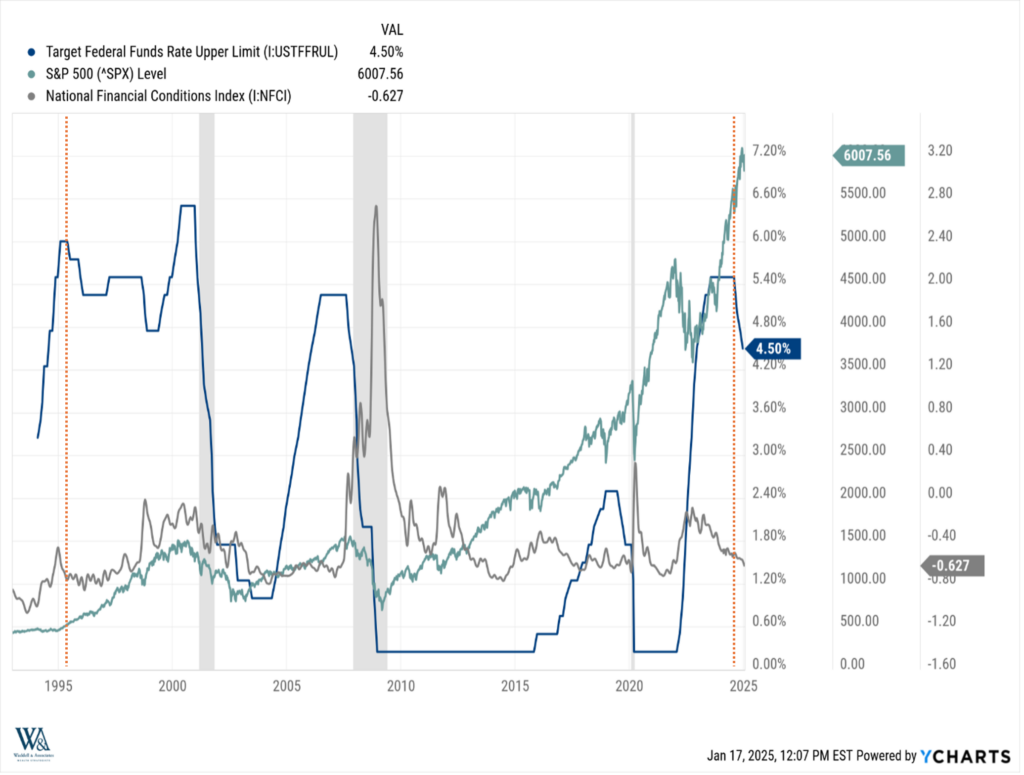
Current Fed chair Jerome Powell began a rate-cutting cycle this past September across a similar backdrop of relatively loose financial conditions, with US equity markets at very-near all-time highs:
It’s a noisy chart, but you’ll see, as marked by the vertical orange lines, that both Greenspan and Powell started cutting interest rates under a similar set: loose financial conditions as measured by the Chicago Fed National Financial Conditions index, and newly minted all-time highs in US equity markets as measured by the S&P 500 index. Of course, after Greenspan’s cuts in 1995, we see what happened thereafter: the S&P 500 continued its run under relatively loose financial conditions until 2000.
Why do financial conditions matter? In simple terms, they are a measure of relative liquidity available in the marketplace. Typically, excess liquidity ends up flowing into investment assets, thereby boosting asset prices. On the other hand, as financial conditions tighten, asset prices typically come under pressure as liquidity exits the system. You can see this on the same chart as conditions tightened into 2000, 2007, and 2022.
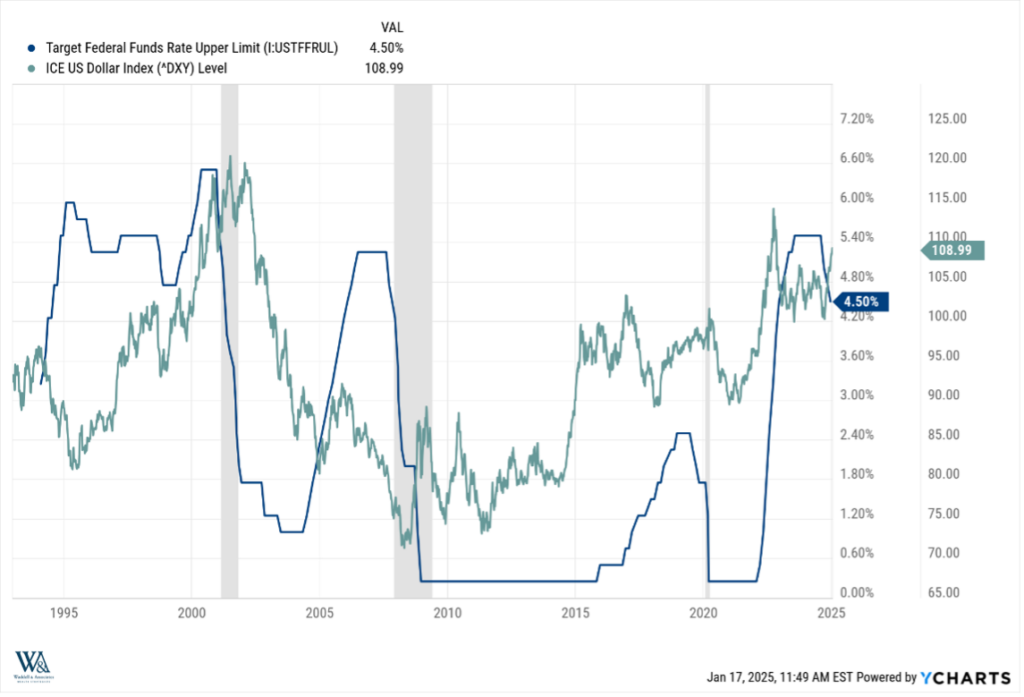
Like financial conditions and equity prices, the direction of the USD has taken a similar path to Greenspan’s1995 rate-cut cycle:
The dollar index, as measured by DXY, ramped almost 50% from 1995 to 2000, following Greenspan’s first cut in 1995. The DXY index is a relative value, meaning US dollar strength is also a function of the strength or weakness against other currencies. Fast forward to today, and since Powell’s first cut in September, the dollar has appreciated almost 10% in a few short months. We will be keen to watch if this trend continues or reverses course.
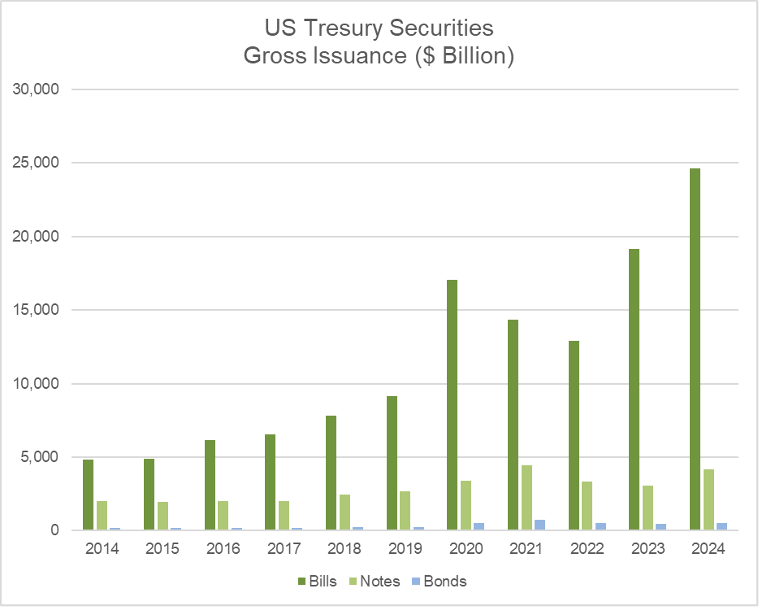
As is the case in comparing anything, it’s important to highlight the differences as well. The US federal debt to GDP is almost twice as high now as it was in 1995, and the Fed’s behavior changed dramatically after the Great Financial Crisis in 2008. Across the current cycle, as the Fed began raising interest rates in 2022, the US Treasury countered this Fed financial tightening by issuing short US Treasury Bills, as opposed to longer-dated maturity notes and bonds, to finance the US Government. Ultimately, as we can see in the Financial Conditions Index, it’s ended up loosening financial conditions, providing a tailwind and support for US equities.
As we move forward from this particular point in cycle time, we will closely monitor financial conditions, as they can be a helpful indicator in the future direction of US equity markets.
Have a great week!
-Matt
Sources: YCharts, SIMFA Research
This communication and its contents are for informational and educational purposes only and should not be used as the sole basis for any investment decision. The information contained herein is based on publicly available sources believed to be reliable but is not a representation, expressed or implied, as to the accuracy, completeness, or correctness of said information. Past performance does not guarantee future results.
">A Cycle ComparisonComparing different market cycles is a lot like the arguments about the greatest athletes of all time in their respective sports. In basketball, most often this becomes Michael Jordan or Lebron James, but the disagreement often ends with each side firmly entrenched in their belief with the mutual understanding that they played in different eras; in other words, agree to disagree. The same, too, can be said of comparing market cycles—but it’s fun to do it anyhow!
A close comparison to this market cycle is the mid-1990’s. Of course, there are inconsistencies and differences, and although history does not necessarily repeat itself, it often rhymes. I won’t tell you how old I was in 1995, but at the time, Fed chair Alan Greenspan kicked off a rate-cutting cycle in response to signs of deteriorating economic growth after having tamed a slight rise in inflation in the years prior. Cue the comparison!
Current Fed chair Jerome Powell began a rate-cutting cycle this past September across a similar backdrop of relatively loose financial conditions, with US equity markets at very-near all-time highs:
It’s a noisy chart, but you’ll see, as marked by the vertical orange lines, that both Greenspan and Powell started cutting interest rates under a similar set: loose financial conditions as measured by the Chicago Fed National Financial Conditions index, and newly minted all-time highs in US equity markets as measured by the S&P 500 index. Of course, after Greenspan’s cuts in 1995, we see what happened thereafter: the S&P 500 continued its run under relatively loose financial conditions until 2000.
Why do financial conditions matter? In simple terms, they are a measure of relative liquidity available in the marketplace. Typically, excess liquidity ends up flowing into investment assets, thereby boosting asset prices. On the other hand, as financial conditions tighten, asset prices typically come under pressure as liquidity exits the system. You can see this on the same chart as conditions tightened into 2000, 2007, and 2022.
Like financial conditions and equity prices, the direction of the USD has taken a similar path to Greenspan’s1995 rate-cut cycle:
The dollar index, as measured by DXY, ramped almost 50% from 1995 to 2000, following Greenspan’s first cut in 1995. The DXY index is a relative value, meaning US dollar strength is also a function of the strength or weakness against other currencies. Fast forward to today, and since Powell’s first cut in September, the dollar has appreciated almost 10% in a few short months. We will be keen to watch if this trend continues or reverses course.
As is the case in comparing anything, it’s important to highlight the differences as well. The US federal debt to GDP is almost twice as high now as it was in 1995, and the Fed’s behavior changed dramatically after the Great Financial Crisis in 2008. Across the current cycle, as the Fed began raising interest rates in 2022, the US Treasury countered this Fed financial tightening by issuing short US Treasury Bills, as opposed to longer-dated maturity notes and bonds, to finance the US Government. Ultimately, as we can see in the Financial Conditions Index, it’s ended up loosening financial conditions, providing a tailwind and support for US equities.
As we move forward from this particular point in cycle time, we will closely monitor financial conditions, as they can be a helpful indicator in the future direction of US equity markets.
Have a great week!
-Matt
Sources: YCharts, SIMFA Research
This communication and its contents are for informational and educational purposes only and should not be used as the sole basis for any investment decision. The information contained herein is based on publicly available sources believed to be reliable but is not a representation, expressed or implied, as to the accuracy, completeness, or correctness of said information. Past performance does not guarantee future results.
" class="link-chevron">The only constant in our lives is change. As musical legend David Bowie once said, “Ch-ch-ch-ch changes! Turn and face the strange.” The song hints that the best path is to embrace the strange, unwelcome, or opportunistic changes life throws us. Although “Changes” was not released until 1972, Bowie penned it in 1969 near the height of the social and political turmoil of the 1970s—sound familiar?
Our passion as wealth strategists at Waddell & Associates is to help you navigate changes more skillfully. Not just in your investment portfolios, but more importantly, in all of these other areas:
BOTTOM LINE: Ch-ch-ch-ch changes. Rely on the credentialed and experienced wealth strategists at W&A to help you skillfully face changes, oh yeah!
-Phyllis
Sources: Wikipedia; vocal.media
">AA- It’s Not What You Think! Third Quarter, 2024The only constant in our lives is change. As musical legend David Bowie once said, “Ch-ch-ch-ch changes! Turn and face the strange.” The song hints that the best path is to embrace the strange, unwelcome, or opportunistic changes life throws us. Although “Changes” was not released until 1972, Bowie penned it in 1969 near the height of the social and political turmoil of the 1970s—sound familiar?
Our passion as wealth strategists at Waddell & Associates is to help you navigate changes more skillfully. Not just in your investment portfolios, but more importantly, in all of these other areas:
BOTTOM LINE: Ch-ch-ch-ch changes. Rely on the credentialed and experienced wealth strategists at W&A to help you skillfully face changes, oh yeah!
-Phyllis
Sources: Wikipedia; vocal.media
" class="link-chevron">The Trump “bump” for the stock market began as betting markets started pricing in Don’s victory. Between early August and late November, the S&P 500 large cap index rallied more than 15% while the Russell 2000 small cap index rallied more than 20%.
Stock markets react quickly. Other markets react more slowly.
This past month, the 10-year Treasury yield rose by 13%, oil prices per barrel rose by 11%, and the US Dollar index rose by 3%. The “catch-up” appreciations in interest rates, oil, and the US dollar have capped further appreciations for stocks. I know of very few reliable truths in investing, but when interest rates, oil, and the US Dollar rise simultaneously, stocks do not. This explains the recent weakness in equities, making it more of a moment for digestion and less of a moment for apprehension. Nonetheless, 2025 presents more questions than answers for investors. Here are the major ones driving market anxieties:
Donald Trump swept the ballot box on promises of faster economic growth, lower consumer inflation, and more fiscal accountability. Fiscal policy can either be economically expansionary or contractionary. For 2024, the US government received roughly $5 trillion and spent $7 trillion, driving a fiscal deficit of nearly $2 trillion—that’s more than 6% of our nation’s GDP. Traditionally, US fiscal deficits average around 3% of GDP. At 6%, President Biden’s fiscal policy has been highly expansionary, as our economic growth attests.
Trump campaigned on slashing spending while using tax cuts to increase economic growth even further. These missions seem slightly at odds as tax cuts (in the short run) increase deficits while spending cuts reduce them. Depending on the relative size of both reductions the deficit could either expand (stimulus) or contract (constraint). Relying on foreign tax receipts through tariffs may neatly solve the math problem, but historically, spirited tariff tournaments have created several others.
It’s unclear, at this moment, what legislation will follow and, therefore, whether we will have fiscal expansion or fiscal contraction. But we do have some Trump budget experience to draw upon. During the first Trump administration, the fiscal deficit rose from 3.4% of GDP to 4.6% of GDP (pre-COVID). This was decidedly expansionary, even as inflation fell. Unfortunately, this time around, fiscal expansion would start with deficit levels at 6%+. Bond markets could protest deeper deficits with Treasury downgrades and/or higher yield demands on Treasury issuance. This could weigh on economic growth prospects just as reductions in deficits at the hands of the DOGE committee might.
Until we gain greater clarity on Trump’s legislative intentions, fiscal policy’s 2025 contribution/deduction from GDP is largely… unknowable.
This time last year, the US Federal Reserve projected that the overnight US interest rate would end 2025 at 3.6%. In their most recent summary of economic projections, they forecast year-end rates of 3.9%. Clearly, the Fed has become more dovishly hawkish with most of the attitude adjustment arriving recently. Note that just a few months ago, investors forecast nearly 10 rate cuts for 2025 , compared with expectations for 1.5 rate cuts today:
Is this an inflation warning? Not really. Inflation expectations have risen marginally, but the 5-year breakeven rate forecasting future inflation levels sits well within its normal range between 2 and 2.5%. What this reversal of Fed cut forecasts likely signals is higher levels of confidence in US economic growth prospects. Consider the following:
The Fed projects US economic growth potential lies around 1.8%. Over the last nine quarters, the US economy has averaged GDP growth of nearly 3%. Government largess can explain some of this, but technological productivity enhancements can as well. What we don’t know is how Trump’s expansionary fiscal policy will affect our economic growth rate that’s performing well above potential. Any acceleration could reignite inflation fears. Any deceleration could reignite recession fears or goad Trump into doubling down on stimulus measures.
Oh, and just to confuse things further, the Fed continues to sell down its balance sheet to tighten monetary conditions. The market expects them to conclude the program mid-year, but given the conditions highlighted above, they may not, further complicating rate projections. In sum, until we gain greater clarity on Trump’s legislative intentions, monetary policy’s 2025 contribution/deduction from GDP is largely… unknowable.
I will save a longer form of this discussion for our upcoming annual outlook, but as a preview, the largest and most important market in the world isn’t the equity or bond market, but the currency market. Trump’s tariff agenda infers a stronger dollar. Trump’s vocal agenda demands a weaker dollar. Clearly, Trump wants to raise revenues from offshore sources to finance lower fiscal deficits. What he hasn’t discussed – but his Treasury secretary nominee certainly understands – is that if you want foreign tax receipts and a weaker currency, you don’t tax foreign goods; you tax foreign investment. But doing that disincentivizes foreign fund flows into the US, which we need to finance our deficits.
For now, the markets have decided that the MAGA agenda is a strong dollar agenda, but this could change quickly. In sum, until we gain greater clarity on Trump’s legislative intentions, currency policy is largely… unknowable.
Enjoy the rest of your weekend!
-David
Sources: LSEG Datastream and Yardeni Research, Federal Reserve Bank of St. Louis, CBO and US Dept. of Treasury
This communication and its contents are for informational and educational purposes only and should not be used as the sole basis for any investment decision. The information contained herein is based on publicly available sources believed to be reliable but is not a representation, expressed or implied, as to the accuracy, completeness, or correctness of said information. Past performance does not guarantee future results.
">2025 Hasn’t Started Yet The Full Story:The Trump “bump” for the stock market began as betting markets started pricing in Don’s victory. Between early August and late November, the S&P 500 large cap index rallied more than 15% while the Russell 2000 small cap index rallied more than 20%.
Stock markets react quickly. Other markets react more slowly.
This past month, the 10-year Treasury yield rose by 13%, oil prices per barrel rose by 11%, and the US Dollar index rose by 3%. The “catch-up” appreciations in interest rates, oil, and the US dollar have capped further appreciations for stocks. I know of very few reliable truths in investing, but when interest rates, oil, and the US Dollar rise simultaneously, stocks do not. This explains the recent weakness in equities, making it more of a moment for digestion and less of a moment for apprehension. Nonetheless, 2025 presents more questions than answers for investors. Here are the major ones driving market anxieties:
Donald Trump swept the ballot box on promises of faster economic growth, lower consumer inflation, and more fiscal accountability. Fiscal policy can either be economically expansionary or contractionary. For 2024, the US government received roughly $5 trillion and spent $7 trillion, driving a fiscal deficit of nearly $2 trillion—that’s more than 6% of our nation’s GDP. Traditionally, US fiscal deficits average around 3% of GDP. At 6%, President Biden’s fiscal policy has been highly expansionary, as our economic growth attests.
Trump campaigned on slashing spending while using tax cuts to increase economic growth even further. These missions seem slightly at odds as tax cuts (in the short run) increase deficits while spending cuts reduce them. Depending on the relative size of both reductions the deficit could either expand (stimulus) or contract (constraint). Relying on foreign tax receipts through tariffs may neatly solve the math problem, but historically, spirited tariff tournaments have created several others.
It’s unclear, at this moment, what legislation will follow and, therefore, whether we will have fiscal expansion or fiscal contraction. But we do have some Trump budget experience to draw upon. During the first Trump administration, the fiscal deficit rose from 3.4% of GDP to 4.6% of GDP (pre-COVID). This was decidedly expansionary, even as inflation fell. Unfortunately, this time around, fiscal expansion would start with deficit levels at 6%+. Bond markets could protest deeper deficits with Treasury downgrades and/or higher yield demands on Treasury issuance. This could weigh on economic growth prospects just as reductions in deficits at the hands of the DOGE committee might.
Until we gain greater clarity on Trump’s legislative intentions, fiscal policy’s 2025 contribution/deduction from GDP is largely… unknowable.
This time last year, the US Federal Reserve projected that the overnight US interest rate would end 2025 at 3.6%. In their most recent summary of economic projections, they forecast year-end rates of 3.9%. Clearly, the Fed has become more dovishly hawkish with most of the attitude adjustment arriving recently. Note that just a few months ago, investors forecast nearly 10 rate cuts for 2025 , compared with expectations for 1.5 rate cuts today:
Is this an inflation warning? Not really. Inflation expectations have risen marginally, but the 5-year breakeven rate forecasting future inflation levels sits well within its normal range between 2 and 2.5%. What this reversal of Fed cut forecasts likely signals is higher levels of confidence in US economic growth prospects. Consider the following:
The Fed projects US economic growth potential lies around 1.8%. Over the last nine quarters, the US economy has averaged GDP growth of nearly 3%. Government largess can explain some of this, but technological productivity enhancements can as well. What we don’t know is how Trump’s expansionary fiscal policy will affect our economic growth rate that’s performing well above potential. Any acceleration could reignite inflation fears. Any deceleration could reignite recession fears or goad Trump into doubling down on stimulus measures.
Oh, and just to confuse things further, the Fed continues to sell down its balance sheet to tighten monetary conditions. The market expects them to conclude the program mid-year, but given the conditions highlighted above, they may not, further complicating rate projections. In sum, until we gain greater clarity on Trump’s legislative intentions, monetary policy’s 2025 contribution/deduction from GDP is largely… unknowable.
I will save a longer form of this discussion for our upcoming annual outlook, but as a preview, the largest and most important market in the world isn’t the equity or bond market, but the currency market. Trump’s tariff agenda infers a stronger dollar. Trump’s vocal agenda demands a weaker dollar. Clearly, Trump wants to raise revenues from offshore sources to finance lower fiscal deficits. What he hasn’t discussed – but his Treasury secretary nominee certainly understands – is that if you want foreign tax receipts and a weaker currency, you don’t tax foreign goods; you tax foreign investment. But doing that disincentivizes foreign fund flows into the US, which we need to finance our deficits.
For now, the markets have decided that the MAGA agenda is a strong dollar agenda, but this could change quickly. In sum, until we gain greater clarity on Trump’s legislative intentions, currency policy is largely… unknowable.
Enjoy the rest of your weekend!
-David
Sources: LSEG Datastream and Yardeni Research, Federal Reserve Bank of St. Louis, CBO and US Dept. of Treasury
This communication and its contents are for informational and educational purposes only and should not be used as the sole basis for any investment decision. The information contained herein is based on publicly available sources believed to be reliable but is not a representation, expressed or implied, as to the accuracy, completeness, or correctness of said information. Past performance does not guarantee future results.
" class="link-chevron">Before we look ahead to the remainder of 2025, let’s look back at the year that was in 2024. As the saying goes, hindsight is 20/20; just when you think an asset should zig, it often zags!
I’m a big visual learner. One of my favorite ways to digest asset class returns is through a quilt chart like the one below. Of course, this does not represent the entire investing universe, but it does provide helpful context through color:
Much like in 2023, large-cap US equities led the way again in 2024, producing a 25% return—over double the closest competitor. Similarly, cash assumed invested at the fed funds rate earned a 5.3% return, beating traditional fixed income and even international, developed equities at 1.3% and 4.3%, respectively. However, the “quilt” nature of the chart shows why we diversify portfolios across different asset classes, and it provides a valuable lesson as we kick off 2025.
If you look at the top left of the quilt, you’ll see that, coming out of the Great Financial Crisis in 2009, REITs led the way in returns for three straight years and for five of the first six years that kicked off the 2010s decade. For those who recall the sentiment at the time, an allocation to REITs was necessary and borderline foolish to underweight inside of portfolios.
On the bottom of the quilt, you’ll see just the opposite. Commodities ranked near the bottom for almost the entire decade. They were the laughingstock of asset allocators, bringing forward the question of why anyone would ever invest in commodities. Amazingly, they awoke from their performance slumber and had fantastic performances in 2021 and 2022.
Looking back at various outlooks for 2022, likely very few, if any, had commodities at the top of the buy list. So, reallocating your hard-earned capital into REITs after their strong run or dumping commodities after their difficult decade would have proven costly thereafter. But that’s what makes the ”quilt” essence of the chart so informative. It is a humbling reminder that being in the prediction business of calendar-year returns is a difficult endeavor.
Fast forward to the present, and we find ourselves in the middle of another leadership streak after US large-cap equities continued to flex their return muscle in 2024. Of course, owning US large-cap stocks has been a lot like picking the Chiefs to win the Super Bowl in recent years. When the trend is your friend, it’s silly to pick the time when that trend will end. However, we do know from history that it will likely end at some point.
Peering through the hourglass of 2025, will US large-cap stocks lead the way? Maybe, but maybe not. Consider the below chart of historical US asset class valuations against the rest of the world:
Going back thirty years, US assets are expensive compared to the rest of the world. Past performance is no guarantee of future results, and as we can see in the quilt chart, a trend might continue, but it also might not. There is no necessary reason that US vs. Global valuations should mean revert, but we know from history that they often do at some point in time.
So, before ditching the underperforming asset classes in your portfolio, it’s important to remember why we own a collection of assets instead of one or two. The collective pool of diversified, un-correlated asset classes helps generate portfolio returns with lower levels of volatility or, in essence, smoothing out the ride in the growth of the portfolio over time.
Have a great weekend!
-Matt
Sources: JP Morgan Asset Management, Topdown Charts, LSEG
This communication and its contents are for informational and educational purposes only and should not be used as the sole basis for any investment decision. The information contained herein is based on publicly available sources believed to be reliable but is not a representation, expressed or implied, as to the accuracy, completeness, or correctness of said information. Past performance does not guarantee future results.
">HindsightBefore we look ahead to the remainder of 2025, let’s look back at the year that was in 2024. As the saying goes, hindsight is 20/20; just when you think an asset should zig, it often zags!
I’m a big visual learner. One of my favorite ways to digest asset class returns is through a quilt chart like the one below. Of course, this does not represent the entire investing universe, but it does provide helpful context through color:
Much like in 2023, large-cap US equities led the way again in 2024, producing a 25% return—over double the closest competitor. Similarly, cash assumed invested at the fed funds rate earned a 5.3% return, beating traditional fixed income and even international, developed equities at 1.3% and 4.3%, respectively. However, the “quilt” nature of the chart shows why we diversify portfolios across different asset classes, and it provides a valuable lesson as we kick off 2025.
If you look at the top left of the quilt, you’ll see that, coming out of the Great Financial Crisis in 2009, REITs led the way in returns for three straight years and for five of the first six years that kicked off the 2010s decade. For those who recall the sentiment at the time, an allocation to REITs was necessary and borderline foolish to underweight inside of portfolios.
On the bottom of the quilt, you’ll see just the opposite. Commodities ranked near the bottom for almost the entire decade. They were the laughingstock of asset allocators, bringing forward the question of why anyone would ever invest in commodities. Amazingly, they awoke from their performance slumber and had fantastic performances in 2021 and 2022.
Looking back at various outlooks for 2022, likely very few, if any, had commodities at the top of the buy list. So, reallocating your hard-earned capital into REITs after their strong run or dumping commodities after their difficult decade would have proven costly thereafter. But that’s what makes the ”quilt” essence of the chart so informative. It is a humbling reminder that being in the prediction business of calendar-year returns is a difficult endeavor.
Fast forward to the present, and we find ourselves in the middle of another leadership streak after US large-cap equities continued to flex their return muscle in 2024. Of course, owning US large-cap stocks has been a lot like picking the Chiefs to win the Super Bowl in recent years. When the trend is your friend, it’s silly to pick the time when that trend will end. However, we do know from history that it will likely end at some point.
Peering through the hourglass of 2025, will US large-cap stocks lead the way? Maybe, but maybe not. Consider the below chart of historical US asset class valuations against the rest of the world:
Going back thirty years, US assets are expensive compared to the rest of the world. Past performance is no guarantee of future results, and as we can see in the quilt chart, a trend might continue, but it also might not. There is no necessary reason that US vs. Global valuations should mean revert, but we know from history that they often do at some point in time.
So, before ditching the underperforming asset classes in your portfolio, it’s important to remember why we own a collection of assets instead of one or two. The collective pool of diversified, un-correlated asset classes helps generate portfolio returns with lower levels of volatility or, in essence, smoothing out the ride in the growth of the portfolio over time.
Have a great weekend!
-Matt
Sources: JP Morgan Asset Management, Topdown Charts, LSEG
This communication and its contents are for informational and educational purposes only and should not be used as the sole basis for any investment decision. The information contained herein is based on publicly available sources believed to be reliable but is not a representation, expressed or implied, as to the accuracy, completeness, or correctness of said information. Past performance does not guarantee future results.
" class="link-chevron">On Wednesday, Jerome Powell and his fellow committee members cut short-term interest rates by 0.25%, but saw their summary of economic projections increase their 2025 expectations for inflation, GDP, and the Fed funds rate. This induced a correction in US equities and a small rise in the 10-year treasury, but it’s important to understand the correction in the context of other asset classes, specifically treasury bond volatility, oil prices, and credit spreads, all of which barely moved alongside their US equity counterparts!
First, the MOVE index, which measures US Treasury volatility, did not have much to say about the equity sell-off and is near the low on the year:
Source: https://www.google.com/finance/quote/MOVE:INDEXNYSEGIS?sa=X&ved=2ahUKEwiGt6HKoLeKAxUoOTQIHSeiBVcQ3ecFegQIJRAf&window=YTD
Second, oil prices are relatively unchanged. If markets were expecting an economic downturn and/or recession, oil prices would be collapsing:
And lastly, credit spreads remain at cycle lows, indicating the equity sell-off wasn’t attributable to increasing systemic credit risk:
Source: https://fred.stlouisfed.org/graph/fredgraph.png?g=1CmaT
While US equity markets were falling, credit spreads didn’t budge, oil and other commodity prices were flat, and treasury bond volatility was non-existent. If Santa were delivering an economic downturn, it wouldn’t be exclusive to a US equity market correction!
On a more fun note, a timeless tradition in our house is the annual reading of “‘Twas the Night Before Christmas.” So, in keeping with the holiday spirit, I wrote a few words to reminisce on the year we’ve shared. I hope you enjoy it and maybe you’ll share it!
‘Twas the night before Christmas, and all through the Street,
The terminals were stirring; the year’s been a treat.
The strategists were nestled, their screens shut down,
While visions of gains danced all around.
The Fed had been slow, with cuts here and there,
To ease the worry of economic despair.
Inflation ticked lower, labor was tight,
Yet uncertainty lingered—an ongoing plight.
The S&P rallied, the Nasdaq soared,
With tech leading gains like many times before.
AI and data centers filled our minds,
While no drones were found, as if by design.
Bonds were resilient, while yields stayed alight,
Gold shined as a hedge all throughout the night.
Crypto found bulls to put on their team,
And Bitcoin hit levels thought only in a dream.
“On Powell! On Yellen! On GDP, hooray!”
Japan and Ukraine kept volatility in play.
With Yen-carry-trades painting the tapes,
Investors stayed cautious, unaware of their fates.
With portfolios balanced and earnings now clear,
Strategists worked calmly to keep clients near.
For long-term investors weathering the storm,
We built firm foundations, beyond the norm.
So, here’s to the markets and what they may bring,
To growth and to value, and everything in between.
As the New Year descends, let’s welcome with pride,
For patience and planning will be our guide.
Happy holidays to all, and to all a good night,
May your future portfolio be prosperous and bright!
– Matt
Sources: FRED, ICE Data Indices LLC, Y Charts, Google.com, FederalReserve.gov
This communication and its contents are for informational and educational purposes only and should not be used as the sole basis for any investment decision. The information contained herein is based on publicly available sources believed to be reliable but is not a representation, expressed or implied, as to the accuracy, completeness, or correctness of said information. Past performance does not guarantee future results.
">
On Wednesday, Jerome Powell and his fellow committee members cut short-term interest rates by 0.25%, but saw their summary of economic projections increase their 2025 expectations for inflation, GDP, and the Fed funds rate. This induced a correction in US equities and a small rise in the 10-year treasury, but it’s important to understand the correction in the context of other asset classes, specifically treasury bond volatility, oil prices, and credit spreads, all of which barely moved alongside their US equity counterparts!
First, the MOVE index, which measures US Treasury volatility, did not have much to say about the equity sell-off and is near the low on the year:
Source: https://www.google.com/finance/quote/MOVE:INDEXNYSEGIS?sa=X&ved=2ahUKEwiGt6HKoLeKAxUoOTQIHSeiBVcQ3ecFegQIJRAf&window=YTD
Second, oil prices are relatively unchanged. If markets were expecting an economic downturn and/or recession, oil prices would be collapsing:
And lastly, credit spreads remain at cycle lows, indicating the equity sell-off wasn’t attributable to increasing systemic credit risk:
Source: https://fred.stlouisfed.org/graph/fredgraph.png?g=1CmaT
While US equity markets were falling, credit spreads didn’t budge, oil and other commodity prices were flat, and treasury bond volatility was non-existent. If Santa were delivering an economic downturn, it wouldn’t be exclusive to a US equity market correction!
On a more fun note, a timeless tradition in our house is the annual reading of “‘Twas the Night Before Christmas.” So, in keeping with the holiday spirit, I wrote a few words to reminisce on the year we’ve shared. I hope you enjoy it and maybe you’ll share it!
‘Twas the night before Christmas, and all through the Street,
The terminals were stirring; the year’s been a treat.
The strategists were nestled, their screens shut down,
While visions of gains danced all around.
The Fed had been slow, with cuts here and there,
To ease the worry of economic despair.
Inflation ticked lower, labor was tight,
Yet uncertainty lingered—an ongoing plight.
The S&P rallied, the Nasdaq soared,
With tech leading gains like many times before.
AI and data centers filled our minds,
While no drones were found, as if by design.
Bonds were resilient, while yields stayed alight,
Gold shined as a hedge all throughout the night.
Crypto found bulls to put on their team,
And Bitcoin hit levels thought only in a dream.
“On Powell! On Yellen! On GDP, hooray!”
Japan and Ukraine kept volatility in play.
With Yen-carry-trades painting the tapes,
Investors stayed cautious, unaware of their fates.
With portfolios balanced and earnings now clear,
Strategists worked calmly to keep clients near.
For long-term investors weathering the storm,
We built firm foundations, beyond the norm.
So, here’s to the markets and what they may bring,
To growth and to value, and everything in between.
As the New Year descends, let’s welcome with pride,
For patience and planning will be our guide.
Happy holidays to all, and to all a good night,
May your future portfolio be prosperous and bright!
– Matt
Sources: FRED, ICE Data Indices LLC, Y Charts, Google.com, FederalReserve.gov
This communication and its contents are for informational and educational purposes only and should not be used as the sole basis for any investment decision. The information contained herein is based on publicly available sources believed to be reliable but is not a representation, expressed or implied, as to the accuracy, completeness, or correctness of said information. Past performance does not guarantee future results.
">‘Twas the Night Before Christmas! Before I get to the main course of this holiday blog, let’s briefly review the week that saw US equities have a healthy market correction.On Wednesday, Jerome Powell and his fellow committee members cut short-term interest rates by 0.25%, but saw their summary of economic projections increase their 2025 expectations for inflation, GDP, and the Fed funds rate. This induced a correction in US equities and a small rise in the 10-year treasury, but it’s important to understand the correction in the context of other asset classes, specifically treasury bond volatility, oil prices, and credit spreads, all of which barely moved alongside their US equity counterparts!
First, the MOVE index, which measures US Treasury volatility, did not have much to say about the equity sell-off and is near the low on the year:
Source: https://www.google.com/finance/quote/MOVE:INDEXNYSEGIS?sa=X&ved=2ahUKEwiGt6HKoLeKAxUoOTQIHSeiBVcQ3ecFegQIJRAf&window=YTD
Second, oil prices are relatively unchanged. If markets were expecting an economic downturn and/or recession, oil prices would be collapsing:
And lastly, credit spreads remain at cycle lows, indicating the equity sell-off wasn’t attributable to increasing systemic credit risk:
Source: https://fred.stlouisfed.org/graph/fredgraph.png?g=1CmaT
While US equity markets were falling, credit spreads didn’t budge, oil and other commodity prices were flat, and treasury bond volatility was non-existent. If Santa were delivering an economic downturn, it wouldn’t be exclusive to a US equity market correction!
On a more fun note, a timeless tradition in our house is the annual reading of “‘Twas the Night Before Christmas.” So, in keeping with the holiday spirit, I wrote a few words to reminisce on the year we’ve shared. I hope you enjoy it and maybe you’ll share it!
‘Twas the night before Christmas, and all through the Street,
The terminals were stirring; the year’s been a treat.
The strategists were nestled, their screens shut down,
While visions of gains danced all around.
The Fed had been slow, with cuts here and there,
To ease the worry of economic despair.
Inflation ticked lower, labor was tight,
Yet uncertainty lingered—an ongoing plight.
The S&P rallied, the Nasdaq soared,
With tech leading gains like many times before.
AI and data centers filled our minds,
While no drones were found, as if by design.
Bonds were resilient, while yields stayed alight,
Gold shined as a hedge all throughout the night.
Crypto found bulls to put on their team,
And Bitcoin hit levels thought only in a dream.
“On Powell! On Yellen! On GDP, hooray!”
Japan and Ukraine kept volatility in play.
With Yen-carry-trades painting the tapes,
Investors stayed cautious, unaware of their fates.
With portfolios balanced and earnings now clear,
Strategists worked calmly to keep clients near.
For long-term investors weathering the storm,
We built firm foundations, beyond the norm.
So, here’s to the markets and what they may bring,
To growth and to value, and everything in between.
As the New Year descends, let’s welcome with pride,
For patience and planning will be our guide.
Happy holidays to all, and to all a good night,
May your future portfolio be prosperous and bright!
– Matt
Sources: FRED, ICE Data Indices LLC, Y Charts, Google.com, FederalReserve.gov
This communication and its contents are for informational and educational purposes only and should not be used as the sole basis for any investment decision. The information contained herein is based on publicly available sources believed to be reliable but is not a representation, expressed or implied, as to the accuracy, completeness, or correctness of said information. Past performance does not guarantee future results.
" class="link-chevron">